About The Kaʻū Calendar

Tuesday, March 22, 2016

Ka`u Calendar News Briefs Tuesday, March 22, 2016

Saturday is the final 2016 Sanctuary Ocean Count of humpback whales. Aerial footage of unusual whale behavior is available at hawaiihumpbackwhale.noaa.gov. See more below. Photo from NOAA
HAWAI`I DEPARTMENT OF HEALTH yesterday reported no new confirmed cases of dengue fever since one was reported last Friday. Presently, the total number of confirmed cases since the beginning of the outbreak is 262, including 236 residents and 26 visitors.
      DOH urges residents to prevent mosquito bites. Wear clothing that minimizes exposed skin, use mosquito repellent on skin that cannot be covered, and avoid areas of high mosquito concentration during the early morning and late afternoon periods when mosquito activity is greatest.
      To read comments, add your own and like this story, see facebook.com/kaucalendar.

SEN. MAZIE HIRONO CO-INTRODUCED the Coral Reef Sustainability Through Innovation Act, legislation that would jumpstart research related to coral reef conservation.
      “In the past two years, Hawai`i’s coral reefs have experienced two serious coral bleaching events, and with rising ocean temperatures, we can expect these events to become more commonplace,” Hirono said. “There is much to be learned about mitigation and the long-term effects of coral bleaching, and this legislation will spur research to better protect this precious natural resource.”
      Hirono said coral reef ecosystems are marine biodiversity hotspots that provide food for millions of people and also protect our shorelines from storms and erosion. Coral reefs in Hawai`i alone are worth $385 million per year to the local economy, and taking into account all of the services, they have a net present value of $10 billion.
      The National Oceanic and Atmospheric Administration has declared a worldwide coral bleaching event that will impact 95 percent of U.S. coral reefs, including reefs in Hawai`i. Long-term coral bleaching leaves reefs vulnerable to disease outbreaks and death.
Coral reefs, which are being damaged by bleaching events,
contribute millions to Hawai`i's economy.
Photo from XL Catlain Seaview Survey
      This no-cost bill would encourage the 12 federal agencies on the U.S. Coral Reef Task Force, which includes NOAA, the Coast Guard and the Department of Defense, to collaboratively use existing funds across agencies to carry out a competitive prize competition. The legislation also allows the federal agencies to work with private entities to both fund and administer the prize competitions. Prize competitions that encourage public-private partnerships like this have a history of incentivizing innovative research that can be integrated into a Federal ocean management strategy.
      “Ocean Conservancy applauds Sen. Hirono and Rep. (Mark) Takai for their leadership in protecting coral reefs and the livelihoods that depend on them,” said Julia Roberson, director of Ocean Conservancy’s Ocean Acidification Program. “Corals are under threat from ocean acidification, bleaching and warming, and yet reef fisheries support thousands of our fishermen, and millions of Americans travel every year to marvel at the beauty of coral ecosystems. The Coral Reef Sustainability Through Innovation Act applies American ingenuity to tackle some of the most pressing problems our corals face.”
      To read comments, add your own and like this story, see facebook.com/kaucalendar.

HAWAIIAN VOLCANO OBSERVATORY scientists discuss vog in the current issue of Volcano Watch.
      “The first few months of 2016 have brought a range of wind and weather conditions to the Island of Hawai`i,” the article states. “As is typical during strong El Niño events, there’s been a notable absence of trade winds and minimal rainfall. Periods of Kona winds (winds with a southerly component) interspersed with light and variable winds have brought noxious volcanic pollution (vog) to many parts of the island, as well as to our neighbor islands to the northwest.
      “Vog forms as volcanic gases bubble out of Kilauea’s active lava lake at Halema`uma`u and from the vents and lava flows in and around Pu`u `O`o. The main culprit in the formation of vog is sulfur dioxide gas (SO2), which is released in ample supply from the volcano. In 2015, Kilauea released roughly 800,000 metric tons of the pungent gas, more than five times the amount released by the dirtiest coal-burning power plant in the United States.
The summit of Mauna Loa rises above a layer of vog.
Photo from USGS/HVO
      “The voluminous visible plumes emitted from Kilauea are composed mainly of water vapor, carbon dioxide and sulfur dioxide gases, as well as small amounts of ash, other gases and particles. SO2 gas is invisible, but once released from the volcano, it reacts chemically in the atmosphere to form tiny liquid acid droplets and fine solid particles. These particles fall into a category of air pollution referred to as PM2.5, particulate matter with diameters of 2.5 microns (0.0001 inch) or less – smaller than the diameter of one strand of a spider’s web or of a human hair. These tiny particles, which are good at scattering light, are largely responsible for the visible haze associated with vog. 
      “The term ‘vog’ is generic, with the actual proportion of gases and particles dependent on how much time it has had to react in the atmosphere. Close to the gas emission sources, vog can contain significant amounts of unreacted SO2 gas. The longer SO2 gas has to react in the atmosphere, the more complete the SO2 gas to particle conversion is. So, farther away from the volcano, vog is composed primarily of particles.
      “The dual gas and/or particle nature of vog means that people are exposed to different vog cocktails, depending on location. In areas closer to Kilauea, such as Ocean View and Pahala, which are downwind of the volcano during prevailing northeasterly trade winds, people are chronically exposed to a mixture of SO2 gas and particles. During non-trade wind conditions, communities in the Hilo and Puna districts are frequently voggy, and, because they are relatively close to the emission sources, there is also a mixture of SO2 gas and particles in the vog. On neighbor islands, and in communities on the western and northern areas of Hawai`i Island, people are mainly exposed to particles.
The Volcano Measurement & Prediction Project
forecasts vog.
      “According to the U.S. Environmental Protection Agency, high concentrations of SO2 gas and particles can cause a variety of effects, including aggravation of existing heart and lung disease, increased asthma symptoms, emergency department visits and hospital admissions for respiratory illnesses. Even healthy people can experience eye, nose and throat irritation, coughing, phlegm, chest tightness and shortness of breath. 
      “In Hawai`i, current vog concentrations are expected to have the highest impact on sensitive populations – people with preexisting medical conditions, the elderly and children. However, minor symptoms are reported by many people exposed to vog, consistent with the effects expected from SO2 and particle exposures.
      “Many websites provide information on current SO2 gas and particle conditions, protective actions for when pollution levels are elevated and other air quality data.
      “The Hawai`i Department of Health provides 15-minute SO2 gas concentration data at www.hiso2index.info and PM2.5 data at http://emdweb.doh.hawaii.gov/air-quality/. PM2.5 data and advice are also available through the multi-agency AirNow website (www.airnow.gov).
      “SO2 gas and PM2.5 data for Hawai`i Volcanoes National Park are available at http://www.hawaiiso2network.com/.
      “The Volcano Measurement and Prediction Project (weather.hawaii.edu/vmap/) provides a modeled two-day forecast for volcanic SO2 gas and particles.
      “Finally, the International Volcanic Health Hazard Network (www.ivhhn.org) provides additional information.
      “Kilauea continues to release large amounts of volcanic gas each day. Learning to identify when vog is present and how to protect ourselves and our families is a sensible adaptation to living with the active volcano in our backyard.”
      See hvo.wr.usgs.gov.
      To read comments, add your own and like this story, see facebook.com/kaucalendar.

DEMONSTRATIONS OF VARIOUS Hawaiian games take place tomorrow from 10 a.m. to 12 p.m. on Kilauea Visitor Center's lanai in Hawai`i Volcanoes National Park. Free; park entrance fees apply.

NA`ALEHU PUBLIC LIBRARY hosts a free Blacksmithing Demonstration tomorrow at 2 p.m. All ages are welcome; young children must be accompanied by an adult.
      Call 939-2442 for more information.

DISCOVERY HARBOUR COMMUNITY Association accepts items for its upcoming Volunteer Fire Department rummage sale tomorrow and Thursday from 10 a.m. to 4 p.m. The sale takes place Friday and Saturday.
      For more information, call 929-9576.

HAWAI`I HUMANE SOCIETY meets with Ka`u residents Thursday at 6 p.m. at Ocean View Community Center. Representatives discuss available programs and resources.           For more information, call Roxy at 329-1175.

THURSDAY IS THE FINAL DAY to register for Hawaiian Islands Humpback Whale National Marine Sanctuary’s last 2016 count of the mammals. Volunteers gather on Saturday to count and record whales’ behavior at various locations, including Miloli`i, Ka Lae, Punalu`u and Ka`ena Point. See sanctuaryoceancount.org.

SUPPORT OUR SPONSORS AT PAHALAPLANTATIONCOTTAGES.COM AND KAUCOFFEEMILL.COM. KA`U COFFEE MILL IS OPEN SEVEN DAYS A WEEK.


Monday, March 21, 2016

Ka`u Calendar News Briefs Monday, March 21, 2016

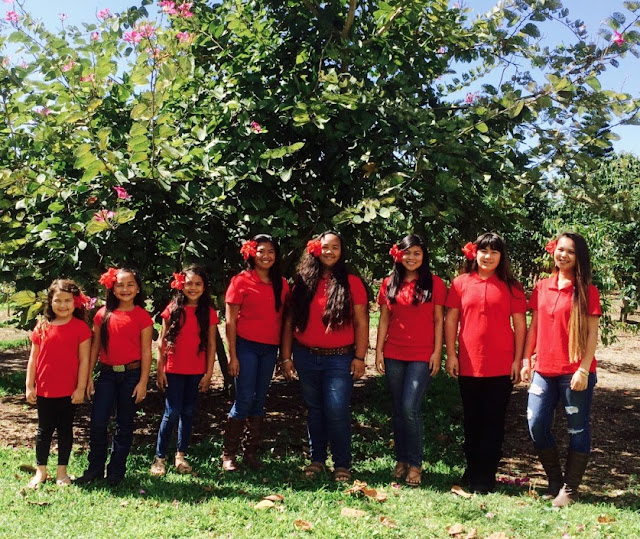
Ka`u Coffee Pageant participants visited Francis and Trini Marques' farm this morning. They range from Peaberries to Ka`u Coffee Junior Miss to Miss Ka`u Coffee candidates. From L to R: Khloe Moses, Chazlynn Pua Queja, Jazmyn Navarro, Lyric Oliveiros, Helena Nihipali-Sesson, Shaira Panganiban, Calaysa Koi and Karlee Fukunaga-Camba. Missing from photo are Casey Koi and Jami Beck.
Photo by Trini Marques

REMAINS OF A CLAW from an extinct land crab has revealed important data on the age of a lava flow that covers much of Hawaiian Ranchos, a makai subdivision in Ocean View. The subdivision lies on two lava flow units. The older one, called Qk2 on Hawaiian geological maps, is thought to be from an eruption about 1,500 to 3,000 years ago. The newer one that thinly covers about a third of Qk2, called Qk3, is composed of `a`a lava thought to be about 750 to 1,500 years old.  
      Ranchos resident Ann Bosted said all known lava tubes in Ranchos are in the older flow. The younger flow contains lava caves, like the well-known Kula Kai Caverns, but they occur outside the subdivision where the flowing lava was deeper. Kula Kai is part of the Kipuka Kanohina system, which includes many caves in Hawaiian Ocean View Estates.
Steve Smith, at left, and Professor Stephan Kempe examine
a crab claw. Photo by Peter & Ann Bosted
      Bosted explained that lava caves form in pahoehoe flows. Once molten lava is contained in the lava tubes (also known as pyroducts), it stays extremely hot and therefore liquid, so that it can flow for many miles without stalling, until it reaches the oceanfront. “Once the lava stops flowing, many of the lava tubes remain intact as larger or smaller caves and can become subterranean shelters for creatures as diverse as insects, crabs, birds and goats,” Bosted said. “If animals die underground, their remains are well protected from scavengers and weathering and can lie undisturbed for many thousands of years. Thus, lava tubes can preserve clues to our past, including evidence that three species of land crabs once roamed the Hawaiian Islands in large numbers. They probably became extinct when humans arrived.”
      Dr. Stephan Kempe, a recently retired professor of geology in Germany, regularly visits Hawai`i and is now one of the world’s foremost authorities on pyroducts. He recently visited a Ranchos lava tube in the Qk2 flow where he spotted a number of claws from the extinct land crab. With permission from the cave’s guardian, Steve Smith, he collected a sample claw and took it back to Germany for dating.
      “The results blew me away,” Smith said. “Professor Kempe established its age to be 2,400 years with only about 30 years as the possible variation. I had no idea that anything could last that long in a lava tube.”
      To Kempe, the geological significance is as important. “The Qk2 flow was thought to be 1,500 to 3,000 years old,” he said. “But we know you can’t have a crab claw that is 2,400 years old in a pyroduct that is 1,500 years old. It’s not possible. This claw means that the age of the flow can now be confidently set as 2,400 to 3,000 years old, an improvement on 1,500 to 3,000 years.”
Close-up of crab claw with centimeter scale.
Photo by Peter & Ann Bosted
      “It is difficult for a geologist doing field work to establish the ages of flows. The best way is to find some organic material, like the remains of trees that were burned and buried by the lava when it flowed, and date them. Sometimes one can find bits sticking out from under the flow along its edges. This is hard to do, but that is how USGS geologists like Jack Lockwood and Frank Trusdale have established the ages of the flows, as depicted on current geological maps of Hawai`i. 
      “Finding a crab claw in the cave, while it does not indicate the flow’s exact age, can, in this case, at least establish the minimum age of the flow. If we were to find a claw that was older than 3,000 years, we would have to adjust the maximum age of the flow, too.”
      How can one date an old crab claw with such accuracy? Kempe explained: “Crab claws, burnt trees or any other organic remains contain minute amounts of the radioactive carbon isotope No. 14, which decays with a half-life of 5,730 years. Thus, it can be used to obtain dates for the last few 10,000 years and is the isotope of choice for most archeological studies.
      “The data we got for the crab claw was carefully compared with data that has been gathered from tree rings all over the world. Tree rings are so well documented that we can date individual years up to 10,000 years back. The results of carbon 14 dating are reported in radiocarbon years and, ‘calibration’ is needed to convert radiocarbon years into calendar years. The date for this crab claw happens to fall on a good period and is therefore relatively exact. 
      “If more money were available for this sort of study, we could more accurately date the individual lava flows, but each carbon dating costs at least $300. We may need to make 10 or 20 or 30 tests, so the costs can add up fast.”
      To read comments, add your own and like this story, see facebook.com/kaucalendar.

Maile David
HAWAI`I COUNTY COUNCIL last week approved resolutions to support upcoming programs in Ka`u. Ka`u’s Council member Maile David introduced the resolutions.
      Res. 430-16 provides $5,500 to support TropiCare 2016 at Ocean View Community Center from May 30 to June 4. The training program by the U.S. Department of Defense brings military reservists to Ka`u to provide free medical care to the public. The program is an exercise of the Innovative Readiness Training Program, which challenges reservists to plan and implement rapid mobilizations to distant and unfamiliar areas.
      Ocean View resident Richard Abbett testified in support of the resolution. “We not only are underserved; we rarely are served in Ka`u,” he said.
      Other resolutions fund up to 60 scholarships for Summer Fun programs in Pahala, Na`alehu and Ocean View. Each location will receive $2,000 to keep up to 20 keiki busy when school is out of session.
      Another resolution appropriates $5,000 for repairs at Ocean View Fire Station, including to its 3,000-gallon water tank.
      Abbett said he appreciates support for fire station repairs in advance of more funding that he hopes may be provided through the next county budget for equipment.
      Ocean View resident Tony Columbo is a volunteer firefighter there. He said funds would go toward normal upkeep at the fire station. He asked David to remain “aggressive” in supporting the community.
      David will be at Ocean View Community a week from today on Monday, March 28 at 6 p.m. to answer questions about local issues.
      To read comments, add your own and like this story, see facebook.com/kaucalendar.

Dr. Virginia Pressler
HAWAI`I DEPARTMENT OF HEALTH is investigating its second imported case of Zika virus to be confirmed this year by the department’s State Laboratories Division. The Kaua`i resident has a history of recent travel to Latin America and may still be infectious. The individual has been advised to keep indoors and stay protected from mosquitoes.
      A Vector Control team will visit the individual’s residence to survey the area for mosquitoes and determine if there is a need to treat the area to reduce any mosquito breeding sites.
      “As Zika continues to spread in multiple regions across the world, we anticipate that we will experience an increase in imported cases and must take precautionary measures to reduce our risk for an outbreak in Hawai`i,” DOH Director Dr. Virginia Pressler said. “It is crucial that we keep practices (such as eliminating standing water and wearing mosquito repellent) top-of-mind as we prepare for travel in and out of the state, especially to areas that may be affected by Zika and other mosquito-borne illnesses.”
      For more information on Zika, see cdc.gov.

MILOLI`I-KA`U GIRLS TRAVELING Volleyball Club has been invited to participate in the 29th annual Ho`oikaika Invitational Tournament May 27-30 on Kaua`i. Members have participated in various tournaments, including the annual Haili Tournament of Hilo, where they placed first and third in different divisions.
      The club is raising funds to offset travel expenses that include flights, room and board and ground transportation.
      “This will be our first off-island trip and an opportunity to compete with girls in our brackets from various neighboring islands, as well as an opportunity to expand our skills and abilities,” donations chair Starlette Freitas said. “Any contribution will be greatly appreciated.”
      Players include Kyia Hashimoto, Hailey Fa`afia, Shaila Fa`afia, Honey Freitas, Lehiwa Freitas-Moses, Precious Mareko-Ke, Kaelyn Medeiros-Shibuya, Chelsea Velez, Johnette Llanes and Jaydah Pilanca-Emmsley.
      Checks made payable to Starlette Freitas may be sent to her at PO Box 847, Na`alehu, HI 96772 with MK Volleyball Club noted on the check.
      To read comments, add your own and like this story, see facebook.com/kaucalendar.

After Dark in the Park focuses on nene and `ua`u recovery
efforts. Photo from NPS
WILDLIFE BIOLOGIST KATHLEEN MISAJON highlights two critically endangered bird species, the iconic nene (Hawaiian goose) and the mysterious `ua`u (Hawaiian petrel), tomorrow at 7 p.m. at Kilauea Visitor Center Auditorium in Hawai`i Volcanoes National Park. Attendees learn about the park’s current and future monitoring programs and how these species are faring in the park and throughout Hawai`i.
      $2 donations support After Dark in the Park programs; park entrance fees apply.

PARK RANGERS AND STAFF from Hawai`i Pacific Parks Association demonstrate various Hawaiian games Wednesday between 10 a.m. and 12 p.m. on Kilauea Visitor Center lanai in Hawai`i Volcanoes National Park. Free; park entrance fees apply.

Blacksmithing is the topic Wednesday at Na`alehu Public Library.
NA`ALEHU PUBLIC LIBRARY hosts a free, live Blacksmithing Demonstration on Wednesday at 2 p.m. Journeyman blacksmith Richard Blaine, assistant Schaunlee Blaine, apprentice Ian Bailey and knifemaker David Brunetta practice the time-honored craft and tell a bit about its history.
      All ages are welcome; young children must be accompanied by an adult.
      Call 939-2442 for more information.

SUPPORT OUR SPONSORS AT PAHALAPLANTATIONCOTTAGES.COM AND KAUCOFFEEMILL.COM. KA`U COFFEE MILL IS OPEN SEVEN DAYS A WEEK.


See kaucalendar.com/KauCalendar_March_2016.pdf.
See kaucalendar.com/TheDirectory2016.pdf.

Sunday, March 20, 2016

Ka`u Calendar News Briefs Sunday, March 20, 2016

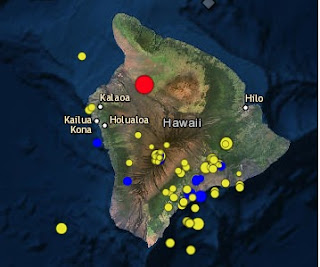
A magnitude-4.5 earthquake sent a sharp shake to Ka`u this morning. See more below. Map from USGS
CULTURAL EDUCATION AND PRESERVATION of the hula heiau in the mountains between Pahala and Na`alehu brought community members and the Edith Kanaka`ole Foundation together yesterday at Pahala Community Center. Foundation representatives Kala and Huihui Kanahele-Mossman said they welcome all ideas, family histories and community participation in not only the future of the physical `Imakakoloa Heiau recently rediscovered on property belonging to Edmund C. Olson Trust. They talked about the heiau becoming a focal point for community and cultural outreach, perhaps with programs in the schools.
      Olson Trust has welcomed the Kanaka`ole Foundation to help steward `Imakakoloa Heiau. At yesterday’s meeting, Keoni Fox, who advocates for historic site and cultural preservation in Ka`u, asked about the timeline for involving the community. He also talked about numerous other cultural sites that would benefit from conservation easements.
Ka`u residents discuss `Imakakoloa Heiau with Edith Kanaka`ole
Foundation representatives. Photo by Julia Neal
      Huihui Kanahele-Mossman explained that kupuna at the Kanaka`ole Foundation visited the hula heiau on Kaua`i, and they decided to come to `Imakakoloa to see it with their own eyes and validate its significance. The planning began last August with consultation with these kupuna, including Nalani Kanaka`ole, Pua Kanaka`ole Kanahele and Kekuhi Kanaka`ole, all experts in hula and Hawaiian culture.
      On the ground has been the removal of cat’s claw and other invasive plants. The heiau location and condition is being mapped and documented ahead of any restoration and plans for ongoing stewardship. The foundation is looking at the old chants, in which lie explanations of the significance of the heiau and its relationship to the chief `Imakakoloa, who shares its name.
      Nohea Ka`awa asked whether the Kanaka`ole Foundation would be willing to teach and share with the Ka`u community the protocol for going to the heiau. Representatives of the foundation agreed.
      Yesterday’s gathering drew suggestions, including the Kanaka`ole Foundation offering language and cultural classes in Ka`u and drawing on local experts. It was mentioned that unlike other areas with Hawaiian populations, Ka`u is without an immersion school where the Hawaiian language is spoken. Local kupuna noted that cultural knowledge is diminishing as kupuna pass on.
      Charmaine Keanu said the community would welcome more keiki learning their culture, language and the history of their home area.
      Darlyne Vierra, of Ka`u Multicultural Society, said she wanted to make sure Ka`u people are involved.
      The foundation asked for the community to answer four questions: What would you like to learn from a study on the heiau? What can the study do for the Ka`u community? How can you contribute to the study? Who would know old stories of this area?
      Anna Cariaga, of Pahala, whose father grew dryland taro in Wood Valley, urged an agreement that would put the heiau area in conservation forever. She called for any arrangement to be in “black and white” so any future owners of the property could not take it away. “We are not going to let nobody come and take that mountain,” proclaimed Cariaga. She asked for more than an “access agreement.” Representatives of the Kanaka`ole Foundation said they are just in the beginning stages of planning and working with Olson Trust and the community. Also mentioned in the talk of preserving historic sites was Makanau, the flat-topped lookout mountain with its own heiau.
      Community members pointed to Ka`u having land and cultural sites like no other place in the Hawaiian Islands. `Imakakoloa Heiau is one of them.
      For more information, email huihui@edithkanakaolefoundation.org or kala@edithkanakaolefoundation.org.
      To read comments, add your own and like this story, see facebook.com/kaucalendar.

Terence Moniz Photo from
Moniz' LinkedIn page
“DOG RESCUED FROM LAVA TUBE” is the headline circulating through media following the late night search and the howling of a spaniel named Kula who fell into a 20-foot-deep shaft connected to a lava tube in Volcano. The three year old Brittany spaniel belongs to Terence Moniz, who was long a popular agriculture teacher in Ka`u, selling fresh produce alongside the road with his students. 
      According to a story in this morning’s Hawai`i Tribune-Herald, Kula went missing Tuesday evening, and Moniz gave up searching until dawn. At 1 a.m., Kula was able to call out. Moniz heard her from his house and found the deep hole where Kula was crying in the night. At daybreak, he called in help from the Humane Society in Kea`au. They borrowed a rappel rope from the National Park Service, fashioned a harness, and Marie Kuahiwinui Eggers scaled down the wall of the lava tube and rescued the dog. Both Kuahiwinui Eggers and Starr Yamada are employees of the Kea`au shelter.
      See hawaiitribune-herald.com.
      To read comments, add your own and like this story, see facebook.com/kaucalendar.

A large red dot locates this morning's earthquake.
Map from USGS
A MAGNITUDE-4.5 EARTHQUAKE at 6:44 a.m. sent a sharp shake to Ka`u, with its epicenter close to Waikoloa and Waiki`i ranch on the other side of Mauna Kea. It was located 3.4 miles west of Waiki`i, 8.7 miles south-southeast of Waikoloa and 12.3 miles south-southwest of Waimea. See the shake map at http://earthquake.usgs.gov/earth-quakes/eventpage/hv61207881-#impact_shakemap:us_hv6120788.
      To read comments, add your own and like this story, see facebook.com/kaucalendar.

IT’S OPEN ENROLLMENT TIME to receive fresh-grown Ka`u food from from Earth Matters Farm on South Point Road. The Community Supported Agriculture program offers a $20 per week program for feeding a family of two to four persons. What comes with the weekly harvest depends on the season but includes such foods as carrots, kale, salad greens, green onions, a root crop like beets, and green beans or eggplant and herbs. Double orders, half orders and a stop when families are away are also available plans. Earth Matters is also working with other growers and plans to add in fruit.
Earth Matters Farm offers a Community Supported Agriculture
program in Ka`u. Photo from Earth Matters Farm
      Joining in Community Supported Agriculture “gives families and individuals a direct connection to the farm, and you will eat the freshest, most nutritional greens and vegetables available year-round. By joining us, you will be supporting organic farming practices that are healthful to people and the environment,” said a statement from Earth Matters.
      Earth Matters is one of the sponsors of the kick-off event for the Ka`u Coffee Festival on Friday, May 13 at Pahala Plantation House. It also offers on-site farming workshops. To learn more and to sign up for the CSA program, call Gail or Greg Smith at 443-8281.
      To read comments, add your own and like this story, see facebook.com/kaucalendar.

HAWAI`I FARMERS UNION UNITED asked Ka`u residents to testify on bills being heard at the state Legislature this week.
HFUU Vice President Simon Russell
      “We ask you oppose HB 2501 HD2 and support farmers, fishermen and the `aina,” HFUU Vice President Simon Russell said. “This new law will have long-term effects on our watersheds statewide, and Hawai`i needs more time to make decisions about its implications. This measure creates a holdover permit process for over a year (unspecified amount of time actually) for water to be removed from the public trust without an environmental assessment. HFUU does not support this concept, and neither does the spirit of the state Constitution with regards to the ‘Public Trust’ doctrine or our Hawai`i state motto, `Ua Mau ke Ea o ka `Aina i ka Pono.’”
      Several Ka`u farmers and ranchers have testified in favor of the bill, which they see as extending time on their revokable water use permits until long-term lease applications are approved.
      The Senate Water, Land & Agriculture Committee considers the bill tomorrow afternoon. To be included, testimony is due today by 2:55 p.m.
      SB 2659 would allow cultivation of industrial hemp and distribution of its seed throughout the state. It is scheduled for a hearing by the House Judiciary Committee Tuesday, and testimony is due tomorrow at 2 p.m. “Please let House Judiciary Chairman Rhoads know you support hemp production statewide for research purposes,” Russell said.
      Residents can provide testimony at capitol.hawaii.gov.
      To read comments, add your own and like this story, see facebook.com/kaucalendar.

After Dark in the Park features recovery efforts for endangered
native Hawaiian birds. Image from NPS
RECOVERY EFFORTS FOR ENDANGERED Native Birds is the topic Tuesday at 7 p.m. at Kilauea Visitor Center Auditorium in Hawai`i Volcanoes National Park. The park is home to numerous endangered plants and animals. Wildlife Biologist Kathleen Misajon highlights two critically endangered bird species, the iconic nene (Hawaiian goose) and the mysterious `ua`u (Hawaiian petrel). Attendees learn about the park’s current and future monitoring programs and how these species are faring in the park and throughout Hawai`i.
      $2 donations support After Dark in the Park programs.

SUPPORT OUR SPONSORS AT PAHALAPLANTATIONCOTTAGES.COM AND KAUCOFFEEMILL.COM. KA`U COFFEE MILL IS OPEN SEVEN DAYS A WEEK.


See kaucalendar.com/KauCalendar_March_2016.pdf.
See kaucalendar.com/TheDirectory2016.html.