About The Kaʻū Calendar

Saturday, June 18, 2022

Ka‘ū News Briefs, Saturday, June 18, 2022

Bring keiki to Kahuku to hike the Storybook Trail and for other adventures at this unit of Hawai'i Volcanoes National Park
 near Ocean View, says a new message from Program Coordinator Wendy Scott Vance. This photo is from the People and
 Land of Kahuku Hike. See more below. Photo by Dave Boyle

IMPROVING KEIKI HEARING AND VISION through early screening and diagnosis is the aim of two bills signed by the governor on Friday. The Hawaiʻi Department of Health joined child health advocates as Gov. David Y. Ige signed HB 986 and HB 987.
    Deputy Director of Health Resources Administration Danette Wong Tomiyasu said, "We know that early childhood development establishes the foundation for our keiki to succeed in school and in life. Early diagnosis and intervention will ensure these keiki reach learning milestones and have every
opportunity to succeed. Mahalo to the advocates for their persistence in fighting for these changes, and Governor Ige and our legislators for prioritizing the health of our keiki."
    HB 986 mandates reporting to DOH of the results of diagnostic hearing tests for infants failing newborn hearing screening or who are diagnosed as deaf or hard of hearing up to age 3 years. Earlier diagnosis is important for better outcomes. This measure will ensure that infants who fail their newborn hearing screening will receive diagnostic testing. Keiki who are diagnosed as deaf or hard of hearing will be referred for early intervention, which includes speech, language, and hearing services.
    HB 987 will set statewide standards for the keiki hearing and vision screenings conducted in schools. This will increase the early identification of hearing and vision loss in children to support the development of language and communication skills needed for learning. It will also set standards for follow-up and screener training and certification.

To read comments, add your own, and like this story, see www.facebook.com/kaucalendar/. See latest print edition at www.kaucalendar.com. See upcoming events at https://kaunewsbriefs.blogspot.com/2022/04/upcoming-events-for-kau-and-volcano.html.

COVID VACCINATIONS WILL BE AVAILABLE SOON FOR TINY KEIKI. The Centers for Disease Control & Prevention approved vaccinations for children under five years of age on Saturday, following the Food & Drug Administration's approval on Friday.
    The state Department of Health issued a notice Saturday saying, "Today @CDCgov recommended use of the vaccines for children under the age of five from both Pfizer-BioNTech and Moderna. DOH is authorizing enrolled COVID-19 vaccination providers to administer the vaccines as soon as they become available."
     The Pfizer vaccine is for keiki six months to four years of age and requires three shots, each a tenth of the volume of the doses given to adults.
    The Moderna vaccine is for keiki six month to five years of age and requires two shots, with a quarter of the volume of doses give to adults. Vulnerable keiki can receive a third dose.
    While COVID vaccinations are not required, other vaccinations are mandates at Hawaiʻi public schools before entering seventh grade.

To read comments, add your own, and like this story, see www.facebook.com/kaucalendar/. See latest print edition at www.kaucalendar.com. See upcoming events at https://kaunewsbriefs.blogspot.com/2022/04/upcoming-events-for-kau-and-volcano.html.

HURRICANE PREPAREDNESS IS A MISSION OF HAWAIʻI'S PUBLIC NURSES and state Department of Health. “We want our residents to prepare for natural disasters and other emergencies before they occur, including how they will manage their health conditions during and after a disaster,” said Joan Takamori, RN, Chief of the Public Health Nursing Branch.
    Judy Kern, Chief of the Office of Public Health Preparedness, said, “Families are encouraged to have a plan and maintain an emergency kit to last for at least two weeks. Caregivers and individuals with special needs should take care to also include need-specific items in their kits.”
    Scott Sutton, Region Director of Longs Drugs, said Longs will host nurses in Keaʻau, Hilo and Kona to help families make their kits and their plans on June 20 and 21 from 9 a.m. to 2 p.m. He said, “Whether we’re ensuring our stores are stocked with emergency items, such as water, batteries and first aid supplies, or proactively contacting pharmacy patients to remind them to refill or pick up prescriptions in advance of potential storms, our teams at Longs Drugs are ready to help residents prepare as hurricane season approaches.”
    Public Health Nurses encourage families to study the Take 10 guide for putting together an emergency kit. See it at https://health.hawaii.gov/prepare/files/2018/06/Take_10_brochure.pdf. They also encourage reading the Plan To Be Ready booklet to help families plan for emergencies. Read it at
https://health.hawaii.gov/prepare/files/2018/06/Plan_
To_Be_Ready.pdf. Both booklets will be available at Longs.
    A children’s activity book that explains emergency preparedness to keiki will also be available at Longs and online. See it at https://health.hawaii.gov/prepare/
     Hurricane season started June 1 in Hawaiʻi and runs through Nov. 30.

To read comments, add your own, and like this story, see www.facebook.com/kaucalendar/. See latest print edition at www.kaucalendar.com. See upcoming events at https://kaunewsbriefs.blogspot.com/2022/04/upcoming-events-for-kau-and-volcano.html.

KAHUKU UNIT OF HAWAI'I VOLCANOES NATIONAL PARK has sent out a reminder about Kahuku's Storybook Trail. "While the kids are out of school bring them to Kahuku! The trail is a great way to get kids who groan when you suggest hiking to get out and read a magical tale about Kaʻū and take a walk as well!"
   There is also the opportunity to rack up miles in the Kūkini Challenge logbook. The end of June is the
Storybook Trail at Kahuku. NPS photo

end of the second quarter and and a hiker will win Hawaiʻi Pacific Park Associationʻs prize of a water flask. "E komo mai, e hele wāwae mamao (come in and hike)!" says the message from Wendy Scott Vance, Kahuku Program Coordinator.
    The Sunday hike at Kahuku is called Hi‘iaka & Pele and is two hours, beginning at 9:30 a.m. Discover two fascinating Hawaiian goddesses, sisters Pelehonuamea (Pele) and Hi‘iaka, and the natural phenomena they represent. Experience the sisters coming alive through the epic stories depicted in the natural landscape of Kahuku on this easy 1.7-mile guided walk on the main road in Kahuku.
Attendees should be prepared for sun, rain, hot & cold conditions. Wear sturdy footwear and bring water. Enter the Kahuku unit of Hawaiʻi Volcanoes National Park on the mauka side of Highway 11 near mile marker 70.5, and meet near the parking area.

Lady Liberty marches with the Hawaiʻi County Band in the Volcano July 4 parade.
Photo by Julia Neal

VOLCANO VILLAGE FOURTH OF JULY PARADE welcomes walking and riding groups and individuals. It is sponsored by Volcano Community Association in Volcano Village from 8:30 a.m. to 1 p.m. The Monday, July 4 parade starts at the Post Office at 9 a.m. and ends at Cooper Center on Wright Rd., followed by Cooper Center’s Independence Day celebration packed with live entertainment, craft and food vendors, keiki games and a large silent auction from 9 a.m.to 11:30 a.m. Parking maps can be found at www.thecoopercenter.org. (No parking at Cooper Center except handicap permitted vehicles with prior reservation.)

SPONSOR A BUCKLE, VOTE FOR RODEO QUEEN ahead of the Saturday, July 9 Rodeo sponsored by Kaʻū Roping & Riding Association and ʻO Kaʻū Kākou. Event to be held on the rodeo grounds behind Nāʻālehu Park. Call 808-854-7917.


BECOME A VENDOR AT THE 3RD ANNUAL EXPERIENCE VOLCANO FESTIVAL on Saturday, July 30th and Sunday, July 31st from 10 a.m. to 4 p.m. each day. Last year, over 2,500 visitors attended and over 40 events were featured during the EVH festival. All vendor spaces are $50 for both days of the festival. Sign up as a vendor or a sponsor at experiencevolcano.com. If you have questions, contact experiencevolcano@gmail.com.

SIGN UP FOR KAʻŪ COFFEE TRAIL RUNS with a change of date from July 3 to Sept. 17. Registration deadline for the annual event is Sept. 14. Organized by Hawaiʻi Island Racers, the 50K begins at 6 a.m., Half Marathon at 7 a.m., and 5K at 7:15 a.m., all starting from Kaʻū Coffee Mill at 96-2696 Wood Valley Road in Pāhala. Proceeds go to support ʻO Kaʻū Kakou. For more details on the event and registration fees, visit https://www.kaucoffeetrailruns.com/.


See The Kaʻū Calendar June edition at www.kaucalendar.com,
on newsstands and in the mail.


SEE UPCOMING EVENTS IN KAʻŪ & VOLCANO
at https://kaunewsbriefs.blogspot.com/2022/04/upcoming-events-for-kau-and-volcano.html


Friday, June 17, 2022

Ka‘ū News Briefs, Friday, June 17, 2022


MILOLI'I SUBSISTANCE FISHING AREA RULES ARE ESTABLISHED. The state Board of Land Natural Resources approved them during its recent meeting to include: Size and/or bag limits for pāku‘iku‘i, kole, uhu, opihi, and ula; seasonal restrictions for kole, ‘ōpelu, ‘ū ‘ū, and uhu; no take of terminal males (blue) of the larger uhu species; no take of female ‘a‘ama with eggs; no take of ‘opihi kō‘ele; no commercial aquarium fishing; and specific gear and species restrictions within several sub-areas within the broader CBSFA boundary.
    A statement from DLNR says "the designation is intended to ensure abundant stocks of priority species and high-quality fishing now and in the future for residents and visitors to Miloli‘i and to reaffirm and perpetuate fishing practices that were customarily and traditionally exercised for Native Hawaiian subsistence, culture, or religion along the southwest coast of Hawai‘i Island."
    In 2005, Miloliʻi became the first permanent, legislatively designated CBSFA in Hawaiʻi.

Protected areas in the recently approved Miloli'i Community-Based
Subsistence Fishing Area.
    Following the numerous community-led public community workshops and meetings, the DLNR Division of Aquatic Resources conducted statewide public scoping last December.
    In testimony before the land board, DAR Administrator Brian Neilson said, “The Miloliʻi CBSFA is an excellent example of the interweaving of traditional and modern scientific knowledge and improving DLNR’s and the community’s capacity to co-manage the State’s public trust resources.”
    The DLNR statement says, "The nearshore ecosystems of the South Kona coast of Hawaiʻi Island teemed with life and abundance which supported pockets of human settlements over the last 500 years. The fishing families of Miloliʻi have continued these traditions and refer to Miloliʻi as their icebox."
    Billed as The Last Fishing Village in Hawai‘i, the coastal areas surrounding Miloli‘i are one of the last pockets in the state where traditional Hawaiian fishing practices have been preserved and are still practiced today. Unique to Miloliʻi and other South Kona communities is the documented relatively high number of villagers who noted fishing as their primary occupation.
    BLNR Chair Suzanne Case commented, “This has been a long road for the people of Miloli‘i, but they persevered, and the designation of the CBSFA will ensure long-term sustainable populations of fish and other marine species and encourage the scientific study and understanding of subsistence fishing management.”
    DAR staff worked closely with the Miloliʻi-based community group, Kalanihale, to develop rules to meet these goals.
    Kalanihale did considerable outreach work to gather support for these rules from members of the Miloliʻi community and other stakeholders in the South Kona area.
    “The community really embraced the concept of community-based. While a few people objected to some of the specific rules, the strong majority of people who offered comments during public hearing and scoping meetings supported CBSFA designation. This includes many young people, and their statements were often the most moving and meaningful, which shows this community is dedicated to preserving its way of life now and in perpetuity,” said Neilson.

To read comments, add your own, and like this story, see www.facebook.com/kaucalendar/. See latest print edition at www.kaucalendar.com. See upcoming events at https://kaunewsbriefs.blogspot.com/2022/04/upcoming-events-for-kau-and-volcano.html.

Darlyne Vierra, of the Kaʻū Multicultural Society, has collected numerous historical documents and is conserving 
many family photos from the Ka'ū Portuguese community. Photo by Julia Neal

THE PORTUGUESE CHAMBER OF COMMERCE, which has held events in Kaʻū, has announced that construction of its Portuguese Cultural & Educational Center will begin soon. Dr. Marlene Hapai, who has carried the torch for the progress for many years, said the location will be in Hilo at Komohana and Ponohawai Streets. She is President and Executive Director for the Center. 
    Architect is Blaise Caldeira who is volunteering for the project. General Contractor is Hardwood Pacific.
Marlene Hapai's dream of a Portuguese Cultural & Heritage
Center is coming true. Photo by Julia Neal
    The Center will be a hot topic at the Summer Festa Saturday at Mo'oheau Bandstand in Hilo from 9 a.m. to 2 p.m. The event is sponsored by the Portuguese Chamber. On hand will be Darlyne Vierra and the Kaʻū Multicultural Society with its display of Portuguese heritage in Kaʻū.              Before Covid, Hapai traveled around the island from community to community on her mission. In September of 2018, she participated in the celebration of the 140th Anniversary of the first Portuguese arriving to this island. Many Kaʻū residents participated, displaying historic photos and treasures of the culture at Pāhala Community Center. 
     On display were the handicrafts of the Portuguese, who introduced and made ʻukulele in Hawaiʻi. Also known for fine hand stitching, the Portuguese made purses, clothing, and table covers, and carved wooden objects, some of them on display from generations ago. Also famous and embedded in Hawaiian culture is the Portuguese oven and its sweetbread.
    A collection of Portuguese family photos from Kaʻū came from Darlyne Vierra and the Kaʻū Multicultural Society, showing off the many skills in the community, from cowboy to sugar worker and supervisor, from dairy owner to rancher. A tree with paper hearts imprinted with Portuguese family names honored those who came here and settled.
    Music came from Sophia Hanoa, who played guitar and sang Portuguese songs. There was a Portuguese pork dish served on Portuguese bread. 
    The famous Portuguese sweetbread was on sale, along with decorative shirts celebrating Portuguese history in Hawaiʻi. 
    The first Portuguese coming here sailed to Hawaiʻi on a journey that took them across the Atlantic, around the southern point of South America, and across the vast Pacific to their new island home. The first ship Priscilla arrived Sept. 30, 1878, with 120 Madeira Islanders. The second ship left Funchal on April 23, 1879, took exactly four months to cross the Atlantic Ocean, round Cape Horn, and sailed across the Pacific to Honolulu. 
Proud Portuguese Paniolo Casey De Silva, a member of the Paniolo Hall of Fame,
 enjoyed his heritage.
 Photo by Julia Neal
    Among the passengers were Manuel Nunes, Augusto Dias, Jose do Espirito Santo, and Joao Fernandes, who are credited with introducing the ʻukulele to Hawaiʻi. Many of the Portuguese settlers worked at the sugar companies in Kaʻū. They became ranchers, paniolo and leaders in the Catholic Church. Portuguese names, like Amaral, Andrade, Baruz, Da Silva, De Silva, Enos, Fontes, Freitas, Francis, Frances, Gomes, Gouveia, Joseph, Lorenzo, Louis, Manoa, Marques, Medeiros, Manuel, Oliveira, Pedra, Pestano, Silva and Vierra are well known in Kaʻū, with many families of Hawaiian and Portuguese ancestry.

To read comments, add your own, and like this story, see www.facebook.com/kaucalendar/. See latest print edition at www.kaucalendar.com. See upcoming events at https://kaunewsbriefs.blogspot.com/2022/04/upcoming-events-for-kau-and-volcano.html.


VOLCANO VILLAGE FOURTH OF JULY PARADE welcomes walking and riding groups and individuals. It is sponsored by Volcano Community Association in Volcano Village from 8:30 a.m. to 1 p.m. The Monday, July 4 parade starts at the Post Office at 9 a.m. and ends at Cooper Center on Wright Rd., followed by Cooper Center’s Independence Day celebration packed with live entertainment, craft and food vendors, keiki games and a large silent auction from 9 a.m.to 11:30 a.m. Parking maps can be found at www.thecoopercenter.org. (No parking at Cooper Center except handicap permitted vehicles with prior reservation.)
 
SPONSOR A BUCKLE, VOTE FOR RODEO QUEEN ahead of the Saturday, July 9 Rodeo sponsored by Kaʻū Roping & Riding Association and ʻO Kaʻū Kākou. Event to be held on the rodeo grounds behind Nāʻālehu Park. Call 808-854-7917.

 
BECOME A VENDOR AT THE 3RD ANNUAL EXPERIENCE VOLCANO FESTIVAL on Saturday, July 30th and Sunday, July 31st from 10 a.m. to 4 p.m. each day. Last year, over 2,500 visitors attended and over 40 events were featured during the EVH festival. All vendor spaces are $50 for both days of the festival. Sign up as a vendor or a sponsor at experiencevolcano.com. If you have questions, contact experiencevolcano@gmail.com.
 
 SIGN UP FOR KAʻŪ COFFEE TRAIL RUNS with a change of date from July 3 to Sept. 17. Registration deadline for the annual event is Sept. 14. Organized by Hawaiʻi Island Racers, the 50K begins at 6 a.m., Half Marathon at 7 a.m., and 5K at 7:15 a.m., all starting from Kaʻū Coffee Mill at 96-2696 Wood Valley Road in Pāhala. Proceeds go to support ʻO Kaʻū Kakou. For more details on the event and registration fees, visit https://www.kaucoffeetrailruns.com/.

  See The Kaʻū Calendar June Edition at www.kaucalendar.com
See The Kaʻū Calendar June edition at 
on newsstands and in the mail. 


Thursday, June 16, 2022

Ka‘ū News Briefs, Thursday, June 16, 2022

People have gathered at the rim of Kīlauea Volcano for more than a century, including here
in 1910. See Volcano Watch below to learn about a forgotten collapse of the crater. NPS photo
OPPORTUNITY & URGENCY ARE TAGGED TO THE TROPICAL AgTECH CONFERENCE JUNE 22 AND 23 at University of Hawaiʻi at Hilo. The event is entitled, The International Conference for Innovative Solutions in Sustainable Tropical Agriculture.  
    Sponsors are the Ulupono Initiative, NEC, Kamehameha Schools, Meadow Gold, USDA, Department of Agriculture, U.H. Cooperative Extension and County of Hawaiʻi.
Kaʻū rancher Michelle Galimba will
be one of the speakers at the Tropical
AgTech Conference in Hilo June 22 and 23.
    Among the speakers is Michelle Galimba who is described in the program as "a cattle rancher in Kaʻū on Hawaiʻi Island where she runs Kuahiwi Ranch with her brother, Guy. Their family ranch provides locally grown beef to supermarkets, farmer’s markets, and restaurants on Oʻahu and Hawaiʻi Island. Having grown up in agriculture in Hawaiʻi, she has seen first hand the stresses and constraints which make farming and ranching particularly challenging in Hawaiʻi. She is interested in the key role that agriculture, particularly small farms, has to play in addressing the big challenges of our time: economic inequity, political dis-enfranchisement, biodiversity loss, and climate change. Michelle has served on the State of Hawaiʻi’s Board of Agriculture as well as on the boards of numerous agricultural organizations and conservation non-profits."
    See all of the conference cast of international speakers from private companies, educational institutions, government and non-profits at www.tropagtech.com/speakers. They include such people as David Slaughter, a professor of biological and agricultural engineering, and director of the Smart Farm Initiative at University of California, Davis, and Arama Kukutai, CEO of Plenty.
      The conference website states that the ​"inaugural Tropical AgTech Conference brings together key global leaders in agricultural technology, to spur innovation and create solutions to the urgent food system problems in the tropics." It says it provides the opportunity to "develop creative, technology-based solutions that increase productivity and efficiency for smallholder farms in the tropics.  Innovations must be climate-smart, farmer-friendly to implement and economically viable at small scale production."                 
     Regarding urgency, the organizers note that the "highest concentrations of hunger already exist in the tropics and climate change is making it increasingly challenging to produce food in the tropics. Currently approximately 40% of the global population live in the tropics with expectations to reach 50% by 2040.  ...Climate change is already having a negative impact on existing crops, and it is expected to get worse.        
    "Driven primarily by climate change, the tropics are expanding. Developing solutions that allow for agriculture production near population centers in the tropics is vital and potentially very profitable."
     The organizers say they want to support tech solutions for increased productivity of small farms. Currently, "AgTech is focused on large-scale production when 80% of food consumed globally comes from small-scale farms (~5 acres)."
     The conference organizers contend that "Hawaiʻi can play a critical role in providing solutions around the world. Hawaiʻi is an ideal place for incubating Tropical AgTech ideas and solutions given our climate, the research and development already taking place here, and our island’s unique resources. Hawaiʻi can be a leader for stimulating agricultural technologies in the tropics and providing solutions to increase food production to help feed the 3.7 billion people living in the tropics."
    
To read comments, add your own, and like this story, see www.facebook.com/kaucalendar/. See latest print edition at www.kaucalendar.com. See upcoming events at https://kaunewsbriefs.blogspot.com/2022/04/upcoming-events-for-kau-and-volcano.html.

JANEAL MCCULLOGH WHO FREQUENTS KA'Ū AND SOUTH KONA is wanted by police. Hawaiʻi Island police are asking for the public’s assistance with locating the 44-year-old in connection with several financial criminal investigations. McCullough is described as 5 feet 3 inches tall, 135 pounds, with brown
hair and brown eyes. Police would also like to let the public know that harboring or concealing a wanted person could results in criminal charges being filed against the person who harbors or conceals the wanted person.
    Anyone with information on McCullough’s whereabouts is encouraged to contact Detective Donovan Kohara at (808) 326-4646 Ext. 267, or via email at donovan.kohara@hawaiicounty.gov. They may also contact the police department’s non-emergency number at (808) 935-3311.

To read comments, add your own, and like this story, see www.facebook.com/kaucalendar/. See latest print edition at www.kaucalendar.com. See upcoming events at https://kaunewsbriefs.blogspot.com/2022/04/upcoming-events-for-kau-and-volcano.html.

A FORGOTTEN COLLAPSE OF HALEMA'UMA'U CRATER IN JUNE 1916 is the subject of this week's Volcano Watch, written by scientists and affiliates of USGS Hawaiian Volcano Observatory. The passage of time has a way of isolating notable events of the past; present-day historians can easily lose track of individual events in the "fog" of history. Volcanology is no exception, especially when reflecting on the complex eruptive histories of Kīlauea and Mauna Loa, two of the world's most active volcanoes.
   Last month, a "Volcano Watch" article highlighted a lesser-known Mauna Loa eruption that ended May 31, 1916. Hawaiian Volcano Observatory (HVO) staff had to make a quick turnaround a week later when Kīlauea Volcano's Halemaʻumaʻu crater began to subside. A series of collapse events took place from June 5–7, 1916, and observers described it as one of the most spectacular occurrences they had ever witnessed at Kīlauea.
    A decade before these events, a continuous lava lake re-appeared within Halemaʻumaʻu for the first time since a collapse in 1894. Relatively steady lake activity continued—through the 1916 Mauna Loa eruption—until June 5, 1916. That morning, HVO staff were surprised to find the lava lake 40 feet (12 meters) lower than it had been measured the day before, when its surface was 300 feet (91 meters) below the crater rim.
View of the walls of Halemaʻumaʻu during the crater collapse of June 5, 1916, looking northeast from the south side of the crater. The lava lake is visible at the lower left, and the outer crater walls are at the top. The crater rim is just out of frame to the top. Within the crater is a bench of lake overflows that marks earlier high-lava levels before the lake began draining; this surface of this bench sat nearly 300 feet (91 m) below the crater rim. A substantial section of the bench has recently collapsed (with a dashed white line marking its former trace), littering talus debris around the edge of the lava lake and exposing the outer crater wall that was previously buried. USGS image

    That, however, was only the preamble. From 8:30 a.m. to 3:00 p.m. on June 5, the lava level dropped another 200 feet (61 meters)! The receding lava formed an inner pit within Halemaʻumaʻu, surrounded by a bench of earlier lake overflows plastered against the outer crater walls. As draining continued, sections of this bench began to "topple" into the still-molten-but-dropping lake.
    These collapses sent billowing clouds of earth-colored dust into the air. Sometimes, the crater walls retained a thin veneer of bench material—which alternatively consisted of dark, solidified lava rock and incandescent, partially-molten lava that had not fully cooled under the earlier flow crust.
    Fortunately, the collapses did not seriously affect the integrity of the outer crater walls, allowing HVO staff to observe the entire spectacle. As described in HVO's weekly bulletin at that time: "Falls from the south inner cliffs became frequent and spectacular, as the bench matter, made of recent overflows, was red hot within, and broke or crumbled like masses of hard cheese. Sometimes this material flowed in a sugary fashion. The great blocks formed an incandescent talus slope below, which spread into a crumbling south promontory.
    "These collapses eventually consumed the entirely of the bench on all sides of the lava lake. When these great masses of rock toppled into the molten lake, the lava sloshed back and forth in waves that lapped up the margins by several tens of feet (several meters) vertically. This resulted in constantly changing circulation patterns within the lava lake."
    The lava level had dropped another 130 feet (40 m) by midday on June 6. However, the rate and severity of the collapses dramatically slowed, and the last substantial dust cloud from a collapse was observed around 11 a.m. on June 7. Lava began refilling the crater in the days that followed, eventually erasing most of the evidence of the 1916 collapse.
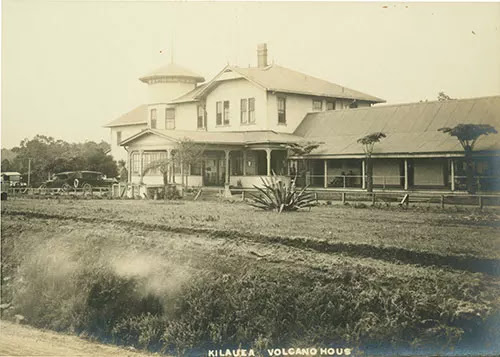
Visitors were coming to see Kīlauea Volcano during the 1916 collapse of
Halemaʻumaʻu and staying at Volcano House, shown in 1916, the year
Hawaiʻi Volcanoes National Park was established. NPS photo
    What caused the Halemaʻumaʻu lava lake to drain so quickly in early June 1916? Geophysical monitoring in recent decades has shown that significant summit depressurization is typically associated with intrusion or eruption elsewhere on the volcano, such as along the rift zones. The 2018 summit collapse and lower East Rift Zone eruption stands as an example of this process.
    Though HVO did not have an extensive geophysical monitoring network in 1916, a seismometer near the summit of Kīlauea recorded an increased number of distant earthquakes during the collapse. Basic analysis suggested that they may have occurred along one of the rift zones—perhaps indicating magma transport from the summit lava lake, similar to the sequence of earthquakes that accompanied the major 1924 collapse of Halemaʻumaʻu.
    With an ongoing summit eruption and lava lake, do we expect Kīlauea to experience a similar crater collapse anytime soon? The simple answer is no. Unlike during the 1916 collapse, the current lava lake is fed by a vent at its side rather than its base. Lacking an effective "drain," summit depressurization cannot evacuate lava from the crater so easily. The result of the current summit eruption has been to partially fill Halemaʻumaʻu crater, creating crust that is continuously uplifting and expanding to build a new crater floor.

Volcano Activity Updates: Kīlauea volcano is erupting. Its USGS Volcano Alert level is at WATCH (https://www.usgs.gov/natural-hazards/volcano-hazards/about-alert-levels). Kīlauea updates are issued daily.
 
    Over the past week, lava has continued to erupt from the western vent within Halemaʻumaʻu crater. All lava is confined within Halemaʻumaʻu crater in Hawai'i Volcanoes National Park. Sulfur dioxide emission rates remain elevated and were last measured at approximately 1,350 tonnes per day (t/d) on June 10. Seismicity is elevated but stable, with few earthquakes and ongoing volcanic tremor. Summit tiltmeters recorded one deflation-inflation event over the past week. For more information on the current eruption of Kīlauea, see https://www.usgs.gov/volcanoes/kilauea/recent-eruption.
    Mauna Loa is not erupting and remains at Volcano Alert Level ADVISORY. This alert level does not mean that an eruption is imminent or that progression to an eruption from the current level of unrest is certain. Mauna Loa updates are issued weekly.
    This past week, about 26 small-magnitude earthquakes were recorded below the summit and upper elevation flanks of Mauna Loa—the majority of these occurred at shallow depths less than 15 kilometers (9 miles) below sea level. Global Positioning System (GPS) measurements show low rates of ground deformation over the past week. Gas concentrations and fumarole temperatures at both the summit and at Sulphur Cone on the Southwest Rift Zone have remained stable over the past week. Webcams show no changes to the landscape. For more information on current monitoring of Mauna Loa, see: https://www.usgs.gov/volcanoes/mauna-loa/monitoring.
    Three earthquakes were reported felt in the Hawaiian Islands during the past week: a M2.5 earthquake 1 km (0 mi) SE of Paʻauilo at 25 km (16 mi) depth on June 15 at 9:36 p.m. HST, a M3.3 earthquake 4 km (2 mi) SSW of Pāhala at 35 km (22 mi) depth on June 15 at 9:36 a.m. HST, and a M3.5 earthquake 2 km (1 mi) SW of Pāhala at 32 km (20 mi) depth on June 9 at 10:26 p.m. HST.
    HVO continues to closely monitor Kīlauea's ongoing eruption and Mauna Loa for any signs of increased activity.
    Visit HVO's website for past Volcano Watch articles, Kīlauea and Mauna Loa updates, volcano photos, maps, recent earthquake info, and more. Email questions to askHVO@usgs.gov.

To read comments, add your own, and like this story, see www.facebook.com/kaucalendar/. See latest print edition at www.kaucalendar.com. See upcoming events at https://kaunewsbriefs.blogspot.com/2022/04/upcoming-events-for-kau-and-volcano.html.
 
VOLCANO VILLAGE FOURTH OF JULY PARADE welcomes walking and riding groups and individuals. It is sponsored by Volcano Community Association in Volcano Village from 8:30 a.m. to 1 p.m. The Monday, July 4 parade starts at the Post Office at 9 a.m. and ends at Cooper Center on Wright Rd., followed by Cooper Center’s Independence Day celebration packed with live entertainment, craft and food vendors, keiki games and a large silent auction from 9 a.m.to 11:30 a.m. Parking maps can be found at www.thecoopercenter.org. (No parking at Cooper Center except handicap permitted vehicles with prior reservation.)
 
SPONSOR A BUCKLE, VOTE FOR RODEO QUEEN ahead of the Saturday, July 9 Rodeo sponsored by Kaʻū Roping & Riding Association and ʻO Kaʻū Kākou. Event to be held on the rodeo grounds behind Nāʻālehu Park. Call 808-854-7917.

BECOME A VENDOR AT THE 3RD ANNUAL EXPERIENCE VOLCANO FESTIVAL on Saturday, July 30th and Sunday, July 31st from 10 a.m. to 4 p.m. each day. Last year, over 2,500 visitors attended and over 40 events were featured during the EVH festival. All vendor spaces are $50 for both days of the festival. Sign up as a vendor or a sponsor at experiencevolcano.com. If you have questions, contact experiencevolcano@gmail.com.
 
 SIGN UP FOR KAʻŪ COFFEE TRAIL RUNS with a change of date from July 3 to Sept. 17. Registration deadline for the annual event is Sept. 14. Organized by Hawaiʻi Island Racers, the 50K begins at 6 a.m., Half Marathon at 7 a.m., and 5K at 7:15 a.m., all starting from Kaʻū Coffee Mill at 96-2696 Wood Valley Road in Pāhala. Proceeds go to support ʻO Kaʻū Kakou. For more details on the event and registration fees, visit https://www.kaucoffeetrailruns.com/.

  See The Kaʻū Calendar June Edition at www.kaucalendar.com
See The Kaʻū Calendar June edition at 
on newsstands and in the mail.