
About The Kaʻū Calendar

Wednesday, October 05, 2022

Ka‘ū News Briefs, Wednesday, Oct. 5, 2022

Seismic activity since June has increased to 40 to 50 earthquakes per day at the summit of 
Mauna Loa, leading Hawai'i Volcanoes National Park to close the trail for hiking there.
NPS photo by A. Lavele
MAUNA LOA SEISMIC ACTIVITY HAS LED TO CLOSURE OF THE SUMMIT. Hawai'i Volcanoes National Park announced on Thursday that Mauna Loa Road and Mauna Loa Lookout at 6,662 feet remain open to the public. Taking the trail to the summit is forbidden for now. Mauna Loa is not erupting. The volcanic alert level remains at advisory, and the aviation color code remains at yellow.
The last Mauna Loa eruption was in 1984. USGS photo by J.D. Griggs
    The USGS Hawaiian Volcano Observatory advisory at 6:30 p.m. on Wednesday says, "Mauna Loa is currently experiencing heightened unrest." USGS reported an increase to 40 to 50 earthquakes per day over the past two weeks, up from five to ten per day in June and ten to 20 earthquakes per day in July and August. Peak numbers of over 100 earthquakes per day occurred on Sept. 23 and 29.
    USGS reports "Inflation or expansion of Mauna Loa's summit is accompanying the earthquake activity and has also increased in the past two weeks. The last time Mauna Loa displayed similar
elevated earthquake activity and expansion of the summit region was late-January to late-March of 2021. Additional periods of increased earthquake activity have also occurred during the 38 years since the last eruption of Mauna Loa in 1984."
    Beginning Thursday, Oct. 6, HVO will change is Updates for Mauna Loa from weekly to daily, , "reflecting the heightened level of unrest. HVO is continuing to monitor conditions carefully and will issue appropriate updates if conditions change. See updated maps and graphs of earthquake activity at Mauna Loa at Past Week Monitoring Data for Mauna Loa | U.S. Geological Survey (usgs.gov). See Mauna Loa FAQs: https://www.usgs.gov/volcanoes/mauna-loa/faqs
    Study: Preparing for Mauna Loa: https://www.usgs.gov/observatories/hvo/news/volcano-watch-failing-prepare-you-are-preparing-fail-benjamin-franklin
     U.S. Geological Survey Hawaiian Volcano Observatory scientists will notify the park if conditions change. For more information, refer to HVO's latest Status Report.www.nps.gov/havo.
    Hawaiian Volcano Observatory is one of five volcano observatories within the U.S. Geological Survey and is responsible for monitoring volcanoes and earthquakes in Hawaiʻi and American Samoa.

To read comments, add your own, and like this story, see www.facebook.com/kaucalendar. See latest print edition at wwwkaucalendar.com. See upcoming events at https://kaunewsbriefs.blogspot.com/2022/04/upcoming-events-for-kau-and-volcano.html.

HAWAI'I BOOK & MUSIC FESTIVAL IS UNDERWAY through Oct. 31. It offers 75 free zoom events, including international, national and Hawaiʻi authors and sessions on musical compositions, fiction,
poetry, memoir, Native Hawaiian culture, sustainability, wellness, and more. Among the featured writers are many from Hawai'i and internationally famed authors of best sellers Seth Godin, John Irving, and Noam Chomsky.
    To attend any of the sessions, register once here.
    Hawai'i books and music are wide ranging in their subjects, with such titles as Indigenous Pacific Islander Ecopoetry, The Eddie Kamae Songbook: A Musical Journey, and Life on the Rocks: Building a Future for Coral Reefs. 
    One of the Special Presentations with Author Giulio Boccletti is Water & Civilization: A Planetary Experiment with D. Kapua'ala Sproat and Boccaletti. Another presentation is Fower of Hawai'i - an anthology of plays by Lee Cataluna with John Wat and Lee Cataluna. 
    Presentations also include books and songs for keiki and many scientific and technical subjects. See the entire schedule at https://hawaiibookandmusicfestival.com/2022-schedule


VOLCANO SCHOOL OF ARTS & SCIENCES PreK recently studied green sea turtles during a week focused on the the letter t. PreK teachers Michelle Buck and Taylor Hamilton said that students learned that the green sea turtle is called honu. During the Week of t, students engaged in reading about, observing, and counting turtles. They learned poems and mele about turtles and created their own honu. "Students brought t objects from home and learned to write the letter t," said Buck.
    Jodie Rosam, an environmental consultant and author of The Ka‘ū Calendar column on Native Plants of Ka‘ū, visited the classroom to read a turtle book, The Adventures of Gary and Harry, and to teach PreK keiki all about honu. She shared a Fun Fact: "Did you know that honu can hold their breath for over 3 hours?" Keiki and teacher pledged to help keep beaches and oceans clean and help save the turtles, and said, "Hooray for letter t."

The honu Hawaiian green sea turtle became the focus for a week of learning the letter t at Volcano
School of Arts & Sciences with a reading by Jodie Rosam of the Gary & Harry honu book.
Photo from Volcano School

In the mail, on stands and at www.kaucalendar.com


Tuesday, October 04, 2022

Ka‘ū News Briefs, Tuesday, Oct. 4, 2022

Collect and submit ants during October to help the state and county identify ant species invading Hawai'i, including aggressive Little Fire Ants. That's the call from the state Department of Land & Natural Resources, the Ant Lab and the Invasive Species Committees. It's Stop the Ant Month. 
Photo from Hawai'i Invasive Species Committee
A CAMPAIGN TO GET RID OF FIRE ANTS IS LAUNCHED FOR OCTOBER.  This is Stop the Ant Month in Hawaiʻi, and residents are encouraged to collect and submit ants to help detect and control the spread of invasive ants. Every year, new Little Fire Ant infestations are detected by people participating in this statewide program, which prevents millions of dollars in impacts and costs for entire communities.
    Everyone can request a free ant-collection kit or can make their own using household supplies. Homeowners can collect ants on their properties by using a thin smear of peanut butter on several chopsticks and leaving the sticks out for about one hour to attract ants. Sticks should then be carefully
collected and sealed in a zip-top bag and frozen overnight, then submitted to any island Invasive Species Committee or the Hawaiʻi Ant Lab for identification.
    Hawai‘i has no native ants and has prioritized the detection of new, harmful ant species, and the management of particularly harmful ant species including LFA. LFA was first detected on Hawai`i Island in 1999. The ants were already widely disbursed on the island and, at the time, no treatment protocol existed. The Hawaiʻi Ant Lab was subsequently established to research and develop methods for the eradication and control of LFA. Now, several treatments are available and populations of ants can be managed or even completely removed from homes if caught early enough.
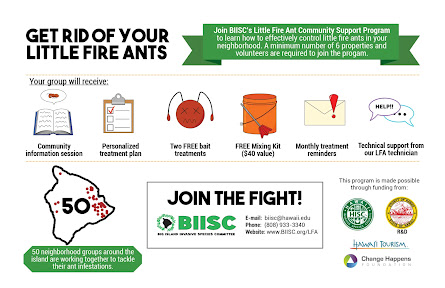
  LFA is considered among the world’s worst invasive species. LFA are tiny, measuring 1/16th inch long, and pale orange in color. They move slowly, unlike the tropical fire ant, which is established in Hawai`i and is much larger. LFA can produce painful stings and large red welts and may cause blindness in pets. They can build up very large colonies on the ground, in trees and other vegetation, and inside buildings and homes and completely overrun a property.
    "There are hundreds of other harmful ant species that are not present in Hawai‘i, but that could arrive with imported goods. Detecting and responding to new harmful ant species is critical to keeping Hawaiʻi a safe place to live, work, and grow food," says a statement on Stop the Ants Month from state Department of Land & Natural Resources.
    For on-site and virutual presentations for community groups and school classes and more help with fighting Little Fire Ants and other ant species, see Big Island Invasive Species Committee at https://www.biisc.org/.

To read comments, add your own, and like this story, see www.facebook.com/kaucalendar. See latest print edition at wwwkaucalendar.com. See upcoming events at https://kaunewsbriefs.blogspot.com/2022/04/upcoming-events-for-kau-and-volcano.html.
    
WINNING GIRLS VOLLEYBALL GAMES continued for the Ka‘ū High Trojans Tuesday evening. In JV, Ka‘ū beat Parker School from Waimea 27-25 and 25-15. Taija Beck nailed 5 Kills and 2 Aces. Tyra Wong Yuen pounded 4 Kills and 2 Aces. Cherish Gravela-Marko came up with 1 Kill and 1 Ace. Waileia Kainoa Haili-Barawis managed 1Kill and 1 Ace and McKenzie Decoito achieved 4 Aces.
In Varsity Ka'u took down Parker 25-17, 25-0 and 25-8. Jazmun Navarro made 9 Kills, Kyia Hashimoto scored 8 Kills and 5 Aces. Kamalyn Jara nailed 12 Kills and 1 Ace. Tehani-Mae Espejo-Navarro had 3 Kills and 9 Aces. Jessa Mae Tamayo made 1 ACE and Shylie Martinez came up with 1 Kill and 1 Ace.

To read comments, add your own, and like this story, see www.facebook.com/kaucalendar. See latest print edition at wwwkaucalendar.com. See upcoming events at https://kaunewsbriefs.blogspot.com/2022/04/upcoming-events-for-kau-and-volcano.html.


NINE MOTORISTS WERE ARRESTED FOR DUI Sept. 26 through Oct. 2. Hawai’i Island police made the arrests for driving under the influence of an intoxicant. Five of the drivers were involved in a traffic accident. None were under the age of 21.
    So far this year, there have been 746 DUI arrests compared with 805 during the same period last year, a decrease of 7.3 percent. There have been 619 major accidents so far this year compared with 600 during the same period last year, an increase of 3.2 percent.    To date, there were 26 fatal crashes (one fatal crash reclassified on 05/30/22 due to a medical condition) resulting in 28 fatalities (one of which had multiple deaths, and one reclassified due to a medical condition), compared with 18 fatal crashes, resulting in 18 fatalities for the same time last year. This represents an increase of 44.4 percent for fatal crashes, and 55.6 percent for fatalities.

To read comments, add your own, and like this story, see www.facebook.com/kaucalendar. See latest print edition at wwwkaucalendar.com. See upcoming events at https://kaunewsbriefs.blogspot.com/2022/04/upcoming-events-for-kau-and-volcano.html.

THE POPULARITY OF THE FREE HELE ON BUS HAS SOARED, along with the use of other county transportation services. County of Hawaiʻi Mass Transit Agency reports significant increase in passenger trips during Fiscal Year 2022 as compared to previous fiscal years. The county points to implementation of the 2018 Transit and Multi-Modal Transportation Master Plan and grants from the Federal Transit Administration for free Hele-On bus and Hele-On Kākoʻo paratransit services.
   From July 1, 2021, to June 30, this year, the Hele-On transit system (buses, paratransit, demand response, taxi, and vanpool) collectively transported 588,416 passenger trips. In the same period last fiscal year, Hele-On recorded 325,049 passenger trips. In addition, HIBIKE, the bike-share system operating islandwide, carried 23,466 bicycle trips so far this year.
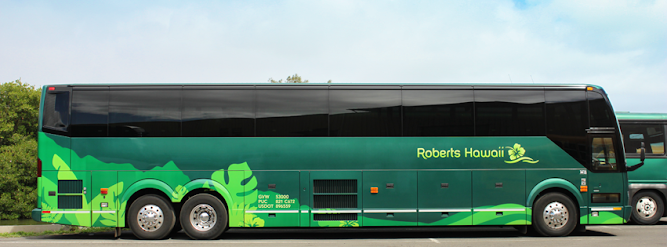
Roberts Hawai'i is one of the contractors that supplements the County of Hawai'i's own Hele On fleet.
Photo from County of Hawai'i

    John Andoh, Mass Transit Administrator, and General Manager, said that about 473,083 passenger trips were made on the Hele-On bus alone, and significant ridership gains were made after the transit system went fare-free in March of 2022.
    The free fares program costs the MTA roughly $560,000, of which $4.5 million from the Coronavirus Response and Relief Supplemental Appropriations Act and $1.9 million in American Rescue Plan Act funding from the FTA will continue to cover each year through December 31, 2025, with no local match required. The Hawaiʻi County Council approved the program in February of 2022.

   
John Andoh, Mass Transit Administrator
for Hawai'i County
"This program is about opportunity," said Mayor Mitch Roth. "As we continue to strive for an island that helps our residents thrive and succeed, we must ensure that they have the ability to get where they need to be when they need to be there – at little to no cost. The way we see it, transportation is a bridge that connects people to workplaces, recreation, their families, and so much more. That's why it's a priority, and that's why we're proud to offer that service for free."
    Hele-On receives grants to cover implementation of the new transit service network as planned in the 2018 Transit & Multi-Modal Transportation Master Plan, which increased public transit access in the Hilo, Kailua-Kona, Waimea, Puna, and Kaʻū areas of the island with later service, more frequent service, and added Sunday and Holiday services. 
    "The Master Plan is helping the County restore creditability in its public transit system and allows it to be an integral part in connecting people to jobs, education, social service, and a better quality of life while driving economic development. With that, transit access to underserved communities has much better transit access," according to the county statement. "Continued higher ridership translates into increased Federal and State formula funding and creates a positive feedback loop for Hele-On to improve and grow the island's mobility network," stated John C. Andoh, Mass Transit Administrator & General Manager.
    For more on Hele-On, call (808) 961-8744, TDD: 711 through the relay service, email heleonbus@hawaiicounty.gov, visit www.heleonbus.org or find Hele-On Bus on Facebook, Twitter, Instagram or YouTube.
    Hele-On provides countywide public transit services on 24 fixed and flex routes countywide Hele-On Kako'o for ADA complementary paratransit service in Hilo, Kailua-Kona, and Puna, a shared ride taxi program with three taxi companies in Hilo, countywide senior and persons with disabilities transportation service in partnership with Hawaii County Economic Opportunities Council (HCEOC), a vanpool program in partnership with Commute with Enterprise and 10 HIBike bike-share stations in Hilo and Kailua-Kona in partnership with PATH. Hele-On transports approximately 588,000 passenger trips annually on a fleet of more than 30 buses, vans, and a trolley. Transit services are contracted with Roberts Hawai'i, taxicab companies, Enterprise Holdings, Transdev, HCEOC, and PATH. 

To read comments, add your own, and like this story, see www.facebook.com/kaucalendar. See latest print edition at wwwkaucalendar.com. See upcoming events at https://kaunewsbriefs.blogspot.com/2022/04/upcoming-events-for-kau-and-volcano.html.

A LOWERING OF COVID CASES IS SHOWN THROUGH TESTING WASTEWATER. State Department of Health's Sept. 29 COVID-19 Wastewater Report shows COVID-19 cases have declined since early June and that Omicron subvariant BA.5 is the dominant strain of COVID-19 in Hawai‘i.
    “Data from wastewater testing aligns with other data sets,” said State Laboratories Division Administrator Edward Desmond, Ph.D, D (ABMM). “Results from COVID-19 tests taken by individuals show case counts have dropped since June. This is consistent with data in the Wastewater Report which shows concentrations of SARS-CoV-2 have declined since June. Genome sequencing shows BA.5 is the most common subvariant in Hawai‘i. The Wastewater Report also supports that finding,” Desmond said.

Wastewater reveals the amount of Covid-19 in a community,
the results released by state Department of Health.
    Wastewater surveillance is one of the tools to monitor COVID-19 levels and can alert health officials to a shift in trends any any presence of new variants.    The Wastewater Report provides a summary of surveillance done as part of the National Wastewater Surveillance System. DOH coordinates collection of samples from 15 wastewater treatment plants across the state. The samples are analyzed by Biobot Analytics as part of the NWSS at no cost to Hawai‘i. Biobot Analytics now provides test results about a week after samples are collected.
    “The State Laboratories Division continues to develop its own COVID-19 wastewater surveillance capabilities. Our staff is performing longitudinal validation of our own protocols by comparing results of our wastewater analysis with results of Biobot’s analysis. The fast, cost-free analysis provided by Biobot gives us desired information and affords our staff time to work toward wastewater testing for other pathogens,” Desmond said.
    SLD will publish a Wastewater Report every two weeks on the DOH COVID-19 Data Reports page where the Variant Report is currently posted.

To read comments, add your own, and like this story, see www.facebook.com/kaucalendar. See latest print edition at wwwkaucalendar.com. See upcoming events at https://kaunewsbriefs.blogspot.com/2022/04/upcoming-events-for-kau-and-volcano.html.


Monday, October 03, 2022

Ka‘ū News Briefs, Monday, Oct. 3, 2022

KULU'I IS THE NATIVE PLANT OF KA'Ū for October in the monthly column for The Kaʻū Calendar newspaper called Lāʻau Letters by Jodie Rosam with illustration by artist Joan Yoshioka. Read about Kaʻū’s native plants and their moʻolelo (stories), uses, preferred habitats, and opportunities to adopt them for stewardship. This column seeks to encourage making new plant friends and reuniting with others:

    Kuluʻī (Nototrichium sandwicense) is also the 2022 Run for the Dry Forest’s featured plant. See
https://akakaforests.org/events/run-for-the-dry-forest-2022.
    Description: Kuluʻī is an endemic shrub (or small tree, though it is usually branched at the base rather than having a single trunk) in the Amaranthaceae family, a cousin to pāpala and ʻāweoweo. If you look closely at the gray trunk, you may notice a diamond patterning within the bark, and that the twigs have small, silvery hairs. The size and shape of the leaves tend to vary, though they are always fuzzy and silverish-green in color and tend to be twice as long as they are wide. Fun fact: the name Nototrichium comes from the Latin root nota, which means remarkable, and tricho, which means hair, likely referring to the “remarkable” pubescence (hairs) on the plant. The very small flowers occur in thick spikes which emerge from the tips of the plant in a soft white hue.
    Uses: The soft, beautiful foliage and flower spikes can be used in lei poʻo, wreaths, and as an addition to flower arrangements. Kuluʻī was also possibly used similarly to pāpala, in which the flowers were packed into ʻohe (bamboo), lit on fire, and thrown from the top of a particular cliff with ideal wind conditions. Once thrown, the wind would ignite the flowers, and they would eject from the ʻohe and put on a spectacular aerial display much like modern-day fireworks.
    Habitat: Kuluʻī grows on all of the main Hawaiian Islands from sea level to approximately 2,400 feet. It grows in open lava flows, dry forests, and exposed ridges, and can tolerate full sun or understory shade. Similar to many of our native plants, kuluʻī like to grow up with friends (who doesn’t?), including wiliwili, naio, lama, and ʻohe makai. In Kaʻū, kuluʻi can be found scattered through the lowland dry forests. You can visit them at the Amy Greenwell Ethnobotanical Garden as well.
    Growing and Purchasing: While it is easy to propagate kuluʻī from seeds, propagation from cuttings will be much quicker and likely more successful. The small (1/16”) fruits can be collected when red and then cleaned, and surface sown on a very well-drained media mixture (which should be at least half perlite). Cuttings can be taken from small branch tips (soft wood). Remove the lower leaves and cut the top ones in half (to reduce water loss from the leaves) and immediately place them into the potting mixture. Keep the cuttings moist and in the shade. Roots should form in about one month. Once they get larger, you can begin to harden them into the sun. Give them a light feeding twice a year. Once they are big enough, they can be planted into full sun and xeric (dry) conditions, and could possibly grow to be the highlight of your landscape and a fun, new friend to love.

To read comments, add your own, and like this story, see www.facebook.com/kaucalendar. See latest print edition at wwwkaucalendar.com. See upcoming events at https://kaunewsbriefs.blogspot.com/2022/04/upcoming-events-for-kau-and-volcano.html.

A BODY IN A SHALLOW GRAVE IN KA'Ū, just off Hwy 11 along a remote road south of the Hawai'i Volcanoes National Park boundary toward Pāhala, has been identified. Following autopsy results, the case is listed as a homicide. Hawai'i Police Department on Monday identified the victim as George Edward
Dodge, of Mountain View. 
    Dodge was reported on July 7 to be missing for a couple of weeks. The badly decomposed body was found in late July and was exhumed from the shallow grave. An autopsy was performed on July 29 and the forensic pathologist ruled the death was a homicide. The exact cause is still under investigation and the final autopsy results are pending.The identity of the man was made through DNA comparisons.
    The HPD report says that Area I Criminal Investigation Section detectives are continuing this investigation and ask anyone who may have information relative to this case to call the police department’s non-emergency number at (808) 935-3311, or Detective Jeremy Kubojiri at (808) 961-2378 or email 
    Tipsters who prefer to remain anonymous may call the islandwide Crime Stoppers number at (808) 961-8300 and may be eligible for a reward of up to $1,000. Crime Stoppers is a volunteer program run by ordinary citizens who want to keep their community safe. Crime Stoppers doesn’t record calls or subscribe to caller ID. All Crime Stoppers information is kept confidential.

To read comments, add your own, and like this story, see www.facebook.com/kaucalendar. See latest print edition at wwwkaucalendar.com. See upcoming events at https://kaunewsbriefs.blogspot.com/2022/04/upcoming-events-for-kau-and-volcano.html.

HAWAI'I ISLAND POLICE RECENTLY ISSUED A WARNING ABOUT ONLINE SCAMS and offered tips to help island residents keep their financial and digital information safe after receiving reports about different types of telephone and online scams affecting citizens in our community.
    One of the scams includes criminals posing as police officers demanding money via wire transfer. Police remind the public that impersonating a police officer is a crime, punishable by up to one year in prison and a $2,000 fine for each offense upon conviction.
    "The Hawai'i Police Department will never ask you to wire money," says the HPD statement. Payment is only needed after a service request, such as duplication of police reports and applications related to firearms. Payment is generally required once someone is charged for an offense and their bail is set. The only acceptable forms of bail payment at the local police station are cash or a bond through a licensed bail bonds company. When the bail payment is received you will be provided with a receipt.

    The following scams have been reported recently: 
    Spoofing scam: Spoofing is a type of scam that criminals use to make something, like a telephone number, appear to be legitimate. In one situation, a victim recently reported receiving several telephone calls, one of which was from a person identifying themselves as an officer with Hawai'i Police Department. The local police station’s phone number was spoofed, giving the impression the call was legitimate and the suspect convinced the victim to wire them a large sum of money.
    Prize-winner scam:
    This scam involves the scammer contacting a victim via e-mail, telephone, or some other means to inform them they have won a spectacular, life-altering prize. The scammer then convinces the victim to send payment in various forms, such as wire transfers, gift cards, pre-paid debit cards and cash.
    Check payment for online sales scam:
    This scam involves items for sale on popular online buy/sell websites and social media platforms. The scammer will contact a victim stating that they’re interested in the product and will send a check as payment. The check will be larger than the agreed upon price and the scammer will request the victim to send back the balance. Although the check initially appears to be legitimate, it ultimately will bounce.
    The counterpart to this scam is when the scammer advertises an item at a sensational price preying on the victim’s desire to get a great deal. The target then sends payment for an item they subsequently never receive.
    Google authentication code scam:
    This online scam is when scammers state they want to purchase an item, or reunite the victim with a lost pet, and will send a confirmation code to prove the victim is a real person. The scammer will try to create a Google voice account using the victim's phone number, which requires the confirmation code to activate it, or unlock the account with the confirmation code. The scammer will have a confirmation sent to the victim's telephone number through Google and will ask for the number.
    Once in possession of the authentication code, the scammer can scam other people using the victim's telephone number. "Even more alarming, with enough information they can apply for fraudulent lines of credit using your information," says the HPD warning.
    Useful tips to protect yourself from being scammed:
    When contacted by someone claiming to be a representative of an entity, ask for their name, identification number, or some other form of identification that can be traced back to the person. Independently obtain a telephone number for that entity and call them to confirm the validity of the call you received.
    If a caller claims to be with a law enforcement agency, ask that person to provide you with a name, badge or identification number, and the agency’s section they are representing. Use that information to independently verify the person’s credentials.
    Legitimate businesses and utility services accept traditional forms of payment and do not ask for payment in the form of gift cards or pre-paid debit cards.
    Always check with a trusted friend or family member prior to sending a large sum of money to someone, especially if the person is not already known.
When knowing the person, before sending money, call the recipient to confirm the identity of the person and that there is a legitimate reason to send the money.
    Be mindful of aggressive callers that try to intimidate and threaten with legal actions. Ask them questions and be mindful of callers who get increasingly agitated when they can’t provide reasonable answers.
    When locating an item online, inspect the photo and / or website carefully for anything that appears out of place and may indicate that the photo was not taken in Hawai'i or the web address has been altered slightly to appear legitimate.
Be cautious of telephone numbers with out-of-state area codes and generic locations listed which is a frequently used technique by scammers.
    If unsure or uneasy about a situation that may be a scam, contact the local police station or call the Hawaii Police Department’s non-emergency number at (808) 935-3311.

To read comments, add your own, and like this story, see www.facebook.com/kaucalendar. See latest print edition at wwwkaucalendar.com. See upcoming events at https://kaunewsbriefs.blogspot.com/2022/04/upcoming-events-for-kau-and-volcano.html.