About The Kaʻū Calendar

Monday, November 07, 2022

Kaʻū News Briefs, Monday, Nov. 7, 2022

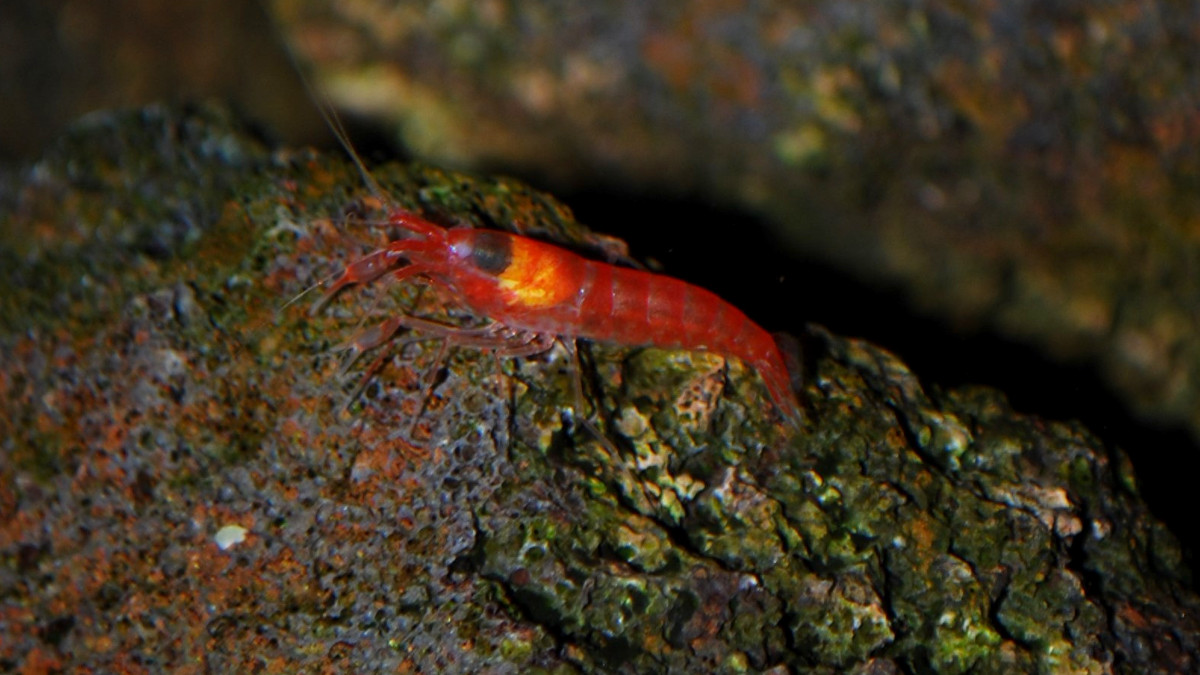
On Monday, Hawai'i Wildlife Fund helped to bring a couple of international researchers and island resident kiaʻi loko (pool caretakers) to several pool complexes in Kaʻū to learn more about the water chemistry and small critters that live in the sediment, and to remove some mosquitofish from these fragile ecosystems in order to protect native pool fauna, like the pool shrimp. 
Photo from Hawai'i Wildlife Fund

MORE FROM THE ANCHIALINE ECOSYSTEM CONFERENCE last weekend is available on https://www.facebook.com/hianchialine/?ref=py_c. A statement from Hawaiʻi Wildlife Fund says the organization "was proud to host this multi-agency, non-government organization, and community collaborative event focusing on anchialine ecosystems that linked scientists, students, managers and caretakers from around Hawaiʻi, Oʻahu, Texas, Maui, Florida, Croatia, Italy, Washington, Oregon, California, Kauaʻi, New York, Massachusetts, Mexico and Canada.
    Hawai'i Wildlife Fund President Megan Lamson said, "Anchialine pools are home to a wide variety of native and endemic wildlife, including the 'charismatic minifauna' of the Hawaiian anchialine pool, the ʻōpaeʻula, or little red pool shrimp, and seven other species of shrimp (including two endangered species), plus damselflies, isopods, snails, and more. In addition, these ecosystems include unique microbial

Hawai'i has one of the largest collections of anchialine
 ponds in the world with some  600 on this island alone.
Photo by Barbara Siedel, The Nature Conservancy

communities and oftentimes distinct cyanobacterial mats and/ or an aquatic plant, Ruppia maritima. The flora and fauna and waters of these pools in term provide critical resources for migratory shorebirds and resident waterbirds."
    "Anchialine pools are threatened by coastal development, changes to subterranean groundwater, overharvest, and especially from invasive species including fish like tilapia, guppies, mosquitofish, and plants like pickleweed, seashore paspalum, mangroves, and kiawe. 
    Hawai'i Wildlife Fund is one of many organizations within the Hui Loko network, a group of fishpond and anchialine pool caretakers on Hawaiʻi Island coordinated by The Nature Conservancy, that is looking to restore these anchialine habitats across the island, to improve wildlife habitat and perpetuate traditions connecting people to these special ʻloko waikai' or brackish-water ponds."
    Folks can find more info or request educational resources / follow-up at hianchialine@gmail.com.

To read comments, add your own, and like this story, see www.facebook.com/kaucalendar. See latest print edition at wwwkaucalendar.com. See upcoming events at https://kaunewsbriefs.blogspot.com/2022/04/upcoming-events-for-kau-and-volcano.html.

MAYOR MITCH ROTH IS ASKING THE PUBLIC TO TAKE A SURVEY to prepare for the 2022 Hawai'i Sustainability Summit, which will be held Wednesday, Nov. 30 through Saturday, Dec. 3. The survey can be taken at https://survey123.arcgis.com/share/3d3c47aab0804350a1a575cb83a6d09f.
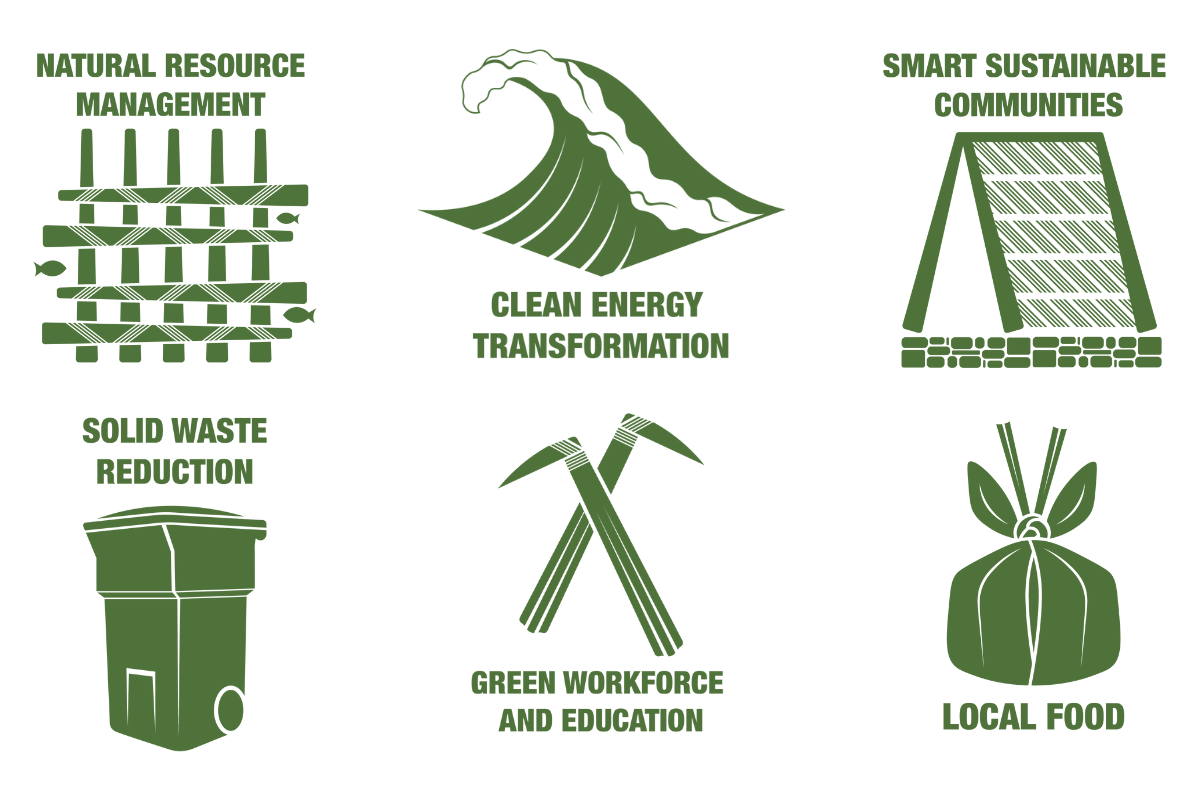
      "This year, the Summit has evolved into a four-day, in-person, by invitation only event bringing together leaders from across our community to focus on building a set of policy priorities, structured around six key areas shared with Hawaiʻi Green Growth’s Aloha+ Challenge: natural resource management, local food, smart sustainable communities, clean energy transformation, solid waste reduction, and green workforce and education."
     With his invitation to invite community members to take the survey, the mayor stated: "The Hawaiʻi that we know and love is quickly slipping away from us. Rising coastal conditions, a lack of economic diversification, the dispersion of our young and bright minds, an increasing lack of genuinely affordable housing units, aging infrastructure, and so much more is making it harder and harder for our local residents to make a living and raise their families here.
Public input for the 2022 Hawai'i Sustainability Summit is sought at 
https://survey123.arcgis.com/share/3d3c47aab0804350a1a575cb83a6d09f
    "Decades of inaction have led us to a tipping point, which has only been exacerbated by a global pandemic, growing instability in the world’s political climate, and scathing public unrest caused by grave inequity - both globally and locally.
    "However, I am hopeful that a new Hawaiʻi is upon us — a better Hawaiʻi.
    "To attain that Hawaiʻi, we must act. As leaders, community organizers, and island-based organizations with a heart for Hawaiʻi, we have a profound opportunity to come together to tackle the most challenging issues of our time. Together, we can set the foundation for change. But, it will take courage, audacity, and the willingness to put aside our individual interests to achieve a grander vision.
    "The 2022 Hawaiʻi Sustainability Summit will aim to do just that. To break down silos and drive shared priority agreements that catalyze sweeping policy shifts for all Hawaiʻi. It will be on the backs of our collective advocacy efforts that we truly begin a path for a sustainable island home.
    "The time to act is now — for our keiki and theirs.
    See more on the Hawai'i Sustainability Summit at https://hisustainabilitysummit.com/.

Six areas of focus for the Hawai'i Sustainability Summit, Nov. 30 - Dec. 3.

To read comments, add your own, and like this story, see www.facebook.com/kaucalendar. See latest print edition at wwwkaucalendar.com. See upcoming events at https://kaunewsbriefs.blogspot.com/2022/04/upcoming-events-for-kau-and-volcano.html
 
ELECTION DAY IS TUESDAY, Nov. 8. In Kaʻū, ballots can be cast until 7 p.m. at Nāʻālehu Police Station: 95-5355 Māmalahoa Hwy, Nāʻālehu, HI 96772
    In addition, there are eight more drop box locations around the island:
    Laupahoehoe Police Station: Puʻualaea Homestead Rd, Laupahoehoe HI 96764.
    Hilo County Building: 25 Aupuni St, Hilo HI 96720
    Pāhoa Police Station: 15-2615 Keaʻau-Pāhoa Rd, Pāhoa HI 96778
    Rodney Yano Memorial Hall: 82-6156 Māmalahoa Hwy, Captain Cook HI 96704
    West Hawaiʻi Civic Center: 74-5044 Ane Keohokālole Hwy, Kailua Kona HI 96740
    Waikoloa Village Association: 68-1792 Melia St, Waikoloa Village, HI 96738
    Waimea Police Station: 67-5185 Kamamalu St, Waimea HI 96743
    North Kohala Police Station: 54-3900 Akoni Pule Hwy, Kapaʻau HI 96755
 
    In addition to the drop boxes, ballots may be brought to the Voter Service Centers in Hilo at County of Hawai‘i Aupuni Center, Conference Room, 101 Pauahi St. Suite 1, and in Kona at West Hawai‘i Civic Center, Community Room (Building G), 74-5044 Ane Keohokālole Hwy until 7 p.m. Election Day, Nov. 8.
    A statement from the County of Hawai'i Elections Division says, "Ballots must be in drop boxes in possession of the Elections Division by 7 p.m. on Election Day! Drop Boxes will be locked at exactly 7:00pm, so get your ballot in ASAP!"

 To read comments, add your own, and like this story, see www.facebook.com/kaucalendar. See latest print edition at wwwkaucalendar.com. See upcoming events at https://kaunewsbriefs.blogspot.com/2022/04/upcoming-events-for-kau-and-volcano.html


In the mail and on stands from Volcano through Kaʻū.


Sunday, November 06, 2022

Kaʻū News Briefs, Sunday, Nov. 6, 2022

A group of Hawai'i state legislators, including Rep. Jeanne Kapela representing Kaʻū, has called on the Public Utilities
 Commission to require the electric company to shift to more renewable energy instead of passing on 
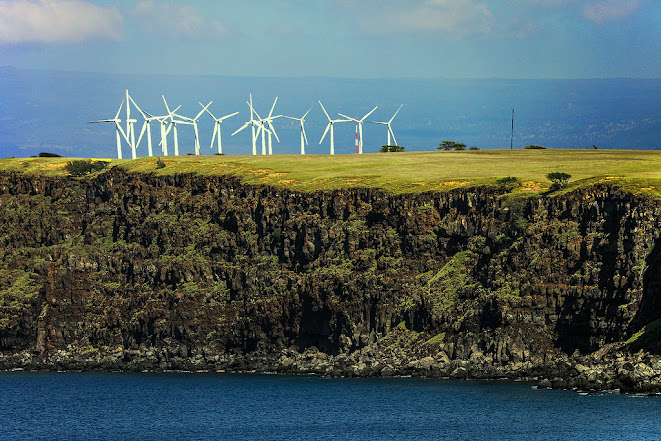
the increase in oil costs to consumers. Above is the Tawhiri wind farm at South Point. Photo by Greg L. Jones

EXPRESSING CONCERN WITH HIGH ELECTRIC BILLS, west Kaʻū's member of the state House of Representatives Jeanne Kapela signed a letter along with a dozen other Reps and seven state senators to Public Utilities Commission Chair Leodoloff Asuncion. The letter also went to PUC Commissioners Naomi Kuwaye and Colin Yost, Consumer Advocate Dean Nishina, Hawai'i Chief Energy Officer Scott Glenn, and Hawaiian Electric Company President and CEO Shelee Kimura. Kapela was the only elected official covering Kaʻū to sign it.
    "While the letter points to O'ahu customers "dramatic increases on their electric bills," it addresses the

Rep. Jeanne Kapela asks the
PUC to incentivize the electric
company to move faster off oil.
regulations that allow the utility to pass through increases in oil costs directly onto customers throughout the state.
    The letter says, "Although the utility and the Public Utilities Commission cannot control global oil prices, oil price volatility is a known cost of our reliance on oil that HECO and the PUC must proactively plan for and aggressively minimize and eliminate."
    "On O'ahu the increase in electric rates is related to the closure of the coal plant creating an increased reliance on oil. The letter blames "the failure of the utility to bring fixed-price renewable projects online in time to meet the energy needs....which has further amplified the impact of high oil prices on customer bills.This debacle highlights the need for PUC leadership and action to prevent such burdensome bill increases that many of Hawai‘i families simply cannot absorb."
    The lawmakers address "how the PUC can work with the legislature to promote further progress on this priority concern." Their letter also points to a recent Honolulu Star Advertiser interview with the PUC chair who stated that, “The PUC cannot simply mandate that the utilities stop charging this longstanding pass-through to customers and says, "This is not entirely correct."
    According to the letter, more than 16 years ago, the legislature amended Chapter 269 to clarify that “...any fuel pass-through clause must fairly share the risk of fuel cost volatility between the utility and customers, as well as provide the utility with sufficient incentive to lower its fuel costs and shift to

renewable energy.” HRS § 269-16(g). Based on this mandate, the PUC finally started in 2018 to require the utility to share in fossil fuel cost changes at an exceedingly modest two percent, along with other safeguards to limit the impacts on the utility."
    The lawmakers call for the PUC to "significantly increase HECO’s responsibility for fuel costs under the Energy Cost Recovery Clause, so that the utility has a fairer and stronger incentive to stabilize and reduce energy costs and maximize the use of cheaper renewable energy sources."
    The letter sates, "As the PUC transitions HECO to performance-based regulation (PBR), utility profit is increasingly tied to performance standards, including customer equity and affordability.
    "Clearly, HECO has performed poorly on the key outcome of customer affordability, by failing to move with urgency and diligence toward bringing lower cost renewable energy onto the grid and pursuing other strategies to mitigate the bill impacts of fuel cost volatility.
    "HECO should share in the financial consequences of this failure by assuming a greater share of fuel costs. Further, to lessen the impacts on customers, including the substantial number of Hawai‘i families qualifying as low- and moderate-income, the PUC should consider adopting an asymmetrical approach to fuel cost sharing, in which the utility shares more of the burden when fuel costs rise.
    "We also believe that the utility should be held accountable for their past inaction and delays.
    "Thus, the commission should also consider pursuing penalties for, or sharing of, the increased costs today caused by the failures to timely acquire and interconnect new renewable projects.
    "The first and best option to reduce oil dependence and customer bill increases due to oil price volatility is to bring new renewable projects with fixed contracts online as expediently as possible.
    "The utility should be held accountable when they fail this obligation.
    "As part of the planning in advance of the coal plant closure, the PUC instituted mechanisms to track the increased costs from the switch to HECO’s oil-fired plants.This tracking mechanism provides the PUC with the information to determine how the utility should share in these cost burdens.
    "In sum, the undersigned formally request that the PUC tie HECO’s profits directly, materially, and systematically to its performance on managing fuel costs.
    "In addition to considering a penalty for performance this year and increases in utility sharing of fuel costs, the PUC should formulate a concrete plan, deliverables, action steps, and incentives to improve HECO’s performance in protecting their customers from increased fuel costs in the future. We look forward to your response and follow-up actions on this priority issue and are also interested in working with you on legislative initiatives that may help support these goals."

To read comments, add your own, and like this story, see www.facebook.com/kaucalendar. See latest print edition at wwwkaucalendar.com. See upcoming events at https://kaunewsbriefs.blogspot.com/2022/04/upcoming-events-for-kau-and-volcano.html  

THE KAʻŪ COLLECTION SITE FOR OPERATION CHRISTMAS CHILD shoebox gift project will be Nāʻālehu Assembly of God Church. Linda Church, of Samaritan's Purse project on this island, said that more than 4,500 locations will open across the globe to collect Operation Christmas Child shoebox gifts. Volunteers are preparing to collect shoebox gifts during National Collection Week, Nov. 14 ­– 21.
    Operation Christmas Child has been collecting and delivering shoebox gifts—filled with school supplies, hygiene items and fun toys—to children worldwide since 1993. 
    Church said, "Anyone can pack a shoebox! In 2022, Operation Christmas Child hopes to collect enough shoeboxes to reach another 11 million children. Individuals, families, and groups still have time to transform empty shoeboxes into fun gifts. 
    Project partners with local churches across the globe will "deliver these tangible expressions of God's love to children in need," she said. Find a step-by-step guide on the How to Pack a Shoebox webpage. Preprinted shoeboxes are available at Big Island Toyota in Kailua-Kona, or Sundays through Nov. 14 at Living Stones Church from 7:30 a.m. to 12:00 p.m., also in Kailua-Kona. For hassle-free shopping, volunteers can pack a shoebox online at Build A Shoebox Online (samaritanspurse.org). For questions, call Church at (808) 937-7220.

To read comments, add your own, and like this story, see www.facebook.com/kaucalendar. See latest print edition at wwwkaucalendar.com. See upcoming events at https://kaunewsbriefs.blogspot.com/2022/04/upcoming-events-for-kau-and-volcano.html  

KAUAHA'AO CONGREGATIONAL CHURCH in Waiohinu will have a fundraiser on Saturday, Dec. 3, after two years without one. From 11 a.m. to 2 p.m, the fundraiser will feature Crafts, Baked Goods, and Roast Pork and Gravy plates.
   Kahu Debbie Wong Yuen said that all proceeds will help with the ministry of the church. With any questions, contact Yuen at dwongyuen.kauahaaochurch@gmail.com or call her at 808-928-8039.

To read comments, add your own, and like this story, see www.facebook.com/kaucalendar. See latest print edition at wwwkaucalendar.com. See upcoming events at https://kaunewsbriefs.blogspot.com/2022/04/upcoming-events-for-kau-and-volcano.html  

Mauna Loa Crater. Photo by Sebastian Blank

FOR MONITORING VOLCANOES, THE SATELLITE IS NOW A BASIC TOOL. That is the message of Volcano Watch, the weekly USGS column. It is written this week by Logan Fusso, a Hawaiian Volcano Observatory scientist:    
    Satellites have become one of the fundamental tools used to monitor active volcanoes. They allow us to monitor volcanoes that are otherwise hard to access and provide perspectives that are not possible to get from the ground. Satellites orbiting the Earth can provide normal “pictures” of a place, but can also provide thermal images, measure amounts and types of gases, changes in gravity, and topography.
    One of the most revolutionary advances has been the use of InSAR (Interferometric Synthetic Aperture Radar) to measure small changes in shape over an entire volcano. As discussed in a previous "Volcano Watch," Synthetic Aperture Radar (SAR) satellites send timed radar waves that bounce off the Earth back to the satellite.
    It takes two sets of waves of the same area to measure change over time. If there has been no change to the volcano for the time between images, the signals will travel the distance in the same amount of time. However, if the volcano has changed by either inflating (uplift) or deflating (sinking), the volcano will be closer or further away in the second image. It will take more time for the radar wave to travel the distance from satellite to the ground, then back to the satellite.
  If the difference between two offset waves are assigned a color based on the size of the offset, they produce a unique set of banded colors that represent the number of wavelengths separating the two images. This process produces images called interferograms. Concentric rings of color relate to the amount of surface inflation or deflation of a volcano.
    While InSAR is useful for monitoring volcanic motions, it is not without problems. The nature of how InSAR images are gathered from a radar satellite often unintentionally captures signals associated with the changes in the Earth’s atmosphere between satellite passes in addition to ground surface change. This additional “atmospheric noise” is especially apparent with changes in topography. At active volcanoes that are very tall, like Mauna Loa, the sloping flanks can magnify atmospheric signals, falsely suggesting that significant change has occurred.
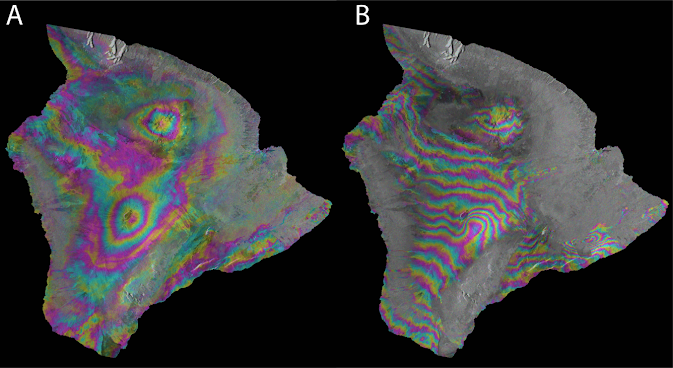
 “Noisy” InSAR interferogram examples covering the Island of Hawaiʻi. (A) shows data that spans 12 days. This InSAR image show similar concentric ring patterns over both Mauna Loa and Mauna Kea. At first glance this might indicate deformation at both volcanos to the untrained eye, but the most likely reason for these colorful concentric ring patterns is atmospheric noise. (B) is another example of an InSAR interferogram with heavy atmospheric noise; this one has a 30-day difference from each SAR image. Some slight (less than a fraction of an inch/mm range) deformation on Mauna Loa and the Southeast Rift Zone of Kīlauea is visible in these images, yet still hard to discern from the atmospheric noise. Notice that the lower forested slopes of the island are blank. This is because heavy tree cover also causes errors in the interferograms. USGS images by Megan McLay

    InSAR scientists are trained to find hints that indicate atmospheric noise has dominated the signal. One method is visually comparing other nearby landscape features with similar topography. For example, comparing InSAR data patterns on Mauna Loa to Mauna Kea has been known to help identify and distinguish between noisy weather signals from true volcanic deformation.
    At first glance, the left image above (A) could seem to show both Mauna Kea and Mauna Loa inflating at the same rate simultaneously. However, we know from our Global Positioning System (GPS) instruments that Mauna Kea shows no evidence for significant deformation, so scientists can conclude that the InSAR signals on Mauna Loa are mostly likely unreliable in this specific instance.
    Likewise, GPS instruments and tiltmeters on Mauna Loa provide “ground truth” at specific points that should match the deformation shown in the interferogram. Finally, both volcanoes showing similar rates of inflation would be extremely rare, making differences in atmospheric conditions the most likely explanation.
    Another method is to compare multiple InSAR images. SAR satellites capture images in both ascending (traveling northward) and descending (traveling southward) directions as they orbit the planet. By creating a second InSAR image, with the same time span, but from different SAR “look directions,” it is possible to compare two interferograms of the same event. If the deformation is real over the survey area, then both InSAR images from opposing directions would show similar rates of motion.
    Hawaiian Volcano Observatory scientists are constantly using these and other tools to track the movement of magma within Hawai'i’s volcanoes in order to identify the warning signs of impending eruptions.
Mauna Loa Crater and old lava flow. Photo by Sebastian Blank

    Volcano Activity Updates: Kīlauea volcano is erupting. Its USGS Volcano Alert level is at WATCH (https://www.usgs.gov/natural-hazards/volcano-hazards/about-alert-levels). Kīlauea updates are issued daily.
    Last week, lava continued to erupt from the western vent within Halemaʻumaʻu crater in Hawai‘i Volcanoes National Park. Sulfur dioxide emission rates remain elevated and were last measured at approximately 700 tonnes per day (t/d) on Oct. 22. Seismicity was elevated but stable, with few earthquakes and ongoing volcanic tremor. Over the past week, summit tiltmeters recorded two deflation-inflation (DI) events. For more information on the current eruption of Kīlauea, see https://www.usgs.gov/volcanoes/kilauea/recent-eruption.
    Mauna Loa is not erupting and remains at Volcano Alert Level ADVISORY. This alert level does not mean that an eruption is imminent or that progression to an eruption from the current level of unrest is certain. Mauna Loa updates are issued daily.
    Last week, about 250 small-magnitude earthquakes were recorded below the summit and upper elevation flanks of Mauna Loa—the majority of these occurred at shallow depths less than 15 kilometers (9 miles) below sea level. Global Positioning System (GPS) measurements show continued ground deformation consistent with inflation of a magma chamber beneath the summit. Gas concentrations and fumarole temperatures at both the summit and at Sulphur Cone on the Southwest Rift Zone have remained stable over the past week. Webcams show no changes to the landscape. For more information on current monitoring of Mauna Loa, see: https://www.usgs.gov/volcanoes/mauna-loa/monitoring.
    There were six vents with 3 or more felt reports in the Hawaiian Islands during the past week: a M3.3 earthquake 14 km (8 mi) S of Fern Forest at 6 km (4 mi) depth on Nov. 2 at 8:03 p.m. HST, A M2.1 earthquake 10 km (6 mi) NE of Pāhala at 30 km (19 mi) depth on Nov. 1 at 2:03 a.m. HST, a M3.9 earthquake 7 km (4 mi) SSE of Waimea at 11 km (7 mi) depth on Nov. 1 at 1:17 a.m. HST, a M3.5 earthquake 9 km (6 mi) E of Pāhala at 32 km (20 mi) depth on Oct. 31 at 3:38 a.m. HST, a M2.6 earthquake 4 km (2 mi) S of Volcano at 2 km (1 mi) depth on Oct. 28 at 12:16 p.m. HST, and a M3.0 earthquake 2 km (1 mi) SW of Volcano at 20 km (12 mi) depth on Oct. 27 at 12:19 p.m. HST. Visit HVO’s website for past Volcano Watch articles, Kīlauea and Mauna Loa updates, volcano photos, maps, recent earthquake info, and more. Email questions to askHVO@usgs.gov.

To read comments, add your own, and like this story, see www.facebook.com/kaucalendar. See latest print edition at wwwkaucalendar.com. See upcoming events at https://kaunewsbriefs.blogspot.com/2022/04/upcoming-events-for-kau-and-volcano.html

In the mail and on stands from Volcano through Kaʻū.


Saturday, November 05, 2022

Kaʻū News Briefs, Saturday, Nov. 5, 2022

      Tiny endangered native Hawaiian shrimp called ‘ōpae‘ula, Metabetaeus lohena.  Photo from DLNR

PRESERVATION OF ANCHIALINE POOLS, one of the justifications for the successful protection of thousands of acres along the Kaʻū Coast, was the subject of this weekend's International Symposium on Anchialine Ecosystems. It was held Thursday through Saturday at King Kamehameha's Kona Beach Hotel in Kona, drawing more than 125 scientists, students, community members, and resource managers, from across Hawai‘i and around the world. This was the fifth International Symposium on Anchialine Ecosystems.
    One sponsor is Hawai'i Wildlife Fund and its president Megan Lamson, who works with volunteers in Kaʻū and beyond on preserving anchialine pools and other coastal resources. Another is The Nature Conservancy, with its Hawai'i Island headquarters based in Kaʻū. A major sponsor is state Department of Land & Natural Resources Division of Aquatic Resources.
    The human gathering about anchialine pools was grounded in the importance of the collective kuleana to culture and place. Hawai‘i has one of the highest concentrations of brackish water, near-coast anchialine pools in the world, with an estimated 600 or more on Hawai‘i Island, said Troy Troy Sakihara. An aquatic biologist with Division of Aquatic Resources, Sakihara is another one of the organizers of the symposium. 
    He and other presenters noted that anchialine pools were the first sources of fresh water for early Hawaiians, giving the pools great cultural significance, continuing into modern times. This was highlighted in many of the scientific presentations, including one by a trio of students from a Hawaiian immersion school at Keaukaha who presented their remarks entirely in ʻŌlelo Hawai‘i, the Hawaiian language.
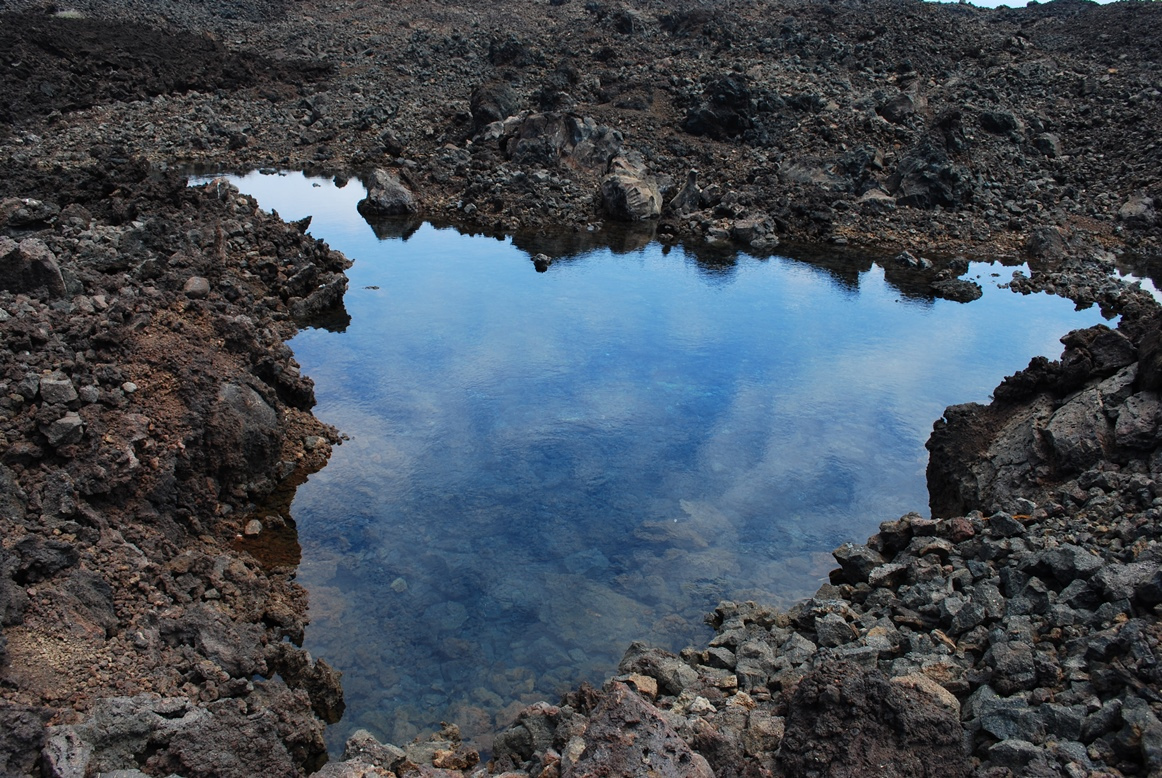
A wai ‘ōpae (water for shrimp) in an ‘a‘a lava field. These pools are home to tiny endangered native shrimp. Photo from DLNR 
    "Like so many of Hawai‘i’s natural and cultural resources, anchialine ecosystems have already been destroyed or are threatened by development, pollution, and invasive species; in the case of the pools by invasive fish like guppies and tilapia," said the statement from the state Division of Aquatic Resources.
    The best-known of the native inhabitants of anchialine pools is the ‘ōpae‘ula, a tiny red shrimp. 
    Several of the presentations focused on water quality in the park’s anchialine pools and the use of ‘auhuhu, a Polynesian introduced plant to control invasive fish and the associated recovery of the natural ecosystem.
    Sakihara said that a broad partnership in preserving anchialine pools “demonstrates how important this underground system of pools is and why we need to do everything we can to protect and restore them.”
    The symposium was heavy on science, but with the overall message that anchialine ecosystems continue to be an important and vital connection to Hawai'i's natural and cultural landscape and history.
    In addition to Department of Aquatic Resources, Hawai'i Wildlife Fund and The Nature Conservancy,
other sponsors and contributors to the symposium include, Division of Forestry & Wildlife, the Division of State Parks, Hui Loko, University of Hawai‘i, U.S. Fish & Wildlife Service, Kamehameha Schools, U.S. Geological Survey, Lili‘uokalani Trust, He‘eia Bay Forever, Hawai‘i Fish Habitat Partnership, Hawai‘i Mountain Running, National Park Service, Kua’aina Ulu ‘Auamo, Hawai‘i Coral Reef Initiative, David Shepard Hawai‘i, Mauna Lani Auberge Resorts, and Four Seasons Resort.

To read comments, add your own, and like this story, see www.facebook.com/kaucalendar. See latest print edition at wwwkaucalendar.com. See upcoming events at https://kaunewsbriefs.blogspot.com/2022/04/upcoming-events-for-kau-and-volcano.html.


HAWAI'I CARE CHOICES, while shuttering its Pohai Malama hospice inpatient facility in Hilo, will continue to deliver in-home services to Volcano, Pāhala, Nāʻālehu, Mark Twain, Green Sands, Discovery Harbour, and as far into Kaʻū as South Point Road. Pōhai Mālama Care Center, a 12-bed inpatient hospice facility in Hilo owned and operated by Hawaiʻi Care Choices since 2012, "will take a tactical pause on all inpatient hospice care operations beginning on November 18, 2022," says a statement from its administration. 
    "All levels of the organization’s services including hospice, palliative, and bereavement care services will continue to be provided for our East Hawai'i Community in various locations other than PMCC, like patient residences, long-term care facilities, and more," said the statement from Hawai'i Care Choices, formerly Hospice of Hilo. 
    "The tactical pause, which is a deliberate break in operations, will allow time for Hawai'i Care Choices to reassess the impact of continued underutilization and the growing cost of building repair and maintenance that is naturally occurring after ten years of usage." CEO Brenda S. Ho said, “This tactical pause offers the necessary break to reimagine and discover possible options for this beautiful home-like facility.”
    The statement said "data and trends over the years show that patients prefer to receive care in the comfort of their own homes."
     Board President Karen Maedo said, “We touched many lives at Pohai Malama, but resources are limited and change has to be made when it is needed.” Fewer that 5 percent of Hawai'i Care Choice’s hospice patient days are in PMCC; most of the organization’s services are delivered to patient’s residence. Medical Director Dr. Lynda Dolan said, “We have always delivered hospice care to where patients lived. This includes the nearly two decades prior to the time PMCC was built. This pause does not change our capability in ensuring quality care is provided.”
    Hawai'i Care Choices remains open and continues to offer all services. The highest priority is to minimize the impact of this tactical pause on current patients receiving inpatient hospice care at PMCC. Staff will work with these patients and families to ensure a smooth transition to other locations for hospice care. For any questions, contact Hawai'i Care Choices at 808-969-1733 or care@hawaiicarechoices.org.
    For more see www.hawaiicarechoices.org. For care west of South Point, see www.hospiceofkona.org.

To read comments, add your own, and like this story, see www.facebook.com/kaucalendar. See latest print edition at wwwkaucalendar.com. See upcoming events at https://kaunewsbriefs.blogspot.com/2022/04/upcoming-events-for-kau-and-volcano.html.


DEADLINE TO REACTIVATE DRIVER'S LICENSES that were given an extension during the pandemic is Nov. 30. Licenses that expired between March 16, 2020 and Nov. 30, 2021 were given the extension. A
statement from the county says, "If a driver's license expired within this time period the driver must go in to a County Driver's Licensing Office to reactivate and renew their driver's license by the close of business on Nov. 30, 2022. On Dec 1, 2022, all drivers holding a license that expired from March 16, 2020 through Nov. 30, 2021 will be required to start again as a new applicant."
  
To read comments, add your own, and like this story, see www.facebook.com/kaucalendar. See latest print edition at wwwkaucalendar.com. See upcoming events at https://kaunewsbriefs.blogspot.com/2022/04/upcoming-events-for-kau-and-volcano.html  


In the mail and on stands from Volcano through Kaʻū.