About The Kaʻū Calendar

Monday, December 22, 2014

Ka`u News Briefs Monday, Dec. 22, 2014

The brightest and most well known open cluster of stars, the Pleiades, is visible in Ka`u's night sky this month. Astronomer Lew Look, author of Stars Over Ka`u, asks, "How many can you count?" NASA image from Lew Cook
COFFEE BERRY BORERS are making headlines not only for their destructive behavior on Ka`u Coffee farms but also what news and social media are spreading as "kinky sex." 
      “See that cup of coffee you grabbed this morning?” asks Brandon Ambrosino at vox.com. “That delicious, life-sustaining beverage comes from coffee beans. And before those beans were roasted, insects were having sex in them.
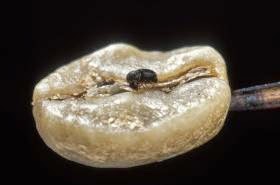
The sex life of coffee berry borers is the subject of several media reports.
Photo by Peggy Greb/USDA Ag Research Service
      “According to a recent study published in the Journal of Insect Behavior, coffee berry borers (Hypothenemus hampei), which are native to Africa, spend a good deal of their lives in coffee beans, which means, writes Discovery News, ‘kinky sex takes place in many coffee beans before they are roasted.’
      “As The Week points out, the sex is also incestuous sometimes. When females aren’t reproducing through parthenogenesis (i.e. by herself) then they ‘have to be copulated by their sibling males before leaving the native coffee fruit to improve their chances of successful colonization,’ writes study co-author Weliton Dias Silva.
      “These insects, which are tiny beetles, are incredibly small, with the females averaging slightly larger lengths (.07 inches) than males (.06 inches). Because the males are smaller, they're called ‘dwarves.’
      “So how do the insects find their way into the actual coffee beans? According to Discovery, they find their way into the beans ‘after sniffing out chemicals released by coffee plants.’ Females leave the beans at 15 days old, but males stick around, which means, yeah, your roasted coffee beans could have male insects in them.
      “If you’re worried about using sex-ruined coffee beans, here are two tips for avoiding them. If the coffee beans seem more hollow than others, or if there are tiny, beetle-sized holes in them, avoid them. And if you like Arabica beans, find a new flavor because that seems to be the most infested bean.
      “Granted, writes The Week, you probably shouldn’t be too worried about the sexual history of your coffee beans as most of the infected ones are taken off the market. That’s good news for coffee drinkers, but bad news for farmers. According to estimates from the USDA, these losses can add up to more than $500 million annually.”
      To comment on or like this story, go to facebook.com/kaucalendar.

Spinner dolphins rest in Hawai`i's bays, where tourists go to interact with them.
Photo from wikipedia
IMPORTANCE TO TOURISM is a strategy suggested by a new study outlining dangers to spinner dolphins and how to preserve their populations in Hawai`i. The study from Duke University attempts to find ways to reduce pressures placed on dolphins as the number of tours to the state’s bays such as Kealakekua Bay in West Hawai`i, which dolphins use as safe places to rest, increases.
      According to the researchers, a combination of federal regulations and community-based conservation measures is the best way to protect Hawai`i’s wild spinner dolphins in Hawai`i. Community-based conservation efforts involve local residents working together to manage the bays and discourage human behaviors that can harm dolphins. Educating and reaching out to the public are key to the efforts, according to the study.
      Heather Heenehan, a doctoral candidate at Duke University’s Marine Laboratory who led the study, said it “explicitly acknowledges that all users of these bays have the right to take advantage of the resources they offer – including dolphins, which are protected from harassment under federal law.”
      David Johnston, assistant professor at Duke’s Nicholas School of the Environment, said, “A combination of management approaches is needed immediately to make interactions between humans and dolphins sustainable. Neither top-down mandates nor bottom-up stakeholder efforts are the sole answer to this problem.”
       To comment on or like this story, go to facebook.com/kaucalendar.

As lava approaches Pahoa Marketplace, Jungle Love gift shop employees told
Gov. David Ige they hope to remain open until Christmas.
Photo from Big Island Video News
AS CHRISTMAS APPROACHES, so does lava on its way toward Pahoa Marketplace. Merchants still open are taking advantage of a slowing of the lava’s progress. A Jungle Love employee, a gift shop in the center, told Gov. David Ige during his visit Thursday that this is their busiest time of year. “This is how we get our bread and butter,” she said. She hopes to stay open until Christmas. “I don’t know very much after that,” she said. 
      Lava remains active about about one-half mile upslope of Pahoa Marketplace. Having entered a more level area, the flow front is widening rather than following a narrow path downhill.
      To comment on or like this story, go to facebook.com/kaucalendar.

IN HIS CURRENT ISSUE OF STARS OVER KA`U in The Ka`u Calendar, astronomer Lew Cook discusses how planets are formed, their relationships to stars and stars visible in late December. 
      “Astronomers have known planets come from gas and dust that forms around very young stars,” Cook says. “Those stars themselves were born from this very dust and gas cloud. For the first time, ESO, the European Southern Observatory in Chile, reports imaging clearly the disk around a young star.
      “‘A new image from ALMA, the Atacama Large Millimeter/sub-millimeter Array, reveals extraordinarily fine detail that has never been seen before in the planet-forming disc around a young star. ALMA‚ Ao’s new high-resolution capabilities, were achieved by spacing the antennas up to 15 kilometers apart. This new result represents an enormous step forward in the understanding of how protoplanetary discs develop and how planets form.
The disk and gas around the star HL Taurus ALMA image from Lew Cook
      ‘ALMA has obtained its most detailed image yet showing the structure of the disc around HL Tau (a variable star), a million-year-old sun-like star located approximately 450 light-years from Earth in the constellation of Taurus. The image exceeds all expectations and reveals a series of concentric and bright rings, separated by gaps.’ 
      “Planets are forming in the gaps seen in the image. The location of the star, HL Taurus, is shown on the Dec. 2014 star chart, but don’t expect to be able to see it, as it is 14th magnitude. You can see, on a good night, stars to the sixth magnitude. Even with a large amateur telescope of 12 inches diameter, it is only just visible.
      “Nearly overhead … at 9 p.m. during the last part of the month is the group of stars called the Pleiades. Galileo was the first to examine the Pleiades through a telescope, discovering there were many stars in the cluster. He counted 36. I doubt he was aware of how may stars there were at the time. Astronomers term this grouping an Open Cluster of stars. The Pleiades is about 400 light years away.
      “It has recently formed from a dust and gas cloud like the Orion nebula and contains around 3,000 stars. Over the next 250 million years they will lose their association with each other, becoming random stars in the Milky Way. The founders of our civilization used the Pleiades as a test of vision for their soldiers: If a person could see seven stars, he passed the test for an archer.
      “The Pleiades is the brightest and most well known open cluster. There are many other star clusters like the Pleiades, but fainter. The stars being born in the Orion nebula are an example (at 1,300 light years). So is the Hyades (150 light years) just southeast of the Pleiades. “Although Aldeberan appears to be part of the Hyades, it is much closer to us at 65 light years. There is another type of cluster that has so many stars in it that the cluster’s gravitational stronghold on the stars keep it together for a very long time. We’ll discuss these globular clusters of stars at a later time. 
      “Speaking of Orion, he rises and continues his relentless chase of the seven sisters of the Pleiades where the Ancient God Zeus cast him after his death from the scorpion’s sting. Be sure to look for the Andromeda Galaxy – the most distant object visible to the unaided eye before it follows Pegasus past the western horizon. Use binoculars or a telescope for a better view.”
      To comment on or like this story, go to facebook.com/kaucalendar.

Aloha Handbells return for Wednesday's Christmas Eve candlelight service
at Na`alehu United Methodist Church. Photo from Julie White
KA`U RESIDENT DICK HERSHBERGER brings Hawaiian Volcano Observatory founder Thomas Jaggar to life tomorrow. A Walk into the Past programs begin at 10 a.m., 12 p.m. and 2 p.m. Participants meet at Hawai`i Volcano National Park’s Kilauea Visitor Center and walk to his underground laboratory near Volcano House. 

NA`ALEHU UNITED METHODIST CHURCH offers Christmas Eve Candlelight Service Wednesday at 7 p.m. with carols, biblical Christmas story and specialty music featuring choir, Aloha Handbells, spiritual dance, trumpets, flutes, `ukulele and more.

SUPPORT OUR SPONSORS AT PAHALAPLANTATIONCOTTAGES.COM AND KAUCOFFEEMILL.COM. KA`U COFFEE MILL IS OPEN SEVEN DAYS A WEEK.





Sunday, December 21, 2014

Ka`u News Briefs Sunday, Dec. 21, 2014

Minnie Mouse invites spectators to vote for their favorite decorated cottages all month during Kilauea Military Camp's Holiday Challenge. Photo by Dave Berry
ALTHOUGH THE KA`U-KALAPANA emergency route remains closed, officials have opened the Railroad Ave. route for residents to get used to in advance of lava possibly covering Hwy 130 near Pahoa. Lava continues a slow advance to Pahoa Marketplace, which is between the current flow front and the highway. If lava makes its way across the highway, lower Puna residents will have to use the new gravel emergency road to get to Kea`au and other parts of the island. Civil Defense Chief Darryl Oliveira estimates the route would add 30 minutes to commute times.
Officials have opened Railroad Ave. in Puna as an emergency route in case
lava continues to flow and cover Hwy 130 near Pahoa.
Photo from Big Island Video News
      At 8 a.m., Hawai`i County Civil Defense announced that the flow front is currently .6 miles upslope of the intersection of Hwy 130 and Pahoa Village Road, where the shopping center is located. The front is narrow and moving slowing, according to the report.
      Unlike east Ka`u residents, lower Puna-area residents no longer have easy access to Long’s Drugs, with the store across from Pahoa Marketplace closing yesterday. Their nearest option is now in Kea`au, which sells products similar to the Pahala store.
      To comment on or like this story, go to facebook.com/kaucalendar.

VOLCANO RESIDENT JACK LOCKWOOD, who was a staff volcanologist at USGS Hawaiian Volcano Observatory for more than 20 years, released the following editorial regarding the feasibility of lava diversion to The Ka`u Calendar and Stephens Media. Lockwood worked on lava diversion efforts at Mt. Etna, Italy in 1983. He also designed lava diversion structures at NOAA’s Mauna Loa Observatory and supervised their construction. 
      “Pele is now sending lava flows north of Kilauea’s East Rift Zone and is threatening property in the Pahoa area for the first time since 1840,” Lockwood writes.
Jack Lockwood
      “Because humans now have the technical capability to alter lava flow paths under certain circumstances, I feel it is time for government agencies and the lower Puna community to re-examine ‘lava diversion’ as a means to lessen property damage from the ongoing eruption. For such an evaluation, two principal questions must be answered: (1) Is it technically feasible, and (2) if feasible, would the artificial diversion of lava be the pono thing to do? 
      “Economic, legal, political and cultural realities also must be evaluated, with the realization that any decision to ‘mess with Mother Nature’ and to interfere with Pele’s activity will always be controversial. In fact, though, we humans do ‘mess with Mother Nature’ all the time — from simple acts such as carrying umbrellas to major projects such as flood control. Channeling water into artificial diversion spillways (such as the Alenaio Stream diversion to protect Hilo from flooding) is socially acceptable — should the potential to divert lava flows be off the table?
      “Lava diversion is a proven technique to protect valuable property and has been successfully carried out in Italy and Iceland, but only after major, government-supported efforts. Lava diversion is only feasible when the terrain is favorable, where there are lesser-value lands downslope toward which flows can be directed, and when sufficient time is available to carefully plan and carry out the operations. Molten lava is a fluid, albeit a very viscous one, and like water will respond to gravity and flow along the easiest terrain pathway to lower elevations.
      “Three methods to divert lava flows have been used successfully in the past: (1) Use of explosives to disrupt lava flow supply conduits near eruptive vents, far from flow fronts; (2) application of large volumes of water on flow fronts to thicken flows and to form barriers of frozen lava; and (3) construction of lava deflection structures at advancing flow fronts to deflect flows toward less destructive paths.
      “Neither of the first two options seem appropriate for the current situation; the construction of bulldozed berms to minimize losses is the best option in the Pahoa area.
      “Lava diversion has been attempted several times in Hawai`i (bombing operations of 1935 and 1942; barrier construction in 1955 and 1960), but none of these attempts were well-planned, and all failed. A great deal is now known about the rheology (physical properties) of flowing lava, and significant engineering knowledge has accumulated about the means to construct diversion structures.
`A`a lava approached a barrier at Mt. Etna in 1983, adding six feet to the top
of the barrier but not going beyond. Photo by Jack Lockwood
      “Because of the legal issues involved, however, lava diversion can only be attempted by government entities operating under the umbrella of a Federal Disaster Declaration (such as now exists in Puna) when questions of liability regarding actions to protect the public good are moot. Independent efforts to protect one’s property are ill-advised, since diversion of lava onto someone else’s property by private individuals will invariably involve liability issues.
      “I, like most long-term Hawai`i residents, have great respect for Pele, and the diverse opinions of Hawaiian people about the question of lava diversion must be seriously considered. Most Hawaiians I’ve spoken with say something like, ‘You can mess with Pele if you want, but she’s going to do what she wants to do in any event.’ I basically agree, and would approach any lava diversion attempts not in an effort to ‘Stop Pele’ or to confront her, but in a spirit of cooperation — using an earthen wall to politely request that she might want to follow a different path.
      “Any such attempts should involve Hawaiian practitioners who know best how to explain to Pele what we might like her to do. Princess Ruth set a good example in July 1881 when she spoke to Pele from the Halai Hills and stopped a Mauna Loa lava flow from entering Hilo!
      “Volcanologists, engineers, emergency agencies and legal experts should meet soon to discuss options for lava diversion and to make recommendations to government. In the end, of course, only our elected politicians will be able to make final decisions about how best to protect the interests of lower Puna residents.
      “There might not be time now to protect structures at the Pahoa Marketplace, and Hwy 130 will be cut in any event if the eruption continues, but if thousands of homes are eventually threatened makai of Pahoa, it would be good to have evaluated the options for lava diversion in advance.”
Pahala swimming pool is open daily this month except Christmas day.
Photo by Tanya Ibarra
      See more at Lockwood’s website, www.volcanologist.com.
      To comment on or like this story, go to facebook.com/kaucalendar.   

TO HELP PREPARE FOR THE HOLIDAYS, Ka`u residents can include exercise in their daily schedules throughout this month.
      Pahala pool offers public recreational swim Saturdays and Sundays from 8 a.m. to 12 p.m. and every day from 1 p.m. to 4 p.m., including weekends. Adult lap swim is available Mondays, Wednesdays and Fridays from 10 a.m. to 12 p.m. and weekends between 8 a.m. and 12 p.m. The pool is closed Christmas Day.
      Open Play Basketball is available at Na`alehu Community Center Mondays through Thursdays, 5:30 to 6:30 p.m. Call 939-2510. 
      Kahuku Park offers an hour of Adult Walk for Fitness Mondays through Fridays at 1:30 p.m. Call 929-9113.
      Call Becky at 345-4334 for information about Exercise for Energy at Discovery Harbour Community Center Mondays and Wednesdays from 3:30 p.m. to 4:30 p.m.
      Zumba Fitness is also available. Linda Fanene teaches at New Hope Christian Fellowship in Volcano Mondays and Thursdays at 5:30 p.m. and Saturdays at 9 a.m. Call her at 990-3835. Erin Cole has hour-long classes at Na`alehu Community Center Mondays and Thursdays at 6 p.m. Call Cole 938-4037 for more information.
Inside the Whitney Vault, Thomas Jaggar, aka Dick
Hershberger, explains seismographic equipment.
Photo by Ron Johnson
      Yoga classes in Volcano on Wednesdays include Debra Serrao’s self-guided yoga at Cooper Center from 9:30 a.m. to 11 a.m. and Bob Kennedy’s beginner’s yoga at Volcano Art Center’s Niaulani Campus from 5:30 p.m. to 7 p.m.
      At Na`alehu Hongwanji, Stephanie Pepper teaches gentle senior yoga Wednesdays from 3 p.m. to 4 p.m., followed by an hour of meditation with Velvet Replogle.
      See more in your December issue of The Ka`u Calendar and at kaucalendar.com.

A DRIVE TO THE COOL ELEVATIONS of Hawai`i Volcanoes National Park promises to instill the holiday spirit during Christmas week.
      On Tuesday, Ka`u resident Dick Hershberger brings Hawaiian Volcano Observatory founder Thomas Jaggar to life at 10 a.m., 12 p.m. and 2 p.m. Participants meet at Kilauea Visitor Center and walk to his underground laboratory near Volcano House.
      Volunteers come together to work off some holiday calories as they clear invasive ginger from park trails Saturday from 9 a.m. to 12 p.m. Meet at Kilauea Visitor Center.
      Christmas in the Country continues this week and through Jan. 4 at Volcano Art Center Gallery from 9 a.m. to 5 p.m. The annual exhibit and sale features handmade ornaments, gifts and wreaths.
      On Friday, Kaipo AhChong shares the art of lei making on the gallery porch between 11 a.m. and 1 p.m.
      While in the park, visitors are encouraged to view the front row of decorated cottages at Kilauea Military Camp and vote for their favorites.  
      All events are free; park entrance fees apply.

SUPPORT OUR SPONSORS AT PAHALAPLANTATIONCOTTAGES.COM AND KAUCOFFEEMILL.COM. KA`U COFFEE MILL IS OPEN SEVEN DAYS A WEEK.

Saturday, December 20, 2014

Ka`u News Briefs Saturday, Dec. 20, 2014

Santa is on his way to Ocean View Community Association's Keiki Christmas Party today. Will he arrive in a classic car, as he did last year? Photo by Melissa Tveter
BAY CLINIC, WITH HEALTH CARE FACILITIES in Na`alehu, is receiving recognition and a $15,253 award as part of $36.3 million in Affordable Care Act funding to health centers across the nation in recognition of quality improvement achievements and to invest in ongoing quality improvement activities.
      Health centers receiving awards are proven leaders in areas such as chronic disease management, preventive care and use of Electronic Health Records to report quality data.
Bay Clinic Ka`u Family Health Center opened last December.
Photo by Joe Febo/Hana Hou Photography
      These health centers are being recognized for high levels of quality performance in one or more of the following four categories: health center quality leaders; national quality leaders; clinical quality improvers; and electronic health record reporters.
      Bay Clinic received recognition and a $15,253 award in the clinical quality improvers category. Clinical quality improvers are recognized if they demonstrated at least a 10 percent improvement in clinical quality measures between 2012 and 2013, showing a significant improvement in the health of the patients they serve.
      “This funding rewards health centers that have a proven track record in clinical quality improvement, which translates to better patient care, and it allows them to expand and improve their systems and infrastructure to bring the highest quality primary care services to the communities they serve,” said U.S. Department of Health and Human Services Secretary Sylvia M. Burwell. “With these funds, health centers in all 50 states will continue to provide access to high quality, comprehensive primary and preventive health care to the patients that need it the most.”
      See hawaiitribune-herald.com.
      To comment on or like this story, go to facebook.com/kaucalendar.

KA`U RESIDENTS COULD SEE improvements in Hele-On bus service following the county’s purchase of three new buses and donation of five more by Honolulu’s transit system. Nancy Cook Lauer reports in West Hawai`i Today that the donated buses will be used as backups and put into service when other buses are being repaired.
      The county purchases the new buses, which cost $450,282 each, with federal funds.
      See westhawaiitoday.com.
      To comment on or like this story, go to facebook.com/kaucalendar.

Fire Chief Darren Rosario
WITH HAWAI`I COUNTY RESIDENTS preparing for New Year’s Eve festivities, Fire Chief Darren Rosario ask for everyone’s kokua in helping prevent fires and also to avoid unnecessary injuries caused by fireworks each year. 
      It is illegal for anyone to:
  • Remove the powder or pyrotechnic contents from any firework; 
  • Throw fireworks from, at or into any vehicle; 
  • Set off any fireworks: 
  1. At any time not within the specified time periods; Within 1,000 feet of any hospital, convalescent home, care home for the elderly, zoo, animal hospital or shelter or church when services are held; 
  2. On any school property without authorization from the said school official; 
  3. On any public way such as a highway, alley, street, sidewalk, or park. 
  4. Offer for sale, sell or give any fireworks to minors; or for any minor to possess, purchase, sell, or set off, ignite or otherwise cause to explode any fireworks, except under the immediate supervision of an adult; 
  5. Set off any aerial luminary devices, commonly called Sky Lanterns or Hawai`i Lanterns, or any other aerial devices, such as bottle rockets, sky rockets, roman candles, cakes, mortars or shells. 
      Use extreme care when setting off fireworks. Children playing with fireworks should be under an adult’s close supervision at all times. Even the smallest of fireworks can cause severe injuries that will quickly ruin the holidays.
      Fireworks should be set off in an area well away from dry grass or flammable materials.
      Be sure fireworks are completely extinguished before being disposed of.
      Have a fire extinguisher and/or a water hose ready to use in the event of an unplanned or unexpected fire. Be sure water hoses can reach all areas where fireworks activities are being conducted, especially around the entire house. It’s also a great idea to wet down any dry, grassy area before and after setting off fireworks.
      To comment on or like this story, go to facebook.com/kaucalendar.

Palila on mamane tree, its food source. Photo from USGS
A STATE ATTEMPT TO TRY TO EXTEND PROTECTION of endangered palila, whose critical habitat is on Mauna Kea, outside its habitat has been stopped by a state judge, according to a story in Hawai`i Tribune-Herald. 
      Currently, state employees and contractors can hunt sheep, goats, cattle and axis deer from the air within the birds’ critical habitat through an exemption to a ban on aerial hunting. The state wanted to extend the area available for aerial hunting to keep ungulates from migrating to palilas’ habitat, where they destroy mamane trees, palilas’ main food source. However, Hilo Circuit Court Judge Glenn Hara ruled that state law doesn’t “specifically provide an exemption for the state from the aerial hunting ban” outside of the critical habitat.
      To comment on or like this story, go to facebook.com/kaucalendar.

U.S. Rep. Tulsi Gabbard is the first
Hindu in Congress. Photo from
U.S. India Relationship Blog
KA`U’S U.S. REP. TULSI GABBARD is visiting India at the invitation of the country’s Prime Minister Narendra Modi, who she recently met with during his visit to the U.S. During their first meeting, the two spoke of the priorities shared by India and the U.S., including defeating threats posed by ISIS and other Islamic extremists, collaborating to address environmental concerns and maximizing economic opportunities. Gabbard’s visit to India as the Prime Minister’s guest will work towards these efforts.

 
      “The potential for the relationship between the United States and India is extremely bright, and I wish to enhance this important partnership through my visit to India,” said Gabbard. “I was honored to accept the invitation of Prime Minister Modi and look forward to meeting with him again. Throughout this visit, I will have the opportunity to meet with a variety of people from different industries in five major cities, with the objective of investing in and strengthening the relationship between the world’s largest and oldest democracies.”


      While in India, Gabbard will build relationships with high ranking officials in government and the military, as well as meet with individuals and leaders in different industries, agencies and organizations that promote business, technology and innovation, renewable energy, tourism, education, opportunities for women and children and environmental protection. She will address the India Ideas Conclave in Goa, deliver welcoming remarks at the Federation of Indian Chambers of Commerce and Industry Conference, speak to students at Goa University and participate in the Bangalore Innovation and Start-Ups technology conference. She will also meet with leadership of the Indian Film Industry to create more opportunities for the industry in Hawai`i, as well as promote eco-tourism and other investments in the Aloha State.

      Gabbard serves on the Congressional Caucus on India and Indian Americans, which was established in 1994 and has been the driver of the India-U.S. bilateral relationship. Gabbard said that, due to increased efforts of this Caucus, among other things, the friendship and opportunities between these two countries has been strengthened and continues to grow.


      Gabbard will return to Washington, DC before Congress reconvenes on Jan. 6. No U.S. tax dollars are used to fund the travel and associated costs of her trip to India.

OCEAN VIEW COMMUNITY CENTER hosts its annual keiki Christmas party today from 11 a.m. to 2 p.m. The free event includes gifts, a visit from Santa Claus, food, fun and celebration. Volunteers are still welcome to help with the event.

Yellow `ohi`a lehua are one of many forms participants learn about tomorrow.
Photo by David Boyle
LUCKY LIZARDS PERFORM TONIGHT at Gilligan’s Café in Discovery Harbour. The restaurant is open Friday and Saturday nights from 4 p.m. to 9 p.m. to support Ka`u Learning Academy.

PARTICIPANTS BRING LUNCH AND LEARN about the vital role of `ohi`a lehua in native Hawaiian forests, the many forms of the `ohi`a lehua tree and its flower during a free program tomorrow at 9:30 a.m. at Kahuku Unit of Hawai`i Volcanoes National Park. 985-6011

SUPPORT OUR SPONSORS AT PAHALAPLANTATIONCOTTAGES.COM AND KAUCOFFEEMILL.COM. KA`U COFFEE MILL IS OPEN SEVEN DAYS A WEEK.