About The Kaʻū Calendar

Tuesday, February 10, 2015

Ka`u News Briefs Tuesday, Feb. 10, 2015

Efforts continue to try to reverse annual declines in population of monk seals in the Hawaiian archipelago. Photo by Julia Neal
SAVING MONK SEALS FROM EXTINCTION requires more money, according to a report by the Marine Conservation Institute. The environmental group called for National Oceanic & Atmospheric Administration to increase its funding request from the current $4 million annually to $7 million by 2017. 
      “If NOAA wants to reverse the long decline of this iconic species, it is going to have to be more aggressive,” said Lance Morgan, the institute’s president.
      According to an Associated Press story in Hawai`i Tribune-Herald by Audrey McAvoy, increased funding would go toward protecting seals in the Northwestern Hawaiian Islands from hazards including sharks and male seals that attack young females. Only one in five seals born there survives until its first birthday.
      Funding would also be used to hire community liasons who would raise awareness and education Hawai`i residents about the seals’ endangered status. McAvoy said seals on the main Hawaiian Islands, where there population is growing by five percent annually, encounter “hostility from people who mistakenly think they are an introduced species not native to Hawai`i or that they are taking away food from fishermen.”
      If the current loss of four percent per year continues, the group estimates that there will be only 450 to 550 monk seals left in 20 years.
      See hawaiitribune-herald.com.
      To comment on or like this story, go to facebook.com/kaucalendar.

Seismic Network Manager Wes Thelen Photo from HVO
YESTERDAY’S 4.3-MAGNITUDE EARTHQUAKE near Volcano Village caused no detectable changes on Kilauea or other active volcanoes on Hawai`i Island, according to a report from Hawaiian Volcano Observatory. The quake could lie on the fault that marks the boundary between Mauna Loa and Kilauea, or it could have occurred on a reactivated fault within the old oceanic crust upon which the island is built. 
      Wes Thelen, HVO’s Seismic Network Manager, said the earthquake was centered about five miles west-southwest of the summit of Kilauea at a depth of approximately eight miles. A map showing its location is posted on HVO’s website.
      During the past 25 years, there have been two earthquakes in this same general area with magnitudes greater than 3.0 and depths of six to 12 miles.
      The USGS “Did you feel it?” website (http://earthquake.usgs.gov/eqcenter/dyfi/) received more than 80 felt reports within two hours of the earthquake. It was felt across the island, but most of the felt reports were from Volcano Village. Residents experienced only weak shaking during the earthquake. At these shaking intensities, damage to buildings or structures is not expected.
      As of 10 a.m. yesterday morning, five aftershocks had been recorded. The strongest was magnitude-one.
      For information on recent earthquakes in Hawai`i and eruption updates, see http://hvo.wr.usgs.gov.
      To comment on or like this story, go to facebook.com/kaucalendar.

HAWAIIAN ELECTRIC CO. AND NEXTERA ENERGY oppose Life of the Land’s motion to intervene in the docket considering NextEra’s purchase of the utility. In their letter to the Public Utilities Commission, the utilities claimed that the community action group’s motion to intervene must “be denied as a matter of law.” According to the utilities, LOL failed to satisfy the requirements and meet the standard to establish intervention as set forth in Hawai`i Administrative Rule 6-61-55.
Life of the Land Executive
Director Henry Curtis
      One section of the rule requires applicants to explain their statutory or other right to participate. The utilities argued that LOL failed to do so. “The only ‘right’ LOL alleges for intervention is as a ratepayer,” the utilities claim. “Specifically, LOL contends that it ‘may have a statutory right to intervene as . . . a ratepayer that will be directly impacted by short-term rate hikes.’ Ratepayers, however, are statutorily represented by the Consumer Advocate. Being a ratepayer does not provide a statutory or other basis for intervention.”
      Another requirement of the rule is that applicants adequately set forth the nature and extent of their property, financial and other interest in the pending matter. According to the utilities, “LOL fails to describe its particular interest in this docket. … Instead, LOL explains that because its ‘members live, work and recreate in Hawai`i,’ LOL ‘is concerned with the impacts, externalities and unintended side-effects of energy projects and programs.’”
      To the rule’s requirement of addressing the effect of the pending order as to the applicant’s interest, LOL Executive Director Henry Curtis wrote, “Life of the Land has major concerns and interest including Externalities, Smart Grids, Inter-Island Cables and Liquefied Natural Gas. We have filed motions to intervene listing these specific interests and been admitted as a party in several dockets.” The utilities considered this to be unresponsive. “Participation in other dockets (each with their own differing subject matters and issues) is irrelevant to whether LOL’s intervention and participation in this transfer of control docket is warranted,” they wrote.
      LOL’s motion claims that there are no other means available to protect its interests. “There is no other avenue for LOL to impact the decisions made in this docket,” Curtis wrote. The utilities responded, “LOL’s interests are represented and statutorily protected by the Consumer Advocate. Additionally, the governor has indicated that he will have special counsel appointed to this docket as an additional means of seeing that the interests of the public as it pertains to the subject transfer of control are addressed and protected.”
      The utilities concluded, “We find that LOL failed to, among other things, satisfactorily demonstrate that its interests are reasonably pertinent to the matters presented. Moreover, LOL failed to substantiate how it will assist in the development of a sound record and refrain from unreasonably broadening the issues already presented.”
      To comment on or like this story, go to facebook.com/kaucalendar.

Applications for Kamehameha Schools summer programs are due Saturday.
APPLICATIONS FOR KAMEHAMEHA SCHOOLS Hawai`i campus summer school programs are due this Saturday, Feb. 14. There are several new courses. The K-8 program is hands-on, experiential learning both inside and outside of the classroom. The High School program offers both dual credit courses where students can earn college credit and blended online courses where students can build valuable distance learning skills.
      Applications and additional information can be downloaded at ksbe.edu/admissions. They are also available at and can be turned in to KS Resource Centers. See http://apps.ksbe.edu/resourcecenters/ to find the nearest location.
      To comment on or like this story, go to facebook.com/kaucalendar.

THE 2015 TASTE AWARDS PRESENTED by Hawai`i Food Manufacturers Association is now accepting nominations, HFMA President Byron Goo announced. Each award, except the Governor’s Lifetime Achievement Award, is based on performance in the previous calendar year. Finalists and winners will be determined by member voting. Winners will be announced at the TASTE Awards gala on June 6.
HFMA President Byron Goo 
      The categories are Governor’s Lifetime Achievement Award, Manufacturer of the Year - Large company (50 or more employees), Manufacturer of the Year - Small company (49 or fewer employees), Start-up Manufacturer of the Year, Product of the Year, Advocate of the Year, Supplier of the Year, Community Service Award and Innovative Marketing Award.
      Deadline to submit nominations is Feb. 27. 2015. See foodsofhawaii.com.
      To comment on or like this story, go to facebook.com/kaucalendar.

THE PUBLIC IS INVITED to Ka`u Community Development Plan Steering Committee’s meeting today at 5:30 p.m. at Na`alehu Community Center. The committee will discuss plans for community review of the draft CDP and ways to help members prepare for it and decision-making that will follow. Public feedback on these agenda items is welcome.  
      The agenda, draft CDP and other information is available at kaucdp.info.

PARK RANGER NOAH GOMES DEMONSTRATES `ohe kapala, traditional Hawaiian bamboo stamping, tomorrow from 10 a.m. to 12 p.m. at Kilauea Visitor Center’s lanai in Hawai`i Volcanoes National Park.
     Free. Park entrance fees apply.

KA`U SCENIC BYWAY COMMITTEE meets Thursday at 5 p.m. at Na`alehu Methodist Church. Public is invited. Email richmorrow@alohabroadband.net for more information.

SUPPORT OUR SPONSORS AT PAHALAPLANTATIONCOTTAGES.COM AND KAUCOFFEEMILL.COM. KA`U COFFEE MILL IS OPEN SEVEN DAYS A WEEK.

See kaucalendar.com/KauCalendar_February2015.pdf.
See kaucalendar.com/Directory2015.swf and
kaucalendar.com/Directory2015.pdf.


Monday, February 09, 2015

Ka`u News Briefs Monday, Feb. 9, 2015

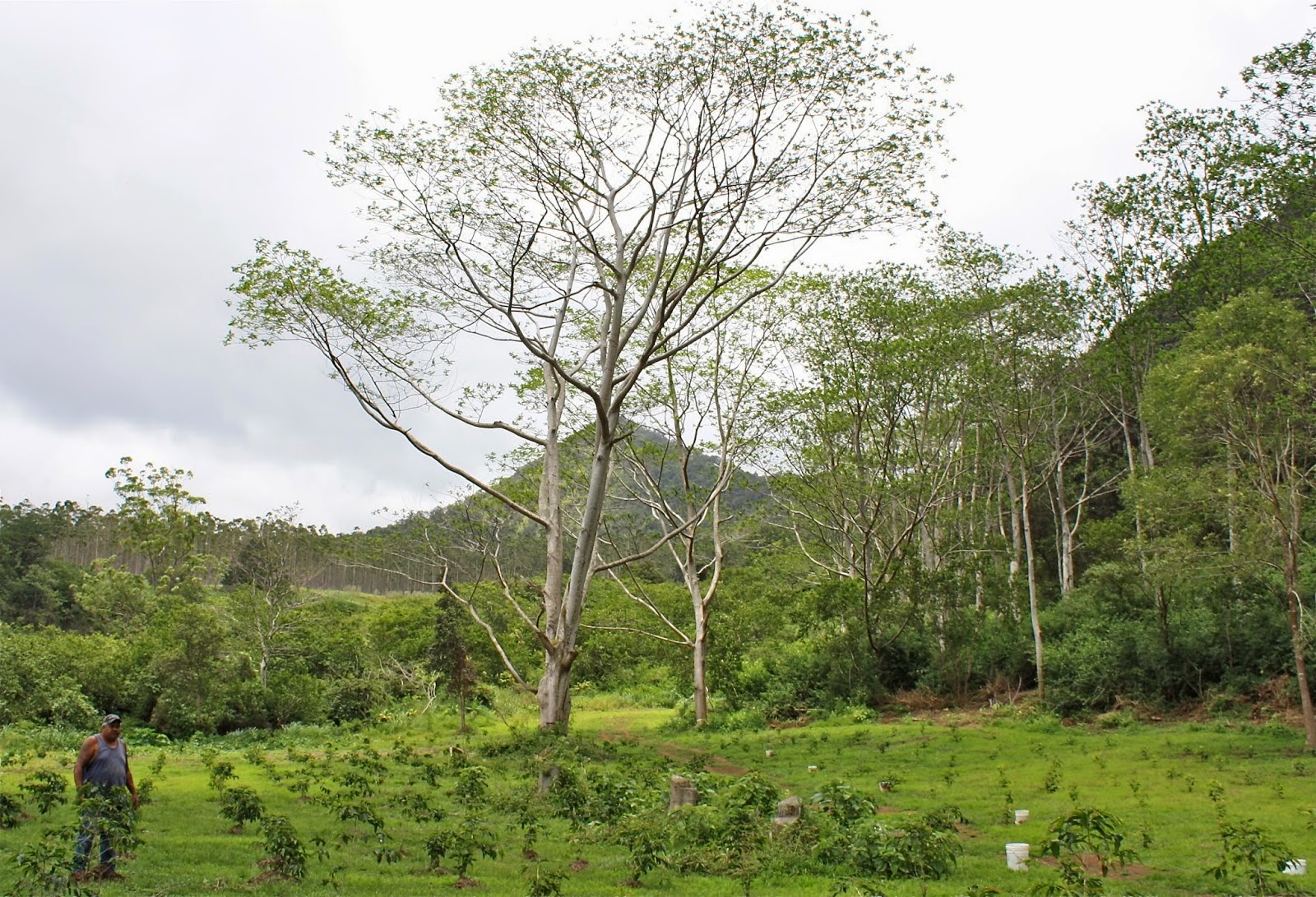
Invasive albizia trees share the Ka`u landscape with newly planted Ka`u Coffee trees. Photo by Geneveve Fyvie
A 4.3-MAGNITUDE EARTHQUAKE OCCURRED at 8:16 a.m. eight miles west southwest of Volcano Village this morning. Hawaiian Volcano Observatory received reports of it being felt around the island, with most reports coming from Volcano, Hawai`i Volcanoes National Park and the Hilo area.
Reports of feeling the 4.3-magnitude earthquake
this morning came from several areas.
Map from HVO
      Originally reported as 4.0-magnitude, HVO first increased it to 4.2, then 4.3.
      The word from the rim of Ha`ema`uma`u Crater comes from the front desk staff at Volcano House, reporting that the earthquake was barely felt and didn’t even take artwork on the walls out of position. Several guests asked if there was an earthquake and were shown the USGS map at hvo.wr.usgs.gov.
      Volcano Art Center also reported no damage, no cleanup required.
      To comment on or like this story, go to facebook.com/kaucalendar.

CONTROLLING INVASIVE ALBIZIA TREES is the topic of nine bills being considered by the state Legislature this year. Ka`u’s Sen. Russell Ruderman introduced one of the bills, SB 591, following devastation in Puna during Tropical Storm Iselle last year. Albizias fell on homes and across roads and power lines, cutting off electricity and access to many residents there. While not as numerous as in Puna, the fast-growing, brittle trees grow in Ka`u, present the same dangers and caused damage during the storm.
An albizia tree in Wood Valley split during
Tropical Storm Iselle. Photo by Julia Neal
      “The Legislature finds that albizia, Falcataria moluccana, is an invasive species that presents an increasingly costly threat to the economy, critical infrastructure and public safety on Hawai`i Island,” according to the bill. “The pre-planned removal of each albizia tree costs significantly less than the combined direct and indirect costs of removal if and when it falls into a road, power line or building. The likelihood of albizia trees falling and the long distances between residential areas and emergency services add significantly to the uncertainty of emergency response capability, resulting in the potential loss of property and human life following a hurricane.” 
      Springer Kaye, manager of the Big Island Invasive Species Committee, told Hawai`i Tribune-Herald reporter Colin M. Stewart that albizia “is the only invasive species we have in Hawai`i that can kill people. When you think about it, it’s a miracle no one died during the storm.”
      More on this and other bills related to albizia is available at capitol.hawai.gov.
      See hawaiitribune-herald.com.
      To comment on or like this story, go to facebook.com/kaucalendar.

Daniel Ho collaborated with others on the Grammy-
nominated album Our World in Song.
A HAWAIIAN MUSICIAN receiving a Grammy nominations this year has a Ka`u connection. Daniel Ho, along with Ka`u community musicians, wrote a song for the mountain Kaiholena during a Ka`u Coffee Festival Music Workshop at Pahala Plantation House. Ho recorded the song on one of his albums previously nominated for a Grammy. Ho’s composition Our World in Song was nominated for best world music album for the 2015 Grammy Awards which were revealed over the weekend and televised last night.
      The music of Ka`u music teacher Keoki Kahumoku has been featured on five Grammy-winning Hawaiian albums.
      To comment on or like this story, go to facebook.com/kaucalendar.

U.S. REP. TULSI GABBARD HAS CO-AUTHORED a bipartisan letter warning congressional colleagues of sequestration’s potential devastating impact to military readiness in Fiscal Year 2016.
      The letter highlights a recent U.S. Army study illustrating effects of sequestration on 30 Army installations across the country, including Schofield Barracks in Hawai`i. Under the Budget Control Act of 2011, 50 percent of the across-the-board sequestration cuts must come from military accounts.
      “Inaction will put us further down the path of undermining our national security, local economies and the livelihoods of military families who have sacrificed so much over the last thirteen years,” the letter states.
U.S. Rep. Tulsi Gabbard
      While Congress has mitigated the effect of sequester cuts by delaying implementation and allowing inter-branch spending flexibility, sequestration will go into full effect at the end of FY2016 absent an agreement to remedy the cuts.
      “Considering the national security threats that we face today and the uncertain threats we will likely face tomorrow, Congress should not allow a dramatic reduction in the Army’s end strength or a similar reduction in the capabilities of the other service branches,” the letter continues. “We believe alleviating the impact of sequestration on the military must be a top priority of the 114th Congress, and that there is the will within the Congress to do so.”
       The growing terrorist threat from the self-declared Islamic State is just one reason why the United States must fully fund the military, Gabbard argues.
      “The world we face today is very different from the one we faced two years ago. We did not anticipate the requirement to send soldiers to Europe to face a resurgent Russia, or back to Iraq to face the rising threat from Islamic State of Iraq and Levant, or to Africa to support the international effort to battle Ebola. The Army must maintain rotational presence in Korea and Europe to meet our security obligations and to surge around the world if needed. We must have a security debate in this country and decide what we want the Army to do in the next ten years before we consider further Army reductions.”
      To comment on or like this story, go to facebook.com/kaucalendar.

FOLLOWING REPORTS THAT PRESIDENT OBAMA plans to send to Congress a proposed Authorization for the Use of Military Force specific to the war against the Islamic State of Iraq and the Levant, Sen. Brian Schatz said:
U.S. Sen. Brian Schatz
      “While I have not seen the President’s proposal for an Authorization of the Use of Military Force to destroy the Islamic State of Iraq and the Levant, sending an AUMF to Congress is a critical first step. Congress must exercise its constitutional role in authorizing the use of force. Under the 2001 and 2002 AUMFs, the President does not have the authority to conduct an open-ended war against ISIL.


      “ISIL is a group of barbaric terrorists, and their extreme tactics display a shocking brutality that must be confronted. But the United States needs a clear strategy for defeating this threat. Congress should revoke the existing AUMFs and debate a strategy for a new authorization tailored specifically for ISIL. A new time-limited and geographically targeted authorization will help sharpen our policy and align appropriations for the mission. And it must make clear that the United States cannot commit U.S. ground forces to combat ISIL.”


      Last December, Schatz sent a letter to President Obama urging him to submit for Congressional consideration a proposed AUMF specific to ISIL.
      To comment on or like this story, go to facebook.com/kaucalendar.

KA`U LITTLE LEAGUE STARTS PRACTICE today at 4 p.m. at Pahala Park. Interested players can register up until Feb. 20. Participants must be five years old by May 1, 2015 for t-ball and seven years old by that date for coach pitch. Registration fee is $30, and a copy of player’s birth certificate as well as proof of residence with a physical address is needed. For more information, call Jolisa at 640-2135 or Tammy at 896-7373.

HAWAI`I VOLCANOES NATIONAL PARK will conduct flight operations several days this month. Management of the park requires use of aircraft to monitor and research volcanic activity, conduct search-and-rescue missions and law enforcement operations, support management of natural and cultural resources and to maintain backcountry facilities.
      Feb. 10, 13, 23 and 27, 8 a.m. to noon, to transport fencing material from near the top of Mauna Loa Road to approximately 9,000-ft. elevation.
      Feb. 11, 9 a.m. to 3 p.m., to survey and control invasive fountain grass in the Ka`u Desert.
      Feb. 17 and 19, 9 a.m. to 11 a.m., to transport crew and equipment to field camp for fountain grass control in Kamo`oali`i.
      Feb. 17, 6 a.m. to 8 a.m., for ungulate surveys and control work in Kahuku between 3,000- and 7,000-ft. elevation.
      Feb. 23, 9 a.m. to noon, to survey and control invasive faya tree in Kahuku above 5,000-ft. elevation.
      Feb. 27, 9 a.m. to noon, to survey and control mullein above Mauna Loa Road.
      According to a statement from the park, management regrets any noise impact to residents and park visitors. Dates and times are subject to change based on aircraft availability and weather.
      To comment on or like this story, go to facebook.com/kaucalendar.

KA`U COMMUNITY DEVELOPMENT PLAN Steering Committee meets tomorrow at 5:30 p.m. at Na`alehu Community Center. The committee will discuss plans for community review of the draft CDP and ways to help members prepare for it and decision-making that will follow. Public feedback on these agenda items is welcome. 
      The agenda, draft CDP and other information is available at kaucdp.info.

Demonstrations of `ohe kapala, Hawaiian bamboo stamping, take place
Wednesday. Photo from NPS
PARK RANGER NOAH GOMES PRESENTS `ohe kapala, traditional Hawaiian bamboo stamping, Wednesday, Feb. 11 from 10 a.m. to 12 p.m. at Kilauea Visitor Center’s lanai in Hawai`i Volcanoes National Park. 
      Gomes is a graduate student in Hawaiian Language and Literature at University of Hawai`i at Hilo, with an undergraduate degree in Hawaiian Language. Originally from Wahiawa, O`ahu, he now resides in Hilo. Gomes has been a lifelong student of Hawaiian natural history and is currently researching the ancient bird hunters of the Hawaiian archipelago.
      `Ohe kapala is a traditional skill he has learned from his university education and through his own pursuit.
      Part of Hawai`i Volcanoes’ ongoing `Ike Hana No`eau: Experience the Skillful Work workshops. Free. Park entrance fees apply.

SUPPORT OUR SPONSORS AT PAHALAPLANTATIONCOTTAGES.COM AND KAUCOFFEEMILL.COM. KA`U COFFEE MILL IS OPEN SEVEN DAYS A WEEK.

See kaucalendar.com/Directory2015.swf and
kaucalendar.com/Directory2015.pdf.
See kaucalendar.com/KauCalendar_February2015.pdf.


Sunday, February 08, 2015

Ka`u News Briefs Sunday, Feb. 8, 2015

Heavy rainfall events are occurring more frequently on Hawai`i Island, according to University of Hawai`i researchers.
Photo by Julia Neal
HAWAI`I FARMERS UNION UNITED has issued a list of bills being considered by state Senate committees this week that it supports. The bills, related to agriculture, could be of interest to Ka`u residents who may want to testify. Testimony is due 24 hours before scheduled hearings.
Ka`u residents can testify on ag bills being considered by Hawai`i state Senate
committees this week.
      SB 314 appropriates funds for critical positions at University of Hawai`i College of Tropical Agriculture and Human Resources Cooperative Extension Service. Testimony is due tomorrow by 1:30 p.m.
      SB 375 authorizes growing of industrial hemp for certain purposes under specified conditions. Appropriates funds for department of agriculture staff to assist in registration of industrial hemp growers and seed testing. Testimony is due tomorrow by 2:45.
      SB 969 allows one or more employee dwellings to be built on agricultural lots of at least five acres, with restrictions. Testimony is due tomorrow by 3 p.m.
      SB 797 establishes notice, reporting and use requirements for any entity or person that uses pesticides under certain circumstances. Testimony due Wednesday by 3 p.m.
      SB 379 expands and creates new categories for homemade food processing for sale to the public. Testimony is due Wednesday by 3:40 p.m.
      SB 588 permits the acquisition of raw milk and raw milk products by consumers if certain conditions are met. Testimony is due Wednesday 3:40 by 3:40 p.m.
      Testimony on these and other bills can be submitted at capitol.hawaii.gov.
      To comment on or like this story, go to facebook.com/kaucalendar.

HEAVY RAINFALL EVENTS HAVE BECOME more frequent over the last 50 years on Hawai`i Island, according to a recent study by University of Hawai`i at Manoa researchers. A rare storm with daily precipitation of nearly 12 inches, occurring once every 20 years by 1960, has become a rather common event – occurring every three to five years by 2009.
Dr. Pao-Shin Chu
      In a paper published in the International Journal of Climatology, Ying Chen, a UH-Manoa graduate student at the time of the study, and Dr. Pao-Shin Chu, professor of atmospheric sciences at UH-Manoa and head of the Hawai`i State Climate Office, analyzed extreme precipitation events and the frequency with which they occur on Hawai`i Island, Oʻahu and Maui.
      While they found that heavy rainfall events have become more frequent over the last 50 years on easternmost Hawai`i Island, the opposite behavior was observed for O`ahu and Maui, to the west. There, rainfall extremes have become less frequent in the last five decades. This study reveals a regional, east to west, difference in how precipitation patterns are responding to a changing climate.
      “In the past, the frequency of heavy rainfall events was assumed to be fairly constant,” Chu said. “However, because climate is changing, the assumption of stable precipitation climatology is questionable and needs to be reconsidered.
      “Changes in the frequency of heavy rain events have repercussions on ecological systems, property, transportation, flood hazards and engineering design, including sewage systems, reservoirs and buildings.”
      This study also provided clues about why and how the frequency of precipitation extremes has changed. Chu and Chen found a greater number of extreme rain events during La Nina years and the opposite during El Nino years.
      In this study, the number of rain gauges used was limited. The researchers used information from 24 weather stations on the three islands. For future work, Chu hopes analyzing data from additional stations will provide a more detailed assessment of changing rain patterns across the Hawaiian Islands.
        To comment on or like this story, go to facebook.com/kaucalendar.

HAWAIIAN VOLCANO OBSERVATORY scientists discuss upslope portions of the June 27th lava flow that continues to be active in Puna in the current issue of Volcano Watch
      Daily reports on the June 27th lava flow posted by Hawai`i County Civil Defense and USGS Hawaiian Volcano Observatory always include an update on the position of the leading tip of the flow. The flow front position is the simplest indicator of the activity and its potential threat. But the June 27th flow, like other pahoehoe lava flow fields, is expansive and dynamic, and the flow front location is only part of the story.
      For the broader picture, let’s look at the June 27th lava flow as a whole. The flow covers an area of about 3,100 acres, but only a tiny fraction of this area consists of active, flowing lava on the surface. Based on measurements taken on Jan. 29, for example, the area of active lava was about 10 acres. In other words, only about 0.3 percent of the June 27th flow field surface consists of active, flowing lava. The rest of the surface is warm, but solidified.

In this thermal map from HVO, temperature is displayed as gray-scale values, with
brightest pixels indicating hottest areas and white showing active breakouts.
      Much of the active lava on the surface, what we call breakouts, is focused around the farthest portion of the flow – near, but not always at, the flow front. The lava gets from the vent to this distal part of the flow via a subsurface lava tube. For much of the length of the flow field, this lava tube is a single ‘master’ tube, perhaps a few yards wide. The June 27th lava flow is about 14 miles long, but this master tube appears to reach no farther than about 12 miles. Over the final two miles of the flow length, the lava moves beneath the surface via a complicated network of minor lava tubes. The master tube can be thought of as an artery that branches out into small capillaries. This network of minor tubes is what supplies lava to the surface breakouts near the flow front.
      When the rate of lava supply from the vent is high, lava moves efficiently through the network of minor tubes, feeding vigorous surface breakouts that reach the flow front. In this case, the flow front advances downslope. But when the lava supply rate is low, the lava on the surface and within the system of minor tubes may cool to the point of solidifying and stalling, and active lava may not be able to reach the flow front. In this scenario, the flow front stalls, but weak breakouts can nevertheless persist a short distance upslope, closer to the end of the master tube.
      It is this second scenario – a lower lava supply and stalling flow front – that appears to have been in play over much of January. If people only hear that the flow front has stalled, they might get the false impression that the flow as a whole is inactive. But scattered breakouts have persisted upslope of the stalled flow front for weeks now.
      HVO and Hawai`i County Civil Defense keep a close watch on these upslope breakouts because they can help determine the future path of activity. The network of minor lava tubes supplying the breakouts is unstable and can change through time, shifting the location of breakouts on the flow field. Once the breakouts have shifted, an increase in the lava supply rate can re-energize the breakouts and feed a new lobe of lava traveling in a new direction.
      HVO's daily eruption updates at http://hvo.wr.usgs.gov/activity/kilaueastatus.php describe these upslope breakouts, but to better show their locations and extent, we have also recently begun posting thermal maps of the flow field at http://hvo.wr.usgs.gov/maps/. These thermal maps are made with images collected by a handheld thermal camera during our helicopter overflights. HVO also posts satellite images, when available, that show hotspots (red pixels) indicating the areas of active breakouts.
      Keeping an eye on the flow front position is an important part of staying abreast of current activity and the ongoing lava flow hazard. But for sure, it is important to be mindful of what’s going on upslope as well.
      See hvo.wr.usgs.gov/volcanowatch.
      To comment on or like this story, go to facebook.com/kaucalendar.

The public is invited to Ka`u CDP Steering Committee's meeting Tuesday. 
SENIOR ID CARDS, for residents ages 60 and over, are available tomorrow from 9 a.m. to 11 a.m. at St. Jude’s Episcopal Church in Ocean View. Call 928-3100 for more information. 

KA`U COMMUNITY DEVELOPMENT PLAN Steering Committee meets Tuesday at 5:30 p.m. at Na`alehu Community Center. The committee will discuss plans for community review of the draft CDP and ways to help members prepare for it and decision-making that will follow. Public feedback is welcome on these agenda items.
      The agenda, draft CDP and other information is available at kaucdp.info.

SUPPORT OUR SPONSORS AT PAHALAPLANTATIONCOTTAGES.COM AND KAUCOFFEEMILL.COM. KA`U COFFEE MILL IS OPEN SEVEN DAYS A WEEK.
See kaucalendar.com/KauCalendar_February2015.pdf.