 |
| Christmas Day in Ka`u. Ka`u resident Richard Taylor captured this blanket of clouds covering a rainbow mauka of Hwy 11. |
BANNING IVORY SALES could be considered by Hawai`i Legislature in the upcoming session. Last year, a bill passed in the House of Representatives but stalled in the Senate.
Nick Grube reported in Civil Beat that Hawai`i is the third-largest market in the country. New York and California, where sales are higher, recently passed bans. |
| Christmas Night in Ka`u. Ka`u photographer Peter Anderson focused in on the moon as it rose in Ka`u's dark skies. |
“There’s no question that we’re a massive market,” Inga Gibson, senior director of the Hawai`i office of the Humane Society of the United States, told Grube. “There’s no question there’s a lot of ivory out there. And a lot of it is brand spanking new.”
The Humane Society is urging the state to ban ivory sales to help curb the killing of elephants, whales, walruses, narwhal, hippos and other species. According to Grube, the ban would not apply to guns, knives and musical instruments that are made up of less than 15 percent ivory. Exemptions would apply for private or personal items already owned or that would be heirlooms. Items used in Native Hawaiian cultural practices and for educational or research purposes would also be exempt.
“People aren’t bringing ivory here to sell to people in Hawai`i,” Keith Swindle, the resident agent in charge of the U.S. Fish and Wildlife Service’s Office of Law Enforcement in Hawai`i and the Pacific Islands, told Grube. “They’re selling it to tourists, and they’re selling it to foreign nationals.”
Swindle said that, with a statewide ban, his agency would be able to go after in-state sales rather than having to prove cross-border transactions to establish jurisdiction.
A ban would also allow Hawai`i’s Division of Conservation and Resource Enforcement to assign officers to investigate cases. The agency has previously testified in support of an ivory ban.
The Humane Society is urging the state to ban ivory sales to help curb the killing of elephants, whales, walruses, narwhal, hippos and other species. According to Grube, the ban would not apply to guns, knives and musical instruments that are made up of less than 15 percent ivory. Exemptions would apply for private or personal items already owned or that would be heirlooms. Items used in Native Hawaiian cultural practices and for educational or research purposes would also be exempt.
“People aren’t bringing ivory here to sell to people in Hawai`i,” Keith Swindle, the resident agent in charge of the U.S. Fish and Wildlife Service’s Office of Law Enforcement in Hawai`i and the Pacific Islands, told Grube. “They’re selling it to tourists, and they’re selling it to foreign nationals.”
Swindle said that, with a statewide ban, his agency would be able to go after in-state sales rather than having to prove cross-border transactions to establish jurisdiction.
A ban would also allow Hawai`i’s Division of Conservation and Resource Enforcement to assign officers to investigate cases. The agency has previously testified in support of an ivory ban.
Hawai`i State Legislature opens Jan. 20.
See civilbeat.com.
Read comments, add your own, and like The Ka`u Calendar News Briefs on Facebook.


KILAUEA MILITARY CAMP’S Holiday Challenge continues through New Year’s Eve. Lights and Christmas displays are along the walkway fronting the historic stone cottages at KMC near the restaurant, bowling alley and Lava Lounge. The public is asked to take a wintery evening stroll and to vote for their favorite decorated cottage.
SUPPORT OUR SPONSORS AT PAHALAPLANTATIONCOTTAGES.COM AND KAUCOFFEEMILL.COM. KA`U COFFEE MILL IS OPEN SEVEN DAYS A WEEK.
See civilbeat.com.
Read comments, add your own, and like The Ka`u Calendar News Briefs on Facebook.
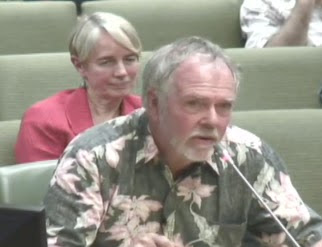 |
| Rep. Richard Creagan, M.D. testified at a special meeting of Hawai`i County Council regarding dengue fever. Image from Hawai`i County |
MILOLI`I’S CURRENT DENGUE FEVER outbreak is not its first, according to Ka`u’s state Rep. Richard Creagan. At as special meeting of Hawai`i County Council on Dec. 2, Creagan, who is a physician, said, as reported by David Corrigan on Big Island Video News, that there was an outbreak in 1993 and 1994, but “we didn’t know what it was, but in retrospect it was dengue because the Health Department did test 10 people who came forward in 2005, and they were all positive for dengue. It was called the Miloli`i Flu. I saw people in the ER who, all the symptoms were dengue … but we didn’t know about dengue. We thought leptospirosis; we thought tick-borne diseases. So, we never knew what happened. After a few months, the cases stopped coming.”
Creagan said the outbreak went away because “there was a two-year, severe drought on this island. And with that drought, apparently, this mosquito population diminished enough. People’s pails in their yard and everything else didn’t have any water in them, so the outbreak died away.
“We may be facing a drought with an El Nino right now, and prediction is we will have it. Frankly, we better hope we have it because that may be the only thing that stops this epidemic.
“It’s still considered an outbreak, but it could become an epidemic.”
The state closed Miloli`i Beach Park and Honomalino Bay last week after finding cases of dengue and dengue-carrying mosquitoes in the areas.
See bigislandvideonews.com.
Read comments, add your own, and like The Ka`u Calendar News Briefs on Facebook.
FREQUENTLY ASKED QUESTIONS about dengue fever are answered on Hawai`i Department of Health’s website, health.hawaii.gov. Here is a sampling:
Where on the Big Island are the cases located? The investigation is still underway, and the Department of Health is still investigating possible areas where cases may have been exposed to infected mosquitoes. Current investigations have identified South Kona … as an area of particular concern, but the entire island is considered to be at risk. All islands in the state should be vigilant and take measures to reduce mosquito breeding grounds.
“It’s still considered an outbreak, but it could become an epidemic.”
The state closed Miloli`i Beach Park and Honomalino Bay last week after finding cases of dengue and dengue-carrying mosquitoes in the areas.
See bigislandvideonews.com.
Read comments, add your own, and like The Ka`u Calendar News Briefs on Facebook.
FREQUENTLY ASKED QUESTIONS about dengue fever are answered on Hawai`i Department of Health’s website, health.hawaii.gov. Here is a sampling:
Where on the Big Island are the cases located? The investigation is still underway, and the Department of Health is still investigating possible areas where cases may have been exposed to infected mosquitoes. Current investigations have identified South Kona … as an area of particular concern, but the entire island is considered to be at risk. All islands in the state should be vigilant and take measures to reduce mosquito breeding grounds.
Is it safe to travel to the Big Island and the rest of Hawai`i? Absolutely, yes. The Big Island and the rest of Hawai`i remain safe destinations for visitors and residents. The current outbreak is very small by global standards, and minor compared to other popular tropical tourist destinations. (Mosquito bite prevention tips for travelers are also available at DOH's website.)

All travel involves at least some risk, but visitors can, in general, reduce their risk by protecting themselves against mosquitoes and mosquito bites by using mosquito repellent that contains DEET and covering up with appropriate clothing no matter where they go. Precautions should especially be taken when going into areas where mosquito activity is likely.
Do I have the symptoms of dengue? If you are concerned that you may have symptoms related to dengue (which can include fever, severe headaches, pain behind the eyes, joint and/or muscle pain and rash), you should contact your healthcare provider and avoid further exposure to mosquitoes.
If you are ill and are worried that you might have dengue fever, it is important that you be evaluated by a healthcare provider. Many of the initial symptoms of dengue can overlap with other conditions that require specific treatment (like leptospirosis); additionally, a small number of individuals with dengue can go on to have severe dengue, and it is important that individuals with dengue be monitored by a healthcare provider to ensure that they are not progressing to severe dengue.
Can I get tested for dengue? If you are at all concerned that you might have dengue, you should contact your healthcare provider and avoid further exposure to mosquitoes.
If you were ill and more than a week has passed since the time of illness, an antibody test can determine whether you were previously infected with dengue. However, determining which dengue virus type you had is not possible after the first week of illness.
Can I get mosquitoes tested for dengue? Can someone come and spray my property for mosquitoes? Mosquito testing for individuals is not something that the DOH is able to offer. Department staff have been conducting on-going assessments for mosquito activity and may as a precaution be spraying in areas; DOH necessarily is prioritizing areas of concern identified through our investigations.
What substance is used in the spraying of mosquitoes? The spray that is used is Aqua Reslin, which targets live adult mosquitoes. Although we recommend that people and pets stay away from treated areas for several hours as a precaution, the U.S. Environmental Protection Agency has determined that the spray poses no health risk to humans or their pets.
Do I have the symptoms of dengue? If you are concerned that you may have symptoms related to dengue (which can include fever, severe headaches, pain behind the eyes, joint and/or muscle pain and rash), you should contact your healthcare provider and avoid further exposure to mosquitoes.
If you are ill and are worried that you might have dengue fever, it is important that you be evaluated by a healthcare provider. Many of the initial symptoms of dengue can overlap with other conditions that require specific treatment (like leptospirosis); additionally, a small number of individuals with dengue can go on to have severe dengue, and it is important that individuals with dengue be monitored by a healthcare provider to ensure that they are not progressing to severe dengue.
Can I get tested for dengue? If you are at all concerned that you might have dengue, you should contact your healthcare provider and avoid further exposure to mosquitoes.
If you were ill and more than a week has passed since the time of illness, an antibody test can determine whether you were previously infected with dengue. However, determining which dengue virus type you had is not possible after the first week of illness.
Can I get mosquitoes tested for dengue? Can someone come and spray my property for mosquitoes? Mosquito testing for individuals is not something that the DOH is able to offer. Department staff have been conducting on-going assessments for mosquito activity and may as a precaution be spraying in areas; DOH necessarily is prioritizing areas of concern identified through our investigations.
What substance is used in the spraying of mosquitoes? The spray that is used is Aqua Reslin, which targets live adult mosquitoes. Although we recommend that people and pets stay away from treated areas for several hours as a precaution, the U.S. Environmental Protection Agency has determined that the spray poses no health risk to humans or their pets.
Read comments, add your own, and like The Ka`u Calendar News Briefs on Facebook.

TO HELP MAKE THE HOLIDAYS greener, Hawai`i County Solid Waste Division of the Department of Environmental Management is again offering Treecycling.
Through Sunday, Jan. 17, residential customers may leave trees in designated areas (not in the rubbish chutes) at any of the County Solid Waste Division Facilities, except for Miloli`i and Ocean View Transfer Stations, during normal business hours. Facility attendants will direct the public to the proper drop-off point. All commercial customers must recycle trees at either of the Organics Facilities in Hilo or Waikoloa.
Trees should be free from all decorations, stands, lights, tinsel and ornaments. Do not drop off artificial or flocked trees in the designated areas. Any flocked trees, artificial trees or trees with tinsel are not recyclable and may be disposed of in the regular trash chutes.
Also, recycle Kadomatsu decorations, which are normally a combination of bamboo, pine and flowers. Kadomatsu is a tradition that began 600 years ago in Japan as a way of offering luck in the New Year.
For more information on Recycling in Hawai`i County, see www.hawaiizerowaste.org, or call 961-8270.
Read comments, add your own, and like The Ka`u Calendar News Briefs on Facebook.
Trees should be free from all decorations, stands, lights, tinsel and ornaments. Do not drop off artificial or flocked trees in the designated areas. Any flocked trees, artificial trees or trees with tinsel are not recyclable and may be disposed of in the regular trash chutes.
Also, recycle Kadomatsu decorations, which are normally a combination of bamboo, pine and flowers. Kadomatsu is a tradition that began 600 years ago in Japan as a way of offering luck in the New Year.
For more information on Recycling in Hawai`i County, see www.hawaiizerowaste.org, or call 961-8270.
Read comments, add your own, and like The Ka`u Calendar News Briefs on Facebook.
 |
| One more week remains to view Volcano Art Center Gallery's Invitational Wreath Exhibit. Photo from VAC |
VOLCANO ART CENTER GALLERY’S annual Invitational Wreath Exhibit continues for one more week during Christmas in the Country. The exhibit presents one-of-a-kind wreaths in a variety of imaginative media, techniques and styles, from the whimsical to the traditional.
KILAUEA MILITARY CAMP’S Holiday Challenge continues through New Year’s Eve. Lights and Christmas displays are along the walkway fronting the historic stone cottages at KMC near the restaurant, bowling alley and Lava Lounge. The public is asked to take a wintery evening stroll and to vote for their favorite decorated cottage.
SUPPORT OUR SPONSORS AT PAHALAPLANTATIONCOTTAGES.COM AND KAUCOFFEEMILL.COM. KA`U COFFEE MILL IS OPEN SEVEN DAYS A WEEK.


 |
| See kaucalendar.com/Directory2015.swf and kaucalendar.com/Directory2015.pdf. |
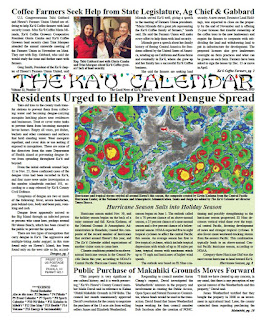 |
| See kaucalendar.com/KauCalendar_December2015.pdf. |


