About The Kaʻū Calendar

Tuesday, January 26, 2016

Ka`u Calendar News Briefs Tuesday, Jan. 26, 2016

The late Sen. Gil Kahele emceed at Gov. Neil Abercrombie's 2010 inauguration event at Pahala Plantation House.
Photo by Julia Neal
SEN. GIL KAHELE, a son of Miloli`i and Ka`u’s state senator in 2011 and 2012, has died. He had been hospitalized and missed last week’s opening of the 2016 state Legislature. During a hearing this morning, Senate President Ron Kouchi informed legislators, who paused for a moment of silence.
Sen. Gil Kahele speaking with Ka`u residents about the future
of Pahala Public & School Library. Photo by Julia Neal
      Kahele was born in Miloli`i, where his father and grandfather were fishermen. He enjoyed taking people on hikes along the coastal trail to his family’s house site and canoe landing. He was a driving force in the establishment of Pa`a Pono Miloli`i, a nonprofit dedicated to keeping the village’s fishing practices and cultural traditions alive for future generations.
      Kahele was instrumental in preservation of wildlands and the South Kona Coast. One of his major legislative achievements in his first year was establishment of the South Kona Wilderness Area, an area roughly 6,000 acres from Honomalino to Kalanamauna dedicated to nature and conservation for perpetuity.
      A longtime operative in the Democratic Party, Kahele helped to organize Gov. Neil Abercrombie’s inaugural events around the islands to be in rural areas. On the Big Island, they were held at Hawaiian Homes Community Hall in Kamuela and at Pahala Plantation House. They were also held on Lana`i and Moloka`i.
      Kahele was a staunch supporter of Pahala Public & School Library when it was threatened with closure. He also worked for clean water and housing for veterans and others.
      Following his graduation from Hilo High School in 1960, Kahele served in the U.S. Marine Corp. and graduated from Laney College in Oakland, California. He retired from Hawai`i State Department of Defense after 33 years as the Director of Public Works at Pohakuloa Training Area.
Sen. Kahele loved walking the villages
of the South Kona Coast.
 Photo by Julia Neal
      On Jan. 11, 2011, Gov. Abercrombie appointed Kahele as senator for the Second District, which encompassed Ka`u, Puna and Hilo. In his first race for public office, he was elected in 2012 to represent Hilo, now known as the First Senatorial District as a result of reapportionment.
      During the current state Legislature, Kahele was to serve as Chair of the Senate Tourism and International Affairs Committee and Vice Chair of Higher Education and the Arts Committee. He was also to serve on Judiciary and Labor & Education Committees.
      “It is with much sadness that I learned of Sen. Kahele’s passing,” Gov. David Ige said. “He was a dedicated public servant who spent the last few years working for the good of his beloved community at the Hawai`i State Legislature. He was a respected and influential leader both in the Legislature and in his hometown community of Hilo. My deepest condolences to his `ohana, friends and supporters during this difficult time.”
      “I am deeply saddened to learn today of the passing of my dear friend, Sen. Gilbert Kahele,” Lt. Gov. Shan Tsutsui said. “Gil was a warm and caring man with the highest principles and values, who had the unique ability to always make you feel welcomed and at ease. I was honored to have served as his colleague in the Senate and to have continued our friendship thereafter. I will miss his kindness, positive outlook, and ability to make me laugh.
      “I send my thoughts and prayers to Gil’s `ohana and friends. He was a committed and loving husband, father and grandfather, who spoke often of his loved ones with great joy and pride. The people of Hawai`i were privileged that a man of his experience and dedication devoted his life to public service. His smile and infectious laugh will continue to live on in our hearts and minds forever.”
      Ka`u’s state Sen. Russell Ruderman said, “I am deeply saddened by the passing of an honored colleague and fellow Big Island Sen. Gilbert Kahele. My thoughts and condolences go out to his family and loved ones.”
      To read comments, add your own, and like this story, see facebook.com/kaucalendar.
KA`U’S STATE SEN. JOSH GREEN’S bill aiming to lower the legal limit for blood alcohol content while driving from .08 to .06 has been scheduled for a hearing on Thursday at 2:45 p.m. with the Committee on Transportation and Energy. “We feel strongly that this bill can help save people's lives and make Hawai`i a safer place to live,” Green said.
       “By setting a standard like this at .06, people will get it more clearly in their minds that that’s what Hawai`i believes,” Green told Lei Kaholokula, of KITV News. “Let people realize that Hawai`i puts teenagers and the lives of our loved ones and families first over worrying about the court backlog” that the measure may create.       
      Ka`u residents can offer testimony on SB2053 at capitol.hawaii.gov. To be heard Thursday, testimony must be submitted by tomorrow at 2:45 p.m.
      To read comments, add your own, and like this story, see facebook.com/kaucalendar.

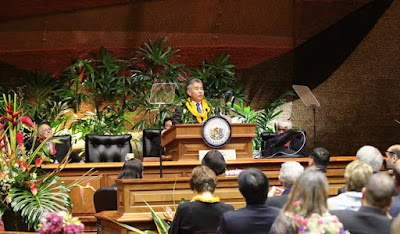
Gov. David Ige gave his State of the Union address yesterday.
Photo from Office of the Governor
GOV. DAVID IGE GAVE his second State of the State address before the Legislature yesterday.
      Ige talked about doing things the right way to make things happen. “It begins with being truthful,” Ige said. “We, in government, are obligated to be truthful, even when the truth is not easy or popular. When we live without truth, our actions fail to pass the test of time. Moreover, we tend to repeat our mistakes because we have not learned from them.”
      Ige gave the SuperFerry and Thirty Meter Telescope as examples where the state failed to follow the law. Regarding the SuperFerry, Ige said “the state should have followed the law and done the right thing in the first place.” In its recent ruling (regarding TMT), the state Supreme Court … said “the state didn’t do the right things in the approval process. It told us we needed to do a better job of listening to people and giving them a real opportunity to be heard,” Ige said.
      “The unrelenting search for truth, knowledge and understanding is an essential part of our human makeup. It helps us become who we are.
      “So does our obligation to be true to our past and cultural heritage.
U.S. Sen. Brian Schatz attended Gov. Ige's
State of the Union address.
Photo from Sen. Schatz
      “That’s why it’s so unfortunate that our past and our future have been pitted against each other on the slopes of Mauna Kea. As governor, I am committed to realigning our values and our actions. They are what define us as a community and allow us to move forward – proud of our past and facing our future with strength and confidence.”
      Ige reaffirmed his commitment to TMT and pledged that “this time, we will listen carefully to all, reflect seriously on what we have heard and, whatever we do in the end, we will do it the right way.”
      Ige said he wants his administration to govern with compassion. He said he wants to do as much as possible to help homeless families throughout the state. “That’s why we increased funding for the Housing First effort and organized a Landlord Summit to encourage acceptance of more low-income and homeless tenants from building owners,” he said.
      Ige said lack of affordable housing is the major reason why homelessness has become so widespread. He said he wants to work with the private sector to develop a comprehensive approach to reduce regulatory barriers, strengthen financial tools, streamline procedures and re-orient policies toward increasing housing production.
      “Our highest single obligation is to take care of our children,” Ige said. He said he wants to air-condition classrooms throughout the state.
      He said he is working with the Department of Energy, other state departments, utilities and clean energy companies to cool 1,000 public school classrooms by the end of this year and thousands more each year through the end of 2018. “We are going to get this job done,” he said.
      In agriculture, Ige urged the Legislature to move more aggressively to take on threats to Hawai`i’s homegrown resources with the creation of the Hawai`i Invasive Species Authority.
      “The transcendent call from our island state to the surrounding world is that when we demean others we betray ourselves. There is a finer, better way. Pledge to it; make it real every day and lead the way,” Ige concluded.
      To read comments, add your own, and like this story, see facebook.com/kaucalendar.

KA`U HIGH SCHOOL SENIORS and college students can receive help with filing Free Applications for Federal Student Aid that are required for access to federal and state financial aid for college. The workshop takes place today from 4 p.m. to 6 p.m. at St. Jude’s Episcopal Church in Ocean View.
      See stjudeshawaii.org or email cindycutts00@yahoo.com for more information.

Kumu Hula Pele Kaio
USGS HAWAIIAN VOLCANO OBSERVATORY scientist Jim Kauahikaua and HVO volunteer Ben Gaddis present the story of the 1880 - 81 Mauna Loa eruption using maps, art and photographs today at 7 p.m. at Kilauea Visitor Center in Hawai`i Volcanoes National Park.

KUMU HULA PELE KAIO presents Hei: Traditional Hawaiian String Figures tomorrow from 10 a.m. to 12 p.m. on Kilauea Visitor Center’s lanai in Hawai`i Volcanoes National Park. Free; park entrance fees apply.

HOW COMMUNITIES PROTECT themselves from vog is the topic of a Volcano Awareness Month program tomorrow at 6:30 p.m. at Ocean View Community Center.

VOLCANO RESIDENT RUSSELL ATKINSON discusses Burning Man Thursday at 7 p.m. at Volcano Art Center in Volcano Village.
      Call 967-8222 for more information.

SUPPORT OUR SPONSORS AT PAHALAPLANTATIONCOTTAGES.COM AND KAUCOFFEEMILL.COM. KA`U COFFEE MILL IS OPEN SEVEN DAYS A WEEK.


See kaucalendar.com/Directory2015.swf
and kaucalendar.com/Directory2015.pdf.
See kaucalendar.com/KauCalendar_January2016.pdf.


Monday, January 25, 2016

Ka`u Calendar News Briefs Monday, Jan. 25, 2016

As part of Volcano Awareness Month in Ka`u, researchers discuss How Communities Protect Themselves from Vog Wednesday at 6:30 p.m. at Ocean View Community Center. See more below. Photos from USGS/HVO
KA`U RESIDENTS CAN SUBMIT COMMENTS on a Draft Environmental Assessment for a proposed forest stewardship and management plan. The Black Rhinoceros Foundation seeks to turn a 190-acre parcel at the southeast corner of Kama`oa and South Point Roads into a native forest of a variety of species. According to the document, the nonprofit’s goal is to establish a thriving mixed species forest there, maintaining a sustainable yield of valuable forest products, while preserving cultural sites as well as the health and function of Pu`u`eo Ahupua`a and the South Point Watershed. Twenty percent of total plantings would be introduced hardwood timber trees that would “provide wildlife habitat and continued productivity for the project.” Trees would be selectively harvested and regenerated to support the foundations goals and to continue management of the property as a working forest.
A 190-acre parcel in Ka`u could become a native
forest. Map from Draft EA
      The land is currently covered in a mixture of introduced noxious and invasive weeds that would be controlled and replaced with more desirable and productive vegetation throughout the project. The primary species to be established are Hawaiian sandalwood, iliahi and koaia (Acacia koaia) in addition to a variety of other native, Polynesian and non-native, non-invasive species. The site would also serve as a seed bank for these valuable Hawaiian endemics, as well as serve as a demonstration site for a viable and productive investment strategy for formerly forested agricultural lands.
      Two sites that contain burials were found during the archaeological inventory survey of the parcel. One is a small lava tube in the west-central portion of the parcel that contains a Historic Period burial. Another is a lava tube lin the northwestern portion of the parcel that contains two sets of presumably Precontact Period human skeletal remains along with some habitation debris. Four additional archaeological sites were recorded on the parcel during the inventory survey: historic boundary walls enclosing the entire study parcel, two collapsed lava tube depressions with modified edges and the remains of a large platform interpreted as a heiau. With the exception of the boundary walls, all of these sites are slated for preservation.
      The Black Rhinoceros Foundation, based in New Mexico, seeks funds by a cost-share grant through Hawai`i’s Forest Stewardship Program.
      The public can offer comments through Feb. 22. Send comments to DLNR Division of Forestry and Wildlife, 1151 Punchbowl Street, Room 325, Honolulu, HI 96813. The draft EA is available at http://oeqc.doh.hawaii.gov/default.aspx. Click on EA_and_EIS_Online_Library, Hawai`i and 2010s.
      To read comments, add your own, and like this story, see facebook.com/kaucalendar.

Sen. Josh Green listed his legislative priorities.
Photo from Sen. Green
AT THE BEGINNING OF THE 2016 Hawai`i Legislature, Ka`u’s Sen. Josh Green shared his top five legislative priorities.
      “The Well Being of the People Comes First. Everyone gets a livable wage of at least $16/hour. We end the homeless crisis by funding Housing First and strategically building homeless shelters. We pass a tax on luxury developments to pay for rental housing initiatives and to build affordable homes.
      “Healthcare for All. We establish a true healthcare safety net in Hawai`i, greatly improve access to mental healthcare and drug and alcohol treatment, and strengthen the state hospital system.
      “Protect our Environment. We ensure pristine air quality in Hawai`i, address the pesticide and GMO concerns many in Hawai`i share through total transparency, guarantee clean water, and fight for 100 percent renewable energy for Hawai`i.
      “Support Public Education. We improve teacher wages to compete with mainland pay, dramatically decrease class sizes, and make community college free for all who choose it.
      “Real Economic Growth. We encourage job creation in emerging fields such as clean energy, healthcare and technology to complement our critical tourism and agriculture base.
      “I will also be spearheading initiatives to lower the legal limit for a DUI from .08 to .06 and to ensure that helmets will be required for all moped riders under the age of 25.”
      Green’s asked constituents to share their thoughts at  facebook.com/senatorjoshgreen, sengreen@capitol.gov or 808-586-9385.
      To read comments, add your own, and like this story, see facebook.com/kaucalendar.

HAWAIIAN VOLCANO OBSERVATORY’S stop on its geologic tour of the Hawaiian Islands in the current issue of Volcano Watch is Maui, as well as the islands of Lanaʻi, Molokaʻi, and Kahoʻolawe, all of which form Maui County.
      “To imagine the landscape of Maui County as it would have appeared about one million years ago, think of the Island of Hawaiʻi today, with several large, coalesced volcanoes that form a single large island,” the article states. “Such was the heyday of ‘Maui Nui,’ when at least seven volcanoes built an island that was about 50 percent bigger than the Island of Hawaiʻi is today. 
      “The oldest of Maui Nui’s volcanoes, Penguin Bank, is now submerged off the west coast of Molokaʻi. From there, successively younger volcanoes are West Molokaʻi and East Molokaʻi. When these three volcanoes began to grow on the seafloor is poorly known, but they probably range from slightly over two million years old (Penguin Bank) to slightly less than two million years old (East Molokaʻi).
      “The sequence of volcanoes then progressed with Lanaʻi, West Maui, Kahoʻolawe, and finally, Haleakalā on East Maui. The formation of these four volcanoes probably occurred between 1.5 and two million years ago.
      “Why so many volcanoes in such a small area? Studies of the entire chain of Hawaiian volcanoes and seamounts suggest that magma supply to the surface began increasing a few million years ago. More magma means more eruptions, which might explain why the Hawaiian hot spot went from forming individual island volcanoes (Niʻihau and Kauaʻi), to an island with two volcanoes (Oʻahu), to islands made up of several volcanoes (Maui Nui and the Island of Hawaiʻi). 
The islands of Maui County were once a land mass 50 percent
larger than Hawai`i Island. Map from USGS/HVO
      “Despite their close proximity, the volcanoes of Maui Nui have quite different eruptive histories. For example, Lanaʻi was short-lived, going extinct after its vigorous shield stage, with no eruptions since about 1.35 million years ago. West Molokaʻi and Kahoʻolawe were also short-lived, but they experienced minor postshield volcanism before going extinct about one million years ago. East Molokaʻi and West Maui persisted longer and were the sites of rejuvenated eruptions just 300,000 years ago (the most recent such eruption on Molokaʻi formed Kalaupapa Peninsula).
      “Haleakalā, the longest-lived of the Maui Nui volcanoes, is currently waning from a long postshield sequence of volcanism. Eruptions there occur about as frequently as they do on Hualālai volcano on the Island of Hawaiʻi. The most recent eruption on Haleakalā took place about 400 years ago, well within the time that Polynesians settled on the Hawaiian Islands. Future eruptions at Haleakalā are likely, which is why the USGS Hawaiian Volcano Observatory maintains a monitoring network there.
      “Because all of the Maui Nui volcanoes are beyond their vigorous shield-building stages, erosion has dominated for the past one million years or so. Water and landslides have helped create dramatic valleys, including the summit ‘crater’ of Haleakalā.
      “The most spectacular of the Maui Nui landslides occurred from East Molokaʻi, where the massive Wailau slide sliced off the volcano’s summit, creating spectacular sea cliffs on the island’s north side. This landslide deposited rocky debris over 160 kilometers (100 miles) across the ocean floor.
      “The islands of Maui Nui have also subsided over time – a normal consequence of the volcanoes’ weight on the sea floor in addition to their motion away from the buoyant hot spot. It was this subsidence, plus rising sea levels, that flooded the land between Maui Nui’s volcanoes, creating the separate islands we see today, probably within the last few hundred thousand years. With continued subsidence at present rates, Haleakalā (East Maui) itself could become isolated from West Maui by a seaway within another 10,000 to 20,000 years.”
      See hvo.wr.usgs.gov.
      To read comments, add your own, and like this story, see facebook.com/kaucalendar.

FAFSA FILING WORKSHOP is tomorrow from 4 p.m. to 6 p.m. at St. Jude’s Episcopal Church in Ocean View. Church members help with filing Free Applications for Federal Student Aid that are required for access to federal and state financial aid for college.
      Applicants should bring with them student and parent Social Security numbers, email addresses and adjusted gross incomes for 2014 and 2015.
      See stjudeshawaii.org or email cindycutts00@yahoo.com for more information.

THE LAVA FLOW THAT CAME TO HILO is the topic at After Dark in the Park tomorrow at 7 p.m. at Kilauea Visitor Center in Hawai`i Volcanoes National Park. USGS Hawaiian Volcano Observatory scientist Jim Kauahikaua and HVO volunteer Ben Gaddis present the story of the 1880 - 81 Mauna Loa eruption using maps, art and photographs.

KUMU HULA PELE KAIO presents Hei: Traditional Hawaiian String Figures Wednesday from 10 a.m. to 12 p.m. on Kilauea Visitor Center’s lanai in Hawai`i Volcanoes National Park. Free; park entrance fees apply.

HOW COMMUNITIES PROTECT themselves from vog is the topic of a Volcano Awareness Month program Wednesday at 6:30 p.m. at Ocean View Community Center. Hawaiian Volcano Observatory scientist Tamar Elias provides an update on Kilauea’s gas emissions, and Dr. Claire Horwell shares results of her 2015 study.

SUPPORT OUR SPONSORS AT PAHALAPLANTATIONCOTTAGES.COM AND KAUCOFFEEMILL.COM. KA`U COFFEE MILL IS OPEN SEVEN DAYS A WEEK.


Sunday, January 24, 2016

Ka`u Calendar News Briefs Sunday, Jan. 24, 2016


Keiki and their families lined the Ka`u Coast at Punalu`u yesterday for `O Ka`u Kakou's eighth annual Keiki Fishing Tournament.
Photo by Peter Anderson
RESULTS OF YESTERDAY’S KEIKI Fishing Tournament are in. Ka`u keiki and their families lined the coast at Punalu`u Beach Park for `O Ka`u Kakou’s eighth annual tournament.
Miss Ka`u Coffee Maria Miranda presented award and prizes
to Keenan Toriano, Rylan Equsa and Daystan Resurreccion,
as well as other winners. Photo from Lee McIntosh
      Loea Kaupu won for Most Fish Overall. Zachary Blano-Louis took second place, and Joe Buyuan placed third.
      Largest Po`opa`a was caught by Chelsea Velez. Noa Cambe caught the second largest, and X’avier Alani caught the third largest.
      In the Kupipi category, Keenana Toriano placed first, Rylan Equsa second and Daystan Resurreccion third.
      Lexi Manila-Louis caught the largest Hinale`a, Jyzeiah Garcia hooked the second largest, and Rylan Peralta caught the third largest.
      First place in the Largest Aholehole category went to Harlem Reyes Espejo. Jance Ke took second, and Gabriel Sesson Paaluhi-Young, third.
Ocean View resident Vernon Harvey posted his aerial footage
of the Keiki Fishing Tournament on YouTube.
       After fishing, participants enjoyed free lunch and shaved ice.
       Aerial footage taken by Vernon Harvey, of Ocean View, can be viewed at
https://www.youtube.com/watch?v=3Xx6CVCPu9Q
.
      To read comments, add your own, and like this story, see facebook.com/kaucalendar.

EAST HAWAI`I REGIONAL BOARD of Hawai`i Health Systems Corporation has appointed Marcella Stroh to its 12-member board. The Regional Board is responsible for governing Hilo Medical Center, Hale Ho`ola Hamakua, Ka`u Hospital and the region’s 10 general and specialty clinics.
Marcella Stroh and Wayne Kanemoto Photo from HHSC
      “Our community is indeed fortunate to have the services of Marcella, a talented and experienced leader,” said Kurt Corbin, East Hawai`i Regional Board Chair. “She joins a Board comprised of dedicated physicians, business executives, educators and professionals who are committed to the ideals of providing exceptional health care regardless of ability to pay.”
      “These are very exciting and important times in the healthcare industry in our community, therefore, it is an honor and privilege for me to be nominated to the East Hawai`i Regional Board,” Stroh said. “I look forward to sharing my expertise and long history of collaboration in the business/financial world for the benefit of our community’s healthcare that is very much needed in these crucial times.”
Waiting for a nibble. Photo by Peter Anderson
      Stroh is the Senior Vice President and Commercial Banking Senior Manager for Hawai`i Island at Central Pacific Bank. She is actively involved in the American Heart Association, the Hawai`i County Economic Opportunity Council, the County of Hawai`i’s Salary Commission, the Hilo Medical Center Foundation, the Hawai`i Island Chamber of Commerce and the Japanese Community Association. She earned her Associate’s Degree in Accounting and Secretarial Science from Hawai`i Community College. She also attended ABA School of Bank Management and Marketing in Boulder, Colorado and AIB School of Executive Management in Madison, Wisconsin. She was born and raised on Hawai`i Island where she raised her two daughters, Kimberly and Kasey. She enjoys spending time with her grandsons, Austin and Asher, and doing outdoor activities.
Chelsea Velez, Noa Cambe and X'avier Alani won in the
Largest Po`opa`a category. Photo from Lee McIntosh

      After a three-year term on the East Hawai`i Regional Board, Wayne Kanemoto has been appointed by Gov. David Ige to HHSC’s Corporate Board to represent the interests of the East Hawai`i Region. He is currently with Kanalani Enterprise, LLC. Previously, Kanemoto served for over 30 years in the United States Army and Army Reserve. His 33-year career in education began as a teacher in Biology Sciences on O`ahu and concluded as principal on Hawai`i Island for 18 years at Laupahoehoe High and Elementary School and the Hilo Community School for Adults. He earned a Bachelor’s Degree from Iowa State University in Zoology, a Master’s Degree in Education from the University of Hawai`i in Curriculum, Administration and was a Colonel, U.S. Army in Infantry & Civil Affairs. He has been a member of Hawai`i County Workforce Investment Board, Hawai`i Family Literacy Consortium, Hawai`i Community School Consortium, Hawai`i Government Employees Association (Unit 6) and Summer Youth Academy.
      To read comments, add your own, and like this story, see facebook.com/kaucalendar.

Largest Aholehole category winners were Harlem Reyes Espejo,
Jance Ke and Gabriel Sesson Paaluhi-Young.
Photo from Lee McIntosh
A BILL TO FUND RESEARCH and mitigation efforts relating to rapid `ohi`a death passed its first reading in the state House of Representatives last week. According to HB 1597, “the `ohi`a makes up about fifty percent of the state's native forest and is a keystone species in native watershed areas.”
      Hawai`i Department of Agriculture will submit a report detailing the nature of rapid `ohi`a death, including its cause, vectors, transmission and prospects for preventing the disease; status of developing and implementing plans and strategies to eliminate, control or prevent the disease in the state; and necessary funds and appropriate legislation to eliminate, control or prevent it in the state.
A success story at yesterday's Keiki Fishing Tournament.
Photo by Peter Anderson
      “We’re continuing to do new things, like fungicide testing, U.S. DOA researcher Lisa Keith told Colin M. Stewart, of Hawai`i Tribune Herald. “We’ve got six new potential chemicals we’re looking at, and we understand more about the genetics and biology now. But we’re just scratching the surface. (The appropriation) will allow us to do real detailed studies. I think we’ll make more progress in a lot of areas, producing more knowledge and information to lead to better management and control.”
      University of Hawai`i Extension Agent Forester J.B. Friday told Stewart, “Our task now is to keep the momentum going. … We have funds and are in the process of hiring scientists to look at the disease itself, the molecular biology of the disease, insects that may carry the disease, and technicians and outreach staff. Much of the funding we have is only for the year 2016, though, so we really appreciate the legislators introducing a bill to fund ongoing efforts to understand and manage this disease that affects our forests and all of us.”
Loea Kaupu, Zachary Blanco-Louis and Joe Buyuan placed
first, second and third in Most Overall Fish.
Photo from Lee McIntosh
      See hawaiitribune-herald.com.
      To read comments, add your own, and like this story, see facebook.com/kaucalendar.

THIRTY METER TELESCOPE OFFICIALS are waiting for the state to tell them how to proceed with plans for the $1.4 billion project planned for the summit of Mauna Kea, Lorin Eleni Gill reported in Pacific Business News.       In December, the Hawai`i Supreme Court invalidated TMT’s conservation use permit, saying the state Board of Land & Natural Resources did not hold a contested case hearing prior to its authorization.
      “We spent eight years now getting the permit, and on Dec. 2 it was invalidated,” TMT International Observatory Executive Director Ed Stone told Gill. “We went through the process, did everything we were asked to do, and it turned out that that was evidently not the right process, so now we’re waiting on what the process needs to be.”
Lexi Manila-Louis, Jyzeiah Garcia and Rylan Peralta caught
the three largest hinale`a. Photo from Lee McIntosh
      Stone said the Land Board has to tell them what they need to do. “It’s their process that had a problem for the court, so the court will instruct them, and they’ll decide what they need to do this time that they didn’t last time. That’s what we need to know before we know we have a way forward,” Stone said.
      “I think all of the partners are concerned because we don’t have a plan right now and we don’t know what it will take to do this job. Only if we have a plan we’ll feel we’re on the right track.”
      See bizjournals.com/pacific.
      To read comments, add your own, and like this story, see facebook.com/kaucalendar.

SCHOOLS, PUBLIC AGENCIES, AND PRIVATE nonprofit organizations may apply to be U.S. Department of Agriculture Summer Food Service Program sponsors.
`O Ka`u Kakou volunteers organized the eighth annual Keiki
Fishing Tournament at Punalu`u. Photo by Peter Anderson
      Children in low-income communities are eligible to receive free or reduced-price meals during the school year through the National School Lunch and School Breakfast Programs. However, the programs end when school lets out for the summer. The SFSP helps fill the hunger gap.
      During the summer months, SFSP provides nutritious meals that help children to learn, play, and grow.
      Sponsoring organizations receive reimbursements for serving healthy meals and snacks at approved sites to children and teenagers (18 years and younger). Sponsors are encouraged to provide educational or recreational activities.
      For more information about SFSP, contact Jennifer Dang, of Hawai`i Child Nutrition Programs, at 587-3600.
      To read comments, add your own, and like this story, see facebook.com/kaucalendar.

Mauna Loa's 1881 eruption is visible in this drawing
by Joseph Nawahi. Image from USGS/HVO
THE LAVA FLOW THAT CAME TO HILO is the topic at After Dark in the Park Tuesday at 7 p.m. at Kilauea Visitor Center in Hawai`i Volcanoes National Park.
      Within the last 160 years, five eruptions sent lava flows to within 10 miles of Hilo Bay. The 1880-1881 Mauna Loa eruption came the closest, with a flow that posed an immediate threat to Hilo and its bay. During the eruption, Princess Regent Lili`uokalani and Princess Ruth Ke`elikolani led efforts to save Hilo town. As residents offered both Christian prayers and appeals to Pele, preparations were also made to dig ditches, construct rock barriers and blast dynamite in attempts to divert advancing lava streams. After more than nine months, the lava flow stopped, but less than a mile from the bayfront.
      USGS Hawaiian Volcano Observatory scientist Jim Kauahikaua and HVO volunteer Ben Gaddis present the story of this Mauna Loa eruption using maps, art and photographs of the lava flow that came to Hilo.

SUPPORT OUR SPONSORS AT PAHALAPLANTATIONCOTTAGES.COM AND KAUCOFFEEMILL.COM. KA`U COFFEE MILL IS OPEN SEVEN DAYS A WEEK.


See kaucalendar.com/Directory2015.swf
and kaucalendar.com/Directory2015.swf.
See kaucalendar.com/KauCalendar_January2016.pdf.