About The Kaʻū Calendar

Tuesday, September 06, 2016

Ka`u Calendar News Briefs Tuesday, Sept. 6, 2016

After rising steadily yesterday, Kilauea's summit lava lake offered visible volcanic activity this morning.
Photo from USGS Hawaiian Volcano Observatory
AN EARTHQUAKE OCCURRED underneath Moku`aweoweo, Mauna Loa’s summit caldera, this morning. U.S. Geological Survey’s Hawaiian Volcano Observatory recorded the magnitude-4.0 earthquake at a depth of 0.74 miles at 4:25 a.m.
A magnitude-4.0 earthquake struck at Mauna Loa's
summit this morning. Map from USGS-HVO
      The USGS "Did you feel it?" website (http://earthquake.usgs.gov/eqcenter/dyfi/) received only one felt report within an hour of the earthquake. This report described light shaking (Intensity III). At that intensity, damage to buildings or structures is not expected. The lack of felt reports is consistent with the remote location and shallow depth of the earthquake.
      The earthquake appears to be isolated. As of 6:30 a.m., no aftershocks had been observed. HVO’s deformation monitoring instruments registered the earthquake but show no significant change in deformation rates or patterns that would indicate increased volcanic hazard at this time.
      Magnitude-4.0 or greater earthquakes occurred in the summit of Mauna Loa six to seven months prior to the volcano’s two most recent eruptions in 1975 and 1984. However, today’s isolated earthquake does not represent a significant departure from the seismic activity rate for the past year, so the Volcano Alert Level for Mauna Loa remains at Advisory.
      According to HVOs Scientist-in-Charge Christina Neal, the earthquake had no apparent effect on Kilauea Volcano’s ongoing eruptions. The Pacific Tsunami Warning Center determined that no damaging tsunami was generated (http://ptwc.weather.gov/?region=2).
      HVO reported this morning that Kilauea’s summit lava lake level has risen to 62 feet below the adjacent floor of Halema`uma`u crater, bringing volcanic activity into view once again.
      For information on recent earthquakes in Hawai`i and eruption updates, see USGS Hawaiian Volcano Observatory’s website at http://hvo.wr.usgs.gov.
      To read comments, add your own, and like this story, see Facebook. Follow us on Instagram and Twitter.

ELEVEN OF THE WORLD’S leading conservation organizations will partner to identify, map, monitor and conserve Key Biodiversity Areas – places that include vital habitats for threatened species – with more than $15 million committed over the next five years. The announcement was made at the IUCN World Conservation Congress currently taking place on O`ahu.
      Through the KBA Partnership, resources and expertise will be mobilized to further identify and map Key Biodiversity Areas worldwide. Monitoring of these sites will enable detection of potential threats and identification of appropriate conservation actions. The Partnership will also advise national governments in expanding their protected areas network and will work with private companies to ensure they minimize and mitigate their impact on nature.
      “This is a vitally important initiative for our planet’s biodiversity,” said Braulio Ferreira de Souza Dias, Executive Secretary of the Convention on Biological Diversity. “This partnership will enhance global conservation efforts by highlighting internationally important sites in need of urgent conservation action. It will also help us reach the targets in the Strategic Plan for Biodiversity and allow national governments and conservation organizations to ensure that scarce resources are directed to the most important places for nature.”
      The International Union for Conservation of Nature has engaged with hundreds of experts and decision-makers to develop a Global Standard for the Identification of Key Biodiversity Areas. The standard was launched during the World Conservation Congress, on Monday.
Porites pukoensis is a critically endangered coral found
in Molokai's marine area. Photo from Corals of the World
      “Our planet is at the crossroads, and we need to take urgent action if we want to secure its ability to support us,” said Inger Andersen, Director General of IUCN. “Information about where and why a site is considered key for the survival of threatened species underpins all sustainable development and will be critical for achieving Sustainable Development Goals.”
      In particular, knowledge about Key Biodiversity Areas will contribute to achievement of goals on conservation and sustainable use oceans and to manage forests, combat desertification and halt land degradation.
      The KBA Partnership builds on the partners’ established track record in site identification, monitoring and conservation. Over the past four decades, BirdLife International has identified more than 13,000 Important Bird and Biodiversity Areas on land and at sea in every region of the world through its 120 national partners and others, while the Critical Ecosystem Partnership Fund has supported identification of 6,000 Key Biodiversity Areas within global biodiversity hotspots.
      To date, more than 18,000 global and regional Key Biodiversity Areas have been identified and mapped. These include Molokai Island marine area, home to the Critically Endangered coral Porites pukoensis, known only to occur in the shallow waters of this site.
      The new Partnership will unite these efforts under a single KBA umbrella. It will expand the KBA network to cover other species and ecosystems using the global KBA standard. These data will guide decision-makers on areas that require safeguarding and will help a range of end users to define their conservation priorities, achieve their international commitments, and comply with their environmental policies.
      KBA Partners are the Amphibian Survival Alliance, BirdLife International, Conservation International, Critical Ecosystem Partnership Fund, Global Environment Facility, Global Wildlife Conservation, IUCN, NatureServe, RSPB, Wildlife Conservation Society and the World Wildlife Fund.
      “Advancing and implementing successful conservation solutions depends on clearly identified global strategies,” said Naoko Ishii, Global Environment Facility CEO. “In this regard, we are proud to be one of the founding members of this exciting new partnership to help map and protect some of the planet's most valuable biodiversity.”
      To read comments, add your own, and like this story, see Facebook. Follow us on Instagram and Twitter.

Brennen Nishimura
Photo by Coach Erin Cole
Kyle Calumpit at HPA
Photo by Coach Erin Cole
KA`U HIGH CROSS COUNTRY team has started its season. Two runners participated in the race on Aug. 27 at HPA. It was warm and sunny in Waimea on the first race of the season, which makes the hill at HPA extra challenging, reports coach Erin Cole. The race changed this year from three miles to 5K (5K is 3.1 miles). 
      Brennen Nishimura came in with a time of 26:32 – #101 out of 177. Kyle Calumpit ran a time of 27:32 – #118 out of 177.
      The Trojans have several more runners that have been training and will be running in future races this season. The race scheduled for Sept. 3 at Kealakehe was cancelled due to the storm. Next race is at Kamehameha School on Sept. 10 at 2 p.m.
      To read comments, add your own, and like this story, see Facebook. Follow us on Instagram and Twitter.

HAWAI`I COUNTY COUNCIL HOLDS meetings this week. Tomorrow, the full council meets at 9 a.m. Public Safety & Mass Transit Committee meets at 1 p.m.; Finance, 1:15 p.m.; Planning, 1:30 p.m.; Public Works & Parks & Recreation, 2 p.m.; and Governmental Relations & Economic Development, 2:45 p.m.
      The Committee on Finance conducts a workshop to discuss the county’s Dedicated and Nondedicated Agricultural Real Property Tax Programs on Thursday at 9 a.m.
      Testimony from the public will be taken at the beginning. “Healthy and structured interaction between stakeholders, committee members and members of the public” will be encouraged during the workshop, according to the announcement.
      All meetings take place at Council Chambers in Hilo. Agendas and live-streaming are available athawaii.county.gov.
      Ka`u residents can participate via teleconferencing at Na`alehu State Office Building.

SUPPORT OUR SPONSORS AT PAHALAPLANTATIONCOTTAGES.COM AND KAUCOFFEEMILL.COM. KA`U COFFEE MILL IS OPEN SEVEN DAYS A WEEK.

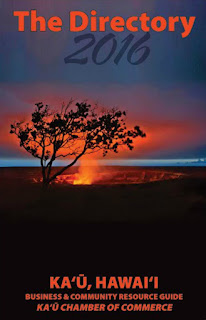
Click on document to enlarge.
See kaucalendar.com
See kaucalendar.com/TheDirectory2016.html
and kaucalendar.com/TheDirectory2016.pdf.


Monday, September 05, 2016

Ka`u Calendar News Briefs Monday, Sept. 5, 2016

Happy Labor Day! According to Hawaiian Volcano Observatory scientists, "charcoal is good
for more than the barbeque." See below. Photo from Wikipedia

SHOULD HAWAI`I ERADICATE MOSQUITOES? A group of stakeholders will ponder the question during meetings this week at Kilauea Military Camp in Hawai`i Volcanoes National Park.
      “We are discussing sort of how we realize the potential for a mosquito-free environment here for public health, conservation and quality of life issues,” Durrell Kapan, co-organizer of the workshop and adjunct professor at the Center for Conservation and Research Training at UH-Manoa, told Max Dible, of West Hawai`i Today.
Dr. Kenneth Kaneshiro
      “There are a number of near-term and potentially longer-term solutions. The important thing is to make sure all the people involved are thinking about these solutions, and to get all those people in the room to understand what those possibilities are.”
      Dr. Kenneth Kaneshiro, program director at UH-Manoa’s Center for Conservation and Research Training, explained that mosquitoes could be controlled by interrupting the insects’ reproductive systems.
      When Dible asked about consequences of eradication, such as reducing food supplies for species such as hoary bats, Kaneshiro said, “Eradication of mosquitoes wouldn’t cause any other problems because they’re not native to Hawai`i. They’re an invasive species that doesn’t belong in the native Hawaiian ecosystem.” He said the ecosystem worked fine before mosquitoes were introduced.
      See westhawaiitoday.com.
      To read comments, add your own, and like this story, see Facebook. Follow us on Instagram and Twitter.

Sen. Brian Schatz
KA`U’S U.S. SENATORS send Labor Day greetings to their constituents.
      “On Labor Day, we honor the work and sacrifice of the labor movement in our country,” Sen. Brian Schatz said. “We thank labor unions as champions for the minimum wage, Social Security, workplace health and safety standards, child labor protections and the 40-hour work week, but our thanks must be more than just words.
      “As Congress returns to session this week, we must focus on the fact that millions of working families are struggling to make ends meet. We are the wealthiest country in the world and yet for far too many Americans, a full-time job still means a life below the poverty line. We must do better. I look forward to working with my Senate colleagues to make real progress toward improving the lives of working families in our country.”
Sen. Mazie Hirono
      Sen. Mazie Hirono said, “When my mother brought our family to Hawai`i, we struggled. We lived in fear of mom getting sick and not being able to work – which meant no pay and no money for food or rent. She had no employment protection. But our family circumstances changed dramatically when mom’s workplace unionized. Better job security, better pay. We were finally able to buy our first home. As we celebrate LaborDay, we celebrate the men and women who fought and sacrificed for basic protections, like safe working conditions and fair wages, that American workers have today.”
      To read comments, add your own, and like this story, see Facebook. Follow us on Instagram and Twitter.

AS KA`U RESIDENTS ENJOY Labor Day barbeques, Hawaiian Volcano Observatory geologists explain in the current issue of Volcano Watch how they use charcoal.
      “One of the fundamental premises of geology is that the key to understanding the future is to look at the past,” the article states. “In order to understand how a volcano will behave, geologists map the deposits of past eruptions. 
      “An important element for characterizing volcanic deposits is to establish if the eruption was predominantly effusive (characterized by lava flows) or explosive. Furthermore, we want to know the spatial distribution of the deposits, and how frequently and where the different types of eruptions occur.
      “To help determine the timing of eruptive activity, geologists use a radiocarbon age-dating technique. Collecting charcoal is the most common method used in Hawai`i, not only by geologists, but also by archaeologists, ecologists, and others.
      “How does radiocarbon, or carbon-14, dating work?
      “Carbon-14 is produced in the atmosphere and readily utilized by plants to build tissue, fiber, and wood. Carbon-14 is radioactive and has a half-life of 5,700 years. As long as a plant is alive, the amount of carbon-14 in its tissue remains approximately the same.
      “Once the plant dies, however, the quantity of carbon-14 in the plant tissue decays, so that after 5,700 years the amount of carbon-14 is 50 percent of the amount present when the plant was alive. After another 5,700 years, the concentration is down to 25 percent of its initial concentration.
      “Any high temperature volcanic product, such as a lava flow, spatter, and hot ash, can create charcoal when it burns or buries a plant. In Hawai`i, geologists dig under lava flows to recover charcoal left from plants.
Dark-colored charcoal, left of rock hammer, from a log buried by lava
was found at the base of an `a`a flow in Ka`u. Photo from USGS-HVO
      “Scientists use the decay rate of carbon-14 to obtain age-dates from this charcoal. A relatively new accelerator mass spectrometer technique can now provide ages between 80 and 100,000 years. 
      “Geologists often make assumptions about the charcoal they collect. We assume that plants are alive at the time an eruption occurs. In addition, we assume that charcoal is created when a lava flow covers the vegetation.
      “These assumptions can create problems if the charcoal is created from wood that was already dead when it burned. There are other potential sources for confounding a radiocarbon age, such as dating forest fire charcoal or ‘old’ living wood, for example, the core of a log one meter (three feet) in diameter that could be quite a bit older than the exterior of the log.
      “To minimize these problems, geologists make sure that collection techniques are impeccable to reduce the chance that spurious charcoal is recovered. We also try to minimize infiltration of contaminant charcoal. Given the choice of age-dating a log or a twig, we choose the twig to avoid inadvertently dating old wood in the interior of the log.
      “Once charcoal is recovered, we dry the sample and pick out small pieces of black shiny charcoal that has a distinctive ‘snap’ when broken. Soft pliable charcoal is discarded. The sample is then sent to a radiocarbon-processing lab, where it is chemically treated to remove modern carbon. The sample is converted to graphite, which is used to determine the radiocarbon age.
      “Once we get the results from the lab, how do we then decide if the age is ‘good?’
      “The radiocarbon age has to fit into the stratigraphic framework based on geologic mapping of the volcanic deposit. For example, if Flow B, dated at 550 years old, is bracketed by Flow A, dated at 1,000 years, and Flow C, dated at 1,500 years, it is highly likely that the radiocarbon age of Flow B is not good, because it should be between 1,000 and 1,500 years.
      “Once we determine that the radiocarbon results are consistent with stratigraphy, we have to calibrate the age. Calibration is necessary because, using tree-ring data from around the world, we know that the concentration of atmospheric carbon-14 varied from time to time, and we must account for this variability.
      “Most ages are reported in years before present, with zero being A.D. 1950, before atmospheric atomic bomb testing altered the amount of carbon-14 in the air. If the age control is good enough based on stratigraphy, radiocarbon ages can be presented in terms of calendar years to facilitate comparison with non-geologic historical events.
      “So, in geology (and other fields), charcoal can be useful for more than just grilling on the barbeque.”
      See hvo.wr.usgs.gov/volcanowatch.
      To read comments, add your own, and like this story, see Facebook. Follow us on Instagram and Twitter.

HAWAI`I COUNTY COUNCIL HOLDS its regular and committee meetings Wednesday. Full council meets at 9 a.m. Public Safety & Mass Transit Committee meets at 1 p.m.; Finance, 1:15 p.m.; Planning, 1:30 p.m.; Public Works & Parks & Recreation, 2 p.m.; and Governmental Relations & Economic Development, 2:45 p.m.
      All meetings take place at Council Chambers in Hilo. Agendas and live-streaming are available at hawaii.county.gov.
      Ka`u residents can participate via teleconferencing at Na`alehu State Office Building.

SUPPORT OUR SPONSORS AT PAHALAPLANTATIONCOTTAGES.COM AND KAUCOFFEEMILL.COM. KA`U COFFEE MILL IS OPEN SEVEN DAYS A WEEK.

Click on document to enlarge.

See kaucalendar.com/TheDirectory2016.html
and kaucalendar.com/TheDirectory2016.pdf.
See kaucalendar.com.


Sunday, September 04, 2016

Ka`u Calendar News Briefs Sunday, Sept. 4, 2016

Last week’s hurricanes had no impact on lava deltas that have formed, and continue to grow, at ocean entries,
Hawaiian Volcano Observatory reported. Photo from USGS-HVO
OCEAN USERS ARE URGED to use reef-safe sunscreens. A compound commonly found in sunscreens has been shown to cause serious harm to corals, and the state Department of Land and Natural Resources is asking people who enter the ocean to avoid using sunscreens that contain oxybenzone. Recent studies have shown that the chemical causes deformities in coral larvae (planulae), making them unable to swim, settle out and form new coral colonies. It also increases the rate at which coral bleaching occurs. This puts coral reef health at risk and reduces resiliency to climate change.
Dr. Bruce Anderson
      “One of the most important things you can do if you plan to get in or near the ocean in Hawai`i is to use a sunscreen that does not contain oxybenzone,” said Dr. Bruce Anderson, administrator of DLNR’s Division of Aquatic Resources. “Sunscreen chemicals wash off swimmers, surfers, paddlers, spearfishers, divers and other ocean users. Even if you’re just sunbathing on the beach, using beach showers will wash chemicals into the ocean. Researchers have found oxybenzone concentrations in some Hawaiian waters at more than 30 times the level considered safe for corals.”
      Sunscreens are important in protecting human skin from the sun’s damaging radiation and are highly recommended for residents and visitors who spend time under the sun. This is especially important in Hawai`i, where tropical latitudes result in direct sunlight that has less atmosphere to travel through than places farther from the equator. As a result, less of the sun’s harmful ultraviolet radiation is filtered out, and it’s easy to burn. Sunscreens contain either minerals or chemicals as active ingredients to filter out UV. Oxybenzone is a chemical filter found in many sunscreens.
      Besides damaging coral, oxybenzone may have negative effects on human health. It and two other sunscreen chemicals, octinoxate and homosalate, have all been shown to cause disruptive reproductive system effects due to their hormone-like activity. Oxybenzone and octinoxate have also been associated with moderate to high rates of skin allergy.
DLNR urges ocean users to avoid sunscreens with chemicals
that damage reefs. Photo from DLNR
      According to Anderson, “the only way you can know whether a sunscreen contains oxybenzone is to read the label. Some sunscreens may claim to be ‘reef safe,’ but there is no agency which regulates that kind of claim. You really have to look at the ingredients.”
      Anderson also recommended using water resistant sunscreens, which are more likely to stay on your skin, and sunscreens that use mineral filters, such as zinc oxide or titanium dioxide. Also, rash guards or wet suits will reduce the area of exposed skin, and thus the amount of sunscreen needed for protection.
      At Ahihi-Kinau Natural Area Reserve on Maui, NAR specialist Jeff Bagshaw has made sunscreen outreach a priority. He’s created cards to pass out to visitors who frequent snorkeling spots there. The cards list sunscreen chemicals in addition to oxybenzone that some scientists believe may have negative impacts on corals. He and his volunteers try to talk to everyone who pulls into the parking lot to encourage them to begin only using products with zinc oxide or titanium dioxide as active sunscreens.
      To read comments, add your own, and like this story, see Facebook. Follow us on Instagram and Twitter.

Fumes emanating from the flow field
delineate part of the active tube system.
Photo from USGS-HVO
THERE IS NO EVIDENCE that high surf from last week’s hurricanes had any impact on the lava deltas that have formed, and continue to grow, at the ocean entries, Hawaiian Volcano Observatory reported.
      The 61g lava flow, extending southeast of Pu`u `O`o on Kilauea’s south flank, continues to carry lava to the ocean near Kamokuna, building lava deltas that extend into the ocean. Deltas can collapse at any time and throw material into the air.
      To read comments, add your own, and like this story, see Facebook. Follow us on Instagram and Twitter.

CHIEF JUSTICE MARK E. RECKTENWALD has appointed Dakota K.M. Frenz to the District Family Court of the Third Circuit on Hawai`i Island. Frenz will fill the vacancy created by Judge Lloyd X. Van De Car’s retirement.
      Frenz served as a deputy prosecuting attorney in the County of Hawai`i from 2006-2012 handling cases in district, family and circuit courts and since 2012 has been in private practice, including criminal law, family law and civil litigation/collections.
      Frenz is currently a member of the Board of Directors of the Kuikahi Mediation Center and an arbitrator with the Court Annexed Arbitration Program. She also volunteers with Friends of Drug Court and the Self-Help Center in East Hawai`i.
      Frenz is a graduate of Whittier Law School and was admitted to the Hawai`i State Bar in 2006.
      The Chief Justice appoints District Court judges from a list of not fewer than six nominees submitted by the Judicial Selection Commission. If confirmed by the state Senate, Frenz will serve a term of six years.
      To read comments, add your own, and like this story, see Facebook. Follow us on Instagram and Twitter.

HAWAI`I DEPARTMENT OF EDUCATION will be sending a U.S. Department of Education Federal Survey Card home with Hawai`i’s public school students for parents to complete beginning Wednesday, Sept. 7. Completed Impact Aid Program survey cards allow HIDOE to qualify for a partial reimbursement for educating federally connected students, such as children whose parents work or live on federal property such as low-income housing, military installations/housing, native American lands or national parks.
Impact Aid funds support public schools statewide.
Image from HIDOE
      The program was created to assist school districts that lose tax revenues (e.g. income, sales and property taxes) due to a federal presence. Received funds go to all local school districts, just like local property taxes, and can be used to hire teachers, purchase textbooks and computers, pay for utilities and more. Parents are strongly urged to complete the surveys and return them to their schools as soon as possible.
      “Impact Aid funds are extremely important to support all our public schools statewide and help to improve quality education for our students,” said Kathryn Matayoshi, HIDOE Superintendent. “During the 2015-16 school year, the state accounted for 27,660 federally connected students and received more than $40 million in Impact Aid funding. We ask all parents for their cooperation to complete these important surveys.”
      Completed survey forms will benefit students at all public schools statewide. Federal reimbursements help to offset such costs as student transportation, school utilities, substitute teachers, portable classrooms and many others necessities.
      Without these federal funds, the Hawai`i public school system would have $40 million to $50 million less per year to operate with and would need to reduce support for all schools to pay all its expenses.
      Every public school has a 100-percent return rate goal and asks that parents complete and return the federal survey next week. See the Impact Aid Program webpage for more information and common questions.
      To read comments, add your own, and like this story, see Facebook. Follow us on Instagram and Twitter.

`Alala No. 2 by Reyn Ojiri. Image from VAC
VOLCANO ART CENTER PRESENTS Return of `Alala: Restoring the Voice of Hawai`i’s Native Forests, a statewide multimedia art competition featuring Hawai`i’s endemic crow. The exhibit is on display at VAC Gallery in Hawai`i Volcanoes National Park through Oct. 9. Proceeds from the exhibition support reintroduction of this important species to Hawai`i’s native forests to take place this fall. The exhibit is open to the public and free of charge, although park entrance fees apply.
      “The response to this collaborative conservation effort has been terrific,” gallery manager Emily Weiss said. “Hawai`i’s creative community has learned so much about this critically endangered species through outreach from the `Alala Project and the Hawai`i Endangered Bird Conservation Program. To date, VAC has received 47 entries. The artwork submitted reflects the artist’s knowledge of and affinity for this special species.”

SUPPORT OUR SPONSORS AT PAHALAPLANTATIONCOTTAGES.COM AND KAUCOFFEEMILL.COM. KA`U COFFEE MILL IS OPEN SEVEN DAYS A WEEK.

Click on document to enlarge.


See kaucalendar.com/TheDirectory2016.html
and kaucalendar.com/TheDirectory2016.pdf.