About The Kaʻū Calendar

Monday, April 17, 2017

Ka`u News Briefs Monday, April 17, 2017

Ka`u Trojans Boys Volleyball team invites the public to Senior Night at the Ka`u Regional Gym on Tuesday at 6 p.m.,
with JV and varsity competition. Team members: No. 21 Titan Ault, No. 12 Jacob Flores, No. 7 Travis Taylor,
No. 17 Jamal Buyuan, No. 10 Joven Padrigo, No. 6 Chadwick Pajimola, No. 8 Pete Dacalio, and  No. 1 Trevor Taylor.
Photo by Pam Taylor

TALMADGE MAGNO, THE NEW HAWAI`I COUNTY CIVIL DEFENSE DIRECTOR, met with the County Council last week as the Finance Committee reviewed the proposed budget for the department.      
Talmadge Magno, as
Chief Ranger in Hawai`i
Volcanoes National Park
     Law enforcement and emergency services, with experience in special maritime and land operations on U.S. borders and for such disasters as Hurricane Katrina, are on his resume.    
     Magno explained his preparedness to work at Civil Defense. He served the National Park Service for 30  years, including time at Hawai`i Volcanoes National Park in law enforcement supervision dealing with the volcanoes and hurricanes and coordinating with county Civil Defense. "All that exposure and that experience led me to this position."
     "I am very fortunate to be able to work in this position and support the island," he said. Magno explained that he was able to work for the county as retirement at age 57 in the federal government is required for positions with firefighting and other physical work.
     "It's my background work in the federal government qualified me for this position," he told the County Council members.
      Magno grew up in Mountain View. Mayor Harry Kim, who chose Magno last December to become Civil Defense Director, coached him in football when Magno was a teen.
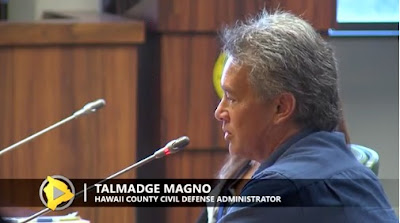
Talmadge Magno, Hawai`i Couny Civil Defense Director.
Photo from Big Island Video News
   
Kim has indicated that he is working closely with Magno in the Civil Defense Department, which is responsible for the County's "total emergency response program to ensure prompt and effective action when natural or manmade caused disaster threatens the County of Hawai`i," says the Civil Defense website. See https://countyofhawaii.bbcportal.com to sign up for Civil Defense messages. See www.hawaiicounty.gov/civil-defense for more on the department.
    See more at www.bigislandvideonews.com

To read comments, add your own, and like this story, see Facebook. Follow us on Instagram and Twitter

CONGRESSWOMAN TULSI GABBARD AND SEN. BRIAN SCHATZ will hold Town Hall meetings in Hilo on Tuesday. The Schatz event location has been changed to the gymnasium at University of Hawai`i from 1 p.m. to 2:30 p.m. The Gabbard event will be held at Waiakea High School at 7:30 p.m.

HAWAI`I PUBLIC RADIO is broadcast in Ka`u through the KAHU license which supported a community radio
station in Pahala for years, featuring such musical and talk-story mentors as Uncle Bobby Gomes (right) and
budding local musicians, playing live on the station in 2013. See HPR story below. Photo by Julia Neal
HAWAI`I PUBLIC RADIO, with two stations in Ka`u at 89.1 FM and 91.3 FM, will launch its on-air fund drive April 19. The goal for the 10-day fundraiser is $900,000. Nearly 800 donors responded to the pre-drive campaign with early gifts totaling $124,882.
   HPR President and General Manager José A. Fajardo pointed out that federal funding is in question under the new President Donald Trump administration. “Many in our community have expressed concern about the current administration’s proposed de-funding of the Corporation for Public Broadcasting. Whether or not that comes to pass, we are advising listeners that their financial contributions are critical to ensuring the station’s resilience and independence in the face of future challenges. Each listener’s generous support is needed now more than ever.” HPR is considered critical for Civil Defense communications in Ka`u.
      The original station was licensed for Ka`u as KAHU radio, in part with Civil Defense funding. After years as a community radio station with live broadcasts, HPR purchased the license from KAHU and the feed was changed to programing originating on O`ahu. Ka`u coverage has been improved through use of a tower at Kulani near Volcano and HPR engineer Don Mussel said that HPR plans to further improve the signal in Ka`u.
Hawai`i Public Radio's 
President and GM José Fajardo
     To make the HPR donation process as simple as possible, a new mobile app takes users straight to the donation form on the station's website hawaiipublicradio.org. The app, when accessed through a smartphone, can also connect the caller directly to pledge phone numbers: (808) 944-8800 or toll-free (888) 970-8800 for HPR-1; (808) 941-3689 or toll-free (877) 941-3689 for HPR-2.
    To further encourage tune-ins and participation, the station is offering, on the first day of the drive, a Discover Prince Waikiki sweepstakes from community partner Prince Resorts Hawai`i. Other special premiums are planned throughout the drive, and matching funds from numerous individuals and local businesses will be announced to further incentivize giving. On the classical music stream, HPR-2, a countdown of listeners’ top 100 musical “faves” will take place over the course of the drive.
     Fajardo added, “We are counting on our listeners, the majority of whom responded positively to our recent program realignment, to recognize the value of our quality journalism and musical sanctuary. And we’re inviting them to become a part of HPR’s success story.”
HPR engineer Don Mussel at the radio building
in Pahala, switching KAHU to HPR in 2013.
Photo by Julia Neal

     Hawaiʻi Public Radio now counts more than 13,000 members, and a growing cohort of members who participate in an ongoing, monthly giving plan. The station’s recent record of lowering pledge goals from one drive to the next, all while expenses steadily increase, is credited directly to the steady and predictable contributions of these Sustaining Members. 
     For programming, see www.hawaiipublicradio.org.
To read comments, add your own, and like this story, see Facebook. Follow us on Instagram and Twitter

Special Merrie Monarch Festival Event, Tue, April 18, 11 a.m. – 1 p.m., Kīlauea Visitor Center lānai in Hawai‘i Volcanoes National Park. Practitioners share lau hala, lomilomi, hū kukui and ulana niu. Falsetto singer Kai Ho‘opi‘i performs. Free; park entrance fees apply.

John Cross presents archival maps and more from
plantation era days on Tuesday at After Dark in the Park.
Photo from NPS
The Value of Plantation-Era Archives in Today’s World, Tue, April 18, 7 p.m., Kīlauea Visitor Center Auditorium in Hawai‘i Volcanoes National Park. John Cross leads a visual journey through Edmund C. Olson Trust Archive’s historic resources and the era that was “Big Sugar.” Free; park entrance fees apply. 

Special Merrie Monarch Festival Event, Wed, April 19, 11 a.m. – 1 p.m., Kīlauea Visitor Center lānai in Hawai‘i Volcanoes National Park. Practitioners share lei making, pala‘ie & kāpala mea ulu. The Young Brothers perform local melodies. Free; park entrance fees apply.

Kai Ho‘opi‘i in Concert, Wed, April 19, 6:30 – 8 p.m., Kīlauea Visitor Center Auditorium in Hawai‘i Volcanoes National Park. The Aloha Festival Hawaiian falsetto contest winner shares traditions and music of his ‘ohana. Free; park entrance fees apply. 

Special Merrie Monarch Festival Event, Thu, April 20, 11 a.m. – 1 p.m., Kīlauea Visitor Center lānai in Hawai‘i Volcanoes National Park. Practitioners share lei making, haku hulu, ‘ohe kāpala and kuku kapa. Multiple Nā Hōkū Hanohano award-winning composer, singer and musician Kenneth Makuakāne performs. Free; park entrance fees apply.

Sunday, April 16, 2017

Ka`u News Briefs Sunday, April 16, 2017


The late Uncle George Na`ope founded the Merrie Monarch Festival, the world's top hula event, with
the 2017 celebration beginning Easter Sunday in Hilo. Na`ope 's legacy also continues in Ka`u, where his
student, Kumu Hula Debbie Ryder, teaches every Wednesday at Pahala Community Center, with
free classes for keiki, beginning adults and advanced adults. See more below.
Photo from Big Island Video News
THE SOUTH POINT RESOURCES MANAGEMENT PLAN is being finalized by the Department of Hawaiian Home Lands. The draft was released last year and DHHL is working to include additional public and professional input as it determines the future of the popular visitor, ranching, fishing and camping area at Kalae, which is also home to many native plants and animals and cultural sites.
     The area has received an increase in visitors with the growing popularity of traveling to Green Sand Beach.
South Point, Kalae, the property belonging to the Department of
Hawaiian Home Lands is the subject of a Draft South Point Resources
Management Plan. Photo by Peter Anderson
     The lands held under the Hawaiian Homes Land Trust are in the ahupua`a of Kama`oa-Pu`u`eo. They extend from South Point toward Green Sand Beach and Mahana Bay. The draft points to an old plan completed for South Point in 1983 and says that "unfortunately, the ongoing issues of this area still have not been addressed three decades later. Many Ka`u community members are frustrated that there has been no progress for the management of South Point resources," the draft plan says. "However, the need to protect and preserve the natural and cultural sites of South Point" was identified as a priority project in the DHHL's Ka`u Regional Plan adopted by the Hawaiian Homes Commission.
     The new draft plan explains that South Point "is a special and unique place. Its significant cultural landscape tells of the very early native Hawaiian settlement of the area." It notes that some 710 acres are designated as a National Historic Landmark. Remaining cultural sites include Pu`u Ali`i, Kalalea Heiau, Lua o Palahemo, canoe mooring holes and Lua Makakei. "Lua o Palahemo is also a unique natural resource," with several types of anchialine pool shrimp, including `opae `ula and the endangered Vetericaris Chaceoru. Rare plants include `ohai, states the plan.

DHHL faces management challenges with South Point's
unpaved roads, which are used increasingly by visitors and
local recreation, four-wheel vehicles.
Photo by Isaac Davis
     DHHL met with community members and families with long histories at South Point before making the plan which states that South Point is envisioned as "a self-sustaining, healthy and safe community where the `aina - inclusive of the people and resources within it - and native Hawaiian culture and values thrive."
     It discusses the challenges of Green Sand Beach, Mahana Bay and the need for a service road and pedestrian path and trail and technical assistance to local people to become legal business entities on DHHL lands. The plan discusses degradation of the land and its resources caused by unmanaged vehicles traveling along the coast. See the plan on the Department of Hawaiian Home Lands website at https://dhhl.hawaii.gov.

To read comments, add your own, and like this story, see Facebook. Follow us on Instagram and Twitter.


MERRIE MONARCH HULUA FESTIVAL 2017 FESTIVITIES began in Hilo on Easter Sunday with the Ho`olaulea at the Hilo Ah Fook Chinen Civic Auditorium.  The opening day featured hula from halau in Hawai`i, Japan and the U.S. mainland. 
     Ka`u artists will be featured at the Merrie Monarch Invitational Hawaiian Arts Fair from 9 a.m. to 5 p.m. Wednesday, April 19 through Friday, April 21, and from 9 a.m. to 4 p.m. on Saturday, April 22 at the Ah Fook-Chinen Civic Auditorium. 
     On Saturday, April 22 will be the Merrie Monarch Royal Parade, which often features Ka`u participants from local ranches with paniolo on their horses, to Thy Word Ministry church with a float of inspiration and music and the Miss Ka`u Coffee pageant contenders and reigning coffee queen and princesses.
      On Wednesday is the free Ho`ike open to everyone with no tickets required, beginning at 6 p.m. at Edith Kanaka`ole Stadium. It is billed as an exhibition night of hula and folk dance from around the Pacific. 
      Televised from the stadium, for those without tickets purchases far in advance, will be Miss Aloha Hula competition on Thursday, April 20 at 6 p.m.; the Group Hula Kahiki (ancient dance) competition on Friday, April 21 at 6 p.m. and the Group Hula `Auana (modern dance) on Saturday, April 22 at 6 p.m.
     See more at www.merriemonarch.com.

To read comments, add your own, and like this story, see Facebook. Follow us on Instagram and Twitter.

Kumu Hula Debbie Ryder, of Halau Hula O Leionalani, leads
a visiting halau at sunrise at Punalu`u,  the namesake of the
song Punalu`u written by her teacher, the late George Na`ope.
Photo by Julia Neal
HULA CLASSES ARE GROWING under the direction of Kumu Hula Debbie Ryder, who teaches each Wednesday at Pahala Community Center. Ryder, who trained under the late George Na`ope, who founded the Merrie Monarch Festival, offers classes for all ages. 
     The class for keiki begins at 5:30 p.m., beginning adults at 6:30 p.m. and advanced adults at 7:30 p.m. All classes are free and under the auspices of Halau Hula O Leionalani.

To read comments, add your own, and like this story, see Facebook. Follow us on Instagram and Twitter.

U.S. SEN. BRIAN SCHATZ invites Ka`u residents to his Town Hall meeting this Tuesday, April 18 in Hilo from 1 p.m. to 2:30 p.m. The event location has been changed to the gymnasium at University of Hawai`i, following a large crowd signing up to attend. Schatz has been issuing numerous statements, testifying in the U.S. Senate and speaking on television about his views on the missile strike in Syria, President Donald Trump's cabinet and Supreme Court selections, and many other issues from health care to the environment, to education.
     Schatz , a member of the Senate Appropriations Committee, announced last week that Hawai‘i will receive more than $1 million to address significant public health concerns and promote healthy behaviors. The U.S. Department of Health and Human Services awarded $1,092,341 to the Hawai‘i state Department of Health's Healthy Hawai‘i Initiative, which works to prevent chronic disease and promote healthy living in the state.


  “Living a healthy lifestyle is the best way to prevent chronic illnesses,” said Senator Schatz. “The Healthy Hawai‘i Initiative helps people understand why this matters and how they can make healthy choices for themselves and their families. That is why I will continue to work in the Senate to make sure our state has the resources we need to promote health and wellness.”
   The Healthy Hawai‘i Initiative is the Hawai‘i state Department of Health’s signature effort to promote healthy living through schools, communities, and workplaces. Since 2000, the initiative has used public campaigns and partnerships with the private and public sectors to successfully address health issues including nutrition, exercise, diabetes, and tobacco use.

To read comments, add your own, and like this story, see Facebook. Follow us on Instagram and Twitter.

Special Merrie Monarch Festival Event, Tue, April 18, 11 a.m. – 1 p.m., Kīlauea Visitor Center lānai in Hawai‘i Volcanoes National Park. Practitioners share lau hala, lomilomi, hū kukui and ulana niu. Falsetto singer Kai Ho‘opi‘i performs. Free; park entrance fees apply.

The Value of Plantation-Era Archives in Today’s World, Tue, April 18, 7 p.m., Kīlauea Visitor Center Auditorium in Hawai‘i Volcanoes National Park. John Cross leads a visual journey through Edmund C. Olson Trust Archive’s historic resources and the era that was “Big Sugar.” Free; park entrance fees apply.

Special Merrie Monarch Festival Event, Wed, April 19, 11 a.m. – 1 p.m., Kīlauea Visitor Center lānai in Hawai‘i Volcanoes National Park. Practitioners share lei making, pala‘ie & kāpala mea ulu. The Young Brothers perform local melodies. Free; park entrance fees apply.

Kai Ho‘opi‘i in Concert, Wed, April 19, 6:30 – 8 p.m., Kīlauea Visitor Center Auditorium in Hawai‘i Volcanoes National Park. The Aloha Festival Hawaiian falsetto contest winner shares traditions and music of his ‘ohana. Free; park entrance fees apply.

Special Merrie Monarch Festival Event, Thu, April 20, 11 a.m. – 1 p.m., Kīlauea Visitor Center lānai in Hawai‘i Volcanoes National Park. Practitioners share lei making, haku hulu, ‘ohe kāpala and kuku kapa. Multiple Nā Hōkū Hanohano award-winning composer, singer and musician Kenneth Makuakāne performs. Free; park entrance fees apply.

Medicare 101, Thursday, April 20, 4:30 p.m., Nā‘ālehu Public Library. AARP representative Ed Hickey provides basic information. 939-2442


Ka`u News Briefs Saturday, April 15, 2017

A wide range of clothing and preparedness is seen amongst the estimated 1,500 people a day visiting Kilauea's
active flow field and ocean entry. Photo from HVO
SATURDAY WAS TAX DAY and marches were held in Hawai`i and throughout the country to "demand transparency from President Trump," asking for release of his tax returns to the public, stated Tulsi Gabbard, who represents Ka`u District in Congress. 
     “Every president has a duty to put the interests of the American people first and foremost, and the American people deserve to know whether allegiance to special interests or undue foreign influence might be interfering with that duty,” Gabbard said. "We need leadership in this country that is committed to setting aside personal interests and serving the interests of the American people. I thank everyone who took the time to march today to demand the transparency required to ensure our government remains of, by, and for the people.”
Congresswoman Tulsi Gabbard holds a Town Hall meeting in
Hilo on Tuesday. 
      Last week, Gabbard signed a Discharge Petition that would force House Republicans to bring HR305 to the floor for a vote. This bill would require the president to disclose federal income tax returns for the three most recent taxable years and establishes civil and criminal penalties for failing to file or falsifying these income tax returns.
     Gabbard is also a cosponsor of Rep. Jerrold Nadler's resolution that would require Attorney General Jeff Sessions to turn over any records relating to investment by any foreign government in any entity owned in whole or in part by President Trump. Additionally, the resolution would require the Attorney General to produce documents related to Trump's failure to create a blind trust for his business dealings and his proposal to instead maintain an interest in his business holdings while turning over the day-to-day operation of those interests to his sons.
     Gabbard holds a Town Hall meeting in Hilo on Tuesday at 7:30 p.m. at Waiakea High School.

To read comments, add your own, and like this story, see Facebook. Follow us on Instagram and Twitter.

Rugged trails along the lava coast require supportive shoes or boots, but not those with metal that can
heat up and burn when walking over hot spots. HVO photo
WHAT'S HOT AND NOT? ask the scientists at Hawaiian Volcano Observatory, who write in this week's Volcano Watch about safety and "essential lava field fashion," something they know about when working all over a volcano, It includes wearing clothes and footwear that won't melt:
     An estimated 1,500 visitors a day hike across the lava flow fields to view the ocean entry and search for active lava breakouts. Round-trip walking distance is far; a one-way trip to the ocean entry from Kalapana is around 4 miles. Add the chase for active lava, milling about, and the hike will quickly add up to over 10 miles when you return.
     With most visitors to Hawai`i not packing much real hiking gear, it's not uncommon to see visitors to the ocean entry that are not dressed for the adventure.
      Here are some tips from for essential lava field fashion from the USGS Hawaiian Volcano
Observatory geologists who walk miles on Kīlauea lava flows—both new and old.
     Fields of newly erupted lava are not flat—they’re hummocks, cracks and crags that have been uplifted and overturned by the pressure of molten lava moving within the flows. To prevent sprains, shoes with support are a must. Boots with high ankle tops are ideal. But, low or mid-top shoes will work with thicker socks.  No-show socks, or no socks at all, are not recommended as they provide fragments of glass a direct path to a walker's skin.
Hiking the volcano requires clothing and shoes that don't melt and staying away from flowing lava.
NPS photo
     The glass fragments are produced from the thin surface of solidified pahoehoe. It crunches under foot and peels away to form razor sharp flakes. These flakes lie in wait, ready to scrape an ungloved hand if extended to the ground during a stumble or fall. When walking far distances on the pahoehoe, it’s a good idea to wear light gloves to help catch a fall. Cotton garden gloves work fine.  While hiking with these seems silly, one fall without them will make a believer. Light gloves are standard gear among the scientists and student groups that regularly visit the flow field.
     Light cotton clothing is recommended as a base layer, or next to the skin. Long-sleeved shirt and long pants made of natural fiber will not only prevent sunburn, they also offer a measure of protection against scrapes and abrasions. Synthetic clothing, while fast-drying and light, must not be exposed too closely to an active lava flow or it will quickly melt. While this is usually not dangerous, it will ruin the material.  Particularly today's expensive rain gear (which should be in the hiker's pack too).
Gloves protect hikers hands when falling on
sharp lava or when examining glass matter
from the volcano. HVO photo
     Most light shoes, not matter how fashionable, will melt if you stand on hot lava. This is obvious.  However, what's not so obvious is what a hot, or freshly-formed, lava flow looks like.  Contrary to popular belief, a flow formed minutes ago does not glow an orange-red. Its surface is a dull silver color, and the air above it shimmers with heat.
    Melting shoes are often not immediately noticed by the wearer. The attention getter is when the soles separate. Stitched soles, common on heavy hiking boots, are ideal as they do not delaminate under heat. But, the more affordable glued soles are fine as long as the hider watches the ground temperature closely.  Don't wear shoes with steel toes or metal shanks. The metal can heat up to foot-cooking temperatures.
    Best practice is to keep safe distances from active lava to protect skin and those outdoor-gear investments.
    All the usual accessories are still in fashion: hat, sunglasses, backpack, etc.  Multiple water bottles are recommended. Another overlooked item, the flashlight, is so in vogue that anyone sporting one will be the life of the party as soon as the sun goes down. Since the best viewing is during dawn or dusk (when you can see the glow), an LED flashlight or headlamp is priceless. So, don't go without one, day or night.
    Of course, all this fashion does come with a formality:  Remember to stay in designated safe areas despite what you see or read in social media.
    Additional Information on hiking to the ocean entry and lava viewing can be found at:
https://pubs.usgs.gov/fs/2000/fs152-00/

To read comments, add your own, and like this story, see Facebook. Follow us on Instagram and Twitter.

Volcano Activity Updates; Kīlauea continues to erupt at its summit and East Rift Zone. This past week, the summit lava lake level varied between about 22 and 29 m (71-95 ft) below the vent rim. The 61g flow was still active, with lava entering the ocean and building a small delta near Kamokuna and small surface breakouts downslope of Puʻu ʻŌʻō on the pali and the coastal plain. The 61g flows do not pose an immediate threat to nearby communities.

A flurry of 150 earthquakes relating inflation of a magma
reservoir near the summit of Mauna Loa.
        Mauna Loa is not erupting. During the past week, a flurry of more than 150 earthquakes were located beneath the upper west flank of the volcano with a peak of just under 60 quakes on April 08. GPS measurements continue to show deformation related to inflation of a magma reservoir beneath the summit and upper Southwest Rift Zone. No significant change in the gas output was noted this past week; the fumarole temperature continued to decrease.
     Two earthquakes were reported felt on the Island of Hawai'i in the past week. On Monday, April 10 at 1:31 a.m. HST a magnitude 3.1 earthquake occurred 14.6 km (9.1 mi) northwest of Na`alehu at a depth of 0.9 km (0.6 mi). On Wednesday, April 12 at 8:29 a.m. HST a magnitude 3.5 earthquake occurred 3.7 km (2.3 mi) southwest of Kīlauea Summit at a depth of 2.6 km (1.6 mi).
     Visit the HVO website (http://hvo.wr.usgs.gov) for past Volcano Watch articles, Kīlauea daily eruption updates and other volcano status reports, current volcano photos, recent earthquakes, and more; call (808) 967-8862 for a Kīlauea summary update; email questions to askHVO@usgs.gov.

SUNRISE SERVICE will be held Easter Sunday morning at Punalu`u Black Sand Beach. All denominations are invited. Time is 6 a.m. with music and prayer and morning refreshments.

www.kaucalendar.com