About The Kaʻū Calendar

Saturday, July 07, 2018

Kaʻū News Briefs Saturday, July 7, 2018

Interpretive signage for the famed Kaʻū Footprints Trail shows the area well traveled in the 1700's by Hawaiian families
 trading and visiting. While walking through Kaʻū, wet ash rained down and their footprints became frozen in time.
 Painting by John Dawson
THE SLIGHT CHANCE OF A PYROCLASTIC SURGE from Kīlauea Caldera into Volcano Village and Golf Course drew the most comments and questions from area residents at the community meeting held at Cooper Center on Thursday. Residents asked USGS scientists about the chances, the percentages, and the likelihood, "if you were betting scientists," that the volcano could send out a blast up to 700 miles an hour, with hot air, lava, and rocks, destroying buildings and taking lives, with little warning.
     Mayor Harry Kim said he had an answer. He said he personally pressed Hawaiian Volcano Observatory chief scientist Tina Neal for some kind of percentage, so the county could make a plan. Kim reported an estimate of one percent. He explained that even though the percentage is small, he felt the need to call the meeting with residents, Hawaiʻi County Civil Defense, and the scientists, to explain the most likely and least likely volcano scenarios in the near future.

     HVO released a document this week describing the most, and least, likely of near term events at Kīlauea Caldera. Read Friday's Kaʻū News Briefs for more detail and see the presentation at Nā Leo TV on demand. Read the entire document.
     Civil Defense Director Talmadge Magno said the county is installing a siren to warn area residents, should there be signs of such a pyroclastic surge on its way. He said the siren would be heard for about 1.5 miles and that those living and working farther away could sign up for the blackboard alert system to receive messages by cell phone and internet. He repeated that the chances are small for a catastrophic event in the near future but, emphasized that it is his job to prepare for the worst case scenario.
     Magno said that residents should plan for every eventuality, decide where they would go for refuge, understand their finances and prepare to bring important documents, should they have to leave.
     One resident asked what people living in the area should be aware of as indicators of the possible arrival of a volcanic surge. More and stronger earthquakes than the many recently shaking the area, and other changes in the volcano that are being monitored by the scientists, such as magma and water mixing to send off explosive eruptions, were some of the answers given.
     Some residents asked which way they should drive if they have to escape. Answers included that there are more services for people in Hilo than Kaʻū, and that decisions could depend on the direction the surge and the wind. It was noted that the caldera walls are lower on the Kaʻū side than the Hilo side, so the surge could move farther in the Kaʻū direction.
     Talking about escape routes led to a question about Piʻimauna Road, which connects Hwy 11 to Volcano Golf course and housing area, Volcano Winery, and the Keauhou Bird Conservation Center.
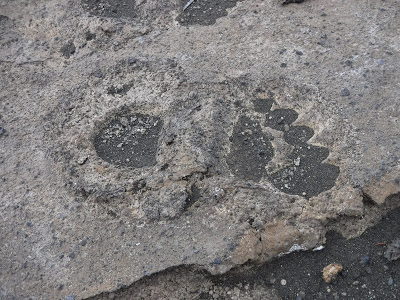
A footprint made in wet volcanic ash in 1790, likely by a male adult. It is one
 of 1,773 separate footprints belonging to at least 400 individuals that 
have been documented by NPS archeologists, led by 
Dr. Jadlyn Moniz-Nakamura. Photo by Ann Bosted
     Near the intersection, a deep, five-foot wide sinkhole opened up on Thursday and reduced traffic to one lane on Hwy 11. One Volcano resident said ideas for alternate emergency routes, should Piʻimauna and Hwy 11 be blocked, emerged years ago, as cracks in Hwy 11 occur regularly. The Civil Defense Administrator said that an alternate route is still in long term planning.
     Since Thursday, the sinkhole has been covered with steel plates and the highway is now back to two lanes. See below for more.
     Whether history is an indicator of what will happen next at Kīlauea is unclear, the scientists said. Collapse events in the floor of Kīlauea Caldera and Halemaʻumaʻu witnessed recently also happened in the 1500s and 1600s, until 1790s, when the volcano emitted a pyroclastic surge and huge ash fall. The famous Footprints Trail in the Kaʻū Desert is evidence of the 1790s explosive eruptions. Those were much larger volcanic events than have happened since May, when Kīlaeua Crater began to change. See the March 1, 2017, Kaʻū News Briefs.
     During Thursday's meeting, the HVO chief scientist said, "What we’re witnessing now is partial collapse of the summit in a step-wise process due to magma withdrawal into the East Rift Zone, feeding the eruption – and it is uncertain how long this will continue. It is uncertain how large this collapse will be. And it is uncertain how violent activity could become, associated with this collapse.
Major cracks (yellow lines) within the caldera of Kīlauea. Red-shaded area east 
of Halemaʻumaʻu are moving down within a scarp-bounded zone. Dark 
pink/gray area shows the region of most significant subsidence. USGS image
     “It is not known how long this activity can continue, without any kind of change,” said Neal. She said the analog of this eruption to any other eruption “is not perfect,” and that this eruption “has its own characteristics."
     Neal said scientists feel “the most likely course” for the next two months at the summit is for continuing moderate-sized earthquakes – “that you’re all very familiar with, that can be damaging” – continuing subsidence, and small or no ash production. She said the duration of this activity is “related to the duration of the lower East Rift Zone eruption, but there is some uncertainty in that as well.”
     Very hazardous explosions, “considered unlikely in the near-term,” related to the ongoing subsidence in the caldera, may not be preceded by a lot of warning, said Neal, but if activity accelerates, they remain possible.
     If subsidence continues, it is possible the summit conditions will evolve to become more hazardous, said Neal. A “very unlikely outcome,” she said, “is that large-scale explosive activity,” associated with large-scale caldera collapse, could occur. The activity, said Neal, “should be preceded by signals that we will recognize with our monitoring equipment.” The signals would include low-level explosive activity beginning, and increased, more severe, and constant earthquakes. However, the timeframes of the warning signs are “uncertain,” and could be short, she said.
State Department of Transportation workers fill the
sinkhole in Hwy 11 with rocks near Volcano.
Photo from HDOT Facebook
     Neal said the activity from this unlikely but hazardous scenario could reach inhabited areas, and include: high lava fountains, like from Kilauea Iki; larger ash and tephra fallout; and pyroclastic surges, potentially life-threatening “rapidly moving ash hurricanes that move away from the summit area.”
     For more information about the current activity and hazard at and around the summit of Kīlauea, see the report: Volcanic Hazard at the Summit of Kīlauea, June 29, 2018 Update, at volcanoes.usgs.gov/vsc/file_mngr/file-184/Summit%20scenarios_7-5-18.pdf.

To read comments, add your own, and like this story, see Facebook. Follow us on Instagram and Twitter. See our online calendars and our latest print edition at kaucalendar.com.

THE SINK HOLE IS FILLED NEAR VOLCANO AND ALL LANES ARE NOW OPEN ON HIGHWAY 11, says Hawaiʻi Department of Transportation’s Facebook. A “deep,” five-foot diameter sinkhole was reported to have opened up mid-week near mile marker 30. One lane of the highway was closed. Workers dug around the opening, making the hole 15’ X 20’ according to DOT, and filled the hole with rocks, dirt, and concrete. The site is now covered with steel plates, with asphalt around the edges, to let the concrete cure over the weekend, says DOT. DOT urges motorists to drive with caution over the plates.

To read comments, add your own, and like this story, see Facebook. Follow us on Instagram and Twitter. See our online calendars and our latest print edition at kaucalendar.com.

DOT finalizes temporary coverage of the sinkhole that opened in
Hwy 11 near mile marker 30. Steel plates will cover the concrete
to cure over the weekend. Photo from HDOT Facebook
HAWAIʻI COUNTY CIVIL DEFENSE IS THE BEST IN THE NATION, said Mayor Harry Kim during the Volcano Village community meeting on Thursday. He praised the way Hawaiʻi Island people have worked together in this eruption situation. He said how important it was that Hawaiian Volcanoes Observatory has, from the beginning, briefed not only officials but the public on what was going on, and what could potentially happen, during this eruption. He said that open communication enabled all to work “as a team,” responding to situations “whether as preparation or actual response.” Kim said the community in Volcano “should feel very free to ask any questions in regards to what we do that affects you, and if you have any kinds of suggestions that makes it better, please, speak up.”

To read comments, add your own, and like this story, see Facebook. Follow us on Instagram and Twitter. See our online calendars and our latest print edition at kaucalendar.com.

The houses in the area in green stripes would be served by the new sewage treatment plant
in the are with trees along Maile Street. Map from County of Hawaiʻi.
AN EXTENSION FOR THE PROPOSED PĀHALA WASTE
WATER TREATMENT SITE has been given to County of Hawaiʻi by the Environmental Protection Agency. The proposed site runs along the Hilo side of the Norfolk pine tree lane along Maile Street, coming into Pahala from Hwy 11. It is southeast of the current Large Capacity Cesspool near the old radio station building on Maile Street and will undergo Environmental Assessments and/or Environmental Impact Statements before the county acquires any land for the project.
     The county is required to build a new treatment system to replace old gang cesspools in Pāhala, which are illegal. The county took over the cesspools for old sugar plantation housing after the sugar mill shut down in Pahala. The county would face fines if it doesn't shut down the cesspools.
     Unlike the proposed locations for the Nāʻālehu plant, there would be little change in routing of the present drainage system in order to place the plant at the proposed location, and the closure of the old LCC would remove effluent from near the school.
     In a letter to the EPA, county Environmental Management Director William Kucharski asked for more time to purchase an appropriate site, extending the deadline from June 27 of this year to June 20, 2020. He stated all other deadlines could be met, including closure dates for the current Large Capacity Cesspools, if granted the extension.

To read comments, add your own, and like this story, see Facebook. Follow us on Instagram and Twitter. See our online calendars and our latest print edition at kaucalendar.com.

KAʻŪ HIGH SCHOOL IS ACCEPTING APPLICATIONS for Varsity Baseball Head Coach, Pep Squad Head, Coach, Girls Soccer Head Coach, and Boys/Girls Judo Coach for the 2018-19 school year. Anyone interested can pick up an application form at the school's main office. Deadline is July 14.

To read comments, add your own, and like this story, see Facebook. Follow us on Instagram and Twitter. See our online calendars and our latest print edition at kaucalendar.com.

NEW and UPCOMING
Image from volcanoartcenter.org
ZENTANGLE: INK-BLOWN ‘ŌHI‘A WITH DINA WOOD KAGELER, celebrating Volcano’s premier rainforest tree, Ke Kumu ‘Ōhi’a, takes place on Saturday, July 14, from 10 a.m. to 1 p.m., at Volcano Art Center’s Ni‘aulani Campus in Volcano Village.
     The class uses “inspiration from Volcano’s own rainforests… to create twig-like strings with the ink-blown method, then tangle leaves and blossoms using watercolors and pens,” says the event description on volcanoartcenter.org. Loaner pens, pencils and watercolors will be available; however, returning tanglers are encouraged to bring their favorite Zentangle supplies.
     No artistic experience is needed. Zentangle Basics and watercolor experience are “helpful but not required,” says the description. The cost of the class is $30 for Volcano Art Center Members or $35 for non-Members, plus a $10 supply fee. Participants are asked to bring a light refreshment to share. Visit volcanoartcenter.org or call 967-8222.

See public Ka‘ū events, meetings, entertainment. 
Print edition of The Ka‘ū Calendar is free to 5,500 mailboxes 
throughout Ka‘ū, from Miloli‘i through Volcano, and free on 
stands throughout the district. Read online at kaucalendar.com 
and facebook.com/kaucalendar.
To read comments, add your own, and like this story, see Facebook. Follow us on Instagram and Twitter. See our online calendars and our latest print edition at kaucalendar.com.

SUNDAY, JULY 8
‘Ōhi‘a Lehua, Sun, July 8, 9:30-11am, Kahuku Unit of Hawai‘i Volcanoes National Park. Learn about vital role of ‘ōhi‘a lehua in native Hawaiian forests, and many forms of ‘ōhi‘a tree and its flower, on this free, easy, one-mile walk. nps.gov/HAVO

MONDAY, JULY 9
Richard Creagan Talk Story, Mon, July 9, 6-9pm, Ocean View Community Center. Current State Representative for District 5 and candidate. He is a Ka‘ū resident, farmer, and a physician. 939-7033

TUESDAY, JULY 10
Hawai‘i County Council Meetings, Tue/Wed, July 10(Committees)/11 (Council), Hilo, Tue/Wed, July 24 (Committees)/25 (Council), Kona. Ka‘ū residents can participate via videoconferencing at Nā‘ālehu State Office Building. Agendas at hawaiicounty.gov

C.E.R.T. Discovery Harbour/Nā‘ālehu, Tue, July 10, 4-6pm, Discovery Harbour Community Hall. Public invited to see what Community Emergency Response Team is about, and participate in training scenarios. Dina Shisler, dinashisler24@yahoo.com, 410-935-8087

The Wonderful World of Wine and Watercolor, Tue, July 10, 4-7pm, Volcano Art Center’s Ni‘aulani Campus, Volcano Village. Learn how to transfer a photo onto watercolor paper through basic techniques. $30/VAC Member, $35/non-Member, plus $17 supply fee. 967-8222, volcanoartcenter.org

THURSDAY, JULY 12
Story Time with Auntie Linda from Tūtū and Me, Thu, July 12, 10:30-noon, Nā‘ālehu Public Library. 929-8571

Thursday Night at the Center - Witnesses in Words: The Literature of Kīlauea, Thu, July 12, 7-8pm, Volcano Art Center’s Ni‘aulani Campus, Volcano Village. A reenactment of first Western visitors to Kīlauea and their perspectives: William Ellis, Titus Coan, Mark Twain and Isabella Bird. Free; $5 donation suggested. 967-8222, volcanoartcenter.org

FRIDAY, JULY 13
Oliver!, a KDEN Production, July 13-29; Fridays and Saturdays, 7:30pm, Sundays 2:30pm. Shows moved to UH Hilo Performing Arts Center. Tickets: $20 general, $15 seniors 60+ and students, $12 keiki 12 and under. Tickets available from July 2 at Kīlauea General Store, Kea‘au Natural Foods, Basically Books, and The Most Irresistible Shop in Hilo. Info and reservations: 982-7344, kden73@aol.com

Exhibit, Birds of Hawai‘i Volcanoes National Park: The Hawai‘i Nei Invitational Daily, July 13-Aug 4, 9-5pm, Volcano Art Center’s Ni‘aulani Campus, Volcano Village. Free. Opening reception: Fri, July 13, 5-7pm. Artists: John Dawson, Reyn Ojiri, Sarah Koh, Wendy Barske, Maria Macias, Cody Yamaguchi, Ann Guth, and John Mydoock. Art represents endemic bird species. volcanoartcenter.org

2nd Annual Bi-Annual Quilt Show, Quilts In The Forest - Where the Path May Lead, Opening reception: Fri, July 13, 5-7pm. Then daily, Tue-Sat, 10-4pm, through Aug 3, Volcano Art Center’s Ni‘aulani Campus, Volcano Village. Free. Workshops and demonstrations planned in conjunction with show. Fia Mattice, 967-8222, quiltshow2018@volcanoartcenter.org. volcanoartcenter.org

SATURDAY, JULY 14
Pancake Breakfast and Raffle, Sat, July 14, 8-11am, Ocean View Community Center. To volunteer, call 939-7033, ovcahi.org

Kāwā Volunteer Day, Sat, July 14, 9:30am, Kāwā. Sign up with James Akau, Nā Mamo o Kāwā, at namamookawa@gmail.com, jakau@nmok.org, or 561-9111. nmok.org

Realms and Divisions of Kahuku, Sat, July 14, 9:30-11:30am, Kahuku Unit of Hawai‘i Volcanoes National Park. Moderately difficult, two-mile, guided hike on Kahuku Unit's newest trail, Pu‘u Kahuku, explores the traditional Hawaiian classification system. Bring snack. Free. nps.gov/HAVO

Zentangle: Ink-Blown ‘Ōhi‘a w/Dina Wood Kageler, Sat, July 14, 10-1pm, Volcano Art Center’s Ni‘aulani Campus, Volcano Village. Celebrating Volcano’s premier rainforest tree, Ke Kumu ‘Ōhi‘a. Loaner pens, pencils and watercolors available. Bring Zentangle supplies, if able. No artistic experience necessary. $30/VAC Member, $35/non-member, plus $10 supply fee. Bring light refreshment to share. Register online, volcanoartcenter.org, or call 967-8222

To read comments, add your own, and like this story, see Facebook. Follow us on Instagram and Twitter. See our online calendars and our latest print edition at kaucalendar.com.

ONGOING
5th annual Ka‘ū Coffee Trail Run registration open. Race day Sat, Sept 22, 7 a.m.; begins and ends at Ka‘ū Coffee Mill. Register online before Mon, July 9: 5K, $25/person; 10K, $35/person; and 1/2 Marathon, $45/person. From July 9 to Aug 11: $30/person, $40/person, and $45/person, respectively. From Aug 13 to Sept 20: $35/person, $45/person, and $55/person. Race day registration ends Sat, Sept 22, at 6:30 a.m. Event organizers, ‘O Ka‘ū Kākou; start location, Ka‘ū Coffee Mill.

Libraries Rock Summer Reading Program: Hawai‘i State Public Library System, through Saturday, July 14, statewide and online. Register and log reading at librarieshawaii.beanstack.org or at a local library. Free. Reading rewards, activities, and programs for children, teens, and adults. 2018 participants have a chance to win a Roundtrip for four to anywhere Alaska Airlines flies.

Paid Intern sought by The Nature Conservancy, to work from October 2018 through August 2019 with their Hawai‘i Island Terrestrial Program, which has native forest preserves located in Ka‘ū and South Kona.
     Benefits offered include: a $1,600 monthly living allowance (before taxes); a $5,920 education award towards higher education; health care and childcare benefits (if eligible); and receive an entry-level conservation career experience.
     Applicants must be at least 17 years old by the program start date, October 2018, and possess or be working towards a high school diploma or equivalent. Applications must also have their own housing and transportation, a drivers license, and be able to pass a criminal history check.
     The internship is offered through Kupu Hawai‘i. Those interested are asked to fill out an online application at kupuhawaii.org under Conservation Leaders Program as soon as possible, as spaces are limited; http://www.kupuhawaii.org/conservation/. For more, call The Nature Conservancy at 443-5401 or call Kupu Hawai‘i at 808-735-1221.

Disaster Recovery Center, jointly operated by Hawaiʻi County, the State of Hawaiʻi, and FEMA, is open daily from 8 a.m. to 8 p.m. at Keaʻau High School Gym. Buses run from 7:30 a.m. and 9 p.m. to and from Keaʻau Armory every 20 minutes and Pāhoa Community Center Shelter every hour. See the full bus schedule on the Civil Defense Website at HawaiiCounty.gov/Active-Alerts. For a list of the information applicants need to bring to the DRC, or to register online, go to DisasterAssistance.gov. 

Find Your Park, invites Hawaiʻi Volcanoes National Park. Kamaʻaina and tourist alike are encouraged to experience authentic Hawaiian cultural programs, guided hikes, After Dark events, and more from Ka‘ū to Volcano to Hilo. “While Kīlauea continues to shake the ground and blast ash from its ever-changing summit crater – causing the partial closure of Hawai‘i Volcanoes National Park on May 11 – park rangers continue to enlighten and engage visitors from other locations,” says a release from HVNP staff.
     Rangers offer new and familiar programs – free of charge, with no entry fees – for visitors at the park’s Kahuku Unit, Volcano Art Center’s Ni‘aulani Campus, the Mokupāpapa Discovery Center in Hilo, and at the Grand Naniloa Hotel in downtown Hilo.
Kahuku Unit
In addition to regularly scheduled Guided Hikes and the monthly Coffee Talk, Kahuku Unit has added daily Ranger Talks, and cultural demonstrations and activities on weekends.
Visitor Contact Station hosts Ike Hana Noe ʻAu, Cultural Demonstrations and Activities, from 12:30 to 1:30 p.m. every Saturday and Sunday, made possible by Hawaiʻi Pacific Parks Association. Sun, July 8: ‘Ohe Kāpala. Make your mark, and learn to create bamboo stamps with traditional and modern Hawaiian designs.
Visitor Contact Station hosts Ranger Talks on Wednesday, Thursday, and Friday at 10:30 a.m. and 1 p.m.; Saturday and Sunday at 10:30 a.m.
Guided Hikes begin at 9:30 a.m. every Saturday and Sunday in June and July. Meet the ranger at the welcome tent. Ōhi‘a Lehua, Sunday, July 8 from 9:30 a.m. to 11 a.m.
Coffee Talk, in the Visitor Contact Station is held the last Friday of the month, 9:30-11 a.m.
Kahuku events are posted to the park website, nps.gov/havo/planyourvisit/kahuku-hikes.htm.
Volcano Art Center’s Ni‘aulani Campus
You can also find your park rangers in Volcano at the Volcano Art Center’s Ni‘aulani Campus at 19-4074 Old Volcano Rd., in Volcano Village. Rangers are there most days from 9 a.m. to 4 p.m. to provide talks and answer questions about the current eruption.
The return of After Dark …near the park at the Volcano Art Center’s Ni‘aulani Campus. TBA
Mokupāpapa Discovery Center
Find you park rangers at Mokupāpapa Discovery Center in downtown Hilo, Monday through Saturday, from 9 a.m. to 4 p.m. Rangers provide daily eruption updates, and at 10 a.m. and 2 p.m., give a talk about all five of Hawai‘i Island’s volcanoes – including Kīlauea. Get your NPS Passport Book stamped. Located at 76 Kamehameha Ave., Hilo. Please note, the Mokupāpapa Discovery Center will be closed on Wednesday, July 4, in observance of Independence Day.
Grand Naniloa Hotel
Two Park Rangers are stationed at the Grand Naniloa Hotel in downtown Hilo, from 8 a.m. to 4:30 p.m., every Sunday and Monday, in the Willie K Crown Room - as long as nothing else is scheduled in the space. The rangers will be doing daily talks at 10 a.m. and 2 p.m. about the eruption. They will show the park film that is normally available to visitors to see at the Kilauea Visitor’s Center at the Summit, Born of Fire, Born in the Sea, every half-hour beginning at 9:30 a.m.

Kona Vet Center visits to Ocean View Community Center are Suspended until further notice. Veterans may call 329-0574 for VA benefit information. ovcahi.org

Tūtū and Me Offers Home Visits to those with keiki zero to five years old: home visits to aid with helpful parenting tips and strategies, educational resources, and a compassionate listening ear. Home visits are free, last 1.5 hours, two to four times a month, for a total of 12 visits, and snacks are provided. For info and to register, call Linda Bong 464-9634.

St. Jude's Episcopal Church Calls For More Volunteers for the Saturday community outreach. Especially needed are cooks for the soup served to those in need, and organizers for the hot showers. "Volunteering for St. Jude's Saturday Shower and Soup ministry is an opportunity to serve God in a powerful way," states St. Jude's April newsletter. Volunteer by contacting Dave Breskin at 319-8333.

Volcano Forest Runs Registration Open through Friday, August 17, at 6 p.m. Half marathon $85, 10K $45, 5K $30. Registration increases August 1: half marathon to $95, 10K to $55, and 5K to $35. Race is run from Cooper Center on Wright Road in Volcano Village on Saturday, August 18.

To read comments, add your own, and like this story, see Facebook. Follow us on Instagram and Twitter. See our online calendars and our latest print edition at kaucalendar.com.


Friday, July 06, 2018

Kaʻū News Briefs Friday, July 6, 2018

An unlikely but possible outcome of activity at the summit of Kīlauea would be a pyroclastic surge. Such surges are fast-moving, hot clouds of volcanic gases, and fragments of magma and older rocks. They form when eruption columns become unstable and collapse back around the vent. Surges typically travel around 22 miles per hour but can move as rapidly as 200 – 700 mph. Surges occurred at Kīlauea during and before 1790 and extended three miles out from the crater as shown by the dashed white circle. It indicates the approximate boundary of a possible, but unlikely surge.
Figure 5 map from USGS with background imagery from Google Earth
POSSIBLE SCENARIOS FOR THE FUTURE OF KĪLAUEA CALDERA AND SURROUNDING COMMUNITIES were presented to residents of Volcano Village Thursday night at Cooper Center by USGS geologists. The entire presentation can be viewed on Na Leo TV on demand.
     Mayor Harry Kim, County Civil Defense chief Talmadge Magno and state Rep. Richard Onishi also attended. Hawaiian Volcanoes Observatory Chief Scientist Tina Neal presented the evaluation along with scientists Jim Swanson and Lyle Anderson.
See more on the Civil Defense presentation and recommendations in Saturday's Ka‘ū News Briefs.
      She said that HVO predicts continued caving-in of walls and subsidence of Kīlaeua Caldera and widening of Halemaʻumaʻu Crater, where the lava lake is gone and lava storage chambers have lost much of their content which moved into lower Puna, where lava flows into the ocean.
     A document from the scientists says that they expect the events at Halemaʻumaʻu "to continue for as long as magma is withdrawn from the summit reservoir(s) at a rate exceeding the rate of magma supply, but the rate, style, and geographical extent of the subsidence – along with associated hazards – may vary. The USGS staff presented likely scenarios under the condition of continued net magma withdrawal.
Halemaʻumaʻu, just after the July 5 collapse event. USGS photo
     MOST LIKELY SCENARIO: USGS predicted that the most likely outcome for the next two months is "continued subsidence of Kīlauea Caldera, episodic slumping into a widening Halemaʻumaʻu crater, felt earthquakes (some large enough to be damaging), and small to intermediate ash plumes that remain below 10,000 feet above sea level. As the reservoir deflates, cracking and slumping is gradually engulfing a broader extent of Kīlauea Caldera (as observed in high rates of ground deformation and propagating cracks around Halemaʻumaʻu ); this process will likely continue to enlarge Halemaʻumaʻu and may involve larger slump blocks than previously. This activity is impressive in scale — and may ultimately involve much or even all of the current Kīlauea Caldera — but it need not necessarily involve new or more hazardous explosive activity.
     "Hazardous explosive activity cannot be ruled out, however. It is possible that a large section of the Halemaʻumaʻu wall could abruptly collapse into the crater. Because a broad region E and NE of Halemaʻumaʻu is currently deforming, it is difficult to predict how large such a collapse might be or its impact on the explosion hazard. Most likely, such an event would generate only strong seismic shaking and a robust ash plume.
     "Should activity continue as described, primary hazards of concern are:
– Damaging earthquakes (potentially exceeding equivalent M5).
– Ash plumes, ashfall (associated with CE events and large rockfalls)
– Large and sudden collapses into the expanding Halemaʻumaʻu crater
– Ground cracking and continued rockfall activity along steep caldera walls
– Vog (although sulfur dioxide output is approaching low pre-2008 levels)
     LESS LIKELY OUTCOMES: USGS predicted less likely outcomes for the next two months. 
Rock slides into Kīlauea after the July 5 collapse event. USGS photo
     "Several mechanisms could change the nature of activity and associated hazards. These are considered less likely but cannot be ruled out. The likelihood of some of these processes may increase if the net rate of magma outflux from the summit increases.
     USGS presented two less likely possibilities: "more hazardous explosions occurring during ongoing subsidence and enlargement of Halema`uma`u," and "a sudden collapse of the larger caldera system." The scientists said the scenarios "may not include all possible future outcomes and hazards."
     A larger explosion during ongoing subsidence in and around Halemaʻumaʻu. If this unlikely (perhaps 1 percent) option were to occur, USGS predicted, "activity could become more hazardous over short time scales. This could be triggered in one of several ways, including a rapid pressure change or other perturbation of the reservoir; opening of new pathways between the reservoir and the surface; or the interaction of magma with groundwater. Rapid pressure change could be caused by a large, sudden landslide from the crater’s steep, faulted rim; alternatively, sudden larger-scale collapse of rock into the reservoir could perturb reservoir pressure above levels seen during previous collapse eruption events. New pathways could be formed by explosive ejection of rubble in the vent or downward propagation of cracks.
    "Groundwater could enter the magmatic system at sufficient rates to produce steam-driven explosive eruptions. Some of these mechanisms could be preceded by detectable changes in monitoring data, but others could happen with no warning. If larger explosions do occur, their style and magnitude cannot be predicted; it is possible that they could produce more ballistics and ash, and possibly also pyroclastic surges.
The WorldView-3 satellite acquired this view of Kīlauea's summit on July 3.
Despite a few clouds, the area of heaviest fractures in the caldera is clear.
Views into the expanding Halema‘uma‘u crater reveal a pit floored by rubble.
HVO, on the northwest caldera rim, is labeled. Photo from USGS
     A sudden collapse of the broader caldera system and catastrophic failure of high caldera walls. "Even less likely but more hazardous scenarios exist. Large explosive eruptions have occurred in Kīlauea’s past after caldera formation or during the last stage of its formation. It is possible that these eruptions were triggered by rapid collapse of broad regions of the caldera along caldera-bounding faults due to withdrawal of large quantities of magma from the summit storage system. Based on our understanding of the magmatic system, this activity should be preceded by significant changes in earthquake activity and ground deformation. At this time, satellite radar data show that high rates of deformation are concentrated in a well-defined area bordered by caldera-boundary faults on the west and south, and on the east and northeast along a line roughly 600-900 meters (yards) from the caldera walls. These data do not suggest that extensive deformation is occurring outside of the caldera. Additionally, we currently see no evidence that major caldera-bounding faults are moving, although some cracks have been detected that probably result from ground shaking. Additional hazards associated with rapid, broad-scale caldera collapse could include high lava fountains and larger and more dangerous explosions producing pyroclastic surges. However, we emphasize that current data do not suggest that a larger, sudden collapse scenario is likely at present."
     The USGS scientists said that Volcano area residents should be prepared for strong seismic shaking as well as ground cracks in the vicinity of the caldera. Hawai`i County Civil Defense asks residents to be ready with a plan, should a more dangerous situation arise.
Halemaʻumaʻu Crater's summit eruptive vent expanded in May, then began to collapse in June. As of July 4, the
collapse, caused by the evacuation of magma from the reservoir, had widened Halemaʻumaʻu Crater and impacted the
larger Kīlauea Caldera. Images from USGS
     While emphasizing a low probability of pyroclastic surges, the scientists defined them:
     "Pyroclastic surges and density currents are highly destructive, generally fast-moving clouds of volcanic gases and fragments of magma and older rocks. They are generally hot and form when eruption columns become unstable and collapse back around the vent. Surges typically travel tens of meters per second (22 mph), but certain types can move as rapidly as 100 – 300 meters per second (200 – 700 mph).
     "Surges usually extend radially from the vent in all directions, but can be influenced by topography, thickening in valleys and thinning over topographic highs. Due to their great heat and high speed, pyroclastic surges are among the most dangerous and destructive of volcanic hazards. There are very few survivors among those caught in the path of a hot surge, and property damage is severe. In the past, surges have been produced at Kīlauea by sustained eruption columns. For example, pyroclastic surges were produced at Kīlauea between the middle 1500s and A.D. 1790.
This chart shows the increase of seismic frequency from June 10 through June 27. USGS figure
     "Surges in and just before 1790 extended 3 – 5 km (1.8 – 3 miles) west and south of the caldera and form the basis for a surgehazard map shown in Figure 5 (see top image). The direction that surges may travel is difficult to predict, and the entire summit area of Kīlauea out to roughly 5 km (3 miles) from center of the caldera is susceptible to surges if they were to occur. The area shown shows, for simplicity, a source near the center of the caldera. The white line shows only the maximum reasonable distance a surge would travel from the caldera as inferred from past eruptions; it does not indicate that such behavior is likely at this time (it is not), nor that surges would fill the entire area within the circle (surge deposits would likely travel within narrow regions). At present, Kīlauea is not producing any sustained eruption columns even during the largest collapse explosion events.

To read comments, add your own, and like this story, see Facebook. Follow us on Instagram and Twitter. See our online calendars and our latest print edition at kaucalendar.com.

HAWAIʻI ELECTRIC LIGHT COMPANY CONSTRUCTION IN VOLCANO VILLAGE begins July 9, through September 30, weather permitting, says an a nnouncement from the utility. Work will be performed in phases along Old Volcano Road, Kalanikoa Road, Kilauea Road, and Wright Road from 7 a.m. to 5 p.m., Monday to Saturday.
Work in the project area may disrupt traffic and power at times between this
Monday through the end of September. Map from Hawaiʻi Electric Light
     Crews will replace 1.25 miles of overhead transmission lines “to improve system reliability,” says the announcement. Work will include hole digging, tree trimming, pole removal, and pole installation. Hole digging operations will begin on July 9. Some of the work will require partial lane closures with delays of up to 10 minutes. Traffic control will be provided and motorists are advised to drive with caution in the work zone. “For the safety of our crews, temporary power interruptions may be necessary. Advance notification will be provided to area residents. We regret any disruption this construction could cause and thank you for your patience and understanding. If you have any questions or concerns, please call 969-6666.”

To read comments, add your own, and like this story, see Facebook. Follow us on Instagram and Twitter. See our online calendars and our latest print edition at kaucalendar.com.

A PUBLIC LANDS BILL was signed into law in Hilo at the Hawaiʻi Planning Mill (HPM Building Supply) today by Gov. David Ige.
     Public Lands – Hilo Community Economic District: defines the Hilo community economic district. It authorizes the Hawaiʻi Board of Land & Natural Resources to extend, modify, or eliminate certain public land leases in the district. It establishes a separate request for interest process to public lands in the economic district, and requires qualified bidders to deposit an amount equal to one per cent of the value of the leasehold improvements.

To read comments, add your own, and like this story, see Facebook. Follow us on Instagram and Twitter. See our online calendars and our latest print edition at kaucalendar.com.

Image from Gov. David Ige's Facebook
BILLS SIGNED INTO LAW  by Gov. David Ige today, July 6, at the Hawaiʻi State Capitol Auditorium, include:
     Unlicensed Care Homes: Authorizes the Department of Health to investigate care facilities reported to be operating without an appropriate certificate or license issued by the Department. Establishes penalties for violations and for knowingly referring or transferring patients to uncertified or unlicensed care facilities, with certain exceptions. Excludes landlords from licensure, under certain conditions.
     Ige posted to Facebook: “We have seen more and more of these unlicensed care homes popping up across the state, and we just want to be sure that we have the ability to inspect these homes, determine whether they’re licensed, enforce the law and ensure the safety and care of patients.”
Image from Gov. David Ige's Facebook
     Protections for Healthcare Workers: Makes intentionally or knowingly causing bodily injury to certain health care workers a Class C felony. Ige posted to Facebook: “We’re see increasing violence against healthcare workers who experience violent assaults at a rate that is four times higher than the national average. This new law aims to provide our healthcare workers with greater protection.”

To read comments, add your own, and like this story, see Facebook. Follow us on Instagram and Twitter. See our online calendars and our latest print edition at kaucalendar.com.

HOURS CHANGE FOR THE DISASTER RECOVERY CENTER starting tomorrow, Saturday, July 7. Jointly operated by Hawaiʻi County, the State of Hawaiʻi, and FEMA, the center is open daily, from 8 a.m. to 6 p.m. weekdays, and 8 a.m. to 4 p.m. weekends, at Keaʻau High School Gym. Buses will still run to and from Keaʻau Armory every 20 minutes, and Pāhoa Community Center Shelter every hour. See the full bus schedule on the Civil Defense Website at HawaiiCounty.gov/Active-Alerts. For a list of the information applicants need to bring to the DRC, or to register online, go to DisasterAssistance.gov.

NEW and UPCOMING
Io Flying Over The Park by John Dawson.
Photo from volcanoartcenter.org
OPENING NIGHT FOR TWO VOLCANO ART CENTER EXHIBITS featuring life of native Hawaiian forests will be held on Friday, July 13, from 5 p.m. to 7 p.m., at Volcano Art Center's Ni‘aulani Campus in Volcano Village.
     Birds Of Hawaiʻi Volcanoes National Park: The Hawaiʻi Nei Invitational Exhibition, is open daily, from 9 a.m. to 5 p.m., July 13 through Aug. 4. It features art by John Dawson, Reyn Ojiri, Sarah Koh, Wendy Barske, Maria Macias, Cody Yamaguchi, Ann Guth, and John Mydoock. The selected artists were asked to represent endemic bird species found in Hawaiʻi Volcanoes National Park.
Iʻiwi III by Reyn Ojiri. Photo from volcanoartcenter.org
     “Originally scheduled for VAC Gallery in HVNP, this multi-media exhibit showcases the work of eight artists focusing on the birds of Hawaiʻi Volcanoes National Park. Due to the Park closure, the exhibit is being combined with the bi-annual Quilts in the Forest exhibition,” states the event description. For more, visit volcanoartcenter.org or call 967-8222
     Quilts In The Forest - Where the Path May Lead, Volcano Art Center’s second annual bi-annual quilt show, open Tuesday through Saturday, from 10 a.m. to 4 p.m., July 13 through Aug. 3. It features the art of local quilters as they “explore new and innovative ways in quilting,” says the event description. Workshops and demonstrations are planned in conjunction with the show. For more, contact Fia Mattice, 967-8222, or quiltshow2018@volcanoartcenter.org.
     Both exhibits and the opening reception are free to the public.

To read comments, add your own, and like this story, see Facebook. Follow us on Instagram and Twitter. See our online calendars and our latest print edition at kaucalendar.com.

SATURDAY, JULY 7
Rodeo fans head to the arena tomorrow and
Sunday in Na`alehu. Photo by Gabe Cuevas
Hawai‘i Wildlife Fund Pā‘ula Cleanup Event w/Ala Kahakai Trails Association and friends, Sat, July 7. Contact in advance for meet up time at Wai‘ōhinu Park. Pending volcanic activity/air quality. Space limited. Free; donations appreciated. kahakai.cleanups@gmail.com,
wildhawaii.org

Ka‘ū Roping & Riding Association’s 41st Annual 4th of July Buckle Rodeo, Sat & Sun, July 7 & 8, slack starts 8am, show starts noon, rodeo grounds behind Nā‘ālehu Park. Tickets available at gate, $8/person. Pre-sale tickets available $7/person around town from Rodeo Queen contestants. Ralph or Tammy, 929-8079

See public Ka‘ū events, meetings, entertainment. 
Print edition of The Ka‘ū Calendar is free to 5,500 mailboxes 
throughout Ka‘ū, from Miloli‘i through Volcano, and free on 
stands throughout the district. Read online at kaucalendar.com 
and facebook.com/kaucalendar.
Palm Trail, Sat and Sun, July 7 and 29, 9:30-12:30pm, Kahuku Unit of Hawai‘i Volcanoes National Park. Moderately difficult, 2.6-mile loop traverses scenic pastures along an ancient cinder cone, with some of the best panoramic views Kahuku has to offer. nps.gov/HAVO

Art in the Everyday Community Quilt Project - Assembly Workshop, Sat, July 7, 10-4pm, Volcano Art Center’s Ni‘aulani Campus, Volcano Village. Visiting Artist Laura Phelps Rogers leads project, with more to come throughout year. A social engagement public work, in which Rogers hopes to construct monumental sculptural quilt built of round wood 5” pieces - each blank and designed by community participants. Pick up blank piece and packet at Volcano Art Center’s Administration Office or at Wailoa Art Center. $10 donation. 967-8222, volcanoartcenter.org

SUNDAY, JULY 8
‘Ōhi‘a Lehua, Sun, July 8, 9:30-11am, Kahuku Unit of Hawai‘i Volcanoes National Park. Learn about vital role of ‘ōhi‘a lehua in native Hawaiian forests, and many forms of ‘ōhi‘a tree and its flower, on this free, easy, one-mile walk. nps.gov/HAVO

MONDAY, JULY 9
State Rep. Richard Creagan Talk Story, Mon, July 9, 6-9pm, Ocean View Community Center. Representing, West Ka‘ū and District 5, Creagan is a Ka‘ū resident, farmer, and a physician. 939-7033

TUESDAY, JULY 10
Hawai‘i County Council Meetings, Tue/Wed, July 10(Committees)/11 (Council), Hilo, Tue/Wed, July 24 (Committees)/25 (Council), Kona. Ka‘ū residents can participate via videoconferencing at Nā‘ālehu State Office Building. Agendas at hawaiicounty.gov

C.E.R.T. Discovery Harbour/Nā‘ālehu, Tue, July 10, 4-6pm, Discovery Harbour Community Hall. Public invited to see what Community Emergency Response Team is about, and participate in training scenarios. Dina Shisler, dinashisler24@yahoo.com, 410-935-8087

The Wonderful World of Wine and Watercolor, Tue, July 10, 4-7pm, Volcano Art Center’s Ni‘aulani Campus, Volcano Village. Learn how to transfer a photo onto watercolor paper through basic techniques. $30/VAC Member, $35/non-Member, plus $17 supply fee. 967-8222, volcanoartcenter.org

THURSDAY, JULY 12
Story Time with Auntie Linda from Tūtū and Me, Thu, July 12, 10:30-noon, Nā‘ālehu Public Library. 929-8571

Thursday Night at the Center - Witnesses in Words: The Literature of Kīlauea, Thu, July 12, 7-8pm, Volcano Art Center’s Ni‘aulani Campus, Volcano Village. A reenactment of first Western visitors to Kīlauea and their perspectives: William Ellis, Titus Coan, Mark Twain and Isabella Bird. Free; $5 donation suggested. 967-8222, volcanoartcenter.org

FRIDAY, JULY 13
Oliver!, a KDEN Production, July 13-29; Fridays and Saturdays, 7:30pm, Sundays 2:30pm. Shows moved to UH Hilo Performing Arts Center. Tickets: $20 general, $15 seniors 60+ and students, $12 keiki 12 and under. Tickets available from July 2 at Kīlauea General Store, Kea‘au Natural Foods, Basically Books, and The Most Irresistible Shop in Hilo. Info and reservations: 982-7344, kden73@aol.com

Exhibit, Birds of Hawai‘i Volcanoes National Park: The Hawai‘i Nei Invitational Daily, July 13-Aug 4, 9-5pm, Volcano Art Center’s Ni‘aulani Campus, Volcano Village. Free. Opening reception: Fri, July 13, 5-7pm. Artists: John Dawson, Reyn Ojiri, Sarah Koh, Wendy Barske, Maria Macias, Cody Yamaguchi, Ann Guth, and John Mydoock. Art represents endemic bird species. volcanoartcenter.org

2nd Annual Bi-Annual Quilt Show, Quilts In The Forest - Where the Path May Lead, Opening reception: Fri, July 13, 5-7pm. Then daily, Tue-Sat, 10-4pm, through Aug 3, Volcano Art Center’s Ni‘aulani Campus, Volcano Village. Free. Workshops and demonstrations planned in conjunction with show. Fia Mattice, 967-8222, quiltshow2018@volcanoartcenter.org. volcanoartcenter.org

To read comments, add your own, and like this story, see Facebook. Follow us on Instagram and Twitter. See our online calendars and our latest print edition at kaucalendar.com.

ONGOING
5th annual Ka‘ū Coffee Trail Run registration open. Race day Sat, Sept 22, 7 a.m.; begins and ends at Ka‘ū Coffee Mill. Register online before Mon, July 9: 5K, $25/person; 10K, $35/person; and 1/2 Marathon, $45/person. From July 9 to Aug 11: $30/person, $40/person, and $45/person, respectively. From Aug 13 to Sept 20: $35/person, $45/person, and $55/person. Race day registration ends Sat, Sept 22, at 6:30 a.m. Event organizers, ‘O Ka‘ū Kākou; start location, Ka‘ū Coffee Mill.

Libraries Rock Summer Reading Program: Hawai‘i State Public Library System, through Saturday, July 14, statewide and online. Register and log reading at librarieshawaii.beanstack.org or at a local library. Free. Reading rewards, activities, and programs for children, teens, and adults. 2018 participants have a chance to win a Roundtrip for four to anywhere Alaska Airlines flies.

Paid Intern sought by The Nature Conservancy, to work from October 2018 through August 2019 with their Hawai‘i Island Terrestrial Program, which has native forest preserves located in Ka‘ū and South Kona.
     Benefits offered include: a $1,600 monthly living allowance (before taxes); a $5,920 education award towards higher education; health care and childcare benefits (if eligible); and receive an entry-level conservation career experience.
     Applicants must be at least 17 years old by the program start date, October 2018, and possess or be working towards a high school diploma or equivalent. Applications must also have their own housing and transportation, a drivers license, and be able to pass a criminal history check.
     The internship is offered through Kupu Hawai‘i. Those interested are asked to fill out an online application at kupuhawaii.org under Conservation Leaders Program as soon as possible, as spaces are limited; http://www.kupuhawaii.org/conservation/. For more, call The Nature Conservancy at 443-5401 or call Kupu Hawai‘i at 808-735-1221.

Disaster Recovery Center is open daily, from 8 a.m. to 6 p.m. weekdays, and 8 a.m. to 4 p.m. weekends, at Keaʻau High School Gym. Buses run to and from the shelters; see the full bus schedule on the Civil Defense Website at HawaiiCounty.gov/Active-Alerts. For a list of the information applicants need to bring to the DRC, or to register online, go to DisasterAssistance.gov.

Find Your Park, invites Hawaiʻi Volcanoes National Park. Kamaʻaina and tourist alike are encouraged to experience authentic Hawaiian cultural programs, guided hikes, After Dark events, and more from Ka‘ū to Volcano to Hilo. “While Kīlauea continues to shake the ground and blast ash from its ever-changing summit crater – causing the partial closure of Hawai‘i Volcanoes National Park on May 11 – park rangers continue to enlighten and engage visitors from other locations,” says a release from HVNP staff.
     Rangers offer new and familiar programs – free of charge, with no entry fees – for visitors at the park’s Kahuku Unit, Volcano Art Center’s Ni‘aulani Campus, the Mokupāpapa Discovery Center in Hilo, and at the Grand Naniloa Hotel in downtown Hilo.
Kahuku Unit
In addition to regularly scheduled Guided Hikes and the monthly Coffee Talk, Kahuku Unit has added daily Ranger Talks, and cultural demonstrations and activities on weekends.
Visitor Contact Station hosts Ike Hana Noe ʻAu, Cultural Demonstrations and Activities, from 12:30 to 1:30 p.m. every Saturday and Sunday, made possible by Hawaiʻi Pacific Parks Association. Sat, July 7: Lau Hala Weaving. One of the most beautiful Hawaiian fiber crafts, the leaves of the hau tree (pandanus) are woven into useful and decorative purposes. Sun, July 8: ‘Ohe Kāpala. Make your mark, and learn to create bamboo stamps with traditional and modern Hawaiian designs.
Visitor Contact Station hosts Ranger Talks on Wednesday, Thursday, and Friday at 10:30 a.m. and 1 p.m.; Saturday and Sunday at 10:30 a.m.
Guided Hikes begin at 9:30 a.m. every Saturday and Sunday in June and July. Meet the ranger at the welcome tent. Palm Trail, Saturday, July 7 from 9:30 a.m. to 12:30 p.m. Ōhi‘a Lehua, Sunday, July 8 from 9:30 a.m. to 11 a.m.
Coffee Talk, in the Visitor Contact Station is held the last Friday of the month, 9:30-11 a.m.
Kahuku events are posted to the park website, nps.gov/havo/planyourvisit/kahuku-hikes.htm.
Volcano Art Center’s Ni‘aulani Campus
You can also find your park rangers in Volcano at the Volcano Art Center’s Ni‘aulani Campus at 19-4074 Old Volcano Rd., in Volcano Village. Rangers are there most days from 9 a.m. to 4 p.m. to provide talks and answer questions about the current eruption.
The return of After Dark …near the park at the Volcano Art Center’s Ni‘aulani Campus. TBA
Mokupāpapa Discovery Center
Find you park rangers at Mokupāpapa Discovery Center in downtown Hilo, Monday through Saturday, from 9 a.m. to 4 p.m. Rangers provide daily eruption updates, and at 10 a.m. and 2 p.m., give a talk about all five of Hawai‘i Island’s volcanoes – including Kīlauea. Get your NPS Passport Book stamped. Located at 76 Kamehameha Ave., Hilo. Please note, the Mokupāpapa Discovery Center will be closed on Wednesday, July 4, in observance of Independence Day.
Grand Naniloa Hotel
Two Park Rangers are stationed at the Grand Naniloa Hotel in downtown Hilo, from 8 a.m. to 4:30 p.m., every Sunday and Monday, in the Willie K Crown Room - as long as nothing else is scheduled in the space. The rangers will be doing daily talks at 10 a.m. and 2 p.m. about the eruption. They will show the park film that is normally available to visitors to see at the Kilauea Visitor’s Center at the Summit, Born of Fire, Born in the Sea, every half-hour beginning at 9:30 a.m.

Kona Vet Center visits to Ocean View Community Center are Suspended until further notice. Veterans may call 329-0574 for VA benefit information. ovcahi.org

Tūtū and Me Offers Home Visits to those with keiki zero to five years old: home visits to aid with helpful parenting tips and strategies, educational resources, and a compassionate listening ear. Home visits are free, last 1.5 hours, two to four times a month, for a total of 12 visits, and snacks are provided. For info and to register, call Linda Bong 464-9634.

St. Jude's Episcopal Church Calls For More Volunteers for the Saturday community outreach. Especially needed are cooks for the soup served to those in need, and organizers for the hot showers. "Volunteering for St. Jude's Saturday Shower and Soup ministry is an opportunity to serve God in a powerful way," states St. Jude's April newsletter. Volunteer by contacting Dave Breskin at 319-8333.

Volcano Forest Runs Registration Open through Friday, August 17, at 6 p.m. Half marathon $85, 10K $45, 5K $30. Registration increases August 1: half marathon to $95, 10K to $55, and 5K to $35. Race is run from Cooper Center on Wright Road in Volcano Village on Saturday, August 18.

To read comments, add your own, and like this story, see Facebook. Follow us on Instagram and Twitter. See our online calendars and our latest print edition at kaucalendar.com.