 |
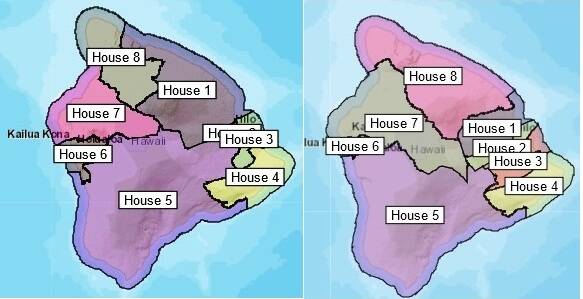
| Redistricting will likely leave Kaʻū with one instead of two members to represent the rural community in the state House of Representatives. How much urban area will be in the district is still in question. These two maps show proposals to combine the two districts now in Kaʻū. The map below shows the current two districts. Maps from the state Reapportionment Commission |
KAʻŪ WOUULD LOSE ONE OF TWO MEMBERS IN THE STATE HOUSE OF REPRESENTATIVES under both options being considered by the Reapportionment Commission, which aims to set districts, according to the one-person, one vote ideal. Currently, West Kaʻū is represented by Jeanne Kapela, of Kona, who replaced Dr. Richard Creagan, when he declined to run for office again in 2020. He held the position for years representing a district from Honu'apo into Kona.
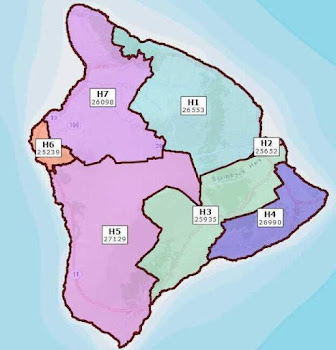 |
| The current state House of Representative districts provide two seats for Ka'u, one for the eastside and one for the westside. Map from state Reapportionment Commission |
East Kaʻū is represented by Richard Onishi, a Hilo resident. He has held the position for a decade.
Whether Kaʻū would be better represented by two representatives or one is a question, but the decision has already been made to put all of Ka'u in one House District 5. Still to be determined is how much of Kona and which parts of Puna will be included. One option for House District 5, based on revised permanent resident population data adopted by the Reapportionment Commission on Jan. 6, would make District 5 span from Honaunau through all of Kaʻū and into Puna, including both sides of Hwy 11 almost to Kurtistown, and the mauka side of Hwy 11 into Kea`au. See https://elections.hawaii.gov/wp-content/uploads/v1231HawaiiHouseProposed2022.pdf
Whether Kaʻū would be better represented by two representatives or one is a question, but the decision has already been made to put all of Ka'u in one House District 5. Still to be determined is how much of Kona and which parts of Puna will be included. One option for House District 5, based on revised permanent resident population data adopted by the Reapportionment Commission on Jan. 6, would make District 5 span from Honaunau through all of Kaʻū and into Puna, including both sides of Hwy 11 almost to Kurtistown, and the mauka side of Hwy 11 into Kea`au. See https://elections.hawaii.gov/wp-content/uploads/v1231HawaiiHouseProposed2022.pdf
See public submissions for redistricting the state House at https://elections.hawaii.gov/about-us/boards-and-commissions/reapportionment/
One view is that the more the district covers rural Hawai'i, with its agriculture and natural resources, the more Kaʻū interests would be represented, without being sidelined by interests from urban Kona and Puna. The aim, however, is to draw the lines to get the populations in each district as close to equal as possible.
One view is that the more the district covers rural Hawai'i, with its agriculture and natural resources, the more Kaʻū interests would be represented, without being sidelined by interests from urban Kona and Puna. The aim, however, is to draw the lines to get the populations in each district as close to equal as possible.
See more on redistricting the state Senate and County Council districts in upcoming Kaʻū News Briefs.
To read comments, add your own, and like this story, see www.facebook.com/kaucalendar/. See latest print edition at www.kaucalendar.com.
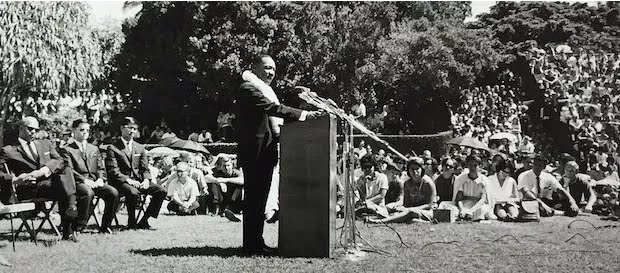 |
| Dr. Martin Luther King Jr. speaking during Civil Rights Week at University of Hawaiʻi in1964. Photo from University of Hawaiʻi News |
MARTIN LUTHER KING DAY, the national holiday on Monday, drew a message from Hawai'i's U.S. Senator Mazie Hirono, who wrote:
“Today, we celebrate Martin Luther King Jr. Day by honoring civil rights leaders who fought against inequality and sacrificed so much to move our country closer towards justice for all.
“In 1957, Martin Luther King Jr. delivered his Give Us the Ballot address where he said, “The denial of this sacred right is a tragic betrayal of the highest mandates of our democratic tradition.” But here we are, in 2022, fighting back against hundreds of bills introduced in states with the clear intention of making it harder for certain people to vote.
“But this year, on a day when we should be coming together to commemorate these civil rights achievements and recommit to the road ahead, we are instead fighting a battle we thought was won decades ago.
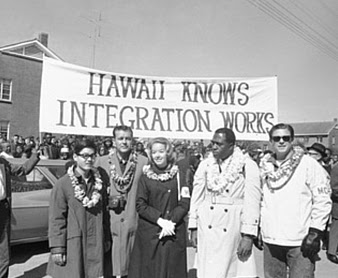 |
| This contingent from Hawai'i provided Dr. Martin Luther King Jr. with lei to wear during the Civil Rights March in Selma in 1965. Photo from the Human Flower Project |
“Our country’s legacy of racial discrimination in voting is undeniable. And it’s undeniable that we are witnessing history repeat itself today. If we want to honor Dr. King’s legacy, we must put politics aside and pass the Freedom to Vote Act and the John Lewis Voting Rights Advancement Act.”
Ka'u's Congressman Kai Kahele said, "Today, we celebrate the vision and legacy of Dr. Martin Luther King Jr. Tomorrow, we forge ahead to keep his dream alive by continuing our fight for equal opportunity and justice for all. #MLKDay"
To read comments, add your own, and like this story, see www.facebook.com/kaucalendar/. See latest print edition at www.kaucalendar.com.
A NEW TONGAN VOLCANO ERUPTION REPORT from Pita Taufatofua includes a message from journalist Barbara Dreavor regarding the islands struck by tidal waves on Saturday, and a resulting breakdown in communications. "It is going to take at least two weeks before international phones and internet are working again, despite initial indications the submarine cable is intact, that is not the case. there are two breaks in it, one of them close to the volcano.
"The vessel which will repair it is in Papua New Guinea and it will take three to four days to prepare it.
"It will head to Samoa to pick up critical equipment, then head to the sites. There may be delays if there are more eruptions or if the cable is buried in the seabed. It will get fixed but Tongans living overseas should prepare themselves for a longer wait to contact loved ones," reported Dreaver.
Taufatofua, the recent Tongan Olympic flag bearer, set up a fundraiser for victims of the tsunami at
https://www.gofundme.com/f/tonga-tsunami-
relief-by-pita-taufatofua?utm_campaign=p_cp+share-sheet&utm_medium=copy_link_all&utm_source=cu.
"The vessel which will repair it is in Papua New Guinea and it will take three to four days to prepare it.
"It will head to Samoa to pick up critical equipment, then head to the sites. There may be delays if there are more eruptions or if the cable is buried in the seabed. It will get fixed but Tongans living overseas should prepare themselves for a longer wait to contact loved ones," reported Dreaver.
Taufatofua, the recent Tongan Olympic flag bearer, set up a fundraiser for victims of the tsunami at
https://www.gofundme.com/f/tonga-tsunami-
relief-by-pita-taufatofua?utm_campaign=p_cp+share-sheet&utm_medium=copy_link_all&utm_source=cu.
Taufatofua also reported that the ship S.S. Adelaide has set sail through UNICEF bringing aid to Tonga.
He also reported the loss of a British woman who had sent up an animal shelter in Tonga. She was washed away by the tidal wave, her body found.
He also reported the loss of a British woman who had sent up an animal shelter in Tonga. She was washed away by the tidal wave, her body found.
To read comments, add your own, and like this story, see www.facebook.com/kaucalendar/. See latest print edition at www.kaucalendar.com.
 |
| See archives of The Ka`u Calendar at www.kaucalendar.com and find the monthly print copy in mailboxes from Volcano through Ocean View. |