About The Kaʻū Calendar

Thursday, January 20, 2022

Ka‘ū News Briefs, Thursday, Jan. 20, 2022

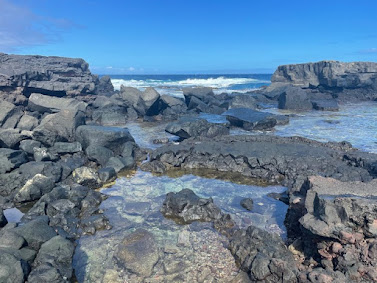
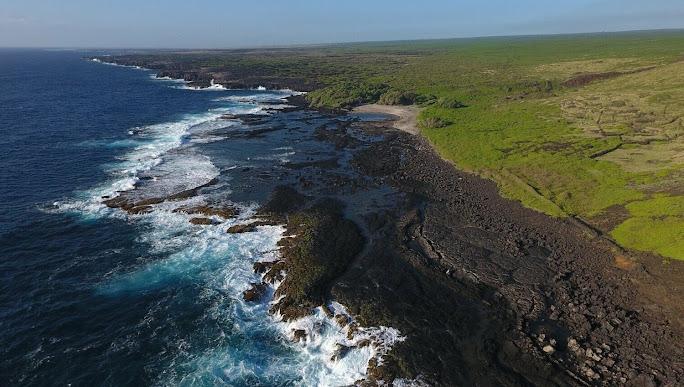
Waikapuna is subject of a community planning meeting via Zoom on Wednesday, Jan. 26. Photo by Shalan Crysdale
 
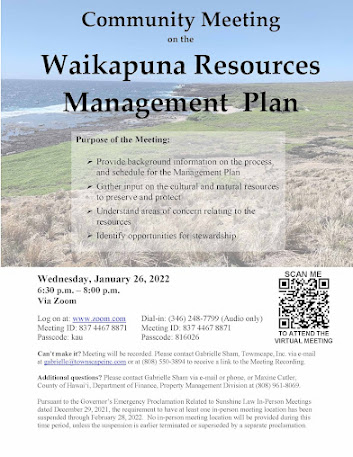
THE LAND MANAGEMENT PLAN FOR WAIKAPUNA IS OPEN FOR PUBLIC INPUT. Those assisting the community in making the plan sent out a notice this week to remind folks that a community meeting will be on Wednesday, Jan. 26 at 6:30 p.m. "to provide mana'o about the important cultural and natural resources of Waikapuna, critical issues relating to the resources, and ideas for stewardship." 
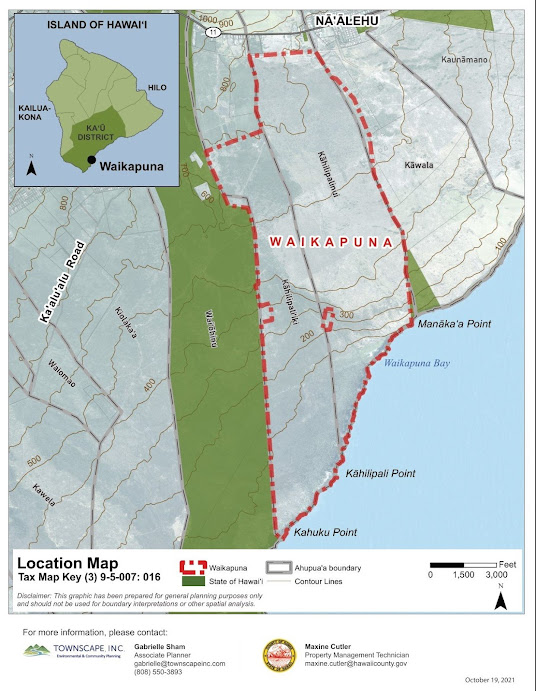
    Waikapuna is 2,317 acres, located south of Nāʻālehu in the ahupua'a of Kahailipalinui and Kahilipali'iki in the moku of Kaʻū.              Several developments have been proposed for this land, the most recent being a subdivision development planned by the previous landowner. 
    Seeking to protect its significant natural and cultural resources, the Ala Kahakai Trail Association, a non-profit organization, raised funds through The Trust for Public Land; the State Legacy Land Conservation Program; County of Hawai'i's Public access, Open Space and Natural Resources Preservation Fund; and private doors to acquire Waikapuna for conservation in 2019.
    County of Hawai'i holds a Conservation Easement over Waikapuna with the purpose to "conserve, preserve, and protect in perpetuity the historic, cultural, agricultural, natural, marine, scenic, open space, fresh water, and native and endemic plant and animal habitat values of the Easement Property." A conservation easement is a legal agreement that permanently limits uses of the land (such as development) in order to protect its conservation values.
    Ala Kahakai Trail Association, which holds title to the property, is required to establish a land management plan that is consistent with the purpose of the Waikapuna Conservation Easement and the State LLCP grant agreement.
Waikapuna's coastline is home to an intricate network
of flora and fauna. Photo from Ala Kahakai Trail Association
    Townscape, a consulting firm, is contracted to help make the plan with community input. Analysis of Waikapuna resources, issues and needs was done during the third quarter of 2022. Next step is to develop management strategies by the second quarter of 2022 and to complete the Final Waikapuna Management Plan by the fourth quarter of 2022. In addition to the community meeting by zoom on Jan. 26, there will be a community meeting regarding the Draft Waikapuna Management Plan during the third quarter of 2022.
    The Jan. 26 meeting is begin held on Zoom, due to ongoing health concerns regarding COVID-19.  The Meeting ID is 837 4467 8871. Passcode is kau. For audio only, dial (346) 248-7799
Meeting ID: 837 4467 887. Passcode : 816026.

To read comments, add your own, and like this story, see www.facebook.com/kaucalendar/. See latest print edition at www.kaucalendar.com.

MAUNA LOA'S EFFUSIVE ERUPTIONS AND SPECTACULAR LAVA FLOWS are the subject of this week's Volcano Watch, written by USGS Hawaiian Volcano Observatory scientists and affiliates:
Mauna Loa is known for its effusive eruptions that produce spectacular lava flows. However, some of the volcanic products found on Mauna Loa are pyroclastic or explosive in character.
Evidence of a more violent style of eruption has been identified in the form of debris fans. These deposits are largely made up of solidified blocks, lapilli (pieces <2.5 inches), and ash.
   The age and general location of the deposits were discussed in an earlierVolcano Watch article published in 2018.    Here, we describe the rock types and sizes, which are used to help constrain the vent locations and size of these unusual explosive eruptions.
    Generally, the ejected rocks are roughly equivalent in size and abundance along the central axis of each fan, and they decrease in size with increasing distance from the caldera rim.    We documented over 1,000 clasts from the debris fan on the northwest rim. The clasts were dominated by ponded lava, ejecta, both unaltered and altered, totaling 78 percent. Pāhoehoe clasts, both unaltered and altered, are the second most abundant, at 20 percent, while gabbroic xenoliths and bread-crust or crackle-surface rocks each comprise 1 percent of the deposit. Clasts in the northwest fan range in size from 3–220 cm (1–87 in) in diameter, with an average size of 26 cm (10 in). 

Types of explosive clasts found in the debris fan deposits at the summit of Mauna Loa: (A) unaltered pondedlavaflow, (B) unaltered pāhoehoe, (C) altered ponded lava flow, often has a red to pink hue, (D) thermally altered pāhoehoe, often has a red-to-pink hue, (E) gabbroic xenolith, the most crystalline rocks we found, (F) bread-crustouter surfaces and vesicular interiors or dense clasts with crackle or crazed surface rinds, (G) bread-crust due to quenching. USGS photos
    The east, or Mauna Loa Cabin apron, is also dominated by ponded lava ejecta, both unaltered and altered. We documented over 1,700 clasts, and ponded lava comprises 98 percent of the lithics, while pāhoehoe clasts, both unaltered and altered, comprise only about 1 percent of the deposit. Bread-crust or crackle-surfaced rocks also comprise 1 percent of this deposit, along with a single gabbroic lapillus that was noted.
        In the east fan, most larger-sized clasts (greater than 40 cm or 16 in) are found in the northern section of the fan. Lithic ejecta in the north ranges from 2–153 cm (0.8–60 in) in length, with an average of 21 cm (8 in). To the south, the clasts are much smaller and more abundant. The ash fraction is over 70 percent of the deposit, burying almost all of the underlying pāhoehoe flows. The clasts range in size from 1–66 cm (0.4–26 in), with an average size of 13 cm (5 in).
    West fan clasts, types, and sizes are randomly scattered at varying distances from the caldera rim, with no clear dispersal pattern. We cataloged over 340 clasts; pāhoehoe, both unaltered and altered, is the most abundant at 44 percent, followed by ponded lava, both unaltered and altered, at 24 percent. Clasts range from 2–90 cm (0.8–35 in), with an average of 20 cm (8 in).
Map of explosive deposits at the edge of Moku'āweoweo, the summit caldera of Mauna Loa. Map showing the size distribution of ejecta, sorted by maximum length in centimeters (one inch is about 2.5 cm). The colors indicate the different size fractions in centimeters. The largest blocks were found closest to the rim. In general, clast size diminished with increasing distance, but medium-sized blocks were found nearly at the distal extent of fan limits. The dark flows in the image outside the caldera are the youngest 'a'ā flows. USGS map.
    Surprisingly, the two most uncommon rocks in the other explosive fans are quite abundant in the west fan. Gabbros comprise 21 percent of the deposit, while bread-crust or crackled-surface rocks comprise 11 percent of the deposit.
    The flow samples indicate the explosions occurred at depth, and had to break through overlying lava flows. Many of the pahoehoe blocks are rounded, suggesting that they were tumbled in the vent or recycled a few times before ejection. Gabbros represent crystalized lava lake.    The most unusual blocks have "bread-crust" textures or have water-quenched-type outer surfaces (crackled). We interpret the bread-crust-textured clasts as the ejected clots of residual melts of crystallizing shallow magma bodies, similar to those that produced the gabbroic xenoliths. This residual melt was still molten or plastic when the explosive activity occurred. In contrast, the crackle-surfaced types are the result of hot rocks being rapidly quenched.

    So why is this information so important? Based on simple geometry of the arcuate shaped deposit fans, clast type, and size distribution, we can determine that the sources of these explosive eruptions were from vents on the caldera floor adjacent to the deposits found on the rim.
    We know that explosive eruptions have occurred on Mauna Loa before, and that this type of activity is likely to happen again. Although no one lives at the summit of Mauna Loa, explosive eruptions have the potential to pose a threat to hikers, aircraft, and communities downwind that could experience ashfall. This study adds another important dimension in reconstructing the long-term eruptive history of Mauna Loa.

is a weekly article and activity update written by U.S. Geological Survey Hawaiian Volcano Observatory scientists and affiliates.

To read comments, add your own, and like this story, see www.facebook.com/kaucalendar/. See latest print edition at www.kaucalendar.com.
See archives of The Ka`u Calendar at
www.kaucalendar.com and find the
monthly print copy in mailboxes from 
Volcano through Ocean View.


Wednesday, January 19, 2022

Ka‘ū News Briefs, Wednesday, Jan. 19, 2022

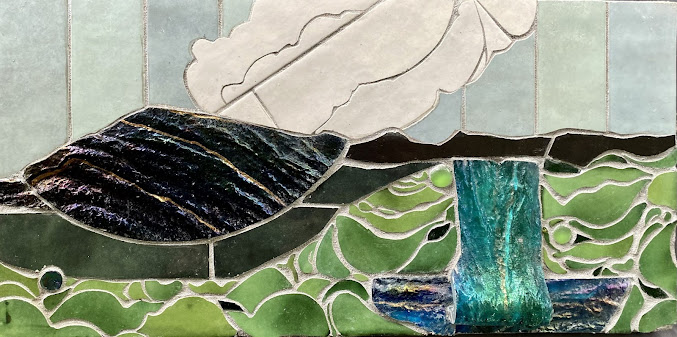
Mauna Falls, Mosaic by Leslie Jean and Marian Fieldson, is comprised of iridescent glass and ceramic. It is on display at Volcano Art Center Gallery through Feb. 20 in the exhibit entitled Nani Moku. See more below.

THE FREEDOM TO VOTE AND JOHN LEWIS VOTING RIGHTS ADVANCEMENT ACTS, combined into one bill, were blocked Wednesday in the U.S. Senate. Hawai'i Sen. Mazie Hirono released this statement:
    “The freedom to vote is the cornerstone of our democracy—without it, we don’t have one, it’s that simple. I never thought I’d see the day where protecting this sacred right has become a partisan issue. It
was not a partisan issue the five times the Senate reauthorized the Voting Rights Act. Yet, Republicans continue to sit back and let state legislatures across the country pass laws that are making it significantly harder, if not impossible, for certain people to vote.
    “These voter suppression laws—and the lies Republicans are spewing about them—are directly undermining our democracy and the integrity of our election system. If this isn’t un-American, I don’t know what is.
    “We celebrated Martin Luther King Jr. Day this week—he fought for voting rights and civil rights his whole life. Many Republicans joined in acknowledging his contributions. What would Dr. King say about the battle we are waging over protecting our freedom to vote? He would call on all of us to get on with it, get it done—period. After tonight’s vote, the battle is not over. We will continue to show the American people what’s at stake and fight to pass comprehensive voting rights legislation.”

To read comments, add your own, and like this story, see www.facebook.com/kaucalendar/. See latest print edition at www.kaucalendar.com

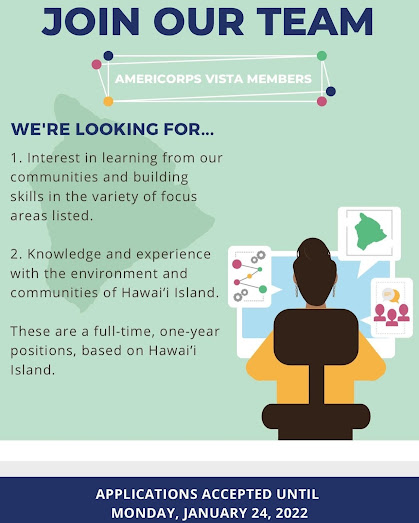
FULL TIME JOBS WITH HAWAI'I COUNTY through AmeriCorps VISTA will support this island's food systems, energy systems, mobility, economic recovery, and resilience building following the 2018 Kīlauea eruption. Six Volunteer In Service to America positions are available. These are full-time, one-year and  based on Hawai'i Island. The deadline to apply is Monday, Jan. 24.
    The Volunteer In Service to America, who will be selected for Design & Technical Development, will work to increase access to information and education by enhancing technology systems that will build capacity, improve usability, and increase effectiveness. The VISTA will work closely with the county's Climate Action Team to collaborate on the climate action website and other public facing
projects.
    The VISTA to work on Food Access Solutions will build capacity to alleviate hunger by advancing food education and increasing access to nutritious food for the rural, culturally diverse communities of Hawai'i, particularly for the most vulnerable populations. The VISTA will support the alignment and integration of the Food System Action Plan with other County planning efforts such as the Climate Action Plan, Kilauea Recovery & Resilience Plan, Hawai'i Island Tourism Strategic Plan, and District Community Development Plans. The VISTA will help to build capacity and knowledge within underserved communities on how to increase food resilience by working with the Food Access Coordinator to support and leverage community networks.

    The VISTA selected for Recovery & Resilience Capacity Building will work with county Department of Research & Development. R&D informs planning, policy, and programmatic decision-making with data-driven research and collaborates in the development and funding of initiatives seeking environmental, community, and economic sustainability for the rural island with its relatively small population of 200,000. This VISTA will be part of a team enhancing the community’s capacity to collaboratively tackle complex challenges like climate change, energy, equitable mobility, food systems, disaster recovery and resilience, and economic recovery.
    The VISTA for Mobility Solutions will help ensure that ALICE (Asset Limited, Income Constrained, Employed) families and low-income communities gain access to the services and support needed to overcome the cycle of poverty. The VISTA will build community capacity to guide the drafting of mobility policy and implementation to advance shared mobility for more equitable transportation in Hawai'i County.
    The VISTA for Energy Solutions will map County and community networks (stakeholder analysis, outreach), strengthen partnerships (facilitate goal-setting exercises, support working groups, improve communication), and facilitate development and delivery of energy programming (research, knowledge 
management, strategy identification, project pilots).
    The VISTA for Economic Recovery Solutions will help ensure that ALICE and low-income communities can recover and be more resilient to disasters and disruptions affecting Hawai'i Island's economy by strengthening community capacity, community/County relationships, and readiness for equitable and sustainable economic recovery actions.

To read comments, add your own, and like this story, see www.facebook.com/kaucalendar/. See latest print edition at www.kaucalendar.com.

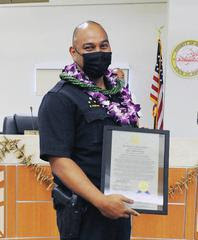
SAVING SWIMMERS IN DISTRESS MADE HAWAI'I POLICE OFFICER REUBEN PUKAHI the latest recipient of a Haweo Award. A statement from Hawai'i Police Department says, "Last summer, he jumped into action without hesitation, risking his safety to help rescue two women. For his selfless actions," award was given to Pukahi on Tuesday in the County Council chambers.
    The Council’s Parks & Recreation & Public Safety Committee recognizes county police and fire department personnel who go above and beyond the call of duty. Haweo, for which this award is named, means to glow or to be radiant. Officer Pukahi was presented with a lei and a certificate signed by each council member at the ceremony.
    On August 10, 2021, Pukahi, along with Kona Community Policing Sergeant Michael Hardie, were at Honl's Beach Park on Ali‘i Drive addressing community complaints of undesirable activities in the area. Surf conditions that day made it very dangerous for amateur and inexperienced beach goers.

Hawai'i Police Department Officer Reuben Pukahi wins a Haweo
Award for saving a woman pulled out to sea by heavy current.
Photo from Hawai'i Police Department

  Hardie and Pukahi observed a young boy, who appeared to be a tourist, with a body board attempting to enter the water. It was apparent he didn't have the experience to safely handle the treacherous surf conditions. As the officers were speaking with the boy, they observed two older women attempting to enter the water on the opposite side of the beach. The women also appeared to be tourists, unaware of the dangers posed by the large surf, and were both carrying masks and snorkels, but no swim fins.
    Before officers could intervene, the two women entered the water and were quickly separated and swept away from shore by the strong currents, directly into the path of the large breaking surf. The women began to tread water but weren’t able to swim toward shore. Seeing the women in distress, some area surfers started paddling over to assist them.
    Seeing that the situation was getting worse and more assistance was needed, Officer Pukahi quickly changed out of his police uniform and into his traditional surf attire and commandeered a bystander's surfboard. Paddling through the surf to one of the women, Pukahi pulled her onto his surfboard just as she was about to be swept onto the rocks and brought her back to shore safely.
Both women sustained only minor abrasions and were very grateful for the life-saving actions of Officer Pukahi and the other surfers.
    “It’s very rare that a supervisor gets the opportunity to be involved in and directly witness the selfless actions of an officer assigned to their unit,” says Hardie, who is Pukahi's supervisor. “Officer Pukahi is an avid, experienced waterman who was fully capable to assist in this situation and it was a blessing that he was present during this incident. If not for the assistance of Officer Pukahi and assisting surfers, this incident could have undoubtedly ended in tragedy.”

To read comments, add your own, and like this story, see www.facebook.com/kaucalendar/. See latest print edition at www.kaucalendar.com.

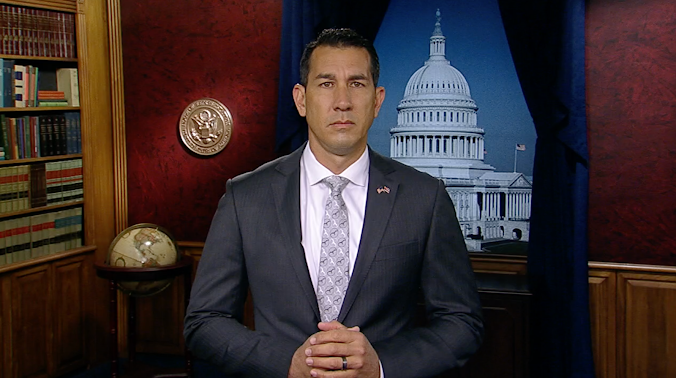
 Congressman Kai Kahele urged the Hawai' Legislature, which opened on Wednesday to take ten steps to
deal with COVID. See his remarks by clicking here.

KAʻŪ'S CONGRESSMAN KAI KAHELE PRESENTED TEN STEPS TO DEAL WITH COVID in a video message for the opening of the 2022 Hawai'i Legislature on Wednesday. He said Hawaiʻi must build a COVID resilient infrastructure and implement a long-term island plan to deal with COVID-19 and its variants. In his op-ed, also submitted to the Star Advertiser and other publications, Kahele implores state leaders to act decisively and execute a multi-year statewide strategy to mitigate the pandemic and save lives.
    Kahele said, "The rampant surge of the Omicron variant has proven COVID-19 is not going away any time soon. We must implement immediate solutions as well as prepare contingency plans for future mutations of the coronavirus and other novel viruses, otherwise we will be in a perpetual state of emergency. Failure to immediately implement an enduring, multi-year statewide plan will result in more residents experiencing infection and mortality. Health inequities will widen especially in our Native 
Hawaiian and Pacific Islander communities and billions will be lost from our state's economy."
    Watch his remarks outlining his ten points by clicking here. Kahele's call to action comes amidst the highest single-day reporting of new COVID-19 cases in Hawaiʻi since the start of the pandemic. On Tuesday, the Hawaiʻi Department of Health reported 6,252 new cases statewide. Here is the text of his op-ed:

Kahele recommends that every household order the four free Covid tests offered 
 by the federal government at www.covidtests.gov
    President Teddy Roosevelt once said: “In any moment of decision, the best thing you can do is the right thing, the next best thing you can do is the wrong thing, and the worst thing you can do is nothing.” As our state begins its third year living under the enormous strain of a deadly health pandemic, there are no signs of abatement. After record daily cases and a health care, educational and local workforce system struggling to deal with the exhaustion of the coronavirus, it is clear to me that we have squandered the opportunity to prepare the state for a “new normal” life with COVID-19.
    Not too long ago Hawai'i appeared to have management of the coronavirus under control. We were one of the best performing states in the nation and with the infusion of almost $3 billion in federal funds and latitude to shape our island strategy to deal with the pandemic, we had an opportunity very few states have due to our unique geography and isolation in the Pacific.
    However, indecisiveness, lack of a statewide strategic plan and failure to have the foresight to prepare for a resurgence of the virus and deadly variants have cost us all greatly. Decisions to relax entry requirements, abandonment of robust testing, failure to procure an abundant supply of proper masks, and inadequate planning for our public schools have led us into the current crisis.
    The rampant surge of the omicron variant has proved COVID-19 is not going away any time soon. We must implement immediate solutions as well as prepare contingency plans for future mutations of the coronavirus and other novel viruses, otherwise we will be in a perpetual state of emergency. Failure to immediately implement an enduring, multiyear statewide plan will result in more residents experiencing infection and mortality. Health inequities will widen especially in our Native Hawaiian and Pacific Islander communities and billions will be lost from our state’s economy.
    Here are 10 points that must be done immediately statewide:

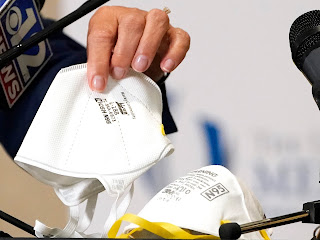
Congressman Kai Kahele says the state needs to
provide free higher quality masks, particularly for
the schools. Photo from NPR
    First, the state needs to modify its entry requirements for all transpacific, international and cruise ship passengers to require a pre-entry test and a post-arrival test regardless of vaccination status.
    Second, the definition “fully vaccinated” needs to change to require an additional vaccine dose or “booster,” if eligible, and this requirement must be in place for all indoor events, to include indoor dining.
    Third, the state needs to require and provide high-quality masks, like N95 or KN95 masks, or at the very least, single-use medical-grade masks to prevent community spread. Cloth masks should not be allowed unless over a high-quality mask. This policy should be mandatory in all schools and clean, high-quality masks should be provided for free by the state daily.
    Fourth, the state needs to invest in a digital, secure health passport that will allow each individual to have an electronic vaccination certificate as well as report and track testing status in real time. Three years into this pandemic, we have failed to take advantage of existing technology to do so, and instead continue to rely exclusively on paper vaccination records, which can be forged.
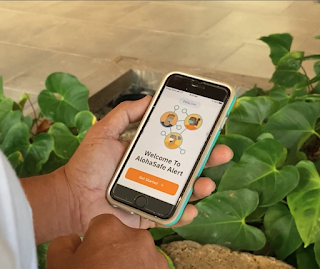
    Fifth, the AlohaSafe Alert needs to be updated in order to be more effective. Residents need the ability to confidently rely on the state reporting system to provide them accurate notice of close contact in real time.
    Sixth, in order to keep schools open, the state must implement a testing strategy in all public schools that first and foremost keeps our teachers and students safe. We also need to provide every classroom in the state the necessary ventilation upgrades and air filtration systems to improve air quality, mitigating the risk of airborne spread.
    Seventh, if we are ever to achieve herd immunity, state, county, health care and community leaders must continue to provide a strong, unified message and robust education about vaccination effectiveness and availability for all eligible residents with the goal of fully vaccinating (including booster shots) 80% of the eligible population by the summer. In order to accomplish this, the state must work with the business community and private sector to provide paid sick leave and time off so residents can plan for when to get vaccinated or boosted.
Kahele recommends upgrading the Aloha State
Alert system. Photo from NPR
    

    Eighth, in the event that someone does test positive, the state must provide clear public health isolation guidance and require two negative antigen tests commencing on the fifth day of isolation, spaced two days apart to allow isolation to end and return to normal life. These tests should be secured by the state and given to each resident when they test positive to help people come out of isolation.
    Ninth, the state must procure the resources needed to respond to the next variant. The state must ensure that all our families have free access to at-home, rapid tests and that there is an adequate supply to meet our needs. Every family should be ordering tests from www.covidtests.gov, but our state still needs its own strategic stockpile ready to serve our residents’ needs.
    Tenth, the state must work with county officials to increase the number of quarantine facilities across the state. Many of our residents are sharing crowded apartments or living with multiple generations under one roof where isolation at home is not possible. We must provide these facilities to reduce the chance of 
spread and keep our residents safe.
    These 10 steps are absolutely critical in building resilience that allows residents and visitors to be safe. We must strengthen our hospitals, health care systems and public health institutions. We need to stop burning out our health care workers and instead give them the resources they need to do their jobs 
effectively.
    People are scared. People are demoralized. People are frustrated. It cannot and must not stay this way. I implore my former colleagues in the state Legislature to act decisively. We need to do better.

To read comments, add your own, and like this story, see www.facebook.com/kaucalendar/. See latest print edition at www.kaucalendar.com.

Mauna Loa Lily, Talaveras ceramic tile mosaicby Leslie Jean.
NANI MOKU
, AN EXHIBIT OF GLASS AND MOSAICS, is on display at Volcano Art Center Gallery in Hawai'i Volcanoes National Park. It features glass by artist Marian Fieldson and mosaics by artist Leslie Jean. 
    The show opened to the public on Jan. 8 and will continue through Feb. 20 from 9 a.m. to 5 p.m. daily. Admission to the exhibit is free, although park entrance fees apply.
      A Volcano Art Center description of Nani Moku says, "Fused glass pieces, created with vivid color and rich texture, by Marian Fieldson and Leslie Jean highlight both the beauty and diversity of Hawai'i's unique landscape. Textured plates, platters and forms in the exhibit are formed directly from Hawai'i Island lava flows. Patterns for the kilncasts Marian used were taken directly from pahoehoe lava."
    See bios on the artists. Read more about the show and buy online at https://volcanoartcenter.org/

To read comments, add your own, and like this story, see www.facebook.com/kaucalendar/. See latest print edition at www.kaucalendar.com.

A LIST OF STATE EXPENDITURES WITH FEDERAL COVID MONEY was released on Tuesday by Gov. David Ige. He said the American Rescue Plan Act funds were to be used for emergency response stemming from the COVID-19 pandemic.
    "COVID resulted in a global economic shutdown, which had devastating consequences on our state. We were force to cut many programs and services, state workers were at risk of being furloughed, our hospital system was overwhelmed, our tourism industry was shut down, and our economy was on the brink of collapse," said Ige. "At the same time, there was greater demand for essential government services and social safety nets. ARPA funds helped us pivot."
    A statement from the governor said that his approach was to funnel the funds to: Support critical services; respond to COVID-19 public health emergency and to promote economic recovery and ensure equitable outcomes for those hit hard by pandemic.
    Ige highlighted unemployment and jobs, his statement saying "a major portion of ARPA funds supported the Department of Labor & Industrial Relations' Unemployment Insurance Program, to support and provide a safety net for the thousands of individuals who were without jobs during the pandemic. The state used $70 million for an Unemployment Insurance call and adjudication center; and $800 million for an Unemployment Insurance loan repayment." The governor proposes to continue support in FY23 with American Rescue funds.
    He also focused on the state's Hospitals/Public Health Response, saying the state spent a large amount of ARPA funds supporting state hospitals, emergency medical services and COVID-19 response. Included were $32 for Hawai'i Health Systems Corp, which operates Kaʻū Hospital and its clinic, along with sister facility Hilo Medical Center and others. Other expenditures included $84M – EMS and injury prevention; $16M – HI Health Systems Oʻahu Region; $2.9M – Wahiawa Hospital Services; $11M – Maui Health System hospital subsidy; $10M – COVID-19 test kits; $8M – Department of Health, COVID administrative support; and $50M – Department of Public Safety, strengthen COVID response.
   Regarding the visitor industry, the governor's statement said, "ARPA funds were used to keep the Hawaiʻi Tourism Authority intact while the pandemic heavily impacted the visitor industry. HTA used these funds to restructure operations and focus more on promoting more sustainable tourism to Hawaiʻi. Funds were also dedicated to creating the Safe Travels program to help mitigate the spread of COVID-19." They were $60M to Hawai'i Tourism Authority,  $11M to the Hawai'i  Convention Center on O'ahu; and $41M to Safe Travels Hawaiʻi.
   Regarding Essential Services, the governor said ARPA funds were critical in supporting important services for the community, with $10.8M going to homeless services, $1.5M to Senior Centers and $1.3M to family health services.
    Education: "It was important to support our university system during the pandemic, as well as those with financial need," said the governor. The state spent $28M on the University of Hawaiʻi System and $1.3M for financial need scholarships through the HI Promise Program.
   Regarding infrastructure expenditures with ARPA funds,  $1.5M supported Broadband initiatives and $2.7M went toward modernization of the state's finance system. Both initiatives are included for additional funding in the governor's supplemental budget request to the Hawai'i Legislature which opened on Wednesday. 
    The governor said,  "The pandemic showed us that there is a huge digital divide in our state, and that access to reliable and high-speed internet is essential for all students and workers. We anticipate additional federal funding this year through the Infrastructure Investment and Jobs Act signed earlier this year, and potentially other federal sources. We will continue to use these funds to restore and rebuild our state this coming year."
    For a complete list of awards and programs supported with these federal funds, visit: COVID-19 Awards and Awards Received by State Departments.

To read comments, add your own, and like this story, see www.facebook.com/kaucalendar/. See latest print edition at www.kaucalendar.com.


See archives of The Ka`u Calendar at
www.kaucalendar.com and find the
monthly print copy in mailboxes from 
Volcano through Ocean View.


Congressman Kai Kahele says the state needs to
provide free higher quality masks, particularly for
the schools. Photo from NPR