About The Kaʻū Calendar

Sunday, January 23, 2022

Ka‘ū News Briefs, Sunday, Jan. 23, 2022

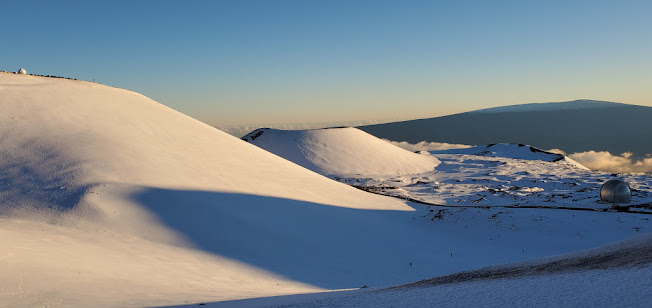
A snow covered summit of Maunakea, which is subject of a new Master Plan for the University of Hawaiʻi Maunakea Lands:
 E Ō I Nā Leo (Listen to the Voices). Photo from UH Hilo Center for Maunakea Stewardship
.
 

A NEW MAUNAKEA MASTER PLAN IS APPROVED BY UNIVERSITY OF HAWAI'I BOARD OF REGENTS. The U.H. statement released midweek says the 
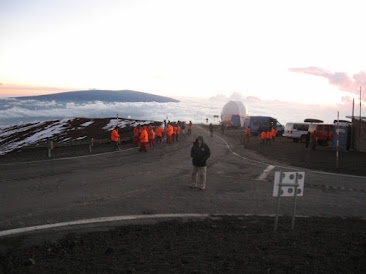
UH Hilo Center for Maunakea Stewardship runs the visitor center.
Photo from U.H Hilo
Master Plan for the University of Hawaiʻi Maunakea Lands: E Ō I Nā Leo (Listen to the Voices)
 "will serve as a framework for aligning land-use decisions in a manner that is consistent with UH’s mission and purpose. Its overarching goals are related to responsible stewardship, maintaining leadership in astronomy, diversifying educational pursuits and seeking balance among those who come to Maunakea."
     The plan lists strategies including, "broadening Native Hawaiian and community participation in planning and programming; measures to reduce impacts to the cultural landscape and natural resources, especially in the summit region, by limiting development; and repurposing the Halepōhaku mid-level facility into a Multidisciplinary Field Station."
    UH Hilo Center for Maunakea Stewardship is responsible for administering the Master Plan along with the Comprehensive Management Plan and the administrative rules. In addition to the CMP are four sub-plans (public access, cultural resources management, natural resources management and observatory decommissioning) that address activities that include hunting, gathering, recreation and traditional and customary practices. The administrative rules cover public and commercial activities.

    
According to the statement, about 150 people submitted written testimony to the Board of Regents, a majority in support of the new plan, and about 30 provided oral testimony, predominantly in opposition of the plan. "Most of the opposition was not related directly to the plan but focused on other Maunakea-related issues including the Thirty Meter Telescope, the State House of Representatives Mauna Kea Working Group draft report, the 1893 overthrow of the Hawaiian Kingdom and whether astronomy and the existence of telescopes should continue on the summit."
    
UH Regent Alapaki Nahale-a voted in favor of the plan and said,“The issues we have to resolve – historical issues, best management of Maunakea – this plan is not going to fix them. I hope that for us, as regents, and for those watching, we don’t continue to practice votes like this, meaning no one is listening and no one cares. I hope those who are concerned and hurt will still have a conversation about how we can do better.”
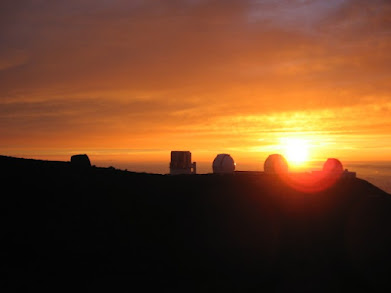
The new Maunakea Master Plan addresses stewardship
of the area managed by University of Hawai'i.
Photo from UH Hilo Center for Maunakea Stewardship.
  
Greg Chun, executive director of Center for Maunakea Stewardship, agreed He said after the meeting, “These are important issues that go beyond the question of management that the State of Hawaiʻi and the broader community need to discuss.”
    
The statement says, "The purpose of the 65-year lease granted to UH by the State in 1968 was to operate the Maunakea Science Reserve as a scientific complex to establish astronomy in Hawaiʻi. The 1998 State audit critical of the university’s overall management of the mauna made it clear that the privilege of stewardship carries an even greater responsibility to care for Maunakea, which led to the development of the management plans, establishment of the Maunakea Rangers, greater protection of natural and cultural resources and other stewardship improvements.
 
"The Master Plan adopted was finalized after extensive consultation and public outreach by UH during which input and advice was sought from individuals, groups, and agencies, such as the Office of Hawaiian Affairs, the Department of Land and Natural Resources , the Maunakea Management Board and Kahu Kū Mauna."
    The university also received more than 1,450 comments (online, telephone messages, U.S. Postal Service) on the draft of the new plan during a more than month-long public comment period that ended in late October.
    Learn more about Master Plan for the University of Hawaiʻi Maunakea Lands: E Ō I Nā Leo (Listen to the Voices) and UH Hilo Center for Maunakea Stewardship at https://hilo.hawaii.edu/maunakea/

 To read comments, add your own, and like this story, see www.facebook.com/kaucalendar/. See latest print edition at www.kaucalendar.com.
   
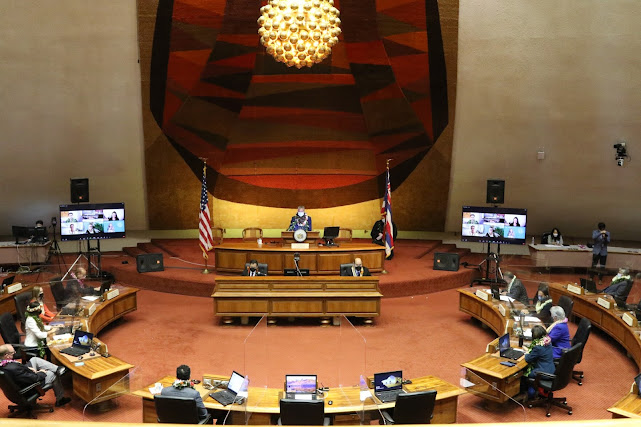
The 2022 Hawai'i Legislature opened on Wednesday, with Miloli'i through Volcano represented
by Senators Dru Kaniho and Joy San Buenaventura and Representatives Jeanne Kapela and Richard Onishi
Photo from Hawai'i Public Radio

Sen. Dru Kanuha serves West
Kaʻū from Honu'apo into Kona:
senkanuha@Capitol.hawaii.gov
THE HAWAI'I LEGISLATURE OPENED ITS 2022 SESSION MIDWEEK. In the Senate, Dru Kanuha represents West Kaʻū into Kona. Joy San Buenaventura represents East Kaʻū into Puna. In the House of Representatives, Jeanne Kapela represents West Kaʻū into Kona and Richard Onishi represents Kaʻū into Hilo. Here is a report from Hawai'i Public Radio:   
    The new legislative session always begins on the third Wednesday of the year. For 2022, that was Jan. 19. The state Senate and House of Representatives gave their opening remarks to kick off the 2022 legislative session on Wednesday. The state Senate’s opening day was relatively subdued.
    Senate President Ron Kouchi highlighted some of the priorities of the coming session, listing several issues that have worsened during the pandemic. Those ranged from the need for mental health services to supporting strategies that work to fight homelessness, which he says could take different forms on different islands. Kouchi says other priorities for the legislative session include affordable housing, teacher pay, raising the minimum wage, and supporting local agriculture by getting local produce to schools, hospitals and prisons around the state. But Kouchi says the issue that keeps him up at night is finding ways to address the learning loss suffered by students during the pandemic.
Sen. Joy San Buenaventura serves
East Kaʻū from Honu'apo into Puna:
sensanbuenaventura@Capitol.hawaii.gov
    Senate Minority Leader Kurt Fevella also talked about mental health services and support of agriculture, as well as the hospitality industry. He signaled he was open to increasing the minimum wage and supporting what he called “reasonable living wages.”
    Over in the House, Speaker Scott Saiki spoke about three main goals the legislative leadership wants to achieve this year — economic, environmental, and cultural justice. "Cultural justice requires the restoration of cultural practices. The House will expand community-based efforts to restore fish ponds and lo'i; repatriate cultural artifacts; teach financial literacy; and provide cultural training to the military. Related to this is the issue of tourism management. We need to take action now before our visitor count again reaches 10 million," Saiki said.
Rep. Jeanne Kapela serves West
Kaʻū from Honu'apo into Kona:
repkapela@Capitol.hawaii.gov
    The House plans to revisit increasing the minimum wage and providing more tax relief for low to moderate-income households. The House will appropriate $600 million to the Hawaiian Home Lands trust for Native Hawaiians who were hit hardest by the pandemic’s economic downturn.
    Saiki also emphasized achieving environmental justice by defueling and decommissioning the Red Hill fuel storage facility, with all costs coming under the responsibility of the federal government.
Rep. Richard Onishi serves East
Kaʻū from Honu'apo into Hilo:
reponishi@Capitol.hawaii.gov
    Several senators and representatives attended the opening session remotely, while others sat at their desks on a socially distanced Senate and House floor amid multiple lei and flowers.  The Senate closed the session by standing for a moment of silence, recognizing the damage and suffering of the people in Tonga from the recent volcanic eruption. Representatives opened their session with remarks and prayer for Tonga.
     Read and listen to Hawai'i Public Radio coverage of the Hawai'i Legislature, including the following stories:
     House leaders propose hiking minimum wage to $18 over several years: https://www.hawaiipublicradio.org/local-news/2022-01-20/house-leaders-propose-hiking-minimum-wage-to-18-over-several-years;
      Teacher pay, housing are just some policies advocates want to see passed this year: https://www.hawaiipublicradio.org/local-news/2022-01-18/teachers-housing-education-advocates-legislature
      
To read comments, add your own, and like this story, see www.facebook.com/kaucalendar/. See latest print edition at www.kaucalendar.com.

A COVID UPDATE ON SUNDAY FROM COUNTY OF HAWAI'I SAYS: "For Hawai'i County, Department of Health reports 371 new cases, 5,492 active cases, and 44 persons hospitalized. Monday, Community Testing is scheduled in Hilo at Afook Chinen Civic Auditorium from noon to 7 p.m. and in Waimea at the Waimea District Park from 2 p.m. to 5 p.m.
    For those who would like Covid self-test kits, Covid at-home test kits are available at covidtests.gov.
    For a comprehensive calendar and list of all pharmacies and clinics providing vaccination and testing, visit the Civil Defense website. www.hawaiicounty.gov. Vaccinations in Kaʻū are at Kaʻū Rural Health Clinic, Bay Clinic and the CVS/Longs in Pāhala.

To read comments, add your own, and like this story, see www.facebook.com/kaucalendar/. See latest print edition at www.kaucalendar.com.


The Pacific Internship Programs for Exploring Science (PIPES) is accepting applications

for its summer 2022 internship program. PIPES is a 10-week undergraduate internship

program May 31 to Aug. 5, offered through University of Hawai'i at Hilo.

The goal is "to connect under-represented undergraduate students, especially those

who are Native Hawaiian or kamaʻāina, to internship opportunities with agencies and

organizations responsible for research, management, and education relating to

environmental issues in Hawaiʻi and throughout the Pacific region. Internships are

paid experiences. Participants may be eligible for additional housing assistance.

For more information, visit: https://hilo.hawaii.edu/uhintern

The deadline to apply is January 31, 2022.

See archives of The Ka`u Calendar at
www.kaucalendar.com and find the
monthly print copy in mailboxes from 
Volcano through Ocean View.


Saturday, January 22, 2022

Ka‘ū News Briefs, Saturday, Jan. 22, 2022

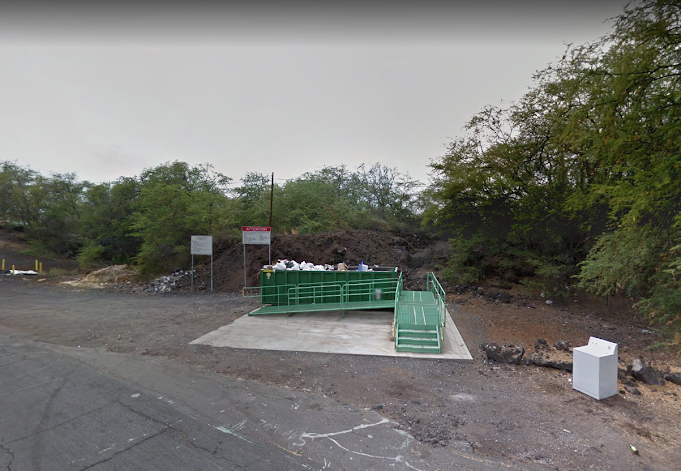
What to do with Miloli'i's trash is the subject of discussions between the county and the community
now that the state has asked the county to shut down this transfer station, which was on conservation land.
The last day of its operation was Saturday. Photo from County of Hawai'i

SATURDAY WAS THE LAST DAY FOR MILOLI'I TO USE ITS TRASH TRANSFER STATION provided by the county. It was located down at the bottom of Miloli'i Road, which allowed household members, community centers and vacation rental occupants and cleaners to avoid hauling it up the steep mountain and onto Hwy 11 to either Ocean View or Waiea transfer stations. They are each about 12 miles away from Miloli'i Road intersection along Hwy 11. 
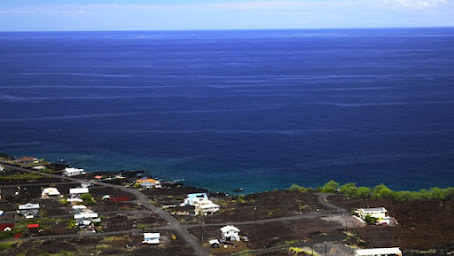
The county and community of Miloli'i are looking for solutions for
trash pickup now that the county transfer station closed.
Photo from University o Hawai'i
 Community member Kaimi Kaupiko said there is some drama surrounding the situation but there is interaction with the county to help provide a solution. Solutions could include a non-profit or private enterprise organized to pick up garbage from homes at Miloli'i and additional focus on recycling and upcycling.  Outreach is being conducted to estimate costs of contracting existing or new garbage entities to do the job. How the operation would be paid for is part of the research for proposals by community and the county.
    Deputy Director of the county Department of Environmental Management Brenda Iokepa Moses said the staff looks forward to working on a solution that would save each family from driving garbage up the steep mountain from the oceanfront Miloli'i community.
    Should a private rubbish hauling company be formed, it would have to haul to a county site that allows commercial dumping, the closest being Waikoloa. The county has been looking at the possibility of upgrading Wai'ohinu transfer station so that local garbage haulers and businesses with commercial rubbish would not have to make the long drive.
    In the meantime, the county adjusted its hours for Ocean View Transfer Station at 92-9017 Māmalahoa Hwy. It is open Tuesday, Friday, Sunday from 6 a.m. to 6 p.m. Hours are adjusted at Waiea Transfer Station at 86-3895 Hawai‘i Belt Road to Monday, Thursday, Saturday from  6 a.m. to 6 p.m.

 To read comments, add your own, and like this story, see www.facebook.com/kaucalendar/. See latest print edition at www.kaucalendar.com.

FOLLOWING THE VOLCANIC ERUPTION AND TSUNAMI, KINGDOM OF TONGA WILL RECEIVE $2.5 MILLION IN USAID MONEY. Congressman Ed Case announced the contribution on Saturday from U.S. State Department’s Agency for International Development. He said the $2.5 million is for critical assistance to the Kingdom of Tonga in the aftermath of the destructive eruption of the Hunga Tonga-Hunga Ha’apai volcano. This funding follows an initial $100,000 provided to the Tonga Red Cross Society "that will fund critical water, sanitation and hygiene supplies and support disease prevention campaigns to reduce the spread of infectious disease,” said Case.
    The humanitarian aid comes after the underwater volcano erupted on January 14 and 15, the biggest recorded anywhere on the planet in 30 years. It triggered widespread damage to Tonga's many islands with heavy ashfall and a tsunami felt across the Pacific, noted Case.
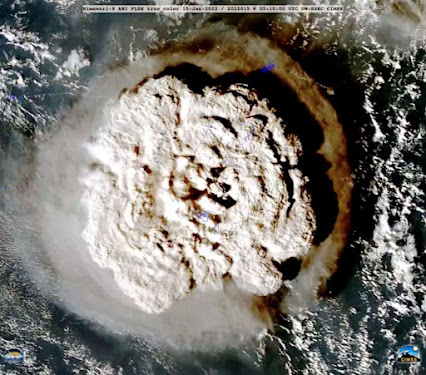
Destruction from the explosion of the underwater Hunga Tonga-Hunga Hapa'i
 Volcano and its tidal waves have drawn USAID funding. Photo from NOAA
    According to a report from USAID Bureau for Humanitarian Assistance, Tonga Red Cross Society reported more than 100,000 people—nearly the entire Tongan population—were affected. Two eruptions and subsequent tsunami waves resulted in at least three deaths, with waves recorded as high as 49 feet in certain areas, according to the Government of Tonga. 
    USAID reported that the volcanic eruptions and tsunami also caused significant disruptions to telecommunications systems nationwide, hampering damage and needs assessments.Tsunami waves reached inland in some parts of Tonga, inundating outlying islands and population centers, including the capital of Nuku’alofa. They damaged and destroyed houses, public infrastructure, and water supplies. Volcanic ashfall affected air and water quality. An estimated inch of ashfall covered major populated islands of Tonga, within 40 to 60 miles from the volcano, the UN reported. "Inundation and ashfall have also affected livelihoods in Tonga, particularly among agricultural and coastal communities," said the USAID statement.
    Earlier this week, Case and his fellow co-chairs of his bipartisan Pacific Islands Caucus in the U. S. House of Representatives sent a letter to President Joe Biden, with copies to Secretary of State Antony Blinken, Secretary of Defense Lloyd Austin, and USAID Administrator Samantha Power, urging immediate and full action to assist Tonga.
    The letter states: “Given reports of extensive damage from both the tsunami and ashfall, we are deeply concerned for the health and welfare of the roughly 100,000 residents of Tonga.” In their letter, the Members of Congress added: “We stand ready to work with you to ensure that assistance is promptly delivered to address this ongoing disaster and that support continues as Tonga rebuilds.”
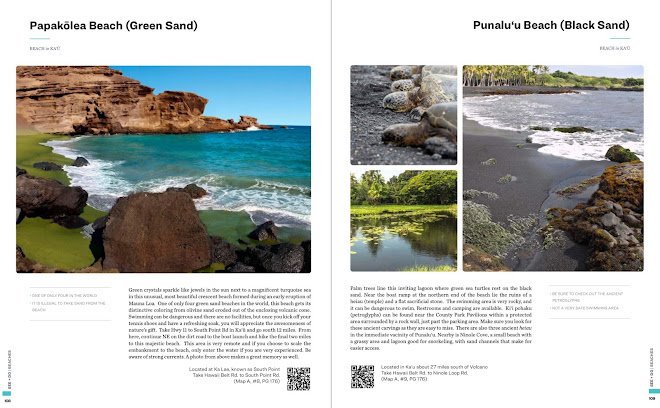
A two page spread in the popular SAVVY360 HAWAI'I magazine, distributed at resorts
and other venues on Hawai'i Island, plus online through its app and at https://savvy360.media/

 To read comments, add your own, and like this story, see www.facebook.com/kaucalendar/. See latest print edition at www.kaucalendar.com.

PUNALU'U BLACK SAND BEACH AND PAPAKOLEA GREEN SAND BEACH are highly promoted, driving almost daily streams of visitors to them. The promotions are abundant in print, online travel guides and magazines, contests for the world's best beaches, and on social media where visitors share their photos and enthusiasm.
    Descriptions of Punalu'u, Papakōlea Green Sand and others beaches around the island are often included among writings and photos about paid-for visitor activities like zip lines, dive tours, fishing excursions, ATV tours to waterfalls, and stargazing. Beaches are also included among postings and pages on shopping, dining, accommodations and where to buy real estate on Hawai'i Island.

SAVVY360 can be read on its platforms. See https://savvy360.media/
    One difference between paid-for visitor attractions and attraction to public beaches is that visitors to most public beaches do not provide direct income for beach stewardship. Many beaches are without enough government money to maintain and manage them and to prevent overcrowding.
    Both Papakōlea Green Sand and Punalu'u are described in many publications and postings. One recent example is the print and online magazine, with accompanying app, called SAVVY360 HAWAI'I, subtitle CURATED TRAVEL + LIFESTYLE.  Its current issue offers a two page spread describing Punalu'u and Papakōlea Green Sand Beaches, with photos and barcodes to direct people to them, writing about Hawaiian culture, archeology and wildlife and cautionary advice about ocean conditions.
   The Punalu'u description says, "Palm trees line this inviting lagoon where green sea turtles rest on the black sand. Near the boat ramp at the northern end of the beach lie the ruins of a heiau (temple) and a flat sacrificial stone. The swimming area is very rocky, and it an be dangerous to swim. Restrooms and camping are available. Ki'i pohaku (petroglyphs) can be found near the County Park Pavilions within a protected area surrounded by a rock wall, just past the parking area. Make sure you look for these ancient carvings as they are easy to miss. There are also three ancient heiau in the immediate vicinity of Punalu'u. Nearby is Ninole Cove, a small beach with a grassy area and lagoon good for snorkeling, with sand channels that make for easier access."

    The Papakōlea Green Sand Beach description says, "Green crystals sparkle like jewels in the sun next to a magnificent turquoise sea in this unusual, most beautiful crescent beach formed during an early eruption of Mauna Loa. One of only four green sand beaches in the world, this beach gets its distinctive coloring from olivine sand eroded out of the enclosing volcanic cone. Swimming can be dangerous and there are no facilities, but once you kick off your tennis shoes and have a refreshing soak, you will appreciate the awesomeness of nature's gift. Take Hwy 11 to South Point Rd in Ka`u and go south 12 miles. From here, continue NE on the dirt road to the boat launch and hike the final two miles to this majestic beach. This area is very remote and if you choose to scale the embankment to the beach, only enter the water if you are very experienced. Be aware of strong currents. A photo from above makes a great memory as well."
    How to fund and manage the stewardship of these beaches is coming up in community discussions on the future of Punalu'u, its county beach park and adjacent resort, commercial and residential properties. It is also coming up regarding Papakōlea Green Sand Beach as the Department of Hawaiian Home Lands 
management planning proceeds.
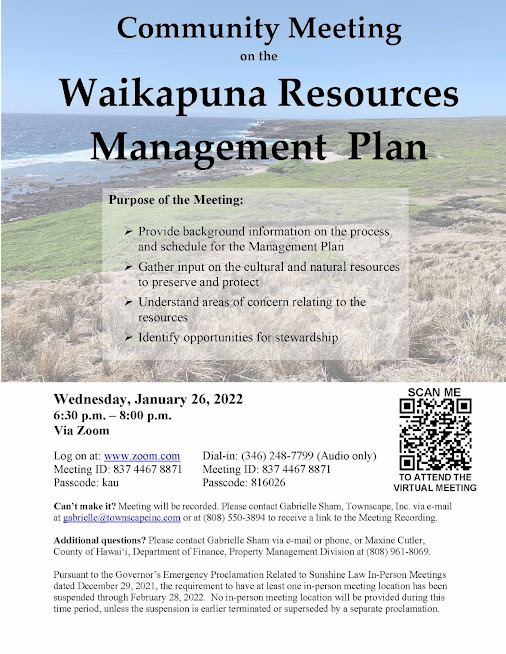
    Other shoreline areas on the Kaʻū Coast, under stewardship of the county and non-profit organizations, are subject of developing Resources Management Plans. One of them is Waikapuna, located between Punalu'u and Green Sand beaches. A community-input zoom meeting is scheduled for this Wednesday, Jan. 26 at 6:30 p.m. Log on at www.zoom.com. Meeting ID: 837 4467 8871. Passcode: kau.

 To read comments, add your own, and like this story, see www.facebook.com/kaucalendar/. See latest print edition at www.kaucalendar.com.
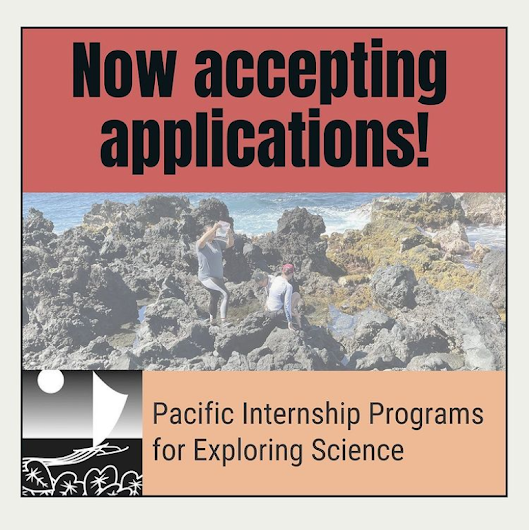
The Pacific Internship Programs for Exploring Science (PIPES) is accepting applications

for its summer 2022 internship program. PIPES is a 10-week undergraduate internship

program May 31 to Aug. 5, offered through University of Hawai'i at Hilo.

The goal is "to connect under-represented undergraduate students, especially those

who are Native Hawaiian or kamaʻāina, to internship opportunities with agencies and

organizations responsible for research, management, and education relating to

environmental issues in Hawaiʻi and throughout the Pacific region. Internships are

paid experiences. Participants may be eligible for additional housing assistance.

For more information, visit: https://hilo.hawaii.edu/uhintern

The deadline to apply is January 31, 2022.

See archives of The Ka`u Calendar at
www.kaucalendar.com and find the
monthly print copy in mailboxes from 
Volcano through Ocean View.