About The Kaʻū Calendar

Saturday, February 12, 2022

Ka‘ū News Briefs, Saturday, Feb. 12, 2022

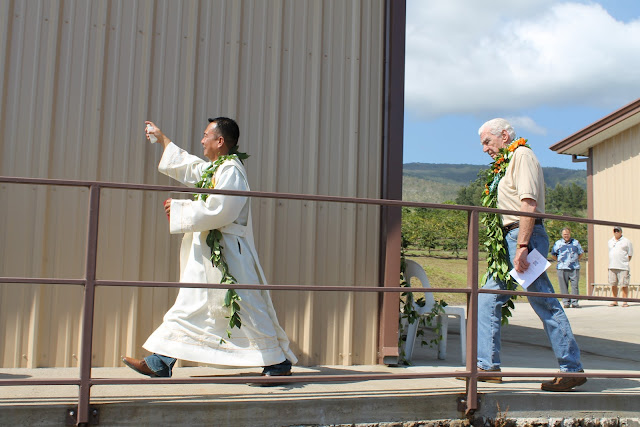
Father Joel blessed Kaʻū Coffee Mill for owner Edmund C. Olson in 2012. This week, Olson closed on selling
 his Olson Trust headquarters at Wainaku in Hilo for another agricultural processing venture, Okolehao
 by Ola Brew. Photo by Geneveve Fyvie

AN OKOLEHAO DISTILLERY is the plan for Edmund C. Olson's headquarters on Hilo Bay. The owner of Kaʻū Coffee Mill, coffee farms and macadamia orchards, including some 8,000 acres in Kaʻū, sold its Wainaku Executive Center to Ola Brew, the maker of beers, ciders, hard seltzers and hard teas. The deal closed Friday morning, said Olson.
     Wainaku Executive Center is a former sugar warehouse that was renovated by the late J.W.A "Doc" Buyers, the last CEO of the C. Brewer & Co. agricultural company. He moved moved the C. Brewer headquarters from Honolulu to to Wainaku in Hilo.

    C. Brewer owned some 38,000 acres in Kaʻū, including some 8,000 around Kaʻū purchased by Olson. Olson bought macadamia orchards, pastures and sugar lands from Brewer and started  processing and growing coffee and macadamia. He also bought Brewer's headquarters at Wainaku in 2012 after C. Brewer shut down.    
    The new venture at Wainaku will be owned and led by Ola Brew, and preliminary plans call for a distillery and growing ti plants on the property. A tasting room for Okolehao and Ola Brew's other products is planned, according to Olson Trust representatives.
    Ti used for Okolehao also provides the leaf for wrapping food for cooking in imu and steaming laulau, as well as making ti leaf lei. For Okolehao, ti provides the root from which distilling makes the alcoholic drink. Ola Brew has already started growing ti on the island and has won awards. For its Okolehao spriits, Ola Brew last year took Double Gold and Best in Class in the @sfworldspiritscompetition. An Ola Brew statement explains the background: 
    "What is Okolehao? Brewed and then distilled from 100% Hawaiian grown ti root. Okolehao was the first alcohol produced and consumed in Hawai'i centuries ago. Once the ti root is harvested, we roast it to
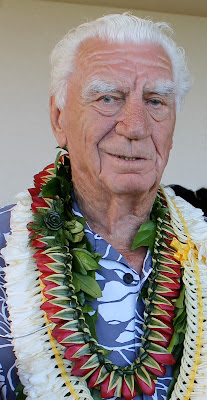
Ed Olson at the blessing of the Wainaku
 Center in 2012. It is soon to become a
distillery for Okolehao. Photo by Julia Neal


break down and release its sugars, giving us a caramelization that enhances the unique earthiness of the spirit with layers of flavor and a lingering subtle sweetness.
    "Every part of the ti plant, from the root to the leaves, has been used for centuries throughout Polynesia. In Hawai'i we use them for lei making, food preservation, medicinally and in ceremony, and of course in Okolehao. But here is the kicker! Ti just so happens to be in the same family as agave, which is the signature crop for the production of tequila!
    "Ola Brew is so very excited to perpetuate the traditions of Okolehao production using organically and responsibly grown ti, cultivated right here on Hawai'i Island!"
    Ola Brew's facilities already include a brewery, taproom and restaurant in Kona and a taproom and restaurant in Hilo. 
    According to Ola Brew, "Hawaiian Ola Brewing Corporation (dba Ola Brew) is a brewery with a focus on ethical and growth-oriented sourcing, working every day to help Hawai'i farmers increase their demand by ensuring a guaranteed market for their crops. We’ve successfully grown a brand of over 25 beverages in Hawai'i, including beers, hard ciders, and hard seltzers."
    See more on Ola Brew at www.olabrewco.com.

To read comments, add your own, and like this story, see www.facebook.com/kaucalendar/. See latest print edition at www.kaucalendar.com. See upcoming events and Kaʻū Calendar newspaper sponsors at http://kaunewsbriefs.blogspot.com/2022/02/events-of-february-2022.html.


STATE SENATOR DRU KANUHA who represents west Kaʻū into Kona, is reaching out to all of Kaʻū in anticipation of running for reelection. He has placed a message in The Kaʻū Calendar newspaper, February edition, saying:
      "It has been an honor representing parts of Kaʻū in the Hawai'i State Senate since 2018. Together, we've improved the schools and health care facilities our families count on, protected our Kona and Kaʻū coffee farmers, worked to expand access to broadband connectivity, and come together to care for our community through the COVID-19 pandemic."
     This year, Senate District 3 will expand to include Pāhala and Volcano Village. Over the coming months, I look forward to meeting you, and learning how I can best advocate for our needs, and earning your trust and your vote. Mahalo for the opportunity to serve you!"

To read comments, add your own, and like this story, see www.facebook.com/kaucalendar/. See latest print edition at www.kaucalendar.com. See upcoming events and Kaʻū Calendar newspaper sponsors at http://kaunewsbriefs.blogspot.com/2022/02/events-of-february-2022.html.

STATE SENATOR JOY SAN BUENAVENTURA continues to serve east Kaʻū through the 2022 Hawai'i Legislature. This year, she is expected to run for reelection for a district outside of Kaʻū, following  reapportionment changing district lines. The district now served by Sen. Dru Kanuha will change to reach into Volcano and include all of  Kaʻū.
     In wrapping up her service here, San Buenaventura sent out a survey card through U.S. Mail this week and asks:

Sen. Joy San Buenaventura is in her
last term serving Kaʻū, with her
district borders moving east
.
      "What do you think is the most important issue facing our community?" The choices are Food Insecurity, Lack of Support for Educatio, Lack of Childcare, Lack or Work Opportunities/Trainin; Traffic, No Internet Access - No Coverage Area, and Increase of Crimes.
      San Buenaventura also asks about infrastructure needs, including Poor Internet Access, No Alternate Roads and a fill-in-the-blank. "What is your biggest issue?" asks the senator, with the query, "What would promote a better quality of life for you in our community?"
      The answers can be given online at https://tinyurl.com/202202-D2survey.

To read comments, add your own, and like this story, see www.facebook.com/kaucalendar/. See latest print edition at www.kaucalendar.com. See upcoming events and Kaʻū Calendar newspaper sponsors at http://kaunewsbriefs.blogspot.com/2022/02/events-of-february-2022.html.
 
THE VOLCANO ERUPTION AT HUNGA TONGA-HUNGA HA'APAI on Jan. 15 was recorded on this island. That is the subject of this week's Volcano Watch, written by USGS Hawaiian Volcano Observatory scientists and affiliates:
    Hunga Tonga-Hunga Ha’apai volcano located in the Kingdom of Tonga produced a powerful eruption on Jan. 15 just after 5 p.m. Tonga Time. The Tonga eruption was recorded on pressure sensors over a wide number of places around the world, including the Island of Hawai‘i about 4,900 kilometers (3,000 miles) away.
Eruption of Hunga Tonga-Hunga Ha'apai captured by NASA satellites and by pressure 
sensors on Hawai'i Island. Images from NASA


   Hunga Tonga-Hunga Ha’apai is located about 64 kilometers (40 miles) north of the Tongan capital city of Nuku’alofa. As with many volcanoes in Tonga, the part of the volcano that is visible above water is small compared to the submarine extent of the edifice and eruptions can alternately grow new land or destroy any islands that are formed.
   The volcano previously erupted in 2014-2015 in an extended sequence that created one larger island by connecting two separate islets. After this episode, the volcano went into a quiet period but it re-awakened in mid-December 2021.
   The largest eruption occurred on Jan. 15 from about 5:10 to 5:30 p.m. TOT, about 6:10 to 6:30 p.m. Hawaii Standard Time on January 14, and shot ash and hot gas tens of kilometers (several miles) into the atmosphere. Several centimeters (about 1 to 3 inches) of ash was deposited on the main island of Tongatapu and Nuku’alofa.
   The skyward rushing ash column was amongst highest observed in modern times and this column generated strong air pressure waves which moved up from the volcano and spread outward from Tonga. Incredibly, the air pressure waves were observed over the entire Earth and people in Alaska (nearly 10,000 kilometers or 6,000 miles away) heard sounds from the eruption. How was this possible?
    Volcanic eruptions produce significant pressure waves from the ejection of rocks and ash. These pressure waves in the air can occur at many different frequencies, from very high frequencies that we hear as sounds (audible) and at lower frequencies that we cannot hear at all (called infrasound). Both types of waves were generated by the recent eruption in Tonga.
    The pressure waves might dissipate quickly if the Earth's atmosphere were uniform. Instead, the atmosphere is layered, and these layers help sound to move efficiently. For pressure waves, the layers relate mostly to the temperature and wind speed of the air and the efficient movement of these waves occurs in the layers called the troposphere, stratosphere and thermosphere.
    The speed that pressure waves travel through the Earth’s atmospheric layers is about 1,100 kilometers or 700 miles per hour. At those speeds it would take a little more than 4 hours for the sound to travel from Tonga to Hawaii.
    The USGS Hawaiian Volcano Observatory operates a set of microphone-like pressure sensors that are deployed to "listen" to our own volcanoes. If there is a large global eruption, and the atmospheric conditions allow, then that eruption can also be captured on the HVO pressure sensor network.

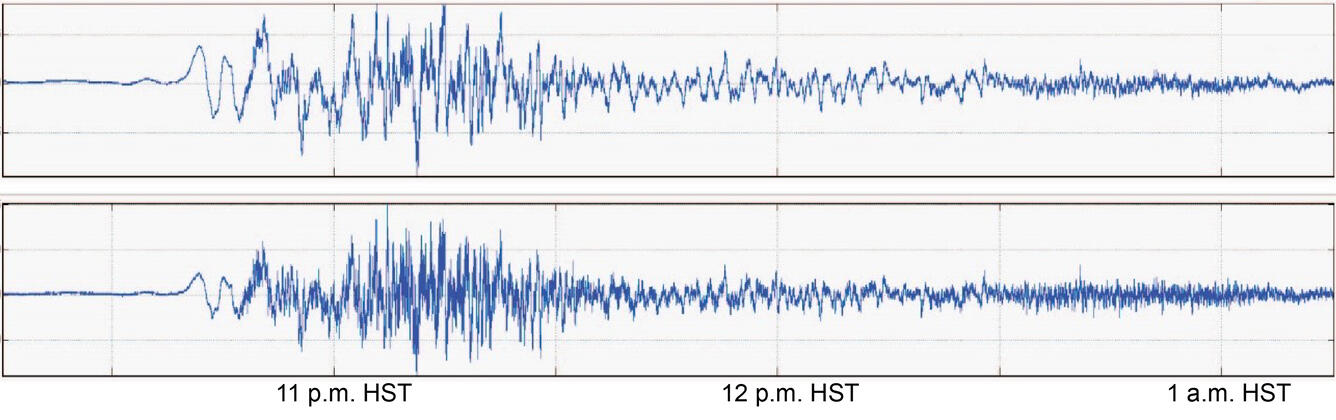
Pressure waves from the Hunga Tonga-Hunga Ha’apai eruption on Jan.  15 recorded on two USGS Hawaiian Volcano Observatory infrasound sensors located south of Kīlauea volcano summit. The record is about four hours long. USGS graphic.

    If we look at the pressure sensor data for the time about four hours after the recent Tonga eruption, we see a large pressure pulse moving over Hawaii (see the two sensor recordings in the figure) at 10:40 p.m. HST on January 14. While Hawaii’s pressure sensor network is designed to detect eruptive activity for Mauna Loa, Kīlauea, and along the Hawaiian rift zones, it also captured the sound waves from the distant Tonga eruption.
    Close inspection of the waves observed in the figure illustrates the idea of audible and infrasound waves discussed earlier.
    The pressure waves are wider at the start of the event and become narrower with time. Since the plot shows wave size with time, this means the earlier waves (left side of the plot) show slow changes of pressure with time. With more time passing, the wave pressure oscillates more quickly. This means that the first waves are low frequency, and the later waves are higher frequency.
    The human ear can generally hear pressure changes higher than about 20 cycles per second (or 20 hertz). Most of the waves shown in the plots are very low frequency and would not be detected by the human ear.
   In Hawai'i, there were no reports of the Tonga eruption being heard, but they were seen traversing the atmosphere on top of Mauna Kea.
    The observation of audible sound waves in Alaska and inaudible waves elsewhere is a topic of interest from scientists, who are looking at the ways that pressure waves propagate in the atmosphere. Regardless, the observation of sound waves moving over the entire Earth is remarkable.

To read comments, add your own, and like this story, see www.facebook.com/kaucalendar/. See latest print edition at www.kaucalendar.com. See upcoming events and Kaʻū Calendar newspaper sponsors at http://kaunewsbriefs.blogspot.com/2022/02/events-of-february-2022.html.


SEE CALENDAR OF EVENTS & SPONSORS

See the February Print Edition of The 

Friday, February 11, 2022

Ka‘ū News Briefs, Friday, Feb. 11, 2022

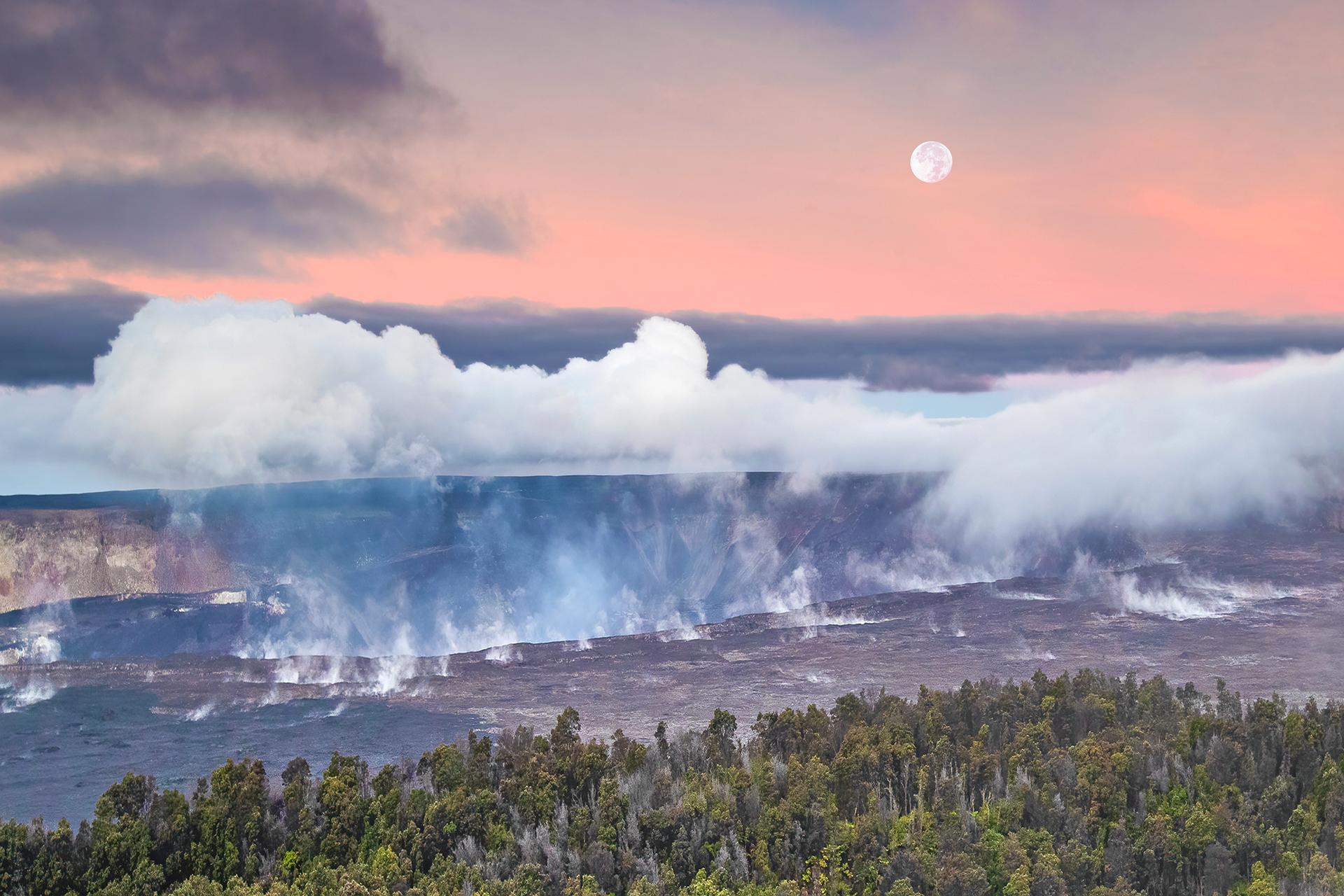
Full moon above a steaming volcanic crater
A full moon above Kaluapele, as Hawai'i Volcanoes National park and USGS seek input on demolishing the severely damaged
Jaggar Museum and other buildings and construct new facilities away from Kīlauea crater's edge. See more below.
Photo by Janice Wei/National Park Service

MICHELLE GALIMBA IS RUNNING FOR COUNTY COUNCIL for District 6, which covers all of Kaʻū, into Volcano and into South Kona. She made the announcement on Friday.
    "Having been born in Kealakekua and spent my childhood in Kapua in South Kona and Nāʻālehu and Waiʻohinu in Kaʻū, as well as having lived in Volcano for a number of years, I have a great love for our beautiful, vast district, and I hope to have the honor of serving this place and its people on the County Council. By working together we can make extraordinary things happen in this extraordinary place that is our ʻaina, our home."
    As a current member of the Windward Planning Commission, a former member of the County Charter Commission, as well as a former member of the Kaʻū Community Development Plan Steering Committee, Galimba said, "I have many years of experience in listening to and working with community members to craft policies and make decisions that express our values and our vision for the future."
    As a rancher and business-person, Galimba said, "I have built a successful business around providing grass-fed, locally grown beef to local markets. As an advocate for local agriculture and farmers, I have worked with the Kaʻū coffee farmers to build a market for their world-class coffee, including coordinating the first Kaʻū Coffee Festival.
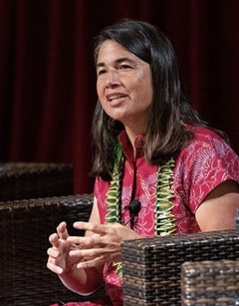
Michelle Galimba is running for County Council to serve
Kaʻū and other rural areas.
    
    During the COVID-19 pandemic Galimba worked with Vibrant Hawaiʻi, O Kaʻū Kakou and the Nāʻālehu Hongwanji to use CARES Act funding from the County of Hawaiʻi to help local restaurants and farmers stay in business, to provide free meals to the most vulnerable residents, and to provide access to internet and laptop computers at the Nāʻālehu Resilience Hub.
    Along with the Trust for Public Land and the Ala Kahakai Trail Association, "I have also worked to preserve thousands of acres of our coastline and agricultural lands by helping to secure public funding for land acquisitions and for putting in place agricultural and cultural resource conservation easements that protect these lands from development in perpetuity."
    She said, "In my experience working together is what gives us the power to make good things happen."
    Galimba promised to "work hard to bring resources to our district by engaging with the Hawaiʻi County administration to ensure that our Districtʻs needs are recognized and acted upon. I will work with the Department of Parks & Recreation to ensure that our public parks have the funding, equipment and manpower they need, and with the Department of Environmental Management to repair and improve our transfer stations. I will work with the Department of Research & Development to create opportunities for new jobs and businesses in our district."
    Galmba said, "We have a responsibility preserve the cultural and natural resource of our district and island. At the same time, it is critical to create opportunities for prosperity and well-being for all. If elected to the County Council, these responsibilities and values will guide my work in serving District 6."
   Galimba, 53, is daughter of Alfred and Sami Galimba. Alfred Galimba is a cattle rancher and dairyman, formerly managing some of the largest dairy farms in the state. He worked at Nāʻālehu Dairy as well as Hawaiian Ranch when those were subsidiaries of C. Brewer & Co. Sami Galimba is a cattle rancher, business-woman, and a school teacher starting at Pāhala Elementary in the 1960ʻs. 
    The candidate is the grand-daughter of the late Eustaquio and Carlina Galimba, long-time residents of Waiʻohinu and the late 
James and Catherine Nellis of Walton, NY. She has three brothers: Raschad, Garrett and Guy Galimba. Along with the late Timothy Alencastre of Volcano, she is the parent of Ua Alencastre-Galimba, who graduated from Kamehameha Schools summa cum laude in 2019 and currently is a junior at Harvard University in Cambridge, MA.
     Galimba chairs the USDAʻs Farm Service Agency County Committee, which helps farmers and ranchers to recover from disasters, and represents Hawaiʻi on the USDAʻs Western Region Sustainable Agriculture Research and Education Program. She has formerly served an eight year term on the State of Hawaiʻiʻs Board of Agriculture. She also is a member of AgHui, a network of agricultural stakeholders dedicated to raising up local agricultural producers and food systems. She is a graduate of the Hawaiʻi Agricultural Leadership Program and had the honor of being the keynote speaker for the Hawaiʻi Agricultural Conference in October 2019.
County Council candidate Michelle Galimba
says she wants to help Kaʻū grow more 
businesses, particularly in agriculture.
    
    Galimba serves on the board of HEMIC (Hawaiʻi Employers Mutual Insurance Company), the Agricultural Leadership Program of Hawaiʻi, the Big Island Resource Conservation and Development Council, and has previously served on the board of Farm Credit Services of Hawaiʻi, Hawaiʻi County 4-H Livestock Association, Vibrant Hawaiʻi, Ka Ohana O Honuʻapo, Kaʻū Farm Bureau, and the County of Hawaiʻi Commission on the Status of Women, She is also a contributor to the anthology Food and Power in Hawaiʻi: Visions of Food Democracy.
    She is a graduate of Punahou School, has a B.A. in Asian Studies from the University of Oregon, and a M.A. and Ph.D in Comparative Literature from the University of California Berkeley. She has taught Mandarin Chinese and World Literature at the University of Hawaiʻi Hilo.
    Along with her brother Guy Galimba, she owns and manages Kuahiwi Ranch and Kuahiwi Ranch Store, which sells livestock feed, local beef, eggs and honey in Nāʻālehu. 
    Galimba said that as a small business owner, she provides agricultural and retail employment opportunities in the district. Having helped to grow the family ranch and business from one cow in 1993 to its present herd of over 3,000 head, she said she "knows that government can both help or hinder local businesses, and would like to help our district and county grow more businesses especially in agriculture."
    See Galimba's campaign website at www.votegalimba.com.

To read comments, add your own, and like this story, see www.facebook.com/kaucalendar/. See latest print edition at www.kaucalendar.com. See February events and Kaʻū Calendar newspaper sponsors at http://kaunewsbriefs.blogspot.com/2022/02/events-of-february-2022.html.

These buildings, damaged during the 2018 volcanic eruption and summit collapse at Kilauea volcano, are slated for removal under
 the Disaster Recovery Project at Hawai'i Volcanoes National Park. Public input is due March 11. NPS photo

COMMUNITY INPUT IS SOUGHT FOR HAWAI'I VOLCANOES NATIONAL PARK, which plans to  demolish the former Jaggar Museum, Okamura Building and Geochemistry Annex on Kīlauea Summit. They were damaged beyond repair during the 2018 volcanic eruption and summit collapse on Kīlauea volcano. Virtual meetings are scheduled on Thursday Feb. 24 at noon and 6 p.m. There are additional  multiple ways to give input, which is due March 11.
    The community outreach is part of the Disaster Recovery Project to repair, replace, relocate or remove critical park infrastructure and USGS-operated facilities and equipment damaged during the 2018 eruption and summit collapse. Under the proposed action, the National Park Service would:
• Demolish three damaged structures at Uēkahuna Bluff on the Kīlauea summit (the former Jaggar Museum, the Okamura Building and the Geochemistry Annex).
• Repair and restore access to the existing overlook area at Uēkahuna adjacent to the former Jaggar Museum.
• Replace the Jaggar Museum visitor center function with a new building near the existing Kīlauea Visitor Center by the park entrance. KVC would still be used for administrative offices and K-12 educational programs, and the auditorium would still host public presentations.
• Realign Crater Rim Drive near the park entrance and install a roundabout to improve safety.
• Allow USGS to construct a replacement field station adjacent to the ball field by Kilauea Military Camp in the park.

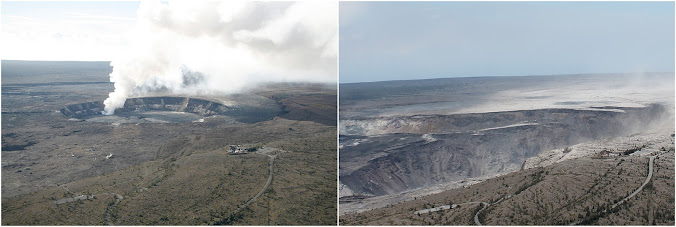
At left shows the Kilauea before the eruption and summit collapse in 2018. At right is the aftermath.
NPS photos
   The public is invited to review project details online, attend a virtual meeting and submit input before March 11 in the following ways:
    Online: The preferred method for receiving input comments is through the NPS Planning, Environment, and Public Comment website at https://parkplanning.nps.gov/HAVODisasterRecovery. Detailed project information, including a story map with video and more are available on the PEPC website.
    Phone: There is a dedicated phone line for receiving comments. People can leave a detailed message or request someone calls them back by calling 808-460-6212.
    Attend a Virtual Meeting: The public is invited to attend one of two virtual public meetings on Thursday, Feb. 24, either from noon to 1 p.m. or from 6 p.m. to 7 p.m. The same information will be presented at both meetings so it is necessary to only attend one meeting. The Disaster Recovery Project presentation will be at the top of the hour:
     Feb. 24, 12 p.m. to 1 p.m. HST: Join the online meeting: https://swca.zoom.us/j/91430664015. Those without access to internet can join by phone: (888) 475-4499 US Toll-free; Meeting ID: 914 3066 4015.
     Feb. 24, 6 p.m. to 7 p.m. HST: Join the online meeting: https://swca.zoom.us/j/97252271515. Those without access to internet can join by phone: (888) 475-4499 US Toll-free; Meeting ID: 972 5227 1515
    The statement from Volcanoes National Park says, "The meetings will provide an opportunity for the public to learn more about the project, have discussions with NPS and USGS staff and provide input. Comments received on the proposed action will be reviewed, analyzed and considered for the environmental assessment. The meetings will be recorded and a link to the recording will be posted on the project website: https://parkplanning.nps.gov/HAVODisasterRecovery."
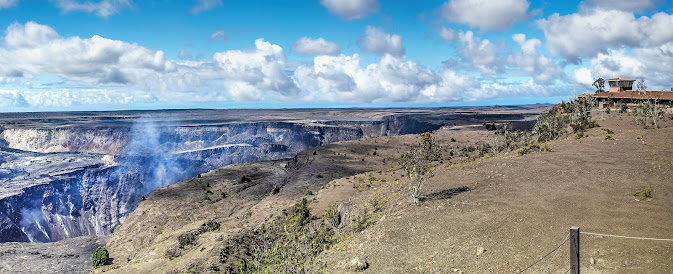
Panoramic view from Uēkahuna looking west towards former Jaggar Museum site (Okamura building on the right). NPS photo

    The Park's notice on the meetings and public input reviewed the disaster that led to planning for demolition of the old and building new facilities away from the crater's edge: 
    "Beginning in May 2018, the park and Kīlauea summit underwent a major change as magma drained from the chamber beneath Halema‘uma‘u Crater, and the caldera began to collapse, triggering thousands of felt earthquakes and clouds of rock and ash that continued until early August. The seismic activity was primarily centered near the crater, and significantly impacted buildings in the immediate vicinity on Uēkahuna Bluff, including Jaggar Museum and the USGS-operated Okamura facility and equipment, resulting in the closure of the area. The 2018 eruption and caldera collapse were the most destructive eruptive events in Hawai‘i in the last two centuries, and the park closed to the public for 134 days. 
    "The results of post-disaster assessments found that significant investment would be necessary to make Jaggar Museum and the USGS Hawaiian Volcano Observatory-operated Okamura building and Geochemistry Annex safe to occupy and operational. The buildings are surrounded by fault lines and the area continues to subside on the crater side, undermining slope stability at the existing terraces and building foundations."
    See much more on the project website at https://parkplanning.nps.gov/HAVODisasterRecovery

To read comments, add your own, and like this story, see www.facebook.com/kaucalendar/. See latest print edition at www.kaucalendar.com. See upcoming events and Kaʻū Calendar newspaper sponsors at http://kaunewsbriefs.blogspot.com/2022/02/events-of-february-2022.html.

THE HELE-ON BUS WILL BE FREE THROUGH 2023 OR LONGER. The County Council approved the measure this week. Free ridership was proposed by new county Public Transit administrator John Andoh.
    Grants will be used to pay for the cost of the service, he said.
      Hele-On already stopped selling most of its tickets on Jan. 17, only selling passes good through February.            
     The free bus and para-transit service is expected to begin March 1 or sooner. The idea is to break down barriers to taking the bus, so more people will choose Hele-On and leave cars and trucks at home. See the routes and other Hele-On news at www.heleonbus.org and on the Hele-On facebook page.

To read comments, add your own, and like this story, see www.facebook.com/kaucalendar/. See latest print edition at www.kaucalendar.com. See upcoming events and Kaʻū Calendar newspaper sponsors at http://kaunewsbriefs.blogspot.com/2022/02/events-of-february-2022.html.

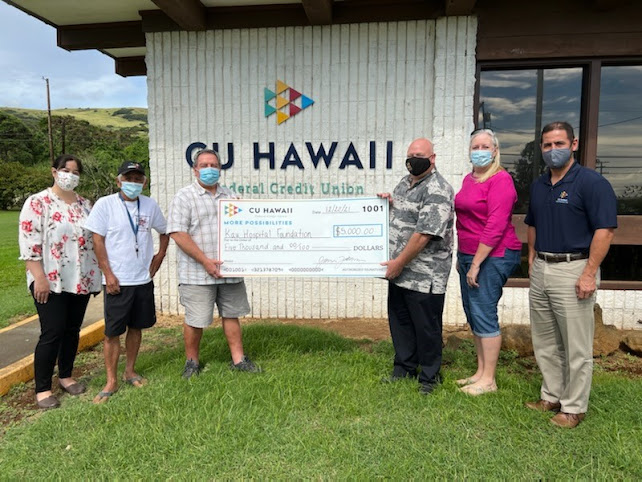
CU Hawai'i Federal Credit Union recently provided a $5,000 check to Kaʻū Hospital Foundation through a  promotion that 
gave a donation from each personal loan made to members. Right to left are Kaʻū Hospital Administrator Jennifer Aguiar, 
Kaʻū Hospital Foundation President Wayne Kawachi, Foundation board member Patrick Getchus,  CU Hawai'i's Kaʻū 
manager Mark Peters, Foundation secretary/treasurer Jean Kailiawa and CU Hawai'i President and CEO James Takamine, 
Photo from CU Hawai'i

CU HAWAI'I FEDERAL CREDIT UNION PROVIDED $5,000 TO KAʻŪ HOSPITAL FOUNDATION in a recent ceremony. CU Hawai'i made the contribution through a “personal touch” in a recent personal loan promotion, giving back funds to hospital foundations on Hawai'i Island. Ka'u Hospital's sister facility, Hilo Medical Center's Foundation also received $5,000, as did Kona Hospital Foundation. 
     CU Hawai'i, with its slogan "More Possibilities,"  offered a personal loan with a great rate, and pledged  a donation for each loan booked to go towards the three island hospitals. 
      A statement from CU Hawai'i says its staff and management "were honored to be able to promote and facilitate this amazing loan special. They are passionate about letting their hearts drive them towards opportunities that make a difference in the lives of their members and community. Where their motto is to provide 'More Possibilities,' they are hopeful that these donations can do just that."
      CU Hawai'i has over 66 years of community-rich history, as a member-owned, not-for-profit cooperative financial institution. This allows CU to provide competitive rates, lower fees, free services and more opportunities for the membership and community. CU Hawai'i has seven branches serving the east, west, north and south sides of the island. In addition, CU sponsors a student credit union.

To read comments, add your own, and like this story, see www.facebook.com/kaucalendar/. See latest print edition at www.kaucalendar.com. See upcoming events and Kaʻū Calendar newspaper sponsors at http://kaunewsbriefs.blogspot.com/2022/02/events-of-february-2022.html.

ENTREPRENEURS, STARTUPS, AND THE BOOMING FOOD WASTE BUSINESS is the theme of a virtual forum on Monday, Feb. 14 from 10 a.m. to 11:30 a.m. It will feature six guest panelists who are leading food waste innovators throughout Hawaiʻi and the continental U.S.
    Panelists include Phil Augustus Acosta, Executive Director of Aloha Harvest, the largest food rescue and redistribution organization in Hawaiʻi, as well as Vincent Mina, the president and founding member of Hawaiʻi Farmers Union United.
    The forum is sponsored by Maui Business Brainstormers, a grassroots group focused on "creating ways to help local entrepreneurs and new and existing businesses thrive on their journey from the ground up."        
    The goal of Monday's virtual forum is to generate solutions to tackle food waste on a local and global scale. According to MBB, "You will be amazed and inspired to act, to do your part. You may start a business focused on reducing food waste."
    To RSVP, visit https://www.natleshipweek-hawaii.org/feb-14-2022---food-waste---maui-hawaii.html.


SEE CALENDAR OF EVENTS & SPONSORS

See the February Print Edition of The Kaʻū Calendar at

Thursday, February 10, 2022

Ka‘ū News Briefs, Thursday, Feb. 10, 2022

After announcing his run for Governor, Lt. Gov. Josh Green, MD. dines with his wife Jaime Kanani Ushiroda at Moku Kitchen
on O'ahu. He started his medical career in the National Health Service Corps, serving Kaʻū.  Photo from Josh Green

JOSH GREEN IS OFFICIALLY RUNNING FOR GOVERNOR. The 51 year old physician and current Lieutenant Governor of Hawai'i got his start in medicine in Kaʻū when he worked for the National Health Service Corps after completing his residency. Folks remember him driving a jeep and living in the A-Frame house at Punalu'u beach, along with his big dog. He continues to serve in rural healthcare on weekends at Kohala Hospital emergency room on the north end of this island.
    His political career carried Green to the state House of Representatives from 2005 to 2009 and to the state Senate from 2009 to 2018. As a senator, Green became majority floor leader and chaired the Health  and Human Services Committees. He said he is especially proud of his work to pass Luke’s Law to provide care for children with Autism Spectrum Disorder, and his effort to pass Tobacco and E-cigarette Regulations, which increased the legal age of sale to 21 for tobacco and e-cigarette products.
    Green was named Hawai'i Physician of the Year in 2009 and Hawai'i Legislator of the Year in 2013.
Concerning his tenure as Lt. Governor, Green's website says, "In 2018, Josh became Hawai'i’s Lt. Governor, and when he saw the need for real solutions on homelessness, he helped build Kauhale communities and the H4 clinic to provide housing and care for those in need. 
Lt. Gov. Josh Green made it official on Thursday. He is running
for Hawai'i governor. Photo from Josh Green
  "When a measles epidemic hit Samoa in 2019, Josh led a team of doctors and nurses from Hawai'i, and within 48 hours they vaccinated 37,000 people and protected Samoa’s children.
    "Just a few months later COVID hit Hawai'i, and as COVID liaison Josh led the largest healthcare response in state history, pulling Hawai'i together to vaccinate over a million people, protect our kupuna, and save thousands of lives."
    Green held fundraisers and fielded input on a run for governor for at least six months. He made the official announcement Thursday by email and in media interviews.
     On his website at www.joshgreenforhawaii.com, he wrote, "As governor, I will work to build more affordable housing across our state, take action on the out of control cost of living, and take on our homeless crisis. I'll stand up for working people and finally sign into law paid family leave and a true living wage."
   The website has statements by Green on the following issues: Affordable Housing, Cost of Living, Homelessness, Building a Stronger Fairer Economy, Investing in the People of Hawai'i, and Nurturing Children.  See www.joshgreenforhawaii.com.   
    Green was was born in Kingston, New York and grew up in Pittsburgh. He received his bachelor's degree from Swathmore College and his medical degree from Pennsylvania State, completing his residency at Pittsburgh. 
     Green is married to Jaime Kanani Ushiroda, from Kaneohe, and has two children, Maia and Sam. In a piece called Our Values and Vision for Hawai'i's Future, Green says, "As parents of two children growing up in Hawai'i, Jaime and I want to do everything we can to help build the future that we want them to live in. A more just, peaceful, prosperous, and tolerant future where every person has the educational and economic opportunities they need to pursue their goals and dreams, where we treat each other with respect and dignity as members of one 'Ohana, and we never turn our backs on anyone or leave anyone behind.
    "A future where we can all rise together."
    The latest campaign spending report filed with the state showed Green with more than $1.1  million in his war chest, having raised more than $774,00 in the last six months of 2021.    
    Concerning other candidates, Hawai'i Tribune Herald reported on Thursday that Congressman Kai Kahele is considered a potential gubernatorial candidate, with no money raised last year and more than $48,000 in his war chest. He is also up for reelection to his U.S. House seat.  
    Hawai'i News Now named developer Peter Savio, who once attempted to buy and condominiumize the coffee lands above Pahala, and UFC fighter BJ Penn, of Hilo, as possible Republican contenders for the governorship. 
     For the Republican Party, Hawai'i Island's Paul Morgan, a business consultant, announced he would run. So did Lynn Miriano, a military veteran with the U.S. lndo Pacific Command. Anti-vaxer Aloha Freedom Coalition chief Gary Cordero, who earlier protested outside Green’s condo in downtown Honolulu, also announced a run for governor.

To read comments, add your own, and like this story, see www.facebook.com/kaucalendar/. See latest print edition at www.kaucalendar.com. See February events and Kaʻū Calendar newspaper sponsors at http://kaunewsbriefs.blogspot.com/2022/02/events-of-february-2022.html.

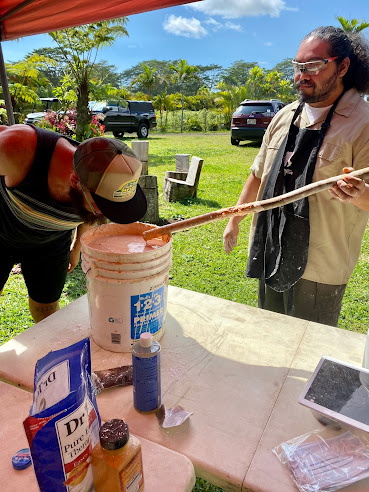
ANCIENT MAYAN TECHNIQUE FOR PREVENTING MALADIES IN FRUIT TREES was the focus of a workshop led by Tony Vera of Mayan World Farm on Thursday. It was sponsored by Hawaiʻi Farmers Union United Kaʻū Chapter and hosted by Matt and Andrea Drayer at Wood Valley Ranch.
    Vera showed participants how to make a Healing Wash solution to paint on the bark of trees. He said it deters harmful insects and pigs and protects the tree from pathogens and weathering. Vera said the solution also increases the pH of the soil and provides calcium, which can regulate nutrient absorption into the plants.
Tony Vera with his Healing Wash for fruit trees.
Photo by Katie Graham
     
    Vera said the rise of invasive insects and diseases threaten the health of fruit trees on this island. "We're getting introduced to a lot of pests here in Hawaiʻi that I feel are destroying a lot of our plants." He said the pests often come with imports to the island.
   Vera encouraged farmers to "look back in history at what we've been using," combining the ancestral ways of farming with the technology of the present. According to Vera, for those facing issues with the longhorn beetle, avocado lace bug, coffee berry borer, and more, the solution could help heal their trees and be used as a preventative measure.
    Vera said he developed his solution through studies in tropical agronomy and soil, experience as a farmer in Hawaiʻi, and knowledge gained from his father and local elders from his village in Belize. Ingredients include neem oil, castille soap, turmeric powder, chili peppers, hydrated lime, salt, and achiote oil. However, he emphasizes, "use the stuff that you have on hand."
    Vera is known for holding the Hawaiʻi state record in giant butternut squash, cabbage, and pepper. Having grown a 500 pound pumpkin in the past, Vera said he has plans to grow a 1,000 pound pumpkin this year. Vera contended that there are few limits to what can be grown on this island. He claimed success with wheat, peaches, grapes, and apples on his property in Orchidland, which is located at 800 feet elevation. "I try to push the boundaries of what we can grow here," Vera said.
     Vera sells a number of his products online and on Wednesdays at the Farmers Market at HI Vibration Hale in Orchidland. His products for sale include the Healing Wash solution, achiote oil, turmeric oil, farm-fresh eggs and produce, and lilikoi curd. To learn more and order online, visit Mayan World Farm on Facebook at facebook.com/MayanWorldFarm or on Instagram at @mayanworldfarmhi.

To read comments, add your own, and like this story, see www.facebook.com/kaucalendar/. See latest print edition at www.kaucalendar.com. See February events and Kaʻū Calendar newspaper sponsors at http://kaunewsbriefs.blogspot.com/2022/02/events-of-february-2022.html.

Senior Night on Thursday for graduating Trojan basketball players who received lei. Left to right are: 40 Jocyiah Mukini,
24 Cyrus Eder33 Jonah Beck, 12 Keenan Toriano, 20 Micah Espejo and 31 Kealiikoa Reyes-Nalu. 
Photo by Josh Ortega

THE TROJANS NAILED THE KEA'AU COUGARS IN JV AND VARSITY competition on Thursday evening. In the JV game, Trojans scored the most points in all four quarters with 15 - 8, 18-4, 13-6 and 12-10. The final score was 58-28.
    Scoring for the Trojans were: Tyson Junior Kuahuia-Faafia - 24, Jaestin Karasuda - 12, Roger Miguel - 6, Patrick Riehle - 5, Ocean Nihipali-Sesson - 5, Keaka McDonnel - 3, Collen Hanshew - 2 and Jestin Penera - 1.
    In Varsity play, Trojans held on to beat the Cougars 45-41. Kea'au took the first quarter 10-7. Kaʻū scored more than Kea'au in the second and third with 12-2 and 13-2. Kea'au rallied in the fourth with 17-13 but Kaʻū came out on top. Scoring for Kaʻū were: Kaimana Manini-Kaupu - 19, Jensen Villa - 8, Cyrus Eder - 4, Jocyiah Mukini - 3, Kealiikoa Reyes-Nalu - 3, Emman Badua - 3, Micah Espejo - 3 and Keenan Toriano - 2.
    It was senior night and all of the graduating basketball players received lei.

JV Trojans beat Kea'au Thursday evening. Players in the back row are 43 Triton Blanco, 20 Patrick Riehle, 33 Tyson Junior Kuahuia-Faafia, 24 Collin Hanshew, and 21 Ocean Nihipali-Sesson. In the front row are: Head Coach Troy Gacayan, 3 Jaestin Karasuda, 4 Keaka McDonnel, 5 Jestin Penera, 10 Roger Miguel, 13 Kalem Libunao-Martinez ad 22 Vladimir Fedoruk.
Photo by Harry McIntosh
To read comments, add your own, and like this story, see www.facebook.com/kaucalendar/. See latest print edition at www.kaucalendar.com. See February events and Kaʻū Calendar newspaper sponsors at http://kaunewsbriefs.blogspot.com/2022/02/events-of-february-2022.html.

SEE FEBRUARY CALENDAR OF EVENTS & SPONSORS

See the February Print Edition of The Kaʻū Calendar at