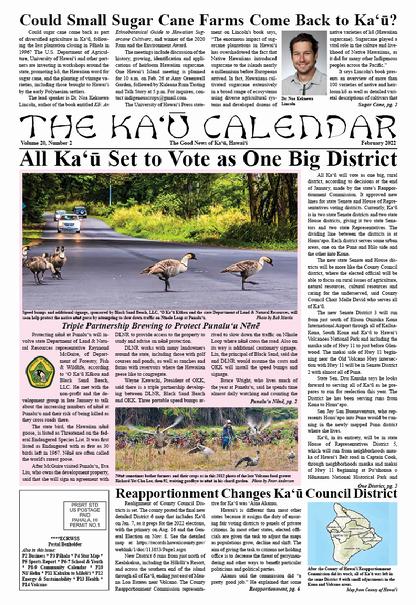
About The Kaʻū Calendar

Monday, February 21, 2022

Ka‘ū News Briefs, Monday, Feb. 21, 2022

 St. Jude's Shower Ministry has reopened to the public on Saturdays from 9 a.m. to noon, with hot water, soap, shampoo, conditioner, and clean towels in Ocean View on Paradise Circle. There is also free food. See more below.
Photo from St. Jude's

GROWING HEMP IN HAWAI'I IS FACING LEGISLATION in the state Senate and House of Representatives. Hawai'i Farmers Union United urges testimony by Tuesday morning.
    The Farmers Union supports SB 2986 and asks for amendments "to eliminate double inspections by the State which is a waste of State and taxpayers dollars and cost farmers money with new fees and wasted time." Farmers Union notes that "U.S. Department of Agriculture already regulates hemp farmers in Hawai'i and has the authority to inspect farms as needed. Required testing by USDA of every hemp crop and the state Department of Health for CBD products protects the public."
    Law enforcement in Hawai'i already has the authority to enter a farm if concerned, "so these double inspections do not improve public safety." Hawai'i hemp farmers "have been the most regulated hemp farmers in the country and these regulations have made them non-competitive," states the Farmers Union.
    The Farmers Union states that it is also concerned that an "arbitrary change in the definition of hemp two years in the future" would make hemp illegal, "which is in conflict with the 2018 U.S. Farm Bill."  
    Farmers Union opposes another hemp regulating measure, SB 2973, contending that it would continue "the unnecessary double and costly regulation of Hawai'i farmers, who are the most regulated hemp farmers in the country," and "change the definition of hemp two years in the future, making hemp illegal."  See https://www.capitol.hawaii.gov/measure_indiv.aspx?billtype=SB&billnumber=2973&year=2022&mc_cid=05c2350332&mc_eid=23faaa7019
  Those on Hawai'i Island listed as having licenses to grow hemp under the state Department of Agriculture's Industrial Hemp Pilot Program are: Kaʻū Hemp; Earth Matters; GoodbyeKitty LLC; Aloha Green LLC; Mauna Kea Agribusiness LLC; Aina Hawaiian Tropical Farms LLC; Kapu Kine Farms LLP; Mauna Kea Trading Company LLC; Mauna Loa Farms LLC; Island Hemp LLP, Aloha Hemp CBD LLP; Asante Gardens LLC; Martin M. Canning; Brittany Neal; Tropical Sunset Farms LLC; Lono Holdings; Thomas Pace; and Gail Babber. See more from the state on growing hemp in Hawai'i at https://hdoa.hawaii.gov/hemp/
 
To read comments, add your own, and like this story, see www.facebook.com/kaucalendar/. See latest print edition at www.kaucalendar.com. See upcoming events and Kaʻū Calendar newspaper sponsors at http://kaunewsbriefs.blogspot.com/2022/02/events-of-february-2022.html.

BISHOP OF THE EPISCOPAL DIOCESE OF HAWAI'I, the Right Rev. Robert Fitzpatrick, will lead the service at St. Jude's Episcopal Church in Ocean View on Sunday, March 6. The service will be on zoom
The Episcopal Bishop of Hawai'i,
Bob Fitzpatrick, comes to Ocean
View on Sunday, March 6.
and live at 92-8606 Paradise Circle Drive. Sunday services are at 9:30 a.m. The zoom link is https://us02web.zoom.us/j/85987340947?pwd=VmJOUWkvM3lCT0N2cVN2RUFiM1kzQT09 Meeting ID: 859 8734 0947; Passcode: Aloha.

ST. JUDE'S SHOWER MINISTRY has reopened to the public on Saturdays from 9 a.m. to noon, with hot water, soap, shampoo, conditioner, and clean towels. Masks and social distancing are required before and after showering. The long standing public shower service, put on pause by Covid, is supported by the Episcopal Diocese of Hawaiʻi's Commission on Mission Beyond Church and St. Jude's own outreach fund. Location is 92-8606 Paradise Circle Drive in Ocean View. Members of the congregation built the facility.

FREE WIFI AND CHARGING OUTLETS ARE AVAILABLE at St. Jude's Episcopal Church for residents of Ocean View. A message from the church says, "St. Jude's has been affectionately named the 'Patron Saint of WiFi' for the community." WiFi is available from 6 a.m. till sundown. Location is 92-8606 Paradise Circle Drive. 

EARLY BIRD REGISTRATION FOR CAMP MOKULEʻIA is open. This summer, Camp Mokuleʻia is offering four weeks of residential camp programs for youth on Oʻahu and one week of day camp for youth on the Big Island, sponsored by the Episcopal Diocese of Hawai'i. Registration deadline is May 6. For more details about 2022 Mokule'ia Summer Camp programs, visit campmokuleia.org/camps-programs.

Free hot meals on Saturdays from 9 a.m. have
resumed at St. Jude's. Photo from St. Ju
des
ST JUDE'S HOT MEALS have resumed and are free to those in need on Saturdays from 9 a.m. until they run out, no later than noon. Volunteers from the community are welcome to help and can contact Karen at pooch53@gmail.com. Location is 92-8606 Paradise Circle Drive in Ocean View.

THIS WEEK, FREE FOOD IN COMMUNITIES THROUGHOUT KAʻŪ will be distributed. Here are the dates and places: 
    KAʻŪ FOOD PANTRY FOOD DISTRIBUTION, Tuesday, Feb. 22, 9:30 a.m. - Pau. Located at St. Judeʻs Episcopalian Church above Kahuku Park in Ocean View. Sponsored by Hawaiʻi Island Food Basket.

    ʻO KAʻŪ KĀKOU PANTRY FOOD DISTRIBUTION, Tuesday, Feb. 22, 10 a.m. - Pau. Located at Kaʻū District Gym in Pāhala. Sponsored by Hawaiʻi Island Food Basket. 
    COOPER CENTER COMMUNITY PANTRY FOOD DISTRIBUTION, Wednesday, Feb. 23, 9:30 - 11 a.m. Located at 19- 4030 Wright Road in Volcano. Sponsored by Hawaiʻi Island Food Basket. 
    SACRED HEART: LOAVES AND FISHES  FOOD DISTRIBUTION, Thursday, Feb. 24, 9 - 11 a.m. Located at 95-5558 Mamalahoa Hwy in Nāʻālehu. Sponsored by Hawaiʻi Island Food Basket. 
    KUPUNA FOOD BASKET, Thursday, Feb. 24, 11 a.m. - 1 p.m. Located at Kaʻū District Gym in Pāhala. Sponsored by Hawaiʻi Island Food Basket.

To read comments, add your own, and like this story, see www.facebook.com/kaucalendar/. See latest print edition at www.kaucalendar.com. See upcoming events and Kaʻū Calendar newspaper sponsors at http://kaunewsbriefs.blogspot.com/2022/02/events-of-february-2022.html.

VIRTUAL PUBLIC MEETING on Hawaiʻi Volcanoes National Park's Disaster Recovery Project. Thursday, Feb. 24, 12 - 1 p.m. and 6 - 7 p.m. To join the 12 p.m. meeting: https://swca.zoom.us/j/91430664015. Those without internet access can join by phone: (888) 475-4499 US Toll-free; Meeting ID: 914 3066 4015. To join the 6 p.m. meeting: https://swca.zoom.us/j/97252271515. Those without internet access can join by phone: (888) 475-4499 US Toll-free; Meeting ID: 972 5227 1515.

COVID-19 PFIZER VACCINE/BOOSTER CLINIC at Ocean View Community Center. Saturday, Feb. 26, 9 a.m. - 12 p.m. Open to ages 5 and up. Home test kits will be available while supplies last. Walk-ins and uninsured are welcome. Bring ID. Contact (808) 932-4205 for any questions.

MILOLIʻI ʻOHANA FUNDRAISER at Park Halau in Miloliʻi. Saturday, Feb. 26 10 a.m. - 3 p.m. Food, crafts, music, silent auction, and more. For more information, contact (808) 937-1310 or visit www.Kalanihale.com.
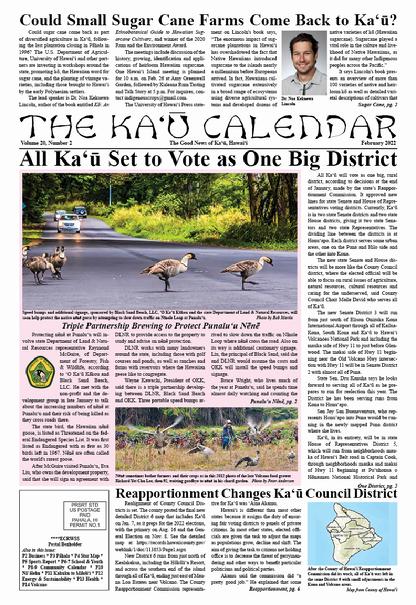
SEE MORE CALENDAR OF EVENTS & SPONSORS

See the February Print Edition of The Kaʻū Calendar at www.kaucalendar.com


Sunday, February 20, 2022

Ka‘ū News Briefs, Sunday, Feb. 20, 2022

Blue Hawaiian taro, more ornamental, but its corm can be eaten. Photo from Gardenia, Creating Gardens.
See www.gardenia.net/plant/colocasia-esculenta-blue-hawaii-taro

GROWING TARO WAS COMMON in Kaʻū in ancient times, with Wai'ohinu being the second biggest producer of wetland taro after Waipi'o on the north end of the island. Dryland taro was also common in Kaʻū, particularly in places like Wood Valley.
    To perpetuate taro growing, the Hawai'i Legislature is entertaining bills to support the preservation of taro lands. Citizens can read more on each bill and testify by clicking on the links:

Taro, also called kalo, this in a dryland planting. Photo from Bishop Museum
    SB2664: RELATING TO THE PROTECTION OF TARO - Creates a classification of agricultural public lands entitled "taro lands." Appropriates funds to the Land Use Commission to create an inventory of lands classified as taro lands. See www.capitol.hawaii.gov/measure_indiv.aspx?billtype=SB&billnumber=2664&year=2022&mc_cid=1a40cf39e5&mc_eid=23faaa7019

    SB2665: RELATING TO THE PROTECTION OF TARO - Prohibits the Board of Land and Natural Resources, in declaring residential development areas and acquiring lands therein, from disturbing certain wetland taro lands and infrastructure on undeveloped lands within the conservation district established

Taro growing on the Kaʻū High School
campus, students working on mulch in 
the background. Photo by Julia Neal
pursuant to chapter 205, Hawaii Revised Statutes. Establishes a fourth class--taro lands classification for public lands. Permits structures for lo'i taro fields in the agricultural district. Establishes growth and perpetuation of traditional Hawaiian crops as a goal of the State Planning Act. Authorizes the Land Use Commission, with the Taro Security and Purity Task Force, to create an inventory of taro lands. See www.capitol.hawaii.gov/measure_indiv.aspx?billtype=SB&billnumber=2665&year=2022&mc_cid=1a40cf39e5&mc_eid=23faaa7019
     How upland, dryland taro was grown and eaten is explained by a Bishop Museum Publication, Hawaiian kalo:
    "Relying on rainfall for irrigation, dryland cultivation favors very moist environments, but can also occur in drier areas with constant mulching. Forest land was frequently cleared for dryland cultivation. One technique practiced in dryland farming was to use fern fronds as mulch during times of high light exposure and to remove the fronds during times of adequate rainfall. Banana stumps, fermented breadfruit and burnt coconut fiber ash were also used as mulching material.
    "Dryland taro was usually grown by placing the huli into a mound of soil, which gave the corm adequate room for expansion. An ‘ō‘ō (digging stick)was used to prepare the hole for the huli. Mulch was placed around the base of the planting and natural rainfall provided watering. Dryland taro takes longer to mature than wetland varieties, about 8-12 months. Some dryland varieties could remain in the soil for three to twelve months beyond maturity. Most Lauloa varieties could stay in the ground indefinitely. Dryland taro was usually eaten in chunks after being baked or steamed." Wetland taro is also explained. See
http://hbs.bishopmuseum.org/botany/taro/key/HawaiianKalo/Media/Html/characters/cultivation.html

HAWAI'I FARMERS UNION UNITED urges citizens to provide strong support for the two bills explained above and the following bills that are now before the Hawai'i Legislature, suggesting that testimony be submitted by this Tuesday, Feb 22.
    SB2675: RELATING TO SUSTAINABLE AGRICULTURE - Establishes a three-year cover crop reimbursement pilot program to provide reimbursement to farming operations in the State for costs related to cover cropping. Establishes a cover crop reimbursement pilot program manager position within the department of agriculture to administer the program. Requires an annual report to the legislature. Appropriates funds.
    SB2990: RELATING TO SUSTAINABLE AGRICULTURE - Establishes a cover crop reimbursement pilot program to provide up to seventy-five per cent cost reimbursement to farming operations in the State for acquiring cover crop seeds, green manure, or compost. Requires the convening of a review panel to screen and rate applicants on the quality of their cover crop and green manure and composting practices. Establishes a cover crop reimbursement pilot program manager position within the Department of Agriculture to administer the program. Requires a report to the Legislature. Appropriates funds.

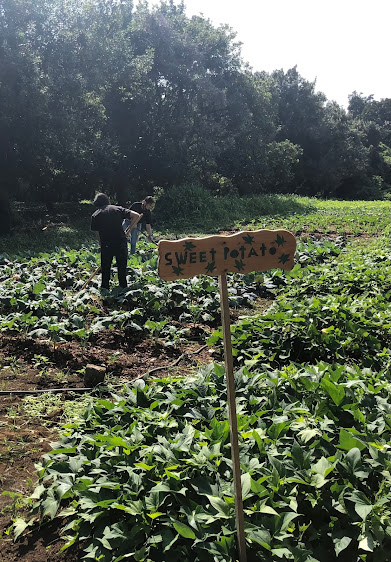
Students growing sweet potatoes on the farm at 
Kaʻū High & Pahala Elementary. Photo by Julia Neal
   SB2865 SD1: RELATING TO THE ISSUANCE OF SPECIAL PURPOSE REVENUE BONDS TO ASSIST DIBSHAWAII LLC. - Authorizes the issuance of special purpose revenue bonds to assist DIBSHawaii LLC in the construction of a net-zero carbon capture storage utilization platform that will recover vented carbon dioxide emissions and scrub and liquify them into food grade liquid carbon dioxide. (SD1)
    SB2955: RELATING TO COMPOSTING - Requires the Department of Agriculture to establish a three-year compost reimbursement pilot program to provide reimbursements to farmers and ranchers when purchasing compost from a certified processor, dealer, retailer, or wholesaler licensed to do business in the State. Establishes a temporary compost reimbursement pilot program manager position. Requires the Department to submit a report to the Legislature. Appropriates funds.
    SB3004: RELATING TO COMPOSTING - Establishes and appropriates funds for a compost reimbursement program within the department of agriculture and one full-time permanent compost reimbursement program manager position to oversee the program. Requires an annual progress report of the program to the legislature prior to each regular session.
    SB3197: RELATING TO AGRICULTURE - Establishes a Beginning Farmer Training Program. Makes an appropriation to the University of Hawaii for the Beginning Farmer Training program.
    HB2304 HD1: RELATING TO THE FARM SCHOOL PROGRAM - Appropriates funds to the DOE to secure additional resources to help implement the Hawaii farm to school program, specifically to implement internal systems and controls to meet the State's local food goals in school meals. Requires the DOE to submit a report to the legislature no later than 1/1/2023 that details a plan and timeline for implementing the Hawaii farm to school program.
    HB1517: RELATING TO COFFEE - Requires coffee blend labels to disclose geographic and regional origins and percent by weight of the blended coffees. Prohibits using geographic origins of coffee in labeling or advertising for roasted or instant coffee that contains less than a certain percentage of coffee by weight from that geographic origin, phased in to a minimum of fifty-one percent after 7/1/2024. Prohibits use of the term "All Hawaiian" in labeling or advertising for roasted or instant coffee not produced entirely from green coffee beans grown in Hawaii. Appropriates moneys for the pesticide subsidy program and for one full-time equivalent position to conduct inspections.

To read comments, add your own, and like this story, see www.facebook.com/kaucalendar/. See latest print edition at www.kaucalendar.com. See upcoming events and Kaʻū Calendar newspaper sponsors at http://kaunewsbriefs.blogspot.com/2022/02/events-of-february-2022.html.

A new Tri-Park pass features a lehua
blossom and is good for a year. NPS photo
MONDAY IS WASHINGTON'S BIRTHDAY, widely known in the advertising world as President's Day to promote special sales. It is one of four federal holidays moved to Mondays by an act of congress in 1968. The others are Memorial Day, Veterans Day and Columbus Day. It means that the holiday is not actually on Pres. George Washington's actual birthday, which is Feb. 22. There won't be a Washington's Birthday holiday on his birthday until Feb. 22, 2028, followed by Monday, Feb. 22, 2038, and Monday, Feb. 22, 2049. It is also a state holiday in Hawa'i with state and county workers on vacation.

To read comments, add your own, and like this story, see www.facebook.com/kaucalendar/. See latest print edition at www.kaucalendar.com. See upcoming events and Kaʻū Calendar newspaper sponsors at http://kaunewsbriefs.blogspot.com/2022/02/events-of-february-2022.html.

A NEW TRI-PARK ANNUAL PASS IS AVAILABLE FROM HAWAI'I VOLCANOES NATIONAL PARK. It features an image of a lehua blossom and can be picked up at Hawaiʻi Volcanoes National Park. The Hawai'i Tri-Park Pass is valid for 12 months from the date of purchase for use at Hawai'i Volcanoes National
Park, Haleakalā National Park, and Pu‘uhonua o Hōnaunau National Historical Park. For info on fees, visit the park website: https://go.nps.gov/HAVO-fees.

To read comments, add your own, and like this story, see www.facebook.com/kaucalendar/. See latest print edition at www.kaucalendar.com. See upcoming events and Kaʻū Calendar newspaper sponsors at http://kaunewsbriefs.blogspot.com/2022/02/events-of-february-2022.html.

BOWLING AT KILAUEA MILITARY CAMP is open to the public. KMC recently posted the reminder on its facebook. "If you're having a #ManicMonday make a reservation to come and bowl with us! Our lanes are open to the public and available for private buyout. Just call to make a reservation at (808)-967-8350."

To read comments, add your own, and like this story, see www.facebook.com/kaucalendar/. See latest print edition at www.kaucalendar.com. See upcoming events and Kaʻū Calendar newspaper sponsors at http://kaunewsbriefs.blogspot.com/2022/02/events-of-february-2022.html.

VIRTUAL PUBLIC MEETING on Hawaiʻi Volcanoes National Park's Disaster Recovery Project. Thursday, Feb. 24, 12 - 1 p.m. and 6 - 7 p.m. To join the 12 p.m. meeting: https://swca.zoom.us/j/91430664015. Those without internet access can join by phone: (888) 475-4499 US Toll-free; Meeting ID: 914 3066 4015. To join the 6 p.m. meeting: https://swca.zoom.us/j/97252271515. Those without internet access can join by phone: (888) 475-4499 US Toll-free; Meeting ID: 972 5227 1515.

COVID-19 PFIZER VACCINE/BOOSTER CLINIC at Ocean View Community Center. Saturday, Feb. 26, 9 a.m. - 12 p.m. Open to ages 5 and up. Home test kits will be available while supplies last. Walk-ins and uninsured are welcome. Bring ID. Contact (808) 932-4205 for any questions. 

MILOLIʻI ʻOHANA FUNDRAISER at Park Halau in Miloliʻi. Saturday, Feb. 26 10 a.m. - 3 p.m. Food, crafts, music, silent auction, and more. For more information, contact (808) 937-1310 or visit www.Kalanihale.com.

SEE MORE CALENDAR OF EVENTS & SPONSORS

See the February Print Edition of The Kaʻū Calendar at www.kaucalendar.com

Saturday, February 19, 2022

Ka‘ū News Briefs, Saturday. Feb. 19, 2022

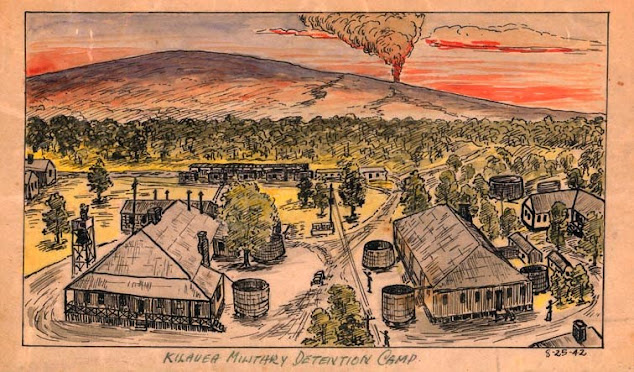
Kīlauea Military Camp during the period Japanese Americans were interred during WWII. The drawing
from August 1942 shows a mess hall (bldg 34; left) and barracks (bldg 35; right) with guard tower, basketball court
(in grassy area) and latrine (extended off the back of bldg. 35).
 Drawing by G. Hoshida. Image courtesy of Japanese American National Museum from HVNP
 
TODAY IS THE 80TH ANNIVERSARY OF THE EXECUTIVE ORDER FOR INTERMENT OF JAPANESE AMERICANS DURING World War II. Pres. Franklin D. Roosevelt signed Executive Order 9066 on Feb. 19, 1942, which led to the internment of Japanese Americans. Sen. Mazie Hirono issued this message of Friday:
    "Long-standing racism and xenophobia led to one of the worst decisions made by a President of this country 80 years ago. Due to unsubstantiated fear of Japanese Americans in 1942, President Roosevelt issued Executive Order 9066 which led to the unjust and unconstitutional internment of Japanese in the U.S. This horrific treatment of Japanese people, simply because of their ancestry, is a stain on our
country's history.
    "Although we have come a long way since 1942, the last two years have shown us that we still have a long way to go when it comes to treating everyone in this country with dignity and respect. As the COVID-19 pandemic swept the world, we again saw the detrimental consequences of unfounded fear and misinformation as discrimination and racism incited a disturbing rise in violence and hate crimes against
Asians in communities across the country.
    "In honor of the sacrifices made by those who survived such horrendous treatment, it is our responsibility to ensure that history does not repeat itself. We must do everything in our power to prevent the mistreatment of not just Asian American Pacific Islander communities, but also all marginalized groups."
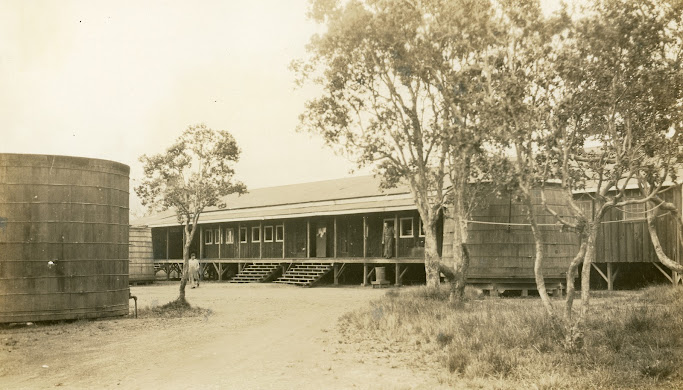
Kīlauea Military Camp building #35, where Japanese detainees spent most of their days during its use as an internment camp.
Image courtesy of Kīlauea Military Camp and HVNP
    
Hirono noted that Executive Order 9066 "authorized the forced relocation and exclusion internment of 120,000 Japanese Americans during World War II, without trial, due process, or any allegation of wrong doing. In addition to losing their property and assets – which were sold, confiscated, or destroyed – incarcerated individuals and families were housed in isolated, dilapidated conditions. EO 9066 was not formally terminated until February 1976 and had lasting consequences for Japanese Americans for decades to come."
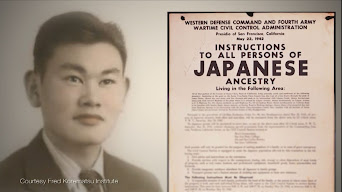
Fred Korematsu took the internment of Japanese
during WWII to the U.S. Supreme Court 
    There are three notable legal cases that arose from the implementation of EO 9066 – Yasui v. United States (1943); Hirabayashi v. United States (1943); and Korematsu v. United States (1944). Yasui and Hirabayashi attempted to challenge the constitutionality of enforcing curfews against U.S. citizens and minority groups at the time. Both cases ended in convictions, which were later overturned in the 1980s. However, "the Supreme Court's decision in Korematsu (1944) resulted in a shameful precedent, which has been repudiated and recognized as a horrible mistake," said Hirono.

THE INTERNMENT OF JAPANESE DURING WORLD WAR II AT KILAUEA MILITARY CAMP is documented by Hawai'i Volcanoes National Park. KMC held Japanese American citizens from Dec. 7, 1941 until May 7, 1942. They were all transferred to O'ahu and internment camps on the mainland. Read the history at https://www.nps.gov/havo/learn/historyculture/japanese-detention.htm

To read comments, add your own, and like this story, see www.facebook.com/kaucalendar/. See latest print edition at www.kaucalendar.com. See upcoming events and Kaʻū Calendar newspaper sponsors at http://kaunewsbriefs.blogspot.com/2022/02/events-of-february-2022.html.

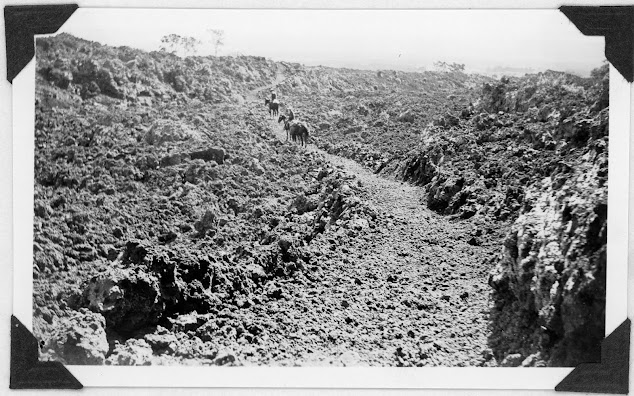
The Buffalo Soldiers built the 30-mile 'a'a trail between Kīlauea and Mauna Loa summits
Photo from HVNP

BLACK HISTORY MONTH AT HAWAI'I VOLCANOES NATIONAL PARK draws the telling of the history of the Buffalo Soldiers. The park message says that "More than 100 years ago, these Black servicemen built a 30-mile trail rock by ʻaʻā rock, with a hammer and a gunny sack, from the erupting summit of Kīlauea (4,024 feet) to the summit of Mauna Loa volcano (13,681 feet). They did this arduous work to help the founder of the Hawaiian Volcano Observatory, Dr. Thomas Jaggar, construct an easier route between the summits and to strengthen the appeal of establishing what is now Hawaiʻi Volcanoes National Park."
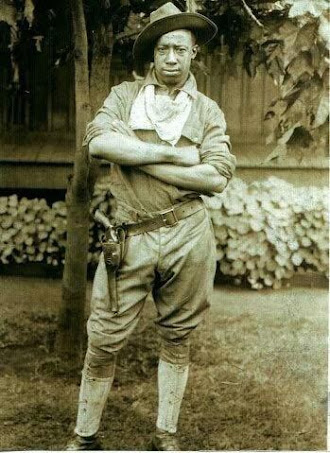
Buffalo Soldier Linold Chappell.
Photo Courtesy of Brian K Chappel
l and HVNP
    The Park also posted a photo from the 1931 Park superintendent’s report, "showing the rugged trail built by the Buffalo Soldiers more than a decade earlier. It was in such good shape that pack animals could withstand it."
    The Park reports that "Before the Buffalo Soldiersʻ arrival, Jaggar lamented that “ Every expedition to the summit exhausts the energies of the men and animals employed and the animals are frequently crippled and have their legs cut through by the rough black lava. Consequently the ranchers will not rent good animals at any price and as there is no shelter on the summit, little water, no feed, violent winds and low temperatures, the men who can with difficulty be induced to go and act as guides or packers object to remaining overnight.”
    See the trove of information about contributions of the Buffalo Soldiers on the Buffalo Soldiers park webpage, including a podcast with Park Archeologist Summer Roper Todd and Ranger Dean Gallagher.
    Visit https://go.nps.gov/havo-buffalo-soldiers.

To read comments, add your own, and like this story, see www.facebook.com/kaucalendar/. See latest print edition at www.kaucalendar.com. See upcoming events and Kaʻū Calendar newspaper sponsors at http://kaunewsbriefs.blogspot.com/2022/02/events-of-february-2022.html.

GRASSROOTS INSTITUTE OF HAWAI'I HAS ISSUED AN OPINION PEICE OPPOSING TAX INCREASES that are making their way through the Hawai'i Legislature. Its CEO Keali'i Akina writes:
    Watching proposed tax hikes make their way through the Legislature has become an annual tradition in Hawai'i, like fireworks on the Fourth of July or hearing Christmas carols at the grocery store in mid-November.
    There is actually no need to raise taxes right now, especially given the state's $3 billion budget surplus. But raising revenues is no longer the primary rationale for the tax increases being proposed. Instead, lawmakers want to use taxes to bring about social change.
    Some tax bills seek to discourage certain behaviors, such as using fossil fuels or drinking alcohol. Others are purely redistributive in nature, like the bill that would create new income tax brackets and drive Hawaii's top marginal income tax to 19% — the highest in the nation. Or the proposed "wealth asset tax," which would levy a 1% tax on the global net worth of individuals with more than $20 million in assets.
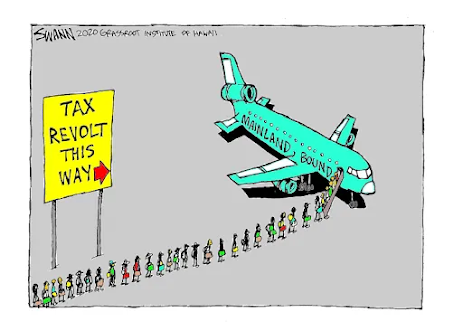
Image from Grassroot Institute of Hawai'i
    Whatever the motivations, the problem with these tax bills, according to Tom Yamachika, president of the Tax Foundation of Hawaii, is that they would have "a lot of ramifications ... which I don't think people are thinking about so much."
    Yamachika was my guest on this week's episode of "Hawaii Together" on ThinkTech Hawaii. As usual, Yamachika stays busy during each legislative session analyzing the many tax proposals, then explaining to the public their many possible ramifications.
    For example, he said, the proposed massive increase in the state's so-called carbon tax, intended to wean Hawaii consumers away from fossil fuels, "would result, predictably, in a very large increase at the [gas] pump."
    While that is bad news in itself, there hasn't been enough consideration about how significantly higher fuel prices would affect consumers and businesses in the islands as a whole.
    "If you think you have it bad now commuting from one part of the island to the other," he said, "think about if you're a truck driver. That's your business, and while you may not pay the bill, it's going to be a heck of a lot bigger bill."
    Or consider the proposed constitutional amendment that would let the state join the counties in taxing real property. Those who don't own a home might think that higher property taxes aren't their problem.
Tom Yamachika, President of
Hawai'i Tax Foundation


    But, said Yamachika, "it's going to affect you whether you are renting somewhere, whether you own your own house or if you're in an apartment. Basically, the issue is that the cost of just staying somewhere is going to increase."
    As for all the bills seeking to soak "the rich," hikes in the state's personal income tax, corporate income tax or capital gains tax, if enacted, would still affect the little guy.
    "If you, for example, penalize somebody who has a business with a hundred employees, he's not going to just stand there and take it," explained Yamachika. "He's going to pull out more money from the business to cover the tax, which leaves less for the employees or higher prices for the consumers or both. ... Or, the person says, 'I don't need this, I'm getting out of Dodge. I'm going to jump on a plane, and I'm out of here.' So the business moves, the jobs move, and what happens to us? Well, we lose the revenue."
    Even "sin" taxes, like the proposed surcharge on alcoholic drinks, could have effects that our legislators might not realize.
Keli'i Akina, President of 
Grassroot Institute of Hawai'i,
opposes state tax increases.
    "When you ... find a cause that depends on that sin tax — for instance, using a tobacco tax to fund a school of medicine or a cancer center — the tax causes some people to stop smoking, but that means revenue goes down," said Yamachika. "Then the [supporters of the] causes being supported by the sin tax panic, wondering if [the revenues] are going to disappear. Their answer is to raise the tobacco tax even more."
    While the supporters of these different tax proposals might be swept away by ideological considerations or the allure of playing Robin Hood, we need to keep reminding lawmakers that tax hikes have real economic consequences, like discouraging investment and raising the cost of living.
    That's why we continue to urge that the Legislature ditch the tax hikes and focus on policies that will make Hawaii more affordable — like reducing regulations, removing barriers to housing and cutting taxes and fees.
    Taxes should not be used as a policy tool to shape public behavior. All they do is make Hawaii more expensive and increase the number of people leaving our state for better opportunities on the mainland.


To read comments, add your own, and like this story, see www.facebook.com/kaucalendar/. See latest print edition at www.kaucalendar.com. See upcoming events and Kaʻū Calendar newspaper sponsors at http://kaunewsbriefs.blogspot.com/2022/02/events-of-february-2022.html.

KAʻŪ TROJANS MADE A STRONG SHOWING AGAINST HPA in boy's basketball Friday night. In the first quarter, Hawai'i Preparatory Academy came up with 21 points, with Trojans scoring 11. Trojans outscored HPA in the second with 12 -8. HPA took the third quareer with 11-9 and Ka'u outscored HPA with 10-9 in the fourth. HPA came out on top with a final score of 49-42. 
    Scoring for the Trojans were Kealiikoa Reyes-Nalu - 20; Kaimana Manini-Kaupu - 14; Jaestin Karasuda - 4; Jensen Villa - 2; Tyson Junior Kuahuia-Faafia - 1 and Jocyiah Mukini - 1.
    It was the final game of the season for the Trojans, with HPA traveling to the Ka'u campus from Waimea.

See the February Print Edition of The Kaʻū Calendar at www.kaucalendar.com
SEE MORE CALENDAR OF EVENTS & SPONSORS
http://kaunewsbriefs.blogspot.com/2022/02/events-of-february-2022.html
To read comments, add your own, and like this story, see www.facebook.com/kaucalendar/. See latest print edition at www.kaucalendar.com. See upcoming events and Kaʻū Calendar newspaper sponsors at http://kaunewsbriefs.blogspot.com/2022/02/events-of-february-2022.html.

VIRTUAL PUBLIC MEETING on Hawaiʻi Volcanoes National Park's Disaster Recovery Project. Thursday, Feb. 24, 12 - 1 p.m. and 6 - 7 p.m. To join the 12 p.m. meeting: https://swca.zoom.us/j/91430664015. Those without internet access can join by phone: (888) 475-4499 US Toll-free; Meeting ID: 914 3066 4015. To join the 6 p.m. meeting: https://swca.zoom.us/j/97252271515. Those without internet access can join by phone: (888) 475-4499 US Toll-free; Meeting ID: 972 5227 1515.

COVID-19 PFIZER VACCINE/BOOSTER CLINIC at Ocean View Community Center. Saturday, Feb. 26, 9 a.m. - 12 p.m. Open to ages 5 and up. Home test kits will be available while supplies last. Walk-ins and uninsured are welcome. Bring ID. Contact (808) 932-4205 for any questions. 

MILOLIʻI ʻOHANA FUNDRAISER at Park Halau in Miloliʻi. Saturday, Feb. 26 10 a.m. - 3 p.m. Food, crafts, music, silent auction, and more. For more information, contact (808) 937-1310 or visit www.Kalanihale.com.


           SEE MORE CALENDAR OF EVENTS & SPONSORS