About The Kaʻū Calendar

Saturday, April 16, 2022

Ka‘ū News Briefs, Saturday, April 16, 2022

Cleanup around the Punalu'u Black Sand Beach area continued on Saturday, with volunteers from O Kaʻū Kakou and the
 broader community, as well as Black Sand Beach, LLC staff and family members. See more below Photo by Matt Baker

FOUR NATIVE HAWAIIAN BIRDS WILL LIKELY GO EXTINCT IN NEXT TWO TO TEN YEARS, unless more measures are taken to save them. One of the measures could translocate some of the birds to places like Kaʻū where they could be released into a mosquito free area, high in the massive native forest on Mauna Loa. All four of the most endangered Hawaiian birds live on other islands, two on Kaua'i and two on Maui.
    A  recent study, with results released this week, says that avian malaria, a non-native disease spread by non-native mosquitoes, is the major culprit and that the territory of the mosquitoes carrying malaria is expanding uphill into native forest bird habitat, as temperatures rise with global warming and climate change. "Just one bite from an infected mosquito can result in the death of a bird," said Dr. Robert Reed, Deputy Director of USGS Pacific Island Ecosystems Research Center. In announcing the report, Reed noted the the study involved USGS, U.S Fish & Wildlife Service and U.S. Department of Interior's Office of Native Hawaiian Relations. It was published by University of Hawai'i Hilo's Hawai'i Cooperative Studies Unit.

The four most endangered native Hawaiian forest birds may be translocated to high elevations
to places like Kaʻū where mosquitos won't kill them with avian malaria. DLNR photos
    The four most endangered Hawaiin birds are all native honeycreepers. One is the ‘akikiki, which is found only at the highest elevations on in Koke'e State Park and the Alaka'i Wilderness Peserve on Kaua'i, with 45 birds in the wild and 45 in captivity. Another is the ‘akeke‘e, which is found only on Kaua'i in Waimea Canyon State Park, Alaka'i Wilderness Preserve and Koke'e State Park, with 638 in the wild and seven in captivity.  The third is kiwikiu, the Maui parrotbill, which is found only in a 50 square-meter area on the windward slope of Haleakala on Maui, with 135 in the wild and two in captivity. The fourth is ʻākohekohe, which lives only above 5,000 feet on Maui, with 1,657 in the wild, none in captivity.
Ridding the islands of mosquitos by using a bacteria that prevents
 them from reproducing would go a long way toward preventing
 extinction of native forest birds. Image from DLNR
    The study came up with three ways to prevent extinction: Suppressing mosquito population using the naturally occurring bacterium wolbachia; bringing birds into captivity; and/or translocating birds from their native forests to higher elevation forests on other islands. The report does not recommend a specific set of actions for preventing extinction of the four birds. It does provide expert assessment of the probability of success of the various management actions to inform decision makers, said Reed.
    He said, as many as 11 other Hawaiian forest birds are threatened with extinction in coming decades. If disease continues to spread, conservation strategies enacted now may help these other birds and keep them from the brink of extinction.
    David Smith, administrator of the state Division of Forestry & Wildlife, emphasized that mosquitos are expanding their range uphill, making more birds vulnerable to avian malaria. In the past, mosquitos were limited to a range from sea level to up to about 4,000 ft. in elevation, but higher temperatures are allowing mosquitoes to live at higher elevations. Smith said there is a rapid decline in several species of native birds and that all Hawaiian forest birds are in danger.
Stanton Enomoto said saving native
 Hawaiian birds is akin to 'ohana
supporting an ill family member.
    Stanton Enomoto, Office of Native Hawaiian Relation's Senior Program Director, noted the importance of involving Hawaiian cultural practitioners in determining the path toward saving the birds from extinction. “It’s akin to ‘ohana supporting an ill family member undergoing treatment here in Hawaiʻi. ‘Ohana support for these bird species not only enhances their chance for recovery, but it sustains the biocultural relationship and preserves their legacy in the event they decline towards extinction,” said Enomoto.

To read comments, add your own, and like this story, see www.facebook.com/kaucalendar/.See latest print edition at www.kaucalendar.com. See upcoming events at https://kaunewsbriefs.blogspot.com/2022/03/upcoming-events-for-kau-and-volcano
 

A COMMUNITY CLEANUP ON LANDS AROUND PUNALU'U BLACK SAND BEACH drew some 30 people on Saturday, including volunteers with O Kaʻū Kakou and the Black Sand Beach, LLC staff and family members. They were assisted with some machinery.
    The morning work ended as heavy rains began and volunteers picked up free pizza from Eva Liu and Matt Baker. Liu, who owns the property with her Black Sand Beach company, participated in the cleanup. OKK, led by Wayne Kawachi, has volunteered cleaning up the pond at Black Sand Beach for many years but concentrated on the coconut tree grove between the pond and the walkway to new parking for beach goers. Last Wednesday parking was restricted from the Black Sand Beach area, with the exception of vehicles used by lifeguards, lei stand employees and the handicapped.

A cleanup day on Saturday followed the establishment of no parking along the roadside nearest
Punalu'u Black Sand Beach. Also restricted this week is parking on the black sand. Photo by Matt Baker

To read comments, add your own, and like this story, see www.facebook.com/kaucalendar/.See latest print edition at www.kaucalendar.com. See upcoming events at https://kaunewsbriefs.blogspot.com/2022/03/upcoming-events-for-kau-and-volcano

OVERLAPPING ERUPTION HISTORIES OF MAUNA LOA AND KILAUEA are the subject of this week's Volcano Watch, written by postdoctoral researcher Julie Chang at USGS Hawaiian Volcano Observatory. She writes:
     Mauna Loa and Kīlauea are the two most active volcanoes on the Island of Hawai‘i, and they have overlapping eruption histories. They are located in close proximity, with their summit craters only about about 34 kilometers (21 miles) apart. In fact, part of Kīlauea is built on the southeast flank of Mauna Loa, which is the older of the two volcanoes.
      Both volcanoes produce lava flows that can travel many miles from the volcanic vent. Additionally, they produce tephra (material ejected explosively) that can be erupted high into the atmosphere and travel long distances by wind. With this in mind, it can sometimes be difficult to determine, with the unaided eye, which volcano is responsible for a specific lava flow or tephra layer.
A geologist examines a two-meter-thick (7 feet) tephra outcrop on the
southeast flank of Mauna Loa. USGS photo by J.M. Chang
    Knowing the source of the erupted material, whether from Mauna Loa or Kīlauea, is important for assessing volcanic hazards on the island. Geologists look to past eruptions, both effusive (in the form of lava flows) and explosive (in the form of volcanic ash and other tephra) to understand the frequency of volcanic eruptions. Recurrence intervals can be calculated to determine how often effusive or explosive events occur, which can help forecast when they may occur in the future.
    For example, if geologists observe an outcrop with six tephra layers sandwiched between an upper lava flow dated at 800 years ago and a lower lava flow dated at 2,000 years ago—a time period of 1,200 years preserved between the two flows—the minimum recurrence interval would be 200 years (1,200 years divided by six explosive eruptions).
    This means that an explosive eruptive event occurred, on average, every 200 years within that 1,200 year time period. If we know that there are six tephra layers, but we donʻt know if they erupted from Mauna Loa or Kīlauea, it is difficult to understand how often eruptions occurred from the individual volcanoes.
    For example, if only one of the tephra layers were from Mauna Loa, the minimum recurrence interval would be 240 years for Kīlauea and over 1,200 years for Mauna Loa. But if three of the tephra layers were from Mauna Loa, the minimum recurrence interval would be 400 years for Kīlauea and 400 years for Mauna Loa.
    So how, then, do geologists determine which volcano produced a certain flow or tephra? Field geologists often use detailed mapping. An explosive eruption, for example, will generally have thicker deposits near the source and thin out away from the source.
    Geologists can also use geochemistry to determine if a particular eruptive product is from Mauna Loa or Kīlauea. Studies have shown that the two volcanoes have different geochemical signatures. For example, Mauna Loa lavas generally have higher silica (Si) and lower calcium (Ca), titanium (Ti), and potassium (K) at a given magnesium (Mg) content than Kīlauea lavas.
Julie M. Chang
    The two volcanoes and their older predecessors generally have different trace element concentrations and isotope signatures as well, with the geochemistries defining two different families along the island chain. On the Island of Hawaiʻi, Mauna Loa and Hualālai form one family, and Kīlauea, Mauna Kea, and Kohala form another. The chemical differences are thought to originate in the hotspot plume and demonstrate that the magma systems for the two volcanoes are not interconnected.
    A new study is applying these geochemical differences between Mauna Loa and Kīlauea to understand the volcanic source of individual layers within a two-meter-thick (7 feet) tephra exposure on the southeast flank of Mauna Loa. The exposure is located approximately 19 kilometers (12 miles) south of Moku‘āweoweo, the summit caldera of Mauna Loa, and 35 kilometers (22 miles) southwest of Halemaʻumaʻu, the summit crater of Kīlauea. Due to varying wind directions, either volcano could potentially be the source of the tephra.
    Initial geochemistry obtained from fresh glass shards found in the tephra layers suggests that tephra from both Kīlauea and Mauna Loa are present at the field site. Tephras from both the Keanakākoʻi Ash (circa 1500–1820 CE) and the Kulanaokuaiki Tephra (circa 400–1000 CE), which erupted from Kīlauea, appear to be present, as well as at least one tephra layer from Mauna Loa.
    The new data will be important for constraining recurrence interval calculations for explosive events on Mauna Loa and Kīlauea and will help the USGS Hawaiian Volcano Observatory provide more robust hazard assessments for the Island of Hawaiʻi.

To read comments, add your own, and like this story, see www.facebook.com/kaucalendar/.See latest print edition at www.kaucalendar.com. See upcoming events at https://kaunewsbriefs.blogspot.com/2022/03/upcoming-events-for-kau-and-volcano


See The Ka'u Calendar April edition at 
www.kaucalendar.com,
on newsstands and in the mail. 

Friday, April 15, 2022

Ka‘ū News Briefs, Friday, April 15, 2022

Lohi Goodwin is running to serve Kaʻū into Kona in the state House of Representatives.
Photo from Lohi Goodwin

LOHI GOODWIN PULLED PAPERS TO RUN FOR STATE HOUSE OF REPRESENTATIVES, District 5. The Ocean View resident has lived for 11 years on Hawai'i Island and served in in the U.S. Air Force for 15 years. He home schools his children and describes himself as a "constitutionalist, pro-freedom" candidate, running as "a conservative Republican."
    "I am not afraid of anything except for leaving my children behind in an unfree tyrannical world," said Goodwin, who proclaimed, "I just love Kaʻū. I've been everywhere on this island and I just love this place." He said he thanks Kaʻū people "for accepting us and allowing us to be part pf this community."
He said "I just feel that since the pandemic has hit, a lot of our civil rights have been trampled upon. The government has become very invasive into our medical histories, personal lives and our families." He said he decided to run for office "because our current Representative sent a letter to Gov David Ige requesting the state to enforce Covid vaccinations without parental consent. I believe that the government has no authority to try to co-parent with me or any other parent. When I was a kid you couldn't even get an aspirin from the school health nurse."   
The Goodwin family supporting Lohi Goodwin's candidacy for state House.
Photo from Lohi Goodwin
    Goodwin is 46 years of age. He is married to Lani Goodwin and they have three children 18, 13 and seven. Their son graduated in 2021 from Kamehameha School in Kea'au. He noted that "the population of Ocean View is exploding. I would push to get our own school. With 8,000 to 9000 people living here we are the largest town in Kaʻū. Our children deserve to have their own school here, instead of wasting time and money to bus kids in junior high and high school down to Pāhala. His son Zion  Kaleo'onaona'okelaniki'eki'etook a bus from Ocean View to Kamehameha School in Kea'au every school day leaving at 5 a.m. and returning at 5 p.m. His 13 year old daughter Moanikeala and the seven-year old Jamesyn Alohakeakua are both home-schooled.
    Goodwin owns a screen printing business that he started when he decided to home school his kids. His wife works at Sea Mountain at Punalu'u condominiums front desk.
    He described Kaʻū as "so diverse. I grow apples and peaches at 4,000 feet. People with other elevations,
different soils and rainfall, can grow different foods, from the mountain to the sea. The meaning of Kaʻū is breast - like your mom's breast which really can sustain you."
    He said that he is concerned about Kaʻū farm lands being sold off to foreign entities. "I hope it doesn't become a trend in which land that supports people's livelihoods is lost. I believe that we need to make land available to more people who will farm. I believe Kaʻū can become sustainable foodwise, if land remains affordable."
    Goodwin said that when he decided to run for state House of Representatives, "I knew from my military background that you never go to battle by yourself. So I've been trying to recruit other candidates into other House and Senate districts, candidates of like minds and with the same love of Hawai'i and our country."
    Goodwin and his family will participate with other candidates to host an event this Saturday, April 16 from 10 a.m. to 2 p.m. at Honu`apo, Whittington Beach Park. Lunch and refreshments are provided, along with an Easter Egg Hunt for the kids. See LohiForFreedom.com. Also see Lohi Goodwin on facebook. See Lohi_Goodwin_4_Freedom on Instagram.

To read comments, add your own, and like this story, see www.facebook.com/kaucalendar/.See latest print edition at www.kaucalendar.com. See upcoming events at https://kaunewsbriefs.blogspot.com/2022/03/upcoming-events-for-kau-and-volcano.

TWO EARTHQUAKES SHOOK KAʻŪ FRIDAY MORNING. U.S. Geological Survey's Hawaiian Volcano Observatory recorded a magnitude-4.3 earthquake on Friday, April 15, at 01:58:25 a.m., followed eight seconds later by a magnitude-4.6 earthquake at 01:58:33 a.m.. Both were located northeast of Pāhala.
    The magnitude-4.3 earthquake was centered about 8 km (5 miles) northeast of Pāhala, at a depth of 34 km (21 miles). The magnitude-4.6 earthquake was centered about 9 km (6 miles) northeast of Pāhala, at a depth of 32 km (20 miles) slightly to the southeast of the first earthquake. A map showing the location is posted on the HVO website at http://usgs.gov/hvo. More details are available at the National Earthquake Information Center website at https://earthquake.usgs.gov/earthquakes/eventpage/hv72984557 (M4.3) and https://earthquake.usgs.gov/earthquakes/eventpage/hv72984552 (M4.6).
  Strong shaking, with maximum Intensity of VI on the Modified Mercalli Intensity Scale, was reported across parts of the Island of Hawai‘i. At that intensity, significant damage to buildings or structures was not expected. The USGS "Did you feel it?" service (http://earthquake.usgs.gov/dyfi/) received over 400 felt reports within the first hour of the earthquakes.
    According to HVO geophysicist Jefferson Chang, these earthquakes had no apparent effect on Kīlauea or Mauna Loa volcanoes. “This earthquake appears to be part of the seismic swarm under the Pāhala area, which has been going on since 2019. Earthquakes in this region have been observed at least as far back as the 1960s. We see no detectable changes in activity at the summits or along the rift zones of Mauna Loa or Kīlauea as a result of these earthquakes. Please be advised that aftershocks are occurring and some of these may be large enough to be felt.” HVO continues to monitor Hawaiian volcanoes for any changes.
     For more on the Pāhala swarm, see https://www.usgs.gov/news/volcano-watch-why-do-so-many-deep-earthquakes-happen-around-pahala.
    For information on recent earthquakes in Hawai'i and eruption updates, visit the USGS Hawaiian Volcano Observatory website at  http://usgs.gov/hvo/.

To read comments, add your own, and like this story, see www.facebook.com/kaucalendar/.See latest print edition at www.kaucalendar.com. See upcoming events at https://kaunewsbriefs.blogspot.com/2022/03/upcoming-events-for-kau-and-volcano.

MORE COMMENTS ON PARKING RESTRICTIONS AT PUNALU'U BLACK SAND BEACH are coming in from readers and people on the street. 
     Ernie Kalani, a veteran and well-known Ka'u musician, said that after he came back from Viet Nam, he lived at Punalu'u at a house in the area where the now-abandoned restaurant and museum were constructed. He said that over the years the beach and parking near the shore were always open to all the locals - to everyone for fishing, boating, diving and going to the beach.
      He said that with the new boulders along the roadway and signage preventing the traditional parking, he hopes the county is involved in making sure that the local interests are served and that the boulders are not on the public right of way.
      A companion of Kalani talking story in front of Mizuno Superette in Pahala this morning said that local people are concerned about change in the area because past developers were never held accountable for major changes they made in land and water. He said the sugar plantation rerouted waterways up mauka that ended up causing beaches to become full of boulders and rocks at such places as Kawa. He noted that there used to be more freshwater ponds at Punalu'u before the sugar plantation began developing the resort. He said that the plantation left without being held accountable for damages. Both talked about the challenge of preserving local lifestyles and preserving access to the ocean for fishing and the mountains for hunting as lands are sold off.
     On The Ka'u Calendar facebook, Lonnie McDowall wrote about pulling public parking off  Punalu'u Black Sand Beach and directing it to the restored parking lot, where any fees would go to a stewardship group. "I’m thinking this is the first of private beaches. All ya gotta do is say you're going to give some money to charity and boom you own a beach."
Are the boulders on both public and private property? The question came in from several
readers. Photo by Bob Martin

    Henry Boothe wrote, "I'm confused. isn't it a good thing there's less parking on the literal sand of this beach? Because one can't drive on the literal sand of this beach it becomes the first private beach? This makes no logical sense."
    Lovelyn Hokulani Alapai wrote, "All the sand is making her way back. I remember when the road ran straight thru the beach. Now she claiming back what was always hers Punalu'u."
     Referring to the few vehicles still parked on the beach belonging to lei stand workers, lifeguards and for handicapped parking, Kalanz Strong said, "What about their vehicle oils - that just makes no sense."
     Maria Hart wrote, "Save Ka'u's shoreline... the last bit of Hawaian ahupua'a."
    Joe Kunkel wrote: "The paved county parking lot adjoins the beach and is still there. The large parking lot by the ruins of the restaurant and cultural center, covered for decades be debris and fallen trees, is restored to a useable status. Both parking lots are very close to the beach."
     Felix Tallon asked about enforcement of the parking rules. "Whose rules are these?" He said it used to be first come, first served for the parking at the beach. "But beach goeers/tourist now that's going to be a problem who's enforcing these now so called rules, some non-local outsider probably that like bulldozer all around Punalu'u."
    Chris Kapa asked, "Who owns the land the the boulders are on?"
    
To read comments, add your own, and like this story, see www.facebook.com/kaucalendar/.See latest print edition at www.kaucalendar.com. See upcoming events at https://kaunewsbriefs.blogspot.com/2022/03/upcoming-events-for-kau-and-volcano


See The Ka'u Calendar April edition at 
www.kaucalendar.com,
on newsstands and in the mail. 

Thursday, April 14, 2022

Ka‘ū News Briefs, Thursday, April 14, 2022

Only the handicapped, lei stand vendors, lifeguards and emergency vehicles are allowed on
the sandy parking at Punalu'u Black Sand Beach. Photo by Bob Martin

NO PARKING ON THE BEACH AT PUNALU'U became a community topic of discussion on Wednesday and Thursday, as visitors and kama'aina were directed to a parking lot mauka of the shoreline. 
    With everyone accustomed to parking on the sand adjacent to the beach and along the adjacent roadside,
the new boulders and signage that block parking drew numerous comments to The Kaʻū Calendar and other area facebook pages.
    It also drew questions exchanged verbally among Kaʻū residents, including: Is this the beginning of a new round of preparing for commercial development near the shore? What will happen to the area being cleaned up? Will it be a park or commercial enterprise, or both? Does the exemption from the Special Management Area permit for cleaning up and making repairs allow all the work being done without additional permits?
    What about the lei stands at the beach? Will the lei stand families who have depended on their beachfront enterprise for generations be allowed to stay? Will their their volunteer lifeguards, who for generations were the only lifeguards at Punalu'u and still do make rescues after county lifeguard hours - Will they be able to keep their presence at the beach?

Boulders block roadside parking near Punalu'u Black Sand Beach.
Photo by Bob Martin
    What about the boat ramp? Will locals head for the boat ramp to park, overwhelming that area? Will the boat ramp area eventually be blocked from parking, camping and picnicking as well?
    Will everyone be charged at the parking lot or kama'aina get a discount or a pass?
    Here are some of the comments posted on The Kaʻū Calendar and other area facebook pages:
    Kelly Clark said the developer is "trying to push this development through on a 1980 Environmental Impact Study," and pointed to other developments on the Hawai'i Island coast, such as the Four Seasons and at Pine Trees "just to name a few." Clark predicted that the resources and turtles will be exploited "for financial gain."
    A couple called Ray N Christy on their facebook page posted that pulling the parking off the beach and nearby roadside - "That's actually a good thing. But check out Punalu'u community page and see what's really brewing," referring to development plans that have been presented to the community over the last six months.
    Emmet Enriques wrote, "Sad that locals not only just lost access but also will be charged in the future… and didn’t even get the opportunity for input." Curtis Sharp replied, "Hapuna Beach charges but not if you're a resident (hi. driers license). Enriques replied, "Exactly. Punalu'u is turning into another Hapuna."
    Echo Love wrote, "A well managed parking lot is what’s essential to ensure safety and convenience for both the locals and visitors coming to the beach. Parking fee is not a big deal in my humble opinion, especially it goes towards a non profit."
Newly painted parking stalls and curbs at the old parking lot where beachgoers
 are directed to leave their vehicles at Punalu'u. Photo by Bob Martin
  Alberto Benovia said, "Kanaka wale no." Kawai Kanawaliwali wrote, "Pushing out the kanakas."
    Laura Wong wrote, "Time to initiate Traditional Access To Coast protections..To ensure that public pathways to the coast are protected. Check out the evolution of private land owners slowly but surely blocking all public access to shoreline on O'ahu and on Maui.
    "The police are routinely called to disputes and physical altercation between property owners and swimmers at a place known as ‘Portlock’ on O'ahu. I grew up surfing swimming and hiking on that shoreline in the 1970’s.
    "Prior to that land privatization, first Hawaiian and then over the years other local people too - went
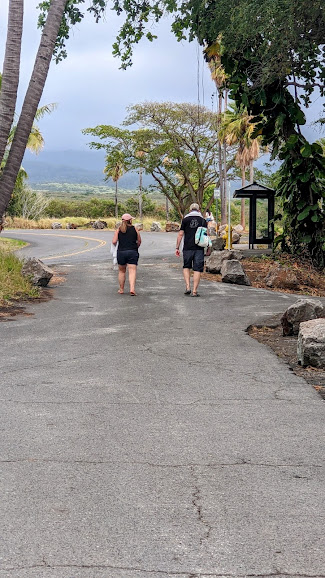
The old path from parking lot to the beach 
has been uncovered. Photo by Bob Martin
fishing and swimming and surfing there. Now the owners of the land fronting that coastline have gated and walled off all access to the shore that fronts their private property. The owners of that land touching public shoreline claim that the public may not access the shore over their property- the county failed to protect access to that shoreline by not upholding the traditional access points used by pedestrians for hundreds of years."
    Manu Kane posted: "Another Cheap Shot at Punalu'u Beach.. Apparently the foreign investors have blocked areas where we used to park and are now funneling locals and tourists to a lot where you're going to have to pay."
    Sophia Hanoa posted, "The people of Ka'ū. No parking signs at Punaluʻu lei stand area are for the safety of everyone. Alternate parking areas are provided. Emergency vehicles and Handicap parking will have access to the area. With an influx of tourists, something had to be done. So please help to support the safety of all, especially our children and elderly."
    Timothy Totten said, "Expansion of the County Beach parking would seem appropriate at this juncture."
    Larry Cush said, "I'm happy to see a parking lot. However, I cringed to hear they are going add a fee for parking. The big boulders seem heavy handed to me. Couldn't there be a way that is more welcoming? Perhaps add fees for commercial bus and tour parking only. Please remember this is about showing caring and inclusive change for the community not just commercial interest!"
    Deborah Ward wrote, "The turtles laying eggs were impacted by the vehicles and disrupted access to the ocean. I think will be an improvement long time coming."

 To read comments, add your own, and like this story, see www.facebook.com/kaucalendar/.See latest print edition at www.kaucalendar.com. See upcoming events at https://kaunewsbriefs.blogspot.com/2022/03/upcoming-events-for-kau-and-volcano
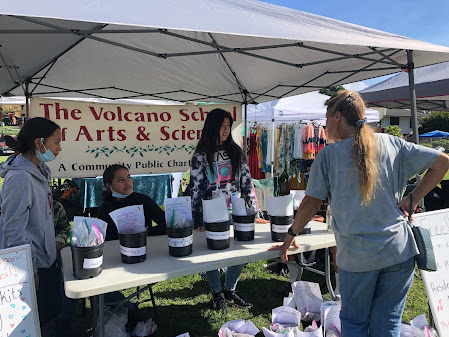
Volcano Students talking about Farm in a Box kits are Kalia Andrade,
 Lahela Hanoa, Aliyah Gayacan, of Na'alehu. Photo by Barbara Sarbin
VOLCANO SCHOOL OF THE ARTS & SCIENCES GAVE FREE FARM IN A BOX KITS at ʻO Kaʻū Kākou's  Nāʻālehu Market on Wednesday. Volcano School 's eighth grade Permaculture and Civics students prepared the kits. Fifty resident families were were treated to packages of organic soil, fertilizer, pea, lettuce, and beet seeds, and a large pot, all sourced from McCall’s Farm in Volcano. Students also supplied instructions to successfully plant and grow the veggies at home.
    This initiative was the culminating event for the students’ studies of Food Justice, which taught the importance of equal access to healthy food in the community. The students visited local farms and ranches to learn about sustainable agriculture and small-scale backyard family farming, including McCall’s Farm in Volcano, Punachicks Farm in Kurtistown, Mana’o Farm and Kuahiwi Ranch in Nāʻālehu.
    As part of this project, students researched the United Nations Sustainable Development Goals, gave presentations on each one to inform their classmates about solutions to these global issues, and participated in a UNICEF Hunger Banquet to bring alive the real situation of World Hunger.
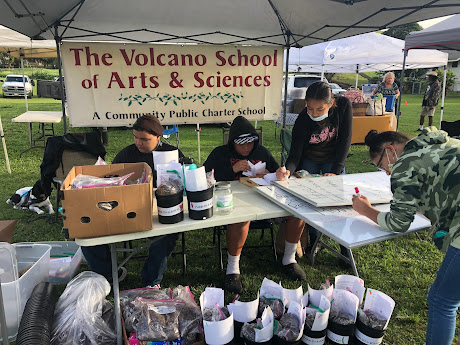
Volcano School students assembling Farm in a Box kits are Kamaehu Guerpo-Craft
 of Pāhala, Raedyn Breihaupt-Louis, Lahela Hanoa, Mackenzie DeCoito, of Nāʻālehu.
Photo by Barbara Sarbin
    The eighth graders also engaged in the Global Run Project, wearing pedometers throughout the school day to try to collect as many steps and miles as possible. A nonprofit charitable organization, Something Good in the World, donated $1 for each mile that the students walked, ran, jumped, and danced. Students said they really enjoyed seeing how many steps and miles they could get each day, and ended up with over 200 miles, raising enough funding to create the 50 Farm-in-a-Box kits.
    The eighth graders worked hard to package the soil and fertilizer. They sorted seeds, decorated labels and instructions, and were excited to spend more than five hours at the Farmer’s Market in Nāʻālehu. Residents approached their booth to ask questions and receive the free kits to support food security by growing their own organic, healthy vegetables at home.
    Many adults commented to the youth about the importance of their community service project and said they were impressed with the students' knowledge of food justice at such a young age. “You are the future,” said one resident who supported their work with a donation towards the project. Their teacher Barbara Sarbin said the students "are the future…now."
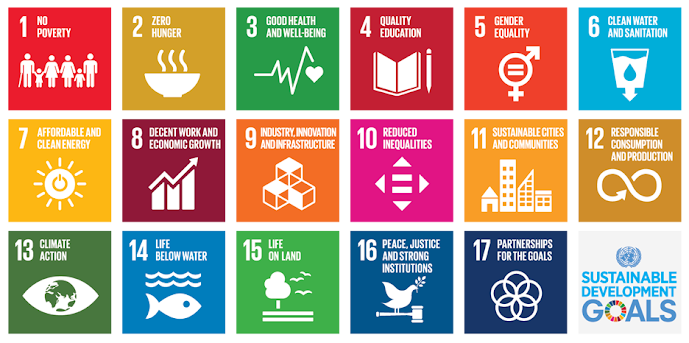
U.N. Sustainable Development Goals studied by Volcano School of Arts & Sciences students.

 To read comments, add your own, and like this story, see www.facebook.com/kaucalendar/.See latest print edition at www.kaucalendar.com. See upcoming events at https://kaunewsbriefs.blogspot.com/2022/03/upcoming-events-for-kau-and-volcano
See The Ka'u Calendar April edition at 
www.kaucalendar.com,
on newsstands and in the mail.