About The Kaʻū Calendar

Wednesday, May 11, 2022

Ka‘ū News Briefs, Wednesday, May 11, 2022

Hilo Boarding School in 1909. It is one of the schools for Native Hawaiians listed in a
study released by the U.S. Department of the Interior on Wednesday. See more below.
Photo from Wikimedia

THE OLD CANE HAUL ROAD BETWEEN PĀHALA AND NĀ'ĀLEHU IS CLOSED about 1.5 miles above Pāhala town. A notice from the county on Wednesday says "the foundation under Old Cane Haul Road above Pāhala Town in Kaʻū is compromised. Use alternate routes." According to a county police message, the hole measures about 2-feet wide, 4-feet long, and  8-feet deep. Kalaiki Road, the old road for hauling sugar cane is private and owned by property owners along the way. "The integrity of an approximate 30-foot section of the road is suspected of being compromised by a deteriorating drainage culvert buried beneath the roadway," says the county statement.
    "Road closure signs have been placed on either side of the affected location. Motorist are strongly advised against crossing this area and to use alternate routes until repairs are made by the landowners." The alternate route is Highway 11 and the Cane Haul Road is sometimes used as an emergency route when the highway is closed due to an accident or to flooding at Kawa flats. However, during flooding, crossing the Cane Haul Road can be dangerous.
    The road will be closed until further notice, according to the county.

To read comments, add your own, and like this story, see www.facebook.com/kaucalendar/. See latest print edition at. www.kaucalendar.com. See upcoming events at https://kaunewsbriefs.blogspot.com/2022/04/upcoming-events-for-kau-and-volcano.html.

A FEDERAL STUDY, INCLUDING KAMEHAMEHA SCHOOLS, HILO BOARDING SCHOOL, MAUNA LOA FORESTRY CAMP SCHOOL and eight others in Hawai'i, concludes that between 1819 and 1969, the U.S. government used militarization and "identity alteration methodologies" in an attempt to assimilate native children into American culture."
    For Hawai'i, it also notes: "Although the ‘Ōlelo Hawai‘i-based public school system initially operated using only the Hawaiian language, it eventually repressed ‘Ōlelo Hawai‘i in education by promoting English. By 1888, only 16 percent of children were taught in Hawaiian."
    The investigative report was released Wednesday by Secretary of the Interior Deb Hawland and Assistant Secretary for Indian Affairs Bryan Newland. They released Volume I through the Federal Indian Boarding School Initiative, "a comprehensive effort to address the troubled legacy of federal Indian boarding school policies."
    The study researched 408 federal schools across 37 states or then territories, including 21 schools in Alaska and 11 schools in Hawai'i.

Hilo Boarding School in 1909. Photo from Wikimedia
     The Secretary of the Interior said, “The consequences of federal Indian boarding school policies—including the intergenerational trauma caused by the family separation and cultural eradication inflicted upon generations of children as young as four years old—are heartbreaking and undeniable. We continue to see the evidence of this attempt to forcibly assimilate Indigenous people in the disparities that communities face. It is my priority to not only give voice to the survivors and descendants of federal Indian boarding school policies, but also to address the lasting legacies of these policies so 
Indigenous peoples can continue to grow and heal.”
    The Assistant Secretary of the Interior said, “This report presents the opportunity for us to reorient federal policies to support the revitalization of Tribal languages and cultural practices to counteract nearly two centuries of federal policies aimed at their destruction. Together, we can help begin a healing process for Indian Country, the Native Hawaiian Community and across the United States, from the Alaskan 
tundra to the Florida everglades, and everywhere in between.”
    Department of Interior also announced The Road to Healing, a year-long tour that aims to
travel across the country "to allow American Indian, Alaska Native, and Native Hawaiian survivors of the federal Indian boarding school system the opportunity to share their stories, help connect communities with trauma-informed support, and facilitate collection of a permanent oral history." Also announced is a collaboration with "the White House Council of Native American Affairs on the path ahead to preserve Tribal languages, invest in survivor-focused services, and honor our obligations to Indigenous communities."
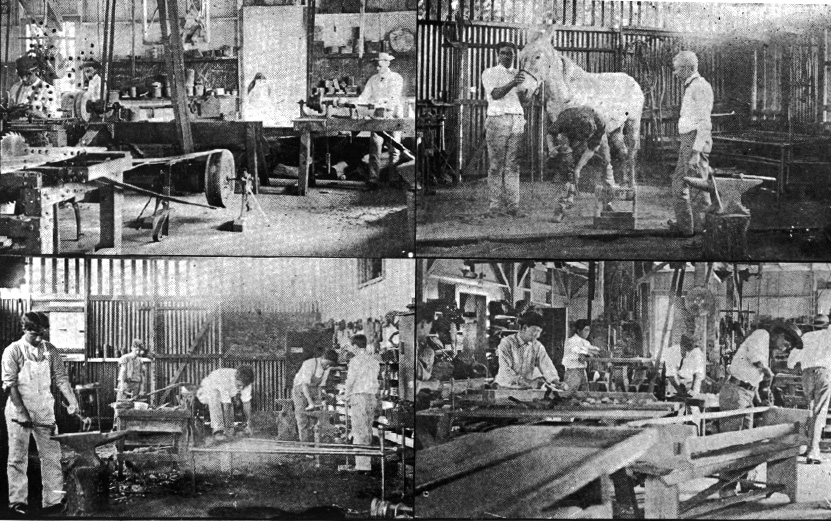
Shop class at Hilo Boarding School in 1901. Photo from Wikimedia
    The study points to such practices in history nationwide of "renaming Indian children from Indian to English names; cutting the hair of Indian children; discouraging or preventing the use of American Indian, Alaska Native, and Native Hawaiian languages, religions and cultural practices; and organizing Indian and Native Hawaiian children into units to perform military drills.
    "Despite assertions to the contrary, the investigation found that the school system largely focused on manual labor and vocational skills that left American Indian, Alaska Native, and Native Hawaiian graduates with employment options often irrelevant to the industrial U.S. economy, further disrupting Tribal economies."
    The study reports some of the history of Hilo Boarding School:
    "The Congregational Mission in Hawai'i opened schools to support their efforts of Christian conversion, and in October 1836, two grass houses were completed between David Lyman's house and Reverend Titus Coan's house. On October 3rd, the school opened with eight boarders, but the number soon increased to twelve. It received $900 in funding annually from the Board of Education (likely Hawai'i), and its assistant teachers are paid from the district school fund of Hilo. Classes were conducted in the English language. 
    "With the advent of World War II, the dormitory facilities were donated to the U.S. Army, which occupied the buildings until 1943. Thereafter, the facilities of Hilo Boarding School were utilized by different community groups until the final destruction of its buildings between 1968 and 1972."
    Read Volume I of the Department of Interior report at https://www.bia.gov/sites/default/files/dup/inline-files/bsi_investigative_report_may_2022_508.pdf. See descriptions and photos of other Hawai'i and mainland schools at https://www.bia.gov/sites/default/files/dup/inline-files/appendix_a_b_school_listing_profiles_508.pdf

To read comments, add your own, and like this story, see www.facebook.com/kaucalendar/. See latest print edition at. www.kaucalendar.com. See upcoming events at https://kaunewsbriefs.blogspot.com/2022/04/upcoming-events-for-kau-and-volcano.html.

Flyer for Kahuapono 2022 Student Enrichment Program.
Image from Three Mountain Alliance.
APPLICATIONS ARE DUE FOR KAHUAPONO STUDENT ENRICHMENT PROGRAM by Friday, May 13. This two-week program from June 27-July 8 is based in Keauhou, Kaʻū and will engage students in hands-on activities, service projects, and observation and reflection activities grounded in mālama ʻāina. Students must be in 6th-12th grade when applying. For an application, go to:

LANDSCAPING WITH NATIVE HAWAIIAN PLANTS on Saturday, May 14 from 9 a.m. - 2 p.m. at Volcano Art Center’s Niaulani Campus led by instructor Zach Mermel of Ola Design Group. In this hands-on workshop, you’ll interact first-hand with a variety of native plants found throughout Hawai’i and learn how to integrate these plant allies into your home ecosystem. Class fee is $35/$30 for VAC members. To register, call (808) 967-8222 or visit volcanoartcenter.org/events/.

KAHUKU COFFEE TALK: ʻUAʻU: THE ENDANGERED HAWAIIAN PETREL on Saturday, May 14 from 9:30 - 11 a.m. at Kahuku Unit Visitor Center. Coffee Talk at Kahuku is an opportunity to get to know your Park and your neighbors, and join an informal conversation on a wide variety of topics on the second Saturday of every month. Entrance located south of the 70.5 mile marker on the mauka side of Hwy 11.
Flyer for Coffee Talk at Kahuku: 'Ua'u, The Endangered
Hawaiian Petrel. Image from Kahuku Unit,
Hawai'i Volcanoes National Park.

SEE MORE UPCOMING EVENTS IN KAʻŪ & VOLCANO
See The Ka'ū Calendar May edition at
www.kaucalendar.com, on newsstands and in the mail.\


Tuesday, May 10, 2022

Ka‘ū News Briefs, Tuesday, May 10, 2022

The home on left burned to the ground, the home on right is severely damaged from a fire just before midnight Tuesday on Ohai Road in the Nāʻālehu Camp, mauka of Highway 11. Photo by Bob Martin

A FIRE BURNED DOWN ONE NĀ'ĀLEHU HOME and severely damaged the neighboring home Monday night on Ohai Road in Nāʻālehu, mauka of Highway 11 in the old sugar camp housing. Two residents of the house that burned to the ground evacuated and were unharmed, according to Hawai'i Fire Department, which responded to the blaze at 11:58 p.m. finding one house fully engulfed and the other 75 perent engulfed in flames. Firefighters squelched the blaze, as one house collapsed the other largely gutted and surrounding homes saved. The damage is estimated at $610,250 for the two houses. The collapsed home 95-1208 Ohai St. is reportedly in the Dancel family and the gutted home in the Davis family.

To read comments, add your own, and like this story, see www.facebook.com/kaucalendar/. See latest print edition at. www.kaucalendar.com. See upcoming events at https://kaunewsbriefs.blogspot.com/2022/04/upcoming-events-for-kau-and-volcano.html.

EAST KAʻŪ IS PART OF THE NEWLY CERTIFIED EAST HAWAI'I BLUE ZONES COMMUNITY. Blue Zones and HMSA reported Saturday on the new certification for seven communities following "a rigorous process that takes three to five years to complete and signifies a tipping point toward long-term well-being change." Blue Zones seek to increase longevity and look to those places in the world where people live well longest for inspiration and best practices.
    HMSA also released a video at https://www.youtube.com/watch?v=sXBEFRlWjtU. It describes "Hawai‘i’s positive impact and how the program is improving health and well-being across Hawai‘i."
    The statement describes Blue Zones Project as "a community-led, well-being improvement initiative designed to make healthy choices easier through permanent changes to lifestyle, environment, policy, and social networks. Since 2015, Blue Zones Project - Hawai‘i has impacted more than 738,000 residents, representing 50 percent of Hawai‘i’s population through the certification of Blue Zones Communities in North Hawai‘i, East Hawai‘i, West Hawai‘i, Central Maui, Kapolei-‘Ewa, Mānoa-Makiki-McCully-Mō‘ili‘ili, and Wahiawā."
Blue Zones have promoted a healthier diet through such images
as this one, as well as recipes and cooking demonstrations.
   According to Blue Zones Project - Hawai‘i, it has also helped over 1,000 businesses implement well-being best practices, such as walking groups, healthier food options and engagement activities to improve productivity, satisfaction, and retention. Statewide, Blue Zones Project participating employers, including County of Hawai'i , Hawaiian Telcom, and state Department of Commerce and Consumer Affairs have seen a "34 percent reduction in turnover, a 27 percent decrease in obesity among employees, and a 60 percent increase in average employee performance."
    Kathy Morimoto, HMSA vice president of Clinical Integration and Community Health said, “We’re excited to see the great progress Blue Zones Project - Hawai‘i has made in improving the overall health and well-being within communities across the state. By encouraging and elevating communities as a whole to make healthier choices through permanent changes to lifestyle, environment, policy, and social networks, we are confident Blue Zones Project - Hawai‘i will continue to generate meaningful impact. It is our goal for family, friends, and neighbors to live their best lives.”
KTA became Blue Zones-approved in 2016, with
various programs for healthy eating. 
    The report from Blue Zones Project - Hawai‘i says it has seen dramatic positive outcomes since the baseline measurement year in 2015. Chronic disease factors such as BMI, nutrition, and life evaluation—proven to drive medical costs and productivity—have decreased by 8.8 percent. According to Sharecare’s annual state well-being rankings, Hawai‘i continues to be one of the ‘healthiest’ states in the country; however, there is much more work to be done to address health disparities across the state.
    With the help of community partners, transformations to food policy, tobacco policy, and the built environment have made significant improvements across the state, reports Blue Zones Project - Hawai‘i. It helped secure more than $200 million in grant funding towards improvements in policies, programs, and infrastructure projects, such as improving access to healthy food as well as pedestrian safety across the state through quick build projects.
    Blue Zones Project - Hawai‘i also reports that its volunteers provided in-kind service valued at $528,332 towards the betterment of the community and Blue Zones Project participating organization initiatives.
  To learn more about Blue Zones Project, contact the Blue Zones Project - Hawai‘i team at bluezonesprojecthawaii@sharecare.com or visit www.bzphawaii.com.

To read comments, add your own, and like this story, see www.facebook.com/kaucalendar/. See latest print edition at. www.kaucalendar.com. See upcoming events at https://kaunewsbriefs.blogspot.com/2022/04/upcoming-events-for-kau-and-volcano.html.

Flyer for Kahuapono 2022 Student Enrichment Program.
Image from Three Mountain Alliance.
APPLICATIONS DUE FOR KAHUAPONO STUDENT ENRICHMENT PROGRAM by Friday, May 13. This two-week program from June 27-July 8 is based in Keauhou, Kaʻū and will engage students in hands-on activities, service projects, and observation and reflection activities grounded in mālama ʻāina. Students must be in 6th-12th grade when applying. For an application, go to:

LANDSCAPING WITH NATIVE HAWAIIAN PLANTS on Saturday, May 14 from 9 a.m. - 2 p.m. at Volcano Art Center’s Niaulani Campus led by instructor Zach Mermel of Ola Design Group. In this hands-on workshop, you’ll interact first-hand with a variety of native plants found throughout Hawai’i and learn how to integrate these plant allies into your home ecosystem. Class fee is $35/$30 for VAC members. To register, call (808) 967-8222 or visit volcanoartcenter.org/events/.

KAHUKU COFFEE TALK: ʻUAʻU: THE ENDANGERED HAWAIIAN PETREL on Saturday, May 14 from 9:30 - 11 a.m. at Kahuku Unit Visitor Center. Coffee Talk at Kahuku is an opportunity to get to know your Park and your neighbors, and join an informal conversation on a wide variety of topics on the second Saturday of every month. Entrance located south of the 70.5 mile marker on the mauka side of Hwy 11.
Flyer for Coffee Talk at Kahuku: 'Ua'u, The Endangered
Hawaiian Petrel. Image from Kahuku Unit,
Hawai'i Volcanoes National Park.

SEE MORE UPCOMING EVENTS IN KAʻŪ & VOLCANO
See The Ka'ū Calendar May edition at
www.kaucalendar.com, on newsstands and in the mail.\


Monday, May 09, 2022

Ka‘ū News Briefs, Monday, May 9, 2022

 
This book with scenes from the Kaʻū High campus and other sites in Kaʻū made the KITV news Sunday night.
Its illustrator is senior Kelson Gallano, the writer Joyce Iwashita. See more below. Illustration by Kelson Gallano

A PARK FOR EVERY CLASSROOM has selected Hawaiʻi Volcanoes National Park to work collaboratively with local teachers and community partners to create professional development workshops for climate change education.
    Hawaiʻi Volcanoes is partnering with the Ke Kula 'Amakihi Community-Based Education program at the Volcano School of Arts and Sciences and the Pacific Islands Climate Adaptation Science Center
Hawai'i Volcanoes is one of eight parks chosen for a
 national pilot program Park for Every Classroom.
NPS photo
to explore what students and families need to learn about climate change and how it affects Hawaiʻi.
    Hawaiʻi Volcanoes National Park is one of eight parks chosen to be part of the national pilot of the Park for Every Classroom program. The PEC program has collaborated with teachers, park staff, and community educators in the northeastern United States since 2011 and is now expanding its reach with a national pilot. The advantage of the PEC model is that schools, park staff, and local organizations share resources and knowledge to tackle specific issues facing a community.
    To learn more about this program or to schedule education huakaʻi (field trip) with staff at the park, contact havo_education@nps.gov.

To read comments, add your own, and like this story, see www.facebook.com/kaucalendar/. See latest print edition at. www.kaucalendar.com. See upcoming events at https://kaunewsbriefs.blogspot.com/2022/04/upcoming-events-for-kau-and-volcano.html.

DEDICATING AN AHUPUA'A for a non-profit place-based research center and living scientific laboratory "to develop sustainability solutions rooted in ancestral knowledge and indigenous practices," is a plan from Hawai'i Community Foundation. Called 'Iole, the name of the ahupua'a, the project is set to bring together academic experts, Native Hawaiian practitioners, community members, students and government leaders to plan and execute the future use of that ahupua'a.
    Mayor Mitch Roth said, “The ʻIole ahupuaʻa is the epitome of potential for sustainable action and community resilience here on Hawaiʻi Island. Our administration has committed to fostering a Hawaiʻi Island where our keiki can thrive and succeed for generations to come, and in that, we are excited to support ʻIole and its partnering organizations in every way possible.”
    Initial programing prioritizes around three focus areas, "energy security, food security and place-based learning, with expertise and resources from partners at the University of Hawaiʻi and Arizona State University, which is already working on this island with marine resource conservation at Miloli'i and mapping forests and reefs.
    Micah Kane, CEO and President of Hawai'i Community Foundation, said, "The world needs authentic solutions to our planet’s most urgent issues, from food security to climate change, to ensure a sustainable future for all people. Solutions that combine ancestral knowledge and indigenous practices with revolutionary science will produce a culturally sound framework that protects the well-being of both people and place, Through our collaborative work at ‘Iole, Hawaiʻi has the opportunity to continue to lead the fight against climate change and affect social issues impacting communities here, and across the globe.”
New Moon Foundation
 
    The site for the effort is on approximately 2,400 acres in Kohala, gifted to Hawai'i Community Foundation from New Moon Foundation and Kohala Institute. Thuy Nguyen Fujimoto, President and co-founder of the New Moon Foundation; Bennett Dorrance Jr., Vice-President and co-founder of the New Moon Foundation; and Jason Fujimoto, President of the Kohala Institute, shared the following in a joint statement: “Our vision is for ‘Iole to be a place and values-based living classroom that practices and models collaboration for the benefit of our Hawai‘i and global communities. We believe and trust in the Hawai‘i Community Foundation and its partners to bring new capacity to ‘Iole and carry the important responsibility of this place into its next chapter.”
    The vision for ʻIole, according to the statement from Hawai'i Community Foundation, is based on the Native Hawaiian sense of shared responsibility to care for, learn from, and thrive off of defined, self-sustaining sections of land known as ahupuaʻa. "The nonprofit will restore and cultivate the ʻIole ahupuaʻa, while developing solutions-based models that can be scaled and replicated" in other parts of Hawai'i and beyond.
    The idea is for the ahupua'a to be "deeply connected and rooted to the richness and resilience of the the broader historic community of the area."
 
Alapaki Nahale-a
  Alapaki Nahale-a, former senior director of community engagement and resources for Hawaiʻi Island at Kamehameha Schools, will serve as Interim CEO of ‘Iole. Nahale-a will be responsible for overseeing operations, staffing and the execution of programming. His initial priorities will be to develop the mission, vision and values for the nonprofit; establish a collaborative community process for discussions and program development. “I am honored and humbled to begin the necessary process of establishing a strong foundation for ʻIole,” said Nahale-a. “We have the opportunity to restore this special place back to abundance, much like our ancestors before us did. As we listen to ʻIole and do what is right for the land, it is my hope that others will be inspired to take responsibility for their own place and share in the belief that humans can live as a healthy part of earth’s ecosystem.”
    The statement from Hawai'i Community Foundation says, "‘Iole is an opportunity to bring together place, people, belief, commitment, and action in a way that changes how people behave in the world, ensuring future generations the chance for prosperity."
    Hawai'i Community Foundation, University of Hawai'i and Arizona State University have committed to jointly raising $6.75 million for operations during the first three years of the project. "The funding allows ʻIole to focus on properly implementing programming and creating impact without being burdened by financial stress or constraint," says the statement on the project.
    UH President David Lassner said, “We are excited at this opportunity to collaboratively envision a 21st century ahupuaʻa. ʻIole can be a place grounded in Hawaiian values and knowledge where we are jointly committed to the innovation and courage necessary to integrate traditional and modern ways of learning, doing and living. The faculty and students of our ten UH campuses can bring to ʻIole our wealth of traditional knowledge of our islands, our understanding of hundreds of years of sustainable living here, our decades of cutting edge research across every discipline and on every island, and our deep commitment to learn how we can all live together sustainably.”
    Arizona State President Michael Crow said, "Iole is a unique opportunity to bring together the people of Hawai‘i, Hawai‘i community
groups, Hawai‘i government leaders, and university partners to advance community engagement, scientific research and educational opportunities—all in one place. Our hope is to come together and work collaboratively to improve the health of our lands, waters and planet.”
    Hawai'i Community Foundation has engaged additional local organizations, including Kamehameha Schools and Hawaiian Electric Industries, which are directly interested and impacted by ʻIole’s focus areas. "Their interest and involvement will further direct and enhance the global value of the solutions developed at ʻIole," says the statement from Hawai'i Community Foundation.

To read comments, add your own, and like this story, see www.facebook.com/kaucalendar/. See latest print edition at. www.kaucalendar.com. See upcoming events at https://kaunewsbriefs.blogspot.com/2022/04/upcoming-events-for-kau-and-volcano.html

From the new book What the World Needs Now by Joyce Yamashita with 
illustrations by Kaʻū High senior Kelson Gallano.

THE NEW BOOK FROM KAʻŪ HIGH SENIOR KELSON GALLANO and educator Joyce Yamashita gained statewide publicity on Sunday evening with a story on KITV. See the video at KITV 5/7 – 10pm news. The book is entitled What the World Needs Now. It is written by Yamashita and illustrated by Gallano and is for sale through Legacy Press, with income going back to school programs. Order from www.bookshawaii.net.

To read comments, add your own, and like this story, see www.facebook.com/kaucalendar/. See latest print edition at. www.kaucalendar.com. See upcoming events at https://kaunewsbriefs.blogspot.com/2022/04/upcoming-events-for-kau-and-volcano.html.

RESTRICTING USE OF THE NAME KAʻŪ COFFEE and other regional names to coffees to coffees
that are least 51 percent from the region on the label, has gone from a bill in the state Legislature to a two-year study. 
    House Bill 1517D1 was changed this session to become a $100,000 study, with results due in 2024. It awaits Gov. David Ige's signature. 
    The funding for the study goes to the state Department of Agriculture to research and calculate the economic impact on disallowing labeling coffee with their regional names if they are less than 51 percent harvested in the region. Many coffees that say Kaʻū, Kona or other regions on the label, reveal that the coffee is blended and 10 percent is sourced from the region. The 90 percent is often imported, cheaper coffee from outside the U.S.
     Opponents to the labeling restrictions say that buyers, including tourists, will cut back on purchasing Hawaiian coffee because it will become even more expensive. Supporters point to labeling of such crops as peaches from Georgia and wine in Europe where labeling is heavily regulated to protect the brands and to keep the value higher.

To read comments, add your own, and like this story, see www.facebook.com/kaucalendar/. See latest print edition at. www.kaucalendar.com. See upcoming events at https://kaunewsbriefs.blogspot.com/2022/04/upcoming-events-for-kau-and-volcano.html.

HAWAI'I IS SECOND TO LAST IN WALLETHUB RANKINGS ON BEST & WORST STATES TO WORK AS A POLICE OFFICER. There are 800,000 police officers nationwide, according to WalletHub research released Monday. The only state with lower overall ranking by WalletHub is Arkansas. The study, which also includes Washington, D.C., ranked Hawai'i as 51st in Law Enforcement Training Requirements, 44th in Opportunity
& Compensation and 28th in Job Hazard & Protection. Just above Hawai'i are Alaska, West Virginia, Mississippi and Nevada. The top places to be a cop, according to the study, are Connecticut, California, Illinois and District of Columbia.
    Other metrics released through the study show that D.C. has the most law-enforcement officers per capita, followed by New Mexico, New York and North Dakota. Highest median income for police officers is in Illinois, Washington, New Jersey and Alaska. Lowest violent crime rate is in Maine, New Hampshire Vermont and Connecticut.
    Highest violent crime rate is in Arkansas, Louisiana New Mexico and Tennessee. Lowest median income for police officers is in Mississippi, followed by Arkansas, South Carolina and Louisiana. Fewest law-enforcement officers per capita are in Oregon, Washington, Iowa and Kentucky.

To read comments, add your own, and like this story, see www.facebook.com/kaucalendar/. See latest print edition at. www.kaucalendar.com. See upcoming events at https://kaunewsbriefs.blogspot.com/2022/04/upcoming-events-for-kau-and-volcano.html.

THE MIKADO
IS THE SUMMER PLAY FOR KDEN. Kīlauea Drama & Entertainment Network announced auditions for 6:30 p.m. on Monday, May 23 and Tuesday, May 24 at Kīlauea Theater within     Kīlauea Military Camp in Volcano.
    Gilbert and Sullivan's The Mikado; or, The Town of Titipu offers parts for all ages and ability.
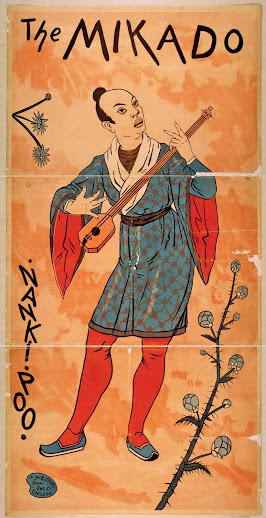
A vintage character poster from The Mikado,
composed in 1885. The play will be produced by
KDEN with auditions in late May.
Image from Encyclopedia Britannica

Auditioneers should be prepared to sing a song that best shows their vocal range and dress comfortably to move on the stage. There will be cold readings as well.
    Principal male characters are The Mikado, Nanki-Poo- his son, Koko- Lord High Executioner, Pooh-Bah – Lord High Everything Else, and Pish-Tush and Go-To both Noble Lords. Principal female characters are Yum-Yum, Pitti-Sing and Peep-Bo all wards of Koko, and Katisha- an Elderly Lady. There is also a chorus of school girls, noblemen and guards. Familiar tunes include I've Got a Little List, Three Little Maids from School, and A Wand'ring Minstrel, I. The show is being directed by Suzi Bond. Walter Greenwood is the music director will conduct the live orchestra.
    As with all Gilbert and Sullivan, the primary theme is duty and respect. It is about following through with commitments made and being responsible for the consequences. They are just set in different places: A pirate cove, a ship, a castle, Japan - that and taking aim at society and its foibles. Gilbert used foreign or fictional locales in several operas, including The Mikado, Princess Ida, The Gondoliers, Utopia, Limited and The Grand Duke, to soften the impact of his pointed satire of British institutions.
    When The Mikado was composed in 1885, Londoners had been enthusiastic about all things Japanese since the opening of Japan to the West in the mid-1850s. Bond said the musical "shows the limited knowledge of Japan and all of East Asia as it claims to be set in Japan, but the names of the characters and places are more Chinese-like. It shows how ignorant of other races the English (white people) were and to some aspect still are. The Mikado takes a swipe at 1880s English society and institutions while disguising it as foreign policies."
    The performance will be July 22 – Aug. 7, Fridays and Saturdays at 7:30 p.m., Sundays at 2:30 p.m. in KMC's Kīlauea Theater. For more information call 982-7344 or email kden73@aol.co

To read comments, add your own, and like this story, see www.facebook.com/kaucalendar/. See latest print edition at. www.kaucalendar.com. See upcoming events at https://kaunewsbriefs.blogspot.com/2022/04/upcoming-events-for-kau-and-volcano.html.

MENTAL HEALTH FIRST AID WORKSHOP on Tuesday, May 10 will be from 8:30 a.m. - 4 p.m. Learn to identify, understand, and respond to signs of mental illnesses and substance use disorders in adults. This is a free workshop (worth $100). Certification fee will be covered by Vibrant Hawaiʻi. To RSVP, visit vibranthawaii.org/get-involved.


SEE MORE UPCOMING EVENTS IN KAʻŪ & VOLCANO
See The Ka'ū Calendar May edition at
www.kaucalendar.com, on newsstands and in the mail.\