About The Kaʻū Calendar

Sunday, May 15, 2022

Ka‘ū News Briefs, Sunday, May 15, 2022

Plenty people remained at Punalu'u Black Sand Beach this weekend after the county lifeguard shifts
ended at 4:30 p.m. An after hours turtle monitoring group has formed, which also advocates for
longer lifeguard hours. Photo by Julia Neal

A NEW PUNALU'U TURTLE & BEACH MONITORING GROUP at Black Sand Beach has drawn volunteers daily to the shoreline to watch over turtles and advise beachgoers to stay away from them. Punalu'u mauka resident Guy Enriques, whose family has run lei stands at the beach for generations and also served as volunteer lifeguards over the years, helped to organize the group.
Guy Enriques years ago with baby hawksbill  turtles scurrying
 to the ocean as onlookers lined the path to the shore.
  Photo by Julia Neal
    Enriques said the volunteers monitor daily from 4:30 p.m., after county lifeguards leave work, and stay until dark. He also said he is advocating to extend lifeguard hours, since the beach usually has many people there, some of them in the water at the end of the county lifeguard shift. 
    Enriques has assisted swimmers in trouble in recent weeks, including a teenage visitor with a boogie board who was being carried out to sea by a current.
    He noted that in addition to the green sea turtles resting on the beach, hawksbill turtle nesting season is coming up and that volunteers will watch for female hawksbills seeking to dig nests in the sand. The effort would augment the Turtle Watch program.
    Malama Pono Punalu'u turtle and beach monitoring group originated with residents in the neighborhood just mauka of Hwy 11 above the beach. Enriques said they conducted a pilot program for the last three weeks and decided to make it a daily scheduled routine. He said to start, some folks plan to volunteer multiple times a week. The goal is for enough people to volunteer so that shifts will be once a month. He said the group will hold an orientation program for new volunteers.
Punalu'u residents Chris and Kathleen Mummie
 take a shift with the Malama Pono Punalu'u group
.
Photo from Malama Pono Punalu'u
  Enriques said volunteers are also interested in tracking the number of visitors to the beach, to better educate the public with signage and handouts, and to help with water safety after hours, by watching for swimmers who might need help and calling in for help when needed.
     "What we are looking for," said Enriques, "are people who have the time, are interested in the turtles and want to help the community." Those who want to volunteer can call Enriques at 808-217-2253 or email enriques@hawaii.rr.com.

To read comments, add your own, and like this story, see www.facebook.com/kaucalendar/. See latest print edition at. www.kaucalendar.com. See upcoming events at https://kaunewsbriefs.blogspot.com/2022/04/upcoming-events-for-kau-and-volcano.html

TO PROTECT CORAL REEFS BY PROHIBITING SALE AND DISTRIBUTION OF SUNSCREEN containing such chemicals as oxybenzone, the County Council will consider a bill on May 17. Hawai'i Wildlife Fund favors the legislation. Its president Megan Lamson and Executive Director Hannah Bernard wrote to members of the council Committee on Climate Resilience & Natural Resource Management. The letter notes the the bill would ban "sale or distribution of non-mineral sunscreen, unless prescribed by a 
licensed healthcare provider." It would take effect Dec 1.
    State of Hawai'i already became the first place in the world to ban such sunscreens but the law is not enforced. CVS and some other retailers have taken the sunscreen with damaging chemicals off their shelves. Hawai'i Wildlife Fund is vying for more legislation, this time at the county level to further encourage reduction of sunscreen going into the ocean.
    "We are in full support of this initiative that would effectively reduce the amount of chemical stressors on our coral reefs!" declares Hawai'i Wildlife Fund. "Research has already shown that certain chemicals 

A bill before the County Council would ban non-mineral sunscreens, which contain chemicals
that bleach and damage coral reefs. Photo from state Department of Land & Natural Resources
in sunscreen, including oxybenzone, have been detrimental to the health of coral larvae. In this time when our oceans are already negatively impacted from the threats of rising temperatures (causing bleaching), overfishing, eutrophication (excessive nutrient inputs), marine debris, and the spread of invasive species, it is critical for us to takes steps towards protecting coral reef ecosystems.
    "Coral reef ecosystems are intimately connected to the health and welfare of our island communities. Our reefs not only support life in Hawai‘i but equate to $360 million directly to the state's economy each year (directly and indirectly).
    "In light of the devastating declines in coral cover across West Hawai‘i in 2015, now more than ever, we need to commit to conservation efforts such as this one and pass Bill 167 into law. Put simply, there are better (more eco-friendly) ways to protect residents and visitors from UV rays that do not put the health of our reefs at risk."
    Hawai‘i Wildlife Fund has been working to conserve native species in Hawai‘i since 1996, and is well known for beach cleanups and anchialine pond work in Kaʻū, as well as educational outreach in the schools. The letter notes that the organization is "involved in research, education, restoration and advocacy projects related to the protection of coastal and nearshore ecosystems around the Pae ‘Āina. Mahalo for voting to pass this bill. Me ke aloha pumehana."

To read comments, add your own, and like this story, see www.facebook.com/kaucalendar/. See latest print edition at. www.kaucalendar.com. See upcoming events at https://kaunewsbriefs.blogspot.com/2022/04/upcoming-events-for-kau-and-volcano.html

Debra Cabral-Galapir, of Pāhala, inside Pōwehi on
 Astro Day held Saturday at Prince Kuhio Plaza in Hilo.
 Photo by Tim Wright AFT
AFTER GOING DARK DURING THE PANDEMIC,
ASTRODAY took flight on Saturday with educational displays on astronomy at Prince Kuhio Plaza in Hilo. The event drew folks from Kaʻū, including Debra Cabral-Galapir, of Pāhala, who found herself in a display about the first-ever photographed black hole, Pōwehi. 
    It was given the name Pōwehi by Larry Kimura, a Hawaiian professor at University of Hawaii-Hilo. The name Pōwehi comes from the Hawaiian creation chant, the Kumulipo and means “embellished dark source of unending creation.” Pō means profound dark source of unending creation. Wehi, means honored with embellishments.
    AstroDay is sponsored by University of Hawai'i Institute for Astronomy and Maunakea Astronomy Outreach Committee. The annual event was dark for two years due to covid.  AstroDay is celebrated on the same day as the international Astronomy Day.

To read comments, add your own, and like this story, see www.facebook.com/kaucalendar/. See latest print edition at. www.kaucalendar.com. See upcoming events at https://kaunewsbriefs.blogspot.com/2022/04/upcoming-events-for-kau-and-volcano.html

SEE UPCOMING EVENTS IN KAʻŪ & VOLCANO
See The Ka'ū Calendar May edition at
www.kaucalendar.com, on newsstands and in the mail.\


Saturday, May 14, 2022

Ka‘ū News Briefs, Saturday, May 14, 2022

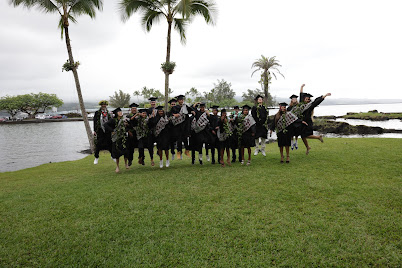
Eighteen Kaʻū High students on Friday, with maile lei and supporters of their Academy for Agri-preneurship. The students earned college credits in agriculture while in high school through cooperation with Hawai'i Community College.
Photo from Hawai'i Executive Collaborative
EIGHTEEN KA'U HIGH SCHOOL STUDENTS RECEIVED AGRICULTURAL ACHIEVEMENT CERTIFICATES from Hawaiʻi Community College during a commencement ceremony on Friday at Edith Kanakaʻole Multi-Purpose Stadium. The students earned the certificates through the Academy for Agri-preneurship at Kaʻū High & Pāhala Elementary School.
      Prior to attending the commencement ceremony, Kaʻū students and their families attended a celebratory luncheon hosted by the Hawaiʻi Executive Collaborative and received gift bags; enjoyed live music from 14-time Nā Hōkū Hanohano award winner, Mark Yamanaka; and heard a keynote address from Derek Kurisu, executive vice president of KTA Superstores and member of the Hawaiʻi Executive Collaborative.
Academy for Agri-prenuership students at Kaʻū High celebrate after earning
college credits in agricultural achievement from Hawai'i Community College.
Photo from Hawai'i Executive Collaborative
    The Academy for Agri-preneurship is part of the Kaʻū Global Learning Lab, a school-centered strategy to revitalize the Ka'ū area. Its aim is to prepare students to be environmentally responsible community members and independent entrepreneurs who practice mālama 'āina, conservation and sustainability, and contribute to the socio
-economic resiliency of Ka'ū, Hawai'i, and the world. At the academy, students engage in project-based learning and career training programs. At an age as young as 14, they are able to earn college credits and certificates of competence in agriculture, entrepreneurship, creative media, and culinary arts. The program is not just for the students in AP/honors classes – of the 18 students who received certificates, six are in special education, two are learning English as a second language, and one is a teenage mother.
    Students awarded Certificates of Competence in Agriculture/Landscaping, with 12 college credits are: Stephen Adler, Laci Ah Yee, Elaina Akiu, Jinia Jackson, Fred Kauwe, Kamamalu Kauwe, Eline Ling, Charlotte Ross, Joaquin Ross, Stephen Throne, Trinity Torres, Kamalani Tuifagu and Kainalu Wanzer
Students awarded Certificates of Achievement in Agriculture with 24 college credits are: Cody Ah Yee,
Cyrus Eder, Kelson Gallano, Collin Hanshew amd Amelia Uribe Bounos.
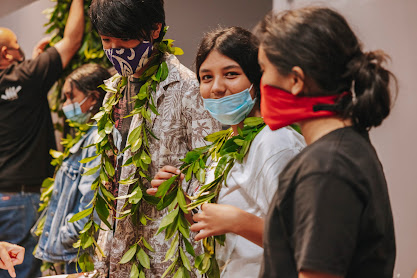
Kaʻū High students included in graduation ceremonies for Hawai'i Community
College for earning college credits while in high school receive lei from 
supporters of the mission of their Agri-preneurship academy.
Photo from Hawai'i Executive Collaborative
    
    The Kaʻū Global Learning Lab was created through a community revitalization project known as Kaʻū Dream, launched in October 2021. Kaʻū Dream is a community resiliency model – developed by and for the community – that aims to build a vibrant, thriving and sustainable Kaʻū through education and economic development.
    "As a former teacher, I've witnessed firsthand how access to practical, hands-on education can change the life of a student," said First Lady Dawn Amano-Ige, chairperson of Kaʻū Dream's community advisory committee. "Supporting our youth is the first step in revitalizing Kaʻū because empowered students are foundational to the success of their community. Today, we celebrate the accomplishments of these students and what their achievements mean to the community at large."
    Cody Ah Yee, graduating senior from Kaʻū High School, said, "I never thought I could get a college
Hawai'i First Lady Dawn Ige, Kaʻū High Principal Sharon Beck and 'Āina
Akamu, who heads up the Academy for Agri-preneurship at Kaʻū High &
Pāhala Elementary, congratulate students who earned college credits.
Photo from Hawai'i Executive Collaborative
certificate while still in high school and it makes me feel really good that I already have credits that I can use towards a college degree. My sister is in the program too and she's also getting a certificate today. My mom is really happy that both of us have college credits now." Ah Yee said he plans on continuing to earn skilled certifications such as an FAA commercial drone pilot license, a commercial driver's license, or join an apprenticeship program.
    Āina Akamu, teacher and Director of the Kaʻū Global Learning Lab, said, "At the Kaʻū Global Learning Lab, our youth are thriving at the intersection of education, agriculture, sustainability, and the Hawaiian value of mālama ʻāina. Not only is the academy providing students with the skills and knowledge they need to achieve career success, but it's also fostering community resiliency by addressing food insecurity in Kaʻū. Our vision is bold – we're here to transform our entire community for the better."
    Duane Kurisu, chairman of the Hawaiʻi Executive Collaborative. said, "The accomplishments of these young people are a testament to the hard work of the teachers, parents and community members who have come together to make dreams into reality. The Kaʻū Dream model is already inspiring others around the world and we have international partners, such as MyFarm Japan and InterGlobe India who are looking to Kaʻū for guidance on how to create successful community revitalization projects in other parts of the globe."
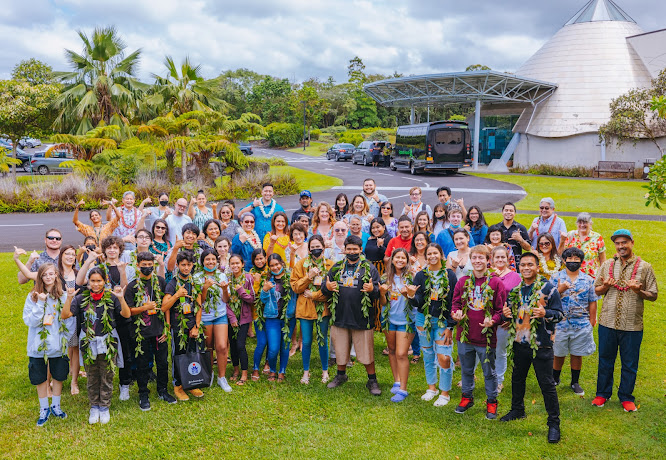
Kaʻū High students earning college credits while still in high school through Academy for Agri-preneurship
joined supporters of the program at Imiloa for a congratulatory luncheon on Friday in Hilo.
Photo from Hawai'i Executive Collaborative
    The mission of Kaʻū Dream is to serve as "a community-driven initiative dedicated to the rediscovery and regeneration of Kaʻū. It is committed to transforming Kaʻū into a vibrant place to live, work, and play while keeping the authenticity of its people and its culture." Learn more at kaudream.org
    The Hawaiʻi Executive Collaborative serves as a backbone organization that provides energy and resources to help leaders from cross-sector partnerships develop a common agenda and create collective impact. HEC's mission "is rooted in Hawaiʻi's soul and aims to mobilize local, national and global leaders to commit toward the safety, wellness and prosperity of Hawaiʻi and elevate its central place in the world." Learn more at hec.org.

To read comments, add your own, and like this story, see www.facebook.com/kaucalendar/. See latest print edition at. www.kaucalendar.com. See upcoming events at https://kaunewsbriefs.blogspot.com/2022/04/upcoming-events-for-kau-and-volcano.html

THE MOST SEISMICALLY ACTIVE REGION IN HAWAI'I IS DEEP BENEATH PĀHALA. This week's Volcano Watch, written by U.S. Geological Survey Hawaiian Volcano Observatory scientists and affiliates, punctuates the regular occurrence of earthquakes in the village:
     Deep beneath Pāhala, a town located in the southern part of the Island of Hawai’i, is currently the most seismically active region of the Hawaiian Islands. Frequent, deep earthquakes (greater than 20 km or 12 miles below sea level) are felt regularly by local residents, and, occasionally, people across the entire island.
    However, the current level of activity was not always common to the region and USGS Hawaiian Volcano Observatory (HVO) researchers are interested in trying to understand more about why it is happening.
    Until 2015, an average of 7 earthquakes occurred deep beneath Pāhala each week. By 2015, the number of earthquakes had approximately quadrupled, with nearly 34 events happening per week. By the spring of 2019, the average number of weekly earthquakes identified in this region increased approximately 70-fold, relative to pre-2015 rates. This high rate of earthquake activity, with several hundred earthquakes occurring in an average week, has continued to the present.
    Since August 2020, larger-magnitude earthquakes have also begun to occur deep beneath Pāhala. Eight magnitude-4.2-to-4.6 earthquakes, at depths of 31–34 km (19–21 miles) have been recorded. These larger events have been reported felt by people on the Island of Hawai’i as well as nearby Hawaiian Islands.
This map compares two months of earthquake activity in the region deep beneath Pāhala from (a) March 1, 2014, to May 1, 2014, and (b) March 1, 2022, to May 1, 2022. Earthquake locations are marked by circles that are colored by depth; blue circles indicate earthquakes that occurred 20–40 km (12–25 miles) below sea level.  USGS map

    HVO, in collaboration with the University of Hawai’i at Mānoa (UHM), will begin an investigation this summer to learn more about the nature of these frequent, deep earthquakes beneath the southern part of the Island of Hawaiʻi.
    Previous geophysical studies have theorized that deep earthquake activity beneath the Pāhala region may be related to hot spot magma transport and/or faulting in the brittle upper mantle beneath the island. Interestingly, the area of elevated seismicity is almost equidistant from the summits of the three most active volcanoes in Hawaiʻi: Kīlauea, Mauna Loa, and Kamaʻehuakanaloa (Lō‘ihi Seamount).
    Whether this region has a possible connection to the shallower magma storage and transport systems of Kīlauea or Mauna Loa is unclear, but there are no obvious indicators of magma transport from this region to the surface. Previous studies relied on data collected from HVO’s widely-spaced permanent seismometers in the region, which were not configured to study this area in detail.
    This summer, HVO and UHM scientists—funded by the Additional Supplemental Appropriations for Disaster Relief Act of 2019 (H.R. 2157)—will hike across the Pāhala region, deploying instruments called seismic nodes that will help to us to understand why these earthquakes are occurring. Seismic nodes are light, compact seismometers that measure ground shaking at the location where they are placed.
    Unlike permanent seismic stations, which are placed farther apart and cover the entire Island of Hawai’i, the temporary seismic nodes will be tightly grouped in order to more densely record earthquake signals across the region surrounding Pāhala. For two months, these nodes will record ground shaking generated by shallow and deep earthquakes occurring across the Island of Hawai’i as well as distant earthquakes from around the world.
    The densely-spaced nodal instruments recording earthquakes over a wide range of depths and locations during this experiment will collect seismic data from below the Pāhala region at unprecedented resolution. Seismologists at HVO and UHM will analyze data collected from these seismic nodes to create images of the structure of the Earth beneath Pāhala from as great as 40–50 km (25–31 miles) below sea level all the way to the surface.
    The data and images will be used to precisely locate the earthquakes in this region and, hopefully, identify or constrain the locations and distributions of shallow and deep fault zones and potential magma pathways within the region. Together, the results will help us to understand what is causing the frequent earthquake activity deep in the region beneath Pāhala.
    We plan to share the results of this project after the data are processed. In the meantime—if you are in the Pāhala area this summer, please watch out for seismic nodes that are recording valuable data to help HVO shed light on the mystery of frequent earthquake activity deep below.
An HVO seismologist deploying a seismic node on the down-drop block of Kīlauea caldera, with permission from
 Hawai‘i Volcanoes National Park. USGS image by J. Chang
Volcano Activity Updates:
    Kīlauea volcano is erupting. Its USGS Volcano Alert level is at WATCH (https://www.usgs.gov/natural-hazards/volcano-hazards/about-alert-levels). Kīlauea updates are issued daily.
    Over the past week, lava has continued to erupt from the western vent within Halemaʻumaʻu crater. All lava is confined within Halemaʻumaʻu crater in Hawai‘i Volcanoes National Park. Sulfur dioxide emission rates remain elevated and were last measured at approximately 2,700 tonnes per day (t/d) on May 10. Seismicity is elevated but stable, with few earthquakes and ongoing volcanic tremor. Summit tiltmeters show several minor inflation and deflation trends over the past week. For more information on the current eruption of Kīlauea, see https://www.usgs.gov/volcanoes/kilauea/recent-eruption.
    Mauna Loa is not erupting and remains at Volcano Alert Level ADVISORY. This alert level does not mean that an eruption is imminent or that progression to an eruption from the current level of unrest is certain. Mauna Loa updates are issued weekly.
    This past week, about 59 small-magnitude earthquakes were recorded below the summit and upper elevation flanks of Mauna Loa—the majority of these occurred at shallow depths less than 15 kilometers (9 miles) below sea level. Global Positioning System (GPS) measurements show low rates of ground deformation over the past week. Gas concentrations and fumarole temperatures at both the summit and at Sulphur Cone on the Southwest Rift Zone have remained stable over the past week. Webcams show no changes to the landscape. For more information on current monitoring of Mauna Loa, see: https://www.usgs.gov/volcanoes/mauna-loa/monitoring.
    One earthquake was reported felt in the Hawaiian Islands during the past week: a M3.4 earthquake 9 km (5 mi) E of Pāhala at 31 km (19 mi) depth on May 8 at 4:08 p.m. HST.
 HVO continues to closely monitor Kīlauea’s ongoing eruption and Mauna Loa for any signs of increased activity. Visit HVO’s website for past Volcano Watch articles, Kīlauea and Mauna Loa updates, volcano photos, maps, recent earthquake info, and more. Email questions to askHVO@usgs.gov.

To read comments, add your own, and like this story, see www.facebook.com/kaucalendar/. See latest print edition at. www.kaucalendar.com. See upcoming events at https://kaunewsbriefs.blogspot.com/2022/04/upcoming-events-for-kau-and-volcano.html

HOKU NIGHTS AT HIPUʻU, Sunday, May 16, 6:30 p.m. Hosted by Ohana Miloliʻi and Hipuʻu o Miloliʻi Kumu every full moon. Topic is Online Learning. Zoom ID: 227 574 9157.

RAINBOW WINDSOCK CRAFT for keiki in grades K-6th on Tuesday, May 17 from 3 - 4:30 p.m. at Kaʻū District Gym & Pāhala Community Center. Registration is open from May 9 - May 13. To register, contact Recreation Director II, Nona Makuakane, at (808) 928-3102.

KAHUKU RANGER PRESENTATION: WHAT’S IN YOUR BACKYARD? THE GEOLOGY OF MAUNA LOA on Friday, May 20 at 9:30 a.m. at Kahuku Unit Visitor Center. Ranger presentations are on the third Friday of every month and are 15-20 minutes long.

SEE MORE UPCOMING EVENTS IN KAʻŪ & VOLCANO
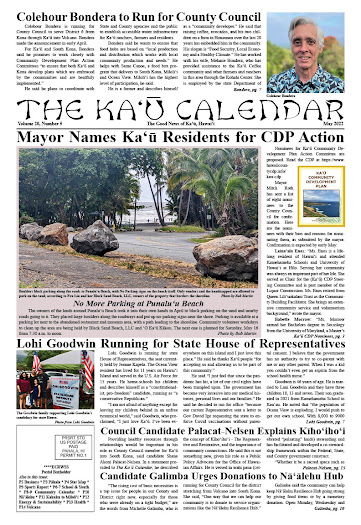
See The Ka'ū Calendar May edition at
www.kaucalendar.com, on newsstands and in the mail.\


Friday, May 13, 2022

Ka‘ū News Briefs, Friday, May 13, 2022

Phase 1 of a water project for Department of Hawaiian Home Lands lessees at South Point broke ground Friday. It will
connect Pastoral homestead lessees in the Kamāʻoa Homestead to water service through a partnership with Hawai'i County.
Photo from DHHL

GROUNDBREAKING FOR WATER SERVICE TO HAWAIIAN HOME LANDS AT SOUTH POINT launched Phase 1 on Friday morning. The statement from Department of Hawaiian Home Lands says its "improvements to an existing County of Hawaiʻi Department of Water Supply system in Kaʻū will soon connect Pastoral homestead lessees in the Kamāʻoa Homestead to water service."
    The groundbreaking celebrated the ultimate connection of the newly built DHHL water storage and distribution system to the county Department of Water Service ’ No. 108 system in Kaʻū. Phase 1 of the DHHL project is being accomplished by Isemoto Contracting Company, to include installation of a 100,000-gallon water reservoir to serve Pastoral homestead lots awarded to native Hawaiians in the mid-1980s.
    DHHL reports, "These lessees, part of the Department’s Acceleration Program, were awarded to native Hawaiians as raw land following a 1983 report by a Federal and State task force that recommended to the State of Hawaiʻi that DHHL should issue undeveloped raw land to native Hawaiians. The program’s effort was to accelerate the distribution of land to beneficiaries of the Hawaiian Homes Commission Act. DHHL issued 2,629 leases of mostly raw land between 1984 and 1987 as part of the program. Since the issuance of lots under the Acceleration Program, the Department has incrementally installed infrastructure, as 
Department of Hawaiian Home Lands Chair William Ailā, Jr. on Friday morning, during the groundbreaking of a new water system for Hawaiian Home Land Lessees at Ka Lae. Photo from DHHL

funding became available. DHHL has plans to complete infrastructure improvements for the remaining Acceleration Program lots on Molokaʻi and Hawaiʻi Island over the next three to five years."
    Hawaiian Homes Commission Chair William J. Ailā, Jr. said, “Partnerships with the County and other agencies are critical in the development of infrastructure for DHHL projects. Building these improvements to County standards allows DWS to adopt it into its existing system, a critical piece that is allowing this project to happen. A water tank is the first step towards resolving a longstanding obligation DHHL made to Kamaoa lessees.
    "The Department’s acceleration program provided pasture lots to native Hawaiians without access to water and placed the responsibility of advocating for future infrastructure improvements in their hands. Today, we take a meaningful step toward delivering access to water for the Pastoral lots.” 
    The $2.7 million Capital Improvement Project is funded by a Fiscal Year 2020 appropriation from the Hawaiʻi State Legislature. Phases 2 and 3 of the Kaʻū Water System project are designed to work on pressure regulating valves, new water meters, and improvements to South Point Road for future homesteading opportunities.         
    In March, DHHL broke ground on 125 Residential lots in the Villages of Laʻi ʻŌpua Village IV Hema Phase 2 subdivision in Kealakehe, and last month began infrastructure construction on 16 Subsistence Agricultural lots in Honomū."

To read comments, add your own, and like this story, see www.facebook.com/kaucalendar/. See latest print edition at. www.kaucalendar.com. See upcoming events at https://kaunewsbriefs.blogspot.com/2022/04/upcoming-events-for-kau-and-volcano.html

PUBLIC INPUT ON A PLAN TO IMPORT MOSQUITOS INTO THE HAWAIIAN ISLANDS and release them, in order to reduce existing mosquito populations, is a request from the state Department of Agriculture. The targeted mosquitoes have led to extinction and near extinction of native Hawaiian birds and also pose a health risk to humans and animals. 
    The state Board of Agriculture approved of the concept this week to import the Asian tiger mosquito Aedes albopictus, the yellow fever mosquito Aedes aegypti, and the southern house mosquito Culex quinquefasciatus, adding them to the List of Restricted Animals that allows regulated introduction into the state.
Asian tiger mosquito was a likely vector in the 
Dengue outbreak that started in South Kona in 2015.
Photo from entomologytoday.org
    The proposed order and proposed rule changes may be viewed online at: https://hdoa.hawaii.gov/blog/main/proposed-administrative-rules/
      Through June 8, Hawai`i Department of Agriculture, Plant Quarantine Branch, will accept comments through Jonathan Ho, Inspection and Compliance Section Chief. Send to Jonathan.K.Ho@hawaii.gov.
      The plan is designed so that the targeted female mosquitoes mate with the introduced mosquitoes. A bacterium in the imported males' reproductive systems makes the mating unproductive and the populations of the targeted mosquitos are reduced. 
      The process is called cytoplasmic incompatibility. According to the statement from Department of Agriculture, "Cytoplasmic incompatibility has been used with much success in other parts of the world to reduce mosquito populations and thus reduce the potential of transmission of mosquito vectored diseases."
Yellow fever mosquito is a vector of of numerous viruses
 including Zika, dengue, chikungunya, yellow fever and
West Nile. Photo from entomologytoday.org
    Human diseases to be reduced or prevented in Hawai'i include the viruses Zika, dengue, chikungunya, yellow fever and West Nile, along with the disease lymphatic filariasis. Diseases of Hawai'i’s fauna to be reduced include avian malaria, avian pox, and dog heartworm. 
    The targeted mosquito species "are invasive, disease-spreading mosquitoes that can be found throughout Hawai'i," reports Department of Agriculture. The Asian tiger mosquito and yellow fever mosquito "are believed to have been the primary vectors during Maui’s 2001 dengue virus outbreak, Oahu’s 2011 dengue virus outbreak, and Hawai'i County’s 2015-2016 dengue outbreak, which led to more than 264 cases of the illness." 
    The southern house mosquito is known to vector West Nile virus on the U.S. mainland and lymphatic
Southern house mosquito carries avian malaria, which has
devastated the population of native forest birds and also
carries dog heartworm. Photo from entomologytoday.org
filariasis in other Pacific nations. The species is present on Hawai'i, Maui, Moloka'i, Lana'i, Kaho'olawe, O'ahu, Kaua'i, and the northwest Hawaiian islands. Department of Agriculture reports that it can thrive at sea-level to 4.800 ft.. 
     Concerning Hawai'i’s native forest birds, the southern house mosquito is a known vector of avian malaria and the yellow fever mosquito is a vector of avian pox. "These diseases have contributed to the extinction of more than half of Hawai'i’s endemic honeycreepers and continue to pose a risk to the remaining species. Lastly, these mosquito species are known to transmit dog heartworm within pets found throughout Hawai'i," says the Department of Agriculture statement.
    DOA notes that efforts to suppress these mosquitoes through pesticides "are inadequate at a landscape scale, and may be problematic for other non-target state and federally protected invertebrate species including Hawaiian picture-wing flies, damselflies, yellowfaced bees and anchialine pond shrimps."

To read comments, add your own, and like this story, see www.facebook.com/kaucalendar/. See latest print edition at. www.kaucalendar.com. See upcoming events at https://kaunewsbriefs.blogspot.com/2022/04/upcoming-events-for-kau-and-volcano.html

COUNTY PROSECUTOR KELDEN WALTJEN SENT OUT A MESSAGE FRIDAY EVENING, urging Gov. David Ige to sign House Bill No. 1486, HD2, SD1 (“HB 1486”) into law. The legislation would increase the penalty for felony theft of motor vehicles and motorcycles from a maximum five-year prison term to a maximum ten-year prison term. 
     “We encourage the public to join us in support of the passage of HB 1486, share their concerns about
County Prosecuting Attorney Kelden Waltjen urges citizens
 to encourage the governor to sign a bill increasing
 prison time for auto and motorcycle theft.
how auto and motorcycle theft has affected our community, and request that Governor Ige sign this bill into law,” said the Prosecuting Attorney. "Currently, most auto and motorcycle thefts are prosecuted as Theft in the Second Degree and/or Unauthorized Control of a Propelled Vehicle in the First Degree, both of which are only class C felony offenses punishable by a maximum five year prison term."
     HB 1486, introduced by Rep. Greggor Ilagan, State House District 4 representing lower Puna, establishes Theft of Motor Vehicles and Motorcycles as a subsection of Theft in the First Degree, which is a class B felony offense punishable by a maximum ten year prison term. 
     This past December, the Hawai‘i County Prosecutor’s Office conducted an online legislative initiatives survey. Of those 1,422 who participated in the survey, 1,265 or 89.21% supported establishing Theft of a Motor Vehicle as a class B felony offense. “By increasing the penalty for auto and motorcycle theft, we promote respect for the law, ensure that offenders 2 receive an appropriate sentence that reflects the seriousness of the offense, provide adequate deterrence for future criminal activity, and protect the public,” said Waltjen. He urges submitting testimony via the Governor’s website at https://governor.hawaii.gov/contact-us/comments-on-legislation/

To read comments, add your own, and like this story, see www.facebook.com/kaucalendar/. See latest print edition at. www.kaucalendar.com. See upcoming events at https://kaunewsbriefs.blogspot.com/2022/04/upcoming-events-for-kau-and-volcano.html

LANDSCAPING WITH NATIVE HAWAIIAN PLANTS on Saturday, May 14 from 9 a.m. - 2 p.m. at Volcano Art Center’s Niaulani Campus will be led by instructor Zach Mermel of Ola Design Group. In this hands-on workshop, you’ll interact first-hand with a variety of native plants found throughout Hawai’i and learn how to integrate these plant allies into your home ecosystem. Class fee is $35/$30 for VAC members. To register, call (808) 967-8222 or visit volcanoartcenter.org/events/.

KAHUKU COFFEE TALK: ʻUAʻU: THE ENDANGERED HAWAIIAN PETREL will be on Saturday, May 14 from 9:30 - 11 a.m. at Kahuku Unit Visitor Center. Coffee Talk at Kahuku is an opportunity to get to know your Park and your neighbors, and join an informal conversation on a wide variety of topics on the second Saturday of every month. Entrance located south of the 70.5 mile marker on the mauka side of Hwy 11.

Flyer for Coffee Talk at Kahuku: 'Ua'u, The Endangered
Hawaiian Petrel. Image from Kahuku Unit,
Hawai'i Volcanoes National Park
.

SEE MORE UPCOMING EVENTS IN KAʻŪ & VOLCANO
See The Ka'ū Calendar May edition at
www.kaucalendar.com, on newsstands and in the mail.\