About The Kaʻū Calendar

Sunday, August 07, 2022

Ka‘ū News Briefs, Sunday, Aug. 7, 2022

Artist's conception of the multiple planet system, initially discovered with Gemini North optics. The art is used to 
explain the National Science Foundation's interest in funding TMT, with a public scoping meeting planned for this
Wednesday at Nāʻālehu Community Center from 6 p.m. to 8 p.m. Gemini Observatory Artwork by Lynette Cook

THE THIRTY METER TELESCOPE MEETING IN NĀ’ALEHU THIS WEDNESDAY is preceded by an explanation online regarding National Science Foundation's decision to seek public input to determine whether to further fund TMT. The scoping meeting will be held at Nāʻālehu Community Center on Wednesday, Aug. 10 from 6 p.m. to 8 p.m..
    NSF poses the question, "Why is NFS considering funding a new telescope? NFS states, "The field of astronomy is entering a new era. In the next two decades, a new class of telescope — known as Extremely Large Telescopes — can be built with capabilities well beyond that of space-based telescopes.
    "These new telescopes will explore the signatures of life on other worlds, answering fundamental questions about humans' place in the universe: Is there other life out in the vast expanse of space? Are there other worlds with life that future generations can explore?
    "NSF is considering a potential future investment in the construction and operations of an Extremely Large Telescope in the Northern Hemisphere, the Thirty Meter Telescope. NSF understands that the possible construction of this telescope on Maunakea, Hawai‘i Island, Hawai'i, is a sensitive issue that requires extensive engagement and understanding of various viewpoints.
    "NSF will not make a funding decision until after it considers the following: Public input; the environmental review of the telescope; the project's technical readiness; the project proponent's management capabilities; the availability of federal funding; and the telescope's alignment with other NSF priorities."
    NSF also states: "A decision by NSF not to go forward with an investment in the construction and operations of the Thirty Meter Telescope could be made at any time, including before the environmental review process has concluded."

To read comments, add your own, and like this story, see www.facebook.com/kaucalendar. See latest print edition at wwwkaucalendar.com. See upcoming events at https://kaunewsbriefs.blogspot.com/2022/04/upcoming-events-for-kau-and-volcano.htm

HAWAI'I'S U.S. SENATORS VOTED YES DURING THE PASSAGE OF THE INFLATION REDUCTION ACT on Sunday. The legislation aims to lower costs for families by investing billions in renewable energy, allowing Medicare to negotiate prescription drug prices, extending the enhanced Affordable Care Act subsidies, and requiring wealthy corporations to pay their fair share in taxes.
    "The Inflation Reduction Act is a historic investment in our families, our climate, and our future. From tackling inflation, to combating climate change, to making health care and prescription drugs more affordable, this bill makes meaningful progress on some of the most pressing challenges families in Hawaii are facing, all while ensuring working families don't pay a cent more in taxes," said Sen. Mazie Hirono. "In order to reduce the deficit, this legislation also closes outrageous tax loopholes that have allowed the largest corporations to avoid paying anything in taxes. Once again, Democrats delivered for our families while Republicans sat on their hands."
     More information on the health care in the bill is available from Hirono at: https://www.hirono.senate.gov/imo/media/doc/IRA%20-%20Health%20FINAL.pdf.          
More information on the climate provisions in the bill is available at: https://www.hirono.senate.gov/imo/media/doc/IRA%20-%20Climate%20FINAL.pdf.        
More information on the tax provisions in the bill is available at: https://www.hirono.senate.gov/imo/media/doc/IRA%20-%20Taxes%20FINAL.pdf.

    Sen. Brian Schatz said, “This is a historic victory for the United States and the planet. We have met the ambition this crisis requires, and passed the biggest climate action in American history. By investing in clean energy, clean transportation, and climate-smart manufacturing, we’ll cut emissions 40 percent by the end of the decade. And we’re going to pay for it all by making billion-dollar corporations finally pay their fair share of taxes. We’re also lowering the cost of prescription drugs for seniors and making health care more affordable – all while saving taxpayer dollars.”

    Schatz pointed out that investing in residential clean energy, the bill extends residential clean energy credit for ten years at the full 30 percent rate, which Hawai‘i residents can use for rooftop solar and battery storage purchases. It gives Hawai‘i residents access to $9 billion in new rebates for home electrification. It revises the expired energy efficiency home improvement credit and increasing its limit from $500 lifetime to $1,200 annually per taxpayer, which Hawai‘i residents can use for heat pumps, doors and windows, home energy audits, and other efficiency upgrades. It revives the expired tax credit for new energy-efficient homes.

To read comments, add your own, and like this story, see www.facebook.com/kaucalendar. See latest print edition at wwwkaucalendar.com. See upcoming events at https://kaunewsbriefs.blogspot.com/2022/04/upcoming-events-for-kau-and-volcano.htm

James Yamaki heads up this year's Kaʻū High Alumni & Friends
Reunion on Sunday, Aug. 21 at Pāhala Community Center.
Photo by Julia Neal
KA'Ū HIGH ALUMNI & FRIENDS ANNUAL REUNION IS LIVE on Sunday, Aug. 21. from 11 a.m. to 5 p.m. at Pāhala Community Center. All are welcome; just bring a potluck dish. A message from organizers says, "The County has eased COVID-19 rules to allow the public to meet for social gatherings at the center. This is the 19th potluck reunion. The potluck was canceled the last two years due to the corona virus pandemic."
    Chase Cabudol and Calvin Ponce are featured entertainers. "Their music will give the reunion an air of festivity. Their upbeat tempo is conducive for dancing," said organizer James Yamaki. "Past potluck reunions have been a showcase of Kaʻū talent and this year is no exception. Expect the unexpected."
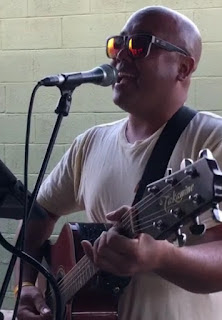
Chase Cabudol. Photo by Julia Neal
    He said that this year's reunion is informal and set up for participation by the broader community. The potluck reunion is held annually on the Sunday of the Statehood Admission Day weekend. It is designed so that classes can hold their own reunions during the weekend and wrap them up by joining the other alumni and friends at the Sunday gathering. He said, "Younger alumni are encouraged to attend to keep the tradition going."
    The class of 1958, which started this annual gathering in 2002, is hosting this year's event. Yamaki is in charge, assisted by registration chair Richard Fujioka and food-line coordinator Mary Gravel Peralta. Assisting are Ernest Kalani, entertainment; Lovey Gerantz, decoration, publicity and program and Ju Ann Kai, assisting with the program. Lisa Dacalio has been the featured artist creating whimsical posters publicizing the annual events. Her poster is of Punalu'u Beach.

To read comments, add your own, and like this story, see www.facebook.com/kaucalendar. See latest print edition at wwwkaucalendar.com. See upcoming events at https://kaunewsbriefs.blogspot.com/2022/04/upcoming-events-for-kau-and-volcano.htm


See www.kaucalendar.com

Saturday, August 06, 2022

Ka‘ū News Briefs, Saturday, Aug. 6, 2022

Volunteers and school staff clear an area for native plants and a culinary greenhouse at Kaʻū High 
& Pāhala Elementary on Saturday. Photo by Jennifer Makuakane

THE SECOND KA'Ū HIGH COMMUNITY GARDEN WORKDAY AND FIFTH ANNUAL HAWAI'I ISLAND FOOD SUMMIT welcomed Jodie Rosam to the Pāhala campus as guest presenter on Saturday with her knowledge of the wiliwili tree. She explained how to propagate the native trees, which are known for their red and orange blossoms and their popularity among native Hawaiians for making lei.

Jody Rosam, left, teaches about the propagation
of wiliwili trees. Photo by Jennifer Makuakane

    Rosam spoke about the natural history and ecology of wiliwili: where they live, how they grow, where to find them in Kaʻū. She explained that wiliwili is drought-deciduous (it drops its leaves during the dry season). The showy orange, red, salmon, peach, light green, yellow, or even white flowers bloom during the summer months after the leaves drop, and the nearly heart-shaped leaflets emerge in threes during the fall. Wiliwili can grow quite large, exceeding 45 feet tall with an impressively wide crown. Wili means to twist, screw, or wind, and wiliwili means repeatedly twisted, referring to the seed pods that twist to expose the bright, coral colored seeds. Rosam told participants about threats to the wiliwilli, including fire, habitat loss, the gall wasp that almost wiped them out in the early 2000s.  
The wiliwili. Art by Joan Yoshioka
    She shared moʻolelo about wiliwili and the four sisters at Paʻula in Kaunāmano, and also shared the ʻōlelo noʻeau. Finally, each participant was able to fill a pot with media, learn to scarify the seed, and plant it to bring home along with growing instructions.
    After Rosam's presentation, volunteers cleared and cleaned the lower field at the school to prepare for the native Hawaiian garden and culinary greenhouse. Both areas will be part of the middle school students' project this coming year.
    Kaʻū High & Pāhala Elementary released a statement thanking the Hawaiʻi Island School garden Network team, Zoe Kosmas of HISIGN lead, Jody Rosam and Stacey Breining of Hawaiʻi Wildlife Fund, Hawaiʻi Island Food Alliance, Hawaiʻi Island Food Basket, County of Hawaiʻi, and state Department of Health.
    The school also sent a mahalo to Āina Akamu and Jennifer Makuakane of its Kaʻū Global Learning Academy, its Farm Manager Jesse Denny and "hardworking volunteers."
    See more from Rosam on the wiliwili in the September 2021 edition of The Ka'u Calendar and in Ka'u News Briefs at  http://kaunewsbriefs.blogspot.com/2021_09_06_archive.html
The wiliwili tree, a species almost wiped out by a wasp in the early 2020s, can be propagated
from its seeds. Photo from Hawai'i Department of Agriculture

To read comments, add your own, and like this story, see www.facebook.com/kaucalendar. See latest print edition at wwwkaucalendar.com. See upcoming events at https://kaunewsbriefs.blogspot.com/2022/04/upcoming-events-for-kau-and-volcano.htm

KILAUEA'S SUMMIT LAVA LAKE CONTINUES TO BE QUIETLY REMARKABLE is the headline for this week's Volcano Watch, written by scientists and associates of USGS Hawaiian Volcano Observatory:
    In fact, the slow and steady lava lake activity in Halemaʻumaʻu crater has been quite fascinating, so it deserves another Volcano Watch visit.
    The first thing to appreciate is that we are witnessing a pattern that has typified Kīlauea’s summit behavior for centuries—the cycle of collapse and refilling. The caldera floor collapses and/or subsides—often due to an eruption on the rift zone—and subsequent summit eruptions fill the depression with new lava. Destruction and reconstruction, set on repeat.
    Numerous cycles of collapse and refilling occurred during the 1800s and early 1900s. These ranged from large to small, some spanning much of the caldera floor, with others limited to just the Halemaʻumaʻu area. In each instance, lava eventually returned to the summit and filled much or all of the depression.
    The collapse of the crater floor in 2018 was one of the largest such events in the past 200 years. Over the past year and a half, lava has been erupting in Halemaʻumaʻu crater and slowly refilling the new
Lava lake activity continues in Halema‘uma‘u, at the summit of Kīlauea. This photo looks east, and shows that the lake surface is composed of large crustal plates separated by incandescent spreading zones, with spattering along the east margin. The lake and the surrounding crater floor, formed by solidified lava, are being gradually uplifted due to endogenous lava supply beneath the surface. USGS photo by M. Patrick
depression. Since returning to Halemaʻumaʻu in December 2020, lava has refilled about 17% of the volume of the 2018 collapse.
    Watching the current activity is like having a time machine to an earlier century on Kīlauea.
    The second thing that is interesting about the current activity is the manner in which the lava is refilling the crater. In the simplest scenario, we might imagine the lava in Halemaʻumaʻu simply pouring in over earlier flows, stacking up and filling the crater.
    While a portion of the refilling is being done in this manner, a major amount of the refilling is
See www.kaucalendar.com

“endogenous.” In other words, lava from the vent is supplied beneath the solidified surface crust, out of view, lifting the crater floor. It’s akin to inflating a giant air mattress.
    We can track this growth with unprecedented detail using modern tools. A continuous laser rangefinder measures the lava surface every second, with centimeter precision. Webcams operating on the rim of Halemaʻumaʻu show the nature of uplift clearly.
    The process of endogenous growth is particularly well illustrated with the webcam on the east rim of Halemaʻumaʻu (the B1cam). Timelapse images from this webcam show the central portion of the crater floor is being lifted like a piston, intact and largely without fracturing.
    The active lava lake—forming a relatively small portion of the crater floor—has essentially been lifted up gradually with the remainder of the crater floor. The laser rangefinder shows short-term fluctuations in the level of the active lava in the lake, superimposed on a gradual upward trend of the crater floor due to this slow uplift.
    Around the perimeter of this central portion of the crater floor, a series of large cracks have developed. Beyond the cracks, along the margins of the crater floor, the behavior is more complex than simple piston-like uplift. This outer region is often tilted and deformed from the endogenous growth below.
    At the same time, this zone along the margins of the crater floor is often resurfaced due to ooze-outs—basically lava that is squeezed out from beneath the crater floor, onto the surface.
    This type of endogenous growth, or “bodily uplift,” was also observed in the 1800s and early 1900s. But it hasn’t been observed so much in the past hundred years on Kīlauea. And it certainly hasn’t been observed this clearly before, given our modern tools such as laser rangefinders and webcams.
    You can bear witness to this important phase in the lifecycle of Kīlauea, and a fascinating period in Hawaiian volcanism. Volcano watchers on the Island of Hawaiʻi can see the summit lava lake filling Halemaʻumaʻu crater by visiting the public viewing areas in Hawaiʻi Volcanoes National Park. For those off-island, Hawaiian Volcano Observatory webcams showing the lake and crater are operating 24/7 on the HVO website (www.usgs.gov/hvo).

To read comments, add your own, and like this story, see www.facebook.com/kaucalendar. See latest print edition at wwwkaucalendar.com. See upcoming events at https://kaunewsbriefs.blogspot.com/2022/04/upcoming-events-for-kau-and-volcano.htm

COMMUNICATING WITH EMPATHY is the topic of this month's Kuʻikahi Mediation Center Brown Bag Lunch event on August 18 as part of its Finding Solutions, Growing Peace series. Talks are Third Thursdays from noon to 1 p.m. via Zoom. This month's speaker is Anne Marie Smoke on the topic Communicating with Empathy: The Path to Seeing More Deeply.
        "How can we engage in communication that will help to establish a deeper connection with others?" asks Smoke.
Anne Marie Smoke, Appellate Mediation Program
Administrator for Center for Alternative Dispute
Resolution, Hawai'i State Judiciary.
    "Empathy development includes emotional intelligence techniques such as perspective taking, staying out of judgement, recognizing someone's emotions, and communicating understanding." The talks is designed for participants to take away tools to practice empathic communication in daily life.
    Smoke is Appellate Mediation Program Administrator and Trainer for Center for Alternative Dispute Resolution at the Hawaiʻi State Judiciary. She holds a graduate certificate in conflict resolution and MS in Travel Industry Management (sustainable tourism), is a facilitator for multiple policy-development and strategic planning initiatives, and has 17 years of training experience including teaching conflict management practices.
    Kuʻikahi's Brown Bag Lunch Series is free and open to the public. Attendees are encouraged to enjoy an informal and educational talk-story session and connect with others interested in Finding Solutions, Growing Peace. To get the Zoom link, register online at https://freebrownbagtalk.eventbrite.com.

To read comments, add your own, and like this story, see www.facebook.com/kaucalendar. See latest print edition at wwwkaucalendar.com. See upcoming events at https://kaunewsbriefs.blogspot.com/2022/04/upcoming-events-for-kau-and-volcano.htm


Friday, August 05, 2022

Ka‘ū News Briefs, Friday, Aug. 5, 2022

Kahuku-Pōhue parcel skirts Pōhue Bay and the Kaʻū Coast, attached to 16,451 acres, recently
acquired by Hawaiʻi Volcanoes National Park and subject of a public input meeting Aug. 13.
NPS Photo

THE MEETING ON THE PŌHUE BAY LANDS just acquired by Hawaiʻi Volcanoes National Park is subject of a call for public participation on Saturday, Aug. 13, from 1 p.m. to 3 p.m. at Ocean View Community Center, 92-8924 Leilani circle. National Park Service has sent out an invite to the public regarding the session on "protection and potential future use of the remote 16,451-acre Kahuku-Pōhue parcel the park acquired last month."
    Park managers are "seeking feedback from the community about the natural and cultural resources of the area, and wish to explore suggestions for public use that are compatible with resource protection," says the invite.
Brackish water pond that connects to the ocean at high tide.
NPS Photo by Jessica Ferracane
  A second meeting will be offered via virtual webinar on Wednesday, August 17 at 6:30 p.m. to 8 p.m. on Zoom, https://zoom.us/j/97789413155; or call in to (346) 248-7799, webinar ID: 977 8941 3155. The park, Trust for Public Land and the Hawaiʻi Alliance for Community-Based Economic Development will participate in both meetings.
    The Park statement says that before the land transfer, the park met with community members in partnership with Trust for Public Land and Hawaiʻi Alliance for Community-Based Economic Development "to better understand the land's cultural, historical and ecological significance. Community engagement will continue over the next few months. Until Pōhue interim operating procedures can be worked out, and safe access protective of cultural and natural resources can be ensured, public access to the Kahuku-Pōhue parcel is temporarily restricted.
    "There are no restroom facilities or capacity for trash removal, and emergency response is very limited. Portions of the current jeep trail and pedestrian routes to the coastline pass through private lands not managed by the park."

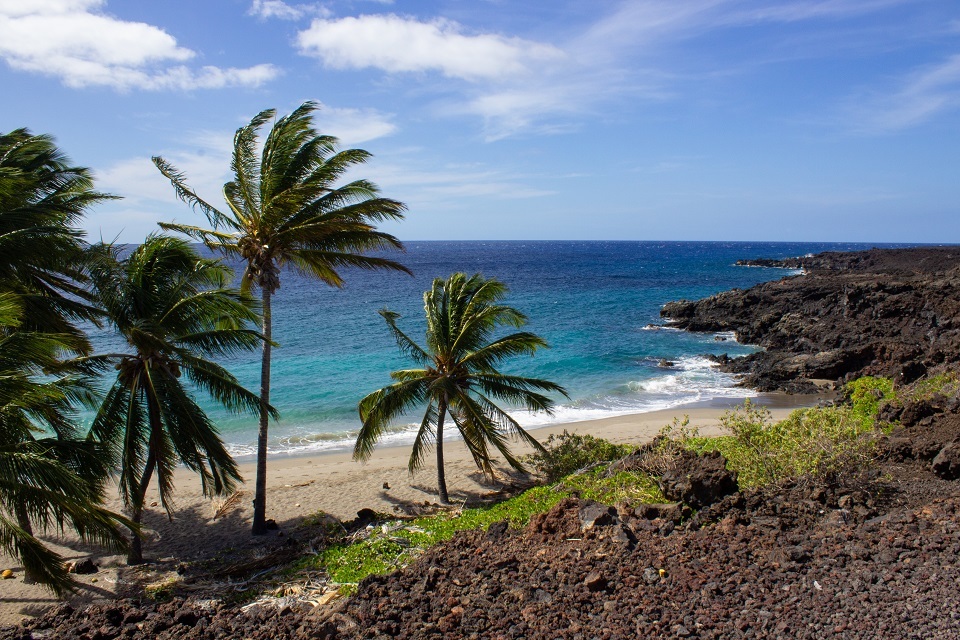
Pōhue is one of the few white sand beaches found on the southern part
 of the island of Hawaiʻi. NPS Photo by Jessica Ferracane
    The Park calls the new section the Kahuku-Pōhue parcel in reference to the Hawaiian place name, Kahuku. Kahuku is the mauka-to-makai (inland to ocean) ahupuaʻa  (historic land division), in which Pōhue is located. In addition, many Kaʻū locals refer to the bay as Pōhue Bay and its adjacent beach as Kahuku Beach. The park welcomes additional information about other ʻinoa ʻāina (Native Hawaiian or indigenous) place names for Kahuku-Pōhue. 
    The Park website includes a section on Kahuku-Pōhu'e at www.nps.gov/havo/learn/historyculture/kahuku-pohue.htm It includes the following:

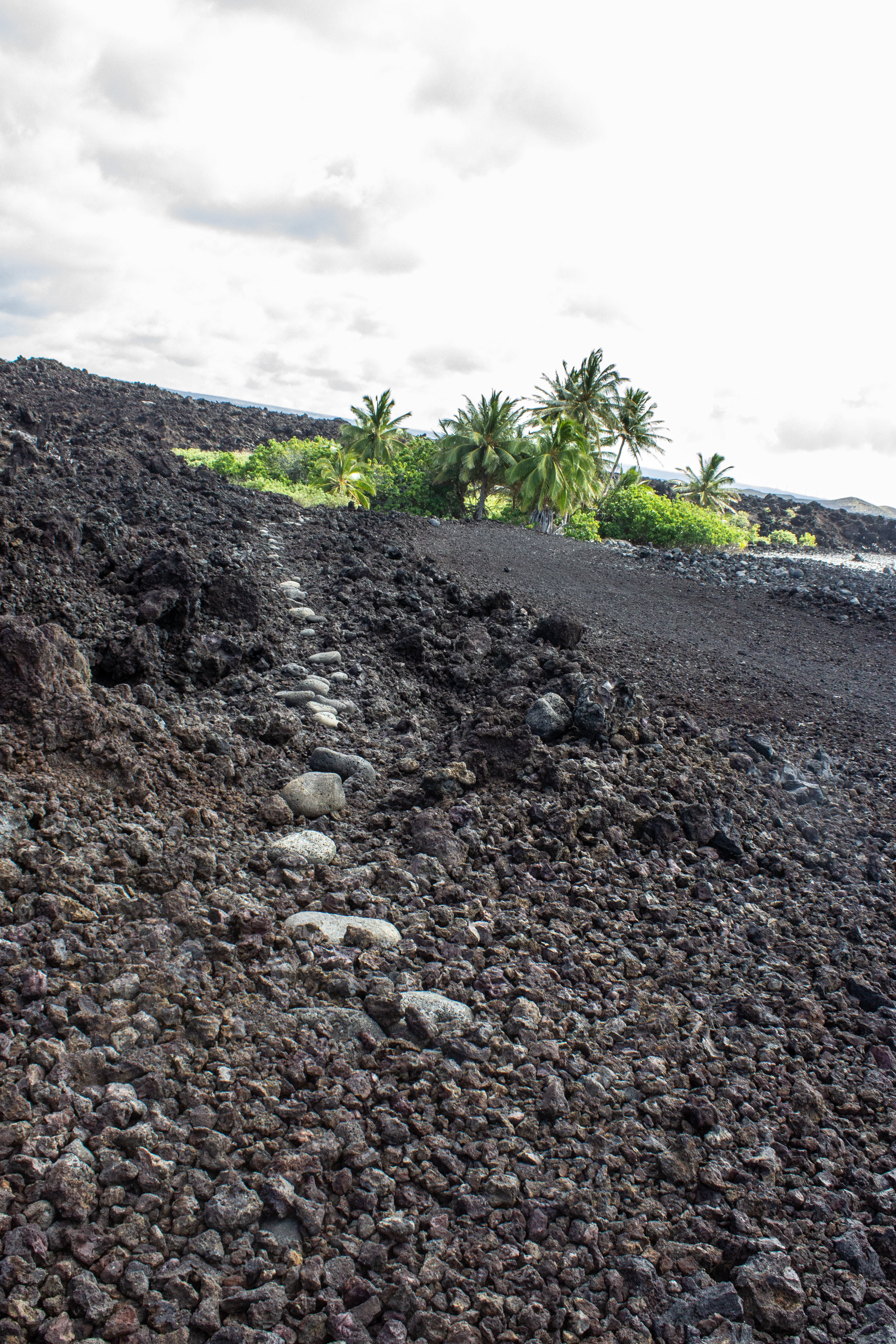
Pōhue holds a network of culturally and historically significant trails.
NPS Photo by Jessica Ferracane
"Located on the southern flank of Mauna Loa, the Kahuku-Pōhue parcel is home to numerous well-preserved and significant Hawaiian cultural sites, including the largest recorded abrader quarry in Hawaiʻi, lava tubes, burial site, mauka-makai (mountain to sea) trails, fishing shrines, remains of once-thriving coastal villages, and petroglyphs. 
A well-preserved portion of the Ala Kahakai National Historic Trail or Ala Loa, an ancient coastal trail system, hugs the coastline. The Pōhue coastline is also critical habitat for federally listed endangered Hawaiian species, including honu‘ea (Hawaiian hawksbill turtle) and ʻīlioholoikauaua (Hawaiian monk seal). Rare endemic ʻōpaeʻula (red shrimp) live in the area’s anchialine ponds, and the bay is often frequented by native and migratory birds, including ʻiwa (frigate bird), koaʻe kea (white tailed tropic bird), kōlea (golden plover), ʻūlili (wandering tattler) and ʻaukuʻu (black crowned night heron).
    The statement notes that "On July 12, 2022, the Trust for Public Land transferred ownership and stewardship of Kahuku-Pōhue to the National Park Service. The 16,451-acre parcel—from Māmalahoa Highway to the shoreline—is now part of Hawaiʻi Volcanoes National Park. Trust for Public Land has also donated $800,000 to the Friends of Volcanoes National Park to support the National Park Service’s management of Pōhue Bay."
    Park Superintendent Rhonda Loh said, “Pōhue is an incredibly precious and culturally significant landscape that needs to be protected.... the park is working to develop an interim operating plan for Pōhue that explores opportunities for public use compatible with resource protection. We thank the community for your patience and for the manaʻo shared so far."

Puʻu Kī, the large cinder cone along the coastline of Pōhue. NPS Photo by Jessica Ferracane
 
To read comments, add your own, and like this story, see www.facebook.com/kaucalendar. See latest print edition at wwwkaucalendar.com. See upcoming events at https://kaunewsbriefs.blogspot.com/2022/04/upcoming-events-for-kau-and-volcano.htm
 
Aiea. Photo from DLNR
WAIEA IS NOW A STATE NATURAL AREA RESERVE, north of Miloliʻi and inland from Hoʻokena Beach Road. State Department of Land & Natural Resources released a statement this week saying, "A roughly 1,260-acre parcel in Waiea, on Hawai‘i island has been designated as part of the State Natural Area Reserve System managed by the DLNR Division of Forestry and Wildlife."
    Waiea NAR contains moist koa and ‘ōhi‘a dominated forests on the western flank of Mauna Loa within the South Kona district. "It is great habitat for rare forest birds and plants. In fact, wild ʻalalā (Hawaiian crow) were last observed in Waiea," says the DLNR statement.
    The new reserve is approximately 1.5 miles mauka (upland) of where Highway 11 (Mamalahoa Hwy) intersects with Ho‘okena Beach Road. While NARs are generally open to everyone for hiking and nature study, this area is currently landlocked by adjacent private land, so currently there is no access.

Waiea understory. Photo from DLNR
DLNR says Waiea is unique, "because it has distinct seasonality compared to other forests in the NARs system. It evolved under a summer wet season, while most wet forests in Hawaiʻi evolved with a winter wet season."
    The NAR system "seeks to keep these forests as intact as possible, to preserve plants and wildlife that evolved over millennia to become unique to the islands. Protection of these species perpetuates the cultural practices that evolved with these ancient landscapes.
    "These native Hawaiian forests absorb rain, providing life-giving water, while reducing erosion onto beaches and reefs below. NARs have the highest levels of protection in the state to ensure that current and future generations can continue to experience these incredible places that make Hawaiʻi so unique."
    Individuals interested in learning more and giving back to the NAR system can take an online tour and make donations which will support planting native trees or removing invasive species like rats or feral goats, that can wipe out the last known individuals of extremely rare species. "This support is critical for local conservation work," says the DLNR statement.
Waiea fenceline. Photo from DLNR

To read comments, add your own, and like this story, see www.facebook.com/kaucalendar. See latest print edition at wwwkaucalendar.com. See upcoming events at https://kaunewsbriefs.blogspot.com/2022/04/upcoming-events-for-kau-and-volcano.htm