About The Kaʻū Calendar

Saturday, January 07, 2023

Kaʻū News Briefs, Saturday, Jan. 7, 2023

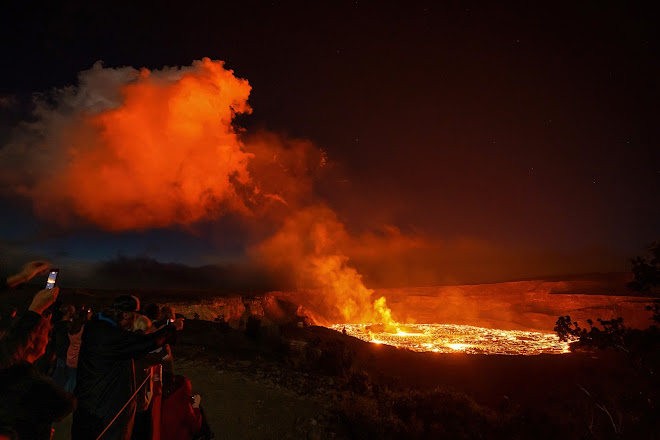
Star above with lava in the Kīlauea caldera. Photo by Lina Kolosova

KILAUEA ERUPTION IS DRAWING MUCH ATTENTION with this report from USGS on Friday:
    The summit eruption of Kīlauea Volcano, within Halemaʻumaʻu crater, continued over the past 24 hours. All recent eruptive activity has been confined to the crater. No significant changes have been observed at the summit or in either rift zone.
    Halemaʻumaʻu Lava Lake Observations: Eruption of lava from vents on the central eastern portion of Halemaʻumaʻu crater floor continued over the past 24 hours. Activity is concentrated in the eastern half of the crater and within the basin in the western half of the crater that was the focus of activity in 2021-2022.
    Summit Observations: Summit tiltmeters have recorded deflation over the past 24 hours. Volcanic tremor remains above background levels. A sulfur dioxide (SO2) emission rate of approximately 12,500 tonnes per day (t/d) was measured on Jan. 6. 
     U.S. Geological Survey on Friday lowered the Kīlauea alert level from WARNING to WATCH, and the aviation color code from RED to ORANGE, noting that the eruption was confined to the summit caldera, with no predictions of it migrating elsewhere.
    See an overflight video on Friday morning from USGS at https://www.usgs.gov/media/videos/early-morning-overflight-video-january-6-2023.

To read comments, add your own, and like this story, see facebook.com/kaucalendar. See latest print edition at kaucalendar.com, in the mail and on stands.

Jill Tokuda on ice in Washington, D.C. before being sworn in
during the wee hours of Friday, after the protracted process of
selecting a Speaker of the House. Tokuda serves Kaʻū and all of
 rural Hawai'i inthe Second District of U.S. House of
Representatives. Photo from Tokuda
JILL TOKUDA WAS ON ICE FOR DAYS, WAITING TO BE SWORN IN TO THE U.S. CONGRESS. It happened after midnight this morning following the protracted selection process for Speaker of the House. Tokuda said, at 2:30 a.m., "We have already hit the ground running, working hard because it's so important that our families, our communities, our workers have not only a voice but someone who's going to really bring about change and action for all of the people of Hawai'i..... We have a lot of work We'll be in touch. We'll keep you updated and I cannot wait to see you very soon in your community."
   Tokuda represents Kaʻū and all of rural Hawai'i, the seat previously held by Kai Kahele, Tulsi Gabbard and Ed Case, who now represents urban Hawai'i but works with the rural representative on issues regarding land preservation, health care, education and more.
    Before being sworn in, Tokuda wrote that "Two years ago, on Jan. 6, the very core of our democracy was attacked. Lives were lost, and many people were severely injured while trying to protect our United States Capitol, uphold our constitution and save our democracy. These brave women and men are the tru heroes of January 6th and they deserve our eternal thanks and support.
    "I remember watching in horror and sadness what was happening that day. Having gone to college in
Sunday, Jan. 9 at 7 p.m. Pahala Plantation House
See www.himusicfestival.com

Washington, D.C., this was once home. And that's what it felt like watching the chaos and destruction. I felt like someone was invading and destroying my home.
    'Right now, we are amidst a different kind of chaos, but one that no less threatens our democracy. As I enter the House Chambers, the very one threatened two years ago today, my thanks and aloha will go out to every woman and man who sacrifices to protect this place. In their honor, I will continue to fight to strengthen our democracy."

To read comments, add your own, and like this story, see facebook.com/kaucalendar. See latest print edition at kaucalendar.com, in the mail and on stands.
                                                                          FOURTEEN MOTORISTS WERE ARRESTED FOR DUI during the week of Dec. 26 through Dec. 31. Hawai’i Island police arrested 14 motorists for driving under the influence of an intoxicant. Two of the drivers were involved in a traffic accident. Two of the drivers were under the age of 21.
    During 2022, there were 979 DUI arrests compared with 1,081 during the same period last year, a decrease of 9.4 percent.
    There have been 846 major accidents so far this year compared with 820 during the same period last year, an increase of 3.2 percent.
    To date, there were 32 fatal crashes (one fatal crash reclassified on 05/30/22 due to a medical condition) resulting in 34 fatalities (one of which had multiple deaths, and one reclassified due to a medical condition), compared with 26 fatal crashes, resulting in 26 fatalities for the same time last year. This represents an increase of 23.1 percent for fatal crashes, and 30.8 percent for fatalities.     Hawai'i police promise that DUI roadblocks and patrols will continue island wide.

To read comments, add your own, and like this story, see facebook.com/kaucalendar. See latest print edition at kaucalendar.com, in the mail and on stands.

FREE FOOD


St. Jude's Hot Meals are free to those in need on Saturdays from 9 a.m. until food runs out, no later than noon. Volunteers from the community are welcome to help and can contact Karen at pooch53@gmail.com. Location is 96-8606 Paradise Circle Drive in Ocean View.  Those in need can also take hot showers from 9 a.m. to noon and use the computer lab from 9:30 a.m. to 1 p.m. Masks and social distancing required.


Free Meals Mondays, Wednesdays, and Fridays are served from 12:30 p.m. to 3:30 p.m. at Nā'ālehu Hongwanji. Volunteers prepare the food provided by 'O Ka'ū Kākou with fresh produce from its gardens on the farm of Eva Liu, who supports the project. Other community members also make donations and approximately 150 meals are served each day, according to OKK President Wayne Kawachi.


OUTDOOR MARKETS


Volcano Evening Market, Cooper Center, Volcano Village, Thursdays, 3 p.m. to 6 p.m., with live music, artisan crafts, ono grinds, and fresh produce. See facebook.com.


Volcano Swap Meet, fourth Saturday of the month from 8 a.m. to noon. Large variety of vendors with numerous products. Tools, clothes, books, toys, local made healing extract and creams, antiques, jewelry, gemstones, crystals, food, music, plants, fruits, and vegetables. Also offered are cakes, coffee, and shave ice. Live music.


Volcano Farmers Market, Cooper Center, Volcano Village on Sundays, 6 a.m. to 10 a.m., with local produce, baked goods, food to go, island beef and Ka'ū Coffee. EBT is used for Supplemental Nutrition Assistance Program, formerly Food Stamps. Call 808-967-7800.


'O Ka'ū Kākou Market, Nā'ālehu, Wednesdays, 8 a.m. to 2 p.m. Contact Nadine Ebert at 808-938-5124 or June Domondon 808-938-4875. See facebook.com/OKauKakouMarket.


Ocean View Community Market, Saturdays and Wednesdays, 6:30 a.m. to 2 p.m., corner of Kona Drive and Highway 11, where Thai Grindz is located. Masks mandatory. 100-person limit, social distancing required. Gate unlocked for vendors at 5:30 a.m., $15 dollars, no reservations needed. Parking in the upper lot only. Vendors must provide their own sanitizer. Food vendor permits required. Carpooling is encouraged.


Ocean View Swap Meet at Ocean View makai shopping center, near Mālama Market. Hours for patrons are 8 a.m. to 3 p.m., Saturday and Sunday. Vendor set-up time is 5 a.m. Masks required.


The Book Shack is open every Wednesday, 9 a.m. to 3 p.m. on the Kauaha'ao Congregational Church grounds at 95-1642 Pinao St. in Wai'ōhinu.


Friday, January 06, 2023

Kaʻū News Briefs, Friday, Jan. 6, 2023


The night and the light at Halema'uma'u, following the return of the eruption of Kīlauea on Thursday. NPS photo by Janice Wei

THE NEW ERUPTION AT THE SUMMIT of Kīlauea volcano is drawing thousands of visitors, notes a message from Hawaiʻi Volcanoes National Park. The visitors are "eager to see new erupting lava by day and the lava glow after dark. This new eruption is viewable from almost all open areas around the caldera."
    While the park remains open 24 hours a day, Puʻupuaʻi Overlook and parking lot are closed to protect breeding and nesting nēnē. The overlook west of the Uēkahuna parking lot also remains closed to protect nēnē. The restrooms, parking lot and viewing areas to the east remain open.
    The public is reminded to stay safe and help protect park resources by following these precautions:
    - Volcanic eruptions can be hazardous and change at any time. Stay on marked trails and overlooks, and avoid earth cracks and cliff edges. Do not enter closed areas.
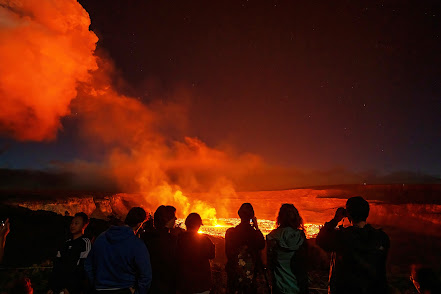
Images show silhouettes of visitors in front of a large bright orange
 lava lake inside a dark crater at night. NPS photo by Janice Wei
   - Hazardous volcanic gases are billowing out the crater and present a danger to everyone, especially people with heart or respiratory problems, infants, young children and pregnant women. Check the park air alert web page before and during the visit.
    - Slow down and drive safely. Expect long waits for parking spaces at popular vantage points like Uēkahuna (formerly the Jaggar Museum) and Devastation Trail parking area.
    - Help protect nēnē by keeping your distance, at least four car lengths away, and never feed nēnē or wildlife. Handouts make nēnē seek out people and cars, putting them in great danger. Drivers should be alert for nēnē along park roads, always observe the speed limit, and slow down for all nēnē crossing signs in the park and throughout the island.
    - At 1,219 meters, (4,000 feet), the summit of Kīlauea can be chilly at any time. Bring a rain jacket, wear long pants and closed-toe shoes. Bring a flashlight if visiting at night.
    So what can visitors expect to see? It depends on when they arrive, and the weather.
    In the Dark: A magnificent reddish orange glow fills the dark sky. Lava flows have covered much of Halemaʻumaʻu crater floor (which is nearly 300 acres or 120 hectares), reflecting into the gas plume wafting out of the volcano, and onto any clouds above. Jagged crater walls are illuminated, showing the scars from the 2018 summit collapse.
    In Daylight. Volcanic gas and steam billow out of Halemaʻumaʻu, and the entire summit caldera, Kaluapele, is fully visible. Koaʻe kea, white-tailed tropicbirds, are often observed flying above the crater.
    The best eruption viewpoints day or night are along Crater Rim Trail, and include Uēkahuna, Kīlauea Overlook, Wahinekapu (Steaming Bluff), Kūpinaʻi Pali (Waldron Ledge), Keanakākoʻi and other overlooks.
    Eruption status updates, live web cams, closure notifications, and planning tips are available on the park website.
    "While an eruption is an exciting experience, keep in mind you are observing a sacred event. The summit of Kīlauea volcano is a wahi kapu (sacred landscape) surrounded with storied places and a fragile ecosystem."
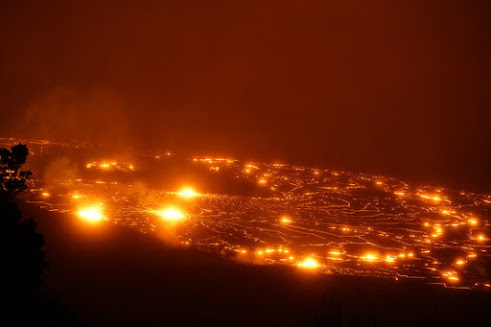
Panoramic view of lava lake. NPS Photo by M.Newman
To read comments, add your own, and like this story, see 
facebook.com/kaucalendar. See latest print edition at kaucalendar.com, in the mail and on stands.

REMOTE CAMERAS PROVIDE NEW VIEWS OF NEW ERUPTIONS is the headline for the weekly Volcano Watch by U.S. Geological Survey Hawaiian Volcano Observatory scientists and affiliates:
    Real-time views of an eruption site are a vital source of information for emergency managers, so webcams are one of the most important tools in an eruption crisis. HVO maintains a network of continuously operating webcams across Mauna Loa and Kīlauea, which have provided views of recent eruptions at these volcanoes.
    Kīlauea summit began erupting again the afternoon of January 5, 2023, and webcams provided views of lava reaching the surface. You can monitor this new activity, which is confined to Halema'uma'u crater within Hawai'i Volcanoes National Park, through one of the many Kīlauea summit webcams available at https://www.usgs.gov/volcanoes/kilauea/summit-webcams.
   The recent eruption of Mauna Loa produced spectacular lava fountains and a long, meandering lava flow that threatened a major highway on the Island of Hawai'i. Given the potential hazard to infrastructure, Hawaiian Volcano Observatory (HVO) scientists needed to keep a close eye on the eruption, around the clock.
    HVO geologists were on the ground and in the air each day, monitoring the situation at Mauna Loa closely. They couldn't be at the mountain-top eruption site all hours of the day but webcams could. The recent eruption of Mauna Loa allowed HVO scientists to test and improve some of our remote camera capabilities.
    These webcams proved invaluable during the opening hours of the Mauna Loa eruption, to be able to pinpoint which rift zone the activity was focusing on. HVO scientists used cameras on the Southwest Rift Zone to confirm that vents were not opening on that section of the volcano, which has greater proximity to residential areas.
Color photograph of webcam monitoring eruption

    Image of a webcam deployed to monitor the 2022 Northeast Rift Zone eruption of Mauna Loa. USGS image

    Once an eruption starts, HVO relies on small, portable webcams to provide close-up 24/7 views of the eruptive activity. These cameras transmit images over the cellular network, and can easily fit in a backpack, so HVO staff deployed them around the new Mauna Loa eruption within hours of its start.
    Another tool HVO deployed was a live-streaming video camera, to provide continuous views of the fountaining at the vent. This is valuable to track whether eruptive activity is picking up or slowing down. The eruption site was remote and maintaining a data connection was a major challenge. But it was worth the work and proved to be popular with volcano watchers around the world. HVO learned useful lessons for live-streaming in this environment, which should help with future eruptions.
    Several time-lapse cameras were also deployed to provide detailed documentation of the lava fountain heights and lava channel activity. These time-lapse cameras didn't transmit their images in real time, but simply stored the images onto a data card for later analysis.
    Many of these camera techniques were developed and improved during the 2018 eruption of Kīlauea, and lessons learned there were directly applied to the Mauna Loa response. We also tested a new "video-lapse" camera. Unlike time-lapse cameras that take a single snapshot at intervals, the video-lapse camera periodically captures short video clips. In our test deployment, the camera captured a 20 second video clip of the lava flowing through the upper channel every 15 minutes.
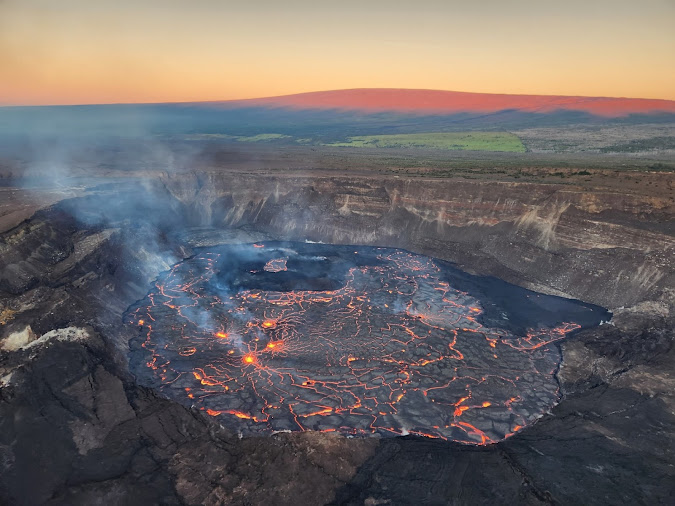

This view from a sunrise overflight at 6:45 a.m. HST shows the Kilauea eruption is confined to Halemaʻumaʻu crater in the
 summit caldera. Mauna Loa (not erupting) is along the horizon in the background. USGS photo

These periodic video clips will be useful for measuring the eruption rate through time. Just as the flow rate is one of the most important variables to understand a river's behavior, the volumetric eruption rate (cubic meters or cubic yards per second) is a fundamental parameter for understanding, and forecasting, lava flows. The simplest way to measure the eruption rate of a lava flow is to estimate the velocity of lava in the channel and multiply that by the depth and width of the channel.
    From our video-lapse clips we can make direct measurements of the velocity of lava in the channel. This is done by using a computer to track moving features in a video. In a lava channel, these might be distinct pieces of crust carried on the surface.
    In essence, this approach is a digital cousin of "Poohsticks", whereby Winnie-the-Pooh and his friends tossed sticks into a creek and watched them flow downstream. In the video clips of the lava channel, the algorithm can track many thousands of virtual Poohsticks.
    Camera technology improves every year, and the recent Mauna Loa eruption was an opportunity for HVO to test and improve our remote camera monitoring approaches. There's still no replacement for a geologist's eyes, but our Mauna Loa response showed that remote field cameras are a valuable complement to field geologists during eruption crises.
To read comments, add your own, and like this story, see facebook.com/kaucalendar. See latest print edition at kaucalendar.com, in the mail and on stands.

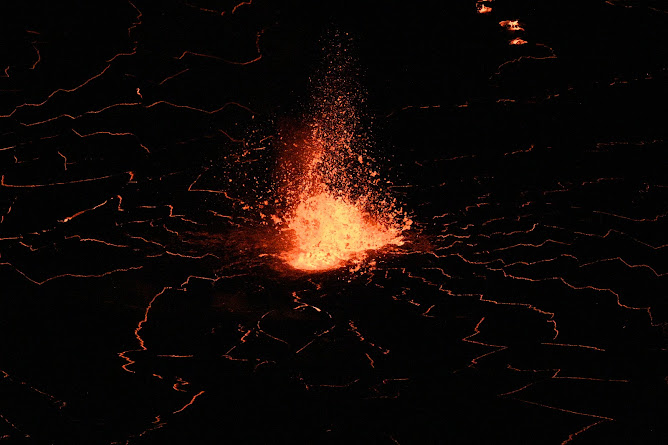
This image, taken early on Jan. 6, shows a lava fountain on the eastern portion of Halema‘uma‘u. Numerous areas of upwelling, like the one pictured here, are actively feeding the lava lake and re-surfacing material that was emplaced from activity in 2022. This fountain measured 16-33 feet in height (5-10 meters).  USGS photo

VOLCANO ACTIVITY UPDATES: Kīlauea is erupting. Its USGS Volcano Alert level is at WATCH. Kīlauea updates are issued daily at https://www.usgs.gov/volcanoes/kilauea/volcano-updates.
Kīlauea volcano began erupting within Halema'uma'u crater at approximately 4:34 p.m. HST on January 5, 2023. All activity is confined to Halemaʻumaʻu crater within Hawai'i Volcanoes National Park. Summit tilt switched from inflation to deflation around 5 p.m. HST on January 5. Following the eruption onset, summit earthquake activity greatly diminished and eruptive tremor (a signal associated with fluid movement) resumed. Volcanic gas emissions in the eruption area are elevated. For Kīlauea monitoring data, see https://www.usgs.gov/volcanoes/kilauea/past-week-monitoring-data-kilauea.
    Mauna Loa is not erupting. Its USGS Volcano Alert Level is at ADVISORY. Mauna Loa updates are issued weekly on Thursdays.
    Webcam imagery may show weak, residual incandescence intermittently in the inactive Northeast Rift Zone fissure 3 lava flow at night. Seismicity remains low and ground deformation rates have decreased. Sulfur dioxide (SO2) emission rates are at background levels. For Mauna Loa monitoring data, see: https://www.usgs.gov/volcanoes/mauna-loa/monitoring-data.
    There were six earthquakes with 3 or more felt reports in the Hawaiian Islands during the past week: a M3.3 earthquake 4 km (2 mi) SW of Pāhala at 35 km (21 mi) depth on Jan. 03 at 9:03 p.m. HST, a M1.7 earthquake 7 km (4 mi) SW of Volcano at 0 km (0 mi) depth on Jan. 3 at 4:01 a.m. HST, a M4.0 earthquake 6 km (3 mi) NW of Volcano at 18 km (11 mi) depth on Jan. 3 at 3:31 a.m. HST, a M3.8 earthquake 46 km (28 mi) W of Hawaiian Ocean View at 38 km (23 mi) depth on Jan. 1 at 8:34 a.m. HST, a M3.0 earthquake 1 km (0 mi) SW of Pāhala at 31 km (19 mi) depth on Dec. 30 at 5:02 p.m. HST, and a M3.1 earthquake 7 km (4 mi) E of Pāhala at 32 km (20 mi) depth on Dec. 30 at 7:49 a.m. HST. HVO continues to closely monitor the ongoing eruption at Kīlauea, and Mauna Loa.

To read comments, add your own, and like this story, see facebook.com/kaucalendar. See latest print edition at kaucalendar.com, in the mail and on stands.

Patricia Wong

TWO NA'ALEHU AND OCEAN VIEW RESIDENTS have been indicted for a murder dating back more than 13 years. Hawai'i County Prosecuting Attorney Kelden Waltjen announced on Friday that Patricia Hanoa Wong, 60, of Na'alehu and Peter Fuerte, 55, of Ocean View, have been charged in the murder of Kaycee Maile Smith. The victim, also known as "Bug," was a rodeo star and former student at Kamehameha Schools in Kapalama. She was 21 at the time of her death by a single gunshot to her head at her home in Orchidland. Wong is indicted for second-degree murder, conspiracy to commit second-degree murder, attempted second-degree murder and two counts of criminal solicitation. Fuerte is indicted as an
accomplice to murder and attempted murder. On Dec. 28, a grand jury in Hilo handed down the indictment with her bail set at $250,000.
    Wong is to be arraigned on Monday. She was initially indicted in 2016 for the same crime on a single count of second-degree murder and extradited from Las Vegas to Hawa'i, the trial pending for the last six years. 
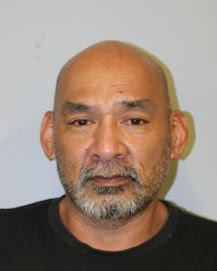
Peter Fuertes

    Fuertes' court date is pending, with his bail set at $50,000. According to police Smith's father, Noel "Bear" Smith, likely killed Jeremy Napoleon on June 19, 2007 and turned up dead hours later when his car ran off the road. Police and prosecutors suspect revenge and money involved in these slayings, as well as 
the slaying of Kaycee Smith.
    The investigation was handled by Captain Rio Amon-Wilkins and Detective Derek Morimoto, Area I Criminal Investigation Section, Hawai‘i Police Department. The case is being prosecuted by Deputy Prosecuting Attorney Annaliese Wolf.
    Waltjen noted that "The charges are merely allegations, and the Defendants are presumed innocent unless and until proven guilty. The Office of the Prosecuting Attorney remains dedicated to the pursuit of justice with integrity and commitment. Anyone having information to assist local law enforcement should call Crime Stoppers at (808) 961-8300."

To read comments, add your own, and like this story, see facebook.com/kaucalendar. See latest print edition at kaucalendar.com, in the mail and on stands.

YOUTH SPORTS PROGRAM sponsored by Hawai'i County Department of Parks & Recreation include: Track & Field, T-Ball, Coach Pitch baseball league, and Age Group Boys' Basketball.
    Two-track meets will be held in February for East and West Hawai'i youth. The Age Group meeting will be held on Saturday, Feb. 4, and the Exponent meeting will be held on Saturday, Feb. 18. On both dates,

events will be held simultaneously at 9 a.m. at the Waiākea High School Ken Yamase Stadium and Konawaena High School Oval Track. All meets will consist of field and running events for youth 6-14 years old.
    Pre-registration by Jan. 20 is required. For a complete list of age group events and the registration packet, visit https://records.hawaiicounty.gov/weblink/DocView.aspx?dbid=1&id=120056. Please call Darrell Yamamoto at (808) 961-8735.
    In East Hawai'i, T-Ball and Coach Pitch baseball leagues will begin in February. An organizational meeting will be held for coaches and team representatives at Edith Kanaka'ole Tennis Stadium in Hilo on January 10 at 5:00 p.m. This meeting is mandatory for all teams interested in participating in the upcoming league. The Co-ed Age Group T-Ball division will accommodate participants 5-6 years old. The Coach Pitch division will accommodate participants 7-8 years old. The age cut-off date is May 1. For more information, call Darrell Yamamoto at (808) 961-8735.


FREE FOOD


St. Jude's Hot Meals are free to those in need on Saturdays from 9 a.m. until food runs out, no later than noon. Volunteers from the community are welcome to help and can contact Karen at pooch53@gmail.com. Location is 96-8606 Paradise Circle Drive in Ocean View.  Those in need can also take hot showers from 9 a.m. to noon and use the computer lab from 9:30 a.m. to 1 p.m. Masks and social distancing required.


Free Meals Mondays, Wednesdays, and Fridays are served from 12:30 p.m. to 3:30 p.m. at Nā'ālehu Hongwanji. Volunteers prepare the food provided by 'O Ka'ū Kākou with fresh produce from its gardens on the farm of Eva Liu, who supports the project. Other community members also make donations and approximately 150 meals are served each day, according to OKK President Wayne Kawachi.


OUTDOOR MARKETS


Volcano Evening Market, Cooper Center, Volcano Village, Thursdays, 3 p.m. to 6 p.m., with live music, artisan crafts, ono grinds, and fresh produce. See facebook.com.


Volcano Swap Meet, fourth Saturday of the month from 8 a.m. to noon. Large variety of vendors with numerous products. Tools, clothes, books, toys, local made healing extract and creams, antiques, jewelry, gemstones, crystals, food, music, plants, fruits, and vegetables. Also offered are cakes, coffee, and shave ice. Live music.


Volcano Farmers Market, Cooper Center, Volcano Village on Sundays, 6 a.m. to 10 a.m., with local produce, baked goods, food to go, island beef and Ka'ū Coffee. EBT is used for Supplemental Nutrition Assistance Program, formerly Food Stamps. Call 808-967-7800.


'O Ka'ū Kākou Market, Nā'ālehu, Wednesdays, 8 a.m. to 2 p.m. Contact Nadine Ebert at 808-938-5124 or June Domondon 808-938-4875. See facebook.com/OKauKakouMarket.


Ocean View Community Market, Saturdays and Wednesdays, 6:30 a.m. to 2 p.m., corner of Kona Drive and Highway 11, where Thai Grindz is located. Masks mandatory. 100-person limit, social distancing required. Gate unlocked for vendors at 5:30 a.m., $15 dollars, no reservations needed. Parking in the upper lot only. Vendors must provide their own sanitizer. Food vendor permits required. Carpooling is encouraged.


Ocean View Swap Meet at Ocean View makai shopping center, near Mālama Market. Hours for patrons are 8 a.m. to 3 p.m., Saturday and Sunday. Vendor set-up time is 5 a.m. Masks required.


The Book Shack is open every Wednesday, 9 a.m. to 3 p.m. on the Kauaha'ao Congregational Church grounds at 95-1642 Pinao St. in Wai'ōhinu.


Thursday, January 05, 2023

Kaʻū News Briefs, Thursday, Jan. 5, 2023

Kīlauea resumed its eruption Thursday afternoon after an earthquake swarm. USGS Photo

KILAUEA IS ERUPTING, following more than 100 earthquakes on Thursday. At approximately 4:34 p.m. on Jan. 5, the USGS Hawaiian Volcano Observatory detected glow in Kīlauea summit webcam images indicating that the eruption has resumed within Halemaʻumaʻu crater in Kīlauea’s summit caldera, within Hawai‘i Volcanoes National Park.
    Hawai'i Volcanoes National Park reported that fountaining lava is visible from several areas and overlooks around the caldera. Planning to visit? The Park recommends checking  out the eruption viewing web page:https://www.nps.gov/havo/planyourvisit/eruption-viewing.htm.
    Ranger tips include:
- Be prepared for crowds
- Parking may be limited
- Pack layers, it can be cold and rainy
- Be respectful to this sacred cultural landscape
    USGS Hawaiian Volcano Observatory elevated Kīlauea’s volcano alert level from WATCH to WARNING on Thursday and its aviation color code from ORANGE to RED as this eruption and associated hazards are evaluated.  
    USGS reports: "The opening phases of eruptions are dynamic. Webcam imagery shows fissures at the base of Halemaʻumaʻu crater generating lava flows on the surface of the crater floor. The activity is confined to Halemaʻumaʻu and the hazards will be reassessed as the eruption progresses. HVO will continue to monitor this activity closely and report any significant changes in future notices. HVO is in constant communication with Hawai‘i Volcanoes National Park as this situation evolves. The activity is confined entirely within the park."

To read comments, add your own, and like this story, see facebook.com/kaucalendar. See latest print edition at kaucalendar.com, in the mail and on stands.


HINAHINA IS THE NOVEMBER PLANT OF THE MONTH for the column Lāʻau Letters: Native Plants of Kaʻū by Jodie Rosam with illustration by Joan Yoshioka. Hinahina's scientific name is Heliotropium anomalum var. argenteum.    
    Description: Hauʻoli Makahiki Hou! I am excited to kick off 2023 by introducing you to a sweet friend of mine, hinahina (or hinahina kū kahakai)! Hinahina is an endemic coastal shrub in the Borage or Boraginaceae family (a cousin to our friend kou). Out of the approximately 250 species of Heliotropium worldwide, only two species are native to Hawaiʻi, including the indigenous kīpūkai (H. curassavicum) and our endemic H. anomalum var. argenteum. Hinahina grows in low bunches, and its 1 to 2 inch long,
Hinahina illustration by Joan Yoshioka
narrow leaves are covered with soft silky hairs that give them a silvery appearance (also earning them the name hinahina) which help to protect them from the harsh coastal sunrays. The succulent leaves grow in rosettes towards the tips of the stems. The small, white, tubular flowers bloom year round in clusters that grow above the foliage, and produce a sweet, citrusy fragrance (my personal favorite!).

Uses: Medicinally, hinahina leaves can be used to make a tea which acts as a tonic, much like the more commonly seen koʻokoʻolau tea. However, being rare on Hawaiʻi Island, harvesting leaves for tea is not recommended without having intimate knowledge of the population’s dynamics. The hardy silver leaves and sweet smelling flower spikes make a gorgeous haku lei. In 1923, hinahina was adopted as the official flower and lei material for Kahoʻolawe. Unfortunately, due to the desecration of the island by both introduced ungulates and military occupation, hinahina is not found naturally on Kahoʻolawe today.
   Habitat: Hinahina can be found in sandy areas, and is locally common on Niʻihau, Kauaʻi, Oʻahu, and Molokaʻi, and rare on Maui and Hawaiʻi Island. It grows along the coast across dry landscapes (0-50 inches of rainfall annually), though given the proper growing conditions, hinahina could grow more mauka. In Kaʻū, hinahina can be admired along the sandy coastlines of Waiʻōhinu, though it is currently being threatened by excessive off-road traffic (ATVs).

Hinahina. Photo from CTHAR

Growing and Purchasing: Hinahina will grow from its tiny seeds, but propagation from cuttings is often more successful, even without using a rooting hormone. To collect seeds, it might be helpful to place a fine mesh bag around pollinated flower clusters to catch the seeds as they ripen. Dry the seeds and then sprinkle them on top of a well-drained media (perlite and vermiculite work well) and keep the pots moist and in the shade until they germinate, which takes 2-3 months. Cuttings should be obtained from small (3-5 inches) sections of softwood, and immediately placed into the well-drained media and placed in the shade (although, again, I do not encourage collecting from our rare populations, so if you are interested in hinahina cuttings, please contact the author). Keep them moist, and they should root within a few weeks. Begin to harden your hinahina as they get about 6 inches in height. Find an area with full sun (at least 6 hours a day) and excellent drainage, and amend the soil with sand, cinder, or coral as necessary (think natural environmental conditions). Hinahina will benefit from an occasional salt water drench (but be mindful of other plants that are not salt tolerant). Resist the temptation to overwater, which will make them grow a bit more leggy and less silvery. Hinahina is drought, heat, salt, and wind tolerant, and will be a showcase  wherever it’s planted. I wish you a happy, healthy, hinahina loving 2023!

To read comments, add your own, and like this story, see facebook.com/kaucalendar. See latest print edition at kaucalendar.com, in the mail and on stands.

FREE FOOD


St. Jude's Hot Meals are free to those in need on Saturdays from 9 a.m. until food runs out, no later than noon. Volunteers from the community are welcome to help and can contact Karen at pooch53@gmail.com. Location is 96-8606 Paradise Circle Drive in Ocean View.  Those in need can also take hot showers from 9 a.m. to noon and use the computer lab from 9:30 a.m. to 1 p.m. Masks and social distancing required.


Free Meals Mondays, Wednesdays, and Fridays are served from 12:30 p.m. to 3:30 p.m. at Nā'ālehu Hongwanji. Volunteers prepare the food provided by 'O Ka'ū Kākou with fresh produce from its gardens on the farm of Eva Liu, who supports the project. Other community members also make donations and approximately 150 meals are served each day, according to OKK President Wayne Kawachi.


OUTDOOR MARKETS


Volcano Evening Market, Cooper Center, Volcano Village, Thursdays, 3 p.m. to 6 p.m., with live music, artisan crafts, ono grinds, and fresh produce. See facebook.com.


Volcano Swap Meet, fourth Saturday of the month from 8 a.m. to noon. Large variety of vendors with numerous products. Tools, clothes, books, toys, local made healing extract and creams, antiques, jewelry, gemstones, crystals, food, music, plants, fruits, and vegetables. Also offered are cakes, coffee, and shave ice. Live music.


Volcano Farmers Market, Cooper Center, Volcano Village on Sundays, 6 a.m. to 10 a.m., with local produce, baked goods, food to go, island beef and Ka'ū Coffee. EBT is used for Supplemental Nutrition Assistance Program, formerly Food Stamps. Call 808-967-7800.


'O Ka'ū Kākou Market, Nā'ālehu, Wednesdays, 8 a.m. to 2 p.m. Contact Nadine Ebert at 808-938-5124 or June Domondon 808-938-4875. See facebook.com/OKauKakouMarket.


Ocean View Community Market, Saturdays and Wednesdays, 6:30 a.m. to 2 p.m., corner of Kona Drive and Highway 11, where Thai Grindz is located. Masks mandatory. 100-person limit, social distancing required. Gate unlocked for vendors at 5:30 a.m., $15 dollars, no reservations needed. Parking in the upper lot only. Vendors must provide their own sanitizer. Food vendor permits required. Carpooling is encouraged.


Ocean View Swap Meet at Ocean View makai shopping center, near Mālama Market. Hours for patrons are 8 a.m. to 3 p.m., Saturday and Sunday. Vendor set-up time is 5 a.m. Masks required.


The Book Shack is open every Wednesday, 9 a.m. to 3 p.m. on the Kauaha'ao Congregational Church grounds at 95-1642 Pinao St. in Wai'ōhinu.