About The Kaʻū Calendar

Sunday, April 23, 2023

Kaʻū News Briefs, Sunday, April 23, 2023

Hawaiian Volcano Observatory geologists documented newly exposed lava flows and tephra layers in the northwest wall of Kīlauea caldera during a field visit Friday morning, April 21. HVO reports that "these new exposures will help us better understand Kīlauea's long term eruptive history, which alternates between effusive periods (producing lava flows) and explosive periods (producing tephra such as ash)" See more on Kīlauea and Mauna Loa volcanoes below. USGS Photo by K. Lynn.

IN HONOR OF EARTH DAY, THE INTEGRATED CLIMATE ACTION PLAN for Hawai'i County will be released to the public on May 1. Mayor Mitch Roth made the announcement on Saturday, noting that ICAP is "a cross-departmental effort that aims to chart the County's responsibility to reduce its contribution to global climate change and make its services and facilities resilient to the effects of a

Annually, the total Energy emissions for Hawaiʻi County is 969,900 MTCO2e while
 Honolulu County’s is 6,863,485 MTCO2e. This means that per year O'ahu produces
 6.9 MTCO2e per person while Hawai'i produces 4.8 MTCO2e per person from energy
use. Hawai'i County is dedicated to further reducing emissions, including transitioning
to an all-electric Hele-on public bus and van fleet. Hawai'i County image
changing climate. It will also identify actions the County can take and will be used as a tool to hold the County accountable for climate action.
    "Adapting to a changing climate is an integral part of fostering a sustainable Hawaiʻi Island where our keiki can raise their keiki for generations," said the Mayor. "As an island, we are incredibly susceptible to adverse impacts on our natural environment, and as government, it is our responsibility to act accordingly to preserve and protect our natural and cultural resources. We understand that this is a critical time for our planet and our island, and we will continue to take bold action to address the impacts of climate change here in Hawaiʻi and around the world."
    Roth said that ICAP will build on the County's history of commitment to climate action and includes

several initiatives, including electrifying the County's Hele-on bus and van fleet, expanding its services, and reducing the cost of energy for County facilities. Ongoing County sustainability initiatives include its Sustainability Summits, participation in the Hawaiʻi Climate Change Mitigation and Adaptation Commission, and establishment of research-based shoreline setbacks to reduce risk to coastal hazards for Hawaiʻi Island.
    ICAP will be available in tandem with a Hawaiʻi Island Sustainability Dashboard that tracks the County's greenhouse gas emissions and can be found at rd.hawaiicounty.gov. There, viewers can also find the Energy Analysis for Hawaiʻi County Buildings.
    The mayor said the report is the first example of ICAP implementation and the County's first step towards zero emissions conversion for its buildings and facilities.
    "The County of Hawaiʻi encourages all residents to review the ICAP and provide feedback through Konveio, an interactive online platform," says the statement. Link to the Konveio site is coh.planning.konveio.com. The County will accept public feedback from May 1 to June 1.

To read comments, add your own, and like this story, see facebook.com/kaucalendar. See latest print edition at kaucalendar.com, in the mail and on stands.

THE MAGNITUDE 4.4 EARTHQUAKE THAT SHOOK VOLCANO AT 2 p.m. on Saturday, apparently did little damage to the area. It was located southeast of Volcano Village and 1.2 miles north northeast of Kīlauea caldera,

DID LAVA FLOW OUT OF MAUNA LOA'S SOUTHERN CALDERA IN late November of 2022? That is the question posed by this week's Volcano Watch, written by USGS Hawaiian Volcano Observatory scientists and affiliates:
    Official statements from the Hawaiian Volcano Observatory noted that initial vents were within the caldera; however, lava flows were reported visible from Kona. Indeed, Kona residents could see lava flows descending the western flank of the volcano and were concerned, feeling that lava was outside of the caldera. In hindsight, it seems appropriate to explain what HVO knew in the first few minutes of the eruption and why Kona residents were able to see the first lava flows.
    Most people are familiar with Mokuʻāweoweo - the inner caldera at Mauna Loa. However, there's also an outer caldera, which is a geologic term indicating that less obvious mapped faults designate a much larger caldera feature than Mokuʻāweoweo.

Map of the Mauna Loa 2022 eruptive fissures, shown as red lines. Red shaded area indicates lava flows produced during the eruption, around fissure vent areas. Solid white line indicates mapped outer caldera boundary. White dotted line indicates inferred outer caldera boundaryburied by historic Mauna Loa lava flows. Fissures documented by C. Parcheta at USGS. Lava flow polygons by USGS National Civil Applications Center.
    Official statements from the Hawaiian Volcano Observatory  noted that initial vents were within the caldera; however, lava flows were reported visible from Kona. Indeed, Kona residents could see lava flows descending the western flank of the volcano and were concerned, feeling that lava was outside of the caldera. In hindsight, it seems appropriate to explain what HVO knew in the first few minutes of the eruption and why Kona residents were able to see the first lava flows.
    Most people are familiar with Mokuʻāweoweo--the inner caldera at Mauna Loa. However, there's also an outer caldera, which is a geologic term indicating that less obvious mapped faults designate a much larger caldera feature than Mokuʻāweoweo.    
    This is also true at Kīlauea. For example, most people think of the Kaluapele as the “giant crater” that
Lava, smoke and light seen from Kona where residents saw the flow in late November
descending the western flank of Mauna Loa. Photo from PBS

Crater Rim Drive mostly encircles, but the outer caldera boundary of Kīlauea caldera extends north to the opposite side of Highway 11. When one drives past the entrance to Hawaiʻi Volcanoes National Park, they are driving within the outer caldera of Kīlauea!
    Mauna Loa’s southern outer caldera is buried under lava flows from the past centuries (see white dashed line on map). Three distinctive pit craters dominate this area from north to south: South Pit in Mokuʻāweoweo, Luahohonu, and Luahou. These pit craters are within the outer caldera, and not part of the Southwest Rift Zone. 
    The western rim of the outer caldera coincides with the inner caldera—we have not found circumferential faults to the west. The white line on map indicates the northern, eastern, and southeastern portions of the outer caldera. The approximate boundary between the caldera and the SWRZ is where these circumferential cracks cross the rift zone. Fissures that cross these circumferential cracks would indicate that the eruption is migrating into a rift zone. Sometimes fissures run right up to the outer caldera boundary and then head in the opposite direction (as during eruptions in 1935, 1942, and 1984).
    This is an important concept because HVO stated that initial 2022 fissures were restricted to the summit area. Yet, overnight photographs from Kona showed lava flows descending the western slope—so how was this possible? Shouldn’t the lava be hidden from view by the western topographic edge of the caldera?
    HVO's use of the phrase “summit region” may have caused confusion for some Kona residents who thought HVO was referring to the “inner caldera.” The flows seen from Kona were coming from 3 km (1.8 miles) of fissures in the south outer caldera. When lava is erupting from this area it is visible because there are no major caldera walls obscuring the view of the western flank.
    Later mapping revealed that 2 km (1.2 mi) of fissures extended from the outer caldera into the uppermost extent of the SWRZ, with minor lava being emitted from those fissures. In total, the 2022 eruption of Mauna Loa saw 8 km (5 mi) of fissures open across the central and southern outer caldera floor during the night of November 27–28.
    By the first eruption overflight at dawn on November 28, all fissures in the inner caldera, southern outer caldera, and the uppermost SWRZ had stopped erupting and were incandescent glowing cracks. A new set of fissures had begun to form on the Northeast Rift Zone (NERZ). The three lowest elevation fissures were erupting during the initial overflight and named fissure 1–3. Fissure 4 opened two days later, on November 29, 2022.
    In total, 17 km (11 mi.) of fissures spanned the uppermost SWRZ, the southern and central outer caldera, and the NERZ during the 2022 eruption of Mauna Loa.
Geologist standing on floor of crater
Geologist from the Hawaiian Volcano Observatory selects a sampling site on the floor of Halema‘uma‘u crater Friday morning, April 21, standing near the eastern rim of the lava lake that was active in the western portion of Halema‘uma‘u crater during the January–March, 2023 eruption. The mound next to the geologist is a spatter rampart; spatter ramparts form when bits of molten lava travel through the air and accumulate on the ground surface, forminga mound-like feature. USGS image by L. Gallant
To read comments, add your own, and like this story, see facebook.com/kaucalendar. See latest print edition at kaucalendar.com, in the mail and on stands.

TWO CREWS OF HAWAIIAN VOLCANO OBSERVATORY GEOLOGISTS VISITED KILAUEA CALDERA on Friday morning, April 21, airlifted by helicopter to collect detailed data to assess hazards and to better understand the workings of the volcano. One crew visited the crater floor to sample cooled lava from the 2020–2023 summit eruptions. The other crew scaled part of the crater's northwest wall to sample ash beds and lava flows dating back many thousands of years in the volcano's past.
    Information they gathered is shared with the National Park Service and emergency managers. Access to this hazardous area is by permission from, and in coordination with, Hawai‘i Volcanoes National Park. The volcano was not erupting.
    Three of the orange-clad geologists collected tephra samples from the Uēkahuna bluff along the northern wall of Kīlauea's summit caldera. Kīlauea has a history of explosive eruptions—the evidence for these events is contained within the many layers exposed along this part of the volcano.
    Although the volcano was not erupting, a wispy plume was seen rising from the crater floor. Kīlauea summit sulfur dioxide (SO2) emission rates remain low and were most recently measured on April 14 at 110 tonnes per day.

Color photograph of crater floor
A morning view of the floor of Halema‘uma‘u, with a wispy plume. USGS image by L. Gallant
    Crews that visit these dynamic locations have extensive training and wear specialized personal protective equipment, such as helmets and gas masks, to keep them safe.
    Both crews witnessed a spectacular sunrise from inside the crater, as captured in this panorama from the base of the northwest wall.

Sunrise from within Kilauea Crater on Friday.  USGS image by M. Zoeller


HAWAIIAN CIVIC CLUB OF KAʻŪ IS OFFERING THE KUPUNA JEANETTE KAUALANI AKIU MEMORIAL SCHOLARSHIP.  Hawaiian Civic Club of Kaʻū President Berkeley Yoshida and Education Committee Chair 'Aina Akamu said the scholarship is for students attending college, university or a post-high school education or training program in the 2023-2024 school year. Application deadline is Friday, April 28. See the application and more at https://www.khpes.org/news/scholarship-applications-available.

MORE SCHOLARSHIPS ARE AVAILABLE FOR KAʻŪ. Cathy Arnold writes that Hui O Ka Leo Nahenahe has announced a scholarship that supports its promotion and perpetuation of Hawaiian culture, especially through education. The scholarship application is to be postmarked no later than June. 1.            
  Applicants must be Hawai'i residents, enrolled in an accredited associate, bachelors, or graduate full-time program at college or university on Hawai'i Island. They must demonstrate financial need, participate in community service projects have a cumulative GPA of 2.8or better, be of Hawaiian Ancestry and demonstrate interest and participation in Hawaiian language and culture. For the scholarship application, see https://www.khpes.org/news/scholarship-applications-available.

A SCHOLARSHIP FOR KAʻŪ  STUDENTS ONLY is offered by University of Hawai'i Hilo College of Agriculture, Forestry & Natural Resource Management. 
     Programs include Agriculture-Agroecology; Agriculture-Aquaculture; Agriculture-Animal Health & Management; Beekeeping; Equine Science and Unmanned Aircraft Systems.
    Kaʻū residents must be accepted at UHH for Fall of 2023, enrolled in College of Agriculture, Forestry & Natural Resource Management and interested in financial aid. Find the Application at bit.ly/UHH_OS.  Deadline to apply is May 5.

HAWAI'I COMMUNITY COLLEGE IN KONA INVITES PROSPECTIVE STUDENTS TO APPLY FOR SCHOLARSHIPS. Its message says: "If finances or life events have kept you from ever attending college, then you have an opportunity to enter a unique program that will: Create a learning environment that helps you to succeed; provide scholarships and academic support; allow you to just try taking a few college courses; and  open the door to additional degree opportunities." See the application form and more at https://www.khpes.org/news/scholarship-applications-available. Also call the  Ēlama & Hilo One Program Coordinator at  808-969-8865, Email elamaone@hawaii.edu.


OUTDOOR MARKETS

Volcano Thursday Market, Cooper Center, Volcano Village, Thursdays, 3 p.m. to 6 p.m., with live music, artisan crafts, ono grinds, and fresh produce. See Volcano Evening Market facebook.

Volcano Swap Meet, fourth Saturday of the month from 8 a.m. to noon. Large variety of vendors with numerous products. Tools, clothes, books, toys, local made healing extract and creams, antiques, jewelry, gemstones, crystals, food, music, plants, fruits, and vegetables. Also offered are cakes, coffee, and shave ice. Live music.

Volcano Farmers Market, Cooper Center, Volcano Village on Sundays, 6 a.m. to 10 a.m., with local produce, baked goods, food to go, island beef and Ka'ū Coffee. EBT is used for Supplemental Nutrition Assistance Program, formerly Food Stamps. Call 808-967-7800.


O Ka'ū Kākou Market, Nā'ālehu, Wednesdays, 8 a.m. to 2 p.m. Contact Nadine Ebert at 808-938-5124 or June Domondon 808-938-4875. See facebook.com/OKauKakouMarket.

Ocean View Community Market, Saturdays and Wednesdays, 6:30 a.m. to 2 p.m., corner Kona Dr. Drive and Hwy 11, near Thai Grindz. Masks mandatory. 100-person limit, social distancing required. Gate unlocked for vendors at 5:30 a.m., $15 dollars, no rez needed. Parking in the upper lot. Vendors must provide their own sanitizer. Food vendor permits required. Carpooling is encouraged.


Kaʻū News Briefs, Saturday, April 22, 2023


Hawaiian Host Group has become the largest grower, processor and seller of macadamias in Hawai'i with its purchase of MacFarms, Kapua Orchards and the Royal Hawaiian brand. Photo from Hawaiian Host Group

THE 4,000 ACRE KAPUA ORCHARDS AND MACFARMS processing plant on the border of Kaʻū and South Kona are acquired by Hawaiian Host Group, the famous confectionary company. Hawaiian Host recently held a blessing for the MacFarm employees. It is one of the largest employers of Kaʻū residents.
    Hawaiian Host also owns Mauna Loa and its operating plant in Kea'au as well as another manufacturing plant on O'ahu. Its purchase of MacFarms stock for $26 million makes Hawaiian Host the largest macadamia grower and producer in the state with some 340,000 trees. Hawaiian Host made the purchase from the former Broederbond Australian company, which is now known as Health & Protein Group LTD.
    Hawaiian Host President and CEO Ed Schultz issued a statement saying, "The addition of 4,000 acres of macadamia orchards in perpetuity allows us to plan for the long-term in Hawai'i. MacFarms has a long-standing history of producing some of the best macadamia nuts in the world, and we look forward to continuing that tradition. This acquisition will allow us to expand our product offerings and continue to provide our customers with the best-quality products, while retaining great jobs in the state of Hawai 'i."
    Macadamia growers in Kaʻū and around the state recently submitted testimony to the Hawai'i Legislature that pointed to Mauna Loa buying nuts from abroad and selling them as a Hawaiian product, while mac nuts lay on the ground on this island unharvested, with company workers on unemployment and smaller growers without a market. 

Hawaiian Host CEO and President Ed Schultz (center) after purchasing MacFarms.
Photo from Hawaiian Host Group
    Many smaller growers and workers said they fear that Mauna Loa could abandon local growers and lay off many of its own Kaʻū workers as it imports more macadamia from other countries, selling them under the Mauna Loa name. They said they hope the 2024 Hawai'i Legislature will pass a truth in labeling bill as it did this year for Hawaiian coffee.
    Hawaiian Host's President pointed out that Hawaiian Host Group employs some 500 people across the state and stated that MacFarms and all of its operations "will remain open due to the popular demand for its products. As demand for its products continues to grow in Hawai‘i, on the mainland, and in Asia, HHG is hiring across locations."
    While Hawai'i is well known for macadamia quality and the United States is the country with the second highest consumption of macadamia nuts, U.S. Hawai'i production and exports are outstripped by other countries. In 2021, top exporters of macadamia nuts were South Africa with $277 million exported, Australia $246M, Kenya $101M, Netherlands $39.7 million grown outside of country, and Guatemala $38.2M. 
    In the same year, top importers of macadamia nuts were China $230M, United States $161M, Germany $85.6M, Vietnam $62.9M, and Japan $51.8M.
    The Hawaiian Host President is well known nationwide among confectioners. The National
Hawaiian Host Group acquired land, trees, another operating
plant and two more brands, MacFarms and Royal Hawaiian.
Image from Hawaiian Host

Confectioners Association
 issued a statement on April 12 saying it named Schultz its 2023 Advocate of the Year. It says that the award "recognizes individuals who go above and beyond to ensure the confectionery industry has a seat at the table when policy discussions occur at the federal, state and local levels." The Hawaiian Host President received his award at NCA’s 2023 State of the Industry Conference in Miami. 
    John Downs, NCA President and CEO, said, “Ed’s leadership and dedication to the industry are exemplified by the outcomes he has achieved for the industry in Hawai'i, making him truly deserving of this recognition."
    The statement from National Confectioners says, "In 2022, Schultz worked to communicate important policy positions for the confectionery industry on numerous issues facing the state legislature in Hawai'i.        "His strategic engagement and strong relationships gave him a seat at the table to advocate for his company and the broader confectionery industry. His efforts stopped harmful legislation from moving forward, and he continues to educate members of the legislature on issues that impact the industry."
    Schultz said, “We must be engaged when new policies are put forward by elected officials at all levels, and I look forward to continuing to share the important role that the confectionery industry plays in our communities and in our great state of Hawai'i.”
    Schultz has been President of Hawaiian Host Group since 2018 and serves on boards of Hawai'i Chapter of Young Presidents Organization and the Chamber of Commerce Hawai'i.

To read comments, add your own, and like this story, see facebook.com/kaucalendar. See latest print edition at kaucalendar.com, in the mail and on stands.

HPD Officer Stephen Kishimoto, Jr. from Hawai'i met
K9 Kim from Hungary when they were both at Vohne
Liche in Indiana. K9 Kim returned to Hawai'i with
Kishimoto to serve as a police dog. Photo from HPD
K-9 KIM HAS JOINED THE HAWAI'I POLICE DEPARTMENT Area II Vice Section. The newest ilio wahine member of HPD, she is a two-year-old German Shorthaired Pointer who specializes in sniffing out narcotics.
    In early March, Officer Stephen Kishimoto Jr., a K9 handler in the department’s Area II Vice Section, traveled to Vohne Liche Kennels in Denver, Indiana, to select a new canine for the department. He chose K9 Kim after looking at three different canines. Kim was born in Hungary and brought to the US by the training kennel, which specializes in training police dogs.
    “Kim’s overall work drive stood out over the other canines,” said Kishimoto.
     Kishimoto and his new K9 partner completed an extensive four-week training course at Vohne Liche’s 350-acre facility, during which the young canine learned search patterns and how to identify and signal for specific drug odors during searches.
    “Kim’s drive to work and pleasant demeanor makes her a great canine to not only to locate illegal narcotics, but she’ll be a great canine for school and public demonstrations,” said Kishimoto. “She’ll represent HPD well.”
    K9 Kim and her training were paid for by Hawai'i branch of the High Intensity Drug Trafficking Areas program, a part of the Office of National Drug Control Policy.
    K9 Kim replaces K9 Rory, a 10-year-old Springer Spaniel, who retired in August 2022.

To read comments, add your own, and like this story, see facebook.com/kaucalendar. See latest print edition at kaucalendar.com, in the mail and on stands.

POLICE ARRESTED 22 MOTORISTS FOR DUI during the week of April 10, through April 16. Hawai`i Island police made the arrests for driving under the influence of an intoxicant. Three of the drivers were involved in a traffic accident. One was under the age of 21. So far this year, there have been 301 DUI arrests compared with 321 during the same period last year, a decrease of 6.2 percent.
    To date, this year, there have been six fatal crashes, resulting in seven fatalities. One fatal crash was reclassified—manner of death was due to natural causes and another fatal crash cause of death was due to a traffic collision that occurred the day prior. Another fatal crash ended up with multiple deaths. There has been a decrease of 50 percent for fatal crashes, and 50 percent for fatalities from last year. Police promise that DUI roadblocks and patrols will continue island wide.

To read comments, add your own, and like this story, see facebook.com/kaucalendar. See latest print edition at kaucalendar.com, in the mail and on stands.

ROADWORK IN THE MILOLI'I, KAʻŪ, VOLCANO AREA has been announced by County of Hawai'i.
     April 24-28, weather permitting, along South Point Road, from 8 a.m. to 2 p.m, from Hwy 11 to the end of the road, the schedule is for mulching of grass and tree trimmings. In Volcano area, from 8 a.m. to 2 p.m., there will be grading of roadway from end of Chain of Craters Road to first gate. At both locations there will be the potential lane closures; flaggers directing traffic; large trucks and personnel on roadway.        Also April 24-28 on Miloli'i Road from 9 a.m. to 1 p.m., there will be installation of pavement parkings on resurfaced roadway, with officers directing traffic and minor delays.

To read comments, add your own, and like this story, see facebook.com/kaucalendar. See latest print edition at kaucalendar.com, in the mail and on stands.

TROJANS BOYS VOLLEYBALL SEASON CAME TO A CLOSE on Saturday with a loss to Kohala on the road. Kohala Cowboys beat Kaʻū Trojans after the Trojans won the first set 25-16. Cowboys took the second, third and fourth sets 25-13, 25-19 and 25-18. 
     Trojans with the most scores were Tyson Junior Kuahuia-Faafia with 19 kills, 32 aces and 4 blocks; Patrick Riehle with 1 kill and 1 block. Vladimir Fedoruk with 3 kills, 2 aces and 1 block, Triton Blanco with 2 kills and 2 aces and Zayden Gallano with 1 kill and 1 block. 


OUTDOOR MARKETS

Volcano Thursday Market, Cooper Center, Volcano Village, Thursdays, 3 p.m. to 6 p.m., with live music, artisan crafts, ono grinds, and fresh produce. See Volcano Evening Market facebook.

Volcano Swap Meet, fourth Saturday of the month from 8 a.m. to noon. Large variety of vendors with numerous products. Tools, clothes, books, toys, local made healing extract and creams, antiques, jewelry, gemstones, crystals, food, music, plants, fruits, and vegetables. Also offered are cakes, coffee, and shave ice. Live music.

Volcano Farmers Market, Cooper Center, Volcano Village on Sundays, 6 a.m. to 10 a.m., with local produce, baked goods, food to go, island beef and Ka'ū Coffee. EBT is used for Supplemental Nutrition Assistance Program, formerly Food Stamps. Call 808-967-7800.


O Ka'ū Kākou Market, Nā'ālehu, Wednesdays, 8 a.m. to 2 p.m. Contact Nadine Ebert at 808-938-5124 or June Domondon 808-938-4875. See facebook.com/OKauKakouMarket.

Ocean View Community Market, Saturdays and Wednesdays, 6:30 a.m. to 2 p.m., corner Kona Dr. Drive and Hwy 11, near Thai Grindz. Masks mandatory. 100-person limit, social distancing required. Gate unlocked for vendors at 5:30 a.m., $15 dollars, no rez needed. Parking in the upper lot. Vendors must provide their own sanitizer. Food vendor permits required. Carpooling is encouraged.


Friday, April 21, 2023

Kaʻū News Briefs, Friday, April 21, 2023

Forecasting arrival of marine debris to Hawaiian waters and deploying rapid removals at sea are aims of a new project funded by
the federal Department of Commerce. See more below. Photo from Papahānaumokuākea Marine Debris Project

SATURDAY IS EARTH DAY. A message from the County Department of Environmental Mangement says Earth Day is "dedicated to celebrate Earth's life, beauty and the need for preserving and renewing the threatened ecological balances upon which all life on Earth depends. Get involved. Start recycling or encourage others to recycle. Start or join a community clean-up. Have a garage/yard sale or donate reusable items to charity instead of throwing them away. Replace energy wasting devices and conserve
energy. There are endless ways to act to preserve our precious environment and Hawai‘i nei."
    The county's www.hawaiizerowaste.org explains that during "the 1969 National UNESCO Conference in San Francisco, social activist John McConnell proposed an Earth Day to the San Francisco Board of Supervisors. The proposal won strong support and was followed by an Earth Day Proclamation by the City of San Francisco. The idea, supported by U. N. Secretary General U Thant, Margaret Mead and many others, spread worldwide. The ringing of the United Nations Peace Bell at the moment of the March Equinox on Earth Day has become a tradition.
     The Democratic senator, Gaylord Nelson of Wisconsin, eventually founded the first nationwide Earth Day that was celebrated on 22 April 1970. Inspired by the protest movements of the 1960s, twenty million Americans took to the streets to demonstrate for a cleaner environment. In the aftermath, President Richard M. Nixon proposed the creation of the Environmental Protection Agency in July 1970 and Congress passed the Clean Air (1970), Clean Water (1972), and Endangered Species (1973) Acts. The 2010 Earth Day, now celebrated worldwide, is its 40th anniversary."

Saturday is the beginning of nine days of National
Park Week, kicking off with free admission and
Journey to the Summit. NPS Photo by Janice Wei
EARTH DAY IS FEE-FREE FOR ENTRANCE TO HAWAI'I VOLCANOES NATIONAL PARK. Saturday is the start of National Park Week and Hawaiʻi Volcanoes National Park and all fee-charging national parks are open to the public at no charge.
    Hawai'i Volcanoes kicks off nine days of celebrating National Parks Week on Saturday between 10 a.m. and 2 p.m. with a family adventure called Journey at the Summit at both the Volcano and Kahuku units. 
    Participants receive an adventure pack with directions to activity stations located in the park. Roll the dice at each adventure station to learn what the family’s quest will entail. Stations are located within a half mile of Kīlauea Visitor Center and at Kahuku. Once the quests are complete, return to the welcome tent to claim a prize. Welcome tents are at Kīlauea Visitor Center the Kahuku Visitor Contact Station.

To read comments, add your own, and like this story, see facebook.com/kaucalendar. See latest print edition at kaucalendar.com, in the mail and on stands. 

WORTH OF WATER IS THE TITLE OF A SCULPTURE PROJECT WITH A CALL TO ARTISTS. Volcano Art Center invites artists to submit proposals in the form of a drawing with descriptive notes or photos of three views of a 3-D maquette for stand alone sculptures or conceptual installations. The aim is to  express the Worth of Water in all its forms, including its sound, shape, interaction with other

environmental elements or creatures, impacts, and/or the cultural value of water.
    Professional artists, amateur artists, and university students in an art program are invited to submit original works. Deadline to apply is May 15th.
    The Worth of Water Exhibit will be installed at the outdoor Niaulani Sculpture Garden and the show will be from Nov. 26 through Jan. 10, The sculpture garden is uniquely situated adjacent to an old growth native rain forest and features a loop trail, designed by landscape architect David Tamura. It provides inviting areas for viewing sculptures.
    Volcano Art Center illustrates the Worth of Water Exhibit Concept with an explanation about water from Mary Kwena Pukui, during a 1975 interview with Kepa Maly:
    “The Hawaiian word for water is wai. The Hawaiian word for wealth is waiwai; wai is doubled, or said twice. When you have wai you have life, the ability to sustain yourself upon the land. And the water is believed to be from the god Kāne i ka wai ola, Kāne the giver of the water of life. The Hawaiian word for spring of water is pūnāwai. Pūnāwai or puʻuna-wai described a place where water bubbles up from the ground (rising like a hill or a mound), it is the source of water.
    'The Hawaiian word kūpuna, may be translated as –kū (standing at) puna (source of water); kūpuna are those who stand at the water source…it is that our elders are those who stand at the source of knowledge. They stand at the well-spring gained by years of their life…”


DEPARTMENT OF COMMERCE FUNDING WILL FOCUS ON THE COAST AND NEARSHORE WATERS TO HELP MAKE HAWAI'I COMMUNITIES AND THE ECONOMY MORE RESILIENT to climate change. Vice President Kamala Harris announced Friday that Department of Commerce has recommended $26 million for projects across Hawai'i. The projects include:
    Nets to Roads: Innovative Research to Scale-up Removal and Repurposing of Derelict Fishing Gear is a project to receive $2.9 million for Hawai'i Sea Grant through the Marine Debris Challenge Competition. In cooperation with University of Hawai', the goal is to accelerate removal of large plastic marine debris across the entire Hawaiian archipelago and recycle it into public infrastructure. The team
will build and test an oceanographic model to forecast the arrival of large marine debris in nearshore waters of Hawai'i to enable rapid at-sea removals, then create a centralized, relational database that captures critical information about each distinct large marine debris item at multiple stages. 
    This project aims to contribute to a circular economy in which 40 tons of ocean plastics are recycled into public asphalt roads annually in the state of Hawai'i.
    Development of New Detecting, Cutting, and Lifting Technologies to Increase Efficiency of Derelict Fishing Gear Removal is also a Sea Grant program to receive $1.8 million through the Marine Debris Challenge Competition for.  Goal is to utilize unmanned aerial vehicles and test commercially available electric diver propulsion vehicles to determine the effectiveness of identifying and geo-locating large derelict fishing gear in Hawai'i's shallow waters and reduce the survey time. This project aims to develop innovative solutions for the mitigation and clean-up of derelict fishing gear in the Papahānaumokuākea Marine National Monument that, when scaled up, have the potential to positively impact derelict fishing gear removal efficiency worldwide.
    Pacific Islands Marine Debris Community Action Coalition is a third Sea Grant Program to receive $299,000 to extend its Marine Debris Action Plan efforts to include partners throughout the Pacific region, such as Guam and American Samoa, who are disproportionately affected by marine debris due to their locations and insufficient waste infrastructure. The Coalition will connect communities not traditionally engaged with nonprofit organizations, government agencies, academic institutions and the business sector to build partnerships to more comprehensively and effectively address marine debris.
    Other projects around the state to be funded:
    REEFrame: Restoration of Severely Degraded Coral Reefs will focus on urban areas where permanent concrete reef framework structures will be build to become coral nurseries and attract reef
Creating coral nurseries by installing concrete framework can lead to the 
 restoration of natural reefs in degraded nearshore waters. Photo from DLNR
species known to benefit corals, leading to restoration of coral reefs.
    Holistic Community-led Habitat Restoration in a Hawaiian Context will employ the traditional Native Hawaiian-based ridge-to-reef ahupua'a strategy will be used to address habitat degradation in watersheds o heavily urbanized areas. From the mountain regions, flatlands, and streams that connect them to the coral reefs in the bay itself, this restoration investment will create watersheds and reefs that withstand future climate conditions. The project will focus on including Native Hawaiian communities and organizations in the restoration work, to build capacity and inspiration for future restoration efforts.
    A Coastal Dunes and Wetlands program will restore flow of water to taro fields and fish pondand build a ridge-to-reef model for collaborative land and ocean stewardship by engaging the community through outreach meetings, workshops, volunteer workdays, and educational activities.
    A Coral Community Dive Program will engage community in coral reef conservation and reduce barriers to environmental work for Native Hawaiians. It will provide professional certifications and training in coral restoration to local residents, and conduct on-the-ground coral restoration at community selected sites to help build coastal resilience. 
     A statement on the funding says it will create jobs and boost economic and environmental outcomes for coastal communities. The awards are made under the Biden Administration's Climate-Ready Coasts initiative funded through the Bipartisan Infrastructure Law (BIL) with additional funds leveraged from the Inflation Reduction Act.
     Secretary of Commerce Gina Raimondo said restoration of coastal reefs and coastal habitats are "central to the Aloha State's culture and economy. The Biden-Harris Administration is proud to be making a significant investment in restoring many of these important habitats, cleaning up marine debris, and ensuring Climate-Ready Coasts in Hawai'i."
    Administered by the Department of Commerce's National Oceanic and Atmospheric Administration, the Climate-Ready Coasts initiative is focused on investing in high-impact projects that create climate solutions by storing carbon; build resilience to coastal hazards such as extreme weather events, pollution and marine debris; restore coastal habitats that help wildlife and humans thrive; build the capacity of underserved communities and support community-driven restoration; and provide employment opportunities.
    NOAA Administrator Rick Spinrad, Phd. said, "These historic investments will ensure long-term protection and preservation of Hawai'i's most beloved coral reef ecosystems. NOAA is proud to recommend these projects to help coastal communities invest in their future, remove marine debris, and build resilience to the impacts of climate change."
    Sen. Mazie Hirono said, "Climate change has already had detrimental consequences in Hawaii and around the world. As ocean temperatures and sea levels continue to rise, we must prioritize sustainable climate solutions that protect our coastlines and the communities that call them home. With this funding, NOAA is investing in community-driven solutions to build more resilient infrastructure and help combat the impacts of climate change. I'm glad to see this federal funding coming to Hawaii and I will continue working to protect Hawaii's environment and coastline for future generations."
    Sen. Brian Schatz said, "This is very exciting, because there are so many excellent organizations doing important work to save our water and our land, and they just need a bit more financial support to expand their efforts. These dollars will go a long way towards taking care of our home." 
    Congressman Ed Case said, "There can be no doubt anymore about climate change's impact on our oceans and coastlines as it is the reality we face today throughout our Hawai'i and our Pacific 'ohana. Our Bipartisan Infrastructure Law and Inflation Reduction Act are generational efforts to combat this reality, and these coastal and nearshore waters resiliency projects implement appropriate measures to mitigate the effects of climate change-induced sea level rise and other weather pattern disruptions."
Image from State of Hawai'i Climate Portal at www.climate.haawaii.gov
    Congresswoman Jill Tokuda said, "I'm pleased to celebrate the news that Hawai'i is receiving crucial funding from the National Oceanic and Atmospheric Administration's Climate Ready Coasts initiative to help our state respond to the climate emergency. Hawai'i is on the front lines of climate change and already experiencing severe impacts from changing weather patterns. We have roads that are on the verge of falling into the ocean, farmers that are combating drought and emerging diseases, and infrastructure that needs to be strengthened and adapted to withstand more intense storms. I applaud this funding from President Biden's Bipartisan Infrastructure Law and Inflation Reduction Act, which will not only result in better environmental outcomes, but also boost local job creation, expand community engagement, and have a long-lasting impact throughout our entire state."
Janessa Jara (center) welcomed members of CU
Hawai'i Federal Credit Union to Appreciation Day
on Friday in Pāhala, with gifts, including this umbrella
received by Danarie Dacalio and Dre Dacalio with
Rose Marine Navarro. Photo by Julia Neal
     The projects funded tie in with State of Hawai'i's climate mitigation goals. See the state Climate Change Portal at www.climate.hawaii.gov.

To read comments, add your own, and like this story, see facebook.com/kaucalendar. See latest print edition at kaucalendar.com, in the mail and on stands. 

FRIDAY WAS CU HAWAI'I MEMBER APPRECIATION DAY at the Nā'ālehu and Pāhala
branches of CU Hawai'i Federal Credit Union.
    CU Hawai'i provided surprise giveaways. Members spun a wheel of fortune to with the needle landing on the name of a gift to receive.                          
    At Nā'ālehu, members also signed entries to win cash prizes. From their own homes and offices, members could also click online:   https://www.surveymonkey.com/r/RJBP8HL.
    CU Hawai'i Pāhala branch is located in the macadamia building on Pikake Street and is open 1 p.m. to 5 p.m. on Fridays. The Nā'ālehu branch is on Hwy 11 in the core of Nā'ālehu town and is open Mondays through Fridays from 9 a.m. to 5 p.m. See www.cuhawaii.com.

 at kaucalendar.com, in the mail and on stands.
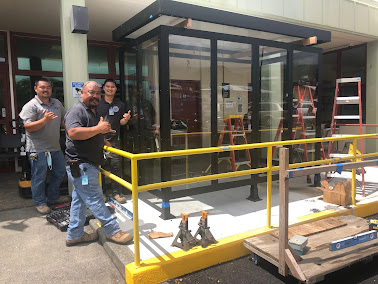
Curtis Higashi, Jay Taganas and Tyren Fukanaga-Camba erect a glass
 greeting and security station at the entrance to Kaʻū Hospital in Pāhala. 
Photo by Julia Neal

A NEW GLASS GREETING AND SECURITY STATION FOR KAʻŪ HOSPITAL & EAST HAWAI'I HEALTH CLINIC went up this week in Pāhala, put together by Jay Taganas and his crew Curtis Higashi and Tyren Fukanaga-Camba.
    The campus for hospital and clinic is at the entrance to Pāhala  at 1 Kamani Street at the corner of Hwy 11.
    The facility offers a 24/7 emergency department, inpatient medical and rehabilitation care, long-term care, adult day health, immunizations, x-ray and lab services, in addition to an on-site family practice rural health clinic.The clinic offers urgent care and appointments and is open Monday through Friday from 7 a.m. to 5:15 p.m., closed on weekends and holidays. Its Family Medicine practitioner is Jennifer Shrestha, Md. Call 808-932-4205. See more services from hospital and clinic online at https://www.easthawaiihealthclinics.org/east-hawaii-health-clinic-at-kau/.

To read comments, add your own, and like this story, see facebook.com/kaucalendar. See latest print edition at kaucalendar.com, in the mail and on stands.


OUTDOOR MARKETS

Volcano Thursday Market, Cooper Center, Volcano Village, Thursdays, 3 p.m. to 6 p.m., with live music, artisan crafts, ono grinds, and fresh produce. See Volcano Evening Market facebook.

Volcano Swap Meet, fourth Saturday of the month from 8 a.m. to noon. Large variety of vendors with numerous products. Tools, clothes, books, toys, local made healing extract and creams, antiques, jewelry, gemstones, crystals, food, music, plants, fruits, and vegetables. Also offered are cakes, coffee, and shave ice. Live music.

Volcano Farmers Market, Cooper Center, Volcano Village on Sundays, 6 a.m. to 10 a.m., with local produce, baked goods, food to go, island beef and Ka'ū Coffee. EBT is used for Supplemental Nutrition Assistance Program, formerly Food Stamps. Call 808-967-7800.


O Ka'ū Kākou Market, Nā'ālehu, Wednesdays, 8 a.m. to 2 p.m. Contact Nadine Ebert at 808-938-5124 or June Domondon 808-938-4875. See facebook.com/OKauKakouMarket.

Ocean View Community Market, Saturdays and Wednesdays, 6:30 a.m. to 2 p.m., corner Kona Dr. Drive and Hwy 11, near Thai Grindz. Masks mandatory. 100-person limit, social distancing required. Gate unlocked for vendors at 5:30 a.m., $15 dollars, no rez needed. Parking in the upper lot. Vendors must provide their own sanitizer. Food vendor permits required. Carpooling is encouraged.