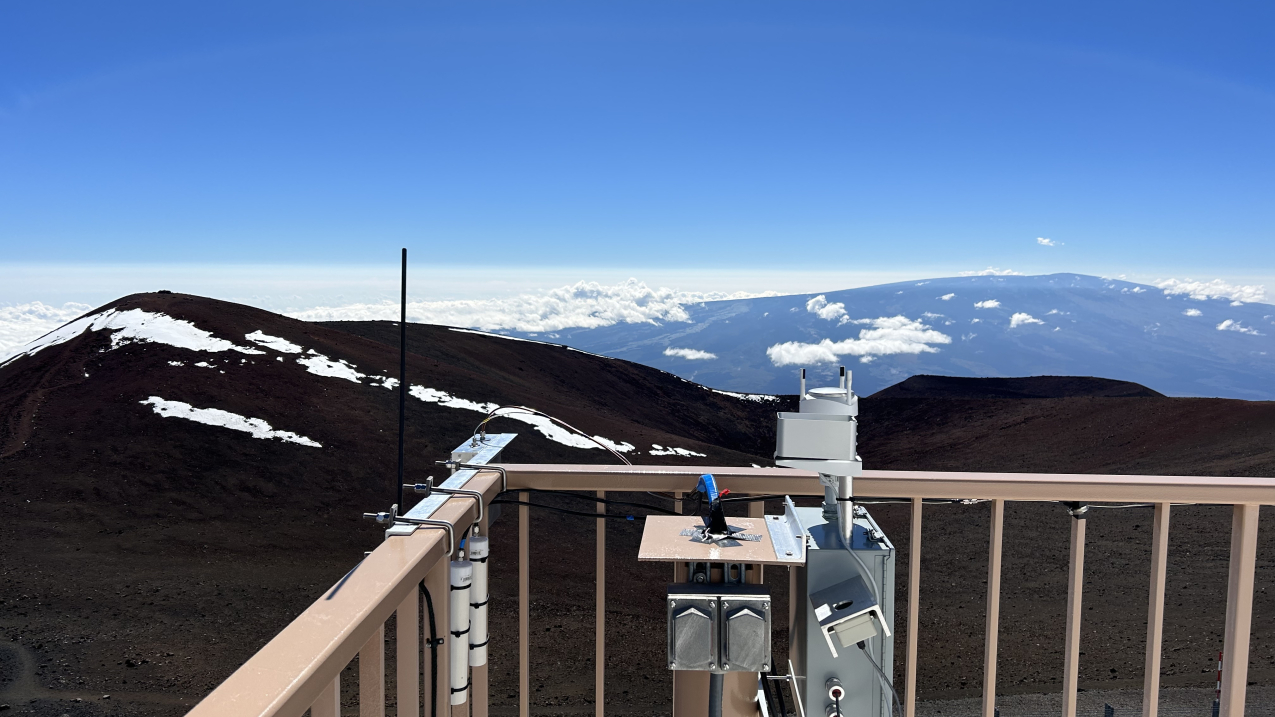
 After the access road to NOAA's Mauna Loa observatory was covered by lava flows from Mauna Loa volcano's November eruption, University of Hawai'i allowed Global Monitoring Laboratory and Scripps Institute of Oceanography to install temporary greenhouse gas sampling sites at its astronomical observatory on the nearby summit of Mauna Kea volcano. This photo shows the air intake tube for NOAA's Picarro analyzer, which was installed on the deck of the Maunakea Observatories building on Dec. 8, 2022. Photo from NOAA
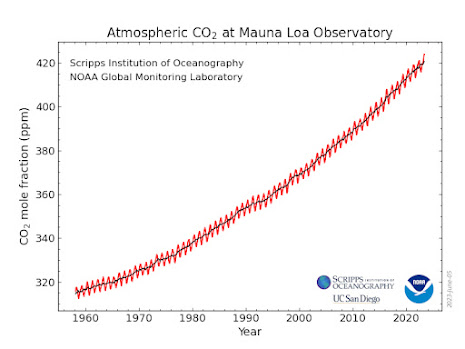
"SADLY, WE'RE SETTING A NEW RECORD" for the rise in carbon dioxide in the atmosphere, said Ralph Keeling, the Scripps Oceanography geoscientist who oversees the Keeling Curve record established by his father 65 year ago from his research at Mauna Loa. Measurements of CO2 obtained by NOAA’s Global Monitoring Laboratory on Mauna Loa averaged 424 parts per million in May, the month when CO2 peaks in the Northern Hemisphere. That represents an increase of 3.0 ppm over May 2022.
Scientists at University of San Diego's Scripps Oceanography, which maintains an independent record, calculated a May monthly average of 423.78 ppm. That increase is also a jump of 3.0 ppm over the May 2022 average reported by the Scripps CO2 Program.
 Keeling said, “What we’d like to see is the curve plateauing and even falling because carbon dioxide as high as 420 or 425 parts per million is not good. It shows as much as we’ve done to mitigate and reduce emissions, we still have a long way to go.” CO2 levels are now more than 50 percent higher than they were before the onset of the industrial era.
NOAA administrator Rick Spinrad, Ph.D. said, “Every year we see carbon dioxide levels in our atmosphere increase as a direct result of human activity. Every year, we see the impacts of climate change in the heat waves, droughts, flooding, wildfires and storms happening all around us. While we will have to adapt to the climate impacts we cannot avoid, we must expend every effort to slash carbon pollution and safeguard this planet and the life that calls it home.”
The University of San Diego Scripps statement said, "CO2 pollution is generated by burning fossil fuels for transportation and electrical generation, by cement manufacturing, deforestation, agriculture and many other practices. Like other greenhouse gases, CO2 traps heat radiating from the planet’s surface that would otherwise escape into space, amplifying extreme weather events, such as heat waves, drought and wildfires, as well as precipitation and flooding."
 The statement also said, "Rising CO2 levels also pose a threat to the world’s ocean, which absorbs both CO2 gas and excess heat from the atmosphere. Impacts include increasing surface and subsurface ocean temperatures and the disruption of marine ecosystems, rising sea levels and ocean acidification, which changes the chemistry of seawater, leading to lower dissolved oxygen, and interferes with the growth of some marine organisms."

NOAA administrator Rick Spinrad, Ph.D. said, “Every year we see carbon dioxide levels in our atmosphere increase as a direct result of human activity. Every year, we see the impacts of climate change in the heat waves, droughts, flooding, wildfires and storms happening all around us. While we will have to adapt to the climate impacts we cannot avoid, we must expend every effort to slash carbon pollution and safeguard this planet and the life that calls it home.”
The University of San Diego Scripps statement said, "CO2 pollution is generated by burning fossil fuels for transportation and electrical generation, by cement manufacturing, deforestation, agriculture and many other practices. Like other greenhouse gases, CO2 traps heat radiating from the planet’s surface that would otherwise escape into space, amplifying extreme weather events, such as heat waves, drought and wildfires, as well as precipitation and flooding."

The statement also noted that this year, NOAA’s measurements were obtained from a temporary sampling site atop the nearby Mauna Kea volcano, which was established after lava flows cut off access to the Mauna Loa observatory in November 2022. Scripps’s May measurements were taken at Mauna Loa, after NOAA staff successfully repowered a Scripps instrument with a solar and battery system in March.
The Mauna Loa data, together with measurements from sampling stations around the world, are incorporated by NOAA’s Global Monitoring Laboratory into the Global Greenhouse Gas Reference Network, a foundational research dataset for international climate scientists and a benchmark for policymakers attempting to address the causes and impacts of climate change.
Widely considered the premier global sampling location for monitoring atmospheric CO2, NOAA and Scripps observatory operations were abruptly suspended on Nov. 29, 2022 when lava flows from the eruption of Mauna Loa volcano buried more than a mile of access road and destroyed transmission lines delivering power to the observatory campus. After a 10-day interruption, NOAA restarted greenhouse gas observations on Dec. 8 from a temporary instrument installation on the deck of the University of Hawai'i observatory, located near the summit of Mauna Kea volcano. Scripps Oceanography initiated air sampling at Mauna Kea on Dec. 14, 2022 and resumed sampling at Mauna Loa on March 9, while maintaining their Mauna Kea observations.
Continuous daily samples were obtained from both Mauna Loa and Mauna Kea by Scripps Oceanography during May, the month when CO2 levels in the Northern Hemisphere reach their maximum levels for the year. Scripps recorded a May CO2 reading from Maunakea of 423.83, which is very close to the reading of 423.78 from Mauna Loa.
The Mauna Loa observatory is situated at an elevation of 11,141 feet above sea level, while the Mauna Kea sampling location is slightly higher, at an elevation of 13,600 feet. Scientists are able to sample air undisturbed by the influence of local pollution or vegetation, and produce measurements that represent the average state of the atmosphere in the Northern Hemisphere from both locations.
Scripps Oceanography geoscientist Charles David Keeling initiated on-site measurements of CO2 at NOAA’s Mauna Loa weather station in 1958. Keeling was the first to recognize that CO2 levels in the Northern Hemisphere fell during the growing season, and rose as plants died back in the fall. He documented these CO2 fluctuations in a record that came to be known as the Keeling Curve. He was also the first to recognize that, despite the seasonal fluctuation, CO2 levels rose every year.
NOAA began measurements in 1974, and the two research institutions have made complementary, independent observations ever since.
The Mauna Loa data, together with measurements from sampling stations around the world, are incorporated by NOAA’s Global Monitoring Laboratory into the Global Greenhouse Gas Reference Network, a foundational research dataset for international climate scientists and a benchmark for policymakers attempting to address the causes and impacts of climate change.
Widely considered the premier global sampling location for monitoring atmospheric CO2, NOAA and Scripps observatory operations were abruptly suspended on Nov. 29, 2022 when lava flows from the

Continuous daily samples were obtained from both Mauna Loa and Mauna Kea by Scripps Oceanography during May, the month when CO2 levels in the Northern Hemisphere reach their maximum levels for the year. Scripps recorded a May CO2 reading from Maunakea of 423.83, which is very close to the reading of 423.78 from Mauna Loa.
The Mauna Loa observatory is situated at an elevation of 11,141 feet above sea level, while the Mauna Kea sampling location is slightly higher, at an elevation of 13,600 feet. Scientists are able to sample air undisturbed by the influence of local pollution or vegetation, and produce measurements that represent the average state of the atmosphere in the Northern Hemisphere from both locations.
Scripps Oceanography geoscientist Charles David Keeling initiated on-site measurements of CO2 at NOAA’s Mauna Loa weather station in 1958. Keeling was the first to recognize that CO2 levels in the Northern Hemisphere fell during the growing season, and rose as plants died back in the fall. He documented these CO2 fluctuations in a record that came to be known as the Keeling Curve. He was also the first to recognize that, despite the seasonal fluctuation, CO2 levels rose every year.
NOAA began measurements in 1974, and the two research institutions have made complementary, independent observations ever since.
To read comments, add your own, and like this story, see facebook.com/kaucalendar. See latest print edition at kaucalendar.com, in the mail and on stands.
THE ACLU DEMAND TO STOP SWEEPS OF HOMELESS CAMPS ON COUNTY PROPERTY until there is sufficient shelter for those displaced has drawn response from the County. Hawaiʻi County. Managing Director Lee E. Lord sent the response Tuesday to American Civil Liberties Union of Hawaiʻi regarding ACLU's concern about constitutional rights of homeless community members. The letter said the County appreciates the ACLU's concern and welcomes dialogue with ACLU "on this very important topic." In the response to the demand letter from Wookie Kim, Legal Director of the ACLU of Hawaiʻi, to stop the "sweeps" of homeless encampments, the County emphasized a commitment to a balanced approach that considers the well-being of both the homeless population and the general public. The County stated its operation conducted to removed homeless people from Hale Hālāwai beach park in Kona on May 24 was comprehensive operation, involving "collaborative efforts and resources from various organizations, including the County of Hawaiʻi Department of Parks & Recreation, Hawaiʻi Police Department, Office of Housing and Community Development, West Hawaiʻi Community Health Center, Care Hawaiʻi – Mental Health and Crisis Outreach, HOPE Services – Shelter Outreach, and 808 Homeless Taskforce."
The County response to the ACLU pointed out that "Prior to the enforcement action, a two-week outreach program was initiated, which led to the identification of 23 individuals experiencing homelessness at Hale Hālāwai. During the outreach, these individuals were informed about the upcoming park enforcement action, offered temporary storage solutions for their personal property, and provided access to homeless support services."
The Mayor said, “our administration is not conducting forced homeless sweeps. We are compassionately enforcing park rules with the assistance of numerous human service organizations, who are there to provide vital resources to those affected by the enforcement efforts. Ensuring the safety of our parks for everyone, including our children, elders, local families, and employees, is our priority. We have a responsibility to address unsafe conditions within the extent permissible by law.” The County also reported that on May 24, "only ten individuals experiencing homelessness remained at Hale Hālāwai. All ten individuals received assistance, including temporary or long-term housing options, and, in some cases, arranged flights to reunite with their families. Most importantly, no citations or arrests were made among the remaining individuals on that day.
"While the option of storing personal property was emphasized, none of the individuals chose to utilize this service. As a result, all unclaimed property was removed from the park, and a significant two tons of rubbish were adequately disposed of." The response stated that the County recognizes its responsibility to maintain the health and safety of its parks for the enjoyment of all residents and visitors. "The Roth Administration maintains that efforts to assist homeless individuals will continue through close collaboration with on-island service providers.
The County emphasized its "commitment to ensuring public safety in its parks while addressing the needs of homeless community members and encouraged open dialogue with the American Civil Liberties Union on this critical matter," said a statement from the County.



The County response to the ACLU pointed out that "Prior to the enforcement action, a two-week outreach program was initiated, which led to the identification of 23 individuals experiencing homelessness at Hale Hālāwai. During the outreach, these individuals were informed about the upcoming park enforcement action, offered temporary storage solutions for their personal property, and provided access to homeless support services."
The Mayor said, “our administration is not conducting forced homeless sweeps. We are compassionately enforcing park rules with the assistance of numerous human service organizations, who are there to provide vital resources to those affected by the enforcement efforts. Ensuring the safety of our parks for everyone, including our children, elders, local families, and employees, is our priority. We have a responsibility to address unsafe conditions within the extent permissible by law.”

"While the option of storing personal property was emphasized, none of the individuals chose to utilize this service. As a result, all unclaimed property was removed from the park, and a significant two tons of rubbish were adequately disposed of." The response stated that the County recognizes its responsibility to maintain the health and safety of its parks for the enjoyment of all residents and visitors. "The Roth Administration maintains that efforts to assist homeless individuals will continue through close collaboration with on-island service providers.
The County emphasized its "commitment to ensuring public safety in its parks while addressing the needs of homeless community members and encouraged open dialogue with the American Civil Liberties Union on this critical matter," said a statement from the County.
To read comments, add your own, and like this story, see facebook.com/kaucalendar. See latest print edition at kaucalendar.com, in the mail and on stands.



.jpg)


