About The Kaʻū Calendar

Monday, August 14, 2023

Kaʻū News Briefs, Monday, August 14, 2023

This was Kaʻū, not Maui, last November and local firefighters said Pāhala was fortunate that the wind direction was slightly in favor of skirting the town of wooden plantation houses. Otherwise, it could have gone up in flames. The county is calling for everyone to take more fire prevention action, as the fatality count on Maui rises to 99. Photo by Julia Neal

HAWAIʻI COUNTY COMMUNITY IS URGED TO PRIORITIZE FIRE SAFTEY awareness and preparedness. Hawaiʻi Fire Department Chief Kazuo Todd and Mayor Mitch Roth issued a statement Monday in light of the recent fires on Hawaiʻi Island and the ongoing crisis in Maui County. "Fire safety is a collective responsibility, and all individuals have a kuleana to take proactive measures to mitigate
wildfire risks in their residences and neighborhoods. By adhering to key fire safety practices, individuals can substantially diminish the potential impact of wildfires." Recommended steps include:
    Adopt Firewise Practices: Establishing a defensible space around your residence, which entails maintaining a safe distance between trees, shrubs, and other flammable vegetation, can drastically curtail the spread of fires to your property. For comprehensive guidance on Firewise practices, please refer to the resources available on the Hawaiʻi Wildfire Management Organization (HWMO) webpage.
    Reduce Waste and Flammable Items: Proper disposal of waste and the removal of flammable items around your property are pivotal in averting accidental fires. Residents are advised to securely store firewood, propane tanks, and other combustible materials away from their homes and structures.
    Install and Maintain Smoke Alarms: Ensuring the installation of smoke alarms on each floor of your home and conducting monthly tests are imperative. Batteries should be replaced as needed to guarantee optimal functionality.
    Create and Practice a Family Emergency Plan: The creation and regular rehearsal of a family escape plan, complete with two exit routes from every room and a designated outdoor meeting point, are vital components of comprehensive fire preparedness.
    Stay Informed and Educated: Residents are encouraged to access additional resources, tips, and information related to fire safety and preparedness on the HWMO webpage and the Civil Defense website. To receive real-time Hawaiʻi County emergency alerts and updates, individuals can sign up for the Everbridge notification system.
    "The recent events weigh heavy on our hearts and serve as poignant reminders of the profound impact that wildfires can have on our communities," said the Mayor. "We have seen how quickly the fires devastated Maui and truly believe that a unified community effort can yield meaningful results in safeguarding homes, families, and our 'āina. We have the privilege of working toward prevention, and we encourage all of our residents to take advantage of this guidance for the safety of us all."
    The Mayor extended gratitude to the community for attentiveness to this pressing matter. For further inquiries or assistance, residents are encouraged to reach out to the Hawaiʻi Fire Department or explore the provided online resources.

To read comments, add your own, and like this story, see facebook.com/kaucalendar. See latest print edition at kaucalendar.com, in the mail and on stands.

A MORATORIUM ON SELLING PROPERTY IN THE DEVASTATED AREAS OF MAUI is proposed by Gov. Josh Green. He said on Monday that he has asked the Attorney General "to explore options to do a moratorium on any sales of properties that have been damaged or destroyed. "Moreover, I would caution people that it's going to be a very long time, before any growth, or housing can be built. And so, you
would be pretty poorly informed if you try to steal land from our people and then build here." He said he envisions the place to become a memorial for all that was lost there.
   In the meantime, two class action lawsuits have been filed, blaming the electric company, contending that failing to turn off the power during the high winds energized the fires and contributed to the firestorm. Some of the law firms involved are litigating suits concerning deadly fires in California.
    Hawaiian Electric CEO Shelee Kimura addressed the devastation of the electrical system in West Maui during a press conference Monday, acknowledging the grief over the loss of life experienced by the Hawaiian Electric ‘ohana, many of them impacted by the tragedy. She reported progress in bringing electricity to Lāhainā Civic Center and hotels that can be used to house displaced people and recovery workers.
    Department of Hawaiian Home Lands Chair Kali Watson said "In the aftermath of the wildfires, DHHL is involved in rebuilding homes and infrastructure" and that his agency will consider "how to build in a way that would be more resilient to future fires and storms." The statement from his office says, "DHHL is committed to meeting the needs of our community and will work alongside federal, state and county leaders to ensure beneficiaries are safe, sheltered and have access to necessities. The Department has allocated resources and funds to support recovery efforts. This requires both immediate crisis management funding and longer-term planning to ensure sustainable recovery.
     The devastating Lāhainā wildfires consumed two homes at DHHL Villages of Leialiʻi, which consists of 104 residential lots. 


Kaʻū High School Alumni & Friends annual Potluck Reunion on Sunday, Aug. 20 from 11 a.m. to 5 p.m. at Pāhala Community Center. Everyone who supports the school is invited. Photo by Julia Neal

ALL FRIENDS OF KA‘Ū HIGH SCHOOL ARE INVITED to the Kaʻū High School Alumni & Friends annual Potluck Reunion on Sunday, Aug. 20 from 11 a.m. to 5 p.m. at Pāhala Community Center. Live music will be provided by Calvin Ponce. Kumu Hula Debbie Ryder and her Hālau Hula ‘O Leionalani will perform from 1 p.m. to 2 p.m. Bring a favorite dish to share.


5,000 in the mail, 2,500 on the street.


Sunday, August 13, 2023

Kaʻū News Briefs, Sunday, August 13, 2023

County of Hawai‘i has issued guidance for helping Maui. Image from Hawai‘i County
HAWAI‘I COUNTY'S MAUI RECOVERY TASK FORCE, led by Cyrus A.K. Johnasen, released a guide on Friday for helping out. "Just four days ago, the people of Maui Nui - our friends, family, and colleagues - lost everything. Their homes, their vehicles, their means of making a living - all of it. But one thing they didn't lose is us - their community - both close-knit and extended. From the very start, we have emphasized that ‘ohana knows no bounds of geography, and neither does kuleana.
     Johnasen said, "This guidance has been shaped by the insights of Hawaiʻi Island officials who attended the initial Task Force meeting on August 10th, as well as leaders from Maui County, non-profit organizations, and local communities who have been in touch within the last 96 hours. It is important for residents to recognize that Mayor Mitch Roth acknowledges the diverse ways individuals are connected to the Maui devastation and encourages responses that match those connections. Nevertheless, the guidance highlights existing capacity challenges that should be handled with attention and sensitivity according to the Mayor's recommendations." The guidance recommends:
    Contribute to high-impact organizations: After extensive discussions with officials, non-profit leaders, and community members in Maui, it has been determined that the most effective immediate contribution is through monetary donations to established community-focused organizations with a strong track record of efficiently distributing funds where they will have the greatest influence. These include: Hawaiʻi Community Foundation's Maui Stong FundCouncil for Native Hawaiian Advancement's Kākoʻo Maui Fund, and Maui United Way's Maui Fire Disaster Fund.
Cyrus Johnasen, right, at a Hawai‘i County Sustainability Summit.
Photo from County of Hawai‘i
    
     Hold off on physical goods... for now: We know that everyone is eager to donate what they have to the families that lost everything. That's "local" style and what makes Hawaiʻi such a special place.
    While the natural inclination is to provide material goods to families who have lost everything, there is presently no clear mechanism to ensure these items promptly reach those in need. Until a reliable distribution system is in place, it is advised that residents on Hawaiʻi Island refrain from sending physical donations. This approach safeguards both our local community and the broader Hawaiʻi Island population until a clear assessment of needs and on-site resources is available to ensure effective distribution.
    Help those who are displaced: The West Hawaiʻi Realtors Association has curated a housing inventory catalog, encompassing not just Hawaiʻi Island but the entire state in collaboration with other real estate associations. Their website details all of the available housing options in real-time and also offers those willing to offer up a second home, vacation rental, ʻohana unit, or additional space for a displaced Maui resident a platform to do so. Interested parties can visit mauikokua.com for more information.
    Share your talents when the time is right: Numerous members of our community have reached out, offering a diverse range of valuable skill sets that could be deployed to aid in the recovery of Lāhainā and the wider Maui community. From architects, engineers, and home builders to solar companies, truckers,
shippers, pilots, and mental health specialists, many have expressed their willingness to contribute to our efforts. While the recovery process is still in its early stages, these valuable talents have been acknowledged, and all residents will be engaged as Maui formulates its next steps forward.
    Stay put until Maui is ready for us: While the desire to lend a hand is strong, it is crucial to remember that Maui's resources are currently stretched thin. Each individual sent over requires resources like food, fuel, and shelter that could otherwise support displaced residents. This isn't to say that our assistance isn't appreciated; it's just that we need to ensure that our footprint is minimal while our impact is meaningful.
      Maui will communicate when it is prepared to accept outside assistance. However, if you have displaced family members requesting help, please heed their call. Our intention is not to speak on their behalf; rather, we aim to limit any unintended adverse effects.
    Final thoughts: In closing, we must remind ourselves that Maui's recovery, like all recovery, will be a marathon and not a sprint. Our approach must be thoughtful and focused to make our contributions meaningful. Mahalo again for your thoughtful collaboration and commitment to Hawaiʻi. Naʻu me ka haʻahaʻa; humbly.


HWY 11 AT MILE MARKER 82 SHUT DOWN ON SUNDAY AT 9. A.M. FOLLOWING A VEHICLE CRASH. Hawai‘i Police Department reported the closure in both directions. "This section of Highway 11 will remain closed for the next several hours as Police conduct their investigation. There are no detours available. Please use alternate routes until the road is reopened." For a road reopening update on this road closure, contact HPS non-emergency line at 808-935-3311.

 To read comments, add your own, and like this story, see facebook.com/kaucalendar. See latest print edition at kaucalendar.com, in the mail and on stands.

A 4.4 MAGNITUDE EARTHQUAKE SHOOK THE KĪLAUEA SUMMIT area Sunday at 1:36 p.m. The earthquake was not large enough to cause a tsunami for the Island of Hawai‘i.

To read comments, add your own, and like this story, see 
facebook.com/kaucalendar. See latest print edition at kaucalendar.com, in the mail and on stands.


5,000 in the mail, 2,500 on the street.


Saturday, August 12, 2023

Kaʻū News Briefs, Saturday, August 12, 2023

Hawaiian Volcano Observatory geologists and a National Park Service archaeologist hike west along the Hilina Pali
 Trail on July 26, 2023. USGS photo by D. Downs 

SEARCHING FOR TEPHRA from one of Kīlauea's largest explosive eruptions is the subject of this week's Volcano Watch, written by U.S.G.S. Hawaiian Volcano Observatory scientists and affiliates.
This week's article was written by HVO geologist Kendra J. Lynn. 
    Understanding the eruptive history of volcanoes in Hawai‘i requires a tremendous amount of time and effort in examining deposits. Typically, older eruptions have less material exposed at the surface because younger eruptions bury them, or wind and rain erode them. Such is the case for one of Kīlauea's largest explosive eruptions, which is not exposed near its source at the summit and must be studied further afield.
    Although Kīlauea is world-renowned for its lava flow eruptions, it also has a history of explosive eruptions. The two most recent explosive periods, which created deposits named the Uwēkahuna Ash and Keanakāko'i Tephra, were preceded by huge outpourings of lava. These large lava flow eruptions may have drained Kīlauea's summit plumbing system and caused caldera collapse; subsequent activity was explosive.
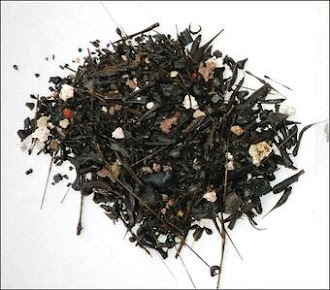
Tephra comes in many forms including these rock fragments,
 tiny spheres and shards of volcanic gas. USGS photo
    Studies of the younger Keanakāko‘i Tephra (1500 to the early 1820s Common Era, or CE) have provided many key insights into Kīlauea's evolution over the past few hundred years.
    The older Uwēkahuna Ash represents possibly 1,200 years of dominantly explosive activity, yet only a few detailed geologic studies exist for these deposits. The type locality of Uwēkahuna Ash was a vertical section within the Uēkahuna bluff on the western wall of Kaluapele (Kīlauea's summit caldera), but summit collapses in 2018 and subsequent rock falls buried this location. Fortunately, we can study samples that were collected from this location and collect new samples from the same deposits further away from the summit.
    The Kulanaokuaiki Tephra is a subset of the Uwēkahuna Ash. It erupted between 400–1000 CE. HVO geologists and collaborators are focusing on one part of this deposit—named Kulanaokuaiki-3 (K-3, for short)—because it is one of the largest known explosive eruptions at Kīlauea in the past several thousand years.
    K-3 explosive activity likely had an eruption column that reached 14–18 km (9–10 miles) above sea level for several hours. The K-3 plume dispersed tephra, in a southeast direction, across an area larger than 65 square km (16,000 acres), from Kīlauea's summit all the way to Halapē on the coastline 17 km (10.5 miles) away.
   Recently, HVO scientists conducted fieldwork in the backcountry of Hawai‘i Volcanoes National Park They focused on finding, measuring, and sampling deposits from K-3 to better understand how, when, and why eruptions of this magnitude might occur. This work was conducted under the supervision of an HAVO archaeologist, who ensured our work would not disrupt any cultural or natural resources.

Volcanic ash from Kīlauea Volcano is tephra.
USGS photo
    In the field, HVO geologists dug small pits in soil and tephra that have accumulated in the low spots on the lava flows that cover the surface of Kīlauea's south flank. Once exposed, the layers of soil, ash, and tephra within the pits were measured, described, and sampled.
    Using these samples we'll assess the degree of tephra fragmentation—a proxy for eruption intensity and size—by measuring the shape and size distribution of tephra grains using state-of-the-art analytical equipment in the HVO Tephra Lab. Magma degassing during the eruption will be evaluated by measuring tephra density using a high-precision pycnometer and/or 3D scanner in the HVO Tephra Lab. Using microscopes, we'll investigate how much of the sample is fresh versus recycled older lava. These physical parameters will help us to understand the K-3 deposit and the eruptions that created it.
    Kīlauea has not had an explosive eruption as large as the K-3 in modern times. It's important to evaluate what generates such large eruptions because a similar eruption today would be devastating to communities surrounding Kīlauea summit and downwind. Another K-3-sized eruption would likely inject volcanic ash into the subtropical jet stream and disrupt regional air traffic.
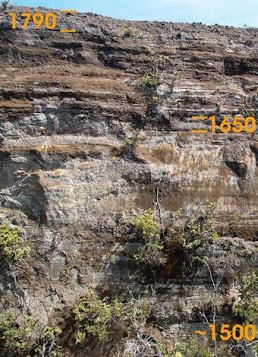
 
Tephra deposits at Kilauea and go back to the
 year 1500 in just these deposits. USGS photo
  While Kīlauea's lava flows are often in the limelight, HVO geologists are continuing to study the deposits from past explosive eruptions. The samples we collect and datasets we generate from them provide an important framework for interpreting modern monitoring signals, allowing us to better characterize Kīlauea's eruptive behavior.
    Volcano Activity Updates: 
    Kīlauea is not erupting. Its USGS Volcano Alert level is ADVISORY. 
Active lava has not been visible within Halemaʻumaʻu crater at the summit of Kīlauea since June 19. Earthquake activity in the summit region remained slightly increased over the past week. Summit tiltmeters generally showed inflation over the past week. A sulfur dioxide (SO2) emission rate of approximately 120 tonnes per day was measured on August 6.
    Mauna Loa is not erupting. Its USGS Volcano Alert Level is at NORMAL. 
    Webcams show no signs of activity on Mauna Loa. Seismicity remains low. Summit ground deformation rates indicate slow inflation as magma replenishes the reservoir system following the recent eruption. SO2 emission rates are at background levels. 
    There were three earthquakes with three or more felt reports in the Hawaiian Islands during the past week: a M3.2 earthquake 4 km (2 mi) S of Volcano at 2 km (1 mi) depth on August 9 at 10:40 a.m. HST, a M3.6 earthquake 4 km (2 mi) NNE of Wai‘ōhinu at 12 km (7 mi) depth on August 4 at 8:30 p.m. HST, and a M3.9 earthquake 69 km (42 mi) WNW of Kalaoa at 43 km (26 mi) depth on August 4 at 5:24 a.m. HST.
    HVO continues to closely monitor Kīlauea and Mauna Loa.
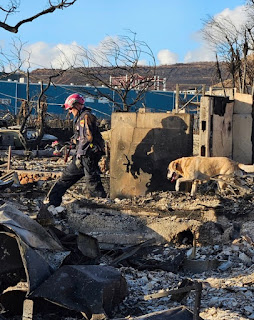
FEMA brought in a recovery crew including
cadaver dogs. Photo from Governor's Office

TO BETTER PREPARE FOR FUTURE WILDFIRES AND TO BETTER UNDERSTAND decisions made before and during this week's Maui and Hawai‘i Island wildfires, is the aim of Hawai‘i's Attorney General Anne Lopez. She announced on Friday that the Department of the Attorney General will conduct "a comprehensive review of critical decision-making and standing policies leading up to, during, and after the wildfires on Maui and Hawaiʻi islands." 
     Lopez said,  “The Department of the Attorney General shares the grief felt by all in Hawaiʻi, and our hearts go out to everyone affected by this tragedy. She said her Department is committed to "sharing with the public the results of this review. As we continue to support all aspects of the ongoing relief effort, now is the time to begin this process of understanding."
       The death rate climbed to 89 on Saturday, with the arrival of 8 cadaver dogs with 12 more to come, to go through the charred buildings and ruins of cars and other sites. In a press conference, Maui Police Chief John Pelletier called again for patience. He said that only 3 percent of the structures have been checked for remains and given that many are burnt to the ground, identifying them is extremely difficult. He recommends that those with relatives who are missing have their DNA tested so an information bank can be established to match remains with relatives. He talked about the pono way of proceeding with respect, aloha and dignity, "because we are Hawai‘i and we are Maui." Referring to the remains of people on the ground, he called for moving slowly since "We are walking on it." He called for "patience, prayers, perseverance." Only a handful of remains have been identified.

AG Anne Lopez will conduct
a review on decision-making
regarding the wildfires.
       Maui Mayor Richard Bissen praised the local community for its fast response to the crisis. He called it a locally led, government-supported operation. Numerous public officials, federal, state and county, said it is not the aim of their agencies to take over the operations but to give support, working in partnerships.
     Kaʻū's member of Congress, Jill Tokuda, who also represents Maui and all rural Hawai‘i, praised "all the frontliners." Public officials noted that on the ground there are 50 members of the National Guard, 150 representing FEMA, and the Coast Guard, which saved 17 lives and assisted locals in saving 40 more when people fled to the ocean to escape the fire. In addition the military is helping with helicopters and other assets.

     Gov. Josh Green, who called Lahaina "Ground Zero," said that one goal is to get displaced survivors into housing as soon as possible and reported that 1,000 hotel rooms on Maui will be used. Five hundred will be for the displaced and 500 for those who have come in to help out, including FEMA, CDC and SBA. He said that 15,000 people, mostly visitors who were on the island, have left. Next is working on long-term housing, said the Governor.
     The Coast Guard representative said that "We understand that Lahaina Harbor is the lifeblood of Lahaina" and promised to help make it operable as soon as possible.
     Tokuda, who visited Lahaina on Saturday, said that while one of her favorite historic places, Lahaina Library is gone, its wooden sign remains untouched, giving her hope for Lahaina's future.
    FEMA Administrator Deanne Criswell also visited Lahaina noted that since 2018 the agency has maintained five times the amount of commodities it stores in Hawai‘i for emergencies.


5,000 in the mail, 2,500 on the street.