About The Kaʻū Calendar

Saturday, August 19, 2023

Kaʻū News Briefs, Saturday, August 19, 2023

A brush fire at Ka Lae occupied firefighters Saturday and led to the shutdown of the
most southern end of South Point Road. Photo by Alex Barrett

KAʻŪ COUNTY AND VOLUNTEER FIREFIGHTERS continued their work on a fire near South Point Saturday evening. The 6 p.m. update from Civil Defense said, "The Hawai‘i Fire Department continues operations along South Point Road near Ka Lae in the Kaʻū District. Fire operations extend along South Point Road and Ka Lae Road. Firefighters will continue to monitor the fire throughout the evening.
    "Due to the brush fire, be advised. the following roads are closed: South Point Road at Ka Lae Road junction/ The following roads are open for local traffic only: South Point Road below Kamaoa Road."
    For more information, visit the County of Hawai‘i Hazard Impact Map.


NATIONAL OCEANIC & ATMOSPHERIC ADMINISTRATION is offering funding opportunities for communities to prepare, adapt and build resilience to weather and climate events; and for research on weather, oceans, and climate. Office of National Marine Sanctuaries is accepting proposals for the following:
    The Climate Resilience Regional Challenge is for projects that build the resilience of coastal communities to extreme weather (e.g., hurricanes and storm surges) and other impacts of climate change, including sea level rise and drought. 
    The focus is on collaborative approaches to achieving resilience in coastal regions. Proposed projects should address risk reduction, regional collaboration, and equity, and build enduring capacity for adaptation. This competitive grant program has two distinct tracks for investing in holistic, collaborative approaches to coastal resilience at regional scales. 
     A letter of intent is due Monday, Aug. 21 with full proposal. Tuesday, Feb. 13.  Track One is titled Regional Collaborative Building and Strategy Development. The $25 million grant focuses on laying the groundwork for future resilience efforts and funds will be used to initiate new, regional-scale efforts and advance existing collaboratives. 
    Track Two is titled Implementation of Resilience and Adaptation Actions. The $550 million grant will support the implementation of transformational resilience and adaptation strategies for coastal communities anchored in existing plans. For both, see:
https://lnks.gd/l/eyJhbGciOiJIUzI1NiJ9.eyJidWxsZXRpbl9saW5rX2lkIjoxMDMsInVyaSI6ImJwMjpjbGljayIsInVybCI6Imh0dHBzOi8vY29hc3Qubm9hYS5nb3YvZnVuZGluZy9pcmEvcmVzaWxpZW5jZS1jaGFsbGVuZ2UvP3V0bV9tZWRpdW09ZW1haWwmdXRtX3NvdXJjZT1Hb3ZEZWxpdmVyeSIsImJ1bGxldGluX2lkIjoiMjAyMzA4MTguODEzMTgwODEifQ.KXINWktLN7iCP8XZrFLlKGOKl2w2yUDEwA8dc-CD7DE/s/712432512/br/224464171434-l.
     The Climate Ready Workforce funds will assist communities in forming partnerships with employers and other entities that train workers with the goal of placing them into jobs that enhance climate resilience.
The grants will be from $ 500,000 to $10 million each. These partnerships will work collaboratively with NOAA to grow regional economies and their associated workforces in climate-related sectors and industries. This competition is jointly run by NOAA's National Sea Grant College Program and Climate Program Office and leverages support from NOAA's Office for Coastal Management. 
    NOAA is seeking state, tribal, territorial and local governments, institutions of higher education, and non-profit organizations in coastal states or territories to lead these partnerships and to place workers in quality jobs that enhance climate resilience.
    The due date is Nov. 30 for the letter of intent, with full proposals due Feb. 13, 2024. See
https://lnks.gd/l/eyJhbGciOiJIUzI1NiJ9.eyJidWxsZXRpbl9saW5rX2lkIjoxMDMsInVyaSI6ImJwMjpjbGljayIsInVybCI6Imh0dHBzOi8vY29hc3Qubm9hYS5nb3YvZnVuZGluZy9pcmEvcmVzaWxpZW5jZS1jaGFsbGVuZ2UvP3V0bV9tZWRpdW09ZW1haWwmdXRtX3NvdXJjZT1Hb3ZEZWxpdmVyeSIsImJ1bGxldGluX2lkIjoiMjAyMzA4MTguODEzMTgwODEifQ.KXINWktLN7iCP8XZrFLlKGOKl2w2yUDEwA8dc-CD7DE/s/712432512/br/224464171434-l.
   The Ocean-Based Climate Resilience Accelerators program provides grants of up to $250,000 to start and up to $10 million to carry on through NOAA's Integrated Ocean Observing System The aim is to identify and support small businesses across ocean-based climate resilience theme areas to attract capital, mature their technologies, and scale their business models for climate impact and economic prosperity.
    Themes are: Ocean-based renewable energy; Coastal and ocean carbon sequestration monitoring and accounting; Hazard mitigation and coastal resilience; Ecosystems services, including change detection, change analysis, and change adaptation and mitigation; Ocean and coastal-based climate resilience theme areas as determined by the applicant.
     Phase One is the scoping and design phase and it will fund selected projects with up to $250,000 per project for accelerator program design. Phase Two will invite all projects selected in Phase One to apply for funding of up to $10 million each to implement the program designed in Phase One.
     The due date is Sept. 11 for Phase One applications. See
https://lnks.gd/l/eyJhbGciOiJIUzI1NiJ9.eyJidWxsZXRpbl9saW5rX2lkIjoxMDUsInVyaSI6ImJwMjpjbGljayIsInVybCI6Imh0dHBzOi8vaW9vcy5ub2FhLmdvdi9hYm91dC9nb3Zlcm5hbmNlLWFuZC1tYW5hZ2VtZW50L2luZmxhdGlvbi1yZWR1Y3Rpb24tYWN0L2FjY2VsZXJhdG9ycy8_dXRtX21lZGl1bT1lbWFpbCZ1dG1fc291cmNlPUdvdkRlbGl2ZXJ5IiwiYnVsbGV0aW5faWQiOiIyMDIzMDgxOC44MTMxODA4MSJ9.go7ZRNhG4_g4fUmAenjQhVlZ63Tlo4NeWOUFolaw148/s/712432512/br/224464171434-l.
The Transformational Habitat Restoration and Coastal Resilience funding is designed to help sustain fisheries, make significant strides in the recovery of threatened and endangered species, and help protect
coastal communities and ecosystems from the impacts of climate change. They support efforts such as reconnecting rivers to their historic floodplains, outplanting corals to rebuild reefs, building living shorelines that protect coasts from erosion and sea level rise, and more.
    The due date is Nov. 17. See


"I AM GRATEFUL TO THE INVESTIGATORS FOR THEIR HARD WORK in solving and charging this case," said Hawai‘i County Police Chief Benjamin Moszkowicz regarding police officer Mark Kealoha Kaili Jr. being accused of breaking into a Nā‘ālehu home on Tuesday and committing burglary and assault. The Police Chief said, “It is important to remember that while the allegations against Officer Kaili are serious, they do not represent the hard work and dedication of the Hawai‘i Police Department.”
    The HPDA statement says, "On Saturday afternoon, August 19, 2023, after conferral with the Hawai‘i
County Prosecutors Office, the 31-year-old Puna Patrol officer was charged with first-degree burglary and third-degree assault stemming from an incident reported Tuesday morning." Kaili’s bail has been set at $6,000. If he does not post bail, he will appear in Hilo District Court on Monday afternoon, Aug. 21.
    On Friday morning, Aug.18 at 10:25 a.m., detectives arrested Kaili at his residence in Hawaiian Paradise Park.
    The charges against Kaili stem from the incident reported early Tuesday morning at a residence in Nā‘ālehu, where two masked men reportedly entered the 20-year-old victim’s residence and assaulted him. During the altercation, the victim’s grandfather intervened, and in the process unmasked one of the suspects, later identified as Kaili, who was off-duty during the alleged incident, and at the time of his arrest.
    The other suspect was immediately identified as 27-year-old Cody Kuaili‘aimoku Kanahele, who is the cousin of the victim. Kanahele was arrested a short time after this incident was reported, and later that same day he was charged with first-degree burglary, and third-degree assault. He was later released from police custody after posting bail, and was given a future court date.
    The Area I Criminal Investigation Division and the Office of Professional Standards (Internal Affairs) are continuing this investigation.
     The Office of Professional Standards has also initiated a standard internal administrative investigation. Officer Kaili has been placed on leave without pay pending the outcome of the separate criminal and internal investigations.

To read comments, add your own, and like this story, see facebook.com/kaucalendar. See latest print edition at kaucalendar.com, in the mail and on stands.


ALL FRIENDS OF KA‘Ū HIGH SCHOOL ARE INVITED to the Kaʻū High School Alumni & Friends annual Potluck Reunion on Sunday, Aug. 20 from 11 a.m. to 5 p.m. at Pāhala Community Center. Live music will be provided by Calvin Ponce. Kumu Hula Debbie Ryder and her Hālau Hula ‘O Leionalani will perform from 1 p.m. to 2 p.m. Bring a favorite dish to share.

To read comments, add your own, and like this story, see facebook.com/kaucalendar. See latest print edition at kaucalendar.com, in the mail and on stands.

PALM TRAIL HIKE on Sunday, Aug. 20 at 9:30 a.m. is a 2.6-mile loop along an old ranch road that leads to amazing volcanic features from the 1868 eruption. At the Kahuku Unit of Hawaiʻi Volcanoes National Park, discover relics of the ranching era and learn about hulihia (catastrophic change) and kūlia (restoration). Enjoy panoramic views of Kahuku and the Kaʻū coast. This is a 3-hour program.

To read comments, add your own, and like this story, see facebook.com/kaucalendar. See latest print edition at kaucalendar.com, in the mail and on stands.


5,000 in the mail, 2,500 on the street.


Friday, August 18, 2023

Kaʻū News Briefs, Friday, August 18, 2023

 State flags were not only flown half-staff in Hawai‘i on Friday, in honor of those lost on Maui. In addition, governors in Nebraska, Pennsylvania, and New Jersey also ordered flags half-staff to honor the victims. Friday was also Admissions Day for Hawai‘i, which became a state in 1959. 
Photo by Bob Martin
Kapua Sproat writes about the Lahaina fires
in The Guardian. Photo from U.H.
KAPUA SPROAT, A UNIVERSITY OF HAWAI‘I LAW PROFESSOR AND ATTORNEY FOR EARTH JUSTICE, has worked on water justice around the state. She co-authored a story for the British newspaper The Guardian this week regarding the risk of fires and the lack of water throughout Hawai‘i, giving Lāhainā as an example. See                                https://www.theguardian.com/commentisfree/2023/aug/17/hawaii-fires-maui-water-rights-disaster-capitalismfbclid=IwAR3ORq0NXYLuktwFNNPVEcjTXb0tFYfgUPebLQWD4t9YjU5FbAowrmfgcwI_aem_AY5Nh5uATaTYQakZb1Vymj22S99M5EVlFTgbFfjmujuruTU8C4jcak-WQ1-b8__eZNs
    The article was recommended by Marsha Hee, of Volcano.


NĀ ‘OHANA O LELE, a coalition of community leaders in Lāhainā, held a press conference Friday. Tiare Lawrence said the group has issued three demands to Gov. Josh Green.
    ONE: Give our community time to grieve. The fire occurred only ten days ago and many people are still in shock and mourning. The governor should not rush to rebuild the community without first giving people time to heal, especially without including the community itself in the planning.
Tiare Lawrence read the demands issued by Na ‘Ohana o Lele
 to Gov. Josh Green. Photo from Maui Now
    TWO: Put the community first in any planning process for rebuilding Lāhainā. The governor should work with the community to develop a plan that meets the needs of the people. Fast-track development cannot come at the cost of community control.
    THREE: Amend the Emergency Proclamation to ensure that Chapter 92 Sunshine Law remains in full force. This law guarantees the public's right to know about the government's decision-making and the discussions and information used in that process. The governor should ensure that all decisions about the rebuilding of Lāhainā are made in the open and with full participation of our Lāhainā community. We need time to gather all of us together to engage in the important conversations that will be needed.
     Lawrence asked that the governor meet with Lāhainā people. "The governor's plans to rebuild the community must be based on the needs of the people, not the interests of developers." She called on the governor to meet the three demands.  See the press conference at https://www.youtube.com/watch?app=desktop&v=vLPvWd1FwcA.

To read comments, add your own, and like this story, see facebook.com/kaucalendar. See latest print edition at kaucalendar.com, in the mail and on stands.

GOV. JOSH GREEN AND THE FIRST LADY JAIME KANANI GREEN RELEASED A VIDEO FRIDAY SAYING LĀHAINĀ PEOPLE WILL DETERMINE LĀHAINĀ'S FUTURE. Through sweat and tears, they talked about the loss of life and pain to the community. The Governor said, "We will rebuild Lāhainā. Lāhainā belongs to its people and we are committed to rebuilding and restoring it the way they want it. The land in Lāhainā is reserved for its people as they return and rebuild. And I have instructed the Attorney General to impose enhanced criminal penalties on anyone who tries to take advantage of victims by acquiring properties in the affected areas."
Lahaina banyan tree behind shells of historic buildings where
Gov. Josh Green said Lahaina will reemerge "like shoots 
from the ashes." Photo from NPR
   He said, "Lāhainā will rise again. It will be a symbol of our resilience, our values and our sacred bonds of ‘ohana. When it is rebuilt it will be a living memorial to the loved ones we have lost, the native Hawaiian culture that founded it centuries ago, and the values that will enable us to endure this tragedy and flourish again, like the great banyan tree that survived the fire and still stands among the ruins today.            
     "We will set an example for the world, on how we will protect and preserve our culture, our history and our values as we navigate the challenges of sustainable development, extreme weather and global climate change in this century. We will never forget what we have lost in Lāhainā and we will never abandon the survivors or our commitment to help them recover and heal. We will mourn those we have lost, honor their memories, and support the survivors and we will nurture our hope for the future that will emerge again like shoots from the ashes." 

To read comments, add your own, and like this story, see facebook.com/kaucalendar. See latest print edition at kaucalendar.com, in the mail and on stands.

Police Officer Mark Kealoha
Kaili, Jr. arrested. Photo from HPD
TWO MASKED MEN ROBBED A HOME IN NĀ‘ĀLEHU TUESDAY. ARRESTED WAS OFF-DUTY POLICE OFFICER Mark Kealoha Kaili, Jr., 32, of Kea‘au, along with Cody Kuaili‘aimoku Kanahele, 27.  According to Hawai‘i Police Department, early Tuesday morning two masked men reportedly entered a 20-year-old victim’s residence in Nā‘ālehu and assaulted him. During the altercation, the victim’s grandfather attempted to intervene, and in the process unmasked one of the suspects, later identified as Kaili, who was off-duty during the alleged incident, as well as at the time of his arrest. Kanahele, cousin of the victim, was arrested a short time after this incident was reported. Later that same day he was charged with first-degree burglary and third-degree assault.
     Kaili was arrested Friday morning at his residence in Hawaiian Paradise Park, on suspicion of first-degree burglary and third-degree assault. Some folks in Ka‘ū say they remember him serving as a lifeguard at Punalu‘u Black Sand Beach.

To read comments, add your own, and like this story, see facebook.com/kaucalendar. See latest print edition at kaucalendar.com, in the mail and on stands.


5,000 in the mail, 2,500 on the street.


Thursday, August 17, 2023

Kaʻū News Briefs, Thursday, August 17, 2023

 Kaʻū Trojans energized the first game of the season Thursday against Pāhoa Daggers. Trojans made the
first touchdown, but after the quarterback was injured, Pāhoa kept scoring and won 20-6.
Photo by Joy Marie Ridgely

KAʻŪ TROJANS TOOK TO THE ROAD FOR THE FIRST FOOTBALL GAME of the season on Thursday. Kaʻū High played Pāhoa at the ballfield in Kea‘au. 
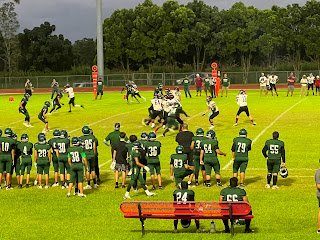
 Kaʻū Trojans on the road Thursday at the ballfield in Kea‘au,
playing Pāhoa Daggers. Photo by Joy Marie Ridgely

    Trojans started the game with big success. On the first drive, Kuahuia-Faaffia scored for the Trojans, receiving a pass from quarterback Adahdiya Ellis-Reyes.
    The quarterback, who also plays defensive starting safety, however, was injured during Pāhoa's first drive and Trojan freshman quarterback Baron Marinovich took over the quarterback position for the rest of the game.
    Pāhoa Daggers won 20-6. The next game is a week from Saturday on Aug. 26 at Kohala where Trojans take on the Cowboys.
    Trojan  Coaches are Ted Blanco, Todd Marinovich, Garrett Greedy and Mark Peters.

A FUNDRAISER FOR LĀHAINĀ AND OTHER MAUI FIRE VICTIMS WILL BE HELD AT THE CLUB AT DISCOVERY HARBOUR. Money raised through the event will go to the Council of Native Hawaiian Advancement's Kako‘o Maui Fund and will be matched by donors for up to $1.5 million. 
   The event will be held on Sunday, Aug. 27 from 4 p.m. and will include a prime rib buffet dinner by DaBOMB BBQ.
    There will be raffle prizes, a silent auction and entertainment. The cost is $60 per ticket which comes with a raffle ticket. The silent auction includes the works of many talented artists and local businesses, who donated their items.
    The Buffet includes Slow Kiawe Smoked Prime Rib with whipped horseradish and smoky Shallot Jus, a baked potato bar, classic caesar salad with sourdough croutons and shaved parmesan and pineapple upside-down cake. At The Pub, a dollar for every drink sold will be donated.
    Call The Club for more at 808-731-5122.

 HAWAI‘I FARMERS UNION UNITED HAS SET UP A MAUI RESPONSE FUND. It is being organized by its statewide President Kaipo Kekano, a long-time Lāhainā resident. Financial donations will support local farmers on Maui affected by the wildfires.
      Hawai‘i Farmers Union has a chapter in Kaʻū. Statewide, it has helped to raise assistance for the Lāhainā population devastated by the fire. Its statement says, "Hawaiʻi Farmers Union United stands with our Maui Ohana. Wildfires and hurricane-strength winds have devastated Maui. We grieve the loss of lives, the devastation of our communities, and the irreplaceable cultural and historical artifacts that have been lost. 

    "These events underscore the preciousness of life and the significance of unity and the aloha spirit during challenging times."
    HFUU collaborated with community groups and organizations to provide immediate relief. With support of Common Ground Collective and community volunteers, HFUU ensured the delivery of over 5,000 lbs. of fresh produce to families around Lāhainā.
    The statement says, "Maui's resilience is unwavering, but the need for support is paramount." Donations can be made at https://hfuu.app.neoncrm.com/np/clients/hfuu/donation.jsp?campaign=2&.
      The Farmer Veteran Coalition is also available to help military veterans in agriculture affected by the wildfires on Maui. Members are encouraged to call FVC at 855-382-3276 or email support@farmvetco.org.

To read comments, add your own, and like this story, see facebook.com/kaucalendar. See latest print edition at kaucalendar.com, in the mail and on stands.

 Aerial view of one of the lava-plastered cones, showing thin 1823 pāhoehoe flows (dark gray) draped over older cinder 
and spatter (tan). Photo by S. Rowland, University of Hawaiʻi at Mānoa

THE MOST UNUSUAL KĪLAUEA ERUPTON...MAYBE 1823?
That is the title of this week's Volcano Watch, written by U.S.G.S. Hawaiian Volcano Observatory scientists and affiliates. The eruption was near what is now modern-day Pāhala and The Great Crack. Here is Volcano Watch:
      Last month a "Volcano Watch" article discussed the bicentennial of the first visit of westerners to Kīlauea caldera, led by English missionary William Ellis, in 1823. Ellis did not just visit the summit region; he had approached from Kaʻū, traveling along what eventually became known as Kīlauea's Southwest Rift Zone (SWRZ). Ellis first witnessed evidence of Kīlauea's restlessness there, in the form of a vast, 4.8-square-mile (12.5 square-kilometer) lava flow that had erupted just a short time before.
    The eruption was over by the time Ellis passed through the Keaīwa area, just east of the modern town of Pāhala, from July 30–31, 1823. The lava was still steaming and in places too hot to walk on. Although lava flows can retain heat for many years after an eruption, it seems unlikely in this case, because the flows from this eruption are unusually thin: in most places, the thickness is less than 1 meter (yard).
     Thinner lava flows dissipate heat much more quickly than thicker ones; therefore, we can assume that the flows visited by Ellis had been molten no more than a few weeks earlier. This assumption aligns with oral accounts from native Hawaiians in the surrounding area, who reported that the eruption had occurred less than a month prior.
    Over the past century, Hawaiian Volcano Observatory scientists have occasionally visited the Keaīwa area to study the eruptive features in detail. They have notably found pāhoehoe lava veneers lapping up the flanks of older cinder cones, several yards (meters) high, resulting in the name "Lava Plastered Cones" that appear on maps of the area.
    The thin lava veneers on the cones are indicative of high flow velocities, enough to overcome topography standing in the eruption's way. Think of a water slide with a jump at the end, where fast-moving water briefly flows uphill. At such high velocities, the entire flow would have been emplaced over just a handful of days. In combination with Ellis's reports, this evidence suggests that the eruption most likely occurred in early to mid-July 1823.
    Seeing that this eruption produced relatively thin and fast-moving pāhoehoe flows, we know that the lava had a low viscosity. Essentially, it spread across the preexisting ground surface like a coat of spilled paint, rather than sticky tar. But why was the viscosity so low? For most Hawaiian eruptions, such low-viscosity lava is only found very close to the eruptive vent, not over the whole flow field as in 1823.
    The 1823 eruptive fissure holds clues that may help answer this question. This fissure—part of the feature famously known as the "Great Crack"—stretches 18 miles (12 kilometers) with widths up to 50 feet (15 meters). This width is especially impressive, as most Hawaiian fissures only widen to about 1 yard (meter). The 1823 fissure is also unusual in having no substantial spatter deposits along its length; it's just a big crack where lava welled up from below and then flowed downhill.


Low-angle aerial view of the Great Crack and surrounding 1823 lava flows (dark gray) along Kīlauea's lower Southwest Rift Zone. The crack is about 50 feet (15 meters) wide in this area with similar but variable depth, depending on the amount of rock rubble filling the opening. USGS photo by D. Downs

    It is likely that the Great Crack existed prior to 1823, but it was possibly cleaved more apart by the intrusion of a subsurface magmatic dike when the eruption started. Large blocks of older rock that dropped into the opening and were coated in 1823 lava offer possible evidence that the crack was widening during the eruption. Prolonged dilation may have prevented the eruption from localizing at one vent, thus influencing the character of the effused lava.
    Another factor to consider is the location of the 1823 eruption, it occurred at a lower elevation along the SWRZ than any event since. The lower end of the fissure system was close enough to sea level that it produced small phreatic explosions, as magma interacted with shallow groundwater. One plausible explanation is that the low-elevation eruption engaged an unusually strong pressure gradient in the volcanic plumbing system from Kīlauea's summit, driving magma to the lower SWRZ with greater force and speed.

    HVO scientists continue working to solve the mysteries of the 1823 Kīlauea Southwest Rift Zone eruption, but after two hundred years, some questions will inevitably remain unanswered. That is, until another similar eruption occurs that we can observe for ourselves—unlikely in our lifetimes, but generally if something has happened once on a volcano, it can happen again!

Volcano Activity Updates: Kīlauea is not erupting. Its USGS Volcano Alert level is ADVISORY.
    Active lava has not been visible within Halemaʻumaʻu crater at the summit of Kīlauea since June 19. Earthquake activity in the summit region remained elevated over the past week. Summit tiltmeters generally showed inflation over the past week. A sulfur dioxide (SO2) emission rate of approximately 86 tonnes per day was measured on August 10.
    Mauna Loa is not erupting. Its USGS Volcano Alert Level is at NORMAL.
    Webcams show no signs of activity on Mauna Loa. Seismicity remains low. Summit ground deformation rates indicate slow inflation as magma replenishes the reservoir system following the recent eruption. SO2 emission rates are at background levels.
    There were four earthquakes with three or more felt reports in the Hawaiian Islands during the past week: a M3.0 earthquake 7 km (4 mi) SW of Volcano at 1 km (1 mi) depth on August 15 at 11:37 a.m. HST, a M4.3 earthquake 6 km (3 mi) WNW of Volcano at 25 km (15 mi) depth on August 13 at 1:36 p.m. HST, a M3.2 earthquake 12 km (7 mi) S of Fern Forest at 5 km (3 mi) depth on August 11 at 9:23 p.m. HST, and a M3.4 earthquake 48 km (29 mi) ESE of Nā‘ālehu at 42 km (26 mi) depth on August 11 at 10:15 a.m. HST.

To read comments, add your own, and like this story, see facebook.com/kaucalendar. See latest print edition at kaucalendar.com, in the mail and on stands.


5,000 in the mail, 2,500 on the street.