About The Kaʻū Calendar

Wednesday, April 10, 2024

Kaʻū News Briefs April 10, 2024

Kaunāmano stewardship is the subject of a public input meeting at Kahuku Ranch Cabins
on Saturday, April 20. RSVP at tinyurl.com/kaunamano. Photo from Ala Kahaki Trail Association

IN ADVANCE OF ATTENDING THE PUBLIC INPUT SESSION ON KAUNĀMANO stewardship with the meeting set for Saturday, April 20, Nohopapa Hawai‘i is asking for completion of a short RSVP form. It can be filled out at tinyurl.com/kaunamano, in order for the organization to estimate expected attendance.
    The open-house talk story is to share background information on the process and schedule for the Stewardship Plan for Kaunāmano, gather mana‘o on the cultural and natural resources to preserve and protect Kaunamano, share areas of potential concern relating to the resources, and share mana‘o on opportunities for future stewardship.
    The meeting will be held from 10 a.m. to 2 p.m. at Kahuku Ranch Cabins in the Koa building. Light pupus and drinks will be provided. With questions, contact info@nohopapa.com.

To read comments, add your own, and like this story, see facebook.com/kaucalendar. See upcoming events, print edition and archive at kaunews.com. See 7,500 copies the mail and on stands.

HAWAI‘I IS RANKED SEVENTH GREENEST STATE by WalletHub, With Earth Day around the corner and the U.S. having experienced $92.9 billion in damage from weather and climate disasters during 2023, WalletHub made the announcement this week and said it aims to showcase the states that best protect the environment.
    WalletHub compared the 50 states in terms of 25 key metrics that speak to the current health of the environment and residents' environmental-friendliness.         The data set ranges from green buildings per capita to the share of energy consumption from renewable resources. Hawai‘i ranked first in Soil Quality and Water Quality, second in the least Gasoline Consumption per Capita, and third in the least Energy Consumption per Capita.
    The Greenest States overall are California, followed by Vermont, New York, Maryland, Washington, Minnesota, Hawai‘i, Maine, Connecticut and Massachusetts. For the full report, visit:https://wallethub.com/edu/greenest-states/11987.

To read comments, add your own, and like this story, see facebook.com/kaucalendar. See upcoming events, print edition and archive at kaunews.com. See 7,500 copies the mail and on stands.

LIMITS ON SIX FOREVER CHEMICALS IN DRINKING WATER have been established by the Environmental Protection Agency. For the first time, EPA established maximum allowable levels of some Polyfluoralkyl substances or PFAS, the "forever chemicals." They were first manufactured in the 1940s

to waterproof and stainproof products. The chemicals are linked to cancers, liver damage, high cholesterol and other ailments. EPA is requiring water utilities to check for the chemicals in drinking water and remove when exceeding EPA limits. With an annual estimated cost of some $1.5 billion, the federal government has promised to assist with the funding.
    The six chemicals are PFOA, PFOS, PFNA, PFHxS, HFPO-DA (GenX), and PFBS. They are found in carpets, rugs, upholstery, food packaging, cookware, makeup, cleaning ingredients, firefighting foam and much more.


To read comments, add your own, and like this story, see facebook.com/kaucalendar. See upcoming events, print edition and archive at kaunews.com. See 7,500 copies the mail and on stands.

HONOLULU HAS THE BIGGEST INFLATION PROBLEM, followed by Miami, according to a study by WalletHub released this week. Inflation, particularly in housing costs, has led to some residents fleeing to outer island places like Kaʻū to buy some of the least expensive properties in the state. However, prices have been going up quickly, with multiple prospective buyers bidding up sales prices higher than the asking prices.

To read comments, add your own, and like this story, see facebook.com/kaucalendar. See upcoming events, print edition and archive at kaunews.com. See 7,500 copies the mail and on stands.

HAWAI'I PUBLIC RADIO'S spring membership campaign kicked off Wednesday on HPR-1 and HPR-2 across broadcast and online streaming platforms. Financial contributions from the community make up 94
percent of the station's $7.4 million operating budget statewide. "Funding from listener contributions and local sponsorships provide critical resources for HPR's in-depth news, talk and music programs, as well as the broadcast and digital infrastructure to deliver these programs to the public," says the HPR announcement.
    HPR's stated that its "primary goal for this campaign is to grow its membership base, which provides a steady, predictable revenue stream that allows the statewide station to plan for future growth. Automatic monthly donations from HPR members are the preferred way to support the local, nonprofit, noncommercial, community-owned radio service. Tax-deductible contributions can start at $10 a month.
    "Community support makes it possible for HPR to further invest in content that listeners rely on. While newsrooms across the country are shrinking, the HPR news team is expanding to bolster its commitment
to statewide and global coverage." In July, HPR hired its first full-time reporter based in Maui County, longtime Moloka‘i Dispatch editor Catherine Cluett Pactol. On the music side, HPR welcomed a new contributing host to Bridging the Gap, Jeffery Ryan Long.
    HPR reports that "HPR supporters are assured that their contributions will be used wisely. For 11 consecutive times, HPR has earned a four-star rating, the highest possible, from Charity Navigator, the country's largest independent evaluator of nonprofits. This sustained top score is an indicator of HPR's transparency and fiscal accountability, and assures donors that their contributions will be used wisely. Only 4percent of charities evaluated receive this sustained top rating."
    The campaign is scheduled to conclude at 6 p.m. on Friday, April 19. Donations may be made online at members.hawaiipublicradio.org or by calling 888-536-4700.

To read comments, add your own, and like this story, see facebook.com/kaucalendar. See upcoming events, print edition and archive at kaunews.com. See 7,500 copies the mail and on stands.


Tuesday, April 09, 2024

Kaʻū News Briefs April 9, 2024

Mayor Mitch Roth frequently talks about aiming for more sustainability on this island where keiki
"can thrive and succeed" and families can remain here at home without moving for housing and
to find employment. He said it again in his budget message on Tuesday. See more below. Image from the Mayor

A PUBLIC COMMENT SESSION FOR THE NEW SEWAGE TREATMENT PLANT OPTION for Pāhala is Wednesday April 10 from 6 p.m. at Pāhala Community Center. The county plan, which would place the treatment plant on land between the pine tree lane on Maile Street and the macadamia nut husking plant on Hwy 11,  is described by the county as "package wastewater treatment plant with new collection system." Plan document will be available for viewing and comments are welcome. The link to join the meeting by Zoom on April 10 is: https://www.zoomgov.com/j/16031058165. 
    View county monthly status update at https://www.dem.hawaiicounty.gov/projects/pahala-na-alehu-large-capacity-cesspool-closures and for direct download at https://www.dem.hawaiicounty.gov/home/showpublisheddocument/307481/638459178461591134.

To read comments, add your own, and like this story, see facebook.com/kaucalendar. See upcoming events, print edition and archive at kaunews.com. See 7,500 copies the mail and on stands.

WITH THE THEME OF CREATING A SUSTAINABLE HAWAI‘I, Mayor Mitch Roth and his administration presented an $888 million 2024-2025 County of Hawai‘i operating budget to the County Council on Tuesday. He said the aim is for this place to be "a Sustainable Hawaiʻi Island where future generations can thrive and succeed."
    The Mayor's budget message says, "The proposed total operating budget of $888,082,546 emphasizes sustainability and growth, with a noteworthy increase in General Fund revenue. This rise in revenue is the result of a combined effort in aggressive grant writing, a robust tourism sector, and an improved building process that has significantly reduced the average processing time for single-family homes to between 34-42 days, leading to an increase in the inventory of homes and tax collection."
    It says, "the administration's successful grant acquisition efforts have brought in an additional $20 million, with significant contributions from the Office of Housing & Community Development and the Mass Transit Agency. These grants are pivotal in advancing housing initiatives and enhancing connectivity across the island, with a notable increase in the Housing First Voucher Program by $7 million, bringing the total to $30 million."
    A relatively substantial part of the budget's revenue comes from the Transient Accommodation Tax (TAT), which has seen an increase from approximately $19 million pre-County TAT to around $27 million year-to-date. "This increase is a testament to the thriving tourism industry and its substantial contribution to the local economy," says the budget message. "In line with the administration's commitment to fiscal responsibility, the proposed budget maintains a 10.3% fund balance, ensuring a solid bond rating and the ability to invest in areas that enhance the community's well-being. This balance is a strategic measure to safeguard against unforeseen costs and maintain financial stability. It also helps to ensure money is there to deal with potential natural disasters such as those seen on Maui in 2023."
    According to the Mayor, "The budget's focus extends beyond immediate needs, with a strategic emphasis on reinforcing county operations and preparing for the future. Investments in infrastructure maintenance, such as repairs to the Civic Auditorium in Hilo, re-grassing of Billy Kenoi Park in Pāhoa, and completion of Puʻu Nui Park and Kamakoa Nui Park in Waikōloa, among other projects, are key to preserving the island's assets. Additionally, allocating funds for state-of-the-art equipment, including emergency response vehicles and non-spray initiative tools, is crucial for enhancing service efficiency and community safety."
The proposed County Budget is more than $888 million.
The biggest area served geographically is District 6, which
includes Kaʻū, Volcano and South Kona
.
 Cybersecurity and digital investments are also a priority, with plans to introduce WiFi in 40 Parks' facilities across the island to enhance connectivity and promote digital equity. "This initiative is part of a broader effort to stay current with technology and protect residents' information from cyber threats."
    The budget message says, "The administration is deeply invested in its personnel, recognizing the importance of a well-equipped and trained workforce. The budget aims to provide competitive salaries and opportunities for growth, ensuring that county employees and their families can thrive.
    "As the county navigates rising costs, the proposed budget is balanced and financially responsible, aligning with the administration's priorities and available resources. Further, the administration looks toward the potential reduction in real property taxes (RPT), which would be a significant consideration in alleviating the financial burden on residents and promoting affordable housing."
    Roth expressed described the budget thoughtful, bold and sustainable. "It is an honor to serve this community and work alongside the Council to create a future where our keiki can raise their keiki for generations. We look forward to a constructive discussion as we finalize this budget together," said the Mayor.

To read comments, add your own, and like this story, see facebook.com/kaucalendar. See upcoming events, print edition and archive at kaunews.com. See 7,500 copies the mail and on stands.

TWO CASES OF WHOOPING COUGH, pertussis, are being investigated by the state Department of Health is investigating two confirmed cases of pertussis, along with eight probable cases in two separate households without travel-related exposures on Hawaiʻi Island. Both households have school-age children who attend local schools but are in geographically distinct areas of the island. DOH reports that no one is hospitalized, and is working with the families and schools to identify close contacts and encourage them to seek medical attention for preventive care as well as testing if symptomatic.
    These confirmed cases follow five previous confirmed cases of whooping cough in Oʻahu visitors among a single household in February 2024, which included a child who was hospitalized. The newer cases on Hawaiʻi Island are not connected with the February cluster. In the past five years from 2019-2023, there were 90 confirmed and probable whooping cough cases reported in Hawaiʻi, including 28 cases linked to three outbreaks. The last case prior to the currently reported cases in 2024 occurred in October of 2023.
    Whooping cough is a highly contagious respiratory infection caused by bacteria. It can cause severe coughing fits (up to 10 weeks or more), followed by a high-pitched "whoop" sound when breathing in. Whooping cough can lead to serious complications, especially in infants, such as pneumonia, dehydration, seizures, and brain damage. Infants may not cough at all. Instead, they may have apnea (life-threatening pauses in breathing) or struggle to breathe.
    DOH recommends seeing a doctor as soon as possible when:
    Experiencing symptoms, such as runny nose, fever and coughing violently and rapidly;
    Struggling to breathe;
    Turning blue or purple;
    DOH suggests the best way to stay protected is to stay up to date with recommended whooping cough vaccines. Two vaccines used in the U.S. help prevent whooping cough are DTaP and Tdap. Infants and children are recommended to complete a series of DTaP doses. Adolescents are recommended to receive one dose of Tdap preferably at age 11 or 12 years old. Women should get a Tdap dose during the third trimester of each pregnancy to help protect their babies early in life, according to DOH.
     Based on data from the Centers for Disease Control and Prevention (CDC), Hawai'i's 2022-2023 kindergarten coverage rate for DTaP was 87.0% compared to a national average of 92.7%. Compared to the previous year, Hawai'i had the largest increase in vaccination exemptions.
    Staying up to date on routine vaccinations is an effective way of protecting our families and the larger community from outbreaks. Parents who are hesitant about vaccination are encouraged to discuss their concerns with their child's https://www.cdc.gov/pertussis/about/signs-symptoms.htmlid contact with others until you are no longer contagious. People can spread the bacteria from the start of the very first symptoms symptoms (see https://www.cdc.gov/pertussis/about/signs-symptoms.html) and for at least two weeks after coughing begins. Taking antibiotics early in the illness may shorten the amount of time someone is contagious. Learn more about treatment at https://www.cdc.gov/pertussis/about/diagnosis-treatment.html
    The federal Center for Disease Control & Prevention recommends practicing good hygiene to prevent the spread of the bacteria that cause whooping cough and other respiratory illnesses:
    Cover mouth and nose with a tissue when coughing or sneezing.
    Throw away used tissues in a waste basket right away.
    Cough or sneeze into you upper sleeve or elbow if without a tissue. Never cough hands as germs can be spread this way.
    Wash hands with soap and water for at least 20 seconds.
    Use an alcohol-based hand sanitizer if soap and water are not available.
    For more information about pertussis (whooping cough), visit the CDC website at https://www.cdc.gov/pertussis/about/index.html.


To read comments, add your own, and like this story, see facebook.com/kaucalendar. See upcoming events, print edition and archive at kaunews.com. See 7,500 copies the mail and on stands.

CHEFZONE ENTREPRENEURS for Hawai‘i's Food Industry: Virtual Information Session. Wednesday April 10 from 5:30 p.m. - 6:30 p.m. Hawai‘i Ag & Culinary Alliance is accepting applications for cohort 4, which aims at cultivating the next generation of Hawaiʻi's value-added entrepreneurs using Hawaiʻi-grown, raised, or caught ingredient. Individuals will have the opportunity to work alongside industry experts to build and establish their new food businesses. For more information, visit the website at https://hawaiifoodandwinefestival.com/cottageindustry/. RSVP for the virtual information session at https://hawaiifoodandwinefestival.com/cottageindustry-infosession/.

TROJAN VARSITY BASEBALL PLAYS KAMEHAMEHA on Wednesday April 10 from 3 p.m at Pāhala Baseball Field.


Monday, April 08, 2024

Kaʻū News Briefs April 8, 2024

A virtual field trip brings the world of Hawai‘i's forest birds into classrooms. See https://dlnr.hawaii.gov/dofaw/virtual/
 A VIRTUAL FIELD TRIP ABOUT ENDANGERED FOREST BIRDS is available to students across the state, courtesy of state Department of Land & Natural Resources Division of Forestry & Wildlife and such partners as Keauhou Bird Conservation Center near Volcano, San Diego Zoo Wildlife Alliance and U.S. Fish & Wildlife Service, which focus on the care and perpetuation of numerous critically endangered Hawaiian forest birds.
    During this Year of the Forest Birds (ka Makahiki o Nā Manu Nahele), the focus is sharing the plight of five species that are in trouble by educating keiki through the virtual field trip, which is comprised of a collection of 360˚ images, videos, and interviews that allow students to learn about places and species they might not get to see in person.
    Dr. Josh Atwood, DOFAW Information and Education Specialist. produced this virtual field trip as well as several others over the past four years. See them at https://dlnr.hawaii.gov/dofaw/virtual/
‘Alala, native Hawaiian Crow at rest n Keauhou Bird Conservation Center.
Photo from KBCC
 
   “We really started this program during COVID, thinking people were unable to get out of their classrooms and to see different places around Hawai‘i,” Atwood said. He explained that after the pandemic virtual field trips remained a good educational tool because not everyone can visit ecologically sensitive places like Keauhou Bird Conservation Center in person. Other entries in the virtual field trip program include visits to closed areas like the laboratory for the Snail Extinction Prevention Program or the site of Kamehameha III’s summer palace at Kaniakapūpū, where in-person classroom visits would not be possible. “With a virtual field trip, a class anywhere in Hawai‘i can experience the center and develop an appreciation for the state’s forest birds.”
     In late February, armed with a collection of cameras and technology, Atwood worked with the host of the Keauhou Bird Conservation Center virtual field trip, wildlife care supervisor Lisa Mason. First standing outside the facility, Atwood records Mason as she delivers her introduction. “On your field trip today, you’ll get to see our facility and some of the birds who call this center their home. ʻAlalā, Palila, ʻAkikiki, ʻAkekeʻe, and Kiwikiu. By putting a tour into a virtual format, it not only makes it available to a broader number of classrooms, but students can explore it at their own pace. It’s a great way to have something that would be good in-person and enhance it by having it as a virtual field trip experience,” Atwood added.
Lisa Mason, host of Keauhou Bird Conservation Center
Virtual Field Trip. Photo from DLNR
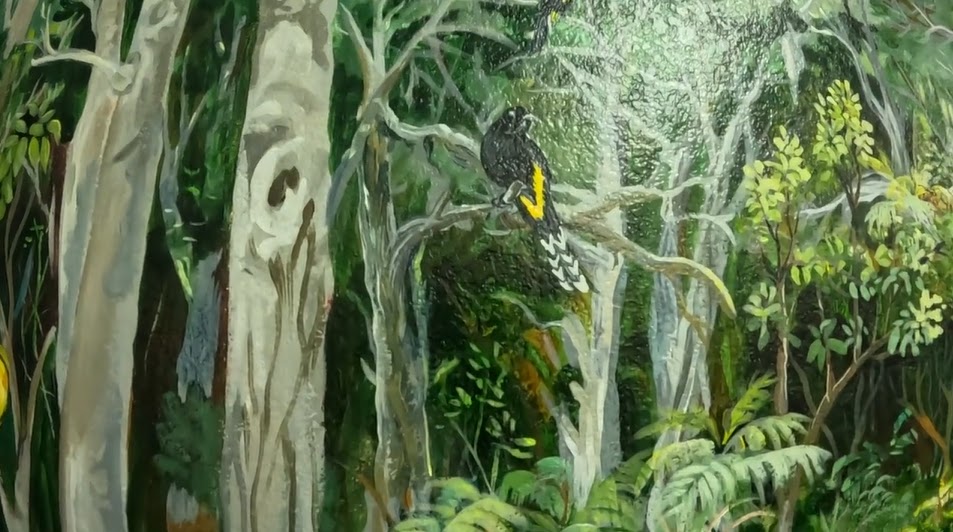
    Once inside the center, taping continues, first in the center’s “keiki corner” surrounded by a floor-to-ceiling mural of forest birds, gifted by local artist Kathleen Kam. “Here on this mural, you can see many of the birds that live across our islands, represented in their native habitats,” Mason explains.
    She and the cameras then move into the library which features the second part of the mural. It’s dedicated to the native Hawaiian crow (ʻAlalā), which viewers will see in real life, once the shades are raised. In addition to ecological education, the virtual field trip also addresses the importance of forest birds and culture.
    Mason said, “To Kānaka Maoli, our native Hawaiian birds are very important to us. They have many roles in the forest as forest engineers. They help to pollinate plants and to spread seeds to regenerate forests.”
    According to Atwood, acceptance and utilization of previously produced virtual field trips has been good, and his team is currently working with the Department of Education to align the virtual field trips with curriculum standards. “We’ve only had our virtual field trips online for a few years and we have something like 70,000 page views. We’ve heard from teachers and students how useful the virtual field trips are. There are clearly places where entire groups of people cannot travel, so this educational tool allows us to provide the next best thing.”

To read comments, add your own, and like this story, see facebook.com/kaucalendar. See upcoming events, print edition and archive at kaunews.com. See 7,500 copies the mail and on stands.

Connie Ritchey checks out the partial eclipse
at Punalu'u Black Sand Beach. Photo by Julia Neal
A SMALL BITE OUT OF THE SUN WAS VISIBLE DURING THE SOLAR ECLIPSE Monday morning,  as seen from Punalu‘u Black Sand Beach. Volcano resident Connie Ritchey, a former ranger at Hawai‘i Volcanoes National Park, manned the post and shared her eclipse glasses with others hoping to see the shadow. 
    She said she recalled the total eclipse in Hawai‘i in July of 1991 with reports of cattle lying down to sleep when the sky went dark. People studying the reaction of marine life durning that eclipse reported the sea creatures hiding among corals and in caves until the sun came back more than 30 years ago.
   Monday's partial eclipse was partially blocked by clouds around the island.

To read comments, add your own, and like this story, see facebook.com/kaucalendar. See upcoming events, print edition and archive at kaunews.com. See 7,500 copies the mail and on stands.

HOKULELE BASKETBALL will hold a golf tournament to raise money to take its ninth graders to Las 
Vegas in July to enter the Jam On It West Coast Championships.
    Anyone who would like to donate or participate may contact Ravel Kaupu Jr 808-217-7243 or Jan Kaeza Penera Email: Kaeza.Hokulele@gmail.com.

UNIVERSITY OF HAWAI‘I COOPERATIVE EXTENSION SERVICE INVITES coffee farmers on Tuesday, April 9 to a live webinar on Coffee-Related Research and Management Updates. Wednesday's presentation and discussion at noon will be about location-specific treatments for Coffee Berry Borer on Hawai'i Island, The speaker is Mielssa Johnson of USDA ARS DKI PBARC. Call Matt at 808-322-0167.