About The Kaʻū Calendar

Thursday, October 17, 2024

Kaʻū News Briefs Oct. 17, 2024


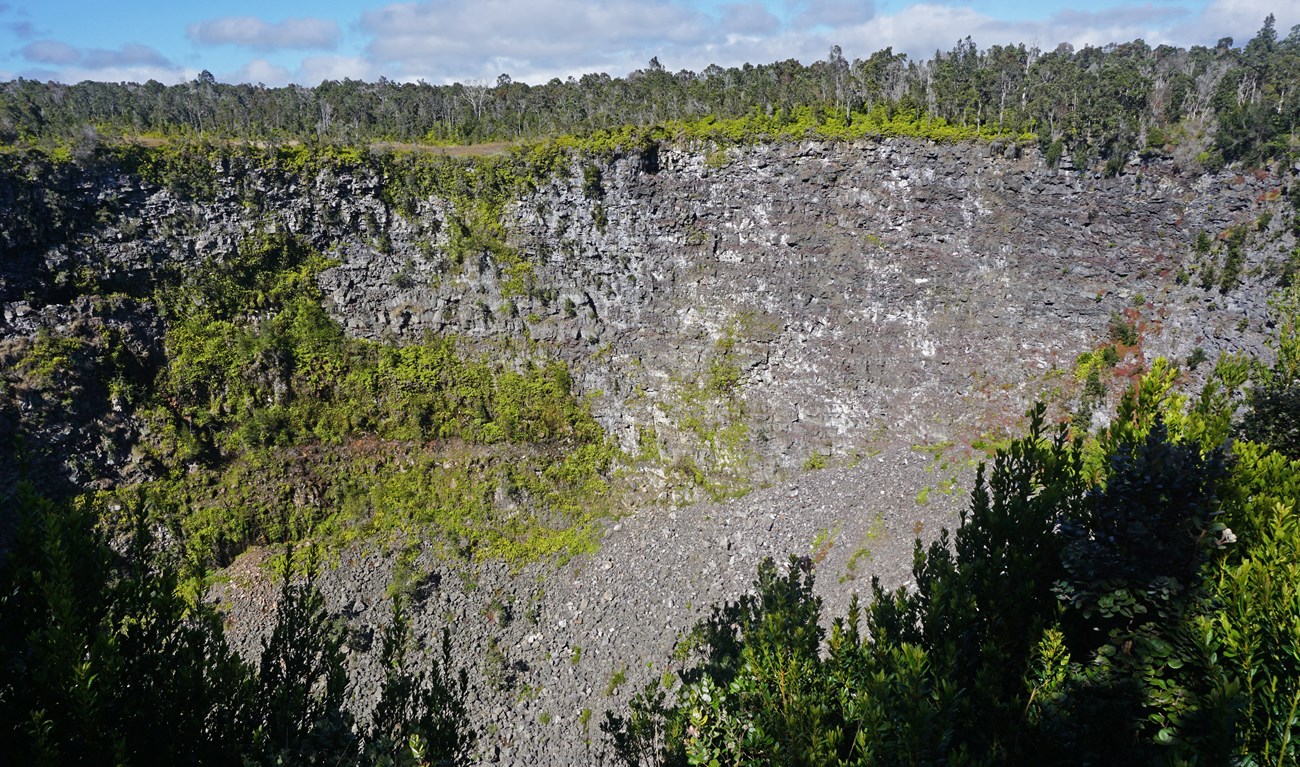
Edge of a forested pit crater
Puhimau Pit Crater in Hawai'i Volcanoes National Park.  NPS Photo by A. LaValle

THE INTENSE SEISMICITY AND GROUND DEFORMATION along the East Rift Zone of Kīlauea in the past couple of months is interpreted to indicate intrusion of magma. This has drawn USGS Hawaiian Volcano scientists and affiliates to write this week's Volcano Watch column about Potential long-term outcomes of recent intrusions in Kilauea East Rift Zone:
    Some of this magma can leak to the surface in eruptions, but there are less likely long-term consequences that have historical analogues. 
     The eruption in and near Nāpau Crater on September 15–20 is an example of a brief eruption in this area. If a longer and larger eruption were to occur, such as at Maunaulu (1969-1974), most lava flows would head south from their vents because of the topography. Some, however, could be trapped within craters, as at Nāpau, partly or completely filling them.

MALAMA 'AINA COMPOSTABLES introduces the public to its Zero Waste business run by Kaʻū High School students through an EPA REO Grant Program. The event is on Saturday, Nov. 2 10:30 a.m. to 2:30 p.m. at the O.K.K. Market in Na'alehu.
    This will be the students' first community collection event focusing on cardboard & Hi-5 resources. "The materials collected will be reused, repurposed and most importantly diverted from the community's landfill," says the statement from the students.
    Participants who contribute will also have the opportunity to win free swag.
    The EPA REO Grant Program is a three year, $1.5 million, youth-led initiative designed to empower students to take an active role in environmental stewardship. Throughout the year, students participate in running a Zero Waste business out of Kaʻū High School, focusing on increasing recycling
rates and reducing waste going into Hawaiʻi's landfill.
    Youth advocates will organize cardboard shredding demos, community outreach and educational presentations throughout the event. There will be a hula performance, games and music provided by a local DJ.
    "Community members are more than welcome to drop off or stay and hangout with us throughout the day."

To read comments, add your own, and like this story, see facebook.com/kaucalendar. See upcoming events, print edition and archive at kaunews.com.

Jennifer Zelko-Schlueter
KU'IKAHI MEDIATION CENTER AND HAWAI'I COUNTY BAR ASSOCIATION invite the public
to their 19th Annual Recognition Dinner and Auction on Sunday, Nov. 17 at Hilo Hawaiian Hotel's Moku'ola Ballroom. Ku'ikahi is giving the 'Peacemaker Award' to Jennifer Zelko-Schlueter, Director of Government and Community Relations at Hawaiian Electric. The HCBA is giving its 'Meritorious Service Award' to the Honorable M. Kanani Laubach, Deputy Chief Judge of the District Court of the Third Circuit.
   The evening kicks off with no-host cocktails, silent auction, and live music at 5 p.m., followed by dinner and program at 6 p.m. The buffet features carved slow roasted prime rib of beef with au jus and creamy horseradish, furikake salmon with teriyaki sauce and wasabi aioli, hoisin glazed roast chicken, grilled shrimp with chimichurri sauce, and vegan tofu katsu. Also served are Caesar salad, penne pasta salad, sautéed seasonal vegetables, steamed rice, dinner rolls, dessert, and iced tea, hot tea, and coffee.
Judge Kanani Laubach

.   Lincoln Ashida emcees the gala event and acts as live auctioneer. Items up for bid in the silent and live auctions include gift certificates for rounds of golf, outdoor excursions, overnight stays, and dining experiences; artwork and gift baskets; fine wines, orchids, and much more.   
    Founded in 1983, Ku'ikahi has been "Finding Solutions, Growing Peace" for 41 years. This fundraiser provides a significant portion of the funds that Ku'ikahi needs to provide free and low-cost dispute prevention and resolution services in East Hawai'i.   "Our mission is to empower people to come together—to talk and to listen, to explore options, and to find their own best solutions," said Ku'ikahi president Shaunda Liu Makaimoku. "Your participation makes this mission a reality. Come celebrate 41 years of peacemaking with us!"
    Tickets are $125 per person (of which $50 is tax deductible) and are available from Ku'ikahi Mediation Center in The Hilo Lagoon Centre at 101 Aupuni Street, Suite PH 1014 B-2. Reserved tables of 8 are available to Platinum, Gold, Silver, and Bronze Sponsors. To purchase tickets or table sponsorships online, use the BUY buttons on https://hawaiimediation.org/recognition2024/. Or contact Shelby at (808) 935-7844 ext. 3 or shelby@hawaiimediation.org.

To read comments, add your own, and like this story, see facebook.com/kaucalendar. See upcoming events, print edition and archive at kaunews.com.


5,000 in the mail, 2,500 on the street.


Wednesday, October 16, 2024

Kaʻū News Briefs Oct. 16, 2024

 Kaʻū Community Development Plan Action Committee voted on Wednesday to send its research to the Windward Planning Commission to consider CDP compliance by the Punalu'u development proposal for a Special Management Area permit. The package to the Planning Commission will also include the response from the developer and all public testimony.
  Photo by Michelle Chacron

PUNALU'U DEVELOPMENT WAS THE MAIN TOPIC OF KAʻŪ COMMUNITY DEVELOPMENT PLAN ACTION COMMITTEE on Wednesday. The group met in Nāʻālehu and voted to send a letter, testimony and other documents to the Windward Planning Commission regarding the rehabilitation and expansion of the resort with accommodations and other development. The developers are seeking a Special Management Area permit designed to protect the shoreline. Its approval is in the hands of Windward Planning Commission and is needed for the project to move forward.
    Action Committee members said that most of the project proposed in the SMA permit application is in compliance with the Kaʻū CDP, which identifies Punalu'u as a resort area. Several members stated they are neither for or against the resort. However, the Action Committee said there are some policies that need work in order to align with the CDP. 
    One is a shoreline study that determines setbacks from development; the last study was in the 1980s. Another is preparing a new Environmental Impact Statement since the one on hand is also many decades old. Another is a CDP policy for developers to provide affordable housing in their project plan. The group also pointed to a policy to prevent the disruption of the view from Hwy 11 to the ocean.
Kaʻū Action Committee members, the public and testifiers
at Wednesday's meeting. Photo from Zoom
     Punalu'u Black Sand Beach, LLC consultant Daryn Arai stressed that the infrastructure at Punalu'u is 50 years old and needs some kind of economic engine to fund its repair. He noted that the proposal for some 230 units of resort development is tiny compared to more than 2,000 units in the past. He contended that the  proposed development, which also has commercial businesses, is the minimum number of units that could fund the repair and upkeep of the water and sewer systems on the property.
    Former County Council member Guy Enriques who grew up at Punalu'u and lives at Punalu'u mauka submitted testimony and urged the Action Committee recommend that the Planning Commission not only follow the CDP but also consider overwhelming opposition to the project at protests and two days of public hearings before the Windward Planning Commission.
     Later in the meeting the Action Committee Vice Chair Hanoa said he listens to the kupuna of the area for direction on Punalu'u and wouldn't be swayed by hundreds or a thousand protesters. He also called non-profits that have preserved and steward land along the coast in Kaʻū the worst thing that has happened, contending they are keeping locals from freely going to the shore except by reservation. He also pointed to jobs that would be created by the resort.
    Most testifiers at the meeting opposed the development, stating that it would change the way of life in Kaʻū, overcrowd the place and damage wildlife and natural resources. A few brought up Hawaiian Kingdom issues and said there are problems with the title to the property.
     See pro and con testimony submitted to the Action Committee in its website records at https://records.hawaiicounty.gov/Weblink/1/fol/88959/Row1.aspx Watch the meetings at the County of Hawai'i's Planning Department Youtube channel at https://www.youtube.com/channel/UCAFoRMb3rfWLQMPd6TAkEGA.

To read comments, add your own, and like this story, see facebook.com/kaucalendar. See upcoming events, print edition and archive at kaunews.com.

HAWAI'I RANKS 15TH IN THE COUNTRY IN POLITICAL ENGAGEMENT, according to a WalletHub study released Wednesday. Top states with the politically engaged are Maryland, Virginia, New Jersey, Oregon, Washington and Montana. The least engaged are Arkansas, Alabama, West Virginia, Oklahoma, Indiana and South Carolina. The Hawai'i study shows that about 44 percent of people 18 to 24 years of age are politically engaged. Those 65 and over are 66.6 percent engaged. By contrast in New Jersey, Wallet Hub reports that 75.3 percent of younger people are engaged politically and 82.6 percent of those over 65 are politically engaged.

Red Flag Warning for wildfires came with
high winds on Wednesday.
    One WalletHub Advisor said, "The strength of the civil society in each state also varies; some states have a variety of nonstate advocacy and interest groups devoted to civic and political engagement, while other states may only have a few."

To read comments, add your own, and like this story, see facebook.com/kaucalendar. See upcoming events, print edition and archive at kaunews.com.

DON'T FORGET THE RISK TO PUBLIC DRINKING WATER SYSTEMS WHEN IT COMES TO RED FLAG WARNINGS FOR WILDFIRES. Should Hawaiian Electric shut down an electric grid because of fire risk, through its Public Safety Power Shutoff program, water pumps that depend on the electric company can stop working in some places.
    The Department of Water Supply (DWS) relies on HECO power to operate wells and booster pumps to distribute water to its customers. The understanding is that a PSPS power outage may last hours to days, depending on weather conditions, location and extent of damage.
    DWS uses backup generators at a limited number of well sites, but these emergency generators cannot fully replicate HECO’s power grid. An extended power outage could diminish or deplete portions of DWS’ water systems and leave customers with low pressure or no water. In order to prevent or delay this scenario from occurring, DWS will likely need to restrict, or ration potable water for fire protection, drinking, cooking, and personal hygiene purposes only.
    Car washing, irrigation, and non-essential uses of water should be suspended until all power and water systems have been returned to normal conditions.
DWS strongly urges its customers and those who depend on a continuous supply of DWS water to review their personal situations and prepare accordingly. Customers should have alternate sources of potable water and enough supply to meet their essential needs during a prolonged power outage that disrupts DWS service.
    Ways to safely store drinking water are listed in the Water Emergency Preparedness guide available under the “Community” drop-down menu option on the Department’s website, www.hawaiidws.org. Future water messages regarding this Red Flag Warning and its potential impact on DWS water customers will be issued by either DWS or the Hawai‘i County Civil Defense Agency.
    See more on Department of Water Supply at https://www.hawaiidws.org/  
    To reach DWS, call (808) 961-8050 during normal business hours, (808) 961-8790 for after-hour emergencies, or email: dws@hawaiidws.org.

faucet
ARBOR DAY FREE GIVEAWAYS WILL BE AT OCEAN VIEW Swap Meet on Saturday, Nov. 2 beginning at 7 a.m. The Swap Meet is on the makai side of Hwy 11 near Malama Market.
To read comments, add your own, and like this story, see facebook.com/kaucalendar. See upcoming events, print edition and archive at kaunews.com.


5,000 in the mail, 2,500 on the street.


Tuesday, October 15, 2024

Kaʻū News Briefs Oct. 15, 2024

May be an image of twilight and horizon
Nights of the Atlas Comet
Comet A3 Tsuchinshan-ATLAS seen over the Pacific Ocean from Chain of Craters Road in Hawaiʻi Volcanoes National Park on Monday evening with Hōkūloa (Venus) to the left. See story in Oct. 13
  Kaʻū News Briefs.  NPS Photo by Janice Wei 

INVASIVE SEAWEEDS ARE REPLACING LIMU IN MANY PLACES IN HAWAI'I, according to a new University of Hawai'i study, which states, "This could have an adverse effect on the seafood we eat to the health of coral reefs." Here is the story from University of Hawai'i News:
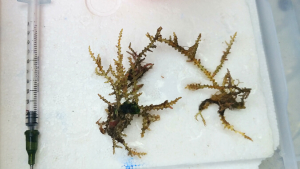
    Botanists from the University of Hawaiʻi recently uncovered key survival strategies used by invasive seaweed species in nearshore ecosystems, potentially explaining their dominance over native Hawaiian limu in certain habitats. Nearshore ecosystems extend up to 300 feet offshore, encompassing the shallow coastal waters where land and ocean environments interact and many marine species live and feed.
    An October 2024 study published in Scientific Reports found that invasive species such as “gorilla ogo” and “spiny seaweed” thrive in areas with submarine groundwater discharge, where daily tidal cycles create extreme salinity (salt level) fluctuations.

large patches of seaweed in the ocean
Invasive gorilla orgo has taken the place of native limu on some reefs in Hawai'i. U.H. photo
    “Understanding how invasive seaweed outcompetes native limu is crucial to furthering our knowledge about reefs and ocean environments,” said Veronica Gibson, a postdoctoral researcher at the UH Mānoa Hawaiʻi Institute of Marine Biology and Heʻeia National Estuarine Research Reserve, and UH Mānoa School of Life Sciences PhD graduate. “These spring-fed coastal areas are unique ecosystems that connect our land use practices directly to ocean health, and what happens to limu—which forms the base of our marine food web—affects everything from the fish we catch to the overall health of our coral reefs.”
closeup of seaweed
Closeup of invasive spiny seaweed. Photo from U.H.

    The research team used advanced plant biology techniques to study how different seaweed species cope with these harsh conditions. Their key method involved measuring how seaweed cells adjust their internal chemistry when exposed to changing salt levels in the water.
    Much like a dried grape swells in water, seaweed cells react to changes in their environment. The scientists found that successful species can quickly change the concentration of dissolved substances inside their cells to match external changes. This ability to regulate internal water pressure is crucial for survival. Seaweed species that can’t adjust quickly enough suffer severe damage—their cells either burst from taking in too much water or shrivel up from losing too much water.

closeup of red seaweed
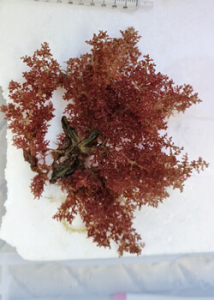
Closeup of native limu maneʻoneʻo. Photo from U.H.

    The invasive species showed remarkable adaptability and developed other survival tactics. Both types showed thinner cell walls in spring-affected areas, while gorilla ogo displayed peak photosynthesis near freshwater springs and developed smaller cells to better handle stress.
    Native species, including limu maneʻoneʻo, were notably absent from spring-influenced areas despite showing similar cellular characteristics to invasive species in offshore environments.
    The findings come as human activity continues to impact watershed systems and submarine groundwater discharge. Submarine groundwater discharge occurs when fresh water from underground aquifers seeps or flows directly into the ocean through the seafloor, creating areas where fresh and saltwater mix near the shore.
    Researchers emphasize the importance of understanding how native species survive in these conditions as changes in water quality and quantity affect nearshore ecosystems, potentially influencing food webs and coral cover. Further research will focus on native limu tolerance and linking findings to watershed management strategies, particularly in areas affected by nutrient pollution from groundwater springs.
    Other authors on the paper are Angelene Dedloff, who earned her bachelor’s degree from the UH Mānoa School of Life Sciences; Kapiʻolani Community College Assistant Professor Lisa Miller; and UH Mānoa School of Life Sciences Professor Celia Smith.
    The Hawaiʻi Institute of Marine Biology is housed in the UH Mānoa School of Ocean and Earth Science and Technology, and the School of Life Sciences is housed in the UH Mānoa College of Natural Sciences.

To read comments, add your own, and like this story, see facebook.com/kaucalendar. See upcoming events, print edition and archive at kaunews.com.

The Kaʻū Calendar News Briefs, Hawaiʻi Island: Kaʻū News Briefs Saturday,  Nov. 11, 2023

NANI O KAHUKU LIVING HISTORY PLAY will be live on Saturday, Oct. 19 at the Kahuku unit of Hawai'i Volcanoes National Park at 11 a.m. The encore of Nani o Kahuku is a first-person living history performance, the script taken from the diary of Hannah Piilani Jones (Nani). She was the daughter of George Jones, owner of Kahuku Ranch in the 1870s. It is a lyrical account of life on the ranch, including day-to-day activities as well as historic visits from Hawaiian royalty.

NIGHT-SKY PHOTOGRAPHER STAN HO presents his work on Saturday, Oct 26 at  9:30 a.m. at the Kahuku Unit of Hawai'i Volcanoes National Park. He is the National Park Arts Foundation's Artist-in-Residence and will present a talk with a PowerPoint of his photography. His month-long residency will culminate with this program featuring his artistic interpretations of the night skies at Volcano and Kahuku.

To read comments, add your own, and like this story, see facebook.com/kaucalendar. See upcoming events, print edition and archive at kaunews.com.


5,000 in the mail, 2,500 on the street.