About The Kaʻū Calendar

Monday, October 21, 2024

Kaʻū News Briefs Oct. 21, 2024


Volcano Skatepark enthusiasts with County Council member Michelle Galimba, Mayor Mitch Roth and Parks & Recreation Director Maurice Messina at last Saturday's reopening at Cooper Center. Photo by Thatcher Moats

REOPENING OF VOLCANO SKATEPARK was celebrated by the community and County of Hawai'i Department of Parks & Recreation on Saturday, Oct. 19. It followed extensive repairs completed in collaboration with a contingent of dedicated volunteers from the Volcano and skateboarding communities.
    Skateboarders, roller skaters, and families joined County of Hawai'i officials and skatepark volunteers at the re-opening event, which featured speakers, a blessing, and a lei untying, marking the official reopening.
    "It's an honor to stand alongside the dedicated community volunteers who put in countless hours to help us make this important resource safe and accessible for everyone once again," said Mayor Mitch Roth. "We understand how valuable these skateparks are in providing our keiki with safe, fun spaces to develop their skills and stay on a positive path. This reopening is a testament to what we can achieve when the
Blessing of the refurbished Volcano Skatepark. Photo by Thatcher Moats
community comes together and works with us to get things done."
    The skatepark, one of eight county skateparks across the island and the only one of wood construction and situated indoors, was closed during the COVID-19 pandemic after the surface of the wooden skating structure deteriorated to the point that it posed considerable safety risks to users.
    As Parks & Recreation explored options to address the skatepark, a group within the Volcano community advocated for rehabilitating the wooden structure and stepped up to support the effort. The Volcano Skatepark Organization established a Friends of the Park agreement with Parks & Recreation and provided expertise and labor, while Parks & Recreation supplied the building materials and general oversight of the restoration project.
    "Working with the Volcano Skatepark Organization was vital to the success of this project," said Maurice Messina, Director of Parks & Recreation. "The volunteers' passion for the sport of skateboarding, combined with their knowledge of skate park construction, allowed us to join together and restore this important community asset. We extend a big 'mahalo' to the Volcano Skatepark Group and all those who supported this endeavor."
    Parks & Recreation plans to continue making improvements to the structure that surrounds the skatepark and hopes that the partnership with the Volcano Skatepark Organization will provide ongoing and timely maintenance of the skatepark to ensure the continued use and enjoyment for skaters.
    The skatepark is at Volcano Park, 19-4030 Wright Road in Volcano. The county park site also includes the Cooper Center facility, a playground, restrooms and other amenities.

Hawai'i County reopened the wooden, indoor Volcano Skatepark at Cooper
Center on Saturday. Photo by Thatcher Moats

A MURDER INVESTIGATION IS ON AT OCEAN VIEW by Hawai‘i Island police. Hawai'i Police Department initiated a second-degree murder investigation after a man with fatal injuries was found inside a residence in the 92-9000 block of Tiki Lane in Hawaii Ocean View Estates on Friday afternoon, Oct. 18.
    Around 1:10 p.m., Ka‘ū patrol officers responded to a residence on Tiki Lane for a report of a deceased man. Upon arrival, police discovered a body of a Caucasian man believed to be in his 50s who had sustained a fatal injury.
    Detectives from the Area II Criminal Investigation Section responded to the scene. After conducting a preliminary investigation, "it was believed that the injuries were suspicious in nature and not accidental," says the HPD statement.
    Efforts are being made to identify the victim who has not yet been positively identified.
Anyone with information relative to this investigation is encouraged to call the department’s non-emergency number at (808) 935-3311. They may also contact Detective Donovan Kohara at (808) 960-3118; or email donovan.kohara@hawaiicounty.gov.
     Citizens who wish to remain anonymous can make an anonymous tip through Crime Stoppers at (808) 961-8300 and be eligible for a reward of up to $1,000. Crime Stoppers does not record any calls or subscribe to caller ID. 

To read comments, add your own, and like this story, see facebook.com/kaucalendar. See upcoming events, print edition and archive at kaunews.com.

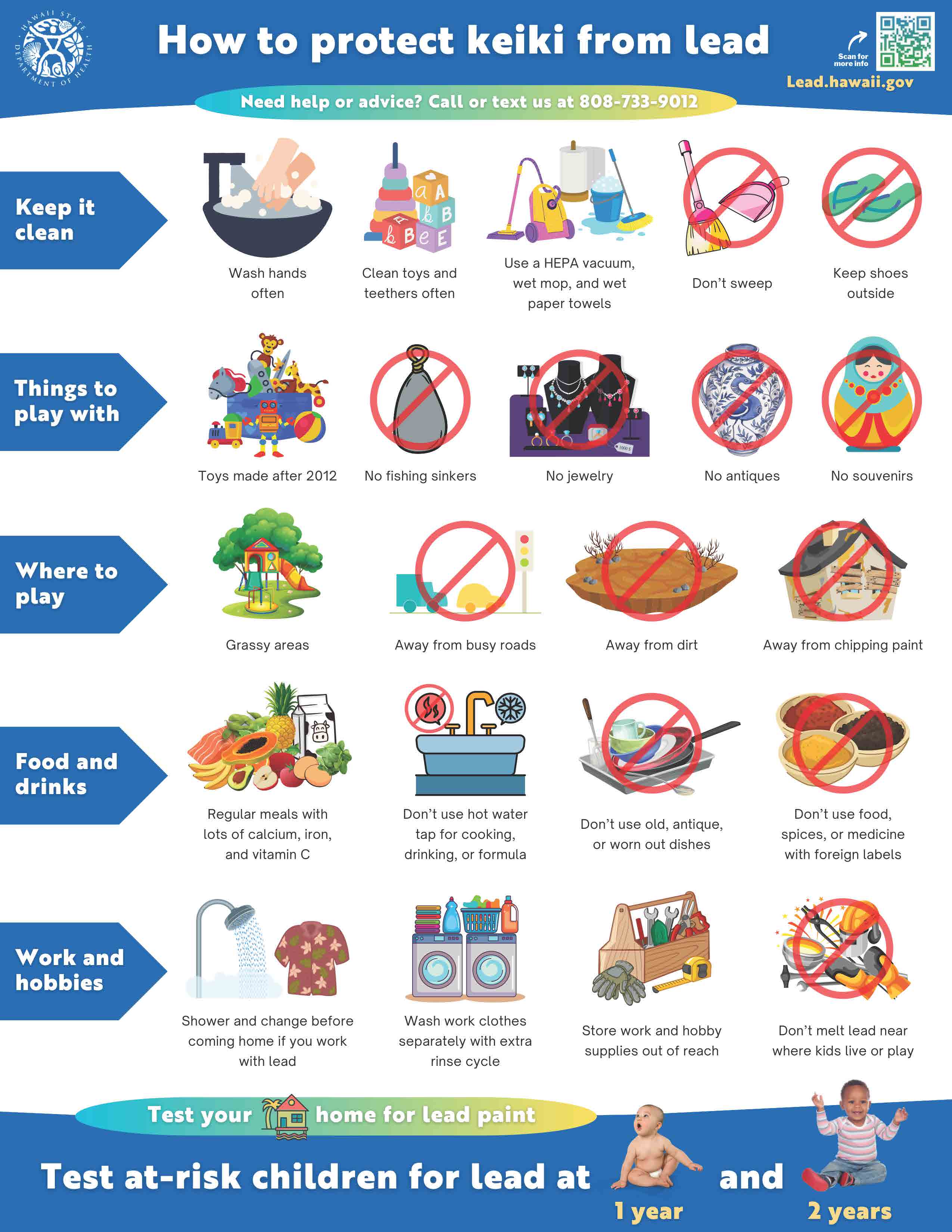
THIS IS NATIONAL LEAD POISONING PREVENTION WEEK, as announced by the state Department of Health. Lead is a toxic metal that is dangerous to health at all ages and there is no safe level of lead in the blood for children. National Lead Poisoning Prevention Week'd theme this year is Bright Futures Begin Lead-Free, with the aim for the public to learn protection from exposure to lead and its serious health effects.
    Lead is often present in the paint of older buildings constructed prior to 1978 and can be found in soil, house dust, old toys, jewelry, antiques, souvenirs, fishing tackle, keys, dishes, food, spices, tobacco products and water. Certain work or hobbies can expose people to lead, which can be brought home on clothes, shoes, hair and other items.
    Department of Health states that public water systems in Hawaiʻi do not historically have lead contamination; however, it is possible for lead to contaminate drinking water through fixtures and piping in older buildings. A collaborative project funded by the U.S. Environmental Protection Agency, the Hawaiʻi Departments of Health, Education and Human Services tested drinking water taps for lead in schools and childcare centers and are continuing work to ensure lead is no longer present in taps that showed five parts per billion lead or higher.
    "Keiki are especially susceptible to the effects of lead exposure because they are still in the developmental stages, which can impact both mental and physical development," said Dr. Ruben Frescas, chief of the DOH Children with Special Health Needs Branch. "They can be exposed to sources of lead in their everyday environment at home and anywhere they play or receive care. With young children who like to play on the ground and put their hands or other objects in their mouths, lead exposure can place these younger keiki at an even higher risk for swallowing lead."

    In children, lead can cause learning and behavior problems that can result in long-term negative effects throughout adulthood like increased delinquency, lower educational attainment and lower income. In pregnant people, lead can damage a developing baby's nervous system and has the potential to cause miscarriages and stillbirths. Children tend to show signs of severe lead toxicity at lower exposure levels than adults. However, most children with lead in their blood have no obvious symptoms.
    In adults, exposure to high levels of lead may cause serious health problems like anemia, kidney and brain damage, infertility in men and women, cancer, nerve and hearing damage, and heart disease. According to the Centers for Disease Control and Prevention, the risk of dying from a heart attack or stroke is two to five times higher among people with higher blood lead levels, which is comparable to the increased risk from smoking, high cholesterol and hypertension.
    The DOH Hawaiʻi Childhood Lead Poisoning Prevention Program receives funding from the CDC to help the community prevent children from being exposed to lead; to identify children already exposed to lead so the source can be removed; and to link families to recommended services like Early Intervention and in-home residential investigations.
Soil, water and paint samples for lead testing can to be sent to a laboratory. The state Department of Health recommends a
  National Lead Laboratory Accredited Laboratory for paint and soil and a Hawaii State Department of Health Certified Lab
 for drinking water. Call the lab ahead of time for collection methods, mailing guidelines, and documentation.

    According to the CDC and American Academy of Pediatrics, children should have a risk assessment for lead exposure at well-child visits and children at increased risk should get a simple blood test for lead. Testing children at 1 and 2 years of age or later if never tested before is required and free with Med-QUEST, the Hawaiʻi Medicaid program. It is okay to test at other times if families or child's doctor are concerned about lead exposure.
    "Lead poisoning is completely preventable and the best way to protect children is to keep them away from lead in the environment and get screened," Frescas said. "Taking a few simple steps today can make a big difference tomorrow and we are here to help our families take those steps."

To read comments, add your own, and like this story, see facebook.com/kaucalendar. See upcoming events, print edition and archive at kaunews.com.

May be a graphic of text

May be an image of text

Sunday, October 20, 2024

Kaʻū News Briefs Oct. 20, 2024

  
A new development plan for hotel, condos and retail at Discovery Harbour may be activated early next year following a ruling
favoring investors in Third Circuit Court. Discovery Harbour Community Association says it will appeal.
Image from South Point Investors is from the May 19, 2015 article in The Ka'u Calendar News Briefs.

AN APPEAL TO HAWAI'I'S INTERMEDIATE COURT OF APPEALS TO REVERSE A RULING FAVORING A DEVELOPMENT PLAN FOR DISCOVERY HARBOUR is expected to be filed by Discovery Harbour Community Association, according to a Hawai'i Tribune-Herald article in Sunday's edition. John Burnett reported that DCHA plans to appeal Hilo Circuit Court Judge Henry Nakamoto's summary judgement issued early this month. The judge's ruling favors South Point Investment Group's contention that the Association cannot restrict use of its land to constructing only residences, nor prevent commercial development there.
     The article refers to a story in The Ka'u Calendar's May 2015 edition, in which South Point Investment's Gary McMickle described a plan for a small hotel, condominiums and shopping center, along with renovation of the Discovery Harbour Golf Course. The investment group owns the 174-acre golf course, 11.7 acres zoned conservation, and 18.23 acres zoned agriculture and describes the two smaller properties as "the commercial lots," says the Tribune-Herald story.       .
   The Tribune-Herald reports that a brief filed with South Point Investment's lawsuit against DCHA  "claimed that aggressive opposition to SPIG’s plans by the DHCA caused the Ka‘u Community Development Plan steering committee to recommend 'low density urban' zoning for the development instead of its preferred designation as a 'retreat resort' area. 
     “The DHCA’s interference in the Kaʻū CDP process has delayed development of the commercial lots and repair of the golf course lots, has cost SPIG a favorable land use designation, and has caused it to incur significant other monetary damages.” 
    In addition to issuing a summary judgement in favor of the developer, Nakamoto ordered the Community Association to come up with $5,385.42 toward the developer's legal expenses. The developer earlier asked the judge for $260,570.73 for attorney fees and costs.
Discovery Harbour Golf Course would be renovated, along with construction of a small hotel, condominiums and retail, according to South Point Investment Group. Photo by Cort Gariepy
 
    Discovery Harbour Community Association website says that after filing the appeal and completion of briefing, a three-judge panel from Intermediate Court of Appeals "will be assigned to decide the case. Our attorneys expect that it may take two to four years for the ICA to issue a ruling.”
     In the meantime, according to the Tribune-Herald story, the developer said he may begin pursuing a plan in early 2025. McMickle told journalist Burnett: “We’re looking at mid-density zoning, about 500 units, and the hotel would probably be between 50 and 75 units.”
     See the May 19, 2015 story in The Ka'u Calendar Newsbriefs at http://kaunewsbriefs.blogspot.com/2015_05_19_archive.html
     Board members of Discovery Harbour Community Association are Sue Bartlow, Nels Eklund, Karen Morrow, Rich Morrow, Erik Ott and Dave Tate.

To read comments, add your own, and like this story, see facebook.com/kaucalendar. See upcoming events, print edition and archive at kaunews.com.

A BILL TO ALLOW VENDING ON COUNTY ROADSIDES IS UP FOR SIGNATURE BY MAYOR MITCH ROTH, following its passage by the County Council last week. Council member Michelle Galimba, who represents all of Kaʻū into Volcano and South Kona, voted for the measure.
     With approval of the Mayor, the Director of the Department of Public Works would grant $50 annual special activity permits to business licensees along county roads. Applicants would have to show capacity to handle any waste management and other concerns put forth by the County Council, Public Works, Hawai'i Police Department and other agencies. The Council would determine the roads where vending would be allowed.
    County roadside vendors without the required permit kept on site for inspection could be fined $250.00.
Exempt from the permitting would be fundraisers by non profit and educational groups raising money for their programs.
      Grassroots Institute of Hawai'i issued a statement saying that allowing more roadside vending would support local families and entrepreneurs, giving them a chance to benefit not only from sales to locals but to tourists.
   The only council member opposing the bill was Rebecca Villegas from Kona, advocating for safer vending places than the roadsides.

To read comments, add your own, and like this story, see facebook.com/kaucalendar. See upcoming events, print edition and archive at kaunews.com.

May be an image of text

Saturday, October 19, 2024

Kaʻū News Briefs Oct. 19, 2024

Opelu fisherman Chuck Kealoha Leslie discusses netmaking and fishing in a new Ike Kaiāulu video. DLNR image
 
FOUR NEW VIDEOS ON THE CONNECTION OF NATURAL RESOURCES TO COMMUNITIES have been released by the state Department of Land & Natural Resources. Called Ike Kaiāulu - Community Knowledge video series, they were produced by education teams within the DLNR Division of Forestry & Wildlife and Division of Aquatic Resources. The program "seeks to tap into an understanding of this rich history of caring for ‘āina and kai," says the DLNR statement.
    The series premiered in 2023 with four videos sharing community knowledge related to limu, wood carving, lāʻau lapaʻau (medicinal plant use), and caring for special places.
Kumu Hula Mele Kahalepuna Chun shares family history with Hawaiian featherwork and its relationship to the health of forest birds in new Ike Kaiāulu video. DLNR image
    The new videos feature experts with knowledge to share across a variety of practices. While sharing their mana'o, interviewees express common themes, talking about  knowledge coming from parents, grandparents and other kūpuna and the importance of passing on that knowledge to younger generations.
    ʻŌpelu fisherman Chuck Kealoha Leslie discusses his knowledge of net making and his hopes for the future of fishing in Hawaiʻi. He shares that he wants keiki to know how we did things in the old ways, and then they can make it their own. He adds, “If they want to do fishing, make fishing their life and make it joyful.”    
    Kumu Hulu Mele Kahalepuna Chun explores her family’s history with Hawaiian featherwork and its relationship to the health of forest birds in Hawaiʻi. She says that passing along the knowledge provided by her tūtū and her mother was not a job, but a kuleana. “What I want to say to our keiki is to make sure it lives. Just holomua: keep it going.” Chun adds that her tūtū was often asked, “Isn’t this a dying art?" She’d say no, "not as long as I can help it.”
Hiʻilei Kawelo shares  experiences with fishponds connection to mauka and makai ecosystem health in new Ike Kaiāulu video
DLNR image


   Paepae o Heʻeia Executive Director Hiʻilei Kawelo shares her experiences with loko iʻa (fishponds) and their connection to mauka and makai ecosystem health. Reflecting on endurance of cultural practices in communities, she says, “The relationships we have within the ahupuaʻa, that’s what makes the magic happen.” 
    Dr. Kawika Winter, Director of the Heʻeia National Estuarine Research Reserve, discusses biocultural restoration and the importance of centering indigenous ways of thinking in ecosystem management. He articulates his views of cultural practice as part of management and life in Hawaiʻi, saying, “We’ve been here a long time, we’re going to continue being here a long time.” On the importance of sharing experience and knowledge, he adds, “So many of the elders who came before me have said that Hawaiʻi has the answers that will help heal the world.”
    All videos are available on the DLNR website. See ʻIke Kaiāulu videos: http://dlnr.hawaii.gov/dofaw/education/videos
Dr. Kawika Winter discusses biocultural restoration and centering indigenous ways of thinking in ecosystem management in a new Ike Kaiāulu videoDLNR image

To read comments, add your own, and like this story, see facebook.com/kaucalendar. See upcoming events, print edition and archive at kaunews.com.


Extremely bright shooting star cluster over Maunakea, Hawaii on July 11,  2024
 Sunday and Monday will be the peak of the Orionid Metero Shower with more than 20 shooting stars
 an hour between midnight and dawn. A meteor shower seen in this photo was
 captured this summer on Maunakea. Image from NAOJ & AsahiShimbun

MORE THAN 20 SHOOTING STARS PER HOUR ARE EXPECTED to be seen in Ka'u's clear night skies on Sunday and Monday with the peaking of the Orionid Meteor Shower. The best time to view is between midnight and dawn as the shooting stars zip in front the the Orion Constellation.The meteors will be fainter than they would be if they were not traveling by at the same time as the full moon.
    According to The Planetary Society, "The Orionid meteor shower is caused by debris from Halley's
Comet, also known as comet 1P/Halley. The comet's 76-year orbit brings it close enough to Earth to have been seen in the night skies for centuries. It last passed close to Earth in 1986 and will return in 2061."
    "Meteors are also known as shooting stars, but they aren't actually stars at all. Meteors are streaks of light in the sky caused by dust and small rocks burning up as they hit Earth's atmosphere at very high speeds — tens of kilometers per second. These small particles create bright streaks of light you can see from the ground at night. In general, the bigger the piece of space dust, the brighter the meteor. See more at planetery.org.

To read comments, add your own, and like this story, see facebook.com/kaucalendar. See upcoming events, print edition and archive at kaunews.com.

MOST GENERAL ELECTION BALLOTS COMING BY MAIL HAVE ARRIVED TO KAʻŪ  RESIDENTS. To count, they must be received by 7 p.m. on Nov. 5 General Election Day. 
    Registration is still available online at any time or in-person at a voter service center. See https://www.elections.hawaiicounty.gov/voter-registration. For an Absentee Ballot, deadline to request a ballot be sent to an alternate address is Oct. 29.
    Some candidates in the Primary Election won their positions that serve  Kaʻū and beyond. County Prosecuting Attorney Kelden Waltjen won the Primary for a four-year term. County Council member Michelle Galimba won the Primary for a two-year term. Kai Kahele won the Primary for the Office of Hawaiian Affairs Trustee seat for Hawai'i four year term.
    On General Election ballots. Kaʻū voters select from the following candidates:
    For Mayor, incumbent Mitch Roth is challenged by Kimo Alameda for the four-year term.
    For state Senate, incumbent Dru Kanuha is challenged by Republican Kurt Sullivan for the four-year term.
    For state House of Representatives, Democrat Jeanne Kapela is challenged by Republican Ashley Oyama and Libertarian Frederick Fogel.
    For Office of Hawaiian Affairs Trustees at large, Keli'i Akina is challenged by Lei Ahu Isa.
    For U.S. Senator representing Hawai'i, Democrat Mazie Hirono is challenged by Republican Bob McDermott, Green Party's Emma Pohlman and We The People Party Shelby Pikachu Billionaire.
    For U.S. House representing rural Hawai'i, incumbent Jill Tokuda is challenged by Republican Steve Bond, Libertarian Arron Toman and Nonpartisan Randall Kelly Meyer.
    For U.S. President, current Vice President Kamala Harris, a Democrat, faces former President Donald Trump, a Republican, and other candidates for the four-year term.
    For U.S. Vice-President, Tim Waltz, a Democrat, faces JD Vance, a Republican and other candidates.
    The other Parties on the ballot for U.S. President and VP are Green Party with Jill Stein for President and Rudolph Ware for VP, Libertarian with Chase Oliver for President and Mike ter Maztt for VP, Party for Socialism and Liberation with Claudia De La Cruz for President and Karina Garcia for VP, and Solidarity Party with Peter Sonski for President and Lauren Onak for VP.
    Two State of Hawai'i Constitutional Amendments are on the ballot. One, which seeks to protect same-sex marriage, asks: “Shall the state constitution be amended to repeal the legislature’s authority to reserve marriage to opposite-sex couples?” A second proposed constitutional amendment would make the selection process of district court judges the same as other judges.
    Three Hawai'i County Charter Amendments are on the ballot. One asks, "Shall the Hawai'i County Charter be amended to provide that any vacancy on the County Council that occurs or exists after a person was duly elected to fill that seat for the upcoming Council term shall be filled by that duly elected successor for the remainder of the unexpired term?" The second asks, "Shall the Hawai'i County Charter be amended to require the Mayor to appoint department heads within 30 days of the start of each mayoral term and within 60 days for any vacancy in office that occurs during the mayoral term?" The third asks, "Shall the Hawai'i County Charter be amended to increase the term length for members of the Cost of Government Commission from 11 to 22 months and extend the deadline for the Commission to submit its report from 11 months after appointment to 20 months after appointment?"

To read comments, add your own, and like this story, see facebook.com/kaucalendar. See upcoming events, print edition and archive at kaunews.com.