About The Kaʻū Calendar

Saturday, October 26, 2024

Kaʻū News Briefs Oct. 26, 2024

The group Huliau with teachers, composers and performers at Saturday's Ho'olaulea at Volcano School of the Arts & Sciences.
  Photo by Sara Espaniola
Making ti lei at the Ho'olaulea on Saturday.
Photo by Sara Espaniola
THE FIRST VOLCANO SCHOOL OF THE ARTS & SCIENCES HO'OLAULEA celebrated in the rain and shine on Saturday, with people, music, food and fun. Hundreds came to the campus during the statewide flood watch with umbrellas and spirit. 
    The Ho'olaulea honored the mission of the preKindergarten through 12th grade Hawai'i focused public charter school, which services students who are 53 percent from low-income families and 47 percent Native Hawaiian, most of them from Ocean View through Kaʻū into Puna, and all living within five districts on Hawai'i Island.
    The school's welcoming words are "Kulia. 'Ohana. Aloha." It serves about 225 students and has been educating for 15 years.
    The school is on two campuses within Volcano Village, one at 99-128 Old Volcano Road and the Keakealani Campus at 19-4024 Haunani Road where new facilities are being developed.
    Volcano School of the Arts & Sciences puts forth a philosophy that "education is more meaningful to
Learning about care for foundling and orphaned animals.
Photo by Sara Espaniola
children when presented in an environment that is familiar, that relates to their home life, and that allows for discovery-based experiential learning." That approach was on hand at the Ho'olaulea with Hawaiian music, cultural experiences and activities connected to nature. 
    The School's mission is to provide an environment in which students are: "Learning through Volcano’s unique natural and cultural resources to become creative global citizens."
    In addition to day program with the small school of choice capping classes at 18 to 20 students, VSAS offers after school enrichment programs in such experiences as cooking, sewing, dance, art and languages. Among the employment positions at the school are teachers, educational assistants, bus drivers, cafeteria helpers and custodians
    Principal is Kalima Kinney. Vice Principal is Chris King-Gates. The school also has Social Worker Kim Miller, Business Manager Jessica Rohyas, and SASA & Enrollment chief Kaye Nagamine.
    The Governing Board Chair is Rob Hamnett and Friends of the Volcano School of Arts & Sciences is led by Ian Cole.
     See much more with opportunities to enroll, work and volunteer at  https://www.volcanoschool.net/
Wide community support in attendance at Volcano School of Arts & Sciences Ho'olauela. Photo by Sara Espaniola


To read comments, add your own, and like this story, see facebook.com/kaucalendar. See upcoming events, print edition and archive at kaunews.com.

KAUAHA'AO CONGREGATIONAL CHURCH in Wai'ohinu, Kaʻū, will host a fundraising Fall Bazaar on Saturday, Nov. 30 from 9 a.m. to 1p.m. on the church campus. The church is located on the corner of Mamalahoa Hwy, Kamaoa Road and Pinao Street just above the Wong Yuen Store.
    Individuals, schools, clubs, sports/athletic groups are invited to be vendors at the "flea market" that will be located on the church lawn. The charge for a 12' X 12' space is $10. Vendors are responsible for bringing their own tent, table and chairs, and if power is needed, a generator. Vendors can sell anything except hot foods/plate lunches.
   Vendors must submit a Vendor Application with the $10 fee by Sat, Nov 23. To request a Vendor Application, and for more information text Delana Phillips at 850-463-7544 or email Treasurer.kauahaaochurch@gmail.com.
    Church members will be selling Laulau plate lunches and Kalua pork bowls, drinks, and baked goods, and will conduct a Craft and Rummage sale.

To read comments, add your own, and like this story, see facebook.com/kaucalendar. See upcoming events, print edition and archive at kaunews.com.

Last Trojan Game of the 2024 Season
Playing in the rain during Kaʻū High's last Trojan football game of the season on Saturday,
Trojans fought hard at home against Honoka'a Dragons but came up short 26 - 68.
Photo by Kamamalu Kauwe

Trojan leaps high in contest with Honoka'a on Saturday. Photo by Kamamalu Kauwe


Kaʻū Trojan cheerleading team on the field for the last football game of the season on Saturday.
Photo by Kamamalu Kauwe


Friday, October 25, 2024

Kaʻū News Briefs Oct. 25, 2024

Lei at the dedication of grounds for the Hawaiian immersion school in Kaʻū at Waiʻōhinu. An auction and fundraising
 campaign are underway. Photo by Cadence Feeley
FUNDRAISING & ONLINE AUCTION BEGIN FOR HAWAIIAN IMMERSION SCHOOL: An online auction and fundraising campaign for $100,000 have been launched to create the first Hawaiian immersion school in Kaʻū in modern times. Supporters can learn more and make direct donations to by going to http://bit.ly/nakmfoundation. The school is called Nā ʻĀʻaliʻi Kū Makani 'O Kaʻū. The non-profit is Nā ʻAʻaliʻi Kū Makani Foundation. The location is in Waiʻōhinu at the old Shirakawa Hotel and former Lorilei Shirakawa hula studio and grounds.
    Chief organizer of the immersion school development, Raylene Auli'i Fujikawa Moses, noted that the campus is provided by the Gary and Apolonia Stice ʻOhana Foundation, a 501C3 nonprofit. "They have since the beginning supported our vision and offered a space to be utilized for our mission." She said the $100,000 to be raised is planned for facilities compliance, curriculum development, staffing needs, keiki meals and program insurance.
    The school is set to begin with a Pre-K program for ages three to four, expanding into additional grades each year. Fujikawa Moses explained the vision for the immersion school.
    "A Hawaiian Immersion school is an educational institution where students learn primarily in the Hawaiian language, promoting both language fluency and cultural knowledge. These schools are part of a broader movement to revive and sustain Hawaiian language and culture after it faced significant decline in the 20th century. Students are immersed in Hawaiian from a young age, which enables them to think, speak, and interact in the language while also learning core subjects like math, science, and history through a Hawaiian cultural lens.
    "Hawaiian Immersion programs are spread across the Hawaiian islands, with schools such as Ke Kula 'o Nāwahīokalaniʻōpuʻu, Ke Kula Kaiapuni ʻo Ānuenue, and Ke Kula Kaiapuni ʻo Maui, among them, providing education from early childhood through high school.
    "These programs are integral in cultivating a strong sense of identity and cultural pride, as well as preparing students for future success.Graduates of Hawaiian Immersion schools often go on to pursue higher education, including colleges in Hawai'i and on the mainland. Many find meaningful work in areas such as education, community leadership, conservation, and the arts. Their bilingual proficiency, coupled with a deep cultural foundation, uniquely positions them to contribute to fields that benefit from an understanding of Hawaiian values and traditions. This immersion experience not only strengthens the community but also sustains the Hawaiian language and culture for future generations."
Interested members of the public can visit the Kaʻū campus on Wednesdays at 10 a.m. and join in fundraising activities, including auction and operation of a thrift store. Fujikawa Moses said, "Welina mai! We accept and appreciate any kākoʻo!"
    Supporters can go online to see the growing number of auction items at http://app.galabid.com/naaaliikumakani/. The auction itself will accept bids Nov. 22-25. Additional auction items are being accepted and already include a $500 stay at Mauna Kea Resort in an ocean facing room with breakfast; a Premium Golf Package for Four at Kohanaiki, two koa canoe paddles valued at $500, one of them a Hoe Wa'a for recreational paddling and the other a Steering Blade; a $300 Gift Card to the Hana Hou Hilo eclectic clothing and gift store; an Aly Dove Photo Session, a Sunrise or Sunset Photoshoot with Moments by Sara Louise; gift baskets from Punalu'u Bake Shop; bags of Rusty's Hawaiian Coffee, selections from KeAliʻi Malu Plants and Things; and many more items.
    Purchased items can be picked up locally at the school on Dec. 7 from 11 a.m. to 4 p.m. The organizers also invite everyone to join in for a celebration featuring Hawaiian music, plate lunches, and a visit to the thrift store, which is also a place to give and buy items to fundraise for the Hawaiian immersion school.The address is 95-6039 Māmalahoa Hwy. Nāʻālehu, Hī 96772.
   A statement from the immersion school's lead parent fundraising advocates Cadence Feeley and Wai'ala Ahn says, "These donations are just a few of the many from our community, and we welcome additional contributions to help us reach our goal."
   Those who would like to make tax-deductible donations can make them to the current fiscal sponsor ʻIewe Hānau o ka ʻĀina and designate the donation for Nā ʻAʻaliʻi Kū Makani Foundation, which is registered and incorporated in Hawai'i. Contact nakmfoundation@gmail.com or visit bit.ly/nakmfoundation.

To read comments, add your own, and like this story, see facebook.com/kaucalendar. See upcoming events, print edition and archive at kaunews.com.

SATURDAY IS THE FIRST HO'OLAULE'A FOR VOLCANO SCHOOL OF THE ARTS & Sciences. It's from 10 a.m. - 3 p.m. 
    Entertainment will include: Uncle Dane and Friends, Huliau, VSAS Kanikapila Club and Jade Malia. 
    'Ono Food will include: Ricoʻs Tacos, Pizza ʻOno, Tubular Treats, Bubble Waffles, Lillipops, Krispy Kreme and  Moloka'i Hot Bread.  
    Game Booths will include: Dunk Tank, Bottle Ring Toss, Putt Putt Golf Maze, Nene Pond, Bouncy House and  Football Toss.
    There will be Silent Auctions, Rummage Sale, Lei Making, Pūʻohe Making, Lauhala weaving, Plant Sale, Bake Sale and Face Painting. 
    All booths and games will accept scripts instead of cash or other payments.

To read comments, add your own, and like this story, see facebook.com/kaucalendar. See upcoming events, print edition and archive at kaunews.com.

'UKULELE LESSONS FOLLOWED BY KANIKAPILA begin weekly this Saturday, Oct. 26 at 3 p.m. in the Ocean View Community Center downstairs. Lessons and Kanikapila will occur throughout the winter, says 'ukulele teacher Scott Taylor. Beginner lessons start at 3 p.m. followed by a Kanikapila around 3:30 p.m. until 5 p.m. All ages are welcome, but Taylor encourages children to bring their parent(s) or an adult friend. He also recommends bringing 'ukulele and a music stand to hold the paper songbooks. Donations are accepted for the song printing costs. Taylor says there in an emphasis not only on learning 'ukulele but also having fun.
Taylor, who summers in Anchorage, Alaska, is a member of the Alaskan Jumping Fleas Society, devoted to playing 'ukulele, with a number of the members performing at public venues. Taylor is the gig coordinator.
    OV Community Center is located at 92-8924 Leilani Circle. Taylor is a 14-year ukulele player and teacher. For more info, call him at 907-350-7849. This activity is a branch of the 'ukulele lessons hosted by Woodley White of Na'alehu.

Scott Taylor, front right, announces beginning 'ukulele classes followed by kanikapila on Saturdays at Ocean View Community Center at 3 p.m. Photo from Scott Taylor


To read comments, add your own, and like this story, see facebook.com/kaucalendar. See upcoming events, print edition and archive at kaunews.com.

THE LAST FOOTBALL GAME OF THE YEAR for the  Kaʻū High Trojans is Saturday, Oct. 26 on home field starting at 1 p.m. Trojans again face Honoka'a, which took the win 64-32 on Sept. 20.


Thursday, October 24, 2024

Kaʻū News Briefs Oct. 24, 2024

Together With Veterans group waves signs to raise awareness about suicides among veterans.
Photo from Kehau Kalani

Malama Our Veterans. Photo from Kehau Kalani
PREVENTING VETERANS FROM COMMITTING SUICIDE is a mission of Together With Veterans group of  Kaʻū  residents who hold signs on the 22nd of every month at 11 a.m. "Twenty-two is too many," said a sign held on Wednesday along Kamani Street next to posters with the 988 help line. The 22 refers to the campaign declaring 22 as the daily number of veteran suicides across the country. According to the Veterans Administration, approximately 8,030 veterans kill themselves every year, more than 5,540 of whom are 50 or older. The rate is about twice the rate of civilian suicides.
    Volunteer Fire Captain Ron Ebert, himself a vet of the Vietnam War, joined the sign waving and said soldiers weren't welcomed home in a positive way during the Vietnam era and it was something he personally had to deal with. Ebert became d public servant and pastor.
    More recent statistics show that more than 30 percent of those returning from war are afflicted with Post Traumatic Stress Syndrome, which can be an important factor in suicide risk.
    Together With Veterans organization is based in Pahala. Its facebook also notes a sign waving in Hilo on bayfront across from King Kamehameha's statue each 22nd of the month. Together With Veterans facebook says: "This in-person sign waving event aims to raise awareness and provide support to those who have served our country. Together, we can make a difference. Let's stand up against this critical issue and create a community that supports our heroes. Don't miss out on this opportunity to show your solidarity and contribute to a cause that truly matters. Mark your calendars for the 22nd of every month and join us for an hour filled with compassion, understanding, and hope!"

May be an image of 2 people and text

To read comments, add your own, and like this story, see facebook.com/kaucalendar. See upcoming events, print edition and archive at kaunews.com.

VOLCANO WATCH: EAST RIFT ZONE WAS BUSY PLACE IN THE 1960S. That's the focus of this week's column by USGS Hawaiian Volcano Observatory scientists and affiliates: The recent eruption at Nāpau Crater was the first on Kīlauea's middle East Rift Zone (ERZ) in six years. We often remember the Pu'u'ō'ō and Maunaulu eruptions when thinking about the middle East Rift Zone, but many lesser-known eruptions occurred on the rift zone in the past 200 years, including 11 during the 1960s!
    While there were several summit eruptions at Kīlauea during the 60s, including one that lasted more than 8 months, eruptions along the ERZ (mainly in the upper and middle portions) were much more frequent. Before the 1955 lower ERZ eruption, the last eruption on the ERZ had taken place near Makaopuhi Crater in 1923.Following the 1960 Kapoho eruption and three quick summit eruptions in the first half of 1961, a new short-lived ERZ eruption began in late-September of that year. Over the course of two days, 13 small flows erupted from vents that were spread over 21 km (13 mi) of the rift zone from Nāpau crater to within 4 km (2.5 mi) of the area where Leilani Estates Subdivision was later built. The largest lava flows from this eruption were located at the lower end of the fissure system closest to Pāhoa and fed by lava fountains 90 to 120 meters (300–400 ft) tall.
Color photograph of active lava pouring into a crater
A fissure on the northwestern crater wall of Makauopuhi Crater on East Rift Zone of Kīlauea sent lava cascading into the 
deepest portion of the crater, forming a lava lake. USGS photo by E. Endo, March 6, 1965, along the old Chain of Craters Road.
  Two additional 2-day-long eruptions took place in December 1962 and August 1963 just uprift of Nāpau Crater. Both eruptions were very small and their lava flows only covered a combined total of 0.16 square km or about 40 acres of land, a quarter of the size of the 1961 flows.
    Less than two months later, a new eruption began along a 13 km (8 mi) stretch of the rift zone starting at Nāpau Crater and migrating east, downrift, to Kalalua Crater. The single day eruption in October 1963 was much larger than the three previous eruptions, though it covered only 3.24 square km (800 acres). Fissures opened on the rim and floor of Nāpau Crater, sending lava cascades down the crater wall and flows covered about 75 percent of the crater floor.
    In 1965, short-lived eruptions in March and December again opened on the ERZ—uprift of Nāpau Crater. After this time, there was a nearly two-year hiatus in eruptions at Kīlauea volcano until a new eruption started at the summit in late-1967, lasting 251 days.
    After that, activity once again shifted back to the ERZ with eruptions in the upper and middle ERZ in August and October of 1968. Associated seismicity and severe ground deformation were recorded at the summit and eruption sites.
    On the first day of the August 1968 eruption, fissures opened across the floor and walls of Hi'iaka Crater, the westernmost eruption site on the upper ERZ during the 1960s. A small lava lake drowned some of the fissures on the crater floor, where much of the ponded lava drained back. Additional fissures opened to the east over the next few days, but only produced small amounts of lava.
    After a little over a month, the October eruption was preceded by tremor and shallow earthquakes in the summit and upper ERZ. The eruption, which lasted 15 days, was the longest in this sequence of middle ERZ eruptions, and spanned from Kānenuiohamo to about where Pu'u'ō'ō cone is now. The eruption shifted along the fissure system but repeatedly focused in and around Nāpau Crater, often flooding the crater floor and sending lava cascading down the crater walls.

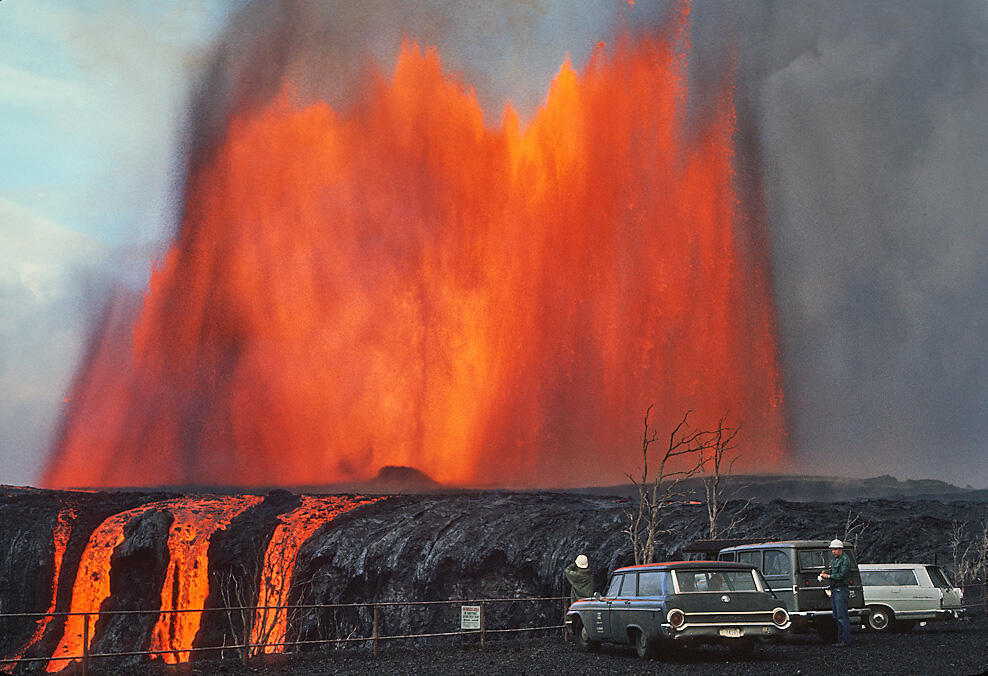
Wide fountain of episode12, the last high fountain of the Mauna Ulu...

December 30, 1969 lava fountain that reached 1,000 feet high spilled into Alo'i Crater. USGS photo 

    As the decade came to an end, Kīlauea put on a spectacular show with the start of the Maunaulu eruption on May 24, 1969. A series of high fountaining events reaching 540 m (1770 ft), were some of the highest recorded at Kīlauea. Lava flows from this eruption extended south to the ocean, covered large portions of the old Chain of Craters Road, and was (at the time) the largest and longest ERZ eruption in over 2000 years before it came to an end in 1974.
    As we continue into this new and dynamic era at Kīlauea, it is relevant to look at the past behaviors of the volcano for clues into what the future may hold. The ERZ is known to be quite active, but only time will tell where the volcano erupts next.

Volcano Activity Updates
    Kīlauea is not erupting. Its USGS Volcano Alert level is ADVISORY. Over the past week, earthquake rates beneath Kīlauea summit and upper-to-middle East Rift Zone have nearly doubled. About 50 earthquakes were located beneath the summit, and about 190 were located in the upper-to-middle East Rift Zone. Ground deformation rates remain low following the September 15-20 middle East Rift Zone eruption, but continue to show that magma is moving at a low rate from the summit to the middle East Rift Zone. Future intrusive episodes and eruptions could occur with continued magma supply. The most recent measurement of sulfur dioxide (SO2) emission rate at the summit was 60 tonnes per day on September 17, 2024, and SO2 emissions were not detected at downwind of the eruption site on Monday, September 23.
    Mauna Loa is not erupting. Its USGS Volcano Alert Level is at NORMAL. No earthquakes were reported felt in the Hawaiian Islands during the past week.
    HVO continues to closely monitor Kīlauea and Mauna Loa.
    Visit HVO's website for past Volcano Watch articles, Kīlauea and Mauna Loa updates, volcano photos, maps, recent earthquake information, and more. Email questions to askHVO@usgs.gov.

To read comments, add your own, and like this story, see facebook.com/kaucalendar. See upcoming events, print edition and archive at kaunews.com.
May be a graphic of text