About The Kaʻū Calendar

Showing posts sorted by date for query par. Sort by relevance Show all posts

Tuesday, January 14, 2025

Kaʻū News Briefs Jan. 14, 2025

HAWAIIAN IMMERSION SCHOOL ORGANIZERS IN WAI'ŌHINU kicked off their Kū Hāweo Project
Conch blows for Kū Hāweo Project
Photo by Raylene Auli'i Fujikawa Moses
recently with a workshop for 14 keiki ages 0-5, and 11 mākua (parents) and kūpuna (elders). It will continue on the second and fourth Saturdays of the month.
    The immersion school organizing group Ke Kula Nā ʻĀʻaliʻi Kū Makani ʻO Kaʻū named the session Kū Hāweo Family Child Interaction Learning Program and said it demonstrated "the community’s commitment to revitalizing ʻōlelo Hawaiʻi and cultural traditions. 
    The workshop, held in Wai‘ōhinu, focused on fostering family collaboration, deepening cultural connections, and integrating ʻōlelo Hawaiʻi (Hawaiian language) into everyday life. Through interactive activities, storytelling, and cultural practices, participants began building a foundation for early learning readiness and a shared connection to the rich heritage of Kaʻū."
   Immersion school organizer and Alaka'i Raylene Auli'i Fujikawa Moses said, “We are excited and encouraged by the turnout and enthusiasm from our ʻohana. This is the first step toward creating a space where families can grow together in their knowledge of ʻōlelo Hawaiʻi and our cultural traditions.”
    She said that the Kū Hāweo program is a cornerstone of the school’s mission to establish a Hawaiian immersion preschool. 
    For more information about Kū Hāweo and how to get involved, contact kauhawaiianimmersion@gmail.com. Moses said, "Mahalo piha to all who participated and supported this important initiative. Together, we are strengthening the roots of our community and ensuring a thriving future for the next generation."
    The immersion school venue in Wai‘ōhinu is provided by the Gary & Apolonia Stice 'Ohana. See sticeohana.org.
Hawaiian immersion school beginnings at Wai‘ōhinu. Photo by Raylene Auli'i Fujikawa Moses


OPENING DAY OF THE 2025 HAWAI'I LEGISLATURE is Wednesday, with ceremonies at the state Capitol involving Kaʻū's state Senate member and Majority Leader Dru Kanuha and House of Representatives member Jeanne Kapela. They are both Democrats and their party leader is Derek Turbin.
Turbin noted that Wednesday will mark the first day a woman becomes Hawai'i Speaker of the House. She is Nadine K. Nakamura, a Neighbor Islander from Kaua'i. 
Photo of Dru Mamo Kanuha
Senate Majority leader Dru Kanuha represents Kaʻū and beyond. 

    Turbin called Opening Day "a unique opportunity for our residents across the state to meet their lawmakers and share their priorities for the session ahead. In past years, hundreds of people have gathered at the Capitol to advance initiatives ranging from rebuilding the Lāhainā community to addressing affordable housing to advancing human rights. During the event, the House and Senate will deliver opening remarks and set the tone for the next four months. After the Pule and ceremonial roll-call, representatives will return to their offices to greet 
their constituents."
    Turbin said the Democratic mission includes the aim to "protect our diverse communities." To connect with legislators, visit https://www.capitol.hawaii.gov/. To learn more about Opening Day and to engage in the legislative process, visit the Public Access Room at https://lrb.hawaii.gov/par/. This resource offers
free seminars, workshops, and tools to help participate, track legislation, and offer testimony.
    To learn more about Senate member Kanuha and to communicate with him, visit

Kapela Jeanne 5143.jpg
House member Jeanne Kapela represents Kaʻū and beyond.

https://www.capitol.hawaii.gov/legislature/memberpage.aspx?member=184&year=2025. Kanuha is Majority Leader and serves on the Senate Committees of Education, Housing, Triansportaion & Culture & the Arts and Ways & Means.
To learn more about House member Kapela representing Ka'u and to communicate with her, visit https://www.repkapela.com/. Kapela serves on the Education, Higher Education and Labor Committees.
To learn more about the Democratic Party and its platform, visit https://www.hawaiidemocrats.org/. To learn more about the Republican Party and its platform, visit https://thehawaiirepublicanparty.com/. To learn more about the Green Party and its platform, visit https://www.greenpartyofhawaii.org/.
To register to vote, visit https://olvr.hawaii.gov/

To read comments, add your own, and like this story, see facebook.com/kaucalendar. See upcoming events, print edition and archive at kaunews.com.


Thursday, December 05, 2024

Kaʻū News Briefs Dec. 5, 2024

Trustee swearing-in wide
New Office of Hawaiian Affairs Board members sworn in on Wednesday are Kaua'i & Ni'ihau Trustee Dan Ahuna, Molokaʻi & Lānaʻi Trustee Luana Alapa, At-Large Trustee Keliʻi Akina, and Board Chair and Hawai'i Island Trustee Kai Kahele.
Photo from OHA

KAI KAHELE WAS ELECTED CHAIR of the Office of Hawaiian Affairs Board of Trustees on Wednesday. Kahele succeeds Trustee Carmen “Hulu” Lindsey who served for the past four years. The board and administration recognized and thanked Lindsey for her service.
    Kahele said, “I am both humbled and honored that my fellow trustees have placed their trust and confidence in me to lead the board. I look forward to leading transparently and in collaboration with the board, staff, community and our beneficiaries. Together, we at OHA will commit our efforts to improving the lives of our Native Hawaiian beneficiaries with the energy and passion our people deserve.”    
Photo: Kai Kahele
Kai Kahele, who formerly represented Kaʻū and
all of rural Hawai'i in the U.S. Congress, is the
new Chair of Office of Hawaiian Affairs Trustees.
   The OHA statement says that Kahele, who recently won the election for Hawai'i Island Trustee, is a Native Hawaiian from Miloliʻi, South Kona. He graduated from Hilo High School in 1992, attended Hawaiʻi Community College and UH-Hilo. Kahele earned a BS in Education from UH Mānoa, where he balanced life as an NCAA Division-I student-athlete and UH Rainbow Warriors Men’s Volleyball Team member. Kahele also earned a MS in Strategic Studies from the U.S. Army War College this past summer. Kahele is a combat veteran, pilot, and commissioned officer in the Hawaiʻi Air National Guard, U.S. Air Force. He is also a commercial pilot for Hawaiian Airlines.
    In 2016, Gov. David Ige appointed Kahele to the Hawaiʻi State Senate for District 1 following the unexpected death of his father, the late Sen. Gil Kahele. During his tenure as a state senator, Kahele served as the Majority Whip, Majority Floor Leader, and Chair of the Committees on Higher Education and Water & Land.
    In 2020, he was elected to represent Hawaiʻi’s 2nd Congressional District in Washington, D.C., in the 117th Congress where he represented Kaʻū and the rest of rural Hawai'i.
    As the trustee representing Hawaiʻi Island, Kahele resides in Hilo with his wife Maria and their daughters.
    “This is an exciting time for the agency, and I look forward to working with Chair Kahele and the entire board addressing the challenges within our Hawaiian communities as well as seizing innovative and transformational opportunities to better serve our beneficiaries,” said Stacy Kealohalani Ferreira, OHA Ka Pouhana/Chief Executive Officer.
    Learn more about OHA at https://www.oha.org/
Governor Josh Green with a child, checking the child's temperature with a healthcare professional to the right of the Governor.
Lt. Governor, Josh Green, Md. led a mission to vaccinate people in Samoa following a measles outbreak that he blames partially on RFK, Jr.'s pushback on vaccines. Green opposes RFK's appointment to lead the federal Department of Health & Human Services. Photo from Team Green

GOV. JOSH GREEN, MD IS DOUBLING DOWN ON HIS OPPOSITION TO TRUMP NOMINEE ROBERT F. KENNEDY, JR.'s appointment to lead the federal Department of Health & Human Services. Green points to Kennedy's approach toward vaccinations. The nomination requires U.S. Senate approval.     On Thursday, the Green Team issued a reminder saying, "Five years ago today, while serving as Hawai'i's Lt. Governor, Josh led an emergency medical mission of 75 doctors and nurses from Hawai'i to fight a devastating measles epidemic in Samoa." Green is a medical doctor who practiced in Kaʻū after completing his residency.
     The Green Team states, "After receiving a call for aid from the Samoan Minister of Health, Josh quickly assembled a team of healthcare professionals and lined up the private donors and community support needed to fund the mission of compassion and aloha."
    Hawaiian Airlines, Par Hawaii, and Fiji Airways stepped in to fund travel and fuel, while organizations like the Health Care Association of Hawai'i rallied to provide essential medical supplies.
    The Green Team notes that "In just 48 hours, the medical team from Hawai'i delivered 37,000 vaccinations across the island nation, raising Samoa's national vaccination rate to 90 percent and saving countless lives."
    Green says, "It was a feat of human effort I've never seen before." The mission to Samoa in December 2019 also " demonstrated the power of collaboration, compassion, and swift action in the face of crisis," says the Green Team statement. It says that the "tragedy was preventable — anti-vaccine misinformation spread in Samoa by RFK Jr. and others left too many children unvaccinated, allowing a highly contagious virus to spread rapidly across the island nation."

Gov. Green is also a doctor. Here's why he thinks RFK, Jr. 'could doom us'
This photo of Robert Kennedy, Jr. is posted on Gov. Josh Green's facebook with a television interview
of Green laying out his reasons for opposing Kennedy's appointment to lead the Dept. Health & Human Services.
    Green says that "spreading anti-vaccine misinformation in Samoa cost the lives of 83 people, mostly children, and thousands of preventable cases of measles. This kind of rhetoric is reckless, irresponsible, and dangerous — and puts everyone's children at risk."
    The Green Team statement says that "Since the measles epidemic in Samoa five years ago, Josh has continued to advocate for science-based responses to disease outbreaks and to fight against anti-vaccine misinformation, including the recent nomination of Robert F. Kennedy Jr. to head the U.S. Department of Health and Human Services."
    Green says,"Vaccination programs are one of the greatest public health achievements in human history. They protect our communities, especially the most vulnerable among us. Samoa's epidemic showed the 
heartbreaking cost of neglecting these programs, and it's a lesson we cannot afford to ignore."
    According to a report published this year in Scientific American, vaccines have saved over 150 million lives over the past 50 years and have cut infant mortality by 40 percent worldwide. Green says, "RFK Jr. has claimed that, 'There's no vaccine that is safe and effective.' That statement is utterly false and has no basis in science. His nomination to lead the Department of Health and Human Services is deeply alarming — our nation's health policies must be guided by science and a commitment to protecting lives, not by conspiracy theories that put children's lives at risk," states the Governor.
    "As we remember the compassion and aloha of the Samoa emergency mission, let's also commit to protecting the progress we've made in public health. Vaccination programs around the world save millions of lives every year, and we need leaders who will champion these efforts, not undermine them. Thank you for standing with us to build a healthier, safer future for our state, our country, and our neighbors around the world," says Green.
Trojan Girls battled with 
Kamehameha on Thursday.
Photo by Julia Neal

To read comments, add your own, and like this story, see facebook.com/kaucalendar. See upcoming events, print edition and archive at kaunews.com.

KAʻŪ TROJAN GIRLS PUT UP A GOOD FIGHT AGAINST KAMEHAMEHA GIRLS BASKETBALL TEAM on Thursday evening. With Trojan starting point guard out sick and freshman and sophomore JV players joining in, "we battled it out pretty good," said Coach Troy Gacayan. Trojans went to the locker room at the half with a lead of 19-16.
The lead went back and forth between Trojans and Warriors throughout the game with the win going to Kamehameha with 39 and Kaʻū with 35.
"We will continue to work hard and improve. We want to represent Kaʻū to the best that we can," said the coach. "I hope for a better result should we face them again in the playoffs."
The game was held at Herkes Kaʻū District Gym.

To read comments, add your own, and like this story, see facebook.com/kaucalendar. See upcoming events, print edition and archive at kaunews.com.


Saturday, November 30, 2024

Kaʻū News Briefs Nov. 30, 2024

County Council member Michelle
Galimba invites the public to ceremonies
on Monday.
A PUBLIC INVITATION FROM KAʻŪ COUNCIL MEMBER MICHELLE GALIMBA TO SWEARING IN CEREMONIES on MONDAY, Dec. 2 says, "Our office would like to extend a warm invitation to attend the Inauguration ceremonies for the Mayor, Prosecuting Attorney, and County Council members."
    The event is a noon at Outrigger Keauhou Resort, 78-128 Ehukai Street, Kailua-Kona. "All are welcome to attend!" says her message. 
    Galimba also noted several grant opportunities open or opening up in early December. The County Department of Research & Developmentʻs Impact program has opened with a deadline of Jan. 8. The intent of the grant program is to support research, programs, or projects that positively impact the areas of agriculture and food systems, business and industry development, community well-being, energy, film and creative industries, and regenerative tourism, within Hawaiʻi Island communities. 
     See more information on the County 's Impact grant at
https://www.rd.hawaiicounty.gov/funding-grant-
resources/impact-grants. Call 808-961-8366.
    The County Councilʻs Waiwai grants are also open with a submission deadline of Jan. 31. The purpose of these County of Hawai‘i Nonprofit Grants-in-Aid is to support qualified nonprofit organizations to carry out programs or services that yield direct benefits to the public and accomplish public purposes within the County of Hawai‘i. Each organization is permitted to submit a total of two applications. Each application is limited to a request of up to $50,000.
See https:/haiicounty.gov/Forms/NPGrantApplication.
    Also available is the second round of the Expanding Agroforestry Project grant program, co-managed in Hawai'i by The Nature Conservancy and the Ulu Cooperative. See https://ulu.coop/eap

To read comments, add your own, and like this story, see facebook.com/kaucalendar. See upcoming events, print edition and archive at kaunews.com.

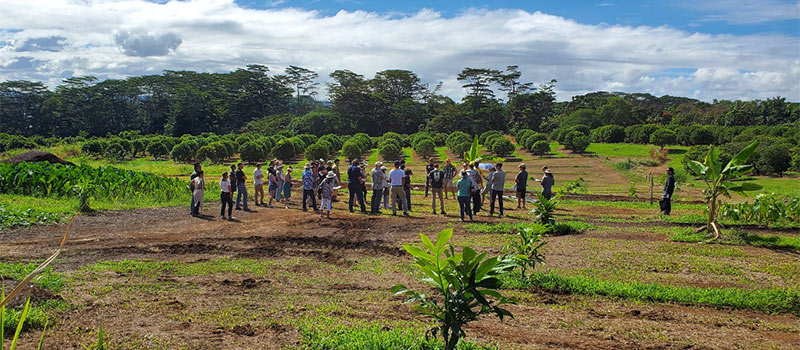
Planting ulu is one of the possible elements of an agroforestry plan. Funding is possible through the Expanding Agroforestry Project, managed in Hawai'i by The Nature Conservancy and the Ulu Cooperative. Photo from Ulu Cooperative

THE EXPANDING AGROFORESTRY PROJECT, co-managed by The Nature Conservancy and the Ulu Cooperative throughout Hawai'i, is open for applications, with the first round deadline Dec. 31.
    The program is funded through the USDA’s Partnerships for Climate-Smart Commodities initiative
Food from trees and plants on the ground grow
together in agroforestry. Photo from Ulu Coop
    In 2022, the USDA announced more than $3.1 billion in funding for 141 projects, including $60 million for this national agroforestry project. The overarching project goal is to add 30,000 new acres of agroforestry across 30 states while creating a network of demonstration sites. The project is also prioritizing a portion of funds to help producers from under-served populations.
    TNC, which is responsible for grant administration, has selected the Hawaiʻi ʻUlu Co-op to be its lead partner managing projects in the Hawaiʻi region. There are five other regions on the Continental U.S. which each have their own lead partner helping to expand financing and develop markets for agroforestry commodities.
    An in formational Webinar held on Friday can be viewed at:
https://us02web.zoom.us/rec/componentpage\action=viewdetailpage&sharelevel=meeting&useWhichPasswd=meeting&clusterId=us02&componentName=need-password&meetingId=ubF8L4PE7Sf4S8-Td1Lf7SXqBH8BvXcYvuiZWwEcapptVFFhKz1QzvDeeNbK6w.uT0Jvl9VydoO5UCF&originRequestUrl=https%3A%2F%Use code q.doy3Mi.

Agroforestry is distinguished from monocropping. It has a variety of trees and accompanying plants.
Photo from the Ulu Cooperative

To read comments, add your own, and like this story, see facebook.com/kaucalendar. See upcoming events, print edition and archive at kaunews.com.

THE WINTER SHOWCASE AT KAʻŪ HIGH & PĀHALA ELEMENTARY SCHOOL will be held Wednesday, Dec. 11 from 9:15 a.m. to 12:25 p.m. Program Coordinator Jennifer Makuakāne said, "Weʻre excited to announce the return of our 2nd Annual K-12 Winter Showcase here at Kaʻū High Pāhala Elementary School! Please join us as our students proudly present their work, projects and

achievements across all grade levels."
Here is the schedule: From 9:15 a.m. - 9:45.a.m., check in at Herkes Kaʻū District Gym Multipurpose Room. From 9:45 a.m. - 11:35 a.m,. visit Grade 7-12 Showcase Classrooms. From 11:35 a.m. - 12:25 p.m., visit K-6 Showcase Classrooms.
Makuakāne shared that the Showcase Learning Intentions are to:
Provide students an opportunity to practice their presentation skills and demonstrate their learning.
Create opportunities for students to share their class projects with other students, community partners, and family.
Build pride students, school, and community by showcasing student and school projects done in collaboration with the community such as project-based learning, technology integration, and other real-world projects.
Practice and prepare for Capstone presentations in grades 6, 8, and 12.
To RSVP, complete the sign-up form by Monday, Dec. 9 at: bit.l.y/24SSCOM. The school encourages its community partners and members to extend the invitation to three or more individuals to attend the Showcase. Contact Makuakāne at (808) 313-4141.

To read comments, add your own, and like this story, see facebook.com/kaucalendar. See upcoming events, print edition and archive at kaunews.com.

VOLCANO WATCH: WHAT SOUNDS THE AUTOMATED ALARMS AT HVO? That's the focus of
this week's column written by USGS Hawaiian Volcano Observatory scientists and affiliates:
    The USGS Hawaiian Volcano Observatory (HVO) keeps its eyes on active volcanoes in many ways. While old fashioned eyes and a notebook are used when field teams are near a volcano, modern volcano observatories also utilize rapidly collected data and computers to support monitoring.
Because it can be very expensive to have scientists watch the volcano data streams on a 24-hour basis, HVO computers are ‘trained’ to look for activity and alert when the volcano is changing or becoming active. They look at a wide array of observations including seismic (ground shaking), infrasound data (air pressure), ground deformation, as well as camera image assessments.
    As the data from these systems enter a computer, they can be assessed as close to the time of collection as possible. If an observation is unusual, the computer can send a message to make a scientist aware at any time of the day or night.
    At the core of many alarm systems is an often-simple computer program which looks for a change in energy from shaking of a seismometer or a burst of sound on an acoustic sensor. If the sensor is usually quiet and then the burst of energy occurs, then this can be detected by the computer which can send an automated message to a scientist. This type of energy burst detector is called a short-term average/long-term average (STA/LTA) detector.

Color plots showing infrasound data
Example plots of STA/LTA alarm on infrasound data for four possible alarm scenarios.
 A shows detection of a real eruption, B shows a false detection of non-volcanic change,
 C shows failure to detect a real eruption amid noisy data, and D shows no
 detection of any event of interest. USGS images

   During eruptions, changes in the air pressure are recorded on sound detecting sensors (like microphones), called an infrasound or acoustic array. The figure shows how a successful detection of an eruption might work using infrasound data and how the system may fail to detect an eruption.
    The first image (A) shows an eruption that creates pressure changes recorded by the sensor. The detection (marked by a red arrow) would be easy to determine using an STA/LTA method, discussed above and shown as the grey and red bar at the bottom of panel A. The long-term average (grey bar) is a period before the eruption and the short-term average (red bar) shows when the eruption energy is strong. In this case, the STA is much bigger than the LTA and we can set the computer to send a message when this specific condition occurs.
    If we next consider the same sensor which has detected another burst (B), but this burst came from a non-eruption source (say a car, a helicopter or another event away from our volcano). In this case, the volcano scientist might be alerted by an event that wasn’t volcanic (a false detection). Next, we show a cartoon example where we have introduced wind noise (C) into the same eruption recorded in (A). In this case, the wind would be so strong that the eruption can only just be seen in the data by the naked eye but may not be visible to the computer’s STA/LTA detector. In the final example wind noise was added to the example which may have been a car or helicopter but not an eruption (D); in this case the non-eruption can only barely be seen in the data and was not detected by the STA/LTA detector.
    The cartoon figures show four possible outcomes that can be used to assess how good an alarming system performs. They include: 1) detection of a real eruption (A), 2) a false detection of non-volcanic change (B), 3) failure to detect a real eruption (C) and, 4) not detecting any event of interest (D).
    These four examples show how HVO scientists can assess the performance of our alarm systems to improve detection of volcanic events and minimize the detection of noise or other activity. The four examples coincide with the concepts of test conditions for alarms using the terms: true-positive (A), false-positive (B), false-negative (C) and true-negative (D). A good alarm system should include true-positives (volcanic events) and true negatives (non-volcanic events) and try to minimize false-positives and false-negatives. Too many false alerts equate to unnecessary loss of sleep during quiet periods for a volcano. In summary, alarm systems are an important and evolving part of HVO operations and are an example of how computers and technology are incorporated in monitoring.

To read comments, add your own, and like this story, see facebook.com/kaucalendar. See upcoming events, print edition and archive at kaunews.com.

Volcano Activity Updates: Kīlauea is not erupting. Its USGS Volcano Alert level is ADVISORY.
   Over the past week, earthquake rates beneath Kīlauea summit and upper East Rift Zone were more than double that of the previous week. About 100 earthquakes were located beneath the summit, and about 226 were located in the upper East Rift Zone. Earthquake rates beneath the middle East Rift Zone were on par with the previous week. Ground deformation rates in the summit region showed increased inflation over the past week, while ground deformation rates near the September 15-20 middle East Rift Zone eruption site have slowed. Future intrusive episodes and eruptions could occur with continued magma supply.
    Mauna Loa is not erupting. Its USGS Volcano Alert Level is at NORMAL.
    Three earthquakes were reported felt in the Hawaiian Islands during the past week: a M3.1 earthquake 6 km (3 mi) SSW of Volcano at 1 km (1 mi) depth on Nov. 27 at 2:19 p.m. HST, a M3.5 earthquake 75 km (46 mi) ENE of Honomū at 32 km (20 mi) depth on Nov. 27 at 12:29 a.m. HST, a M3.1 earthquake 2 km (1 mi) SSW of Pāhala at 30 km (18 mi) depth on Nov. 22 at 2:02 p.m. HST.
    HVO continues to closely monitor Kīlauea and Mauna Loa.
    Visit HVO’s website for past Volcano Watch articles, Kīlauea and Mauna Loa updates, volcano photos, maps, recent earthquake information, and more. Email questions to askHVO@usgs.gov.

To read comments, add your own, and like this story, see facebook.com/kaucalendar. See upcoming events, print edition and archive at kaunews.com.


Friday, November 01, 2024

Kaʻū News Briefs Nov.1, 2024

Kalani Meinecke, shown here at an earlier presentation on local history, will join in the cultural festival this Saturday and the health festival at Ke Ola Pu‘uhonua grounds in Nā‘ālehu  Photo by Julia Neal

KALANI MEINECKE WILL JOIN THE HO'OKUPU HULA NO KAʻŪ CULTURAL FESTIVAL on Saturday and the health fair on Sunday to share mo'olelo of Kaʻū, says the event organizer Kumu Debbie Ryder. Meinecke is a retired professor at Windward Community College and is known as an Educational Cultural Historical Consultant. Ryder said his great grand uncle was Willie Meinecke who opened the first general store in Wai‘ōhinu in the 1880's. He was known as not only a resident but a historian of Wai‘ōhinu.
    In addition to Meinecke, this Saturday, will be hula, musical performers and cultural practitioners. Ryder said hālau are coming from afar and near and that the headliner singer will be Ku‘uipo Kumukahi. Also playing is the musical group He Mea Hou, led by Victor Chock.
    The free event begins at 9 a.m. at Ke Ola Pu‘uhonua grounds in Nā‘ālehu, with Pule and Ho‘okupu, with Ku‘uipo Kumukahi at 10 a.m. She is followed by:
    Hālau Kaleo a Keahialapalapa with Kumu Hula Naoho Kanahele, great granddaughter of Aunty Edith Kanakaole;
    Hālau Na Pua O Uluhaimalama with Kumu Hula Emery Acerat, whose ʻūniki is from the late Ray Fonseca;
No photo description available.
Hālau Kaleo a Keahialapalapa with Kumu Hula Naoho Kanahele performs on Saturday.
Photo from Debbie Ryder

    Hālau Hula ‘O Leionalani with Kumu Hula Debbie Ryder whose ʻūniki is from the late Loea George Lanakilakeikiahiali‘i Naope;
    Ho‘omaika‘i Hula Studio with Kumu Hula Shona LamHo, an O‘ahu Hula sister of Debbie Ryder; and
    Hālauauolaokalani with Kumu Hula Moses Kaho‘okele Crabbe.
    Cultural practitioner demonstrations include: Net Making with Uncle Chucky Leslie of Nāpō‘opo‘o;
    Among cultural practices will be poi pounding and demonstrating with Bobbie Pahia from Maui and Kawehi Ryder of Pāhala; and Medicinal Awa (Kava) with Todd Reilly.
    There will also be food and vendor booths. The Saturday festival is followed by a free Kūlia I Ka Nu‘u Health Fair from 10 a.m. to 2 p.m. on Sunday at the same location, sponsored by Hawaiian Music Perpetuation Society. It includes La‘au lapa‘au, health screening, food demonstrations, resource provider demonstrations mele and hula.

To read comments, add your own, and like this story, see facebook.com/kaucalendar. See upcoming events, print edition and archive at kaunews.com.

   
Borehole tiltmeter being lowered into the casing of a ten foot deep hole. USGS Photo

TILTING TOWARDS LAVA: HOW TILTMETERS MONITOR VOLCANO ACTIVITY. That's the focus of this week's Volcano Watch by USGS Hawaiian Volcano Observatory scientists and affiliates:
    Over the past century, technological advancements have vastly improved volcano monitoring. One key innovation was the introduction of modern borehole tiltmeters, devices that measure very small changes in the inclination of the volcano’s surface.
    Borehole tiltmeters have been used by the USGS Hawaiian Volcano Observatory (HVO) since the early 1970s and have since become an essential part of HVO’s volcano monitoring program. An older style of instrument called a “water tube tiltmeter” goes back even farther to the 1950s. Today the modern tiltmeter network on the Island of Hawaiʻi forms part of a larger array of monitoring tools, including seismic stations, GPS receivers, gas sensors, and webcam/satellite imagery. Together, these tools help scientists keep a close eye on the changing behaviors at volcanoes that may lead to eruptions.
    A tiltmeter is a sensitive instrument designed to detect very slight changes in deformation of the ground. They are installed around volcanoes to monitor changes in the Earth’s surface caused by magma moving underground. These movements often precede eruptions, as pressure from magma pushes against the surrounding rock, causing the surface to bulge or shift slightly.
Photo showing releveling maintenance being conducted on an analog tiltmeter located near Uēkahuna bluff at the
summit of Kīlauea, within Hawaiʻi Volcanoes National Park. USGS image by M. Warren

    Imagine a carpenter’s level laid on the ground at Kīlauea, oriented radially away from Kaluapele (the summit caldera). As magma enters the magma reservoir beneath the cand the volcano inflates, the end of the carpenter’s level closest to the caldera is raised upwards, and the bubble in the level moves inward and upward. Tiltmeters work in much the same way, only with much higher precision. HVO tiltmeters detect changes as small as five nanoradians—that’s less than one millionth of a degree—or the equivalent the Uēkahuna bluff being raised in elevation about the thickness of a human hair relative to the center of Kaluapele. This level of precision makes them invaluable for tracking subtle changes in volcanic activity and providing early warnings to scientists.More than a dozen borehole tiltmeters are strategically installed on Kīlauea and Mauna Loa at key locations across the volcano summits and calderas. These areas are of particular interest because they are most likely to experience significant ground deformation during periods of volcanic unrest and before an eruption onset.These tiltmeters operate continuously and produce one data point every 60 seconds, transmitting data in near real-time to HVO. This data is critical for early detection of volcanic activity. For example, when magma begins to rise toward the surface, it can cause noticeable tilting of the ground, which is recorded by the tiltmeters. By analyzing multiple monitoring datasets, scientists can determine where magma is moving and whether an eruption may be imminent.
On the right, a tiltmeter is ready for installation in a shallow borehole. On the left, the tiltmeter is located at the bottom of a 3 to 4 m (10 to 15 ft borehole lined with a metal casing. The tiltmeter is surrounded by sand to secure it within the borehole so that it does not touch the casing. USGS photos
    Borehole tiltmeters need routine maintenance including changing batteries and upgrading the radio telemetry used to send the data back to HVO. Each tiltmeter also has a limited range of tilt over which it can accurately record deformation. For example, our analog tiltmeters, such as the instrument at Uēkahuna bluff at the summit of Kīlauea, need to be manually leveled in their boreholes if deformation exceeds 300 microradians. Then, the tiltmeter will need time to “settle” from the physical disturbance before the data can be used quantitively—although they remain qualitatively useful, providing indications of short-term volcanic processes. Other digital tiltmeters, however, can be leveled remotely with no interruption in data quality.
    Tiltmeters have been particularly useful in tracking changes as Kīlauea's summit inflates and deflates, and large changes can indicate that magma is migrating. Kīlauea’s tiltmeter network provided valuable information about magma moving from the summit to the middle East Rift Zone during the several intrusions leading up to the most recent eruption in and near Nāpau Crater from September 15–20, 2024.
    Mauna Loa has also been under close surveillance by HVO’s tiltmeter network. Although less active than Kīlauea in recent decades, Mauna Loa is still capable of producing hazardous eruptions. In the months leading up to and in the hours during the initial onset of the 2022 Mauna Loa eruption, tiltmeters played a critical role in helping scientists track unrest and heightened summit deformation.
    Tiltmeters are a crucial component of the volcanic monitoring network in Hawaii. By detecting subtle changes in ground inclination, they provide early warning signals of volcanic unrest and help scientists to better understand the behavior of Hawaii’s dynamic volcanoes.

To read comments, add your own, and like this story, see facebook.com/kaucalendar. See upcoming events, print edition and archive at kaunews.com.

VOLCANO ACTIVITY UPDATES: Kīlauea is not erupting. Its USGS Volcano Alert level is ADVISORY. Over the past week, earthquake rates beneath Kīlauea summit and upper-to-middle
Recent earthquakes on Hawai'i island, including a
swarm offshore at the underwater seamount Lo'ihi,
also called Kama'ehualanaloa. USGS map
See https://www.usgs.gov/observatories/hvo

East Rift Zone were on par with the previous week. About 30 earthquakes were located beneath the summit, and about 200 were located in the upper-to-middle East Rift Zone.                  Ground deformation rates show slow inflation at the summit with continued slow magma accumulation near the September 15-20 middle East Rift Zone eruption site. Future intrusive episodes and eruptions could occur with continued magma supply. The most recent measurement of sulfur dioxide (SO2) emission rate at the summit was 60 tonnes per day on Sept. 17, 2024, and SO2 emissions were not detected at downwind of the eruption site on Monday, Septe. 23.
    Mauna Loa is not erupting. Its USGS Volcano Alert Level is at NORMAL.
    No earthquakes were reported felt in the Hawaiian Islands during the past week.
    HVO continues to closely monitor Kīlauea and Mauna Loa.
    Please visit HVO’s website for past Volcano Watch articles, Kīlauea and Mauna Loa updates, volcano photos, maps, recent earthquake information, and more. Email questions to askHVO@usgs.gov.

To read comments, add your own, and like this story, see facebook.com/kaucalendar. See upcoming events, print edition and archive at kaunews.com.


Tuesday, April 16, 2024

Kaʻū News Briefs April 15, 2024

Schools in Kaʻū and beyond can become Ocean Guardian Schools, with funding from NOAA.
Photo from NOAA

FUNDING FOR HAWAI‘I SCHOOLS THAT COMMIT TO BE OCEAN GUARDIAN SCHOOLS is available with a deadline to apply on June 1 through the Office of National Marine Sanctuaries, National Oceanic & Atmospheric Administration. The program supports PreK-12 teachers and students to promote watershed education and ocean stewardship in the school and community.
    An Ocean Guardian School makes a commitment to protect and conserve local watersheds, the world's oceans, and special ocean areas. Each school proposes and implements a school-or community-based conservation project. Grant applications range from $1,000 to $4,000 per school. The application is available at https://nmssanctuaries.blob.core.windows.net/sanctuaries-prod/media/docs/2024-ogs-application.pdf?utm_medium=email&utm_source=GovDelivery In Hawai‘i, for more information, contact mahealani.bambico@noaa.gov


To read comments, add your own, and like this story, see facebook.com/kaucalendar. See upcoming events, print edition and archive at kaunews.com. See 7,500 copies the mail and on stands.

PUTTING INFRASTRUCTURE IN PLACES NEAR THE OCEAN SHOULD BE CAREFULLY CONSIDERED, according to a new University of Hawai‘i study by Earth scientists. A statement from UH says, “As sea levels rise, coastal groundwater is lifted closer to the surface while also becoming saltier and more corrosive." It says that "networks of buried and partially buried infrastructure have increased danger of corrosion and failure of critical systems such as sewer lines, roadways and building foundations due to interaction with this shallower and saltier groundwater."
    Shellie Habel, lead author and coastal geologist in the UH Mānoa School of Ocean and Earth Science and Technology (SOEST), said, “While it has been recognized that shallowing groundwater will eventually result in chronic flooding as it surfaces, what’s less known is that it can start causing problems decades beforehand as groundwater interacts with buried infrastructure. This knowledge gap often results in coastal groundwater changes being fully overlooked in infrastructure planning.”
    The research team aimed to create awareness about these issues and offer guidance from world experts on managing them. Habel and co-authors reviewed existing literature to examine the diverse effects on different types of infrastructure. Additionally, by employing worldwide elevation data and geospatial data that indicate the extent of urban development, they identified 1,546 low-lying coastal cities and towns globally, where around 1.42 billion people live, that are likely experiencing these impacts.
    “The Intergovernmental Panel on Climate Change Assessment Report tells us that sea-level rise is an unstoppable and irreversible reality for centuries to millennia,” said Chip Fletcher, study co-author, interim dean of SOEST, and director of the UH Mānoa Climate Resilience Collaborative  “Now is the time to prepare for the challenges posed by this problem by redesigning our communities for greater resilience and social equity.”
    The report states that "Well before the visible effects of surface flooding, sea-level rise pushes up the water table and shifts salty water landward. With this, the subsurface environment becomes more corrosive to critical underground infrastructure networks—buried drainage and sewage lines can become compromised and mobilize urban contamination, and building foundations can weaken." It says that
"Extensive research conducted by CRC has substantiated that critical infrastructure around the world, including drainage and basements, is likely currently experiencing flooding from rising groundwater levels.
    “The damage caused by sea level rise-influenced coastal groundwater is often concealed and not immediately perceptible,” said Habel, who is based at CRC and Hawaiʻi Sea Grant in SOEST. “As a result, it tends to be overlooked in infrastructure management and planning efforts.”
    Habel said that “Being aware of these hidden impacts of sea-level rise is of significant importance for the State of Hawaiʻi due to the concentration of communities situated along low-lying coastal zones where groundwater is generally very shallow.”
    CRC collaborates with partners across the nation and infrastructure managers in Hawaiʻi to gain a comprehensive assessment of how vital infrastructure, encompassing pipe networks, roadways and buildings, is impacted. "Understanding the impacts and risks associated with sea level rise-influenced coastal groundwater enables more effective management and adaptation," according to CRC.

 To read comments, add your own, and like this story, see facebook.com/kaucalendar. See upcoming events, print edition and archive at kaunews.com. See 7,500 copies the mail and on stands.

IT'S CONFERENCE COMMITTEE TIME AT THE HAWAI‘I LEGISLATURE. Public Access Room has produced a video to help the public learn which bills have passed over the Senate or state House of Representatives and has noted that sessions are not only live but available on YouTube.
    During conference, legislators work on final versions of the bills that they want to send off to the governor. No more public testimony is accepted, but citizens can still make their voices heard. Learn about what goes on, how to advocate, and how to keep track of things during conference.
     Watch Video at https://lrb.hawaii.gov/par/video-on-the-conference-process/
    Follow bills and learn more at capitol.hawaii.gov.
Bill deadlines in the weeks ahead are:
April 22 = Executive Budget (HB1800) Decking
April 25 = Final Decking (non-fiscal bills)
April 26 = Final Decking (fiscal bills)
May 3 = End of session, Last day for Final Reading
    Conference takes place from Monday, April 15, through Friday, April 26. The function of conference committees is to reconcile differences between the House and Senate versions of the bill. Bills must move out of conference and be decked for final reading by the Final Decking deadlines (April 25 for non-fiscal bills, April 26 for fiscal bills).

To read comments, add your own, and like this story, see facebook.com/kaucalendar. See upcoming events, print edition and archive at kaunews.com. See 7,500 copies the mail and on stands.