About The Kaʻū Calendar

Friday, March 22, 2013

Ka`u News Briefs March 22, 2013

The Ka`u Coast could be a study area for adding more land to the National Parks. Photo by Peter Anderson
PLAN TO STUDY THE KA`U COAST and other places in Hawai`i with the goal of expanding national parklands drew praise from conservation groups this week. The commentary followed Sen. Brian Schatz introducing S.618 – Pacific Island Parks Act of 2013, his first bill in the U.S. Senate. It would launch a three-year study on values, resources and costs. The legislation says the Secretary of the Interior “shall conduct a special resource study of each of the following sites:
(A) The Ka`u Coast on the island of Hawai`i, Hawai`i.
(B) The northern coast of Maui, Hawai`i.
(C) The southeastern coast of Kauai, Hawai`i.
(D) Historic sites on Midway Atoll.”
      The initiative builds on community efforts in Ka`u dating back to the doubling of the size of Hawai`i Volcanoes National Park, with help from the late Sen. Dan Iouye, and to a state task force on conserving the coast. The task force, set up through state legislation from Rep. Bob Herkes, encouraged funding from federal, state, county and private sources for the subsequent preservation of Honu`apo, Kawa and lands west of Punalu`u. Most of the lands had been put up for sale by speculators, and community groups organized to preserve them.
The late Sen. Dan Inouye joined Hawai`i Volcanoes National Park
superintendent Cindy Orlando at the opening of the park's Kahuku Unit.
      One of the areas that would be studied under the Schatz bill is the Great Crack between Pahala and Hawai`i Volcanoes National Park, long on the acquisitions list for the National Park Service.
      Hawaiian Islands state director for the Trust for Public Land, Lea Hong, said: “Parks are a wise investment, supporting hunting, fishing, camping and other outdoor recreational activities that contribute a total of $725.5 billion annually to the U.S. economy and 6.15 million jobs, according to the Outdoor Industry Association. More broadly, outdoor recreation, nature conservation and historic preservation contribute a total of $1.06 trillion annually to the economy, supporting 8.4 million jobs – or one out every 16 jobs in the U.S.”
      Hawaiian Islands Land Trust executive director Ted Clement said, “We support Senator Schatz’s efforts to expand national parks in Hawai`i because Hawai`i’s long-term well being, environmentally, economically, and otherwise, is directly linked to the land and the choices we make about it. Indeed, Hawai`i’s state motto proclaims, ‘The life of the land is perpetuated in righteousness.’ The proposed legislation will help keep Hawai`i a world-class destination and highly desirable place to live, work and visit – factors critical to our economy.”
Lea Hong
      The Nature Conservancy’s Hawai`i State director Suzanne Case said, “The federal Land and Water Conservation Fund was enacted nearly 50 years ago to use revenues from the extraction of offshore oil and gas to support the conservation of other precious resources – our land and water. Today, the LWCF is the primary federal financing tool to conserve our national parks, forests, and wildlife refuges. Legislation like that introduced by Senator Schatz today proposes to identify some of those precious resources in Hawai`i and the Pacific that are at risk of being lost but have the potential for protection through the Land and Water Conservation Fund.”
      Robert D. Harris, director of the Sierra Club of Hawai`i, said, “The Sierra Club appreciates and strongly supports Senator Schatz’s efforts to protect Hawai`i’s special places. Recognizing the looming impacts of climate change and sea level rise, this is an important step toward preserving Hawai`i’s unique cultural and natural heritage and ensuring our children have amazing beaches and wild places to explore.”
      The latest action on the bill is that it has been referred to the U.S. Senate Committee on Energy & Natural Resources.
      Comments may be made by selecting the “new parks” from the topics drop-down menu at www.schatz.senate.gov/contact.

Sen. Josh Green
GMO LABELING IS SHELVED, and a study will be conducted on the costs and value of identifying for the public which foods are genetically engineered. The state Senate’s Agriculture Committee, in a joint meeting with the Consumer Protection and Health Committees, almost cancelled a public hearing on the issue yesterday, over the objections of West Ka`u Senator Josh Green. The Honolulu Star- Advertiser this morning quoted Green, who chairs the Health Committee: “I think the reason we have to have a hearing and we have to have labeling is just because of public trust.” Writer Sara Zoellic also reported Green saying: “Had we not had a hearing, it would have been easy to see people blame government in a conspiratorial way. That’s not OK.”
      Testimony on the issue came from all sides, with workers from Monsanto and other GMO seed producers lining up to testify alongside GMO labeling proponents.
      The committees voted to shelve the bill and authorize a study, noting that the state attorney general found flaws in the language that could deem it unconstitutional. Similar bills to label GMO are being heard at legislatures around the country.

IN TESTIMONY OPPOSING THE PROPOSAL for `Aina Koa Pono to sell biofuel that would be manufactured at a refinery off Wood Valley Road to Hawai`i Electric Light Co., Life of the Land concluded that “the contract should be rejected based on the proposed high price” and “the proposed secret price.”
      Life of the Land's testimony submitted last week to the Public Utilities Commission also noted that the utility's own testimony covers how the `Aina Koa Pono project would meet the utility's system requirements and also covers the price to be charged for the fuel. However, the utility has delayed its presentation of a  Life Cycle Analysis, which would evaluate the input costs versus the output value for the  `Aina Koa Pono project, and an evaluation of externalities that could result (such as traffic, pollution of air and groundwater and displacement of food producing agricultural operations).
      Life of the Land recommended that with the applicant opting "to file the Life Cycle Analysis/externalities data at a later date, the Commission should only issue preliminary approval of what is essentially a term sheet: prices and fuel characteristics. Final approval must await the submission of documentation regarding the Life Cycle Analysis/externalities. At that point the parties/participants and the public would have an opportunity to opine on the new submittals. The parties/participants would then propose a new schedule (information requests, testimony, and a possible evidentiary hearing) restricted to evaluating the Life Cycle Analysis/externalities.
      “If the Commission approves or modifies the proposed price, then we advocate that the Commission only give preliminary approval to the first two issues (meeting the utility’s system requirements; and the price), and defer ruling on the third issue (Life Cycle Analysis/externalities) pending further filing of relevant documentation by the applicant.”
      See this and more testimony at puc.hawaii.gov. Docket number is 2012-0185.

Pahala Public & School Library celebrates 50 years of service next month.
Photo by Julia Neal
THE FIFTIETH ANNIVERSARY of Pahala Public & School Library will be celebrated Friday, April 19 at the library located at 96-3150 Pikake Street. As part of National Library Week, the event begins at 10:30 a.m. with local hula halau, students of Ka`u High & Pahala Elementary School and a crafts demonstration from 11 a.m. until 2 p.m. with Hawaiian Civic Club of Ka`u. At 2 p.m. the winners of the Haiku Poetry Contest will be announced, and the haiku recited. Contests, door prizes and refreshments will be offered throughout the day.
      Pahala Library is now open three days a week on Mondays, Thursdays and Fridays.
      For more information call 928-2015.

TALK TO ME LIKE THE RAIN and Let Me Listen and I Can’t Imagine Tomorrow are the titles of two one-act plays by Tennessee Williams that will be performed Sunday at 3 p.m. at Pahala Plantation House. University of Hawai`i-Hilo drama department senior Julie Dobbs directs Dick Hershberger and Arlene Araki in the rarely performed plays. Tea and cookies will be served, and a potluck dinner follows.

TOMORROW IS A BUSY DAY for Ka`u sports. At home, the boys volleyball team plays Kohala/St. Joseph’s at 10 a.m., and the softball team meets Konawaena at 1 p.m. A Judo tournament takes place in Hilo at 9 a.m. Track and field team members travel to Laupahoehoe for a meet at 9 a.m., along with the tennis team, whose match begins at 10 a.m.

SUPPORT OUR SPONSORS AT PAHALAPLANTATIONCOTTAGES.COM AND KAUCOFFEEMILL.COM. KA`U COFFEE MILL IS OPEN SEVEN DAYS A WEEK.

Thursday, March 21, 2013

Ka'u News Briefs March 21, 2013

The Ka`u Coast is famous for being the remote home of sea turtles and could be the site of additional national park lands.
Photo by Suz Fields
MORE NATIONAL PARK LANDS could be added in Ka`u if legislation by Sen. Brian Schatz goes forward. The bill, aimed at expanding Hawai`i’s National Parks, including sections of the Ka`u Coast, is the first piece of legislation offered by the freshman U.S. Senator who was appointed to office by Gov. Neil Abercrombie at the end of last year, following the death of longtime Senator Daniel Inouye.
      Preservation of the Ka`u Coast has been a community initiative for more than a decade, leading to preservation of more than 1,000 acres between Honu`apo Pier and Punalu`u through county, state, federal and private money. The land is under the stewardship of the county with cooperation from community groups.
      Thousands of additional Ka`u acres are under consideration around Road to the Sea and the slope above Honu`po across lands toward South Point.
Sen. Brian Schatz, right, and Gov. Neil Abercrombie visited Ka`u for
inauguration ceremonies at historic Pahala Plantation House.
Photo by Geneveve Fyvie
      Called the Pacific Islands Parks Act of 2013, the Schatz legislation calls for resource studies on the Ka`u Coast and several other Hawaiian Islands locations to be overseen by the Secretary of the Interior. The studies over three years could be funded from revenues taken in by the federal government from offshore gas and oil operations.
      Schatz noted the value of national parks in Hawai`i for the visitor industry, as the parks bring in more than $260 million a year. Comments on the bill can be directed to Schatz’s website at schatz.senate.gov/contact.cfm. See the new parks link.
      Hawai`i Volcanoes National Parks Superintendent Cindy Orlando said that the park is very interested in the studies and has been working with Hawai`i’s delegation to congress on this initiative for a number of years. Rep. Ed Case and Mazie Hirono asked for the studies of the Ka`u Coast, following the state’s South Kona – Ka`u Coastal Conservation Task Force of community members recommending preservation of the Ka`u Coast in 2006.

HISTORIC PRESERVATION strategies diverged at a state Senate public hearing yesterday with county and state agencies and the construction industry taking a different path than professionals in the field, including representatives of the Office of Hawaiian Affairs, Hawaiian Civic Clubs, Historic Hawai`i Foundation, the Society for Hawaiian Archaeology and the International Archeological Research Institute.
      University of Hawai`i archeology professor Dr. Sara Collins presented testimony from Society for Hawaiian Archaeology, opposing Senate Bill 1171. She said the bill would allow approvals of large projects without completion of a full archaeological inventory survey ahead of construction. The proposed legislation, she explained, would allow “phased reviews.”
      Collins said the law “would only add confusion and uncertainty to the historic preservation review process in State law” and that state agencies already have the ability to allow phased reviews through their administrative rules. “It is the rules that establish the project review process and provide the context for when certain kinds of information are needed and when decisions are appropriately made. ….To amend the law without a full consideration of this overarching context is risky and unnecessary.” She concluded by saying that “the procedural safeguards contained in the established regulations are critical to the protection of historic properties and cultural resources.”
    
Dr. Sara Collins, of University of Hawai`i, testified
against the change in historic site survey laws.
  Most of the testimony from individuals opposed the change in the historic preservation law. Kaua Keaenui testified: “If developers and government entities followed the rules in the first place and didn’t try to undermine and sidestep the law, there wouldn’t be any delay in projects or rising penalty costs. The City (of Honolulu) pays out penalty costs at more than $7 million a month (and rising) for the rail. Is the community okay with this? Get the government to follow the rules. There’s nothing wrong with the rules addressing reviews of historic preservation projects. Government and developers just need to start following the rules and stop trying to circumvent it to address their needs.”
      Those supporting the bill include the statewide Hawai`i Chamber of Commerce, Hawai`i Construction Alliance, the Building Industry Association of Hawai`i, the General Contractors Association of Hawai`i, the Mason Union Local 1 & 630 and state and county agencies.

     Hawai`i County Planning Directory Bobby Leithead-Todd supported the bill to allow phased review. “We clearly see the benefit of accommodating for the phased review of projects on this island, especially linear projects that carry long distances, such as improvements to the Queen Ka‘ahumanu Highway in the North Kona District and to the Kea‘au-Pahoa Highway in the Puna District, and the construction of the Daniel K. lnouye Memorial Highway between East and West Hawai‘i.Large projects like these should not be handled with an “all-or-nothing” approach. Phased review, approval and implementation provide a practical solution for certain larger projects.
      “The proposed bill, if adopted, will have no detrimental impact on the state Department of Land & Natural Resources and Burial Council oversight of the State’s historic and cultural resources. It simply provides an option for the State DLNR to be able to consider a phased review and approval of projects. The fiduciary responsibility of the State DLNR to provide leadership in preserving, restoring, and maintaining the State’s historic and cultural properties, will remain in tact,” testified the Big Island’s Planning Director.
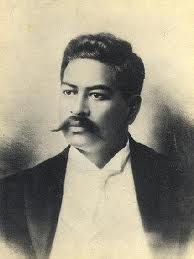
      Most of the testimony from community organizations, unaligned with the building industry, opposed the legislation. The Association of Hawaiian Civic Clubs, representing 69 member organizations and founded in 1918 when Prince Kuhio was a Delegate to the U.S. Congress, gave testimony saying that Kuhio “expressed serious concerns about the decline of the Hawaiian people, culture and traditions – issues that the Civic Clubs have always defended.” 
Hawaiian Civic Clubs testified that Prince
Kuhio worried about loss of Hawaiian culture.
     The Civic Clubs stated that the proposed “phased review could allow the inexorable approval and forward movement, development and construction of a project, regardless of what lies in its path, due to previous expenditures of time and money. In other words, Senators, if iwi kupuna (the buried remains of ancestors) are hindering the project after so much has already been finished, and after the passage of earlier phased reviews, the argument to press on is valid. But looked at holistically, given a project review in its entirety – not phased –this would not happen because what’s at the end of the path would be revealed before development begins and accommodations could be planned….At this time, SB1171 very much favors development and construction with potential of destroying iwi kupuna and trust in governmental process. We accept kuleana to protect iwi kupuna and oppose this bill.”
      Native Hawaiian Legal Corp. testified to examples of delays and cost overruns, as well as desecration of graves resulting from not doing the studies ahead of construction. Listed were a Wal-Mart, Ward Village Shops, and Kawaiaha`o Chruch’s multi-purpose center, all on O`ahu.
      Native Hawaiian Legal Corp. gave the example of an Archaeological Inventory Survey being done ahead of a ten-mile long, 600-acres area for Saddle Road, resulting in no delays.
      The International Archaeological Research Institute testified that “This bill runs contrary to the intent of historic preservation, as well as to the interests of the public, planners, developers, contractors and government agencies. The phasing of archaeological inventory surveys would build in poorly informed decision-making and planning regarding the protection of cultural resources.”
      Historic Hawai`i Foundation also opposed the bill on behalf of its 850 members who “work to preserve Hawai`i’s unique architectural and cultural heritage and believe that historic preservation is an important element in the present and future quality of life, economic
viability and environmental sustainability of the state.” The testimony says that “a blanket provision allowing for a phased review of projects could introduce unintended consequences that could lead to the detriment of historic properties ad cultural resources.”

`AINA KO PONO TESTIMONY from Life of the Land went to the Public Utilities Commission last week opposing the proposal for the hui to sell diesel that would be manufactured in a refinery off Wood Valley Road. The contract would be for 20 years.
      Life of the Land stated “There are several weaknesses in this proposed contract including the price, the technology, the externalities, and the availability of cheaper alternatives that make this project unreasonable and not in the public interest.”
      Concerning alternatives, Life of the Land testified that “Hawai`i is known around the world for its sun and sand, and for being a tropical paradise. We have every type of renewable energy that exists in the world. Every island has abundant solar, wind, wave and ocean energy resources and some have geothermal resources. We have enough energy resources to power our State (and perhaps to also power California). But we also have precious ecosystems and diverse communities.” 
      Life of the Land also testified that “Often proponenets of projects will assert that they have found the perfect solution, one with no impacts. What they really mean is that they are blind to the impacts. That sends up a red flag; Watch out! Caveat emptor! They are not looking!”
      The testimony gives an example: “Many renewable energy projects rely on trace (rare earth) minerals produced in truly unsustainable manners. Many renewable energy projects rely on fossil fuel to make their components.” The testimony refers to a federal study on Hidden Costs of Energy: Unpriced Consequences of Energy Production and Use, testifying how externalities should be considered in new energy projects. See more in tomorrow’s Ka`u New Briefs or see www.puc.hawaii/gov. Click on Aina Koa Pono, the link, and documents for all the testimony.

JUNIOR RANGER DAY takes place this Saturday when participants connect the culture, people and `aina of the Kahuku Unit of Hawai`i Volcanoes National Park through art, `oli, GPS, and compass and listen to the mo`olelo of Pupu-hulu-ena, Keo-ua-ku-a-hu`ula and Kamehameha I. The free event takes place from 10 a.m. to 2 p.m. and includes lunch and cultural craft demonstrations. Pre-registration required at 985-6019.

HAWAI`I VOLCANOES INSTITUTE presents Life on Recent Lava Flows with botanist Tim Tunison this Saturday from 9 a.m. to 3 p.m. Fee is $50 for Friends and $65 for non-members. Student fees (K-12 and college with valid ID) are $25 for members and $35 for non-members. For more and to register, see fhvnp.org, email institute@fhvnp.org or call 985-7373.

Wednesday, March 20, 2013

Ka`u News Briefs March 20, 2013

Hawai`i Wildlife Fund volunteers removed this and other potential Japanese tsunami marine debris during last
 Saturday's Ka`u Coast Cleanup. Photo by Dr. Mark Kimura, UH-Hilo
GMO LABELING OF FOODS is the subject of a state Senate public hearing tomorrow in Honolulu. Ka`u citizens can testify on the measure, pro and con, by going online to www.capitol.hawaii.gov/senate.aspx?testimonypanel=on#panel. Both East Ka`u Senator Russell Ruderman and West Ka`u Senator Josh Green support the measure.
Sen. Josh Green
Sen. Russell Ruderman 
      According to a story by Derrick DePledge in this morning’s Honolulu Star-Advertiser, “The bill was at risk of failing this session if it did not get a Senate hearing by an internal procedural deadline this week. In private moves over the past few days, Senate leaders planned to remove the Senate Health Committee as a referral on the bill because of concerns that Sen. Josh Green, the committee’s chairman and a supporter of GMO labeling, would use a hearing to appeal to anti-GMO activists.”
      According to DePledge, “Green strenuously fought the move, however, and after a lengthy private caucus among senators Tuesday, the Senate Health Committee stayed on the referral,” and the hearing will take place before the senate Agriculture Committee, the Senate Health Committee and the Senate Consumer Protection & Commerce Committee. The ag committee chair will conduct the hearing.
A rally against GMO products was held in Hilo Saturday.
Photo by Ko Ueno
      DePledge quoted Green: “The people are concerned with the health impact of GMOs, and I support their call for labeling. I also believe the Senate Committee on Health should have remained the lead on this bill.” Green is a physician and previously worked at the emergency room at Ka`u Hospital.
      According to the Star-Advertiser story, Senate ag committee chair Clarence Nishihara said, “First, I’d like to make it clear that this is a food labeling and not an anti-GMO bill, nor is it a pro-bioengineering bill.” See more at www.staradvertiser.com.
      The opinion of state Attorney General David Louie is that the bill could be found unconstitutional since the federal government authorizes the labeling of foods. He also put forth that First Amendment rights and interstate commerce regulations could be violated. Louie said the bill lacks a specific purpose showing the interest of the state.
      GMO labeling laws are likely to be tested in court, as the issue is coming up in many states. Initiatives in legislatures around the country include a proposal to label genetically engineered salmon in Alaska, an Arizona bill to label genetically engineered food, and a Colorado bill to require any person, selling, distributing or offering for sale food, to make sure genetically engineered food is labeled. Similar legislation has been introduced in the states of Indiana, Missouri, New Hampshire, New Jersey, New York, Oregon, Tennessee, Vermont and Washington.

`AINA KOA PONO’S proposed contract to sell diesel to the electric companies “can provide a type of hedge, a financial hedge by reducing ratepayers’ exposure to price volatility, and a physical hedge because the locally produced biodiesel reduces ratepayers’ exposure to man-made, natural, of other disturbances that can affect the supply chain of Hawai`i’s imported fuels,” states testimony from the state Department of Business, Economic Development & Tourism.
      The testimony was provided last week to the state Public Utilities Commission which is tasked with approving or disapproving the `Aina Koa Pono contract which would back the construction of a refinery off Wood Valley Road and the use of pasture between Pahala and Na`alehu for clearing trees and brush and growing crops to feed the refinery.
      The testimony states that “Hawai`i has recently been exposed to this because ‘petroleum diesel prices are so dependent on demand (Asia and Pacific sourced oil has significantly increased in price since the Japan tsunami and the loss of Japan’s nuclear reactor capacity, and other factors (e.g., Tesoro’s plan to sell its Hawai`i operations) not related to production costs, petroleum forecasts tend to vary widely.’”
      The Department of Business, Economic Development & Tourism testified that “the Contract under review here can be thought of as insurance against bad outcomes; in this case, continued volatile, rising and high oil prices….”
      See more testimony from other agencies and the public at www.puc.hawaii.gov. Click on `Aina Koa Pono, on the link, and documents. The docket number is 2012-0185.

Several items from Saturday's Ka`u Coast Cleanup are
potential Japanese tsunami marine debris.
Photo by Dr. Mark Kimura, UH-Hilo
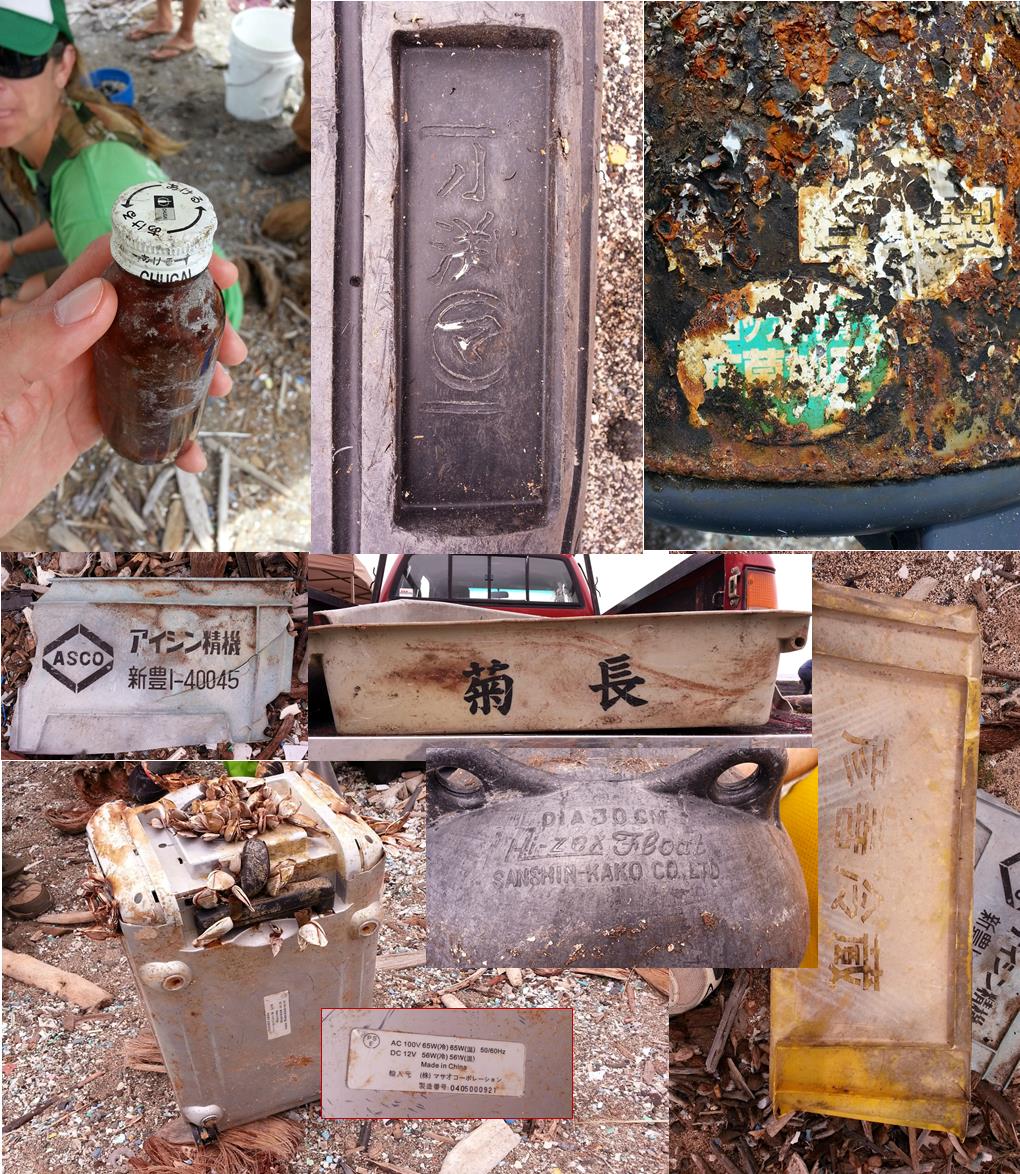
POSSIBLE TSUNAMI DEBRIS from Japan was found when 58 volunteers covered over a mile of coastline last Saturday from Kai`ole Bay to Ki`i (including Kamilo Point). They removed several truckloads full of debris weighing almost one ton.
      Debris likely from Japan included two glass fishing net balls, mini fridge/cooler with rollers, a rice-cooker-like Thermos with spout and multiple large buoys from Sanshin-Kako Co., Ltd. in Japan. Also picked up were many small plastic toy items (camel, rhinos, army figurines), a #13 drifter block from UH-Hilo study (released from outside Hilo Bay), NOAA weather balloon, and part of a dog-sled runner.
      Volunteers came from Hilo, Puna, Kohala, and Kona and included two large groups from Hawai`i Community College-Hilo and Cornell University’s Hawai`i Field Program based in Waimea. Local artist Don Elwing displayed his debris art at Wai`ohinu Park and gifted one lucky volunteer a free piece. Kealakekua-based Hawai`i Kombucha joined in and donated a five-gallon keg of homemade Orange Kombucha to all the volunteers.
      Hawai`i Wildlife Fund continues its restoration efforts in Ka`u with anchialine pond cleanups next Tuesday and Wednesday and another Ka`u Coast Cleanup Saturday, July 13. Sign up with Megan Lamson at 769-7629 or kahakai.cleanups@gmail.com.

THIS IS DETECT-A-LEAK-WEEK IN HAWAI`I. The state Commission on Water Resource Management, in partnership with the island county water departments and the Hawai`i Rural Water Association, is encouraging all Hawai`i residents to check for leaks at their homes, properties and workplaces.
      “The Department of Land and Natural Resources’ Rain Follows the Forest initiative aims to enhance water supplies by protecting and restoring our rainforests to capture as much of the rain as possible,” Gov. Neil Abercrombie said. “But we must also be good stewards of our drinking water by using it as efficiently as possible, which involves checking for leaks and taking corrective action. Detect-A-Leak Week is an important statewide awareness program that complements this administration’s efforts to increase the recharge of our aquifers and streams.”
Quirino Antonio
      The U.S. Environmental Protection Agency estimates common household leaks can waste more than 10,000 gallons of water each year in the average home – enough water to fill a backyard swimming pool. This water loss can be significantly reduced in Hawai`i if all residents statewide check their plumbing fixtures for leaks.
       “Every effort made to repair leaks helps protect water, our most precious resource. Thank you for doing your part at home and in your yard during Detect-A-Leak Week,” said Quirino Antonio, County of Hawai`i Department of Water Supply manager and chief engineer.
      There are three types of leaks that should be checked – toilet, property and under ground. During Detect-A-Leak-Week, the department is distributing toilet leak detection dye tablets at all ACE hardware, Home Depot, and HPM Building Supply stores, as well as Department of Water Supply customer service counters.
      For more information on how Detect-A-Leak Week is being observed and for more tips on how to check for leaks at home, visit www.hawaiidws.org.

KA`U AGRICULTURAL WATER COOPERATIVE District meets tomorrow at 4 p.m. at the Royal Hawaiian Orchards Macadamia Field Office. For more information, contact Jeff McCall at 928-6456.

MEMBER TRAINING FOR Ka`u Ag Water Cooperative District takes place a week from today, next Wednesday at Pahala Community Center. Members and potential members of the regional water systems’ cooperatives, including Ha`ao, Mountain House, Moa`ula, Alili, Hilea, Keaiwa, Wood Valley and Kapapala can learn about being an ag water co-op member and how the development process is proceeding. For more information, email mbondera@kohalacenter.org.

`Ohelo is one species that establishes in recent lava flows.
Photo by Tim Tunison
HAWAI`I VOLCANOES INSTITUTE is still accepting registration for Life on Recent Lava Flows with botanist Tim Tunison Saturday from 9 a.m. to 3 p.m.
      Program cost is $50 for Friends members and $65 for non-members. Student fees (K-12 and college with valid ID) are $25 for members and $35 for non-members. Non-members are welcome to join the Friends in order to get the member discount.
      For more information and to register, see fhvnp.org, email institute@fhvnp.org or call 985-7373.

A PERFORMANCE OF TWO OF TENNESSEE WILLIAMS’ one-act plays takes place Sunday at Pahala Plantation House. Dick Hershberger and Arlene Araki present Talk to Me Like the Rain and Let Me Listen and I Can’t Imagine Tomorrow, directed by University of Hawai`i-Hilo drama department senior Julie Dobbs. The plays begin at 3 p.m. Tea and cookies will be served, and a potluck dinner follows.

SUPPORT OUR SPONSORS AT PAHALAPLANTATIONCOTTAGES.COM AND KAUCOFFEEMILL.COM. KA`U COFFEE MILL IS OPEN SEVEN DAYS A WEEK.