|
| A volunteer with Stewardship at the Summit removes invasive Himalayan ginger from a kolea lau nui, an endemic understory tree found in the rain forests on Kilauea volcano in Hawai`i Volcanoes National Park. Stewardship dates are set through June. NPS Photo from Jessica Ferracane |
 |
| Margaret Wille |
It calls for the mayor to enter into a four-year contract, with the option of two one-year extensions, to provide organics diversion, treatment of mulch for invasive species, a compost demonstration project and to expand organic diversion programs to a composting operation.
At 1 p.m., the Environmental Management Committee takes up Bill 32 and 33 introduced by Kohala’s County Council member Margaret Wille.
Bill 32 relates to disposal of refuse in a manner that rewards those who separate recyclables and compostables from landfill refuse. It would require the Environmental Management director to implement a partial pay-per-bag fee program for refuse to be landfilled, allowing each household and business one 33-gallon bag of refuse per week to be landfilled without any bag fee.
Bill 33 would prohibit the disposal of compostable or recyclable material at any county landfill or transfer station as of Jan. 1, 2018. It would also establish additional requirements and fees for commercial haulers with regard to the disposal of compostable or recyclable materials.
Other committees meeting tomorrow are Governmental Relations & Economic Development at 9 a.m.; Planning, 9:15 a.m.; Public Works and Parks & Recreation, 9:30 a.m.; and Human Services & Social Services, 9:45 a.m.
The full County Council meets Wednesday at 9 a.m.
All meetings, held at Council Chambers in Hilo, are streamed live at hawaiicounty.gov. Click on Council Meetings.
Ka`u residents can also participate via videoconferencing at Ocean View Community Center.
Agendas are available at hawaiicounty.gov.
To comment on or like this story, go to facebook.com/kaucalendar.
At 1 p.m., the Environmental Management Committee takes up Bill 32 and 33 introduced by Kohala’s County Council member Margaret Wille.
Bill 32 relates to disposal of refuse in a manner that rewards those who separate recyclables and compostables from landfill refuse. It would require the Environmental Management director to implement a partial pay-per-bag fee program for refuse to be landfilled, allowing each household and business one 33-gallon bag of refuse per week to be landfilled without any bag fee.
Bill 33 would prohibit the disposal of compostable or recyclable material at any county landfill or transfer station as of Jan. 1, 2018. It would also establish additional requirements and fees for commercial haulers with regard to the disposal of compostable or recyclable materials.
Other committees meeting tomorrow are Governmental Relations & Economic Development at 9 a.m.; Planning, 9:15 a.m.; Public Works and Parks & Recreation, 9:30 a.m.; and Human Services & Social Services, 9:45 a.m.
The full County Council meets Wednesday at 9 a.m.
All meetings, held at Council Chambers in Hilo, are streamed live at hawaiicounty.gov. Click on Council Meetings.
Ka`u residents can also participate via videoconferencing at Ocean View Community Center.
Agendas are available at hawaiicounty.gov.
To comment on or like this story, go to facebook.com/kaucalendar.
 |
| Ronn Nozoe Photo from HDOE |
HAWAI`I DEPARTMENT OF EDUCATION Deputy Superintendent Ronn Nozoe, credited with helping steer schools toward higher achievement and lead organizational change, heads to Washington D.C. next month. He will be Deputy Assistant Secretary for Policy and Programs in the Office of Elementary and Secondary Education at the U.S. Department of Education. The position is a presidential appointment.
“Ronn Nozoe is part of a great team in Hawai`i that has made tremendous strides in improving teaching and learning across the state. His experience as a teacher, principal, superintendent and state leader make him well qualified to help the U.S. Department of Education’s effort to partner with states and local districts to help ensure all students are successful,” said Deborah Delisle, Assistant Secretary for Elementary and Secondary Education. “We are thrilled to have Ronn on board.”
Superintendent Kathryn Matayoshi praised the move. “Ronn will bring to Washington school- and state-level perspectives of the hard work that has been done here in Hawai`i as well as a focus on keeping students at the center of our work,” Matayoshi said.
Nozoe was appointed Deputy Superintendent in December 2010 after serving as interim Deputy Superintendent since January 2010. During his tenure, the state has seen measurable improvements in student achievement, behavior, absenteeism, graduation rates and college-going rates, including unprecedented gains on the National Assessment of Educational Progress. Under the direction of Matayoshi, he has led the charge in aligning school, complex, state and national efforts to systemically improve student learning, including development of the Academic Leadership Team; establishment of the Teacher Leader Workgroup and Deputy’s Principal Roundtable to ensure face-to-face input and feedback in making adjustments for better outcomes; leading the Zones of School Innovation in collaboration with CASs and Principals of the Zones’ schools; overseeing development, implementation and monitoring of the Strategic Plan, Race to the Top, Elementary and Secondary Education Act Waiver and Strive HI system; development and implementation of the Complex Area Support Team structure and routines; improving the relationship with U.S. Pacific Command and the military to one that is more engaged; and partnering with Hawai`i State Teachers Association on the Joint Committee to improve the Educator Effectiveness System.
“At the heart of any real change and improvement are deeply committed and selfless people who are willing to put the cause – in our case, kids – before their individual needs or wants,” Nozoe said. “By increasing the number and quality of measures of success, we are now able to recognize excellence and progress in more schools and more people which helps to highlight the valiant efforts happening statewide.”
Sen. Mazie Hirono congratulated Nozoe on his appointment. “Ronn has been a great asset in our state and served our students and educators well. I know he’ll be a wonderful leader in the U.S. Department of Education, implementing policies that will help students be successful nationwide,” Hirono said.
The USDOE Office of Elementary and Secondary Education is responsible for ensuring access and excellence in learning between federal, state, and local educational agencies.
KA`U RESIDENTS CAN HELP PROTECT the native Hawaiian rainforest at the summit of KIlauea by volunteering for Stewardship at the Summit programs in Hawai`i Volcanoes National Park now through June.
Stewardship at the Summit begins at 9 a.m. and ends at noon. The dates from April through June are: April 2, 11, 17, and 24; May 1, 8, 20 and 30; and June 5, 13, and 19.
Volunteers help remove invasive, non-native plant species that prevent native species from growing. Meet project leaders Paul and Jane Field at Kilauea Visitor Center at 9 a.m. on any of the above dates. Wear sturdy hiking shoes and long pants. Bring a hat, raingear, day pack, snacks and water. Gloves and tools are provided. No advance registration is required, and there is no cost to participate, but park entrance fees apply.
Volunteers have dedicated 4,271 hours of their time and have restored more than 25 acres of native rainforest within the park since 2012. Countless Himalayan ginger, faya, strawberry guava and other invasive, non-native plants that threaten the native understory near the summit of Kilauea volcano have been removed. In their place, once-shaded `ama`u and hapu`u tree ferns have re-emerged, and pa`iniu, kawa`u and other important native plants are returning to the stewardship plots.
To comment on or like this story, go to facebook.com/kaucalendar.
PAHALA-KA`U ALUMNI REUNION organizers remind classmates to sign up for the event. Dates are June 19, 20 and 21 at Las Vegas’ California Hotels & Casinos. Rooms must be reserved no later than May 17 for special rates at 800-634-6255. Group code is ASFPAHA.
SUPPORT OUR SPONSORS AT PAHALAPLANTATIONCOTTAGES.COM AND KAUCOFFEEMILL.COM. KA`U COFFEE MILL IS OPEN SEVEN DAYS A WEEK.


Superintendent Kathryn Matayoshi praised the move. “Ronn will bring to Washington school- and state-level perspectives of the hard work that has been done here in Hawai`i as well as a focus on keeping students at the center of our work,” Matayoshi said.
Nozoe was appointed Deputy Superintendent in December 2010 after serving as interim Deputy Superintendent since January 2010. During his tenure, the state has seen measurable improvements in student achievement, behavior, absenteeism, graduation rates and college-going rates, including unprecedented gains on the National Assessment of Educational Progress. Under the direction of Matayoshi, he has led the charge in aligning school, complex, state and national efforts to systemically improve student learning, including development of the Academic Leadership Team; establishment of the Teacher Leader Workgroup and Deputy’s Principal Roundtable to ensure face-to-face input and feedback in making adjustments for better outcomes; leading the Zones of School Innovation in collaboration with CASs and Principals of the Zones’ schools; overseeing development, implementation and monitoring of the Strategic Plan, Race to the Top, Elementary and Secondary Education Act Waiver and Strive HI system; development and implementation of the Complex Area Support Team structure and routines; improving the relationship with U.S. Pacific Command and the military to one that is more engaged; and partnering with Hawai`i State Teachers Association on the Joint Committee to improve the Educator Effectiveness System.
“At the heart of any real change and improvement are deeply committed and selfless people who are willing to put the cause – in our case, kids – before their individual needs or wants,” Nozoe said. “By increasing the number and quality of measures of success, we are now able to recognize excellence and progress in more schools and more people which helps to highlight the valiant efforts happening statewide.”
Sen. Mazie Hirono congratulated Nozoe on his appointment. “Ronn has been a great asset in our state and served our students and educators well. I know he’ll be a wonderful leader in the U.S. Department of Education, implementing policies that will help students be successful nationwide,” Hirono said.
The USDOE Office of Elementary and Secondary Education is responsible for ensuring access and excellence in learning between federal, state, and local educational agencies.
To comment on or like this story, go to facebook.com/kaucalendar.
 |
| Sen. Brian Schatz |
THE U.S. SENATE HAS PASSED the Schatz-Murray-Shaheen Amendment #1063 which would establish a deficit-neutral reserve fund for legislation to ensure all legally married spouses have access to Social Security and VA benefits their family has earned, including all same-sex couples.
Sen. Brian Schatz, who co-authored the bill, said, “Gay couples legally married in any state should be entitled to veterans and Social Security benefits identical to any other married couples… . Eleven Republicans joined Democrats in recognizing that gay couples deserve equal treatment, regardless of where they live. We still have work to do to, but this is progress and a win for equal rights. I thank Sen. Murray and Sen. Shaheen for their leadership on this important issue.”
Sen. Brian Schatz, who co-authored the bill, said, “Gay couples legally married in any state should be entitled to veterans and Social Security benefits identical to any other married couples… . Eleven Republicans joined Democrats in recognizing that gay couples deserve equal treatment, regardless of where they live. We still have work to do to, but this is progress and a win for equal rights. I thank Sen. Murray and Sen. Shaheen for their leadership on this important issue.”
To comment on or like this story, go to facebook.com/kaucalendar.
KA`U RESIDENTS CAN HELP PROTECT the native Hawaiian rainforest at the summit of KIlauea by volunteering for Stewardship at the Summit programs in Hawai`i Volcanoes National Park now through June.
Stewardship at the Summit begins at 9 a.m. and ends at noon. The dates from April through June are: April 2, 11, 17, and 24; May 1, 8, 20 and 30; and June 5, 13, and 19.
Volunteers help remove invasive, non-native plant species that prevent native species from growing. Meet project leaders Paul and Jane Field at Kilauea Visitor Center at 9 a.m. on any of the above dates. Wear sturdy hiking shoes and long pants. Bring a hat, raingear, day pack, snacks and water. Gloves and tools are provided. No advance registration is required, and there is no cost to participate, but park entrance fees apply.
Volunteers have dedicated 4,271 hours of their time and have restored more than 25 acres of native rainforest within the park since 2012. Countless Himalayan ginger, faya, strawberry guava and other invasive, non-native plants that threaten the native understory near the summit of Kilauea volcano have been removed. In their place, once-shaded `ama`u and hapu`u tree ferns have re-emerged, and pa`iniu, kawa`u and other important native plants are returning to the stewardship plots.
To comment on or like this story, go to facebook.com/kaucalendar.
 |
| Ka`u Farm Bureau President Ralph Gaston |
KA`U FARM BUREAU MEETS today at 6 p.m. at Pahala Community Center. Election of officers is on the agenda, along with a guest speaker. For more information, email ralph@rustyshawaiian.com.
PAHALA-KA`U ALUMNI REUNION organizers remind classmates to sign up for the event. Dates are June 19, 20 and 21 at Las Vegas’ California Hotels & Casinos. Rooms must be reserved no later than May 17 for special rates at 800-634-6255. Group code is ASFPAHA.
“Let’s make this year’s reunion another memorable year,” said organizer Priscilla Obado. For more information, call Obado at 225-9173.
SUPPORT OUR SPONSORS AT PAHALAPLANTATIONCOTTAGES.COM AND KAUCOFFEEMILL.COM. KA`U COFFEE MILL IS OPEN SEVEN DAYS A WEEK.
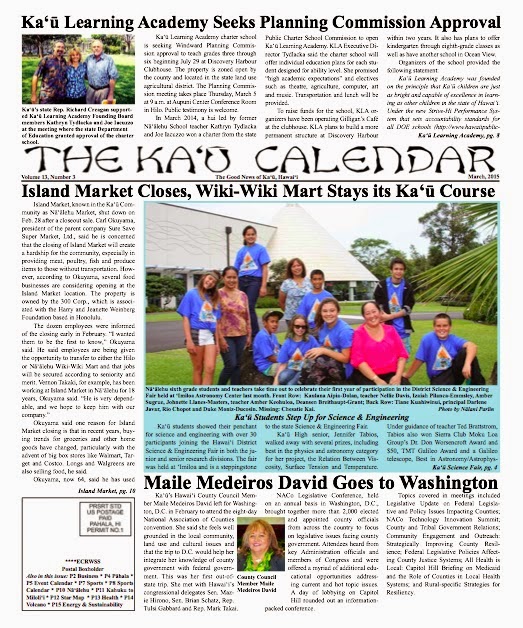 |
| See kaucalendar.com/KauCalendar_March2015.pdf. |
 |
| See kaucalendar.com/Directory2015.pdf and kaucalendar.com/Directory2015.swf. |


%2Bxs.jpg)

xs.jpg)