About The Kaʻū Calendar

Sunday, May 10, 2015

Ka`u News Briefs Sunday, May 10, 2015

Preserving Ka`u's agricultural lands was the topic of a Ka`u Community Development Plan focused discussion yesterday.
Photo by Geneveve Fyvie
STRATEGIES FOR PRESERVING KA`U’S AGRICULTURAL AND COASTAL LANDS for this and future generations were center stage at public meetings on the Ka`u Community Development Plan yesterday at Na`alehu Community Center. 
      One objective of the CDP is to preserve prime and other viable ag lands and enhance viewscapes that exemplify Ka`u’s rural character. The CDP identifies urban areas that preserve surrounding ag lands and establishes firm urban growth boundaries. It prohibits rezones that would increase residential density in agricultural areas. It also guides expansion of lands held in public trust, including ag conservation easements.
      One of the challenges identified for farmers and ranchers is limited land tenure. County planner Ron Whitmore reviewed planning tools designed to help farmers come up with leases or ownership strategies for land security. Included were strategies to put farmers in a position that would be secure enough to allow banks to lend money for farming enterprises.
Ka`u CDP calls for using ag lands for ag.
      Several members of the coffee industry were present, including growers who built Ka`u Coffee farms at Moa`ula and Pear Tree over the last two decades but find themselves with no long-term leases where their coffee is grown. The land is currently for sale. Should the land be sold and subdivided with housing allowed, high prices could preclude most Ka`u Coffee farmers from buying their plots though some have said they would like to buy their farms.
      Hawai`i Farm Bureau President Chris Manfredi brought up the idea that Covenants, Conditions and Restrictions on farm property could preserve substantial acreage for agriculture with houses built by new owners on only a small area of the land.
      Whitmore mentioned a possible planning tool where ag properties could accommodate small farms, with parcels leased out, without the possibility of building houses on them. This could keep farmland out of the speculative housing market with leases secure enough to allow financing for ag.
      Another option would be to seek private and public funding to buy ag land to preserve it under some kind of ag park or cooperative arrangement.
      Whitmore explained that any existing agricultural lot of record is already zoned for a farm dwelling, farm labor housing, farm buildings and such structures as mills and commercial kitchens for manufacturing of farm products. Ag parcels are also available for alternative energy projects, ag tourism and open area recreational use.
      He said oversight for tax breaks aimed at keeping land in agriculture needs to be improved as does the method by which the county ensures that farm dwellings on farmlands are being used by farmers rather than gentleman estates.
      Regarding proposed land use changes on ag properties coming before government decision makers, Whitmore said that the “decision is based on what the current owner pitches” and that it is very difficult to hold them to it once permission to subdivide or otherwise allow additional housing on the land is granted.
      Another idea put forth was to look closely at state-owned parcels to establish ag parks.
      Ralph Roland brought up the idea of issuing temporary dwelling permits, when needed, for farm labor.
      Whitmore noted that there is a large excess of buildable lots for housing in Ka`u, including the Pahala area. He said the reason to plan for concentrating housing in existing settlement areas includes affordability – infrastructure such as water and electricity are already developed there.
      Manfredi asked why more land was not planned for urban use in Pahala in the proposed CDP draft. Whitmore said planners did not see a demand for more and said that planners’ studies show that infilling could accommodate future needs. Manfredi said he could envision more land needed for housing in the long term and noted that it was recommended in the CDP draft to delete land along Hwy 11 on the Volcano side of Pahala from the General Plan for urban expansion.
     Whitmore presented maps showing existing agriculture in Ka`u. The entire draft Community Development Plan is available at libraries, community centers and online at kaucdp.info. Public comment online and by mail is welcomed.
      At another Ka`u CDP Focused Discussion this Tuesday at Discovery Harbour Community Center at 10 a.m., the topic is a proposed development there.
      See more on the Ka`u CDP draft meetings on ag and the coastline in tomorrow’s Ka`u News Briefs.
      To comment on or like this story, go to facebook.com/kaucalendar.

DO YOU OWN NON-INDUSTRIAL PRIVATE forest land and want to restore on it to native forest habitat for threatened and endangered species? The U.S. Department of Agriculture’s Natural Resources Conservation Service has federal funds to help landowners do this, and they are encouraged to apply. 
      NRCS partners with the state Department of Land and Natural Resources to engage local and regional stakeholders in science-based collaborative, community-driven land management activities. Specifically, the partnership will focus on planning, prioritization, implementation and monitoring of non-industrial private forest lands. Funds are now available, as DLNR was Hawai`i’s first recipient of the Regional Conservation Partnership Program.
      “We are very excited to partner with the Natural Resources Conservation Service to protect Hawai`i’s native forests,” said Suzanne Case, DLNR Chairperson. “These forests are critical to Hawai`i’s economy because they capture and supply our fresh water. Forests prevent erosion that muddies our coral reefs and fisheries and protect the native plants and animals unique to our islands.”
      “Now that the watershed boundaries have been identified, we look forward to this partnership in protecting and improving healthy forests across the islands,” said Bruce Petersen, NRCS Director for the Pacific Islands Area.
      Through the Farm Bill, funds are being provided from the Environmental Quality Incentives Program. Through EQIP, there will be an application, evaluation and ranking process to address resource concerns such as improving surface water, improving ground water quality, reducing soil erosion and increasing native forest habitat for threatened and endangered species.
      The deadline to apply for the RCPP Healthy Forest initiative is June 5. Only agricultural producers in the watershed partnership areas may apply for this RCPP Healthy Forest Initiative. Land enrolled in this initiative must meet EQIP eligibility.
      For more information, see www.pia.nrcs.usda.gov.
      To comment on or like this story, go to facebook.com/kaucalendar.

Sen. Brian Schatz
A BIPARTISAN RESOLUTION RECOGNIZING contributions of tourism to the United States passed the Senate. Introduced by Sen. Brian Schatz and others, the resolution supports goals of National Travel and Tourism Week and acknowledges the important role travel and tourism play in boosting the U.S. economy. One out of every nine jobs in the U.S. depends on travel and tourism, and the industry supports 15 million jobs across the country. Schatz is a co-chair of the bipartisan Senate Tourism Caucus. 
      “Tourism and travel gives us the chance to share Hawai`i’s natural beauty and culture with the rest of the world,” Schatz said. “It’s not only a great way to share Hawai`i’s vibrant culture, it’s one of the most important sectors of our local economy, creating good jobs and supporting thousands of small businesses. I’m proud to join my colleagues to recognize the important role our visitor industry plays, and I look forward to continue working on policies that promote travel to Hawai`i and boost our local economy.”
      To comment on or like this story, go to facebook.com/kaucalendar.

SENIOR ID CARDS ARE AVAILABLE tomorrow from 9 a.m. to 10 a.m. at Pahala Housing Center and 11 a.m. to 12 p.m., Nā‘ālehu Community Center. For ages 60 and over. Call 928-3100 for more information.

KA`U RESIDENT DICK HERSHBERGER brings Hawaiian Volcano Observatory founder Thomas Jaggar to life every this and every other Tuesday during A Walk into the Past at 10 a.m., 12 p.m. and 2 p.m. Participants meet at Kilauea Visitor Center for a short walk to the Whitney Vault in Hawai`i Volcanoes National Park.

SUPPORT OUR SPONSORS AT PAHALAPLANTATIONCOTTAGES.COM AND KAUCOFFEEMILL.COM. KA`U COFFEE MILL IS OPEN SEVEN DAYS A WEEK.
See kaucalendar.com/KauCalendar_May2015.pdf.
See kaucalendar.com/Directory2015.pdf and
kaucalendar.com/Directory2015.swf.


Saturday, May 09, 2015

Ka`u News Briefs Saturday, May 9, 2015

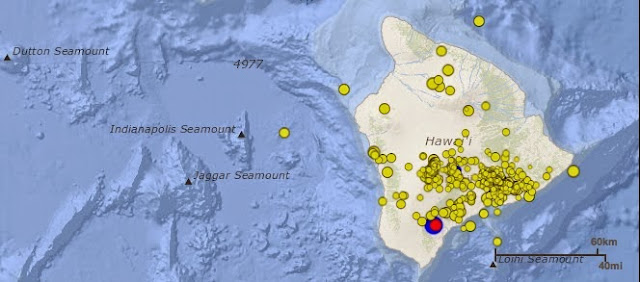
The U.S. Geological Survey registered a 4.5 magnitude earthquake this morning with aftershocks.
Image from Hawaiian Volcano Observatory
A MAGNITUDE 4.5 EARTHQUAKE centered five miles north of Na`alehu rattled the island this morning. The U.S. Geological Survey's Hawaiian Volcano Observatory registered the temblor at 2:18 a.m. at a depth of 6 miles. According to Wes Thelen, HVO's Seismic Network Manager, the depth, location, and recorded seismic waves of today’s earthquake suggest a source on the large fault plane between the old ocean floor and overlying volcanic crust, a common source for earthquakes in this area.
      A map showing its location is posted on the HVO website at http://hvo.wr.usgs.gov/seismic/volcweb/earthquakes/.
      The earthquake was widely felt on the Island of Hawaiʻi. The USGS Did you feel it? Web site (http://earthquake.usgs.gov/eqcenter/dyfi/) received over 70 felt reports within an hour of the earthquake. Light shaking (Intensity IV) has been reported across the island. At these shaking intensities, damage to buildings or structures is not expected, HVO reported.
      Three aftershocks (magnitudes 1.6, 1.5, 1.4) of the earthquake were recorded as of 3:30 a.m., HST. Additional aftershocks are possible and could be felt.
     Over the past 30 years, the area north of Nāʻālehu has experienced six earthquakes, including today's event, with magnitudes greater than 4.0 and at depths of 5–13 km (3.1–8.1 mi). This area of Kaʻū is a seismically active region where a magnitude-6.2 earthquake occurred in 1919. Areas adjacent to this morning’s event experienced earthquakes of magnitudes 6.0, 7.1, and 7.9 in 1868.
     According to HVO, the earthquake caused no detectable changes in Kīlauea Volcano's ongoing eruptions, on Mauna Loa, or at other active volcanoes on the Island of Hawaiʻi. A magnitude-3.1 earthquake that occurred in Kīlauea Caldera about one minute before the magnitude-4.5 earthquake was unrelated to the Nāʻālehu event.
     For information on recent earthquakes in Hawai`i and eruption updates, visit the USGS Hawaiian Volcano Observatory website at http://hvo.wr.usgs.gov.
To comment on or like this story, go to facebook.com/kaucalendar.
Tutu and Me staff members are required to spend cultural days to learn more
about the community, and recently visited Hawai`i Volcanoes National Park.

TUTU AND ME, the traveling preschool sponsored by Partners in Development Foundation, has opened enrollment for keiki ages birth through five for the 2015-2016 school year. This follows a successful 2014-2015 program plus volunteer work by staff members in the larger Ka`u community, said Betty Clark, Site Manger for the southern communities of the Hawai`i Island.
     She pointed out that all staff members are required to volunteer in the community. Community contributions have included a beach clean-up, volunteering at Pahala and Na`alehu Elementary Schools, and helping 'O Ka`u Kakou with Senior Bingo.
     Staff members are also required to spend time learning about culture. These kumu a'o days have been spent at Hawai`i Volcanoes National Park, the Merrie Monarch Festival Craft Fair and a full day learning Hawaiian mele, lau hala weaving and games, sponsored by the Hawaiian Civic Club of Ka'u and taught by Zachary Bernardi and Allen Stafford.
     The Tutu and Me staff recently led a keiki and family visit to the Kipuka Pua`ulu Bird Park and trail in the National Park.
     To register for Tutu and Me, call Clark at 929-8571. Email her at eclark@pidfoundation.org and see www.pidfoundation.org.
To comment on or like this story, go to facebook.com/kaucalendar.


The interactive map shows the crop when one clicks on a farm, like this Ka`u Coffee
farm near Pahala. Map from Agricultural Baseline Project
THE STATEWIDE AGRICULTURAL BASELINE PROJECT has posted online a draft copy of the agricultural footprint of the islands and is asking for those in the know to comment on farms that may be missing from the interactive maps and to correct any inaccuracies.
     Those interested are able to see types of crops on the areas mapped in Ka`u, from coffee to macadamia, truck crops, mango orchards and biomass tree farms. The map can be enlarged to see specific fields. Click on them and the crop type is revealed.
    The draft will be onine until mide June and the final report and digital layer is expected to be completed by the end of October. Project director is Jeff Melrose.
      Melrose is working with the University of Hawai`i-Hilo Spacial Data Analysis and Visualization Lab. Contact him at jmelrose@hawaii.edu.
    The link to the ag footprint map is  http://geodata.sdal.hilo.hawaii.edu/statewideagbaseline/map.html
To comment on or like this story, go to facebook.com/kaucalendar.

HAWAI`I CENTER FOR FOOD SAFETY has released an abridged edition of its new report, contending that pesticides are threatening the health of residents, particularly when used near schools, homes and hospitals. The organization calls for more oversight and public notice of pesticide use and states that pesticides may be damaging to food security, human health and health of the environment. The report is called Pesticides in Paradise: Hawai`'s Health & Environment at Risk. Hawai`i Center for Food Safety also takes up the GMO issue and contends that GMO agriculture uses more pesticides than other ag and therefore puts the public at higher risk.
     Hawai`i Crop Improvement Association executive director Bennette Misalucha, issued a statement saying Center for Food Safety. "is advancing its true mission - using fear and pseudoscience to raise money and perpetuate misinformation."
  Center for Food Safety, in its press release, states that Pesticides in Paradise "delivers a comprehensive review of published scientific and medical research examining the threats pesticides used in Hawai‘i pose to public health, especially the risk to pregnant women and young children. The report also considers the severe impacts of pesticides on Hawai‘i’s ecosystems and the challenges the growing seed industry pose to local food self-sufficiency."
      Focusing on GMO, the statement says that "Alarmingly, the GE (Genetically Engineered) seed industry’s footprint on the Hawaiian Islands (24,700 acres) is 72 percent of the total area planted to food crops other than sugarcane or pineapple (34,400 acres). Since 1987 Hawai‘i has hosted more cumulative field trials (3,243) than any other state. In 2014 alone, 178 different GE field tests were conducted on over 1,381 sites in Hawai’i (vs. only 175 sites in California). Herbicide-resistance was the most frequently tested trait in GE crop field tests in Hawai‘i over the past five years. This means that plants genetically engineered in Hawai‘i, by and large, are engineered to resist greater and greater application of herbicides."
     Ashley Lukens, PhD, Director of Hawai`i Center for Food Safety, said, “We frequently hear that genetic engineering has nothing to do with pesticides, and that pesticides do not have an impact on our environmental and public health, but this comprehensive review tells a very different story."
     The report contends that "one agrochemical company applied 90 different pesticide formulations containing 63 different active ingredients on Kaua‘i from just 2007 to 2012, and sprayed on two-thirds, or 65 percent, of the days of the year. Some of the most dangerous restricted use pesticides on the market are being used year round, including atrazine, chlorpyrifos, and paraquat."
     The full report is expected to be released in June. Download the abridged report and see more at www.centerforfoodsafety.org.
To comment on or like this story, go to facebook.com/kaucalendar.

AGRICULTURE AND COASTAL MANAGEMENT in Ka`u are topics of focused discussions today at Na`alehu Community Center. Ka`u Community Development Plan staff members speak with Ka`u residents about ag at 9 a.m. and coastal management at 1 p.m.
According to county planner Ron Whitmore, the purpose of these discussions is to explore specific topics of interest in-depth. "It is an opportunity for community members to expand their understanding of the CDP and the rationale behind particular strategies. It is also an opportunity to provide new information, suggest alternative CDP strategies, and propose additional areas of analysis." He stated that the discussions are "designed to be friendly, fact-driven, and learning-oriented. They are not formal meetings, opportunities to testify, or debates. Participants should come with an open mind and a sincere interest in finding the most effective CDP strategies to achieve the community’s objectives."
The future of Punalu`u, where people gather and hawksbill turtles nest,
is one of of the topics expected to be discussed at this afternoon's meeting on
 coastal management at 1 p.m., Na`alehu Cmmunity Center.
Photo by Dave Berry
     During the morning session about agriculture, the plan is to cover sub-topics like: ag zones and permitted uses, farm land preservation, infrastructure improvements to expand agriculture (eg, water, energy, amendments), and barriers farmers face like land tenure, diversification, and value chain development.
     During the afternoon session about coastal management, sub-topics for discussion are expected to include: shoreline setbacks, public access & trails, South Point management, resort development, and the future of Punaluʻu.
     County planners familiar with these issues will be on hand and equipped with background material and geographic information systems (GIS) to support the discussion and do “on the fly” analysis.
     Participants’ questions, comments, and suggestions will be documented. The CDP Planning Team will use outputs of the discussion to do additional analysis, refine the CDP rationale, and/or recommend CDP revisions, Whitmore stated.
     A similar discussion about potential development in Discovery Harbour is scheduled for this coming Tuesday, May 12, at 10 a.m.. Focused discussions about other topics can also be scheduled. See kaucdp.info or call 961-8137 for more information.

THROUGH THE ARTIST'S' EYE is an invitational exhibition at Volcano Art Center Gallery through May 31, focusing on native plants, animals and minerals found in Hawai`i Volcanoes National Park.
To comment on or like this story, go to facebook.com/kaucalendar.

SUPPORT OUR SPONSORS AT PAHALAPLANTATIONCOTTAGES.COM AND KAUCOFFEEMILL.COM. KA`U COFFEE MILL IS OPEN SEVEN DAYS A WEEK.


Friday, May 08, 2015

Ka`u News Briefs Friday, May 8, 2015

Agriculture and coastal management in Ka`u are topics at Ka`u CDP focused discussions tomorrow. Photo by Julia Neal
PROPOSED CHANGES TO AG TAX EXEMPTIONS went into the storage shed Tuesday when Hawai`i County Finance Committee postponed Bill 317. Kohala Council Member Margaret Wille introduced the bill after a task force spent about two years studying tax structures that allow various exemptions depending on how owners use ag land.
Council member Maile David
      Wille said the purpose of the bill was to benefit those who produce by closing tax loopholes and changing “the lax status to actual ag production.” According to Wille, about 10,000 landowners receive ag tax exemptions but do not farm. Her bill called for three-year programs in which owners would have to prove that the land is being farmed, either by receiving income of or losing at least $2,000 per year.
      Ka`u’s County Council member Maile David said she agreed that the county needs to tighten up exemptions for ag use but disagreed with Wille’s bill. “When you create a bill like this that has so many layers of procedures and so many things that require the farmer to do, I’m not sure we are actually helping the farmer or deterring him because of all the paperwork you have to do,” she said.
      David questioned how to determine what bona fide ag is. Council members referred to gentlemen farmers, who, for example, have large parcels and “two sheep” and take ag exemptions. “The problem is separating a farmer that has the resources to go full-on farming and mom-and-pop operations,” David said.
      She also quoted one of her farming constituents saying, “This will do more harm than good for the small ag community.”
      Jeff Melrose, who published the county’s agricultural baseline study, asked the Council to look at implications and choices before making changes to the tax structure. “It’s important to apply tax structure to the goal of food sustainability,” he said. He suggested looking into creating a tax category for local food production.
      Ka`u rancher Kyle Soares said he has spent tens of thousands of dollars on property taxes for 2,500 acres over 20 years. “If you think pasture is worth $420 an acre in property taxes, you’re kidding yourself,” he said. He said he has planned to stop his ranching operation in January 2016.
      To comment on or like this story, go to facebook.com/kaucalendar.

NEW FEDERAL OVERSIGHT RULES FOR HAWAIIAN HOME LANDS are proposed and available to view at doi.gov/ohr/notifications. The draft marks the first time that the U.S. government has attempted to set up rules for its responsibility in administration of the 200,000-acre land trust for Hawaiians established in 1921. There are 60 days to comment. 
      The Department of the Interior oversees the state’s involvement in Hawaiian Home Lands under the Hawaiian Homes Commission Act. The proposed rules cover such situations as analyzing the benefit or loss to Hawaiians when the Hawaiian Homes Commission and Department of Hawaiian Home Lands trades trust lands for other property. Included are requirements that federal laws, including the National Historic Preservation Act and federal land appraisal standards, be followed.
      Congress established the Hawaiian Homes Commission Act to provide land to Hawaiians for farming, ranching and housing for the lease rate of $1 a year. Native Hawaiians have long complained of long waiting lists, with many dying without ever having access to land. In Ka`u, Hawaiian rancher Tommy Kaniho has lobbied for decades for water for ranch lands at Ka Lae to make the lands more useful for ranching, farming and living. In addition to the Ka Lae, South Point, area, Hawaiian Home Lands are located mauka of Punalu`u and within Discovery Harbour where DHHL purchased more than 40 houselots.
      A statement from DOI says the agency “takes our responsibilities for the Hawaiian Home Lands Trust and its beneficiaries seriously” and calls the trust “vital to the health and strength of the Native Hawaiian community and especially to the beneficiaries who live on the lands or are on the waiting list for a homestead lease.”
      Statewide, more than 26,000 Hawaiians are on the waiting lists.
      To comment on or like this story, go to facebook.com/kaucalendar.

Stephen Schatz
STEPHEN SCHATZ IS HAWAI`I’S NEW deputy superintendent for the Department of Education.
      Schatz brings 20 years of educational experience to the DOE leadership post. He most recently served as assistant superintendent for the Office of Strategy, Innovation and Performance, overseeing assessment and accountability, data governance and analysis, and policy, innovation, planning and evaluation.
      “I’m passionate about instruction and focused on supporting our leaders to provide equity of opportunity for all students within our system,” Schatz said. “I want to thank the Superintendent and the Board for their trust and look forward to working with our principals and teachers in achieving student success.”
      Schatz joined the Hawai`i public school system at the beginning of the 2002-03 school year as a vice principal at Wai`alua High and Intermediate before becoming principal of Pohakea Elementary in Leeward Oahu in 2004.
Schatz was appointed complex area superintendent for the Honolulu District in February 2009.
      He became assistant superintendent for strategic reform in July 2011.
      Schatz has a bachelor’s degree from the University of California at Santa Cruz and a master’s degree in education administration from California State University Dominguez Hills.
      Superintendent Kathryn Matayoshi said, “Stephen not only brings his educational experience to the position but also his perspective as a parent of two public school children.”
      Schatz fills the vacancy left by Ronn Nozoe, who moved to Washington, D.C., where he is now deputy assistant secretary for policy and programs in the Office of Elementary and Secondary Education at the U.S. Department of Education.
      To comment on or like this story, go to facebook.com/kaucalendar.

Mobile slaughter services are coming to Ka`u. Photo from Hawai`i Island Meat
SMALL-SCALE KA`U RANCHERS WHO RAISE livestock will soon have a new option for quality, humane and convenient slaughter services and can learn about this new offering at upcoming workshops in Hilo and Pahala. 
      A mobile slaughter unit capable of processing pigs, sheep, goats and cattle will open for business on the island in early 2016. Hawai`i Island Meat, a cooperative business created in response to the expressed needs of island ranchers for additional local slaughter facilities, will be facilitating two free informational workshops for producers interested in accessing the service.
      The workshops will be held in Hilo from 5 p.m. to 6 p.m. on Sunday, May 17 at the Komohana Agricultural Research Station, 875 Komohana Street, and in Pahala from 5 p.m. to 6 p.m. on Sunday, June 14, at Pahala Community Center. 
      Like their counterparts in the continental United States, many meat producers on Hawai`i Island face significant barriers to starting and maintaining their businesses. Despite its abundant ranch lands and ranching operations, the island currently imports 17 percent of its beef and more than 95 percent of its pork, lamb and goat products due to competition from imported meat products, high operational costs and insufficient access to U.S. Department of Agriculture-inspected slaughterhouses.
      HIM’s 36-foot trailer, made possible with funding from the Hawai`i Department of Agriculture, will meet USDA sanitation standards and be capable of processing eight to 10 head of cattle, 15 pigs and 30 lamb or goats per day.
      “Not only will the mobile slaughter unit help to revitalize family ranching operations on Hawai`i Island, it will increase the amount of healthy, locally grown protein available to our communities and can be part of the solution to reduce the island’s population of feral and invasive cattle, pigs, sheep and goats,” said Melanie Bondera, cooperative business development specialist at The Kohala Center. “Locally produced meats are also in high demand by island residents, visitors and gourmet chefs, so the increased availability will contribute positively to farm-to-fork programs and our local economy.”
      More information about the program is available on HIM’s website at HawaiiIslandMeat.com or via email at HawaiiIslandMeat@gmail.com.
      To comment on or like this story, go to facebook.com/kaucalendar.

Mexican flag
ST. JUDE’S EPISCOPAL CHURCH in Ocean View hosts its annual Cinco de Mayo fiesta today. Doors open at 6 p.m., and dinner is served from 6:30 p.m. to 9 p.m., with live music Tickets are available at the door for $8 each or two for $15 or can be pre-purchased from Thom White, Elaine Meier or Cordelia Burt. Call 939-7555. 

AGRICULTURE AND COASTAL MANAGEMENT in Ka`u are topics of focused discussions tomorrow at Na`alehu Community Center. Ka`u Community Development Plan staff members speak with Ka`u residents about ag at 9 a.m. and coastal management at 1 p.m. 
      See kaucdp.info or call 961-8137 for more information.

SUPPORT OUR SPONSORS AT PAHALAPLANTATIONCOTTAGES.COM AND KAUCOFFEEMILL.COM. KA`U COFFEE MILL IS OPEN SEVEN DAYS A WEEK.

See kaucalendar.com/KauCalendar_May2015.pdf.
See kaucalendar.com/Directory2015.pdf and
kaucalendar.com/Directory2015.swf.