About The Kaʻū Calendar

Monday, September 05, 2016

Ka`u Calendar News Briefs Monday, Sept. 5, 2016

Happy Labor Day! According to Hawaiian Volcano Observatory scientists, "charcoal is good
for more than the barbeque." See below. Photo from Wikipedia

SHOULD HAWAI`I ERADICATE MOSQUITOES? A group of stakeholders will ponder the question during meetings this week at Kilauea Military Camp in Hawai`i Volcanoes National Park.
      “We are discussing sort of how we realize the potential for a mosquito-free environment here for public health, conservation and quality of life issues,” Durrell Kapan, co-organizer of the workshop and adjunct professor at the Center for Conservation and Research Training at UH-Manoa, told Max Dible, of West Hawai`i Today.
Dr. Kenneth Kaneshiro
      “There are a number of near-term and potentially longer-term solutions. The important thing is to make sure all the people involved are thinking about these solutions, and to get all those people in the room to understand what those possibilities are.”
      Dr. Kenneth Kaneshiro, program director at UH-Manoa’s Center for Conservation and Research Training, explained that mosquitoes could be controlled by interrupting the insects’ reproductive systems.
      When Dible asked about consequences of eradication, such as reducing food supplies for species such as hoary bats, Kaneshiro said, “Eradication of mosquitoes wouldn’t cause any other problems because they’re not native to Hawai`i. They’re an invasive species that doesn’t belong in the native Hawaiian ecosystem.” He said the ecosystem worked fine before mosquitoes were introduced.
      See westhawaiitoday.com.
      To read comments, add your own, and like this story, see Facebook. Follow us on Instagram and Twitter.

Sen. Brian Schatz
KA`U’S U.S. SENATORS send Labor Day greetings to their constituents.
      “On Labor Day, we honor the work and sacrifice of the labor movement in our country,” Sen. Brian Schatz said. “We thank labor unions as champions for the minimum wage, Social Security, workplace health and safety standards, child labor protections and the 40-hour work week, but our thanks must be more than just words.
      “As Congress returns to session this week, we must focus on the fact that millions of working families are struggling to make ends meet. We are the wealthiest country in the world and yet for far too many Americans, a full-time job still means a life below the poverty line. We must do better. I look forward to working with my Senate colleagues to make real progress toward improving the lives of working families in our country.”
Sen. Mazie Hirono
      Sen. Mazie Hirono said, “When my mother brought our family to Hawai`i, we struggled. We lived in fear of mom getting sick and not being able to work – which meant no pay and no money for food or rent. She had no employment protection. But our family circumstances changed dramatically when mom’s workplace unionized. Better job security, better pay. We were finally able to buy our first home. As we celebrate LaborDay, we celebrate the men and women who fought and sacrificed for basic protections, like safe working conditions and fair wages, that American workers have today.”
      To read comments, add your own, and like this story, see Facebook. Follow us on Instagram and Twitter.

AS KA`U RESIDENTS ENJOY Labor Day barbeques, Hawaiian Volcano Observatory geologists explain in the current issue of Volcano Watch how they use charcoal.
      “One of the fundamental premises of geology is that the key to understanding the future is to look at the past,” the article states. “In order to understand how a volcano will behave, geologists map the deposits of past eruptions. 
      “An important element for characterizing volcanic deposits is to establish if the eruption was predominantly effusive (characterized by lava flows) or explosive. Furthermore, we want to know the spatial distribution of the deposits, and how frequently and where the different types of eruptions occur.
      “To help determine the timing of eruptive activity, geologists use a radiocarbon age-dating technique. Collecting charcoal is the most common method used in Hawai`i, not only by geologists, but also by archaeologists, ecologists, and others.
      “How does radiocarbon, or carbon-14, dating work?
      “Carbon-14 is produced in the atmosphere and readily utilized by plants to build tissue, fiber, and wood. Carbon-14 is radioactive and has a half-life of 5,700 years. As long as a plant is alive, the amount of carbon-14 in its tissue remains approximately the same.
      “Once the plant dies, however, the quantity of carbon-14 in the plant tissue decays, so that after 5,700 years the amount of carbon-14 is 50 percent of the amount present when the plant was alive. After another 5,700 years, the concentration is down to 25 percent of its initial concentration.
      “Any high temperature volcanic product, such as a lava flow, spatter, and hot ash, can create charcoal when it burns or buries a plant. In Hawai`i, geologists dig under lava flows to recover charcoal left from plants.
Dark-colored charcoal, left of rock hammer, from a log buried by lava
was found at the base of an `a`a flow in Ka`u. Photo from USGS-HVO
      “Scientists use the decay rate of carbon-14 to obtain age-dates from this charcoal. A relatively new accelerator mass spectrometer technique can now provide ages between 80 and 100,000 years. 
      “Geologists often make assumptions about the charcoal they collect. We assume that plants are alive at the time an eruption occurs. In addition, we assume that charcoal is created when a lava flow covers the vegetation.
      “These assumptions can create problems if the charcoal is created from wood that was already dead when it burned. There are other potential sources for confounding a radiocarbon age, such as dating forest fire charcoal or ‘old’ living wood, for example, the core of a log one meter (three feet) in diameter that could be quite a bit older than the exterior of the log.
      “To minimize these problems, geologists make sure that collection techniques are impeccable to reduce the chance that spurious charcoal is recovered. We also try to minimize infiltration of contaminant charcoal. Given the choice of age-dating a log or a twig, we choose the twig to avoid inadvertently dating old wood in the interior of the log.
      “Once charcoal is recovered, we dry the sample and pick out small pieces of black shiny charcoal that has a distinctive ‘snap’ when broken. Soft pliable charcoal is discarded. The sample is then sent to a radiocarbon-processing lab, where it is chemically treated to remove modern carbon. The sample is converted to graphite, which is used to determine the radiocarbon age.
      “Once we get the results from the lab, how do we then decide if the age is ‘good?’
      “The radiocarbon age has to fit into the stratigraphic framework based on geologic mapping of the volcanic deposit. For example, if Flow B, dated at 550 years old, is bracketed by Flow A, dated at 1,000 years, and Flow C, dated at 1,500 years, it is highly likely that the radiocarbon age of Flow B is not good, because it should be between 1,000 and 1,500 years.
      “Once we determine that the radiocarbon results are consistent with stratigraphy, we have to calibrate the age. Calibration is necessary because, using tree-ring data from around the world, we know that the concentration of atmospheric carbon-14 varied from time to time, and we must account for this variability.
      “Most ages are reported in years before present, with zero being A.D. 1950, before atmospheric atomic bomb testing altered the amount of carbon-14 in the air. If the age control is good enough based on stratigraphy, radiocarbon ages can be presented in terms of calendar years to facilitate comparison with non-geologic historical events.
      “So, in geology (and other fields), charcoal can be useful for more than just grilling on the barbeque.”
      See hvo.wr.usgs.gov/volcanowatch.
      To read comments, add your own, and like this story, see Facebook. Follow us on Instagram and Twitter.

HAWAI`I COUNTY COUNCIL HOLDS its regular and committee meetings Wednesday. Full council meets at 9 a.m. Public Safety & Mass Transit Committee meets at 1 p.m.; Finance, 1:15 p.m.; Planning, 1:30 p.m.; Public Works & Parks & Recreation, 2 p.m.; and Governmental Relations & Economic Development, 2:45 p.m.
      All meetings take place at Council Chambers in Hilo. Agendas and live-streaming are available at hawaii.county.gov.
      Ka`u residents can participate via teleconferencing at Na`alehu State Office Building.

SUPPORT OUR SPONSORS AT PAHALAPLANTATIONCOTTAGES.COM AND KAUCOFFEEMILL.COM. KA`U COFFEE MILL IS OPEN SEVEN DAYS A WEEK.
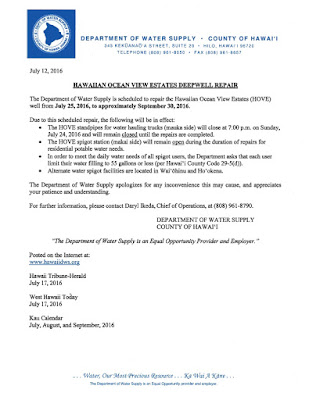
Click on document to enlarge.

See kaucalendar.com/TheDirectory2016.html
and kaucalendar.com/TheDirectory2016.pdf.
See kaucalendar.com.


Sunday, September 04, 2016

Ka`u Calendar News Briefs Sunday, Sept. 4, 2016

Last week’s hurricanes had no impact on lava deltas that have formed, and continue to grow, at ocean entries,
Hawaiian Volcano Observatory reported. Photo from USGS-HVO
OCEAN USERS ARE URGED to use reef-safe sunscreens. A compound commonly found in sunscreens has been shown to cause serious harm to corals, and the state Department of Land and Natural Resources is asking people who enter the ocean to avoid using sunscreens that contain oxybenzone. Recent studies have shown that the chemical causes deformities in coral larvae (planulae), making them unable to swim, settle out and form new coral colonies. It also increases the rate at which coral bleaching occurs. This puts coral reef health at risk and reduces resiliency to climate change.
Dr. Bruce Anderson
      “One of the most important things you can do if you plan to get in or near the ocean in Hawai`i is to use a sunscreen that does not contain oxybenzone,” said Dr. Bruce Anderson, administrator of DLNR’s Division of Aquatic Resources. “Sunscreen chemicals wash off swimmers, surfers, paddlers, spearfishers, divers and other ocean users. Even if you’re just sunbathing on the beach, using beach showers will wash chemicals into the ocean. Researchers have found oxybenzone concentrations in some Hawaiian waters at more than 30 times the level considered safe for corals.”
      Sunscreens are important in protecting human skin from the sun’s damaging radiation and are highly recommended for residents and visitors who spend time under the sun. This is especially important in Hawai`i, where tropical latitudes result in direct sunlight that has less atmosphere to travel through than places farther from the equator. As a result, less of the sun’s harmful ultraviolet radiation is filtered out, and it’s easy to burn. Sunscreens contain either minerals or chemicals as active ingredients to filter out UV. Oxybenzone is a chemical filter found in many sunscreens.
      Besides damaging coral, oxybenzone may have negative effects on human health. It and two other sunscreen chemicals, octinoxate and homosalate, have all been shown to cause disruptive reproductive system effects due to their hormone-like activity. Oxybenzone and octinoxate have also been associated with moderate to high rates of skin allergy.
DLNR urges ocean users to avoid sunscreens with chemicals
that damage reefs. Photo from DLNR
      According to Anderson, “the only way you can know whether a sunscreen contains oxybenzone is to read the label. Some sunscreens may claim to be ‘reef safe,’ but there is no agency which regulates that kind of claim. You really have to look at the ingredients.”
      Anderson also recommended using water resistant sunscreens, which are more likely to stay on your skin, and sunscreens that use mineral filters, such as zinc oxide or titanium dioxide. Also, rash guards or wet suits will reduce the area of exposed skin, and thus the amount of sunscreen needed for protection.
      At Ahihi-Kinau Natural Area Reserve on Maui, NAR specialist Jeff Bagshaw has made sunscreen outreach a priority. He’s created cards to pass out to visitors who frequent snorkeling spots there. The cards list sunscreen chemicals in addition to oxybenzone that some scientists believe may have negative impacts on corals. He and his volunteers try to talk to everyone who pulls into the parking lot to encourage them to begin only using products with zinc oxide or titanium dioxide as active sunscreens.
      To read comments, add your own, and like this story, see Facebook. Follow us on Instagram and Twitter.

Fumes emanating from the flow field
delineate part of the active tube system.
Photo from USGS-HVO
THERE IS NO EVIDENCE that high surf from last week’s hurricanes had any impact on the lava deltas that have formed, and continue to grow, at the ocean entries, Hawaiian Volcano Observatory reported.
      The 61g lava flow, extending southeast of Pu`u `O`o on Kilauea’s south flank, continues to carry lava to the ocean near Kamokuna, building lava deltas that extend into the ocean. Deltas can collapse at any time and throw material into the air.
      To read comments, add your own, and like this story, see Facebook. Follow us on Instagram and Twitter.

CHIEF JUSTICE MARK E. RECKTENWALD has appointed Dakota K.M. Frenz to the District Family Court of the Third Circuit on Hawai`i Island. Frenz will fill the vacancy created by Judge Lloyd X. Van De Car’s retirement.
      Frenz served as a deputy prosecuting attorney in the County of Hawai`i from 2006-2012 handling cases in district, family and circuit courts and since 2012 has been in private practice, including criminal law, family law and civil litigation/collections.
      Frenz is currently a member of the Board of Directors of the Kuikahi Mediation Center and an arbitrator with the Court Annexed Arbitration Program. She also volunteers with Friends of Drug Court and the Self-Help Center in East Hawai`i.
      Frenz is a graduate of Whittier Law School and was admitted to the Hawai`i State Bar in 2006.
      The Chief Justice appoints District Court judges from a list of not fewer than six nominees submitted by the Judicial Selection Commission. If confirmed by the state Senate, Frenz will serve a term of six years.
      To read comments, add your own, and like this story, see Facebook. Follow us on Instagram and Twitter.

HAWAI`I DEPARTMENT OF EDUCATION will be sending a U.S. Department of Education Federal Survey Card home with Hawai`i’s public school students for parents to complete beginning Wednesday, Sept. 7. Completed Impact Aid Program survey cards allow HIDOE to qualify for a partial reimbursement for educating federally connected students, such as children whose parents work or live on federal property such as low-income housing, military installations/housing, native American lands or national parks.
Impact Aid funds support public schools statewide.
Image from HIDOE
      The program was created to assist school districts that lose tax revenues (e.g. income, sales and property taxes) due to a federal presence. Received funds go to all local school districts, just like local property taxes, and can be used to hire teachers, purchase textbooks and computers, pay for utilities and more. Parents are strongly urged to complete the surveys and return them to their schools as soon as possible.
      “Impact Aid funds are extremely important to support all our public schools statewide and help to improve quality education for our students,” said Kathryn Matayoshi, HIDOE Superintendent. “During the 2015-16 school year, the state accounted for 27,660 federally connected students and received more than $40 million in Impact Aid funding. We ask all parents for their cooperation to complete these important surveys.”
      Completed survey forms will benefit students at all public schools statewide. Federal reimbursements help to offset such costs as student transportation, school utilities, substitute teachers, portable classrooms and many others necessities.
      Without these federal funds, the Hawai`i public school system would have $40 million to $50 million less per year to operate with and would need to reduce support for all schools to pay all its expenses.
      Every public school has a 100-percent return rate goal and asks that parents complete and return the federal survey next week. See the Impact Aid Program webpage for more information and common questions.
      To read comments, add your own, and like this story, see Facebook. Follow us on Instagram and Twitter.

`Alala No. 2 by Reyn Ojiri. Image from VAC
VOLCANO ART CENTER PRESENTS Return of `Alala: Restoring the Voice of Hawai`i’s Native Forests, a statewide multimedia art competition featuring Hawai`i’s endemic crow. The exhibit is on display at VAC Gallery in Hawai`i Volcanoes National Park through Oct. 9. Proceeds from the exhibition support reintroduction of this important species to Hawai`i’s native forests to take place this fall. The exhibit is open to the public and free of charge, although park entrance fees apply.
      “The response to this collaborative conservation effort has been terrific,” gallery manager Emily Weiss said. “Hawai`i’s creative community has learned so much about this critically endangered species through outreach from the `Alala Project and the Hawai`i Endangered Bird Conservation Program. To date, VAC has received 47 entries. The artwork submitted reflects the artist’s knowledge of and affinity for this special species.”

SUPPORT OUR SPONSORS AT PAHALAPLANTATIONCOTTAGES.COM AND KAUCOFFEEMILL.COM. KA`U COFFEE MILL IS OPEN SEVEN DAYS A WEEK.

Click on document to enlarge.


See kaucalendar.com/TheDirectory2016.html
and kaucalendar.com/TheDirectory2016.pdf.


Saturday, September 03, 2016

Ka`u Calendar News Briefs Saturday, Sept. 3, 2016

Ka`u rancher Michelle Galimba asked U.S. Rep. Tulsi Gabbard to support preservation of the Ka`u Coast.
See more below. Photo by Julia Neal
A HIGH-SURF WARNING continues through tomorrow afternoon as Hurricane Lester passes north of Hawai`i Island. The National Weather Service expects warning-level surf along all exposed east-facing shores to continue through tonight before quickly trending down on Sunday.
      Expect ocean water surging and sweeping across beaches, creating potential for impacts to coastal properties and infrastructure, including roadways. Powerful longshore and rip currents will be present at most beaches. Large breaking waves and strong currents may impact harbor entrances and channels, causing challenging boat handling.
Hurricane Lester is passing Hawai`i Island to the north.
Map from NOAA
      Large breaking surf, significant shorebreak and dangerous currents make entering the water very hazardous. Anyone entering the water could face significant injury or death, NWS said.
      To read comments, add your own, and like this story, see Facebook. Follow us on Instagram and Twitter.

HAWAI`I DEPARTMENT OF LAND & Natural Resources is responding to changing forecasts for Hurricane Lester.
      All forest reserves, wildlife sanctuaries, natural area reserves and Na Ala Hele hiking trails are re-opened. Department of Forestry & Wildlife campgrounds will remain closed through the weekend.
      All state parks will remain open for Labor Day weekend, unless any changes in storm behavior indicate a need for closure
      Camping and overnight lodging facilities are now re-opened.
      To read comments, add your own, and like this story, see Facebook. Follow us on Instagram and Twitter.

Visitors drive down reopened Chain of Craters Road. NPS Photo
MOST AREAS PREVIOUSLY CLOSED within Hawai`i Volcanoes National Park due to Hurricane Lester are now open.
      Park rangers opened Chain of Craters Road, all backcountry campsites and trails, the coastal lava viewing area and Mauna Loa Road under sunny skies Friday afternoon, much to the delight of visitors eager to explore the park during the long Labor Day weekend.
      “We urge all park visitors to maintain a safe distance from the shoreline, whether viewing lava at the Kamokuna ocean entry, hiking the Puna Coast Trail or camping at any of the coastal campsites,” said Chief Ranger John Broward. “We are anticipating surf up to 25 feet tonight and possibly through the weekend.”
      The Kahuku Unit is open today and tomorrow, with no cancellations to any guided hikes or programs.
      Backcountry campers are reminded that all overnight stays require a backcountry permit. Permits can be obtained up to 24 hours in advance from the backcountry office, located at the Visitor Emergency Operations Center, open daily from 8 a.m. to 4 p.m.
      To read comments, add your own, and like this story, see Facebook. Follow us on Instagram and Twitter.

U.S. Rep. Tulsi Gabbard at Ka`u Coffee Mill.
Photo by Ron Johnson
KA`U RANCHER MICHELLE GALIMBA asked U.S. Rep. Tulsi Gabbard to support preservation of the Ka`u Coast during the congresswoman’s visit to Ka`u this week.
      “Some people have said that health of the marine environment here is comparable to the Northwestern Hawaiian Islands,” Galimba said. President Barack Obama recently expanded Papahanaumokuakea Marine National Monument there, which is home to more than 7,000 species.
      “The fact that we’re so remote and undeveloped is really a huge asset,” Galimba said. “What’s really important to me is preserving the coastline here. We’ve done a lot, but there’s still a lot more to do. There are still several parcels along that coast that need to get protected.”
      Galimba mentioned efforts underway by Ala Kahakai Trail and U.S. Fish & Wildlife Service. The National Park Service also is working to extend its holdings along the Ka`u Coast.
      Gabbard said she would “absolutely” support such efforts. “I am a supporter of making sure we preserve our natural resources, our home, everything that is special to us.” she said.
      To read comments, add your own, and like this story, see Facebook. Follow us on Instagram and Twitter.

INTERNATIONAL UNION for Conservation of Nature’s World Conservation Congress continues on O`ahu. The congress is a special event attended by heads of state, policymakers and environmentalists from around the world.
U.S. Brian Schatz gave the keynote address
at the World Conservation Congress.
      “I’m very proud that our state was chosen to host the event this year, and I was honored to be invited to give the keynote address,” said U.S. Sen. Brian Schatz.
      “We live in a time of massive ecological disruption, one that cannot be accurately described without sounding downright apocalyptic,” Schatz said in his speech. “But over the last few years, there is growing reason for optimism. Global political will continues to grow. It’s not yet enough but for the first time, it looks like many of the world’s leaders get it. Leaders responsible for infrastructure, for public health, for safety and for prosperity see with their own eyes that economic progress relies on environmental stewardship. …
      “The people who care about birds and butterflies and the people who care about the bottom line are finally in agreement – it just makes sense to take care of the earth. …
      “Progress is being made, and I’m optimistic that this is only the beginning.”
      To read comments, add your own, and like this story, see Facebook. Follow us on Instagram and Twitter.

STATE AGENCIES ARE PARTNERING to help spread conservation messages.
      As the Department of Land and Natural Resources was exploring ways to reach more visitors and kama`aina with information about conserving and protecting natural and cultural resources, Hawai`i Tourism Authority was engaged in developing a five-year strategic plan. “Coincidentally, the stars were in alignment, and what we were thinking turned out to be a perfect fit with HTA’s strategic plan,” said DLNR Chair Suzanne Case.
HTA President & CEO George Szigeti
Photo from HTA
      DLNR is charged with management and administration of state parks, historical sites, forests, forest reserves, aquatic life, wildlife, wildlife sanctuaries, game management areas, public hunting areas and natural area reserves. HTA is responsible for strategically managing the state’s marketing initiatives to support tourism, the state’s largest industry.
      HTA President & CEO George D. Szigeti said, “Instrumental to our strategic plan is supporting efforts to protect our environment and perpetuate it for generations to come. Travelers come here from around the world to explore the natural beauty of our islands, from the ocean to the mountains. HTA’s vision for preserving the quality of Hawai`i’s environment goes hand-in-hand with the sustainability programs DLNR oversees every day statewide.”
      HTA’s strategic plan reflects the adoption of a goal to “improve the integrity of the destination,” achieved through an objective of being “a better steward of the destination and to increase support for programs that manage, improve and protect Hawai`i’s natural environment and areas frequented by visitors.
      In a programmatic agreement signed between the agencies in June, HTA agreed to provide funding for certain DLNR public communications efforts. In this first year of the agreement, that funding has secured broadcast air time for three DLNR & YOU television specials: Renegades, Risks & Rewards of the Napali Coast; Kaua`i’s Endangered Sea Birds; and Hawai`i’s Endangered Forest Birds. The first special aired on Hawai`i station KFVE-TV (K5) in April and June. The second program on endangered sea birds is being broadcast during the IUCN World Conservation Congress, on K5, tomorrow at 6:30 p.m. and Sept. 10 at 6 p.m. The third documentary is currently in production and scheduled to air later this year.
DLNR Chair Suzanne Case
Photo by John DeMello
      Additionally, HTA is funding the design, development and placement of 25 large outdoor signs promoting conservation messages at strategic locations. The signs will include a map, which depicts key natural and cultural resources, along with a series of messages about what visitors and local people alike can do to help protect resources. A sign vendor has been selected, and work on the signs will begin this fall.
      The DLNR & YOU brand, according to Case, “is our effort to include everyone in the kuleana (responsibility) of helping really mālama (to care) for our limited and precious natural and cultural resources. When you think about the reasons so many people come to Hawai`i to experience and share those things that make this place one of the planet’s most diverse ecological and cultural landscapes, it really takes all of us.”
      HTA funding to DLNR in 2016 amounts to $53,600. Szigeti noted, “We are proud to do our part in educating visitors and reinforcing to residents the significance of preserving Hawai`i’s natural and cultural resources. The DLNR & YOU initiatives are vital to reminding everyone that the quality of life we cherish requires a continual commitment to support conservation and protect the ecosystems that makes Hawai`i such a treasured destination for travelers worldwide.”
      To read comments, add your own, and like this story, see Facebook. Follow us on Instagram and Twitter.

LEARN ABOUT THE FORMATION and various uses of Pu`u o Lokuana over time and enjoy a breathtaking view of lower Ka`u. Kahuku Unit of Hawai`i Volcanoes National Park’s free program takes place tomorrow from 9:30 a.m. to 10:30 a.m.

SUPPORT OUR SPONSORS AT PAHALAPLANTATIONCOTTAGES.COM AND KAUCOFFEEMILL.COM. KA`U COFFEE MILL IS OPEN SEVEN DAYS A WEEK.

Click on document to enlarge.

See kaucalendar.com/TheDirectory2016.html
and kaucalendar.com/TheDirectory2016.pdf.