About The Kaʻū Calendar

Saturday, February 25, 2017

Ka`u News Briefs Saturday, Feb. 25, 2017

Calm waters, no wind and an overcast sky made for perfect whale counting at Ka Lae on Saturday where 23 breaches were seen
 in 15 minutes during the second of this season's Ocean Counts for humpback whales. See story below.
File Photo from NOAA
EARLY CHILDHOOD EDUCATION was the opening topic of the National Governors Association meeting in Washington, D.C. on Saturday, attended by Hawai`i's Gov. David Ige. The governor told The Ka`u Calendar that "Early childhood education is important." Investment in early childhood education "pays huge dividends in the long term."
"#We the States" is the slogan for the National Governors Association meeting in
Washington, D.C where Gov. David Ige is supporting early childhood education.
Photo by M. Martin Neal
     He referred to his budget before the 2017 Hawai`i Legislature, which proposes the most money allocated in history to pay for teaching in Hawai`i's public schools. It includes preschool and other early childhood education funding. In addition, the governor is involved with the Executive Office on Early Learning, which coordinates programs and funding with his administration and the Hawai`i Legislature.
     Ige also told The Ka`u Calendar that Hawai`i has benefited from federal early childhood education grants supported by the bipartisan National Governors Association and that the organization has been helpful in gathering, developing and sharing "best practices." The Governors Association members, both Republicans and Democrats, lobby Congress for early childhood education funding, particularly Preschool Development Grants.
Gov. David Ige at the opening of the National Governors Association
meeting in Washington, D.C. on Saturday. Photo from Gov. Ige staff
    Said one NGA letter to Congress, "Governors understand that early childhood education is a key component of building a literate, knowledgeable and skilled 21st century workforce. Preschool Development Grants, including expansion grants, enable governors to build on their efforts to promote school readiness by accelerating state-focused innovation to improve access and quality in early childhood education. States use the program to better serve our youngest students, including English language learners and early learners with disabilities; improve the professional development of preschool teachers and administrators; and expand access to early education programs to thousands of students."
     During the meeting on early childhood education, Ige and governors of all political persuasions threw in their backing. The chair for the session, Gov. Robert Bentley, of Alabama, said, "The most important education is childhood education" and declared that he wants to make "early childhood education a priority across the nation."
     Mike Peters, President and CEO of one of the largest employers in some states, Huntington Ingalls, which builds aircraft carriers and other vessels, told the governors that early childhood education creates a stronger workforce. 
     Actress Jennifer Garner and Mike Shriver represented the non-profit organization Save the Children, which is dedicated to young people in need. They talked about the "house-visit model" that helps make mothers into educators. Garner focused on education from birth to third grade, the kind of program that is popular in Ka`u, called Tutu & Me.
     Many letters of support for early childhood education have been sent from Ka`u to the governor and Hawai`i Legislature to support funding of Tutu & Me. The traveling preschool moves around Ka`u and welcomes grandparents, aunties, uncles and parents to bring the keiki to start learning from birth until they attend public school. Tutu & Me also makes house calls.  
     Bills in motion at the Hawai`i Legislature include SB1152 and HB500, which would appropriate money to continue funding public prekindergarten classrooms and set up administration of charter school prekindergarten classrooms. HB498 and SB687 would enable the Early Learning Board to appoint the director of the  Executive Office on Early Learning. 
     To read and send in testimony on these early childhood education bills, which are coming before state Senate and House committees next week, click on the bill numbers above. To find related bills, go to the Hawai`i State Legislature at www.capitol.hawaii.gov and type in key words.

To read comments, add your own, and like this story, see Facebook. Follow us on Instagram and Twitter.

WHALE COUNTING DREW MORE THAN 590 VOLUNTEERS on Hawai`i, O`ahu and Kaua`i Islands on Saturday during the second session of data gathering for the 2017 Hawaiian Islands Humpback Whale National Marine Sanctuary Ocean Count.
The second SanctuaryOcean Count of humpback whales this season
took place Saturday, sponsored by the Hawaiian Islands Humpback
Whale National Marine Sancturary. Photo from NOAA
    There were more whale sightings on Hawai`i Island this Ocean Count compared to last month's. Conditions were generally overcast across the sites with flat, calm waters and little to no wind, which allowed for great whale viewing conditions. Volunteers at South Point, at the Ka Lae Ocean Count site, had quite a show. In 15 minutes, they saw 23 breaches - the acrobatic display where the humpback uses its tail to launch itself out of the water then lands back on the surface with a splash.
     Ocean Count serves to promote public awareness about humpback whales, the sanctuary, and shore-based whale watching opportunities. The count is conducted three times per year during the peak whale season and provides a snapshot of humpback whales sightings from the shoreline. Participants tally humpback whale sightings and document the animals' surface behaviors during the survey.
     Volunteers collected data from 50 sites statewide on Feb. 25. A total of 174 whale sightings were recorded during the 11:30 a.m. - 11:45 a.m. time period, the most of any time period during the day's count.
    Preliminary data detailing whale sightings by site location are available at: http://www.sanctuaryoceancount.org/resources/. Additional information is available on the sanctuary's website at http://hawaiihumpbackwhale.noaa.gov.

To read comments, add your own, and like this story, see Facebook. Follow us on Instagram and Twitter.

OCEAN VIEW SATURDAY MARKET was shut down by police about half way through the morning and didn't reopen, according to Mike Alexander, of Ocean View. He said the scare surrounded reports of live ammunition, reportedly being sold at the outdoor venue, which operates like a swap meet, with animals, food, plants, clothing, used furniture and other household goods, and a chiropractor who gives Saturday market adjustments. The ammunition turned out to be cannonballs someone was selling, said Alexander.

To read comments, add your own, and like this story, see Facebook. Follow us on Instagram and Twitter.

Palm Trail Hike, Sun, Feb 26, 9:30 a.m. – 12:30 p.m., Hawai‘i Volcanoes National Park’s Kahuku Unit. This free, moderately difficult 2.6-mile loop trail provides one of the best panoramic views Kahuku has to offer.

www.kaucalendar.com


.


Friday, February 24, 2017

Ka`u News Briefs, Friday, Feb. 24, 2017


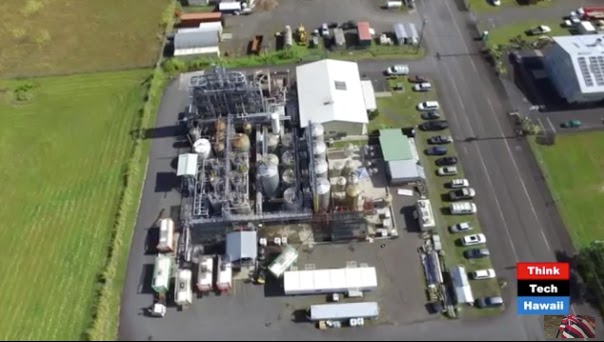
Pacific Biodiesel's plant in Kea`au. The company has been planting test plots on the Big Island and looking for land to
grow sunflower and safflower for food and utility oils. It blessed a sunflower farm on Maui today and Ka`u's Rep.
Tulsi Gabbard and Ka`u's Senator Mazie Hirono attended. Photo from Pacific Biodiesel & Think Tech Hawai`i
PACIFIC BIODIESEL, which operates a biofuel manufacturing plant at Shipman Industrial Park in Kea`au, is getting into the sunflower growing business to make more biofuel and food products. Sunflower and safflower test plots have been grown on the Big Island and a new effort to plant sunflower on 115 acres of former sugar land in central Maui was blessed on Friday. Rep. Tulsi Gabbard and Sen. Mazie Hirono both attended and gave remarks on the importance of developing more sustainable energy sources throughout Hawai`i.
Pacific Biodiesel founder Bob King with Rep. Tulsi Gabbard at the blessing of a
new sunflower farm to grow oils for food and fuel on Friday.
Photo from Tulsi Gabbard
     In 2015 Kelly King, vice president of Pacific Biodiesel, told Pacific Business News that the company wants to grow sunflower crops on tens of thousands of acres as feedstock to make biofuel. Under consideration have been lands owned by Department of Hawaiian Home Lands and private properties on the Big Island.
    Funding and research for the expansion into sunflower and possible safflower oils have come with help from University of Hawai`i and the U.S. Office of Naval Research, the Hawai`i Military Biofuels Crop Program and the Hawai`i Natural Energy Institute.
     Pacific Biodiesel has a manufacturing location in Shipman Industrial Park in Kea`au where used cooking oil and grease trap waste are the current feedstock for making transportation and utility fuel.
    The company has assisted with Hawai`i and other counties adopting biofuel to run their vehicles.
     King said the Kea`au plant is like a distillery and "exceeds all technology." She said it manufactures what is probably the highest quality biodiesel in the world. She said the number of employees totals at about 35 at Shipman and nearly 80 statewide. She said Pacific Biodiesel is proud to provide a variety of jobs and has hired students from Hawai`i Community College, which is teaching technology processing.
     Pacific Biodiesel sells its fuel for electric companies, the trucking industry, boating, back up generation, farming equipment and passenger cars. Kelly said that it is important to realize that electric cars often indirectly rely on imported oil, when it is burned to make the electricity for the power company that provides the electricity used when the electric car is plugged in. The electric car is clean when the electricity that it uses comes from solar or other alternative energies like biodiesel, she explained. 
     Kelly said that she looks forward to not only the biofuel value of sunflower and safflower but also their edible value and the opportunity for the oils to first be used for food, and secondarily to be upcycled into fuel for transportation and for the electric companies. At the Maui farm, she said, she expects to produce about 100 gallons of fuel per acre per harvest, with three harvests a year.
     See more at www.biodiesel.com

To read comments, add your own, and like this story, see Facebook. Follow us on Instagram and Twitter.


THE U.S. CORAL REEF TASK FORCE met in Washington D.C. this week and Hawai`i Gov. David Ige attended on his way to the National Governors Association Winter Meeting this weekend. The United States Coral Reef Task Force was established in 1998 by Presidential Executive Order to lead U.S. efforts to preserve and protect coral reef ecosystems. The USCRTF includes leaders of 12 Federal agencies, seven U.S. States including Hawai`i, Territories, Commonwealths, and three Freely Associated States.
Gov. David Ige attending the Coral Reef Task Force Meeting in
Washington, D.C. on Thursday. Photo from the Governor
     The USCRTF helps build partnerships, strategies, and support for on-the-ground action to conserve coral reefs. During the meeting, Dr. Luis Solorzano, of The Nature Conservancy, made a presentation on Coral Restoration - why we should be hopeful? The organization also released its new Handbook on Coral Reef Impacts: Avoidance, Minimization, Compensatory Mitigation and Restoration. 
   Within the Hawai`i state government, the Department of Land & Natural Resources works closely with the Coral Reef Task Force, with Robert Nishimoto taking the lead. See more, including Hawai`i's Local Action Strategies for preserving coral reefs at www.coralreef.gov.

To read comments, add your own, and like this story, see Facebook. Follow us on Instagram and Twitter

THE FUTURE OF HEALTH CARE IN KA`U is a big part of the discussion between community members, policy makers and staff at Ka`u Hospital tomorrow at 1:30 p.m. The community is invited to attend and give input to the East Hawai`i Regional Board of the Hawai`i Hospital System Corp., which manages Ka`u Hospital and its clinic, as well as the Hilo and Kona Hospitals. 

To read comments, add your own, and like this story, see Facebook. Follow us on Instagram and Twitter.

Na`alehu School children went out for track and competed and
won at Konawa`ena this month. Photo by Bob Martin
NA`ALHEU STUDENTS competed well at an island wide Track and Field event this month at Konawaena High School. Head Coach Linda Le and assistant coach Bob Martin report that Neiwad Boaz took 2nd place in the girls 11-12 shot put. Anthony Clark won 3rd Place in the boys 11-12 1200m. Layton Ka-ne-Kala took 1st Place in boys 6-8 Standing Long Jump and Ariel Cohen won 1st Place in girls 11-12 1200m.

COUNT THE HUMPBACK WHALES ON SATURDAY along the Ka`u Coast. Register at  hawaiihumpbackwhale.noaa.gov or 725-5923.

Love the Arts: Singin’ in the Rainforest, Sat, Feb 25, 5 – 9 p.m., Volcano Art Center in Volcano Village. The annual fundraiser features one-of-a-kind umbrellas painted by Hawai‘i Island artists. Fine wine, a luxurious gourmet buffet, spirited Hawaiian music and live and silent auctions. 967-8222
.


Soil and Composting class at Ka`u Farm School on Sunday, Feb. 26 at Earth Matters Farm on the corner of South Point Road and Kama`oa Roa`oa Road, 2 p.m. to 6 p.m. Special guests include Rep. Richard Creagan, Chair of the Agriculture Committee of the state House of Representatives and Melanie Willich, Director of the Young Farmers Program at Kohala Center. Free, sponsored by Kohala Center and Hawai`i Farmers Union United. Donations accepted. RSVP to kaufarmschool@gmail.com or call 808-721-6977.

To read comments, add your own, and like this story, see Facebook. Follow us on Instagram and Twitter.


www.kaucalendar.com


Thursday, February 23, 2017

Ka`u News Briefs Thursday, Feb. 23, 2017

Lava flowing toward the emergency road along the Puna Coast is shown in this photo by the USGS, which explains in
its weekly Volcano Watch (see below) how scientists measure remotely the temperature of lava.
THE NATIONAL ENVIRONMENTAL SCORECARD ranked Hawai`i in the top 15 states and graded both of Hawai`i's Senators Mazie Hirono and Brian Schatz and Rep. Tulsi Gabbard with ratings of 100 percent. The analysis released Thursday covers the 2016 work of members of Congress.
     The Environmental Scorecard is sponsored by the League of Conservation Voters and, since 1970, has been considered the yardstick for measuring responsibility to the environment among elected officials. The lifetime score for Hirono is 94 percent. For Schatz it is 95 percent. After learning of his score, Schatz tweeted: "Let's keep defending clean air and clean water in 2017 and beyond."
     Other Senators earning 100 percent for 2016 were Michael Bennet, of Colorado; Richard Blumenthal and Chris Murphy, both of Connecticut;  Bill Nelson, of Florida; and Dick Durbin, of Illinois.
  The lowest rating was 0 percent, and went to former Senator and new U.S. Attorney General Jeff Sessions and Richard Shelby, both of Alabama; Tom Cotton of Arkansas; David Perdue, of Georgia; Dan Coats of Indiana and Joni Earnst of Iowa.
      In the House of Representatives, Ka`u's member Tulsi Gabbard earned 100 percent, as did urban Hawai`i's Rep. Colleen Hanabusa.
     Gabbard stated, “In Hawaiʻi, we know that protecting our ʻāina and caring for our home is more than just a policy discussion, it’s a basic necessity and responsibility. I will continue working to advance Hawaiʻi’s renewable energy initiatives, protect our coral reefs, keep our water, air and oceans clean, fight against invasive species, and support sustainable growth throughout our state and country. We cannot afford to play politics with our environment—it’s too important for our economy, our security, our health, and the future of our planet.”
    The scorecard represents the consensus of experts from about 20 respected environmental and conservation organizations who select the key votes on which members of Congress should be scored.
     According to the League of Conservation Voters, "Since 1970, the National Environmental Scorecard has been providing objective, factual information about the most important environmental legislation considered and the corresponding voting records of all members of Congress."
     Categories of legislation covered include: Air; Clean Energy; Climate Change; Dirty Energy; Drilling; Lands & Forests; Oceans; Toxics & the Public's Right to Know; Transportation; Water; and Wildlife. An "Other" category covers such issues as overhauling the regulatory process, sweeping funding cuts, the National Environmental Policy Act, federal appointments and nominations, campaign finance reform, trade, and eminent domain issues.

To read comments, add your own, and like this story, see Facebook. Follow us on Instagram and Twitter.

RECYLE HAWAI`I HAS RELEASED A NEW OUTREACH GUIDE. Included is My Zero Waste Checklist & Tips that encourages everyone to buy in bulk or concentrate; purchase only what is needed; choose products with minimal packaging; and use both sides of paper, including two-sided copies. It encourages people to fight junk mail by removing name and address form mailing lists.
    It suggests getting into the habit of reusing containers by swapping disposables for refillable, bottles and reusable shopping bags, cloth napkins and personal take out containers. Give gently used items to families, friends, a shelter or garage sale. Take "still good stuff" to a recycling and reuse center.
      The guide also details recycling accepted at Hawai`i County Transfer Stations. See more at www.recylehawaii.org.

To read comments, add your own, and like this story, see Facebook. Follow us on Instagram and Twitter.

REMOTELY MEASURING THE TEMPERATURE OF LAVA from Kilauea Volcano is the subject of this week's Volcano Watch by scientists at Hawaiian Volcano Observatory:     If something is hot enough, it emits light in wavelengths that are visible to the human eye. This is called incandescence. If you've ever seen the red-, orange-, or yellow-ish glow from Kīlauea Volcano's lava lake or an active lava flow, then you have observed incandescence.     
     Color is a rough indication of the temperature of hot materials, including lava. The human eye is remarkably sensitive to subtle color differences, and, with some practice, you can roughly estimate the temperature range of an object based on the color of its incandescent glow.
     For example, yellow indicates a temperature of about 1000–1200 degrees Celsius (1832–2192 degrees Fahrenheit). Orange indicates a slightly cooler temperature of about 800–1000 degrees Celsius (1472–1832 degrees Fahrenheit), while red is even cooler, about 600–800 degrees Celsius (1112–1472 degrees Fahrenheit).
     A remote sensing instrument that can determine the temperature of distant objects based on their incandescent color is called an optical pyrometer. "Remote sensing" refers to the use of imaging technology that acts as extensions of our eyes, allowing us to see the world in a new light and from different perspectives.
     One of the most important characteristics of active lava is its eruption temperature. This information can help determine the lava's composition and flow characteristics. It also provides important hints about the magma's plumbing system, source region, and supply rate, and how far the lava might travel.
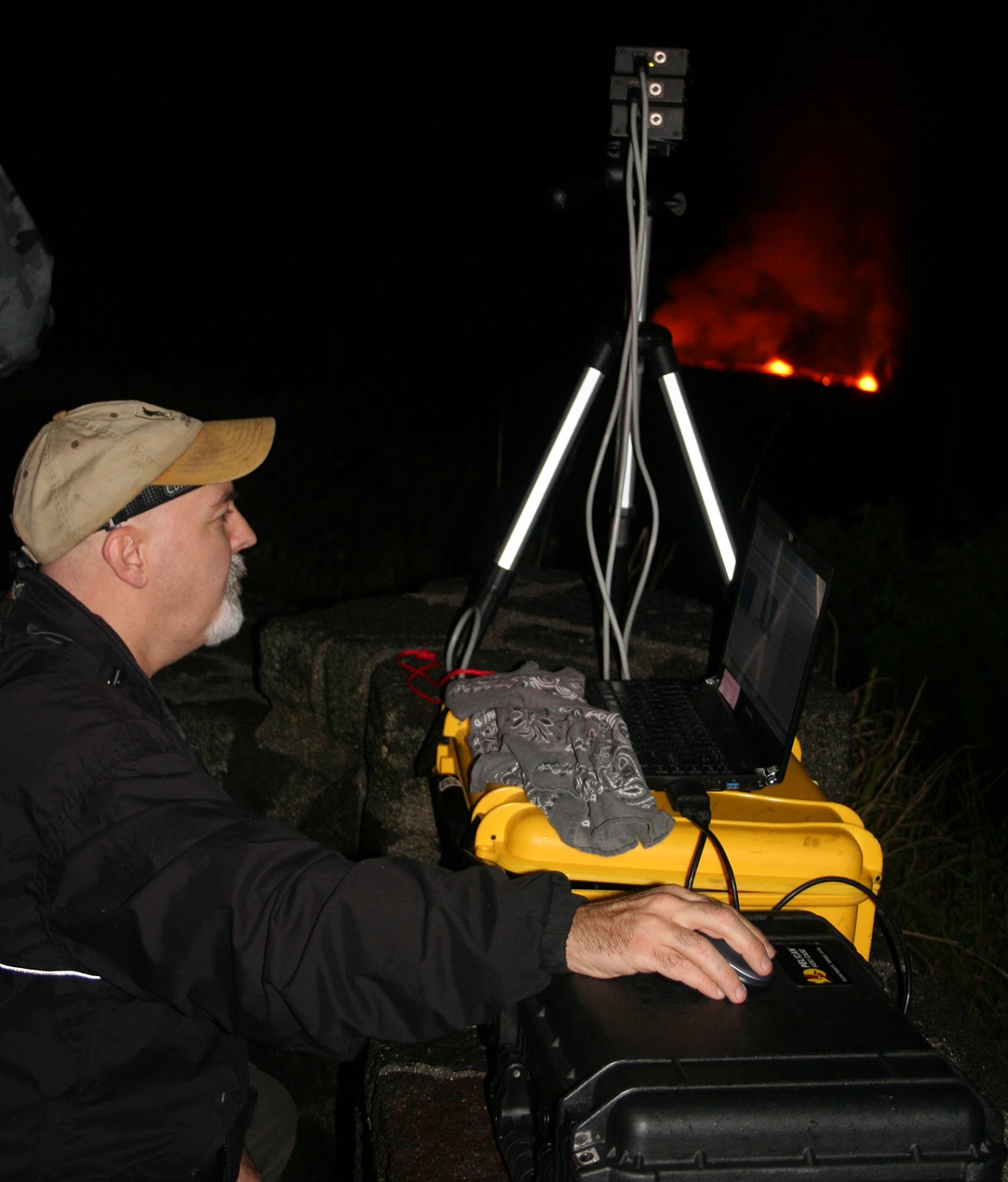
 U.S. Geological Survey scientist used a custom-built,
high-speed camera to remotely measure the
temperature of spattering lava on the surface
of Kīlauea Volcano's summit lava lake
(background). This particular experiment,
conducted from the Jaggar Museum
overlook in Hawaiʻi Volcanoes National
Park on December 10, 2016, was part of
 a NASA-funded research project. USGS photo.
     The outer surface of erupting lava cools incredibly quickly when it is first exposed to air—hundreds of degrees per second. Hence, remotely measuring the eruption temperature is an attempt to record something that is visible for only a fraction of a second. Previous work on Kīlauea and other active volcanoes has demonstrated that existing methods of remotely determining lava flow temperatures can have hundreds of degrees of uncertainty.
       In early December 2016, scientists from the U.S. Geological Survey and NASA visited Kīlauea Volcano to experiment with a portable, ground-based camera system for use as an optical imaging pyrometer. The custom-built, high-speed camera can acquire images at more than 50 frames per second in three wavelengths (green, red, and near-infrared). It was calibrated by collecting images of a high temperature calibration oven.
     During their field work, the USGS and NASA scientists collected thousands of images of active lava from Kīlauea's two ongoing eruptions. This included breakouts along the 61g lava flow, as well as spattering lava along the edges of the summit lava lake, which was visible from the Jaggar Museum overlook in Hawai'i Volcanoes National Park. 
     The eruption temperature of Kīlauea lava is well-known— up to about 1170 degrees Celsius (2140 degrees Fahrenheit) at the summit and around 1140 degrees Celsius (2084 degrees Fahrenheit) on the East Rift Zone. Because of this, the volcano is the perfect place to determine how these camera data can be used to retrieve reliable temperatures from the hottest parts of active flows and lava lakes.
     The results of this study will establish the validity of a generic data processing method that could be applied to other satellite, airborne, and ground-based remote sensing data sets. The ultimate goal of this NASA-funded research is to design an instrument capable of reliably measuring the temperature of active lava on Jupiter's moon, Io, the only other object in our solar system known to have active, high-temperature volcanism.
Kīlauea Volcano, on the Island of Hawaiʻi, is one of the best places in the world for scientists to conduct their remote sensing research, which is important for future NASA missions to the outer reaches of our solar system, concluded Volcano Watch.

Kīlauea spatter shows a red color, which is cooler than yellow and orange.
Scientists can remotely measure temperature of the lava from
a distance. USGS photo
VOLCANO ACTIVITY UPDATES:
     Kīlauea continues to erupt at its summit and East Rift Zone. This past week, the summit lava lake level varied between about 20 and 30 m (66–98 ft) below the vent rim. The 61g flow was still active, with lava entering the ocean near Kamokuna and surface breakouts downslope of Pu'u 'Ō'ō and on the coastal plain about 730 m (about 0.5 mi) inland of the ocean. The 61g flows do not pose an immediate threat to nearby communities.
     Mauna Loa is not erupting. During the past week, a few dozen small-magnitude earthquakes occurred beneath the volcano, primarily in the upper Southwest Rift at depths less than 5 km (3 mi), with a few on the volcano's west flank at slightly greater depths. GPS measurements continue to show deformation related to inflation of a magma reservoir beneath the summit and upper Southwest Rift Zone. No significant change in the summit fumarole temperature was noted this past week. 
     Two earthquakes were reported felt on the Island of Hawaiʻi this past week. On February 17, at 5:33 a.m., HST, a magnitude-4.6 earthquake occurred 23.7 km (14.7 mi) northwest of Kawaihae at a depth of 41 km (25 mi), and, at 5:49 a.m., a magnitude-2.4 earthquake occurred 22.4 km (13.9 mi) northwest of Kawaihae at a depth of 40 km (24 mi).
     Visit the HVO website (http://hvo.wr.usgs.gov) for past Volcano Watch articles, Kīlauea daily eruption updates, Mauna Loa weekly updates, volcano photos, recent earthquakes info, and more; call for summary updates at 808-967-8862 (Kīlauea) or 808-967-8866 (Mauna Loa); email questions to askHVO@usgs.gov

Ocean View Community Development Corp. meeting, Fri, Feb 24, 5 p.m., Hawaiian Ranchos office.

Japanese Internment on Hawai`i Island is the subject of the first Coffee Talk at Kahuku, Friday, Feb. 24 at 9:30 a.m., Kahuku Unit Visitor Center at Hawai`i Volcanoes National Park. Dr. Jade Moniz-Nakamua leads the talk on Japanese held at Kilauea Military Camp during World War II. Free.
Counting whales in Ka`u and beyond this Saturday can be
supported by purchasing tee shirts.
See www.hawaiihumpbackwhale.noaa.gov

Sanctuary Ocean Count, Sat, Feb 25, 8 a.m. - 12:15 p.m., various coastal locations, several in Ka`u. Participants count humpback whales and record their behaviors. Registration required. See hawaiihumpbackwhale.noaa.gov or 725-5923.

Ka`u Hospital Community Input Meeting, Sat, Feb 25, 1:30 p.m. at the hospital. Kurt Corbin, Chair of the East Hawai`i Regional Board of the Hawai`i Hospital System Corp, which oversees the hospital and clinic operations, said that "Personal conversations and dialogue with our community stakeholders are absolutely essential in helping guide the decisions that the Regional Board must make." Board members and administrators will be on hand and a financial overview and future outlook will be presented. For more information, contact Terry Larson, Regional Board Secretary at 932-3103.

Love the Arts: Singin’ in the Rainforest, Sat, Feb 25, 5 – 9 p.m., Volcano Art Center in Volcano Village. The annual fundraiser features one-of-a-kind umbrellas painted by Hawai‘i Island artists. Fine wine, a luxurious gourmet buffet, spirited Hawaiian music and live and silent auctions. 967-8222.

Soil and Composting class at Ka`u Farm School on Sunday, Feb. 26 at Earth Matters Farm on the corner of South Point Road and Kama`oa Roa`oa Road, 2 p.m. to 6 p.m. Special guests include Rep. Richard Creagan, Chair of the Agriculture Committee of the state House of Representatives and Melanie Willich, Director of the Young Farmers Program at Kohala Center. Free, sponsored by Kohala Center and Hawai`i Farmers Union United. Donations accepted. RSVP to kaufarmschool@gmail.com or call 808-721-6977

Palm Trail Hike, Sun, Feb 26, 9:30 a.m. – 12:30 p.m., Hawai‘i Volcanoes National Park’s Kahuku Unit. This free, moderately difficult 2.6-mile loop trail provides one of the best panoramic views Kahuku has to offer.