|
| While Hawaiʻi Volcanoes National Park is closed, its staff and USGS Hawaiian Volcanoes Observatory are asking the public to weigh in on its future by June. Photo by Julia Neal |
PUBLIC INPUT FOR THE DISASTER RECOVERY PROJECT AT HAWAIʻI VOLCANOES NATIONAL PARK is sought by the Park and the U.S. Geological Survey. A joint statement issued today says they seek, "community input to consider and refine four initial design concepts for the proposed HAVO Disaster Recovery Project via a virtual civic engagement process." See the concept drawings and read the plans in upcoming Kaʻū News Briefs.
The intent of the project is to repair and/or replace critical park infrastructure and USGS-operated facilities and equipment, damaged during the 2018 eruption and summit collapse of Kīlauea volcano. The project also includes plans for the potential future use of the Uēkahuna Bluff area, a site considered sacred to many Native Hawaiians and other groups.
 |
| The public is invited to be involved in planning for the future of Hawaiʻi Volcanoes National Park as it remains closed due to Covid-19. Photo by Julia Neal |
The seismic activity was primarily centered near the crater, and significantly impacted buildings in the immediate vicinity on Uēkahuna Bluff, including Jaggar Museum and the USGS-operated Reginald T. Okamura facility and equipment, resulting in the closure of the area. The 2018 eruption and caldera collapse were the most destructive eruptive events in Hawai‘i in the last two centuries.
 |
| Rhonda Loh, Acting Superintendent of Hawaiʻi Volcanoes National Park. NPS photo |
T. Okamura building safe to occupy and operational. Most importantly, the buildings are surrounded by fault lines and the area continues to subside on the crater side, undermining slope stability at the existing terraces and building foundations.
In addition, the project presents solutions to overcrowding at Kīlauea Visitor Center, ranging from renovation to rebuilding the facility elsewhere in the Park.
The Park is closed during the pandemic, but during normal times when it is open to the public, "The existing KVC building is inadequate for current visitation due to its small size, and the closure of Jaggar Museum has exacerbated the overcrowding of KVC by concentrating all visitor contact in one location," says the statement from the Park and USGS.
Hawai‘i Volcanoes National Park Acting Superintendent Rhonda Loh said, "Hawai‘i Volcanoes National Park belongs to everyone, and to our future generations. We need to hear from our community and stakeholders about what they envision for their mo‘opuna - their grandchildren - and the generations that will follow."
USGS HHVO Scientist-in-Charge, Tina Neal said, "The USGS Hawaiian Volcano Observatory is looking forward to a new field station inside Hawai‘i Volcanoes National Park. A facility in the summit region is vital for our volcano monitoring and research programs that support Park management and public safety in Hawai‘i."
To slow the spread of COVID-19, the Park will conduct the civic engagement online in lieu of public meetings.
To view and comment on the four design concepts and summaries, visit https://parkplanning.nps.gov/projectHome.cfm?projectId=92891. To be mailed the design concepts, or to receive answers to questions, call (808) 460-6212, or email havo_planning@nps.gov. The comment period will end June 15. Following this period, the National Park Service will use community feedback received to determine which concept, or modified concept, will be the proposed concept. NPS will evaluate the impacts of any proposed alternative.
The statement from the Park and USGS says, "During this process, if it is safe to do so, the Park hopes to hold in-person meetings with the community. The NPS and USGS encourage civic engagement throughout the process. Public input early in the process is important. The park is currently in the preliminary planning phase of this project, and invites all interested members of the community to voice your ideas, comments, or concerns regarding this effort."
To read comments, add your own, and like this story, see Facebook. Follow us on Instagram and Twitter. See our Fresh Food on The Kaʻū Calendar and our latest print edition at kaucalendar.com.
CAN HAWAIʻI IMPOSE AND ENFORCE COVID-19 PREVENTION PUBLIC HEALTH REQUIREMENTS FOR PEOPLE TO FLY HERE? Congressman Ed Case today called on the Federal Aviation Administration to clarify. Case's letter to FAA Administrator Steve Dickson asks for the FAA's "cooperation in confirming Hawai‘i's ability to impose and enforce conditions on air travel to Hawai‘i, which are critical to ensuring the health of Hawai‘i's residents and visitors, and the safe recovery of Hawai‘i's economy and in particular our travel and tourism industry."
Case wrote, "This could include requiring testing of all intended passengers (including crew) on any direct air travel to Hawai‘i before boarding. Such testing could include at least fever testing and, as available, on-site rapid COVID-19 testing, as now required by international airlines such as Emirates on some flights."
 Case said the airline would enforce the conditions
to accept any intended
passenger on any direct flight to Hawai‘i, and any airline "would be required
to deny boarding to any intended passenger with a fever which, under
Centers for Disease Control and Prevention guidelines, indicates
potential COVID-19 infection or who tests positive."
Case said the airline would enforce the conditions
to accept any intended
passenger on any direct flight to Hawai‘i, and any airline "would be required
to deny boarding to any intended passenger with a fever which, under
Centers for Disease Control and Prevention guidelines, indicates
potential COVID-19 infection or who tests positive."
He noted that State of Hawai‘i imposed the 14-day incoming quarantine requirement, in large part, because it understood from the FAA that imposition of such pre-board conditions was not authorized by existing statutes and regulations, and would jeopardize federal funding. He also said that he understands that FAA focuses on safe and efficient use of the nation's airspace (with safety not generally including protection of general ground populations from COVID-19). He said, "protection of the general public health in addition to air-related risks is not within FAA's mandate." He wrote that "absent superseding authority in other federal agencies such as the CDC, the FAA is unwilling or unable to authorize the State of Hawai‘i to impose reasonable public health-related restrictions on travelers as a condition of travel to Hawai‘i."
Case urged the FAA Administrator to "revisit these issues and assist me, the State of Hawai‘i, the people I represent, the visitors to Hawai‘i, and the destinations to which they will return, in finding a solution allowing the State of Hawai‘i to impose reasonable public health pre-board conditions on intended passengers to Hawai‘i." He asked that, if necessary, the FAA help him to propose statutory amendments that would provide FAA with the necessary authority.
"I ask that you do so on an emergency basis, considering the continued public health threat to Hawai‘i from our inability to impose and enforce effective mitigation requirements. But I also ask that you do so because these questions will have to be answered and the necessary changes will have to be made for Hawai‘i to reopen to any great extent to air travel. Simply put, if passengers do not feel safe coming to Hawai‘i because they fear contracting COVID-19 on the flight or in Hawai‘i, or if Hawai‘i residents do not feel safe with passengers getting off planes in Hawai‘i, air travel to Hawai‘i will not recover, leading to many consequences to include FAA and airport-supportive revenues."
The letter concludes: "Considering the urgency of protecting Hawai‘i's
current and future public health, I ask for your specific response by no later
than Wednesday, May 20th. I stand ready, together with the State of Hawai‘i
and other interested parties both in Hawai‘i and nationally, to work with you
on fashioning an effective solution to this critical matter."
To read comments, add your own, and like this story, see Facebook. Follow us on Instagram and Twitter. See our Fresh Food on The Kaʻū Calendar and our latest print edition at kaucalendar.com.
MORINGA, A HIGHLY NUTRITIOUS, HARDY TREE, propagated to help those in need of food throughout the world, made its way into the ‘O Ka‘ū Kākou Market in Nā‘ālehu on Wednesday. Propagator and researcher of food plants, Ed Rau, founder of Sustainable Bioresources, LLC in Discovery Harbour, set up a booth and gave young, potted trees away.
Food from the moringa comes from its deep green leaves, tubers, and very young seed pods. It is familiar in Filipino gardens and cuisine as malunggay. The new leaves can be eaten raw in salads, and cooked in soups and stews. The young seedpods can be cooked and eaten before they become large and fibrous. The tubers are also known for their nutrition and for cooking.
Trees can grow tall and thin or be pruned to stay low, like coffee trees, to allow them to bush out with maximum leaf productivity. Rau says the flowers are edible and provide nectar for bees.
Moringa is a member of the horseradish, drumstick, and bottle tree family. It is also known for its medicinal uses. Rau said, "Research and development of new products from moringa, establishing an International Moringa Seed Bank, and promotion of moringa as a major crop in Hawai‘i, have become the primary activities of our company." He said he will meet with anyone interested in moringa farming or placing moringa in family food gardens.
In places where there is famine, moringa has been planted and seeds distributed to grow food for the hungry. According to sustainablebioresources.com:
"The leaves are the most nutritious part of the plant and are a significant source of vitamins, minerals, protein, and soluble dietary fiber. They can be eaten fresh, cooked as a vegetable, or dried and made into a powder for addition to soups, stews, bread, and other dishes. The powder is lightweight and easy to transport, does not require refrigeration, resists pest infestations, and retains much of its nutritional and medicinal properties in storage. These properties make it an ideal food supplement for use in programs to combat malnutrition, and iron and vitamin A deficiencies, in remote areas that have limited infrastructure and resources."
Moringa farms, with beehives, can provide honey year-round, as the flowering of moringa is continuous in such tropical places as Haiti, Rau said.
See sustainablebioresources.com or call Rau at 808-339-7325.
To read comments, add your own, and like this story, see Facebook. Follow us on Instagram and Twitter. See our Fresh Food on The Kaʻū Calendar and our latest print edition at kaucalendar.com.
THE ANNUAL HAWAI‘I COFFEE ASSOCIATION CONFERENCE IS POSTPONED. HCA President Chris Manfredi made the announcement today. The statewide event brought together HCA members, sponsors, coffee quality and tasting competitors, vendors, friends, and supporters.
"We regret to announce the HCA's 25th Annual Conference, Trade Show and Cupping Competition originally scheduled for July 30-August 1, 2020 will be postponed until a date to be determined. The recent developments surrounding the COVID 19 pandemic make planning and safely executing the event impractical at this time. We will continue to survey our members so that we may best address the needs of Hawai‘i's coffee industry."
Visit hawaiicoffeeassoc.org for recent information. "We have been posting information to help you manage the recent crisis," said Manfredi.
HCA is also planning a webinar to provide updates on the effects of the pandemic on the Hawai‘i coffee industry, and other topics. See the HCA website for webinar dates and schedules.
To read comments, add your own, and like this story, see Facebook. Follow us on Instagram and Twitter. See our Fresh Food on The Kaʻū Calendar and our latest print edition at kaucalendar.com.
A KA‘Ū HOSPITAL NURSE DREW AN AWARD AND PRAISE through a Central Pacific Bank celebration of frontline workers during the pandemic. Jerelyn Hammer, RN, works in long term care. Here is the write up for the nomination:
"I nominate Ajer Hammer, a ER/Long-Term-care nurse at Ka‘ū Hospital on the Big Island, a remote hospital with some of the hardest working CNA's and fellow RN's/LPN's.
"Most days, one RN is in charge of the entire ER, while another is in charge of the entire long term care, hustling after their shift is over, working through lunch breaks. She is my hero because she never ceases to amaze me with her compassion towards her patients and her co-workers. She always has time to help others. She and her co-workers are some of the kindest hospital staff you will ever be treated by. Thank you Ajer Hammer for all you do for your community."
Central Pacific Bank rewarded Hammer with Mahalo Meals, from the restaurant of her choice. She chose Thai Thai in Volcano. The meals arrived on Monday, "a great way to begin celebrating Hospital Week. The food was sensational. We are so proud of Jerelyn and really appreciative of the recognition of our great nursing staff," said Ka‘ū Hospital Administrator Merilyn Harris.
To read comments, add your own, and like this story, see Facebook. Follow us on Instagram and Twitter. See our Fresh Food on The Kaʻū Calendar and our latest print edition at kaucalendar.com.
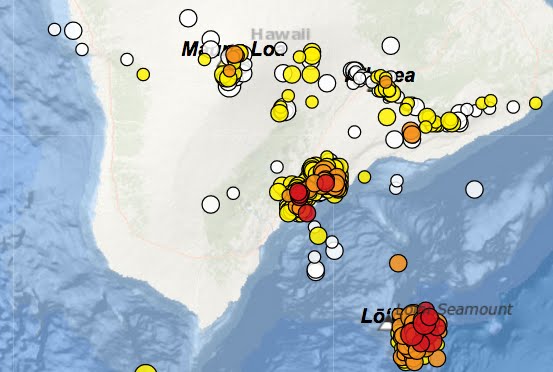
THE LŌʻIHI AND PĀHALA EARTHQUAKE SWARMS SLOWED DOWN on Tuesday and Wednesday. Hawaiian Volcano Observatory issued an overview:
Beginning at about 3 a.m. May 11, and continuing through the morning of May 12, HVO detected more than 100 earthquakes beneath Lōʻihi, including 79 magnitude-2 and 19 magnitude-3 and above. This is a significant increase above long term background rates of fewer than three earthquakes per day at Lōʻihi, generally with magnitudes less than M2. The number of earthquakes peaked at 14 per hour between 1 p.m. and 2 p.m. on Monday afternoon and decreased thereafter. Since the early morning hours of March 12, earthquake rates have been less than four per hour.
The earthquake swarm is located beneath the southeast rift zone and southeastern flank of Lōʻihi at depths of 3.6 to 12.4 km (2.2 to 7.7 mi) below sea level or approximately 1 to 9.8 km (0.6 to 6 mi) below the volcano's surface.
Hawai‘i Volcanoes National Park Acting Superintendent Rhonda Loh said, "Hawai‘i Volcanoes National Park belongs to everyone, and to our future generations. We need to hear from our community and stakeholders about what they envision for their mo‘opuna - their grandchildren - and the generations that will follow."
USGS HHVO Scientist-in-Charge, Tina Neal said, "The USGS Hawaiian Volcano Observatory is looking forward to a new field station inside Hawai‘i Volcanoes National Park. A facility in the summit region is vital for our volcano monitoring and research programs that support Park management and public safety in Hawai‘i."
To slow the spread of COVID-19, the Park will conduct the civic engagement online in lieu of public meetings.
 |
| USGS Scientists in Charge Tina Neal USGS photo |
The statement from the Park and USGS says, "During this process, if it is safe to do so, the Park hopes to hold in-person meetings with the community. The NPS and USGS encourage civic engagement throughout the process. Public input early in the process is important. The park is currently in the preliminary planning phase of this project, and invites all interested members of the community to voice your ideas, comments, or concerns regarding this effort."
To read comments, add your own, and like this story, see Facebook. Follow us on Instagram and Twitter. See our Fresh Food on The Kaʻū Calendar and our latest print edition at kaucalendar.com.
CAN HAWAIʻI IMPOSE AND ENFORCE COVID-19 PREVENTION PUBLIC HEALTH REQUIREMENTS FOR PEOPLE TO FLY HERE? Congressman Ed Case today called on the Federal Aviation Administration to clarify. Case's letter to FAA Administrator Steve Dickson asks for the FAA's "cooperation in confirming Hawai‘i's ability to impose and enforce conditions on air travel to Hawai‘i, which are critical to ensuring the health of Hawai‘i's residents and visitors, and the safe recovery of Hawai‘i's economy and in particular our travel and tourism industry."
Case wrote, "This could include requiring testing of all intended passengers (including crew) on any direct air travel to Hawai‘i before boarding. Such testing could include at least fever testing and, as available, on-site rapid COVID-19 testing, as now required by international airlines such as Emirates on some flights."
 Case said the airline would enforce the conditions
to accept any intended
passenger on any direct flight to Hawai‘i, and any airline "would be required
to deny boarding to any intended passenger with a fever which, under
Centers for Disease Control and Prevention guidelines, indicates
potential COVID-19 infection or who tests positive."
Case said the airline would enforce the conditions
to accept any intended
passenger on any direct flight to Hawai‘i, and any airline "would be required
to deny boarding to any intended passenger with a fever which, under
Centers for Disease Control and Prevention guidelines, indicates
potential COVID-19 infection or who tests positive."He noted that State of Hawai‘i imposed the 14-day incoming quarantine requirement, in large part, because it understood from the FAA that imposition of such pre-board conditions was not authorized by existing statutes and regulations, and would jeopardize federal funding. He also said that he understands that FAA focuses on safe and efficient use of the nation's airspace (with safety not generally including protection of general ground populations from COVID-19). He said, "protection of the general public health in addition to air-related risks is not within FAA's mandate." He wrote that "absent superseding authority in other federal agencies such as the CDC, the FAA is unwilling or unable to authorize the State of Hawai‘i to impose reasonable public health-related restrictions on travelers as a condition of travel to Hawai‘i."
Case urged the FAA Administrator to "revisit these issues and assist me, the State of Hawai‘i, the people I represent, the visitors to Hawai‘i, and the destinations to which they will return, in finding a solution allowing the State of Hawai‘i to impose reasonable public health pre-board conditions on intended passengers to Hawai‘i." He asked that, if necessary, the FAA help him to propose statutory amendments that would provide FAA with the necessary authority.
"I ask that you do so on an emergency basis, considering the continued public health threat to Hawai‘i from our inability to impose and enforce effective mitigation requirements. But I also ask that you do so because these questions will have to be answered and the necessary changes will have to be made for Hawai‘i to reopen to any great extent to air travel. Simply put, if passengers do not feel safe coming to Hawai‘i because they fear contracting COVID-19 on the flight or in Hawai‘i, or if Hawai‘i residents do not feel safe with passengers getting off planes in Hawai‘i, air travel to Hawai‘i will not recover, leading to many consequences to include FAA and airport-supportive revenues."
 |
| The moringa giveaway at OKK Market in Nāʻālehu today came with education from Ed Rau.He promotes growing the trees for high nutrition value food,courtesyof hisSustainable Bioresources, based in Discovery Harbour. Photo by Yvette Slack |
To read comments, add your own, and like this story, see Facebook. Follow us on Instagram and Twitter. See our Fresh Food on The Kaʻū Calendar and our latest print edition at kaucalendar.com.
MORINGA, A HIGHLY NUTRITIOUS, HARDY TREE, propagated to help those in need of food throughout the world, made its way into the ‘O Ka‘ū Kākou Market in Nā‘ālehu on Wednesday. Propagator and researcher of food plants, Ed Rau, founder of Sustainable Bioresources, LLC in Discovery Harbour, set up a booth and gave young, potted trees away.
Food from the moringa comes from its deep green leaves, tubers, and very young seed pods. It is familiar in Filipino gardens and cuisine as malunggay. The new leaves can be eaten raw in salads, and cooked in soups and stews. The young seedpods can be cooked and eaten before they become large and fibrous. The tubers are also known for their nutrition and for cooking.
 |
| The young pods of moringa, locally called malunggay, offer muchprotein, vitamins, and fiber, as do the leaves and tubers.Photo from sustainablebioresources.com |
Moringa is a member of the horseradish, drumstick, and bottle tree family. It is also known for its medicinal uses. Rau said, "Research and development of new products from moringa, establishing an International Moringa Seed Bank, and promotion of moringa as a major crop in Hawai‘i, have become the primary activities of our company." He said he will meet with anyone interested in moringa farming or placing moringa in family food gardens.
 |
| Moringa plants flower year-round forfood and honey production in Haiti Photo from Sustainable Bioresources. |
"The leaves are the most nutritious part of the plant and are a significant source of vitamins, minerals, protein, and soluble dietary fiber. They can be eaten fresh, cooked as a vegetable, or dried and made into a powder for addition to soups, stews, bread, and other dishes. The powder is lightweight and easy to transport, does not require refrigeration, resists pest infestations, and retains much of its nutritional and medicinal properties in storage. These properties make it an ideal food supplement for use in programs to combat malnutrition, and iron and vitamin A deficiencies, in remote areas that have limited infrastructure and resources."
Moringa farms, with beehives, can provide honey year-round, as the flowering of moringa is continuous in such tropical places as Haiti, Rau said.
See sustainablebioresources.com or call Rau at 808-339-7325.
To read comments, add your own, and like this story, see Facebook. Follow us on Instagram and Twitter. See our Fresh Food on The Kaʻū Calendar and our latest print edition at kaucalendar.com.
THE ANNUAL HAWAI‘I COFFEE ASSOCIATION CONFERENCE IS POSTPONED. HCA President Chris Manfredi made the announcement today. The statewide event brought together HCA members, sponsors, coffee quality and tasting competitors, vendors, friends, and supporters.
 |
| HCA Pres. Chris Manfredi |
Visit hawaiicoffeeassoc.org for recent information. "We have been posting information to help you manage the recent crisis," said Manfredi.
HCA is also planning a webinar to provide updates on the effects of the pandemic on the Hawai‘i coffee industry, and other topics. See the HCA website for webinar dates and schedules.
To read comments, add your own, and like this story, see Facebook. Follow us on Instagram and Twitter. See our Fresh Food on The Kaʻū Calendar and our latest print edition at kaucalendar.com.
A KA‘Ū HOSPITAL NURSE DREW AN AWARD AND PRAISE through a Central Pacific Bank celebration of frontline workers during the pandemic. Jerelyn Hammer, RN, works in long term care. Here is the write up for the nomination:
"I nominate Ajer Hammer, a ER/Long-Term-care nurse at Ka‘ū Hospital on the Big Island, a remote hospital with some of the hardest working CNA's and fellow RN's/LPN's.
 |
| Nurses and staff receive Thai Thai Mahalo Meals to frontline workers courtesy of Central Pacific Bank and a winner for her work,Jerelynn Hammer, RN, at Kaʻū Hospital. Photo from Kaʻū Hospital |
Central Pacific Bank rewarded Hammer with Mahalo Meals, from the restaurant of her choice. She chose Thai Thai in Volcano. The meals arrived on Monday, "a great way to begin celebrating Hospital Week. The food was sensational. We are so proud of Jerelyn and really appreciative of the recognition of our great nursing staff," said Ka‘ū Hospital Administrator Merilyn Harris.
To read comments, add your own, and like this story, see Facebook. Follow us on Instagram and Twitter. See our Fresh Food on The Kaʻū Calendar and our latest print edition at kaucalendar.com.
THE LŌʻIHI AND PĀHALA EARTHQUAKE SWARMS SLOWED DOWN on Tuesday and Wednesday. Hawaiian Volcano Observatory issued an overview:
Beginning at about 3 a.m. May 11, and continuing through the morning of May 12, HVO detected more than 100 earthquakes beneath Lōʻihi, including 79 magnitude-2 and 19 magnitude-3 and above. This is a significant increase above long term background rates of fewer than three earthquakes per day at Lōʻihi, generally with magnitudes less than M2. The number of earthquakes peaked at 14 per hour between 1 p.m. and 2 p.m. on Monday afternoon and decreased thereafter. Since the early morning hours of March 12, earthquake rates have been less than four per hour.
The earthquake swarm is located beneath the southeast rift zone and southeastern flank of Lōʻihi at depths of 3.6 to 12.4 km (2.2 to 7.7 mi) below sea level or approximately 1 to 9.8 km (0.6 to 6 mi) below the volcano's surface.
According to HVO, "This swarm may represent a brief magmatic intrusion or movement of magmatic fluids within the volcanic edifice. Although the swarm appears to have diminished in intensity, if earthquakes become shallower, it could lead to the beginning of a submarine eruption, similar to what occurred in 1996.
"An eruption of Lōʻihi, if it were to occur, may cause partial draining of its summit magma chamber and summit collapse, as happened in 1996. Significant, sudden changes to the volcano's surface could displace large volumes of ocean water, which, if large enough, might generate very small local tsunami waves. Earthquakes of magnitude 4 and above could occur if the swarm were to intensify and these may be felt on the Island of Hawaiʻi.
"If an eruption or stronger earthquakes occur, very small tsunami waves may affect southeast shores of the Island of Hawaiʻi. Relatively low-energy, steam- and gas-driven explosions can occur at the depth of Lōʻihi, but with limited local effects on the volcano and surrounding ocean water.
There is no direct relationship between the current Lōʻihi swarm and the ongoing increased seismicity observed in Pāhala over the past year. The Lōʻihi swarm is ~35 km (21.7 mi) southeast of Pāhala, at significantly shallower depths. The current Lōʻihi swarm is also unrelated to seismicity observed on the south flank of Kīlauea."
HVO provides its in-depth description of Lōʻihi: The seamount is an active volcano on the seafloor south of Kīlauea Volcano, about 30 km (19 miles) from the shoreline of the Island of Hawaiʻi. The top of the seamount is about 975 m (3,199 feet ) below sea level. The volcano consists of a broad summit area marked by three pit craters and two prominent rift zones extending from the summit about 22 km (13.6 mi) south-southeast and about 15 km (9.3 mi) north-northeast. The volcano likely has a shallow magma chamber between 1 to 2.5 km (0.6 to 1.6 mi) deep below the summit.
Earthquake activity has been recorded near Lōʻihi since 1952. Prior Lōʻihi earthquake swarms occurred in 1952, 1971–72, 1975, 1986, 1988, 1990, 1991, 1996, 2005, and 2017, and were characterized by hundreds to thousands of earthquakes occurring over weeks to months with magnitudes ranging up to M4.9.
The largest earthquake detected at Lōʻihi was a M5.1 in May of 2005. Many of the 1952 Lōʻihi earthquakes were felt in coastal communities and one of the earthquakes generated a small tsunami that swept inland about 180 m (600 ft) at Kalapana; no damage was reported. The 1996 Lōʻihi earthquake swarm was one of the most intense earthquake swarms recorded by the HVO monitoring networks and is summarized below.
For the six weeks commencing July 16, 1996, HVO recorded more than 4,000 earthquakes in the Lōʻihi area. Ninety-five of the earthquakes were between magnitude-4.0 and 4.9, and nearly 400 were stronger than M3. Most of the quakes occurred during the last half of July during three time periods, each lasting about two to five days and separated by less than one to four days. Subsequent undersea expeditions to the area discovered that the volcano's summit area had collapsed to form a new crater about 1,800 ft across and 900 ft deep. Hydrothermal vents were observed in the new crater, and evidence was found of newly erupted lava. For more information, see the University of Hawaiʻi, School of Ocean and Earth Science and Technology, web site.
HVO continues to closely monitor the earthquake activity in the Lōʻihi area and will issue further updates as needed. There are no monitoring instruments on Lōʻihi seamount, thus earthquake locations are not as accurate as those on the Island of Hawaiʻi. Significant changes in activity at Lōʻihi, Mauna Loa, and Kīlauea Volcanos will be reported through the USGS Volcano Notification System and the HVO website. They are in frequent communication with Hawai‘i Volcanoes National Park and Hawai‘i County Civil Defense, to keep them apprised of the activity.
To read comments, add your own, and like this story, see Facebook. Follow us on Instagram and Twitter. See our Fresh Food on The Kaʻū Calendar and our latest print edition at kaucalendar.com.
NO NEW CASES OF COVID-19 were reported for Hawaiʻi Island Tuesday. There are also no active cases on the island. Of 75 cases confirmed since the pandemic began, all 75 recovered. There were no deaths on Hawaiʻi Island. Only one case was confirmed in Kaʻū, the victim, now recovered, from the 96772 zip code. There have been no cases in Volcano.
Today's message from Hawaiʻi County Civil Defense Director Talmadge Magno says that the number of people tested on Hawaiʻi Island is about 5,100. Seventy-five tested positive and all 75 have been cleared as recovered by the Department of Health.
"The health care organizations, to all of you, and the supporting agencies, a huge acknowledgment and thank you, for your good work of developing and continuing a comprehensive testing network for the safety of Hawaiʻi's people. Know that early testing means early detection and early care, and you are helping develop a comprehensive database of information for health care officials to know what is going on and to keep on top of things.
"Remember, the good numbers today just reinforces the importance of following the policies of prevention. The virus threats still remain, and we need to get better and keep Hawaiʻi safe. Thank you for listening, and how lucky we are to be here in Hawaiʻi. This is your Hawaiʻi County Civil Defense."
Statewide, three new cases were reported today by DOH, all on Oʻahu, bringing the state's case count to 638. The state death toll remains 17, with 11 on Oʻahu and six on Maui .
Worldwide, more than 4.34 million have contracted COVID-19. The death toll is more than 297,108.
To read comments, add your own, and like this story, see Facebook. Follow us on Instagram and Twitter. See our Fresh Food on The Kaʻū Calendar and our latest print edition at kaucalendar.com.
To read comments, add your own, and like this story, see Facebook. Follow us on Instagram
and Twitter.
See our Fresh Food on
The Kaʻū Calendar
and our latest print edition at kaucalendar.com.
Daily, weekly, and monthly recurring Kaʻū and Volcano Events, Meetings, Entertainment, Exercise, Meditation, and more are listed at kaucalendar.com. However, all non-essential activities are canceled through the end of May.
MOST EVENTS ARE CANCELLED to stem the spread of the novel coronavirus. The state is under a stay-at-home order, with l4 days of quarantine required for anyone coming into the state. Interisland travel is restricted. Those in Hawaiʻi should stay at home unless needing to obtain food or medical care.
 The Food Basket Food Pantries Distribution, where families can receive 14 days of food per family:


 |
| Lōʻihi, the seamount, an underwater volcano, off the Kaʻū Coast. Images from University of Hawaiʻi |
"If an eruption or stronger earthquakes occur, very small tsunami waves may affect southeast shores of the Island of Hawaiʻi. Relatively low-energy, steam- and gas-driven explosions can occur at the depth of Lōʻihi, but with limited local effects on the volcano and surrounding ocean water.
There is no direct relationship between the current Lōʻihi swarm and the ongoing increased seismicity observed in Pāhala over the past year. The Lōʻihi swarm is ~35 km (21.7 mi) southeast of Pāhala, at significantly shallower depths. The current Lōʻihi swarm is also unrelated to seismicity observed on the south flank of Kīlauea."
HVO provides its in-depth description of Lōʻihi: The seamount is an active volcano on the seafloor south of Kīlauea Volcano, about 30 km (19 miles) from the shoreline of the Island of Hawaiʻi. The top of the seamount is about 975 m (3,199 feet ) below sea level. The volcano consists of a broad summit area marked by three pit craters and two prominent rift zones extending from the summit about 22 km (13.6 mi) south-southeast and about 15 km (9.3 mi) north-northeast. The volcano likely has a shallow magma chamber between 1 to 2.5 km (0.6 to 1.6 mi) deep below the summit.
 |
| The Nautilus SUBSEA program collects data from the underwater Lōʻihi volcano in 2018. Photo from Nautilus |
The largest earthquake detected at Lōʻihi was a M5.1 in May of 2005. Many of the 1952 Lōʻihi earthquakes were felt in coastal communities and one of the earthquakes generated a small tsunami that swept inland about 180 m (600 ft) at Kalapana; no damage was reported. The 1996 Lōʻihi earthquake swarm was one of the most intense earthquake swarms recorded by the HVO monitoring networks and is summarized below.
 |
| Lōʻihi will probably be the next volcano to rise out of the ocean to form a new Hawaiian Island. |
HVO continues to closely monitor the earthquake activity in the Lōʻihi area and will issue further updates as needed. There are no monitoring instruments on Lōʻihi seamount, thus earthquake locations are not as accurate as those on the Island of Hawaiʻi. Significant changes in activity at Lōʻihi, Mauna Loa, and Kīlauea Volcanos will be reported through the USGS Volcano Notification System and the HVO website. They are in frequent communication with Hawai‘i Volcanoes National Park and Hawai‘i County Civil Defense, to keep them apprised of the activity.
To read comments, add your own, and like this story, see Facebook. Follow us on Instagram and Twitter. See our Fresh Food on The Kaʻū Calendar and our latest print edition at kaucalendar.com.
 |
No COVID-19 cases so far in the zip code areas of Volcano,
Pāhala, and Ocean View. White indicates zero cases, light
yellow indicates one to five cases. The 96772 area in
Kaʻū has one case recorded. Map from DOH
|
Today's message from Hawaiʻi County Civil Defense Director Talmadge Magno says that the number of people tested on Hawaiʻi Island is about 5,100. Seventy-five tested positive and all 75 have been cleared as recovered by the Department of Health.
"The health care organizations, to all of you, and the supporting agencies, a huge acknowledgment and thank you, for your good work of developing and continuing a comprehensive testing network for the safety of Hawaiʻi's people. Know that early testing means early detection and early care, and you are helping develop a comprehensive database of information for health care officials to know what is going on and to keep on top of things.
"Remember, the good numbers today just reinforces the importance of following the policies of prevention. The virus threats still remain, and we need to get better and keep Hawaiʻi safe. Thank you for listening, and how lucky we are to be here in Hawaiʻi. This is your Hawaiʻi County Civil Defense."
 |
Civil Defense Director
|
Worldwide, more than 4.34 million have contracted COVID-19. The death toll is more than 297,108.
WATCH THE 2020 PANAʻEWA STAMPEDE RODEO tomorrow and
Saturday. The Cowboy Channel show Wild Rides will feature the
competition, which features paniolo from Kaʻū, on Thursday, May 14 at 7:30 p.m. and Saturday, May 16 at 4:30 p.m. The Thursday showing includes Rider the
Rodeo Clown / Performer and his wife. The Saturday showing will include JJ
Harrison.
The first
show from Panaʻewa Stampede Rodeo was on last week, on RFD TV. The second
show has been on two times on Wild Rides on the Cowboy Channel.
 |
Read online at kaucalendar.com. See our Fresh Food on The Kaʻū Calendar
directory for farms, ranches, takeout. Print edition of The Kaʻū Calendar is
free, with 7,500 distributed on stands and to all postal addresses throughout
Kaʻū, from Miloliʻi through Volcano throughout the district. Read online at
kaucalendar.com and facebook.com/kaucalendar. To advertise your
business or your social cause, contact kaucalendarads@gmail.com.
|
and Twitter.
See our Fresh Food on
The Kaʻū Calendar
and our latest print edition at kaucalendar.com.
Daily, weekly, and monthly recurring Kaʻū and Volcano Events, Meetings, Entertainment, Exercise, Meditation, and more are listed at kaucalendar.com. However, all non-essential activities are canceled through the end of May.
MOST EVENTS ARE CANCELLED to stem the spread of the novel coronavirus. The state is under a stay-at-home order, with l4 days of quarantine required for anyone coming into the state. Interisland travel is restricted. Those in Hawaiʻi should stay at home unless needing to obtain food or medical care.
ONGOING
Free COVID-19 Screenings are at Bay Clinic during business hours, with appointment. Call 333-3600.
 ʻO Kaʻū Kākou Market in Nāʻālehu is open three days per week – Monday, Wednesday, and Friday – from 8 a.m. to noon. The goal is no more than 50 customers on the grounds at a time. Vendor booths per day are limited to 25, with 30 feet of space between vendors. Masks and hand sanitizing are required to attend the market. Social distancing will be enforced. A wide selection of fresh vegetables and fruits, prepared take away foods, assorted added value foods, breads and baked goods, honey, cheese, grass-fed beef, fish, vegetable plants, masks, handmade soaps, coffee, and more are offered on various days. Contact Sue Barnett, OKK Market Manager, at 808-345-9374, for more and to apply to vend.
 Volcano Farmers Market at
 Cooper Center Wright Road , off of Old Volcano Highway , is open on Sundays from 6 a.m. to 10 a.m. , with much local produce, island beef, and prepared foods. Call 808-967-7800.
Free Breakfast and Lunch for Anyone Eighteen and Under is available at Kaʻū High & Pāhala Elementary and at Nāʻālehu Elementary weekdays through May. Each youth must be present to receive a meal. Service is drive-up or walk-up, and social distancing rules (at least six feet away) are observed. Breakfast is served 7:30 a.m. to 8 a.m., lunch from 11:30 a.m. to noon. Food is being delivered to Ocean View.
St. Jude's Episcopal Church Soup Kitchen is open, with a modified menu and increased health & safety standards, every Saturday from 9 a.m. to 1 p.m. Hot showers, the computer lab, and in-person services and bible studies are suspended. Services are posted online on Sundays at stjudeshawaii.org.
A testing team from Aloha Critical Care in Kona will provide testing at St. Jude's every other Wednesday. The next date is May 20 from 9 a.m. to 1 p.m.
The next drive-thru screening at Nāʻālehu Community Center will be held Wednesday, May 27 from 9 a.m. to 1 p.m. Screening will be carried out by Aliʻi Health, with support from County of Hawai‘i COVID-19 Task Force, Premier Medical Group and Pathways Telehealth.
 Wearing masks is required for everyone.
To bypass the screening queue at community test sites, patients can call ahead to Pathways Telehealth, option 5 at 808-747-8321. The free clinic will also offer on-site screening to meet testing criteria. Physicians qualify those for testing, under the guidance of Center for Disease Control & Prevention and Hawaiʻi's COVID-19 Response Task Force.
Those visiting screening clinics will be asked to show photo ID, and any health insurance cards – though health insurance is not required to be tested. They are also asked to bring their own pen to fill in forms.
For further information, call Civil Defense at 935-0031.
The next drive-thru screening at Nāʻālehu Community Center will be held Wednesday, May 27 from 9 a.m. to 1 p.m. Screening will be carried out by Aliʻi Health, with support from County of Hawai‘i COVID-19 Task Force, Premier Medical Group and Pathways Telehealth.

To bypass the screening queue at community test sites, patients can call ahead to Pathways Telehealth, option 5 at 808-747-8321. The free clinic will also offer on-site screening to meet testing criteria. Physicians qualify those for testing, under the guidance of Center for Disease Control & Prevention and Hawaiʻi's COVID-19 Response Task Force.
Those visiting screening clinics will be asked to show photo ID, and any health insurance cards – though health insurance is not required to be tested. They are also asked to bring their own pen to fill in forms.

 Volcano Farmers Market at
 Free Breakfast and Lunch for Anyone Eighteen and Under is available at Kaʻū High & Pāhala Elementary and at Nāʻālehu Elementary weekdays through May. Each youth must be present to receive a meal. Service is drive-up or walk-up, and social distancing rules (at least six feet away) are observed. Breakfast is served 7:30 a.m. to 8 a.m., lunch from 11:30 a.m. to noon. Food is being delivered to Ocean View.
St. Jude's Episcopal Church Soup Kitchen is open, with a modified menu and increased health & safety standards, every Saturday from 9 a.m. to 1 p.m. Hot showers, the computer lab, and in-person services and bible studies are suspended. Services are posted online on Sundays at stjudeshawaii.org.
 The Food Basket Food Pantries Distribution, where families can receive 14 days of food per family:
The Ocean View location for May was Kahuku Park on Monday, May 11, 10 a.m. to noon. Call The Food Basket, 933-6030, for the next date.
The Nāʻālehu location Sacred Heart Church at 95-558 Mamālahoa Hwy, under their Loaves and Fishes program, on Thursday, May 28 from9 a.m. to 11 a.m. Call 928-8208.
The Nāʻālehu location Sacred Heart Church at 95-558 Mamālahoa Hwy, under their Loaves and Fishes program, on Thursday, May 28 from
The Pāhala location is Kaʻū District Gym at 96-1149 Kamani Street , distributed by the ʻO Kaʻū Kākou Pantry, on Tuesday, May 26, 10 a.m. to noon. Call The Food Basket, 933-6030.
The Volcano location is Cooper Center at 19-4030 Wright Road Wednesday, May 27 from 10 a.m. to noon. Call Kehau at 443-4130.
On-Call Emergency Box Food Pantry is open at Cooper Center Tuesdays through Saturdays from 11 a.m. to noon. Call 967-7800 to confirm.
Kīlauea Visitor Center Auditorium Closed for Renovation through June 30. The Park is closed until further notice due to COVID-19 spread mitigation. A popular seven-and-a-half minute 2018 eruption video will be shown on a television in the exhibits area, once the Park and center reopen, and is available online for free download.
To read comments, add your own, and like this story, see Facebook. Follow us on Instagram and Twitter. See our online calendars and our latest print edition at kaucalendar.com.