About The Kaʻū Calendar

Monday, March 07, 2022

Ka‘ū News Briefs, Monday, March 7, 2022

Public Input due on March 11
Input on the proposed Disaster Recovery Project plans at Hawai'i Volcanoes National Park, including
new locations for visitor and research entities, parking and roadways is due March 11. 
See Story Map for visual interpretation of the project elements. NPS photo from November 2018 shows 
extensive damage to the closed southwest portion of Crater Rim Drive.

 THE PENTAGON ANNOUNCED TODAY IT WILL EMPTY FUEL STORED IN RED HILL that led to the tainting of drinking water for thousands of military families, other O'ahu residents and workers, forcing them to leave their homes. Rep. Kai Kahele, serving Kaʻū and all of rural Hawai'i in Congress, issued a statement, covering his role in negotiations. The decision by the Pentagon comes about a month after he and Congressman Ed Case introduced a measure in the House of Representatives, asking Congress to force the closure of fuel storage at Red Hill.

On Feb. 11, Congressman Kahele, with Rep, Ed Case to his left, introduced
Red Hill Watershed and Aquifer Initiative Act to require U.S. Navy to defuel Red
Hill Bulk Fuel Storage Facility by end of 2022 and permanently close the facility.
    Kahele wrote: "Earlier this morning, I received the call I had been hoping to receive: Admiral Aquilino, Commander of the U.S. Indo-Pacific Command informed me that the Secretary of Defense had approved the permanent shut down of the Red Hill Bulk Fuel Storage Facility.    
    "Today is a historic day in Hawaiʻi – it is a day of both relief and celebration. It is proof that when we come together as a community, change is possible. It is proof that when we come together to work towards a common good, we can make a difference.
    "I would like to mahalo to my colleagues in the Hawaiʻi Congressional Delegation and former colleagues in the Hawaiʻi State Legislature. I also want to thank Ernie Lau and the Board of Water Supply for their courage and leadership. I would also like to send a huge mahalo to the community members and the families who stood on the front line of this issue. Your work and dedication was an inspiration, not only to Hawaiʻi, but across the United States, and it is because of you that we are here today.

Congressman Kahele (Right) briefs fellow Members of House Armed Services 
Committee on the unfolding crisis at Red Hill, including Seapower and
Projection Subcommittee  Chair Joe Courtney (D-CT) (Top Left)
and Readiness Subcommittee Chair John Garamendi (D-CA) (Middle).

    "I fully support the Department of Defense in its decision to permanently defuel and permanently close the World War II-era fuel storage tanks at Red Hill. This is a much-needed and overdue step, but it is in no way an end to the Department's obligations to the people of Hawaiʻi on this issue.

    "It is imperative that the Department of Defense guarantee funding for full remediation of Oʻahu's aquifer. The community has been loud and clear: ola i ka wai. Water is life."
    Kahele also said the federal government must be responsible for cleanup: "At this point, the extent of contamination and environmental damage is not yet known. We know fuel continues to drip, as we speak, from the rock formations into our fresh water aquifer right now. Our federal government must commit to seeing the full remediation of this precious resource through - and restore the fresh, pure drinking water for the people of Hawaiʻi.
    "I encourage the Department of Defense to work quickly - and with the utmost care - to relocate the millions of gallons of fuel and shut down these tanks. We will fully expect the continued partnership from the Department to restore the aquifer to its prior state - clean and safe - as it was prior to contamination. While today is truly a day to celebrate, we must do so with cautious optimism. For while today may signal the end of the Red Hill as a fuel storage facility, it is only the beginning of the hard work ahead."

Admiral Aquilino called Kai Kahele
this morning to say Red Hill will 
be shut down for fuel storage.
    "We must hold the Navy accountable. We must make sure that the impacted resources are fully remediated, and we must make sure that the families that have suffered health impacts receive the care and support they need in the months and years ahead."
    "Our work is not yet done. But we have seen how this extraordinary community, working with dedicated federal and state leaders, can truly help to create a better Hawaiʻi."

IN REGARDS TO RED HILL, CONGRESSMAN ED CASE said, “Secretary of Defense Austin’s directive today that the Navy proceed to defuel and close Red Hill is exactly the right decision for assuring both safe drinking water and national security.” He said, “It is painfully clear that protecting the natural resource of our aquifer cannot be assured through the continuation of Red Hill. It is also clear that other fuel storage distribution strategies will fulfill our real national security needs in this difficult century for the Indo-Pacific."

IN REGARDS TO RED HILL, SEN. MAZIE HIRONO SAID: "I strongly support the Department of
Defense's decision to close the Red Hill facility... I would like to commend leadership at the Department of Defense—especially Deputy Secretary Hicks, with whom I have been in weekly contact over the last few months—for reaching the conclusion that shutting down this facility is the right thing to do for the people of Hawaiʻi and for our environment. The military plays a vital role in Hawaiʻi and it is important we work together going forward.
    "There is a lot of work to do, including defueling the tanks safely and the long term cleanup efforts that will be required to close down the facility. I will continue to work very closely with the DoD, the Environmental Protection Agency and the State of Hawai'i to make sure this happens."
    "Additionally, as a member of the Senate Armed Services Committee, I will work closely with DoD to ensure the Department has the resources to develop and implement a long-term plan to ensure we are able to meet the strategic fuel reserve needs of the Indo-Pacific Region and protect national security as the nation shifts to a more distributed force posture in the Pacific."

Noah Gomes shares the history
of hunting native birds of Kahuku,
during Coffee Talk at Kahuku,
Saturday from 9:30 a.m. 11 a.m.

To read comments, add your own, and like this story, see www.facebook.com/kaucalendar/. See latest print edition at www.kaucalendar.com. See upcoming events at https://kaunewsbriefs.blogspot.com/2022/03/upcoming-events-for-kau-and-volcano.html.


HISTORICAL HUNTING OF NATIVE BIRDS OF KAHUKU is the topic at Coffee Talk with Noah Gomes, this Saturday, March 12 from 9:30 a.m. to 11 a.m. Meet at the Kahuku Unit Visitor Center of Hawai'i Volcanoes National Park.

     A statement on the event quotes Mary Kawena Pukui and the 'Olelo No'eau:  Ka Wela O Ka Ua. It  describes the chiefs in their feather capes and helmets as rainbows.


     The statement from the Park says, "In the recent past the vast lands of Kahuku held a treasured resource, so valuable that people were willing to fight each other for access to it. This now-depleted resource was Kahuku's native birds. How and why did people hunt native Hawaiian birds? Will we ever hunt them again?"
    Gomes will help answer these questions in his presentation about this historic practice. He completed his Master's research on the Traditional Hawaiian Bird Hunters in 2015 at the University of Hawaiʻi at Hilo. He has a B.A. in Hawaiian Studies and an M.A. in Hawaiian Language and Literature. He is from Wahiawā, Oʻahu and participates in the conservation of native Hawaiian birds. 

         Attendance is limited to 25 and reservations are required by calling 808-464-3550 to leave a message and receive a return call. Coffee will be available during the event for purchase by credit card only.


To read comments, add your own, and like this story, see www.facebook.com/kaucalendar/. See latest print edition at www.kaucalendar.com. See upcoming events at https://kaunewsbriefs.blogspot.com/2022/03/upcoming-events-for-kau-and-volcano.html.


MANAGE CONFLICT IN YOUR WORKPLACE WITH EMOTIONAL INTELLIGENCE is the topic of this month's free talk hosted by the non-profit Ku'ikahi Mediation Center. It's one of the events in the Finding Solutions, Growing Peace Brown Bag Lunch Series. Talks are on Third Thursdays from noon to 1 p.m. via Zoom.
    Speaker Diane Petropulos quotes Daniel Goleman, who said a person can have emotional competence by virtue of: 'empathy, which involves reading the feelings of others, and social skills, which allow handling those feelings artfully,
    In this talk, explore how high Emotional Intelligence (EQ) can lead to outstanding workplace performance, based on our potential for learning self-awareness, motivation, self-regulation, and adeptness in relationships.
    Petropulos is a certified online dispute resolution mediator and a member of a federal mediator panel resolving Equal Employment Opportunity claims and other workplace disputes. She is a former lecturer at the master's level in the Human Resource Management Program at UH-Manoa. Since 2001, Petropulos has mediated hundreds of court cases on behalf of Maui Mediation Services, where she currently serves on their Board of Directors.

    Ku'ikahi's Brown Bag Lunch Series is free and open to the public. Attendees are encouraged to enjoy an informal and educational talk-story session and connect with others interested in Finding Solutions, Growing Peace.

    To get the Zoom link, register online at https://freebrownbagtalk.eventbrite.com.

    For more information, contact Ku'ikahi Mediation Center at (808) 935-7844 or info@hawaiimediation.org. Or visit www.hawaiimediation.org.

    This lunch-and-learn series is made possible, in part, with funding from County of Hawai'i and Hawai'i Island United Way.


To read comments, add your own, and like this story, see www.facebook.com/kaucalendar/. See latest print edition at www.kaucalendar.com. See upcoming events at https://kaunewsbriefs.blogspot.com/2022/03/upcoming-events-for-kau-and-volcano.html.


SCIENCE CAMPS OF AMERICA HAS A NEW SCHOLARSHIP FOR KAŪ STUDENTS. The new scholarship is for Land & Sea Camp courtesy of the Gary and Apolonia Stice ʻOhana. "Their generous gift will pay the full registration fee for a student from Kaʻū who will be entering grades 8-12 in the fall," said Science Camps founder Mike Richards.
Scholarships for Kaʻū students, grade 8-12, are available for
Science Camps of America, to be held in Pahala this summer.
Photo from Science Camps of America

    
    "Hawaiʻi Island is the classroom, with exploration spanning the magnificent forests, shores, and mountains," said Richards. Land & Sea Camp is one of two science camps held in Pāhala each year by Science Camps of America. Land & Sea camp is from July 1-10 and Air & Space Camp will run from July 11-20. Teens can attend one or both of the sleepaway camp sessions.
     Land & Sea Camp offers hands-on experience with geology, forestry, marine biology, environmental engineering, and ecosystems. Air & Space Camp invites students to investigate the atmosphere, climate, astronomy, planetary science, aerospace engineering, and space exploration. "Either way, teens will make lifelong connections with campers from around the globe as science becomes an adventure," said Richards.
    The Stice ʻOhana joins the Edmund C. Olson Trust as sponsors of scholarships for Kaʻū students to attend Science Camp. To apply, visit https://scicamp.org/scholarship.

To read comments, add your own, and like this story, see www.facebook.com/kaucalendar/. See latest print edition at www.kaucalendar.com. See upcoming events at https://kaunewsbriefs.blogspot.com/2022/03/upcoming-events-for-kau-and-volcano.html.

Ian Tibbets is missing.
IAN TIBBETS OF OCEAN VIEW IS MISSING. Hawai‘i Island police are asking for the public’s assistance in locating the 55-year-old man. Tibbetts is described as Caucasian, 5 feet 7 inches tall, 155 pounds, with blonde hair and blue eyes. He was last seen in the Ocean View area in the latter part of January 2022. Police ask that anyone with information on his whereabouts to call the police department’s non-emergency line at (808) 935-3311, or Officer Augustine Akiu, Jr. of the Ka‘ū Patrol Division at (808) 939-2520.

To read comments, add your own, and like this story, see www.facebook.com/kaucalendar/. See latest print edition at www.kaucalendar.com. See upcoming events at https://kaunewsbriefs.blogspot.com/2022/03/upcoming-events-for-kau-and-volcano.html.

                      SEE UPCOMING EVENTS IN KAʻŪ & VOLCANO

See March edition of The Kaʻū Calendar newspaper at 
www.kaucalendar.com

Sunday, March 06, 2022

Ka‘ū News Briefs, Sunday, March 6, 2022

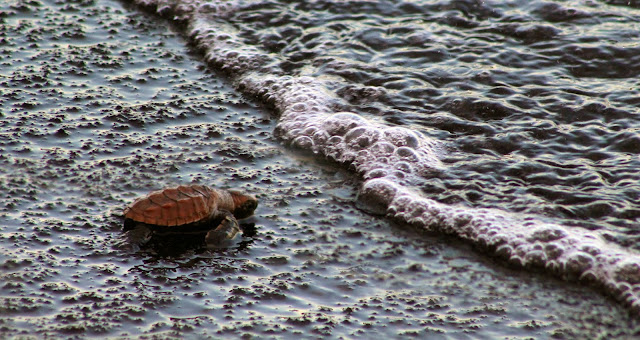
Leaving Punaluʻu Beach in October of 2018, a hawksbill hatchling seeks its future in the Pacific Ocean. 
See volunteer opportunities below for this Spring into Winter for watching over hawksbill turtle nests and hatchlings.Photo by Peter Bosted

UHERO'S ECONOMIC FORECAST FOR HAWAI'I shows the economy is recovering but could stumble with fallout from the Russian invasion of Ukraine, interest rate hikes, and COVID-19 surprises. Dating the forecast March 6, University of Hawai'i Economic Research Organization, under the leadership of Executive Director Carl S. Bonham, Ph.D., issued its predictions and analysis:
    The COVID-19 waves since last summer caused a pullback in Hawai'i tourism and a pause in labor market recovery. With the rapid end of the Omicron wave, visitor arrivals are picking up and broader recovery is resuming. The expected transition of the virus to an endemic disease sets the stage for easing of travel restrictions and the long-awaited return of international visitors. Considerable risks remain, including COVID-19 surprises, Fed tightening, and economic fallout from the Russian invasion of Ukraine.
    The Omicron wave of the COVID-19 pandemic dealt a blow to global growth. The rapid retreat of this wave and likely evolution to endemic status are good news. Still, lingering struggles with the virus, the weight of fiscal retrenchment, and ongoing supply and price pressures have moderated the outlook for 2022. Russia’s invasion of Ukraine—and the resulting international sanctions—add new uncertainty to the US and global outlook.
    Hawai'i’s visitor industry recovery was halted by last summer’s Delta wave, and Omicron caused another setback at year end. Bookings by US visitors have now bounced back to their pre-pandemic pace, although bookings by Asian visitors remain essentially zero. While we are concerned by the recent surge of COVID-19 in some Asian countries, we expect travel restrictions to ease in coming months, permitting a significant return of international visitors.
    The pandemic has had unusual effects in labor markets, including record rates of business formation and a surge in worker absences. Job recovery in Hawai'i, which had proceeded at a healthy clip, paused after the Delta wave hit. Employment gains will resume this year, although a reduced labor force and lagging tourism will delay a full recovery.
    Hawai'i home prices surged 18% last year, roughly in line with the US overall. Higher prices and rising mortgage rates will further erode housing affordability in the Islands. Initiatives to address affordability are ongoing at the state and local levels. 
    Robust construction activity continues. Federal spending under Hawai'i’s share of a massive $8 billion Navy contract and the Infrastructure Investment and Jobs Act will support the industry in coming years. The possibility of a moratorium on new water meters because of the Red Hill water crisis is a concern for new residential development.
    Our outlook for Hawai'i is relatively upbeat. The anticipated retreat of COVID-19 will clear the way for a more complete visitor industry recovery. After a weak start to the year, arrivals will surpass last summer’s peak by the second quarter and reach 90% of their pre-pandemic level by the year’s end. Visitor numbers will reach 9.5 million in 2023.
    The easing of COVID-related restrictions, and of public concern about infection risk, will also support recovery. The state’s payroll base will see increasing gains as the year progresses and expand by 4.5% for the year as a whole. By 2023, job growth will have absorbed most of the slack in the labor market, driving the unemployment rate down to 3.3%.
    Income growth in Hawai'i, which has been supported by extensive federal stimulus, will take a hit this year as the direct support to families ends. Real personal income will drop 4.7% this year. Gains in employment and wages will enable the beginning of income recovery as the year progresses.
    The path ahead appears clearer, but there remain big risks. Despite gains, COVID-19 still has the capacity to be very disruptive. Federal Reserve interest rate hikes could cause more slowing than desired. Russia’s invasion of Ukraine could cause higher energy costs and slower global growth, which would impact Hawai'i tourism and local inflation.  See the complete report at https://uhero.hawaii.edu/wp-content/uploads/2022/02/22Q1_Forecast.pdf.

To read comments, add your own, and like this story, see www.facebook.com/kaucalendar/. See latest print edition at www.kaucalendar.com. See upcoming events at https://kaunewsbriefs.blogspot.com/2022/03/upcoming-events-for-kau-and-volcano.html.

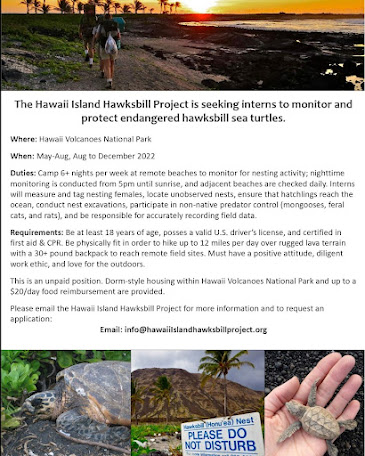
THE HAWKSBILL PROJECT is looking for volunteers to watch over the nesting sites of endangered honu'ea - hawksbill sea turtles - this year. Most of the sites for the project on this island are in Kaʻū. The periods when volunteers are needed to camp and protect the turtles and their eggs are from May to August and August to December.

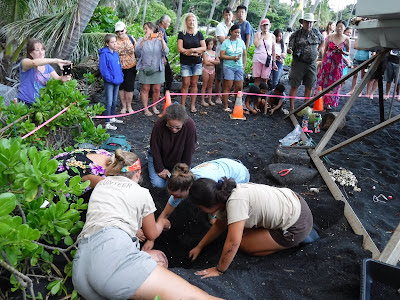
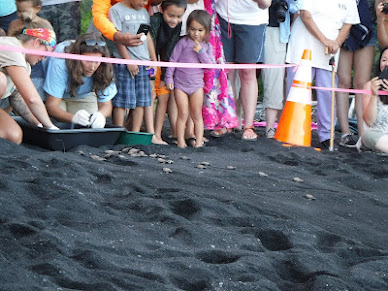
Volunteers from the Hawksbill Recovery Project carefully excavate a nest as
 they search for tiny hatchlings that were unable to dig their way to the surface. 
Photo by Annie Bosted
    Volunteers camp for six consecutive nights at remote beaches. There are day and night watches and daily search for more nesting turtles on the nearby beaches.
    The volunteers will be interns with the Hawai'i Island Hawksbill Project. They will measure and tag nesting females, locate unobserved nests, ensure that hatchlings reach the ocean, conduct nest excavations, participate in non-native predator control to protect the nests, eggs and hatchlings from mongoises, feral cats and rats. The will also be responsible for accurately ach intern must be at least 18 years of age, with U.S. drivers license, and be certified in first aid and CPR. Interns must be fit enough to hike up to 12 miles per day over rugged lava terrain with a backpack 30 pounds or heavier. 
    "Must have a positive attitude, diligent work ethic and love the outdoors," says the call for volunteers. The project provides dorm-style housing at Hawai'i Volcanoes National Park for nights not camping and up to $20 per day for food. For more, email info@hawaiiislandhawksbillproject.org.
Lauren Kurpita, wearing gloves, releases the tiny hatchlings onto the beach.
 They instinctively scurry towards the water, where they will spend the rest 
of their lives, save for infrequent visits to the sand for egg-laying females. 
Photo by Annie Bosted
     Megan Lamson, Hawai'i Wildlife Fund's Hawai'i Program Director, said, "The Kaʻū coastline is the home to the most important honu'ea nesting habitat in the state. Hawaiian hawksbills are critically endangered and efforts like the Hawai'i Island Hawksbill Sea Turtle Recovery Project on Hawai'i Island and other efforts on Maui by Hawai'i Wildlife Fund and on Moloka'i are some of the best opportunities to save his rare turtle species. Please support this effort and volunteer today." She also urged everyone to "always pick up fishing line along the coastline!" Fishing line can entangle and kills this critically endangered species.

See more on hawksbills and the project at https://www.facebook.com/hawaiislandhawksbillproject/ and at Hawai'i Wildlife Fund's website  at www.wildhawaii.org.

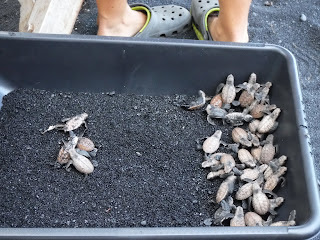
Hatchlings are corralled in a tub as they wait for the nest
excavation to be completed. They are released as a group, as
there is safety in numbers. The majority of hatchlings congregate
on the side of the tub closest to the ocean. Photo by Annie Bosted
A MORAL RESPONSIBILITY AND ABILITY TO CHOOSE TO PRESERVE THE EARTH is an obligation for humankind, according to Robert Cowie of University of Hawai'i. A story by University of Hawai'i News writer Marcie Grabowski reports on a new paper issued by biologists with the University of Hawai' at Manoa and the Museum National d’Histoire Naturelle in Paris. It suggests that humankind may be witnessing a mass biodiversity extinction event on the planet. Grabowski writes:
    Mass biodiversity extinction events caused by extreme natural phenomena have marked the history of life on Earth five times. Today, many experts warn that a Sixth Mass Extinction crisis is underway, this time entirely caused by human activities.
    A comprehensive assessment of evidence of this ongoing extinction event was published in Biological Reviews and can be reviewed at (https://onlinelibrary.wiley.com/doi/full/10.1111/brv.1281). The paper is written by biologists from the University of Hawaiʻi at Mānoa and the Muséum National d’Histoire Naturelle in Paris, France.
“Drastically increased rates of species extinctions and declining abundances of many animal and plant populations are well documented, yet some deny that these phenomena amount to mass extinction,” said Robert Cowie, lead author of the study and research professor at the UH Mānoa Pacific Biosciences Research Center (https://www.pbrc.hawaii.edu/) in the School of Ocean and Earth Science and Technology (https://www.soest.hawaii.edu/soestwp/). “This denial is based on a highly biased assessment of the crisis which focuses on mammals and birds and ignores invertebrates, which of course constitute the great majority of biodiversity.”
    By extrapolating from estimates obtained for land snails and slugs, Cowie and co-authors estimated that since the year 1500, Earth could already have lost between 7.5% and 13% of the two million known species—a staggering 150,000 to 260,000 species.
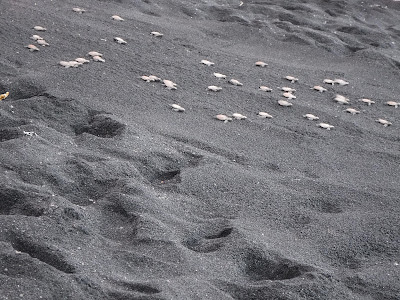
The exodus. Dogged determination and strong instincts motivate the
hatchlings to get off the beach and into the water. Photo by Annie Bosted

    “Including invertebrates was key to confirming that we are indeed witnessing the onset of the Sixth Mass Extinction in Earth’s history,” said Cowie.
    Extinction hits island species disproportionately. The situation is not the same everywhere. Although marine species face significant threats, there is no evidence that the crisis is affecting the oceans to the same extent as the land. On land, island species, such as those of the Hawaiian Islands, are much more affected than continental species. And the rate of extinction of plants seems lower than that of terrestrial animals.
    Unfortunately, along with science denial taking a foothold in modern society on a range of issues, the new study points out that some people also deny that the sixth extinction has begun. Additionally, others accept it as a new and natural evolutionary trajectory, as humans are just another species playing their natural role in Earth’s history. Some even consider that biodiversity should be manipulated solely for the benefit of humanity—but benefit defined by whom?

    “Humans are the only species capable of manipulating the biosphere on a large scale,” Cowie emphasized. “We are not just another species evolving in the face of external influences. In contrast, we are the only species that has conscious choice regarding our future and that of Earth’s biodiversity.”
    To fight the crisis, various conservation initiatives have been successful for certain charismatic animals. But these initiatives cannot target all species, and they cannot reverse the overall trend of species extinction. The authors believe it is essential to continue such efforts, to continue to cultivate a wonder for nature, and crucially to document biodiversity before it disappears.
    “Despite the rhetoric about the gravity of the crisis, and although remedial solutions exist and are brought to the attention of decision-makers, it is clear that political will is lacking,” said Cowie. “Denying the crisis, accepting it without reacting, or even encouraging it constitutes an abrogation of humanity’s common responsibility and paves the way for Earth to continue on its sad trajectory towards the Sixth Mass Extinction.”
    The research is an example of UH Mānoa’s goal of Excellence in Research: Advancing the Research and Creative Work Enterprise (https://manoa.hawaii.edu/wp/wp-content/uploads/2020/12/manoa-2025-strategic-plan.pdf#page=25), one of four goals identified in the U.H. 2015–25 Strategic Plan (https://manoa.hawaii.edu/wp/wp-content/uploads/2020/12/manoa-2025-strategic-plan.pd), updated in December 2020.

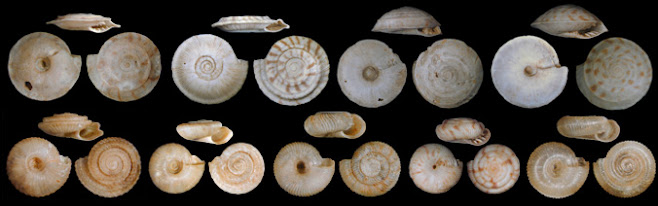
Shells from recently extinct land snails from French Polynesia. Photo by O.Gargominy, A.Sartori

To read comments, add your own, and like this story, see www.facebook.com/kaucalendar/. See latest print edition at www.kaucalendar.com. See upcoming events at https://kaunewsbriefs.blogspot.com/2022/03/upcoming-events-for-kau-and-volcano.html.


                      SEE UPCOMING EVENTS IN KAʻŪ & VOLCANO

See March edition of The Kaʻū Calendar newspaper at 
www.kaucalendar.com


Saturday, March 05, 2022

Ka‘ū News Briefs, Saturday, March 5, 2022

The Lava Flows & Goes

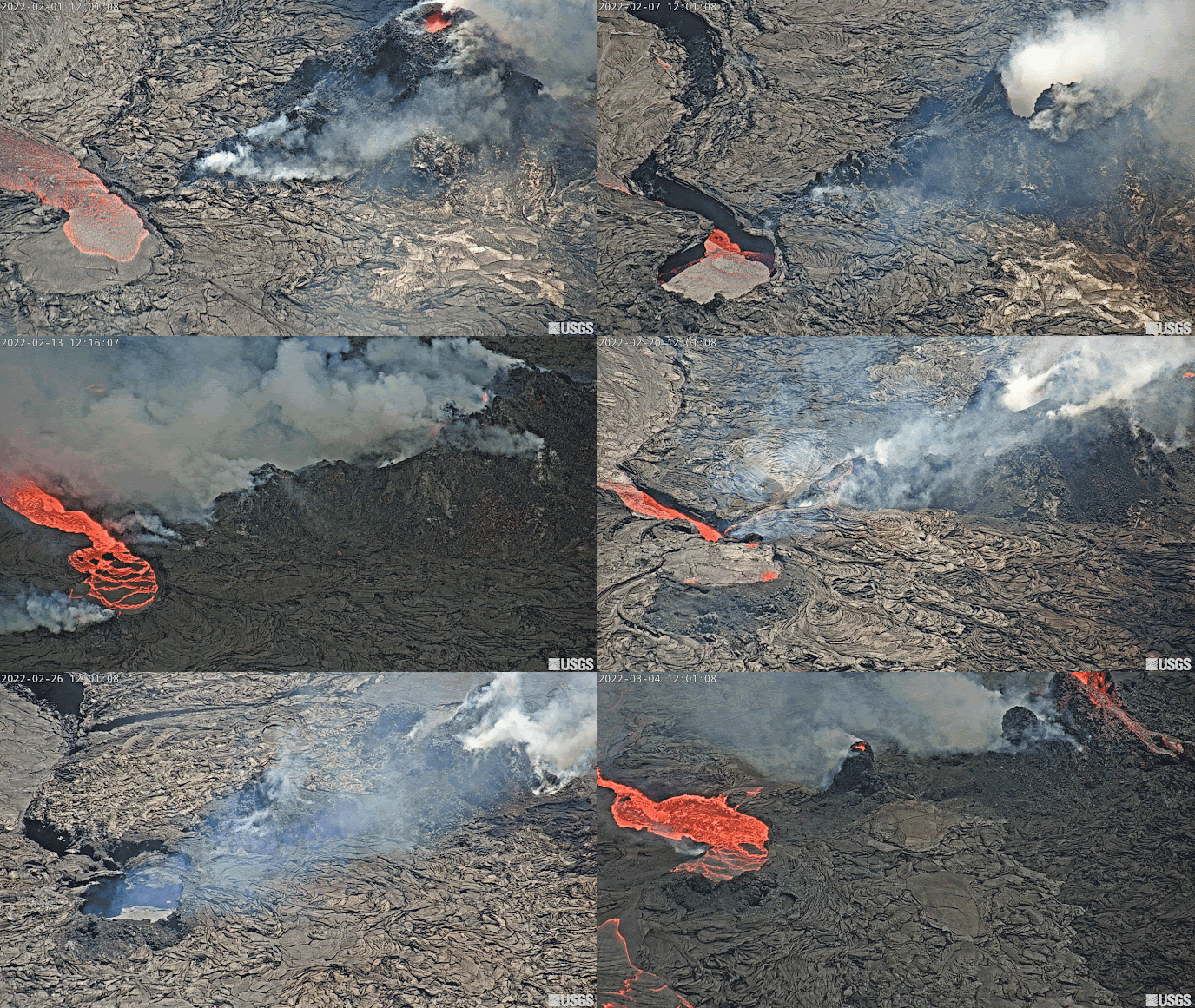
This animated gif features one V1cam image, taken around noon each day, from February 1, 2022, through March 4, 2022. At the beginning of February, there was still a prominent enclosed cone over the west vent area within Halema‘uma‘u crater, at the summit of Kīlauea. Over the past month, that cone has broken down and lava has infilled around its craggy remains. The V1cam provides a live view of the west vent in Halemaʻumaʻu and the lava lake. The camera is located on the northwest rim of the caldera, and looks east. USGS images. See more in Volcano Watch below.

A TEMPORARY JONES ACT WAIVER IS SUPPORTED BY ADVOCATES IN GUAM AND HAWAI'I. Guam, like Hawai'i, has been dependent on foreign oil because of the cost of the Jones Act requirement for any oil and other goods  from the U.S. mainland to arrive on U.S. carriers, built, owned and largely staffed by U.S. citizens - the cost much higher than using foreign flagged ships.

    As a result, about a quarter to a third of oil shipped to Hawai'i has come from Russia on foreign ships. However, the only refinery in Hawai'i vowed to reject Russian oil, likely leading to higher gasoline and electricity costs. 

    U.S Congressman Rep. Ed Case said he is working on a Jones Act waiver in Washington, D.C. He said, “We’ve never found ourselves in a situation like this,” with the cost of Hawai'i oil likely to soar with the expense of bringing it from the mainland. Case has authored numerous measures to reform the Jones Act, arguing that is responsible for much of the high cost of living in Hawai'i.

Guamanian Jesse Lujon writes
 of Guam and Hawai'i both needing a
waiver from the Jones Act
to combat cost of oil.
    Jesse Anderson Lujon, a former senator in the Guam
Legislature, wrote an opinion piece in Guam's Pacific Daily News on Sunday. It mirrors concerns in Hawai'i: "The Russian invasion of Ukraine is a new and painful challenge to navigate in our effort to move past the economic turmoil the pandemic has heaped on our island. The invasion is very likely to cause already sky-high gas prices to increase, making it even more expensive for Guamanians to drive anywhere. Another effect of the invasion might be the rising cost of electricity.....It may even cause the price of airline tickets to increase, which comes at a time when we desperately need tourists to return to Guam."
    Lujon wrote that "it is imperative for us to understand that since we import almost everything we need to survive, a temporary waiver of the Jones Act is more relevant and justifiable now than ever before."
    Another Jones Act opposition advocate, Grassroot Institute of Hawai'i leader Keli'i Akina, who also serves on the board of Office of Hawaiian Affairs, wrote a letter to Pres. Joe Biden this week asking for the waiver. See more on the effect of the war in Ukraine on Hawai'i in the Thursday Ka'u News Briefs at http://kaunewsbriefs.blogspot.com/2022_03_03_archive.html

To read comments, add your own, and like this story, see www.facebook.com/kaucalendar/. See latest print edition at www.kaucalendar.com. See upcoming events  at https://kaunewsbriefs.blogspot.com/2022/03/upcoming-events-for-kau-and-volcano.html.

LEARNING LOSS CAUSED BY THE PANDEMIC is the focus of a letter this week sent by Sen. Mazie Hirono to the federal Department of Eduction. She said the American Rescue Plan gave $100 million to the DOE's Institute of Education Sciences to conduct research related to learning loss caused by the pandemic. She said she is especially interested in in the data on Asian American and Pacific Islander communities. She noted a significant learning loss among K-12 students and asked the agency for more information about the work to research and address learning loss in at-risk and  marginalized 
students, and their efforts to disseminate this information to states, school districts, and other education stakeholders.
    A statement from Hirono's office said, "COVID-19 has set students back significantly and further widened opportunity and achievement gaps. At the end of the 2020-21 school year, it was reported that students were five months behind in math and four months behind in reading and these numbers were even higher for students from families with low incomes and students of color." In her letter, Hirono wrote, "IES has an opportunity to play an important role in providing resources—whether through developing and sharing best practices for measuring and addressing learning loss with educators, providing educators with detailed guidance, or disseminating other information focused on addressing learning loss."

    She said that states, school districts, and other education stakeholders "face tremendous challenges to getting students back on track after the challenges they faced during the last two years, and it is critical that we provide them with all available resources."
    Regarding reporting disaggregated data on Asian American and Pacific Islander communities, she said this would allow policymakers the opportunity to better understand how students from different sub-populations have been affected by these learning disruptions.
    Hirono has advocated for federal funding to support K-12 students, including through the Coronavirus Aid, Relief, and Economic Security Act (CARES Act), Coronavirus Response and Relief Supplemental Appropriations Act (CRRSAA), and American Rescue Plan Act (ARPA), which have collectively provided $200 billion in funding for states, school districts, and K-12 schools to support these students. Last March, ARPA provided $100 million for IES to research and address learning loss in K-12 students, as well as additional funding to support low-income students, students of color, children with disabilities, English learners, migrant students, students experiencing homelessness, and children in foster care.

    During the 116th Congress, Hirono introduced the Learning Opportunity and Achievement Act (LOAA) to combat learning loss due to COVID-19, particularly for at-risk and marginalized students. Like LOAA, ARPA provided funding to address COVID-related learning loss and directed IES to research and disseminate information to education
stakeholders.

To read comments, add your own, and like this story, see www.facebook.com/kaucalendar/. See latest print edition at www.kaucalendar.com. See upcoming events at https://kaunewsbriefs.blogspot.com/2022/03/upcoming-events-for-kau-and-volcano.html.

FRESH LAVA FLOWING INTO THE LAVA LAKE AT KĪLAUEA VOLCANO IS ON AND OFF and may stay that way for some time. The overall trend of Kīlauea’s summit magma system is slow deflation, according to this week's Volcano Watch by scientists and affiliates of USGS Hawaiian Volcano Observatory. The column noted the value of historic data streams used to monitor eruption pauses and renewals at Kīlauea’s summit, including ground tilt from borehole tiltmeters. 
    Tilt data also provides valuable insight into the behavior of the lava lake, especially the data from Halemaʻumaʻu crater from 2008–2018, before the series of collapses in 2018 changed Kīlauea’s summit topography.
    In 2008, a short series of explosions preceded the opening of a lava lake in the “old” Halemaʻumaʻu crater. The lake grew steadily, forming what became known as the Overlook crater. Convection of lava within the lake provided a steady supply of sulfur dioxide (SO2), which was the main contributor to vog (volcanic air pollution) in Hawaiʻi. It also provided a reliable glow against the night sky that was visible throughout the summit region.
    When lava began erupting from fissures in Leilani Estates in 2018, Kīlauea’s summit reservoir system began to deflate, and the lava lake quickly drained away before the summit began to collapse.
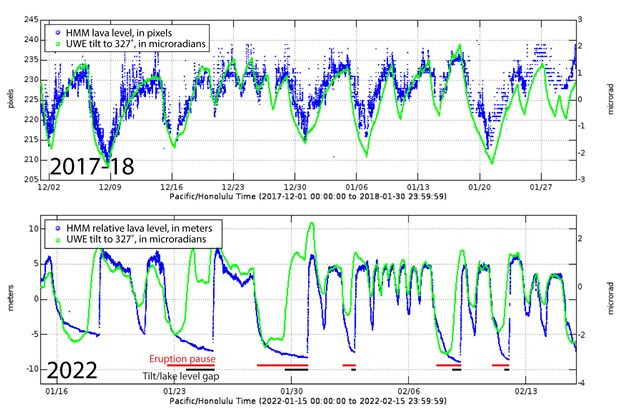
    One of the interesting facets of the 2008–2018 lava lake era was the close association between summit tilt data and the surface level of the lava lake. As the lake surface would rise within the Overlook crater, summit tiltmeters would record inflationary tilt. As the lava lake surface withdrew, tiltmeters would record deflationary tilt.
ABOVE USGS PLOT: “Summit tiltmeter data (green) shown against lava lake level (blue). The top panel is for the time period 12/1/2017–1/30/2018 and is representative of the “old” lava lake. For this panel, lake level was retrieved from thermal camera images, hence it is given in units of “pixels.” The bottom panel is from 1/15/2022–2/15/2022; in this case, the lake level is determined from a laser rangefinder and is presented as variations around its average level in meters. Note that in the bottom panel, the lake level graph has also been detrended to control for its steady rise. The bars at the bottom of the bottom panel show examples of eruption pause durations (red bars) and times during which inflation has recommenced, but eruption has not yet (black bars).”
    The interpretation was that there was a fully open connection between the lava lake and the shallow summit magma reservoir, referred to as the Halemaʻumaʻu (HMM) reservoir. As a result, the lake acted like a barometer, with its level moving up and down in direct proportion to pressure changes in the HMM reservoir.
    This unique behavior made it possible to determine certain quantities for the HMM magma reservoir that are difficult or impossible to determine at other volcanoes. For example, it is easier to track magma chamber volume changes than to determine the overall volume, but the open nature of the 2008–2018 lava lake also made this calculation possible.
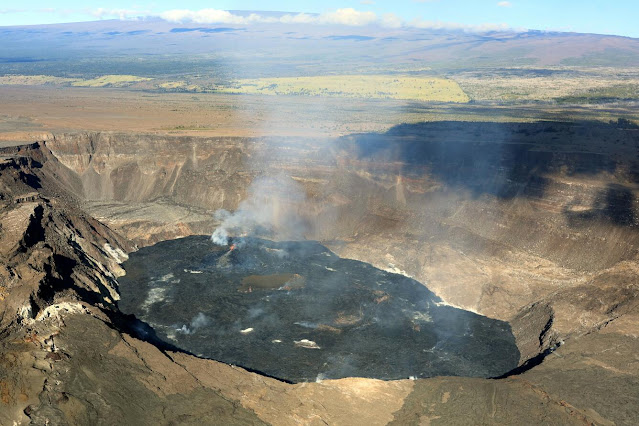
A daytime view of the lava lake at Halema'uma'u on Feb. 2, with Mauna Loa looming in the background.
 USGS photo by F. Trusdell

    In a 2019 publication, scientists showed that by tracking deformation and lava level changes during the opening stages of Kīlauea’s 2018 summit collapses, it was possible to determine that the entire 2018 collapse and eruption decreased the HMM magma reservoir volume by a most likely amount of 20%, leaving the majority of the magma in place.
    The current lava lake in Halemaʻumaʻu also rises and falls together with inflationary and deflationary tilt. This indicates that, to some extent, there is again an open connection to the shallow HMM magma chamber. However, some of the deflation and inflation cycles are larger than others, and during these episodes the lava lake level goes down and the eruption pauses. The eruption doesn’t resume, and the lake level doesn’t rise again at the same time as the tiltmeters show inflationary tilt, but instead waits until the amount of inflationary tilt is about equal to the amount of preceding deflationary tilt.
    As the February 3rd Volcano Watch stated, this gives us a rough idea of when the eruption pause might be over and active lava will return to the crater, allowing for an amount of forecasting that isn’t usually possible. The gap in time between the return of inflationary tilt and eruption renewal is also an indication that the connection between the surface and shallow HMM reservoir isn’t always open. While the summit is inflating, pressure is building in the reservoir, and it isn’t until the eruption starts again that the pressure is released. After this the system equilibrates and once again behaves as an open system, like it did in 2008–2018.
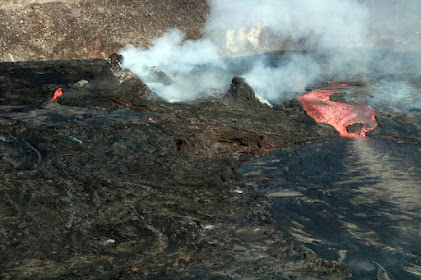
Telephoto view during eruption monitoring overflight of Kīlauea summit
 on March 2 shows west vent area within Halema‘uma‘u crater. Lava erupts
from multiple locations near where the west vent cone, which has broken
 down over the past several weeksm  Int he right side of this image, lava
pours from the pond north of the west vent area into the active lava lake. 
USGS Photo by K. Mulliken
   This is an interesting and important difference between the current lava lake and the lake that existed from 2008–2018 and presents the opportunity to learn more about the conditions under which the system might change from closed to open.
    The current overall trend of Kīlauea’s summit magma system is slow deflation. This means there are no signs right now that the eruption could get more vigorous, and this regime of intermittent pauses and renewals could continue for a while. Without any changes, there may even be a time when there isn’t enough pressure left to drive the current eruption. However, Kīlauea Volcano rarely goes without change for long, so we will be sure to stay attentive and prepared for the unexpected.

To read comments, add your own, and like this story, see www.facebook.com/kaucalendar/. See latest print edition at www.kaucalendar.com. See upcoming events at https://kaunewsbriefs.blogspot.com/2022/03/upcoming-events-for-kau-and-volcano.html.


              SEE UPCOMING EVENTS IN KAʻŪ & VOLCANO

See March edition of The Kaʻū Calendar newspaper at 
www.kaucalendar.com