About The Kaʻū Calendar

Friday, May 13, 2022

Ka‘ū News Briefs, Friday, May 13, 2022

Phase 1 of a water project for Department of Hawaiian Home Lands lessees at South Point broke ground Friday. It will
connect Pastoral homestead lessees in the Kamāʻoa Homestead to water service through a partnership with Hawai'i County.
Photo from DHHL

GROUNDBREAKING FOR WATER SERVICE TO HAWAIIAN HOME LANDS AT SOUTH POINT launched Phase 1 on Friday morning. The statement from Department of Hawaiian Home Lands says its "improvements to an existing County of Hawaiʻi Department of Water Supply system in Kaʻū will soon connect Pastoral homestead lessees in the Kamāʻoa Homestead to water service."
    The groundbreaking celebrated the ultimate connection of the newly built DHHL water storage and distribution system to the county Department of Water Service ’ No. 108 system in Kaʻū. Phase 1 of the DHHL project is being accomplished by Isemoto Contracting Company, to include installation of a 100,000-gallon water reservoir to serve Pastoral homestead lots awarded to native Hawaiians in the mid-1980s.
    DHHL reports, "These lessees, part of the Department’s Acceleration Program, were awarded to native Hawaiians as raw land following a 1983 report by a Federal and State task force that recommended to the State of Hawaiʻi that DHHL should issue undeveloped raw land to native Hawaiians. The program’s effort was to accelerate the distribution of land to beneficiaries of the Hawaiian Homes Commission Act. DHHL issued 2,629 leases of mostly raw land between 1984 and 1987 as part of the program. Since the issuance of lots under the Acceleration Program, the Department has incrementally installed infrastructure, as 
Department of Hawaiian Home Lands Chair William Ailā, Jr. on Friday morning, during the groundbreaking of a new water system for Hawaiian Home Land Lessees at Ka Lae. Photo from DHHL

funding became available. DHHL has plans to complete infrastructure improvements for the remaining Acceleration Program lots on Molokaʻi and Hawaiʻi Island over the next three to five years."
    Hawaiian Homes Commission Chair William J. Ailā, Jr. said, “Partnerships with the County and other agencies are critical in the development of infrastructure for DHHL projects. Building these improvements to County standards allows DWS to adopt it into its existing system, a critical piece that is allowing this project to happen. A water tank is the first step towards resolving a longstanding obligation DHHL made to Kamaoa lessees.
    "The Department’s acceleration program provided pasture lots to native Hawaiians without access to water and placed the responsibility of advocating for future infrastructure improvements in their hands. Today, we take a meaningful step toward delivering access to water for the Pastoral lots.” 
    The $2.7 million Capital Improvement Project is funded by a Fiscal Year 2020 appropriation from the Hawaiʻi State Legislature. Phases 2 and 3 of the Kaʻū Water System project are designed to work on pressure regulating valves, new water meters, and improvements to South Point Road for future homesteading opportunities.         
    In March, DHHL broke ground on 125 Residential lots in the Villages of Laʻi ʻŌpua Village IV Hema Phase 2 subdivision in Kealakehe, and last month began infrastructure construction on 16 Subsistence Agricultural lots in Honomū."

To read comments, add your own, and like this story, see www.facebook.com/kaucalendar/. See latest print edition at. www.kaucalendar.com. See upcoming events at https://kaunewsbriefs.blogspot.com/2022/04/upcoming-events-for-kau-and-volcano.html

PUBLIC INPUT ON A PLAN TO IMPORT MOSQUITOS INTO THE HAWAIIAN ISLANDS and release them, in order to reduce existing mosquito populations, is a request from the state Department of Agriculture. The targeted mosquitoes have led to extinction and near extinction of native Hawaiian birds and also pose a health risk to humans and animals. 
    The state Board of Agriculture approved of the concept this week to import the Asian tiger mosquito Aedes albopictus, the yellow fever mosquito Aedes aegypti, and the southern house mosquito Culex quinquefasciatus, adding them to the List of Restricted Animals that allows regulated introduction into the state.
Asian tiger mosquito was a likely vector in the 
Dengue outbreak that started in South Kona in 2015.
Photo from entomologytoday.org
    The proposed order and proposed rule changes may be viewed online at: https://hdoa.hawaii.gov/blog/main/proposed-administrative-rules/
      Through June 8, Hawai`i Department of Agriculture, Plant Quarantine Branch, will accept comments through Jonathan Ho, Inspection and Compliance Section Chief. Send to Jonathan.K.Ho@hawaii.gov.
      The plan is designed so that the targeted female mosquitoes mate with the introduced mosquitoes. A bacterium in the imported males' reproductive systems makes the mating unproductive and the populations of the targeted mosquitos are reduced. 
      The process is called cytoplasmic incompatibility. According to the statement from Department of Agriculture, "Cytoplasmic incompatibility has been used with much success in other parts of the world to reduce mosquito populations and thus reduce the potential of transmission of mosquito vectored diseases."
Yellow fever mosquito is a vector of of numerous viruses
 including Zika, dengue, chikungunya, yellow fever and
West Nile. Photo from entomologytoday.org
    Human diseases to be reduced or prevented in Hawai'i include the viruses Zika, dengue, chikungunya, yellow fever and West Nile, along with the disease lymphatic filariasis. Diseases of Hawai'i’s fauna to be reduced include avian malaria, avian pox, and dog heartworm. 
    The targeted mosquito species "are invasive, disease-spreading mosquitoes that can be found throughout Hawai'i," reports Department of Agriculture. The Asian tiger mosquito and yellow fever mosquito "are believed to have been the primary vectors during Maui’s 2001 dengue virus outbreak, Oahu’s 2011 dengue virus outbreak, and Hawai'i County’s 2015-2016 dengue outbreak, which led to more than 264 cases of the illness." 
    The southern house mosquito is known to vector West Nile virus on the U.S. mainland and lymphatic
Southern house mosquito carries avian malaria, which has
devastated the population of native forest birds and also
carries dog heartworm. Photo from entomologytoday.org
filariasis in other Pacific nations. The species is present on Hawai'i, Maui, Moloka'i, Lana'i, Kaho'olawe, O'ahu, Kaua'i, and the northwest Hawaiian islands. Department of Agriculture reports that it can thrive at sea-level to 4.800 ft.. 
     Concerning Hawai'i’s native forest birds, the southern house mosquito is a known vector of avian malaria and the yellow fever mosquito is a vector of avian pox. "These diseases have contributed to the extinction of more than half of Hawai'i’s endemic honeycreepers and continue to pose a risk to the remaining species. Lastly, these mosquito species are known to transmit dog heartworm within pets found throughout Hawai'i," says the Department of Agriculture statement.
    DOA notes that efforts to suppress these mosquitoes through pesticides "are inadequate at a landscape scale, and may be problematic for other non-target state and federally protected invertebrate species including Hawaiian picture-wing flies, damselflies, yellowfaced bees and anchialine pond shrimps."

To read comments, add your own, and like this story, see www.facebook.com/kaucalendar/. See latest print edition at. www.kaucalendar.com. See upcoming events at https://kaunewsbriefs.blogspot.com/2022/04/upcoming-events-for-kau-and-volcano.html

COUNTY PROSECUTOR KELDEN WALTJEN SENT OUT A MESSAGE FRIDAY EVENING, urging Gov. David Ige to sign House Bill No. 1486, HD2, SD1 (“HB 1486”) into law. The legislation would increase the penalty for felony theft of motor vehicles and motorcycles from a maximum five-year prison term to a maximum ten-year prison term. 
     “We encourage the public to join us in support of the passage of HB 1486, share their concerns about
County Prosecuting Attorney Kelden Waltjen urges citizens
 to encourage the governor to sign a bill increasing
 prison time for auto and motorcycle theft.
how auto and motorcycle theft has affected our community, and request that Governor Ige sign this bill into law,” said the Prosecuting Attorney. "Currently, most auto and motorcycle thefts are prosecuted as Theft in the Second Degree and/or Unauthorized Control of a Propelled Vehicle in the First Degree, both of which are only class C felony offenses punishable by a maximum five year prison term."
     HB 1486, introduced by Rep. Greggor Ilagan, State House District 4 representing lower Puna, establishes Theft of Motor Vehicles and Motorcycles as a subsection of Theft in the First Degree, which is a class B felony offense punishable by a maximum ten year prison term. 
     This past December, the Hawai‘i County Prosecutor’s Office conducted an online legislative initiatives survey. Of those 1,422 who participated in the survey, 1,265 or 89.21% supported establishing Theft of a Motor Vehicle as a class B felony offense. “By increasing the penalty for auto and motorcycle theft, we promote respect for the law, ensure that offenders 2 receive an appropriate sentence that reflects the seriousness of the offense, provide adequate deterrence for future criminal activity, and protect the public,” said Waltjen. He urges submitting testimony via the Governor’s website at https://governor.hawaii.gov/contact-us/comments-on-legislation/

To read comments, add your own, and like this story, see www.facebook.com/kaucalendar/. See latest print edition at. www.kaucalendar.com. See upcoming events at https://kaunewsbriefs.blogspot.com/2022/04/upcoming-events-for-kau-and-volcano.html

LANDSCAPING WITH NATIVE HAWAIIAN PLANTS on Saturday, May 14 from 9 a.m. - 2 p.m. at Volcano Art Center’s Niaulani Campus will be led by instructor Zach Mermel of Ola Design Group. In this hands-on workshop, you’ll interact first-hand with a variety of native plants found throughout Hawai’i and learn how to integrate these plant allies into your home ecosystem. Class fee is $35/$30 for VAC members. To register, call (808) 967-8222 or visit volcanoartcenter.org/events/.

KAHUKU COFFEE TALK: ʻUAʻU: THE ENDANGERED HAWAIIAN PETREL will be on Saturday, May 14 from 9:30 - 11 a.m. at Kahuku Unit Visitor Center. Coffee Talk at Kahuku is an opportunity to get to know your Park and your neighbors, and join an informal conversation on a wide variety of topics on the second Saturday of every month. Entrance located south of the 70.5 mile marker on the mauka side of Hwy 11.

Flyer for Coffee Talk at Kahuku: 'Ua'u, The Endangered
Hawaiian Petrel. Image from Kahuku Unit,
Hawai'i Volcanoes National Park
.

SEE MORE UPCOMING EVENTS IN KAʻŪ & VOLCANO
See The Ka'ū Calendar May edition at
www.kaucalendar.com, on newsstands and in the mail.\


Thursday, May 12, 2022

Ka‘ū News Briefs, Thursday, May 12, 2022

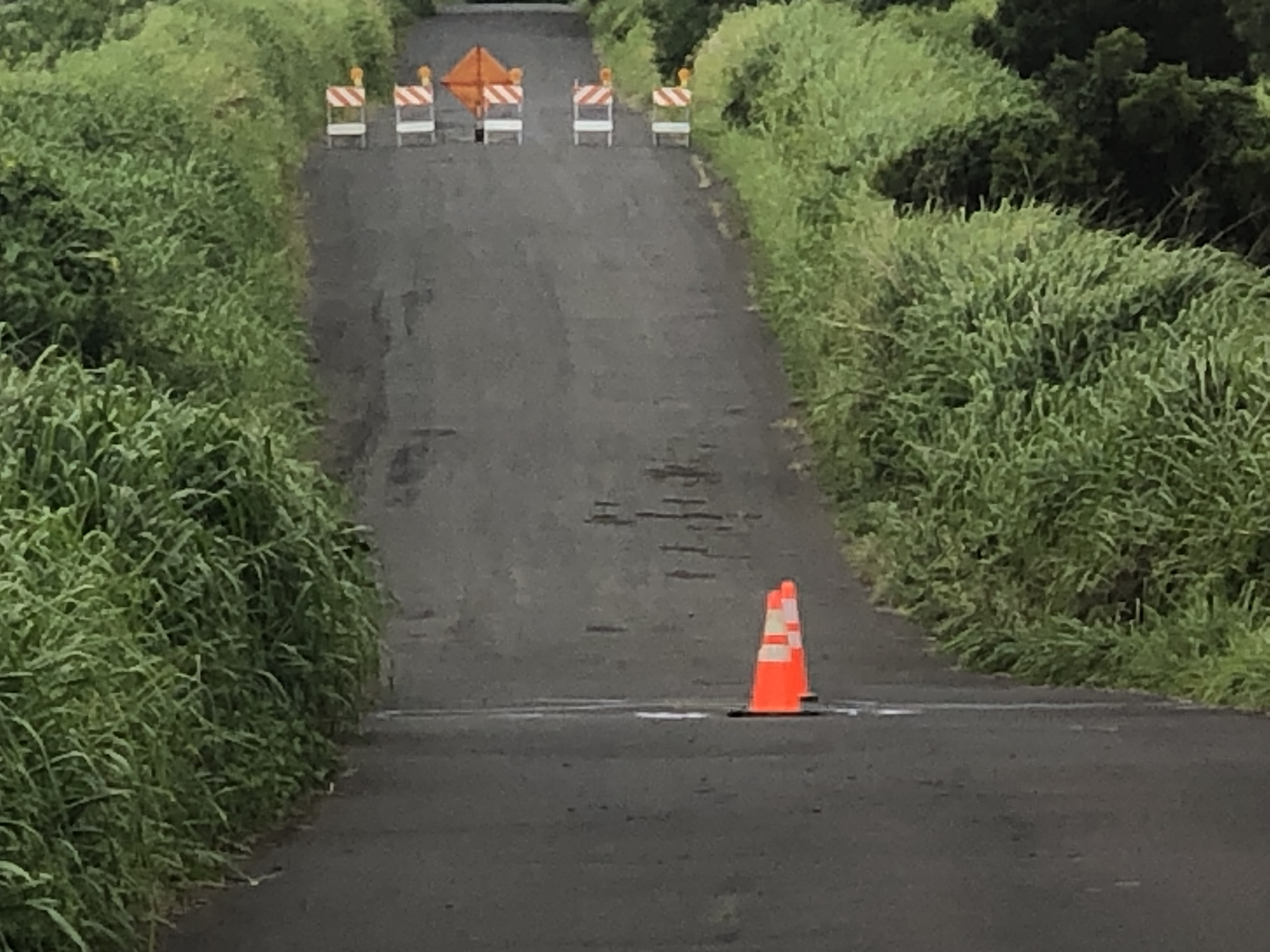
Ka'alaiki Road is closed, cutting off the emergency evacuation route above Highway 11 and limiting access to Kaʻū Coffee
 farms, ranches and homes, due to a sinkhole about 1.5 miles above Pāhala. Photo by Julia Neal

THE CLOSURE OF KA'ALAIKI, THE OLD CANE HAUL ROAD, mauka of Hwy 11 between Pāhala and Nāʻālehu, is not only making it more difficult for Kaʻū Coffee farmers and ranchers to go between village and farm, it is blocking the public emergency evacuation route above Highway 11. The public is directed by the police department to use Ka'alaiki Road when there are brush fires and accidents along Highway 11. Ka'alaiki Road was closed by the county on Thursday, until repairs can be made, after a 2-ft wide, 4-ft. long, 8-ft. deep sinkhole was discovered about 1.5 miles above Pāhala
    Kaʻū Coffee farmer and rancher Phil Becker said he is in communication with Hawai'i County Public Works director Ikaika Rodenhurst who promises to help resolve the situation. One challenge is the ownership of Ka'alaiki Road. Becker said former Mayor Harry Kim told him and rancher Al Galimba years ago that Ka'alaiki is a "road in limbo," meaning that no one entity owns it. It is owned by property owners on both sides along its path between Pāhala and Nāʻālehu
Cones in the foreground are at the location of the sinkhole on Ka'alaiki Road.
Signage barricades block traffic from the Nāʻālehu side. Photo by Julia Neal
     Becker said that part of the larger ongoing discussion is the need to regularly fix potholes and pave sections of the road to make it safe. Becker wrote to the county last October to ask for maintenance and warning that the road is full of potholes, its sides overgrown and "dangerous to navigate. Drivers are dodging potholes... It's an accident waiting to happen." He stated that Ray Mizuno, in charge of maintaining county roads in Ka'u in the past, "did a fantastic job of refreshing the road and maintaining it in safe condition." However the maintenance has been lacking in recent years, said Becker. He noted that in December of 2015, he and Galimba put up $10,000, as did County Council member for Kaʻū, Maile David, with her county funding. The funding was used to fix potholes and cut overhanging trees and and grass, including ongoing maintenance until money ran out, said Becker.
     Becker followed up with another letter on April 7, before the sinkhole appeared, and again Wednesday and Thursday with phone calls to the county. He said the pot holes are worse and noted that agricultural land has been subdivided along Ka'alaiki Road and more people are likely to travel the road in the near future to their homes, ranches and farms.
With land being cleared for more farms and farmhouses along Ka'alaiki Road, road maintenance is a priority, say ranchers and farmers. The county does not own Ka'alaiki, a road in limbo, but shut it down on Thursday until repairs can be made to fill a sinkhole. Ka'alaiki also serves as the emergency evacuation route when Hwy 11 is closed between Pāhala and Nāʻālehu
Photo by Julia Neal
To read comments, add your own, and like this story, see www.facebook.com/kaucalendar/. See latest print edition at. www.kaucalendar.com. See upcoming events at https://kaunewsbriefs.blogspot.com/2022/04/upcoming-events-for-kau-and-volcano.html.

PROOF OF COFFEE ORIGIN TO REDUCE COUNTERFEITING IN THE INDUSTRY IS THE PLAN OF HAWAI'I COFFEE ASSOCIATION and its partner Oritain, according to a statement from Hawai'i Coffee Association Executive Director Chris Manfredi on Thursday. "Relying on the tenets of science, HCA has inked an agreement with product traceability company Oritain to build a statewide 'Origin Fingerprint' database to verify the origins of Hawai'i-grown coffee," says the HCA statement.
   Oritain will explain its technology for certifying  and other Hawaiian coffees at 12:45 p.m., Saturday, May 21 during the 2022 HCA conference at the Outrigger Kona Resort & Spa in Keauhou-Kona. Oritain will also display at the conference's trade show and is an event sponsor. Also during the conference, Kaʻū Coffee farmers will find out the winners in the statewide annual cupping contest.
      Oritain was founded in 2008 in New Zealand, and expanded to London, Switzerland, and Australia. On May 3, it announced its first U.S. office in Washington, D.C. Oritain markets itself as the global leader in scientifically proving the origin of products. Its verification underpins brands’ claims around product quality and sustainability, giving them the confidence to communicate these benefits to stakeholders and consumers. Clients include Alliance for Coffee Excellence, Kering, beef, lamb, pork, salmon, honey and apple enterprises, and fiber sources such as COTTON USA and Wools of New Zealand.
     Manfredi, who for many years has locally brokered Kaʻū Coffee and helped organize the Kaʻū Coffee Festival, said, "This partnership will allow us to sample green and roasted coffee to prove its origin. The effort will build Hawai'i coffee traceability and integrity. It is designed to thwart counterfeiting and build marketability. It's important to the industry and consumers to know where coffee is grown and in the case of counterfeiting, where it is not grown. Coffee counterfeiting is the bane of Hawaii-grown coffee. It represents unfair competition to Hawaii's growers. It undermines our pricing and the generations of growers who have contributed to the exceptional quality associated with Hawaii's brands." 
     Oritain uses scientific testing to measure a product's stable isotopes and trace elements to verify origin. The methodology originated in the criminal forensic field and has since been peer-reviewed in scientific journals over the last two decades, says the HCA statement.
    How it Works: A product's origin can be identified by measuring the chemical compositions of plants and animals that vary naturally in the environment. As something is grown, reared or made, it absorbs a unique ratio of elements and isotopes depending on the local temperature, altitude, precipitation, soil conditions, fertilizer and farm practices.
    Oritain runs this data through its statistical models to produce an Origin Fingerprint that it then uses to test subsequent samples as they move through the supply chain. Any samples that are inconsistent with the Origin Fingerprint, have likely been adulterated.
    "Our Hawai'i coffee industry is excited about this project and its possibilities for the future," adds Manfredi. "It will build product trust and boost marketability."
    Oritain CEO Grant Cochrane said, "Hawai'i-grown coffee has earned a world-renowned reputation for its specialty status, farming practices and flavor profile. It is coffee that is unrivaled from anywhere else in the world. However, with such a strong reputation, brings a temptation to cheat by substituting coffee from
other origins and labelling it as Hawaiian. This partnership marks a significant step in deterring this type of behavior by protecting the integrity and reputation of an important specialty crop."
Ka'u Coffee farmers will compete in a statewide cupping
 contest, the results revealed at next week's HCA conference.
    In addition to the Oritain presentation, the May 19-21 HCA conference offers educational opportunities, interactive workshops on cupping, roasting and field-grafting; plus talks on soil health, on-farm technology and updates on the latest industry research and legislative issues. 
    Register for the conference at https://hawaiicoffeeassoc.org/page-1771716 . Sponsorship and trade show exhibitor opportunities are available and silent auction donations are welcome.
    Major sponsors of the HCA Conference include state Department of Agriculture, Oritain, American AgCredit, FedEx, Honolulu Coffee Company, Kaua'i Coffee Company, Kona Hills, Monarch Coffee, Satake, Savor Brands, Sustainable Agro Solutions, TricorBraun Flex and UCC Hawai'i.
    The statement from the organization says, "The Hawai'i Coffee Association's mission is to represent all sectors of the Hawai'i coffee industry, including growers, millers, wholesalers, roasters and retailers. The HCA's primary objective is to increase awareness and consumption of Hawai'i-grown coffees. A major component of HCA's work is the continuing education of members and consumers."
    Learn more about the HCA at http://www.hawaiicoffeeassoc.org/.

To read comments, add your own, and like this story, see www.facebook.com/kaucalendar/. See latest print edition at. www.kaucalendar.com. See upcoming events at https://kaunewsbriefs.blogspot.com/2022/04/upcoming-events-for-kau-and-volcano.html.

Flyer for Kahuapono 2022 Student Enrichment Program.
Image from Three Mountain Alliance.
APPLICATIONS ARE DUE FOR KAHUAPONO STUDENT ENRICHMENT PROGRAM by Friday, May 13. This two-week program from June 27-July 8 is based in Keauhou, Kaʻū and will engage students in hands-on activities, service projects, and observation and reflection activities grounded in mālama ʻāina. Students must be in 6th-12th grade when applying. For an application, go to:

LANDSCAPING WITH NATIVE HAWAIIAN PLANTS on Saturday, May 14 from 9 a.m. - 2 p.m. at Volcano Art Center’s Niaulani Campus led by instructor Zach Mermel of Ola Design Group. In this hands-on workshop, you’ll interact first-hand with a variety of native plants found throughout Hawai’i and learn how to integrate these plant allies into your home ecosystem. Class fee is $35/$30 for VAC members. To register, call (808) 967-8222 or visit volcanoartcenter.org/events/.

KAHUKU COFFEE TALK: ʻUAʻU: THE ENDANGERED HAWAIIAN PETREL on Saturday, May 14 from 9:30 - 11 a.m. at Kahuku Unit Visitor Center. Coffee Talk at Kahuku is an opportunity to get to know your Park and your neighbors, and join an informal conversation on a wide variety of topics on the second Saturday of every month. Entrance located south of the 70.5 mile marker on the mauka side of Hwy 11.
Flyer for Coffee Talk at Kahuku: 'Ua'u, The Endangered
Hawaiian Petrel. Image from Kahuku Unit,
Hawai'i Volcanoes National Park.

SEE MORE UPCOMING EVENTS IN KAʻŪ & VOLCANO
See The Ka'ū Calendar May edition at
www.kaucalendar.com, on newsstands and in the mail.\


Wednesday, May 11, 2022

Ka‘ū News Briefs, Wednesday, May 11, 2022

Hilo Boarding School in 1909. It is one of the schools for Native Hawaiians listed in a
study released by the U.S. Department of the Interior on Wednesday. See more below.
Photo from Wikimedia

THE OLD CANE HAUL ROAD BETWEEN PĀHALA AND NĀ'ĀLEHU IS CLOSED about 1.5 miles above Pāhala town. A notice from the county on Wednesday says "the foundation under Old Cane Haul Road above Pāhala Town in Kaʻū is compromised. Use alternate routes." According to a county police message, the hole measures about 2-feet wide, 4-feet long, and  8-feet deep. Kalaiki Road, the old road for hauling sugar cane is private and owned by property owners along the way. "The integrity of an approximate 30-foot section of the road is suspected of being compromised by a deteriorating drainage culvert buried beneath the roadway," says the county statement.
    "Road closure signs have been placed on either side of the affected location. Motorist are strongly advised against crossing this area and to use alternate routes until repairs are made by the landowners." The alternate route is Highway 11 and the Cane Haul Road is sometimes used as an emergency route when the highway is closed due to an accident or to flooding at Kawa flats. However, during flooding, crossing the Cane Haul Road can be dangerous.
    The road will be closed until further notice, according to the county.

To read comments, add your own, and like this story, see www.facebook.com/kaucalendar/. See latest print edition at. www.kaucalendar.com. See upcoming events at https://kaunewsbriefs.blogspot.com/2022/04/upcoming-events-for-kau-and-volcano.html.

A FEDERAL STUDY, INCLUDING KAMEHAMEHA SCHOOLS, HILO BOARDING SCHOOL, MAUNA LOA FORESTRY CAMP SCHOOL and eight others in Hawai'i, concludes that between 1819 and 1969, the U.S. government used militarization and "identity alteration methodologies" in an attempt to assimilate native children into American culture."
    For Hawai'i, it also notes: "Although the ‘Ōlelo Hawai‘i-based public school system initially operated using only the Hawaiian language, it eventually repressed ‘Ōlelo Hawai‘i in education by promoting English. By 1888, only 16 percent of children were taught in Hawaiian."
    The investigative report was released Wednesday by Secretary of the Interior Deb Hawland and Assistant Secretary for Indian Affairs Bryan Newland. They released Volume I through the Federal Indian Boarding School Initiative, "a comprehensive effort to address the troubled legacy of federal Indian boarding school policies."
    The study researched 408 federal schools across 37 states or then territories, including 21 schools in Alaska and 11 schools in Hawai'i.

Hilo Boarding School in 1909. Photo from Wikimedia
     The Secretary of the Interior said, “The consequences of federal Indian boarding school policies—including the intergenerational trauma caused by the family separation and cultural eradication inflicted upon generations of children as young as four years old—are heartbreaking and undeniable. We continue to see the evidence of this attempt to forcibly assimilate Indigenous people in the disparities that communities face. It is my priority to not only give voice to the survivors and descendants of federal Indian boarding school policies, but also to address the lasting legacies of these policies so 
Indigenous peoples can continue to grow and heal.”
    The Assistant Secretary of the Interior said, “This report presents the opportunity for us to reorient federal policies to support the revitalization of Tribal languages and cultural practices to counteract nearly two centuries of federal policies aimed at their destruction. Together, we can help begin a healing process for Indian Country, the Native Hawaiian Community and across the United States, from the Alaskan 
tundra to the Florida everglades, and everywhere in between.”
    Department of Interior also announced The Road to Healing, a year-long tour that aims to
travel across the country "to allow American Indian, Alaska Native, and Native Hawaiian survivors of the federal Indian boarding school system the opportunity to share their stories, help connect communities with trauma-informed support, and facilitate collection of a permanent oral history." Also announced is a collaboration with "the White House Council of Native American Affairs on the path ahead to preserve Tribal languages, invest in survivor-focused services, and honor our obligations to Indigenous communities."
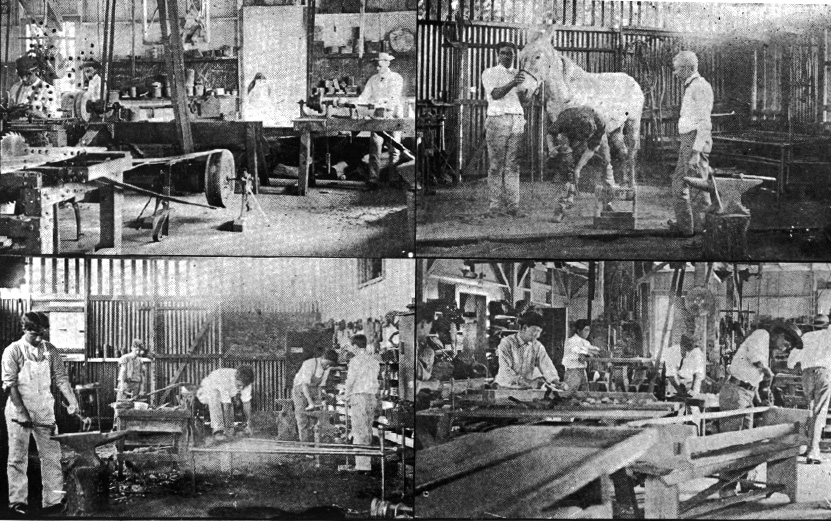
Shop class at Hilo Boarding School in 1901. Photo from Wikimedia
    The study points to such practices in history nationwide of "renaming Indian children from Indian to English names; cutting the hair of Indian children; discouraging or preventing the use of American Indian, Alaska Native, and Native Hawaiian languages, religions and cultural practices; and organizing Indian and Native Hawaiian children into units to perform military drills.
    "Despite assertions to the contrary, the investigation found that the school system largely focused on manual labor and vocational skills that left American Indian, Alaska Native, and Native Hawaiian graduates with employment options often irrelevant to the industrial U.S. economy, further disrupting Tribal economies."
    The study reports some of the history of Hilo Boarding School:
    "The Congregational Mission in Hawai'i opened schools to support their efforts of Christian conversion, and in October 1836, two grass houses were completed between David Lyman's house and Reverend Titus Coan's house. On October 3rd, the school opened with eight boarders, but the number soon increased to twelve. It received $900 in funding annually from the Board of Education (likely Hawai'i), and its assistant teachers are paid from the district school fund of Hilo. Classes were conducted in the English language. 
    "With the advent of World War II, the dormitory facilities were donated to the U.S. Army, which occupied the buildings until 1943. Thereafter, the facilities of Hilo Boarding School were utilized by different community groups until the final destruction of its buildings between 1968 and 1972."
    Read Volume I of the Department of Interior report at https://www.bia.gov/sites/default/files/dup/inline-files/bsi_investigative_report_may_2022_508.pdf. See descriptions and photos of other Hawai'i and mainland schools at https://www.bia.gov/sites/default/files/dup/inline-files/appendix_a_b_school_listing_profiles_508.pdf

To read comments, add your own, and like this story, see www.facebook.com/kaucalendar/. See latest print edition at. www.kaucalendar.com. See upcoming events at https://kaunewsbriefs.blogspot.com/2022/04/upcoming-events-for-kau-and-volcano.html.

Flyer for Kahuapono 2022 Student Enrichment Program.
Image from Three Mountain Alliance.
APPLICATIONS ARE DUE FOR KAHUAPONO STUDENT ENRICHMENT PROGRAM by Friday, May 13. This two-week program from June 27-July 8 is based in Keauhou, Kaʻū and will engage students in hands-on activities, service projects, and observation and reflection activities grounded in mālama ʻāina. Students must be in 6th-12th grade when applying. For an application, go to:

LANDSCAPING WITH NATIVE HAWAIIAN PLANTS on Saturday, May 14 from 9 a.m. - 2 p.m. at Volcano Art Center’s Niaulani Campus led by instructor Zach Mermel of Ola Design Group. In this hands-on workshop, you’ll interact first-hand with a variety of native plants found throughout Hawai’i and learn how to integrate these plant allies into your home ecosystem. Class fee is $35/$30 for VAC members. To register, call (808) 967-8222 or visit volcanoartcenter.org/events/.

KAHUKU COFFEE TALK: ʻUAʻU: THE ENDANGERED HAWAIIAN PETREL on Saturday, May 14 from 9:30 - 11 a.m. at Kahuku Unit Visitor Center. Coffee Talk at Kahuku is an opportunity to get to know your Park and your neighbors, and join an informal conversation on a wide variety of topics on the second Saturday of every month. Entrance located south of the 70.5 mile marker on the mauka side of Hwy 11.
Flyer for Coffee Talk at Kahuku: 'Ua'u, The Endangered
Hawaiian Petrel. Image from Kahuku Unit,
Hawai'i Volcanoes National Park.

SEE MORE UPCOMING EVENTS IN KAʻŪ & VOLCANO
See The Ka'ū Calendar May edition at
www.kaucalendar.com, on newsstands and in the mail.\