 |
Eighteen Kaʻū High students on Friday, with maile lei and supporters of their Academy for Agri-preneurship. The students earned college credits in agriculture while in high school through cooperation with Hawai'i Community College.
Photo from Hawai'i Executive Collaborative |
EIGHTEEN KA'U HIGH SCHOOL STUDENTS RECEIVED AGRICULTURAL ACHIEVEMENT CERTIFICATES from Hawaiʻi Community College during a commencement ceremony on Friday at Edith Kanakaʻole Multi-Purpose Stadium. The students earned the certificates through the Academy for Agri-preneurship at Kaʻū High & Pāhala Elementary School.
Prior to attending the commencement ceremony, Kaʻū students and their families attended a celebratory luncheon hosted by the Hawaiʻi Executive Collaborative and received gift bags; enjoyed live music from 14-time Nā Hōkū Hanohano award winner, Mark Yamanaka; and heard a keynote address from Derek Kurisu, executive vice president of KTA Superstores and member of the Hawaiʻi Executive Collaborative.
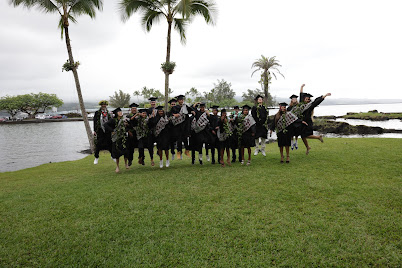 |
Academy for Agri-prenuership students at Kaʻū High celebrate after earning
college credits in agricultural achievement from Hawai'i Community College.
Photo from Hawai'i Executive Collaborative |
The Academy for Agri-preneurship is part of the Kaʻū Global Learning Lab, a school-centered strategy to revitalize the Ka'ū area. Its aim is to prepare students to be environmentally responsible community members and independent entrepreneurs who practice mālama 'āina, conservation and sustainability, and contribute to the socio-economic resiliency of Ka'ū, Hawai'i, and the world. At the academy, students engage in project-based learning and career training programs. At an age as young as 14, they are able to earn college credits and certificates of competence in agriculture, entrepreneurship, creative media, and culinary arts. The program is not just for the students in AP/honors classes – of the 18 students who received certificates, six are in special education, two are learning English as a second language, and one is a teenage mother.
Students awarded Certificates of Competence in Agriculture/Landscaping, with 12 college credits are: Stephen Adler, Laci Ah Yee, Elaina Akiu, Jinia Jackson, Fred Kauwe, Kamamalu Kauwe, Eline Ling, Charlotte Ross, Joaquin Ross, Stephen Throne, Trinity Torres, Kamalani Tuifagu and Kainalu Wanzer
Students awarded Certificates of Achievement in Agriculture with 24 college credits are: Cody Ah Yee,
Cyrus Eder, Kelson Gallano, Collin Hanshew amd Amelia Uribe Bounos.
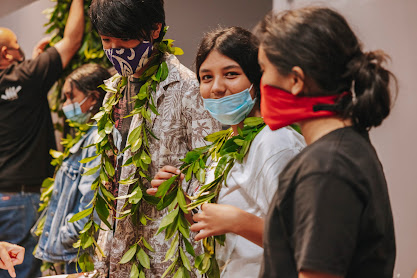 |
Kaʻū High students included in graduation ceremonies for Hawai'i Community College for earning college credits while in high school receive lei from supporters of the mission of their Agri-preneurship academy. Photo from Hawai'i Executive Collaborative |
The Kaʻū Global Learning Lab was created through a community revitalization project known as Kaʻū Dream, launched in October 2021. Kaʻū Dream is a community resiliency model – developed by and for the community – that aims to build a vibrant, thriving and sustainable Kaʻū through education and economic development.
"As a former teacher, I've witnessed firsthand how access to practical, hands-on education can change the life of a student," said First Lady Dawn Amano-Ige, chairperson of Kaʻū Dream's community advisory committee. "Supporting our youth is the first step in revitalizing Kaʻū because empowered students are foundational to the success of their community. Today, we celebrate the accomplishments of these students and what their achievements mean to the community at large."
Cody Ah Yee, graduating senior from Kaʻū High School, said, "I never thought I could get a college
.jpg) |
Hawai'i First Lady Dawn Ige, Kaʻū High Principal Sharon Beck and 'Āina Akamu, who heads up the Academy for Agri-preneurship at Kaʻū High & Pāhala Elementary, congratulate students who earned college credits. Photo from Hawai'i Executive Collaborative |
certificate while still in high school and it makes me feel really good that I already have credits that I can use towards a college degree. My sister is in the program too and she's also getting a certificate today. My mom is really happy that both of us have college credits now." Ah Yee said he plans on continuing to earn skilled certifications such as an FAA commercial drone pilot license, a commercial driver's license, or join an apprenticeship program.
Āina Akamu, teacher and Director of the Kaʻū Global Learning Lab, said, "At the Kaʻū Global Learning Lab, our youth are thriving at the intersection of education, agriculture, sustainability, and the Hawaiian value of mālama ʻāina. Not only is the academy providing students with the skills and knowledge they need to achieve career success, but it's also fostering community resiliency by addressing food insecurity in Kaʻū. Our vision is bold – we're here to transform our entire community for the better."
Duane Kurisu, chairman of the Hawaiʻi Executive Collaborative. said, "The accomplishments of these young people are a testament to the hard work of the teachers, parents and community members who have come together to make dreams into reality. The Kaʻū Dream model is already inspiring others around the world and we have international partners, such as MyFarm Japan and InterGlobe India who are looking to Kaʻū for guidance on how to create successful community revitalization projects in other parts of the globe."
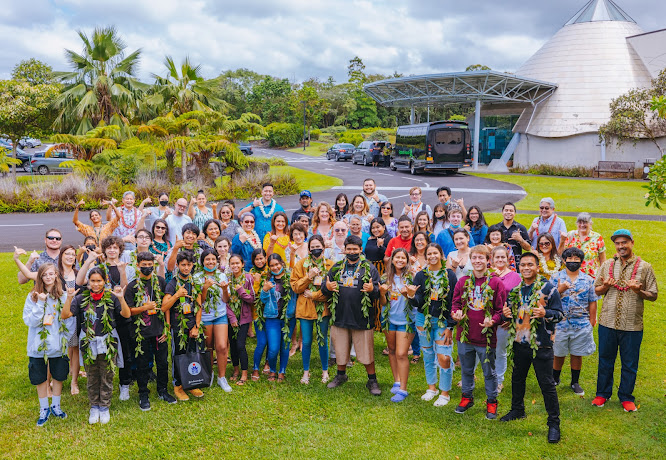 |
Kaʻū High students earning college credits while still in high school through Academy for Agri-preneurship
joined supporters of the program at Imiloa for a congratulatory luncheon on Friday in Hilo.
Photo from Hawai'i Executive Collaborative |
The mission of Kaʻū Dream is to serve as "a community-driven initiative dedicated to the rediscovery and regeneration of Kaʻū. It is committed to transforming Kaʻū into a vibrant place to live, work, and play while keeping the authenticity of its people and its culture." Learn more at
kaudream.org.
The Hawaiʻi Executive Collaborative serves as a backbone organization that provides energy and resources to help leaders from cross-sector partnerships develop a common agenda and create collective impact. HEC's mission "is rooted in Hawaiʻi's soul and aims to mobilize local, national and global leaders to commit toward the safety, wellness and prosperity of Hawaiʻi and elevate its central place in the world." Learn more at
hec.org.
To read comments, add your own, and like this story, see
www.facebook.com/kaucalendar/. See latest print edition at.
www.kaucalendar.com. See upcoming events at
https://kaunewsbriefs.blogspot.com/2022/04/upcoming-events-for-kau-and-volcano.htmlTHE MOST SEISMICALLY ACTIVE REGION IN HAWAI'I IS DEEP BENEATH PĀHALA. This week's
Volcano Watch, written by U.S. Geological Survey Hawaiian Volcano Observatory scientists and affiliates, punctuates the regular occurrence of earthquakes in the village:
Deep beneath Pāhala, a town located in the southern part of the Island of Hawai’i, is currently the most seismically active region of the Hawaiian Islands. Frequent, deep earthquakes (greater than 20 km or 12 miles below sea level) are felt regularly by local residents, and, occasionally, people across the entire island.
However, the current level of activity was not always common to the region and USGS Hawaiian Volcano Observatory (HVO) researchers are interested in trying to understand more about why it is happening.
Until 2015, an average of 7 earthquakes occurred deep beneath Pāhala each week. By 2015, the number of earthquakes had approximately quadrupled, with nearly 34 events happening per week. By the spring of 2019, the average number of weekly earthquakes identified in this region increased approximately 70-fold, relative to pre-2015 rates. This high rate of earthquake activity, with several hundred earthquakes occurring in an average week, has continued to the present.
Since August 2020, larger-magnitude earthquakes have also begun to occur deep beneath Pāhala. Eight magnitude-4.2-to-4.6 earthquakes, at depths of 31–34 km (19–21 miles) have been recorded. These larger events have been reported felt by people on the Island of Hawai’i as well as nearby Hawaiian Islands.
 |
| This map compares two months of earthquake activity in the region deep beneath Pāhala from (a) March 1, 2014, to May 1, 2014, and (b) March 1, 2022, to May 1, 2022. Earthquake locations are marked by circles that are colored by depth; blue circles indicate earthquakes that occurred 20–40 km (12–25 miles) below sea level. USGS map |
HVO, in collaboration with the University of Hawai’i at Mānoa (UHM), will begin an investigation this summer to learn more about the nature of these frequent, deep earthquakes beneath the southern part of the Island of Hawaiʻi.
Previous geophysical studies have theorized that deep earthquake activity beneath the Pāhala region may be related to hot spot
magma transport and/or faulting in the brittle upper
mantle beneath the island. Interestingly, the area of elevated
seismicity is almost equidistant from the summits of the three most active volcanoes in Hawaiʻi: Kīlauea, Mauna Loa, and Kamaʻehuakanaloa (Lō‘ihi Seamount).
Whether this region has a possible connection to the shallower magma storage and transport systems of Kīlauea or Mauna Loa is unclear, but there are no obvious indicators of magma transport from this region to the surface. Previous studies relied on data collected from HVO’s widely-spaced permanent seismometers in the region, which were not configured to study this area in detail.
This summer, HVO and UHM scientists—funded by the Additional Supplemental Appropriations for Disaster Relief Act of 2019 (H.R. 2157)—will hike across the Pāhala region, deploying instruments called seismic nodes that will help to us to understand why these earthquakes are occurring. Seismic nodes are light, compact seismometers that measure ground shaking at the location where they are placed.
Unlike permanent seismic stations, which are placed farther apart and cover the entire Island of Hawai’i, the temporary seismic nodes will be tightly grouped in order to more densely record earthquake signals across the region surrounding Pāhala. For two months, these nodes will record ground shaking generated by shallow and deep earthquakes occurring across the Island of Hawai’i as well as distant earthquakes from around the world.
The densely-spaced nodal instruments recording earthquakes over a wide range of depths and locations during this experiment will collect seismic data from below the Pāhala region at unprecedented resolution. Seismologists at HVO and UHM will analyze data collected from these seismic nodes to create images of the structure of the Earth beneath Pāhala from as great as 40–50 km (25–31 miles) below sea level all the way to the surface.
The data and images will be used to precisely locate the earthquakes in this region and, hopefully, identify or constrain the locations and distributions of shallow and deep fault zones and potential magma pathways within the region. Together, the results will help us to understand what is causing the frequent earthquake activity deep in the region beneath Pāhala.
We plan to share the results of this project after the data are processed. In the meantime—if you are in the Pāhala area this summer, please watch out for seismic nodes that are recording valuable data to help HVO shed light on the mystery of frequent earthquake activity deep below.
 |
An HVO seismologist deploying a seismic node on the down-drop block of Kīlauea caldera, with permission from
Hawai‘i Volcanoes National Park. USGS image by J. Chang |
Volcano Activity Updates: Kīlauea volcano is erupting. Its USGS Volcano Alert level is at WATCH (
https://www.usgs.gov/natural-hazards/volcano-hazards/about-alert-levels).
Kīlauea updates are issued daily.
Over the past week,
lava has continued to erupt from the western
vent within Halemaʻumaʻu crater. All lava is confined within Halemaʻumaʻu crater in Hawai‘i Volcanoes National Park. Sulfur dioxide
emission rates remain elevated and were last measured at approximately 2,700 tonnes per day (t/d) on May 10.
Seismicity is elevated but stable, with few earthquakes and ongoing volcanic tremor. Summit tiltmeters show several minor inflation and deflation trends over the past week. For more information on the current eruption of Kīlauea, see
https://www.usgs.gov/volcanoes/kilauea/recent-eruption.
Mauna Loa is not erupting and remains at Volcano Alert Level ADVISORY. This alert level does not mean that an eruption is imminent or that progression to an eruption from the current level of unrest is certain.
Mauna Loa updates are issued weekly.
This past week, about 59 small-magnitude earthquakes were recorded below the summit and upper elevation flanks of Mauna Loa—the majority of these occurred at shallow depths less than 15 kilometers (9 miles) below sea level. Global Positioning System (GPS) measurements show low rates of ground
deformation over the past week. Gas concentrations and
fumarole temperatures at both the summit and at Sulphur Cone on the Southwest Rift Zone have remained stable over the past week. Webcams show no changes to the landscape. For more information on current monitoring of Mauna Loa, see:
https://www.usgs.gov/volcanoes/mauna-loa/monitoring.
One earthquake was reported felt in the Hawaiian Islands during the past week: a M3.4 earthquake 9 km (5 mi) E of Pāhala at 31 km (19 mi) depth on May 8 at 4:08 p.m. HST.
HVO continues to closely monitor Kīlauea’s ongoing eruption and Mauna Loa for any signs of increased activity. Visit
HVO’s website for past
Volcano Watch articles, Kīlauea and Mauna Loa updates, volcano photos, maps, recent earthquake info, and more. Email questions to
askHVO@usgs.gov.
To read comments, add your own, and like this story, see
www.facebook.com/kaucalendar/. See latest print edition at.
www.kaucalendar.com. See upcoming events at
https://kaunewsbriefs.blogspot.com/2022/04/upcoming-events-for-kau-and-volcano.html
HOKU NIGHTS AT HIPUʻU, Sunday, May 16, 6:30 p.m. Hosted by Ohana Miloliʻi and Hipuʻu o Miloliʻi Kumu every full moon. Topic is Online Learning. Zoom ID: 227 574 9157.
RAINBOW WINDSOCK CRAFT for keiki in grades K-6th on Tuesday, May 17 from 3 - 4:30 p.m. at Kaʻū District Gym & Pāhala Community Center. Registration is open from May 9 - May 13. To register, contact Recreation Director II, Nona Makuakane, at (808) 928-3102.
KAHUKU RANGER PRESENTATION: WHAT’S IN YOUR BACKYARD? THE GEOLOGY OF MAUNA LOA on Friday, May 20 at 9:30 a.m. at Kahuku Unit Visitor Center. Ranger presentations are on the third Friday of every month and are 15-20 minutes long.
SEE MORE UPCOMING EVENTS IN KAʻŪ & VOLCANO
 |
See The Ka'ū Calendar May edition at |


.jpg)


.jpg)
