About The Kaʻū Calendar

Tuesday, July 12, 2022

Ka‘ū News Briefs, Tuesday, July 12, 2022

The 16,451-acre Pōhue Bay parcel is home to numerous well-preserved and significant Hawaiian cultural sites, including the largest recorded abrader quarry in Hawaiʻi, ancient lava tube burials, mauka-makai trails, fishing shrines, remains of once-thriving coastal villages and petroglyphs. Hawaiʻi Volcanoes National Park became its steward on Tuesday.
Photo from Trust for Public Land

POHUE BAY AND SURROUNDING LAND BECAME PART OF HAWAIʻI VOLCANOES NATIONAL PARK on Tuesday. The 16,451 acres from Mamalahoa Highway to the shoreline near Ocean View was transferred Tuesday from Trust for Public Land, which stewarded the sale by a private landowner, to the National Park Service. A statement from TPL and NPS says the aim is "preserving the area's unique natural and cultural resources from development." Lea Hong, Associate Vice President, Hawaiian Islands State Director for Trust for Public Land, said, "Aloha ʻāina begins with our commitment to preserving our islands' precious natural and cultural systems. We are grateful the National Park Service will steward the area with the support of the community, ensuring the history, culture and natural beauty of this place are protected for future generations."
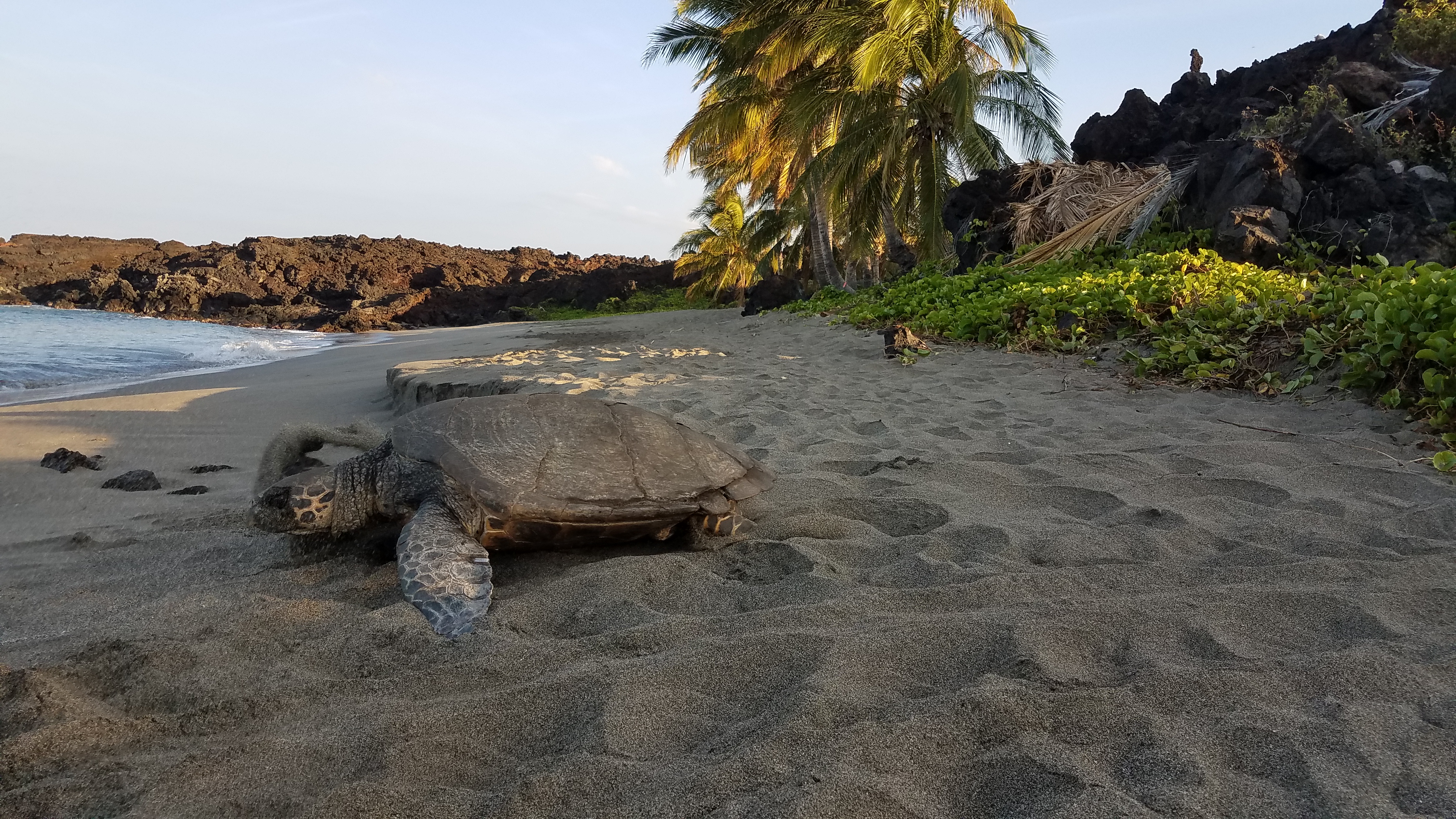
Hawksbill turtles nest at Pōhue Bay, its surrounding lands now protects as part of Hawaiʻi
Volcanoes National Park. Photo from National Park Service

   Trust for Public Land purchased Pōhue Bay for over $9.4 million funded by the federal Land and Water Conservation Fund, plus a catalytic donation from Wyss Foundation. Trust for Public Land transferred ownership and stewardship of Pōhue Bay to the National Park Service "so the area's native ecosystems and cultural treasures would be well cared for and preserved," says the joint statement. Trust for Public Land also transferred and donated $800,000 to Friends of Hawaʻ'i Volcanoes National Park to support the National Park Service's management of Pōhue Bay.
    Pōhue Bay has been the subject of several resort development proposals. However, community members identified the Pōhue Bay property as one of the highest priority acquisition/expansion areas in the Kaʻū Community Development Plan, and the acquisition of Pōhue is recommended in the 2016 Hawaiʻi Volcanoes National Park General Management Plan.

    Before the land transfer, NPS met with community members in partnership with TPL and Hawaiʻi
More of the Kaʻū Coast preserved through the purchase of
lands surrounding Pōhue Bay. Photo from Trust for Public Land

Alliance for Community-Based Economic Development "to better understand the land's cultural, historical and ecological significance. This preliminary process will continue over the next several months. Until a Pōhue interim operating plan is completed, and safe access protective of cultural and natural resources can be ensured, public access is temporarily restricted. There are no bathroom facilities or capacity for trash removal, and emergency response is very limited. Portions of the current jeep trail and pedestrian routes to the coastline pass through private lands not managed by the park," says the joint statement.
    Hawaiʻi Volcanoes National Park Superintendent Rhonda Loh said, "Pōhue is an incredibly precious and culturally significant landscape that needs to be protected. We are actively seeking community feedback to get a better understanding of the natural and cultural resources in the area. The park is working to develop an interim operating plan for Pōhue that explores opportunities for public use compatible with resource protection. We thank the community for your patience and for the manaʻo shared so far."
    A public meeting will be held at the Ocean View Community Center on Saturday, August 13 from 1 p.m. to 3 p.m., and additional meetings will be announced soon.
    Pōhue Bay is home to numerous well-preserved and significant Hawaiian cultural sites, including the largest recorded abrader quarry in Hawaiʻi, lava tubes, burial sites, mauka-makai (mountain to sea) trails, fishing shrines, remains of once-thriving coastal villages, and petroglyphs. A well-preserved portion of the Ala Kahakai National Historic Trail or Ala Loa, an ancient coastal trail system, hugs the coastline.
An anchialine pond and home to Rare endemic ʻōpaeʻula (red shrimp), located within
the addition to Hawai'i Volcanoes National Park, which includes Pōhue Bay.
Photo from Trust for Public Land
    The Pōhue coastline is also critical habitat for federally listed endangered Hawaiian species, including the Hawaiian hawksbill turtle (honu'ea) and Hawaiian monk seal. Rare endemic ʻōpaeʻula, (red shrimp), live in the area's anchialine ponds, and the bay is often frequented by native and migratory birds, including ʻiwa (frigate bird), koaʻe kea (white tailed tropic bird), kōlea (golden plover), ʻūlili (wandering tattler) and ʻaukuʻu (black crowned night heron).
    Trust for Public Land is a national nonprofit that works to connect everyone to the benefits and joys of the outdoors. As a leader in equitable access to the outdoors, TPL works with communities to create parks and protect public land where they are needed most. Since 1972, TPL has protected more than three million acres of public land, created more than 5,000 parks, trails, schoolyards, and iconic outdoor places, raised $84 billion in public funding for parks and for parks and public lands, and connected more than nine million people to the outdoors. To learn more, visit tpl.org.
    More than 20,000 National Park Service employees care for America's 423 national parks and work with communities across the nation to help preserve local history and create close-to-home recreational opportunities. Learn more at www.nps.gov, and on Facebook, Instagram, Twitter, and YouTube.
    In 2018 Hansjörg Wyss and the Wyss Foundation met the nature crisis by launching the Wyss Campaign for Nature. Wyss has committed $1.5 billion to the Campaign before the end of this decade, supporting Indigenous Peoples, local communities, and nations in their efforts to protect 30 percent of the planet by 2030.

To read comments, add your own, and like this story, see www.facebook.com/kaucalendar. See latest print edition at www.kaucalendar.com. See upcoming events at https://kaunewsbriefs.blogspot.com/2022/04/upcoming-events-for-kau-and-volcano.htm.

"THE MOST CONSEQUENTIAL ALLOCATION OF FUNDING for the implementation of the Hawaiian Homes Commission Act in its 100-year history," is the phrase employed by Hawaiian Homes Commission Chair William J. Ailā, Jr. He released a statement Monday to described the $600 million funding bill passed by the 2022 Hawai'i Legislature that was signed by Gov. David Ige.  Act 279 appropriates the $600 million to serve beneficiaries of the Hawaiian Homes Commission Act. DHHL lands are in the South Point area, Wai'ohinu and above Punalu'u, as well as house lots in Discovery Harbour.

Hawaiian Homelands of Ka'u, encircled in red,  are in the South Point area DHHL lands are in the South Point area, Wai'ohinu and above Punalu'u, as well as house lots in Discovery Harbour. DHHL map.


    "Sufficient funding to develop the raw landholdings of the Hawaiian Home Lands Trust has been elusive for decades. Today's signing marks a turning of the page from this dark past to a brighter future for native Hawaiians," said Ailā. "The measure will allow the Department of Hawaiian Home Lands to
expedite the construction of thousands of new homestead lots and housing units throughout the state. DHHL will also leverage its federal funding and trust assets to expand housing services to beneficiaries including down-payment assistance, rental subsidies, and expanded financial literacy education. These resources offer us an aggressive way forward. I thank the legislature for their bold decision making and Gov. Ige for his acknowledgment and support of the promises made to native Hawaiians."

To read comments, add your own, and like this story, see www.facebook.com/kaucalendar. See latest print edition at www.kaucalendar.com. See upcoming events at https://kaunewsbriefs.blogspot.com/2022/04/upcoming-events-for-kau-and-volcano.htm.

New Halema'umau Crater Thermal Images Released 

    Uncrewed aircraft systems (UAS) flights on July 7 allowed USGS aerial visual and thermal imagery to be collected of Halema‘uma‘u crater at the summit of Kīlauea. The active lake surface is limited to the western portion of the crater. The scale of the thermal map ranges from blue to red, with blue colors indicative of cooler temperatures and red colors indicative of warmer temperatures. USGS has special use permits from the National Park Service to conduct official UAS missions as part of HVO’s mission to monitor active volcanoes in Hawai'i, assess their hazards, issue warnings, and advance scientific understanding to reduce impacts of volcanic eruptions. USGS Image

To read comments, add your own, and like this story, see www.facebook.com/kaucalendar. See latest print edition at www.kaucalendar.com. See upcoming events at https://kaunewsbriefs.blogspot.com/2022/04/upcoming-events-for-kau-and-volcano.htm.


Monday, July 11, 2022

Ka‘ū News Briefs, Monday, July 11, 2022

MAJOR HURRICANE DARBY IS TRACKING TOWARD HAWAIʻI ISLAND but is expected to lose intensity, become a Tropical Storm and arrive as a Depression on Saturday evening at 5 p.m.. On Monday, Darby was moving west at 17 mph with sustained winds of 140 mph about 1,825 miles east-southweast of South Point. Central Pacific Hurricane Center predicts that Darby will begin turning to a more west-northwest direction on Tuesday and move from the Eastern Pacific to the Central Pacific Basin on Wednesday.

Hurricane Darby is expected to reach the southside of Hawaiʻi
Island on Saturday as a Depression as she enters drier air, over
cooler waters. Image from www.Weatherboy.com
    The hurricane is very compact with hurricane force winds only extending 50 nautical miles from her eye. Darby "maintains a classic major hurricane structure with well-defined outflow in all quadrants, a symmetric cloud pattern, and a distinct small eye (less than 10 n mi in diameter). Satellite images indicate that the eye has become even more defined over the past few hours, but deep convection has been weakening a little to the west of the eye," says the 5 p.m. Hurricane Center update. "Darby is likely near its peak intensity. The major hurricane will be moving over progressively cooler waters and crossing the 26 degree C isotherm in about 24 hours. In addition, Darby will be moving into a drier airmass, which should accelerate the weakening trend. In a few days when Darby is over the central Pacific, a mid- to upper-level trough should induce strong westerly shear and cause Darby to become a post-tropical cyclone in about 4 days."

To read comments, add your own, and like this story, see www.facebook.com/kaucalendar. See latest print edition at www.kaucalendar.com. See upcoming events at https://kaunewsbriefs.blogspot.com/2022/04/upcoming-events-for-kau-and-volcano.htm.

A promotional photo shown online by Big Island ATV Southside Tours. 


AN ACCIDENT INVOLVING AN ATV TOUR IN KAʻŪ was reported by Big Island Thieves Media on Sunday. At Waiʻōhinu Park, passersby said they saw a helicopter land, bringing a woman with an injured leg for assessment and treatment, along with her companion. Big Island ATV Southside Tours is one of at least two ATV tour companies operating in Kaʻū. The company provides riders from ten to 90 years of age with either double or single quads for the adventure, along with helmets, gloves, dust masks and bottled water. The cost starts at $200.
    Tours go down the public Kaʻalualu Road and onto trails on Department of Hawaiian Home Lands and Kamehameha School property.
    An online promotion for Big Island ATV Southside Tours posts the following: "Welcome to the Southern most area of the United States! Our tour will take you to places that tourists and locals alike have never visited. This is the REAL untouched Hawaii. The Southpoint area is where the Hawaiians originally landed on the Big Island. It's beautiful, warm, sunny and sometimes windy.

A family shown along the trail on Big Island ATV Southside Tours.

"Youʻll be crossing rugged lava flows and grassy fields, Ancient Kiawe forests with all the natural fauna and flora of The Big Island. Gorgeous aqua coastline with crashing waves worthy of photos, especially when the surfs up! If on a winter tour you might even see a whale or two. You will experience colorful tropical fish and green sea turtles visible from rugged lava cliffs as you peer into Shark Bay. We also do private family tours so book ahead so we have spaces available for you and your family. Get a little SUN and have a little FUN! Lets GO!" See the website for Big Island ATV Southside Tours at https://www.viator.com/tours/Big-Island-of-Hawaii/Big-Island-ATV-Southside-Tours/d669-358276P1?m=58932&nid=VR.16e43091-f2b3-4122-88e4-75e1d56f1d1e.TA_EMAIL_ATTRSUP?mcid=56757.
    A review online in July says, "The hosts, Wes and Vicki were so knowledgeable about the island, and the terrain. The trails we took were rough at times, but that made the experience even better. The spots they took us to at the ocean, and bays were perfect, we even got to view the sea turtles at shark cove. We would recommend this tour to everyone, well worth the money."

To read comments, add your own, and like this story, see www.facebook.com/kaucalendar. See latest print edition at www.kaucalendar.com. See upcoming events at https://kaunewsbriefs.blogspot.com/2022/04/upcoming-events-for-kau-and-volcano.htm.

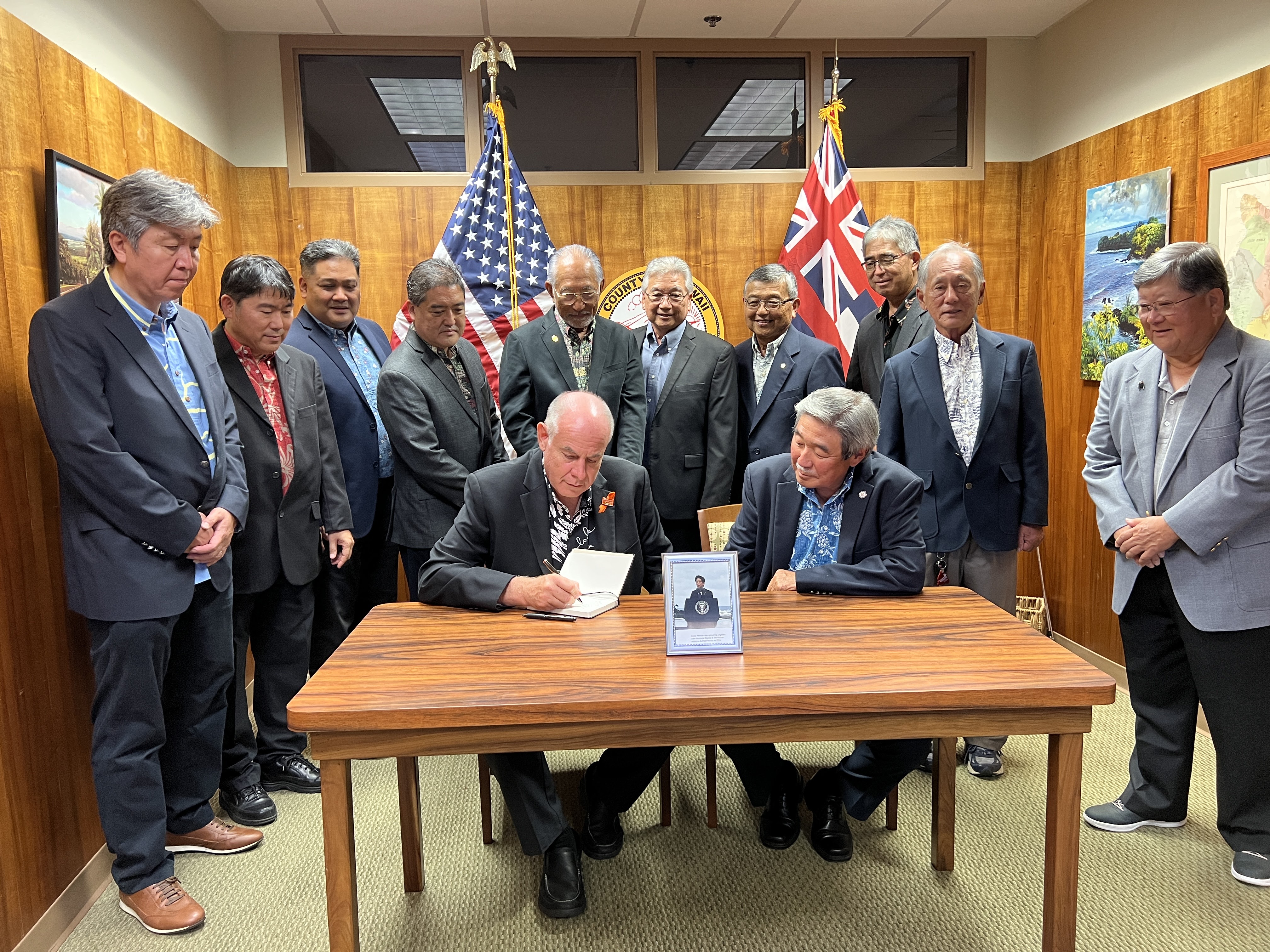
AN OPPORTUNITY TO SIGN BOOKS OF CONDOLENCES in memory of the late former Prime Minister of Japan, Shinzo Abe, who was gunned down last week, is available through Hawaiʻi County, in partnership with the Honorary Consul General of Japan in Hilo, Art Taniguchi.
    The last time the County of Hawaiʻi hosted Books of Condolences for Japan was in 2011, when The Great Tōhoku Earthquake destroyed more than 100,000 buildings and triggered a nuclear disaster.
    Abe's Books of Condolences can be found in the Office of the Mayor in both Hilo and Kona and are open to the public for comment. After a week, the Books will be hand-delivered to the Consul General of Japan in Honolulu and sent off to Japan to be stored and archived for Prime Minister Abe and his ʻohana. The Books will be available to the public through Friday, July 15.
    “We encourage anyone with a message of solidarity and unity for our Japanese brothers and sisters to come down to the Mayor’s office and share that message,” said Mayor Mitch Roth. “Prime Minister Abe was a friend to Hawaiʻi and the United States, and through that, there are many across our state who have been impacted by his sudden passing. Regardless of our differences with our elected officials, we should all stand against violence and join the Japanese community in memorial and mourning.”
Mayor Mitch Roth and Honorary Consul General for Japan in Hilo, Art
 Taniguchi, offer the public opportunity to sign Books of Condolences 
for the late former Prime Minister of Japan Shinzo Abe.
Photo from the Mayor's Office
    The Hilo Honorary Consul General for Japan said, “Prime Minister Abe was well-respected domestically and internationally, and the world mourns the loss of a great leader and visionary. We are very thankful that Mayor Roth has allowed Books of Condolences in the Mayor’s Offices in Hilo and Kona from Tuesday through Friday. We encourage anyone who wishes to offer their condolences to please go into either the Hilo or Kona offices of the Mayor and share your thoughts during normal office hours.”

To read comments, add your own, and like this story, see  www.facebook.com/kaucalendar. See latest print edition at www.kaucalendar.com. See upcoming events at https://kaunewsbriefs.blogspot.com/2022/04/upcoming-events-for-kau-and-volcano.htm

Kaʻū musicians head to Kona this Friday for a performance
at Gertrude's on Ali'i Drive.


Sunday, July 10, 2022

Ka‘ū News Briefs, Sunday, July 10, 2022


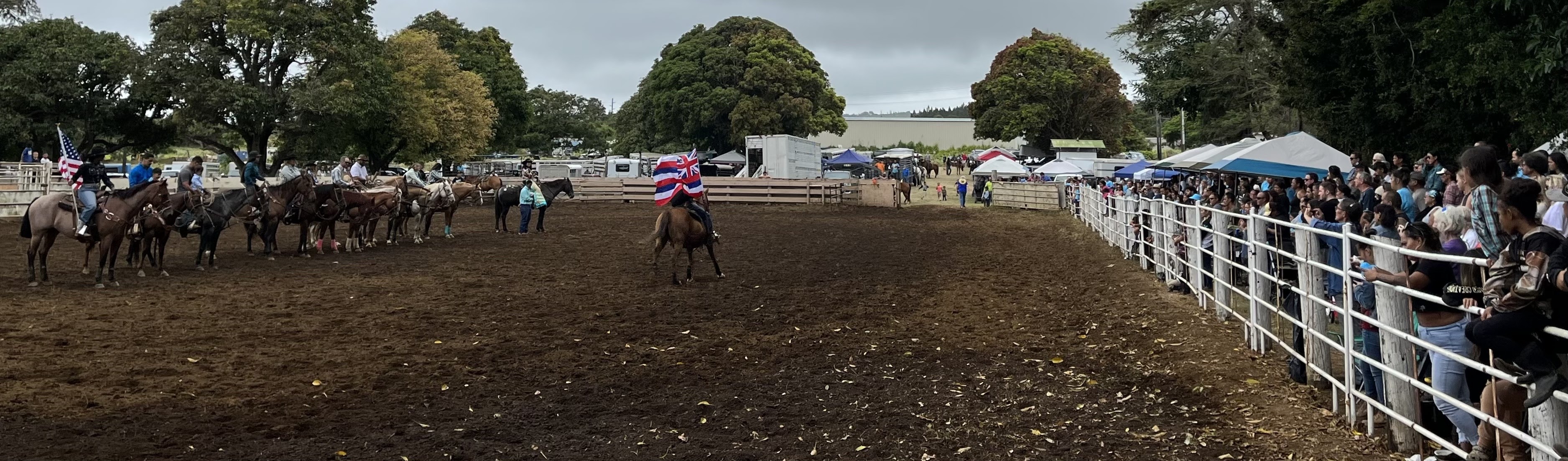
Nāʻālehu Rodeo Grounds, owned and managed by the non-profit Kaʻū Roping & Riding Association. See more of this
weekend's rodeo photos below. Photo by Lina Kolosova

IS WHAT YOU SEE WHAT YOU SMELL, COMING FROM THE VOLCANO? That is the question posed in his week's Volcano Watch, written by U.S. Geological Survey Hawaiian Volcano Observatory scientists and affiliates. The answer from the HAVO scientists is "Surprisingly, no! When you see a volcanic plume on the Island of Hawai‘i, you may see a few different colors—white, or bluish, or brownish. Those different colors result from atmospheric scattering by liquid water droplets (white) and sulfate aerosols (blue, brown) in the plume. What you smell is sulfur dioxide (SO2), which is invisible to our eyes." Here is the rest of Volcano Watch:
For several years, a special USGS ultraviolet camera perched near Keanakākoʻi Crater at Kīlauea's summit. The camera was capable of detecting SO2 gas coming from Halema‘uma‘u crater. It was removed when cracking near Keanakākoʻi Crater was making access difficult and SO2 emissions were in decline. Photo from USGS
    Observations of SO2 are critical to both tracking and understanding eruptive behavior. The USGS Hawaiian Volcano Observatory relies heavily on measurements of SO2 emission rate, which is often used as a proxy for volcanic activity. Such measurements are also critical for vog (volcanic air pollution) forecasts and can be used for calculating lava eruption rates.
    HVO also relies heavily on cameras to document activity, including both visual and thermal cameras. A third type of camera—an ultraviolet (UV) camera—allows volcanologists to visualize those important, and otherwise invisible, SO2 plumes. SO2 absorbs ultraviolet light, which makes it visible in UV imagery even when it cannot be seen by standard cameras.
    UV cameras have been used at Kīlauea before. Patricia Nadeau, current member of the HVO gas geochemistry group, studied the summit plume using a UV camera in 2010 while a graduate student at Michigan Technological University. Later, in 2013, a combined effort between the Cascades Volcano Observatory (CVO) and HVO resulted in the installation of an automated UV camera system at the summit of Kīlauea. That camera station was removed in 2018 when it was threatened by ground cracking associated with summit caldera collapse events. A campaign-survey-style UV camera was also used for
At left, the degassing plume at Kīlauea in 2013 as seen by a standard, visible-light camera. Note that plume is mostly transparent, with some blue/brown tones from aerosol scattering, and hard to distinguish from background cloud. At right, the plume from the same vantage point as seen by a UV camera. The sulfur dioxide in the plume absorbs UV and makes the plume appear dark. USGS Photos by C. Kern
part of the 2018 lower East Rift Zone eruption response, but HVO has not utilized such cameras much since then.
    Now, with lava and strong SO2 degassing having returned to Kīlauea summit in late 2020, HVO and CVO are teaming up with colleagues at the University of Sheffield in the United Kingdom. The UK scientists have developed a new generation of small UV cameras that use Raspberry Pi technology. A Raspberry Pi is a small, low-cost computer, about the size of a credit card, and HVO has used them in other applications before.
Pi-cams will be tested this month at Kīlauea summit and later
at Mauna Loa. Photo from Pi Supply
  The new cameras—PiCams—will be tested later this month and can be used as portable field tools or installed as permanent stations in HVO’s monitoring network. Pending the outcome of the initial tests, HVO plans to install at least one PiCam permanently at Kīlauea’s summit. A second PiCam will either be kept portable for flexibility or will eventually be installed near Mauna Loa’s summit.
    SO2 emission rates can also be derived from UV camera images. Traditional SO2 emission rate measurements are made by traversing beneath the plume with a UV spectrometer mounted on a car, so that each measurement takes ten or more minutes, with only 6–10 of those measurements made per day. Beginning in 2012, HVO pioneered a network of continuous spectrometers to measure Kīlauea’s SO2 emission rate at a much higher temporal resolution than possible with vehicle-based measurements, but the network did not provide spatial information about the SO2 plume.
    Once the PiCams are ready for use, they will provide both a 2-dimensional view of Kīlauea’s SO2 degassing as well as a high-temporal resolution, continuous timeseries of SO2 emission rate measurements.
    The continuous SO2 emission rate data will make it easier to study degassing in conjunction with other continuous datasets, like earthquake activity and ground deformation. This will give greater insight into the role of degassing in specific eruptive events, something that has not always been easy to do in the past. Similar work has been done over the past decade at many volcanoes around the world—including here at Kīlauea, where earthquake activity and SO2 emissions were shown to be linked during lava lake rise-fall events in 2010. The current lava lake in Halema‘uma‘u has a different configuration and set of behaviors from the 2008–-2018 lava lake, and HVO is eager to see what the new PiCams will show us about the degassing of the new lake.

To read comments, add your own, and like this story, see www.facebook.com/kaucalendar. See latest print edition at www.kaucalendar.com. See upcoming events at https://kaunewsbriefs.blogspot.com/2022/04/upcoming-events-for-kau-and-volcano.htm

Starting small, Kaʻū Roping & Riding introduces keiki to rodeo with goats instead of calves.
Photo by Lina Kolosova

The rodeo in Nāʻālehu wrapped up Sunday. See the results in an upcoming Kaʻū News Briefs. The Kaʻū Roping & Riding
Rodeo grounds were closed to the public over the last two years during the pandemic.
Photo by Lina Kolosova

SOLVING THE 40 PERCENT PHYSICIAN SHORTAGE ON THIS ISLAND is one of the aims of a bill signed by Gov. David Ige last week. The bill, passed by the 2022 Hawaiʻi Legislature, references The Hawaiʻi Physician Workforce Assessment Project Report, which indicates that Hawaiʻi is in need of at least 750 doctors, with the greatest statewide shortage being in primary care specialties. The proportional need is greatest on the neighbor islands, with both Maui and Hawaiʻi County experiencing a physician shortage of 40 percent.
    In addition to the bills introduced by the legislature, Ige identified the physician shortage as a priority at the start of the 2022 legislative session by including funding to expand the residency program at University of Hawaiʻi's John A. Burns School of Medicine.
    “My administration is committed to supporting the development and expansion of high-quality educational and training sites, especially on the neighbor islands where we face the greatest challenge,” said Ige. “Mahalo to our lawmakers for also making this a priority and to JABSOM and our local medical partners for their dedication to ensure our local residents can access the healthcare they need now and in the future.”
   Senate Bill 2657 funds JABSOM’s expansion of medical residency and medical student training opportunities on the neighbor islands, and with the U.S. Veteran Affairs Pacific Islands Healthcare System sites across the state––specifically in areas where healthcare is most needed. The VA is a valuable partner in JABSOM’s academic programs. Internal Medicine, Family Medicine, Psychiatry, Geriatrics, and Addiction Medicine residents or fellows have part of their curriculum based at VA sites.
    Currently, some medical students complete pre-clinical rotations for up to three months on the neighbor islands of Hawaiʻi Island, Lanaʻi, and starting this academic year, Kauaʻi. Third-year students participate in a longitudinal clerkship program where groups of students train in the same location for a five-month long rotation in rural communities. Third year students presently train at several locations on Hawaiʻi Island, Maui and Kauaʻi.
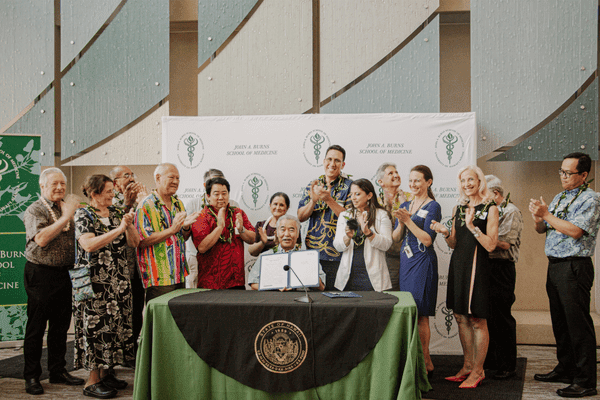
Gov. David Ige signs a bill to help reduce the doctor shortage of some 40 percent on Hawaiʻi Island
and Maui and a smaller but significant shortage elsewhere in the islands. Photo from JABSCOM

   “Data show that more than 80% of physicians who graduate from both JABSOM and its residency programs tend to stay in Hawaiʻi to practice—that is one of the highest retention rates in the country,” said JABSOM Dean Jerris Hedges. “We know that physicians who train in rural areas on our neighbor islands are also more likely to put down roots and nurture the communities that they’re in. We look forward to expanding our medical training opportunities to these underserved areas and to stay true to JABSOM’s vision of ALOHA: Attain Lasting Optimal Health for All.”
    To alleviate the shortage of physicians in the state, more than 225 physicians participate in JABSOM’s Accreditation Council of Graduate Medical Education-accredited residency and fellowship programs. Kaiser Permanente Hawaiʻi also has a primary care internal medicine residency program and the Hilo Medical Center is the sponsor of the Hawaiʻi Island Family Medicine Residency Program. With the exception of the Hilo-based program, the remainder of these civilian residency programs are on Oʻahu, with some having clinical rotations on the neighbor islands. The neighbor island rotations – through the VA clinics or in partnership with other neighbor island physicians and health systems – gives residents and fellows the opportunity to train and eventually practice in rural areas.
 
  “Hawaiʻi Residency Programs, as the employer of the JABSOM residents and most fellows, is committed to our rural and at-risk communities by training our future physician workforce,” said Natalie Talamoa, executive director of Hawaiʻi Residency Programs. “We are excited that the State of Hawaiʻi shares our goal and look forward to working together on this initiative to invest in our neighbor island communities that have been hardest hit by the physician shortage. This funding will increase access to training opportunities for our residents and fellows, and provide them exposure and understanding of our most vulnerable populations so that they want to return to serve these communities.”
    “The VA’s ability to expand Graduate Medical Education can help reduce the effects of a forecasted physician shortage here in the Pacific Islands, especially in Hawaiʻi, thanks to the partnership we have with the John A. Burns School of Medicine,” said Adam Robinson, Jr., director of the Veteran Affairs Pacific Islands Health Care System. “We take pride in providing the largest education and training enterprise for health professionals in the nation, but we can’t do it without the relationships we share with our valued academic affiliate residency sponsors.”
    Senate Bill 2597 allows for more loans to be given in the Hawaiʻi State Loan Repayment Program, which helps graduates of JABSOM and other health professions reduce their educational debt in exchange for remaining in Hawaiʻi to practice. Loan repayment programs are a critical part of addressing the health professional workforce shortage, and Hawaiʻi’s program has proven to be highly successful.
    According to JABSOM’s Hawaiʻi and Pacific Basin Area Health Education Center Director Kelley Withy, “83% of loan repayers have remained in Hawai‘i to practice, and 70% have remained at the site where they performed their service. Currently, there are 25 active providers in the program with another seven waiting for funding. We are very thankful to the legislature for the matching funds so that we can provide more opportunities to those interested in caring for communities where there is a dire shortage of healthcare providers.”
    Health care professionals who have benefited from the loan repayment program serve on all islands and in the communities of Waimea, Kihei, Waiʻanae, Hilo and Wailuku; at Federally Qualified Health Centers in Kalihi-Palama and Kokua Kalihi Valley; and in public institutional settings at the federal detention center in Honolulu, the Halawa correctional facility and the Maui County correctional center. Health care professionals who are eligible to participate in the program include physicians, nurse practitioners, psychologists, social workers and many others.
    Those present at the bill signing ceremony included state lawmakers Rep. Gregg Takayama, Rep. Ryan Yamane, Sen. Donna Mercado Kim and Sen. Jarrett Keohokalole, UH President David Lassner, JABSOM Dean Jerris Hedges, JABSOM Associate Dean for Academic Affairs Lee Buenconsejo-Lum, JABSOM Associate Dean for Administration and Finance Nancy Foster, as well as leadership from affiliated hospitals, the Hawaiʻi Residency Programs, Inc., the VA Pacific Islands Health Care System, and leaders from several of JABSOM’s clinical departments and the Office of Medical Education that oversees the MD Program curriculum.