About The Kaʻū Calendar

Sunday, September 25, 2022

Ka‘ū News Briefs, Saturday, Sept. 24, 2022

Friends of Hawai'i Volcanoes National Park is working with descendants of the Puʻuhonua O Hōnaunau  
area to build a Friends group there. Photo from Hawai'i Public Radio

FRIENDS OF HAWAI'I VOLCANOES NATIONAL PARK is working with Puʻuhonua O Hōnaunau National Historical Park to create its own Friends group, according to a story from Hawai'i Public Radio reporter Ku'uwehi Hirashi this week. A private donation of $70,000 will help to establish the Friends group, according to the Friends President & CEO Elizabeth Fien. 
     According to the HPR story, Fien noted that "Puʻuhonua O Hōnaunau in South Kona was brought into the national park system in 1955. But its history as a place of refuge for ancient Hawaiian lawbreakers goes back centuries.
    “So certain people and places and things and times were sacred. They were kapu or forbidden, and any breaking of a kapu would disturb the stability of the society and the punishment was often death. Any fugitive who broke the kapu could seek refuge within the walls of puʻuhonua. So in some senses, this is probably one of the very first sanctuary cities,” Fien told HPR.
Hale O Keawe Puʻuhonua O Hōnaunau
Friends of Hawai'i Volcanoes National Park is helping to create a Friends group
 at Puʻuhonua O Hōnaunau. Photo from Hawai'i Public Radio
   Friends of Hawai'i Volcanoes National Park has been operating for 25 years, sponsoring the Youth Ranger Program, which is well attended by Kaʻū High School students. It also offers Guardians of the Trails, Forest Restoration, Institute on Demand Private Tours, Wild Cave Exploration and more. Activities include removal of endangered species, improvement of trails and cultural programs and events.
    Fien told HPR that "About four years ago I was visiting Puʻuhonua O Hōnaunau and I was struck — There was a real spiritual connection — I was struck by the park, but I was also struck by the fact that so many things needed help there. Repairs need to be done and more cultural programs need to happen. So when this grant came along, I thought it would be perfect."
Elizabeth Fien, President & CEO of Friends of
Hawai'i Volcanoes National Park, is working
to establish a Friends organization at 
Puʻuhonua O Hōnaunau National Historic Park.

    Friends of Hawai'i Volcanoes applied and received $70,000 through the National Park Foundation’s Strong Parks, Strong Communities program to work with a group of community stakeholders, including descendants of the area, to form the Friends of Puʻuhonua O Hōnaunau National Historical Park.
    “This grant enables us to do things like the marketing materials, website, membership,” Fien told HPR. “And our first major project that we want to tackle is we want to create an environmental cultural learning center. That’s a big project, but it’s what the descendants and stakeholders would love to see happen.”
    Fien said a web site for the Pu'uhonua O Hōnaunau Friends should be online soon. See more at Friends of Hawaiʻi Volcanoes National Park website at fhvnp.org.
To read comments, add your own, and like this story, see www.facebook.com/kaucalendar. See latest print edition at wwwkaucalendar.com. See upcoming events at https://kaunewsbriefs.blogspot.com/2022/04/upcoming-events-for-kau-and-volcano.html.
THE TREND OF MIGRATING TO HAWAI'I ISLAND from O'ahu was featured in a Pacific Business News story on Saturday. It also noted that the state of Hawai'i’s "declining population due to net out-migration" is something policymakers and economists "have been worriedly watching." The story also noted that data on intra-state migrants from 2019 to 2020 adds IRS figures on the money attached to these movers. "They ranged from somewhat wealthier than the people we lost, to significantly so, depending on which island. Of Hawai'i’s four counties, Honolulu is the net loser, shedding nearly 4,000 more people than it gained, whose combined adjusted gross income was just over $162 million. With the data emphasizing tax filers, PBN reached out to Tom Yamachika, President of Tax Foundation of Hawai'i. Yamachika told PBN, “We have been warning lawmakers for several years now that our state has been losing people. News media and some local nonprofits have been trying to find out why this is so, and have been told by many that they are unable to make ends meet here between the high cost of living and taxes. We have told
lawmakers that the tax environment here in Hawai'i already has reached a point where people are ‘voting with their feet’ and getting on a plane with a one-way ticket out of here. The more that happens, the more pressure there will be for lawmakers to either force the rest of us who remain to make up for the lost revenue, or to right-size government services to match the dwindling population. Historically, lawmakers have been severely reluctant to downsize government services and programs, so the rest of us who call Hawai'i home are in trouble."
    The PBN story noted that "people don’t just move between states, they also move between counties in Hawai'i. From 2019 to 2020, the single largest intra-island migration was the 724 people who moved from Honolulu to Hawai'i Island. The second largest migration? The 542 people who moved from Hawai'i Island to O'ahu. PBN also reported that "It’s noteworthy that for every Hawai'i county, this analysis finds that the new arrivals out-earn the Hawai'i residents they replaced. Connecting the dots that young families are leaving, and that tax filers with annual incomes at $60,000 are leaving, the data support longstanding perceptions that the cost of living drives our exodus."
    Joe Kent, Executive Vice President of Grassroot Institute Hawai'i, told PBN that "Hawai'i may be becoming an attractive place for high earners to move to, and that could help diversify our economy. But the numbers also seem to show that the Hawai'i residents with lower incomes are fleeing for the Mainland in search of a lower cost of living. Lawmakers should focus on lowering costs and allowing more opportunities, such as by reducing taxation and regulations, which could help families across the board afford to stay in the Islands.”
    PBN also reported on the population change from 2019 to 2020. "Right in the middle of that time period, in January 2020, PBN reported on findings by CBRE and University of Hawai'i Economic Research Organization that Hawai'i had already become a net population loser due to stagnant wages and high costs. The labor force had shrunk by 25,000 people since 2017. As a result, Hawai'i’s GDP growth, UHERO projected, would be half that of the Mainland’s by 2040.
To read comments, add your own, and like this story, see www.facebook.com/kaucalendar. See latest print edition at wwwkaucalendar.com. See upcoming events at https://kaunewsbriefs.blogspot.com/2022/04/upcoming-events-for-kau-and-volcano.html.
KAʻŪ TROJANS RACKED UP 14 POINTS AGAINST HPA ON SATURDAY at home. The loss to the Ka Makani of Hawai'i Preparatory Academy, was six points as Kaʻū continues to score and narrow losses as the season progresses, under coach Greg Rush. The Trojans, comprised of talent from Kaʻū High and Volcano School of the Arts & Sciences, next plays Honoka'a on Saturday, Oct. 1 at the ball field in Pāhala.
KAʻŪ TROJAN GIRLS VOLLEYBALL TAKES ON PAHOA with a home game on Tuesday, Sept. 27 at the Robert E Herkes Kaʻū District Gym. Start time is 5 p.m. for JV, followed by Varsity. 
To read comments, add your own, and like this story, see www.facebook.com/kaucalendar. See latest print edition at wwwkaucalendar.com. See upcoming events at https://kaunewsbriefs.blogspot.com/2022/04/upcoming-events-for-kau-and-volcano.html.


See September issue of The Kaʻū Calendar
at www.kaucalendar.com, and in the
mail - Volcano, Kaʻū to South Kona.


Friday, September 23, 2022

Ka‘ū News Briefs, Friday, Sept. 23, 2022

Enrollment in Nāʻālehu Elementary School, students shown here during a free school supply distribution, is 416,
according to data released this week by Department of Education for all public and charter schools in the state.
There has been a decline in enrollment throughout Hawai'i. Photo from Nāʻālehu School

ENROLLMENT IN KAʻŪ SCHOOLS FOR THIS YEAR has been released by the state Department of Education. 
    Nāʻālehu Elementary registered 43 in kindergarten, 43 in first grade, 51 in second, 80 in third, 65 in fourth, 50 in fifth and 60 in sixth. Enrollment in regular school is 390. There are 26 students in Special Education. Total enrollment at the school is 416.  Nāʻālehu's Pre-K program hosts 6 students.  
    Kaʻū High & Pāhala Elementary registered 12 students in kindergarten, 15 in first grade, 15 in
Kaʻū High has a small graduating class compared
to many schools in Hawai'i. This year there are
61 in the Class of 2023. Photo by Julia Neal
second grade, 11 in third grade, 19 in fourth grade, 18 in fifth grade, 12 in sixth grade, 72 in seventh grade, 55 in eighth grade, 69 in ninth grade, 67 in tenth grade, 47 in eleventh grade and 61 in the Class of 2023. The total enrollment in regular school is 474. In addition, in Special Education, there are 10 students in kindergarten through sixth grade, 14 in seventh and eighth, and 29 in ninth through twelfth grades. Total enrollment at the school is 527. The campus serves students living from Ocean View to Pāhala.
    Volcano School of the Arts & Science registered 14 in kindergarten, 21 in first grade, 21 in second grade, 23 in third grade, 22 in fourth grade, 20 in fifth grade, 17 in sixth grade, 24 in seventh grade, 18 in eighth grade, 12 in ninth grade, 15 in tenth grade, 5 in eleventh grade. The first graduating high school class will be the Class of 2024. Total enrollment in regular school is 212. There are 25 students in Special Education in kindergarden through sixth grade, 9 in seventh and eighth, and 18 in ninth through eleventh grades. Total enrollment at the Volcano School is 264.
    While Kaʻū schools are small compared to most of those statewide, the five smallest HIDOE schools in the state are: Ni‘ihau High and Elementary  with 176 students, Maunaloa Elementary (46), the Hawai'i School for the Deaf & the Blind (53), Kilohana Elementary (75), and Waiāhole Elementary (91).
Volcano School of the Arts & Sciences.
Photo from Volcano School

    "Based on enrollment for the 2022-23 school year, the five largest HIDOE public schools by grade level are: High schools (grades 9-12): Campbell (3,039), Waipahu (2,661), Mililani (2,565), Farrington (2,238), and Moanalua (2,064).
     The largest (grades 6-8) Middle Schools and (7-8) Intermediate Schools are: Mililani Middle (1,580), ‘Ewa Makai Middle (1,119), Waipahu Intermediate (1,084), Maui Waena Intermediate (1,044), and Kaimukī Middle (950).
    The largest Elementary Schools are: August Ahrens (1,164), ‘Ewa (1,086), Holomua (1,071), Keone‘ula (915), and Waipahu (853).
    The five largest charter schools are: Hawaiʻi Technology Academy (1,403), Kamaile Academy (949), Kīhei Charter School (693), the Hawaiʻi Academy of Arts & Sciences (683), and Kanu O Ka ʻĀina (612).
    Statewide, public and charter schools are experiencing a decline in enrollment, according to a statement from the Department of Education, which reported the decrease for the 2022-23 school year, with enrollment of 168,634 students, compared with 171,600 students at the start of last school year — a difference of 1.7 percent. the figures include distance learning students.
    Department of Education schools enrolled a total of 156,518 students this year, compared with 159,503 students at the start of last school year, a 1.9 percent decrease. The figures include students enrolled in schools and the state distance learning program. The state's 37 charter schools, meanwhile, enrolled a total of 12,116 students, compared with 12,097 the previous year.
    "The declining trend in enrollment counts over the past four school years reflects Hawaiʻi’s overall declining birth rate over the last decade. Department data also show that families’ leading reason for removing their students from public schools is for relocation to mainland states," according to DOE.
    View the report on enrollment at all the schools at https://www.hawaiipublicschools.org/DOE%20Forms/Enrollment/HIDOEenrollment2022-23.pdf
    
To read comments, add your own, and like this story, see www.facebook.com/kaucalendar. See latest print edition at wwwkaucalendar.com. See upcoming events at https://kaunewsbriefs.blogspot.com/2022/04/upcoming-events-for-kau-and-volcano.html.

UHERO FORECASTS A MILD RECESSION IMPACTING THE ECONOMY OF HAWAI'I. University of Hawai'i Economic Research Organization issued its report on Friday, saying "Hawai'i's economic prospects have worsened over the past several months. Surging inflation and interest rates are already impacting local famlies, as they have elsewhere. And the Fed's necessary 

policy medicine - additional interest rate hikes- will bring further challenges before this is over.
    "A Hawai'i economy that has already downshifted over the course of the year wll slow further as the US. economy enters recession. The long-awaited return of Japanese visitors and robust public sector construction will offset U.S. weakness, which we think will keep Hawai'i job growth in a positive territory. But there are troubling risks as well including the impact of a very weak yen, potenetial larger Fed interest rate hikes and a deeper U.S. fall. In any event, a return to satisfactory economic progress here will not being until 2024."
UHERO predicts that a coming recession "will not be anywhere as severe as the last two." UHERO also suggested Hawai'i could avoid a recession. "While the U.S. is the main source of Hawai'i tourists, international visitors are just beginning to return in larger numbers. Returning visitors from Japan and other international markets may partially insulate Hawai'i from a U.S. downturn." The report also notes that the Department of Hawaiian Homelands has the potential to be an important source for new housing construction with its $600 million of new funding for it.
    See the 18 page forecast plus numerous data points used in the analysis at https://uhero.hawaii.edu/wp-content/uploads/2022/09/22Q3_Forecast.pdf

To read comments, add your own, and like this story, see www.facebook.com/kaucalendar. See latest print edition at wwwkaucalendar.com. See upcoming events at https://kaunewsbriefs.blogspot.com/2022/04/upcoming-events-for-kau-and-volcano.html.

Earthquake swarm Friday at Mauna Loa.
USGS map from Big Island Video News
AN EARTHQUAKE SWARM AT MAUNA LOA was reported by Hawai'i County Civil Defense on Friday, with data from U.S. Geological Survey's Hawaiian Volcano Observatory.
    The message pointed to "small seismic swarm activity ongoing beneath the summit of Mauna Loa Volcano. Over 38 earthquakes of up to 2.7 in magnitude occurred beneath the summit caldera region just below sea level. According to HVO, Seismic activity beneath Mauna Loa has been gradually increasing over the past two months and small earthquake swarms are considered a normal part of this increase in activity. Currently there are no indications that magma is moving toward the surface and there is no eminent signs that an eruption will occur. HVO and Civil Defense will continue to closely monitor this activity and report any significant changes that may affect your safety."
    USGS reported that the "earthquakes may result from changes in the magma storage system and/or may be part of normal re-adjustments of the volcano due to changing stresses within it."

To read comments, add your own, and like this story, see www.facebook.com/kaucalendar. See latest print edition at wwwkaucalendar.com. See upcoming events at https://kaunewsbriefs.blogspot.com/2022/04/upcoming-events-for-kau-and-volcano.html.

WHERE IS THE LAVA HEADED AND WHEN WILL IT GET THERE? That is focus of Volcano Watch by USGS Hawaiian Volcano Observatory scientists and affiliates. This week's article is by Postdoctoral Researcher David Hyman:
    When lava flows break out on the flanks of Kīlauea or Mauna Loa, Hawaiʻi residents and emergency management agencies from all over the world want to know what to expect.
    During the 2018 Kīlauea Lower East Rift Zone eruption, lava from 24 fissures inundated more than 8,000 acres (3,200 hectares) of land in the Puna District and more than 700 structures were destroyed. Sobering figures like these highlight the need for forecasting the advance of lava flows to help emergency managers, residents, and USGS Hawaiian Volcano Observatory (HVO) staff. Highly accurate forecasts for other natural hazards such as hurricanes, flooding, drought, and even the spread of vog from Kīlauea are now commonplace. Can we do the same for lava flows?
   The most successful forecasting efforts for other natural hazards rely on the ability to simulate flows of water or air. Even though the motion of these fluids is typically much more complex than that of lava, we know a great deal more about water and air than lava as a material. After all, we can't see inside a lava flow to observe what is happening below the surface the way we can for water and air.
   At the heart of hazard forecasts are computer algorithms crunching the numbers as fast as possible to make a relevant forecast. After all, a prediction of severe flooding in 24 hours is not very useful if it takes 23 hours to make that forecast.

color map of lava flow forecast
Oblique view of an example simulation showing lava flow advance from Fissure 22 (white line segments) of the 2018 Kīlauea lower East Rift Zone eruption. Color contours show the lava flow front in 1-hour increments. The simulated flow entered the ocean after 22 hours elapsed, comparable to the actual timeframe it took that lava flow to reach the ocean. View is from 2 miles (3 kilometers) offshore to the southeast at 8500 feet (2600 meter) elevation. The Google Earth basemap is from images collected after the end of the eruption.

    Although researchers have been applying the principles of fluid dynamics to lava flows for more than 40 years, most simulations are too slow to use during a crisis when we really want to know the answer to the questions: Where's that lava headed and when will it get there?
To help answer that question, HVO scientists have for many years forecasted the general path of lava flows using the principle of steepest descent—that lava flows downhill. In many cases, these forecasts have worked really well; however, this method can't by itself answer the second part: "... and when will it get there?" because it predicts only the route, not the speed or the flow's final length.
    To help answer these questions, USGS scientists are developing a new lava flow forecasting model based around the physics-based simulation of lava as it flows across real topography while cooling and solidifying. This model is designed with simplified, but realistic physics, enabling the simulation of 24 hours of lava advance in as little as a couple of minutes on an ordinary laptop.
This research is supported by the Additional Supplemental Disaster Relief Act of 2019 (H.R. 2157), which has also funded the work of many HVO projects that have been the subjects of recent Volcano Watch articles.
    Of course, we don't have perfect knowledge or measurements of our model inputs, so a single simulation doesn't provide much information about our confidence in a forecast. By running the code many times with a range of inputs, the collection—or ensemble—of all these models can give us a much better idea of the range of possible outcomes. This has been a common practice in forecasting hazardous weather such as hurricanes for many years and is now the cutting edge in volcanic hazards research. HVO scientists are investigating how to produce ensembles using this new model, with the goal of successfully forecasting lava inundation during future eruptions.
    Although there is a great deal we do not know about what a volcano is about to do, we can make some short-term forecasts based on what is currently happening. These forecasts, even over short periods of time, give people in the path of lava flows the ability to plan, providing critical answers to the questions: "Where's that lava headed and when will it get there?"

The night glow of eruption and stars of the dark night sky combine. NPS Photo/Janice Wei

AFTER DARK IN THE PARK: THE ONE YEAR ANNIVERSARY OF KILAUEA VOLCANO'S ONGOING SUMMIT ERUPTION is subject of two programs next week. On Tuesday, Sept. 27 at 7 p.m., USGS Hawaiian Volcano Observatory Deputy Scientist-in-Charge David Phillips makes the presentation at Kilauea Visitor Center Auditorium. On Thursday, Sept. 29 at 3 p.m., a Year on the Edge is the talk by a Hawai'i Volcanoes National Park ranger and HVO scientists on the edge of the crater. Details are posted on Hawai'i Volcanoes National Park website at https://www.nps.gov/havo/learn/news/september-2022-events.htm. Email askHVO@usgs.gov for more info.

To read comments, add your own, and like this story, see www.facebook.com/kaucalendar. See latest print edition at wwwkaucalendar.com. See upcoming events at https://kaunewsbriefs.blogspot.com/2022/04/upcoming-events-for-kau-and-volcano.html.

VOLCANO ACTIVITY UPDATES: Kīlauea volcano is erupting. Its USGS Volcano Alert level is at WATCH (https://www.usgs.gov/natural-hazards/volcano-hazards/about-alert-levels). Kīlauea updates are issued daily.
    Over the past week, lava has continued to erupt from the western vent within Halemaʻumaʻu crater in Hawai'i Volcanoes National Park. Sulfur dioxide emission rates remain elevated and were last measured at approximately 930 tonnes per day (t/d) on September 21. Seismicity is elevated but stable. At the summit, a brief earthquake swarm and elevated rates of ground deformation occurred on September 20. No unusual activity has been noted along the East Rift Zone or Southwest Rift Zone. For more information on the current eruption of Kīlauea, see https://www.usgs.gov/volcanoes/kilauea/recent-eruption.
   Mauna Loa is not erupting and remains at Volcano Alert Level ADVISORY. This alert level does not mean that an eruption is imminent or that progression to an eruption from the current level of unrest is certain. Mauna Loa updates are issued weekly.
    This past week, about 190 small-magnitude earthquakes were recorded below the summit and upper elevation flanks of Mauna Loa—the majority of these occurred at shallow depths less than 15 kilometers (9 miles) below sea level. Global Positioning System (GPS) measurements show low rates of ground deformation over the past week. Gas concentrations and fumarole temperatures at both the summit and at Sulphur Cone on the Southwest Rift Zone have remained stable over the past week. Webcams show no changes to the landscape. For more information on current monitoring of Mauna Loa, see: https://www.usgs.gov/volcanoes/mauna-loa/monitoring.
    Six earthquakes were reported felt in the Hawaiian Islands during the past week: a M3.4 earthquake 10 km (6 mi) NE of Pāhala at 31 km (19 mi) depth occurred on Sept. 20 at 6:02 p.m. HST, a M2.3 earthquake 5 km (3 mi) E of Pāhala at 33 km (20 mi) depth on Sept. 20 at 5:41 a.m. HST, a M3.4 earthquake 11 km (6 mi) NW of Kalaoa at 43 km (26 mi) depth on Sept. 20 at 5:20 a.m. HST, a M3.2 earthquake 14.1 km (8.8 mi) S of Volcano at 5 km (3 mi) depth on Sept. 17 at 5:19 a.m. HST, a M3.2 earthquake 16 km (9 mi) S of Volcano at 7 km (4 mi) depth on Sept. 17 at 1:39 a.m. HST, and a M3.8 earthquake 46 km (28 mi) S of Lanai City at 14 km (8 mi) depth on Sept. 16 at 6:19 a.m. HST.
   HVO continues to closely monitor Kīlauea's ongoing eruption and Mauna Loa for any signs of increased activity.

To read comments, add your own, and like this story, see www.facebook.com/kaucalendar. See latest print edition at wwwkaucalendar.com. See upcoming events at https://kaunewsbriefs.blogspot.com/2022/04/upcoming-events-for-kau-and-volcano.html.

Practice Yoga outdoors in Wai'ohinu Park on Wednesdays, 8:30 a.m. to 10 a.m.
WEEKLY YOGA CLASSES AT WAIOHINU PARK are drawing more participants at its outdoor sessions after an attendance fallback during the pandemic. Laurie Boyle is offering PracticeYoga in Wai'ohinu Park every Wednesday from 8:30 a.m. to 10 a.m., weather permitting. All levels welcome. Donations appreciated. No reservations needed. With questions, contact Boyle at ezmerelda5@gmail.com.

To read comments, add your own, and like this story, see www.facebook.com/kaucalendar. See latest print edition at wwwkaucalendar.com. See upcoming events at https://kaunewsbriefs.blogspot.com/2022/04/upcoming-events-for-kau-and-volcano.html.

KAʻŪ TROJANS GIRLS VOLLEYBALL travelled almost 110 miles to Hawai'i Preparatory Academy in Waimea on Friday to sustain the JV's winning streak in three sets 66-24, 19-25 and 15-10. Varsity lost the away game in three sets with 19-25, 13-25 and 9-25. Alajshae Barrios slammed


3 kills. Jaydah Pilanca-Emmsely pounded 2 kills. Kyia Hashimoto achieved1 kill and 1 ace. Kamalyn Jara made 1 ace. Shaylie Martinez came up with 1 ace. 

KAʻŪ TROJANS FOOTBALL COMES HOME Saturday for a game against Ka Makani, of Hawai'i Preparatory Academy fromWaimea. Start time is 2 p.m. On Friday, the winning Kaʻū Girls Trojan Volleyball Team is on the road to play Ka Makani in Waimea. Start times are 5 p.m. for JV and 6 p.m. for Varsity. Ka'u's Cross Country team is headed for Kealakehe on Saturday for a Big Island Interscholastic Federation meet. It begins at 9 a.m. Trojans sports teams are comprised of talent from Kaʻū High and Volcano School of the Arts & Sciences.

To read comments, add your own, and like this story, see www.facebook.com/kaucalendar. See latest print edition at wwwkaucalendar.com. See upcoming events at https://kaunewsbriefs.blogspot.com/2022/04/upcoming-events-for-kau-and-volcano.html.


See September issue of The Kaʻū Calendar
at www.kaucalendar.com, and in the
mail - Volcano, Kaʻū to South Kona.

Thursday, September 22, 2022

Ka‘ū News Briefs, Thursday, Sept. 22, 2022

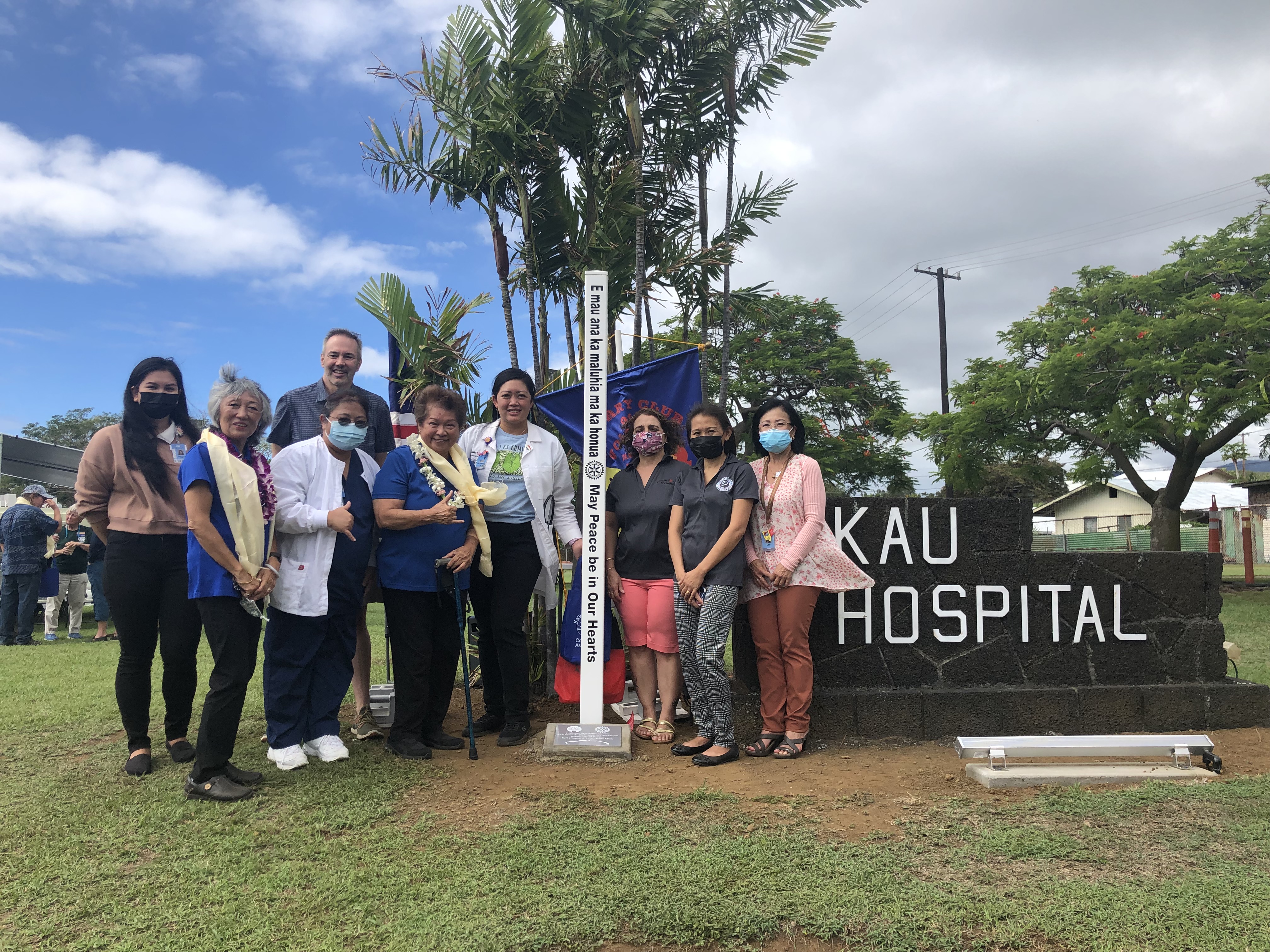
A Peace Pole was dedicated on the grounds of Kaʻū Hospital on Thursday, drawing staff and supporters.
The pole is located next to the Kaʻū Hospital sign at the entry to Pāhala village. Photo by Julia Neal
A PEACE POLE WELCOMES PEOPLE TO PĀHALA TOWN. Dedicated on the grounds of Kaʻū Hospital on Thursday at the entrance to the village, it says: "E mau ana ka maluhia ma ka honua. May Peace be in Our Hearts."
    On hand were county, state and hospital officials, along with co-sponsors of the project from Volcano Rotary Club, Kaʻū Rural Health Community Association and its founder Jessie Marques, who welcomed participants along with her board members.
    The ceremony opened with a bell ringing, Pule by Kupuna Jesse Ke of the Kaʻū Advisory Council, and Pledge of Allegiance led by U.S. Air Force Veteran Chuck Doyle, followed by recognition of Bev Garrett of Volcano Rotary Club and Jennefer Aguiar, Assistant Administrator of Kaʻū Hospital & Rural Health Clinic.
Peace Pole before the unveiling at left and Volcano Rotary Club's
 banner on the right during ceremonies Thursday at Kaʻū Hospital
.
Photo by Otis Salmo
    Hawai'i County was represented by its Managing Director Lee Lord. Hawai'i Health Systems Corp., which manages Kaʻū Hospital & Rural Health Clinic, was represented by CEO Dan Brinkman and its East Hawai'i board members.
    County Council member-elect Michelle Galimba praised the effort and said she first saw a Peace Pole in Kaʻū while riding horse on land she ranches for cattle mauka of Kāwā. It may have been established by the late Jerry Kaluna on family kuleana lands in the area. Galimba noted other symbols of peace in Ka'u at Wood Valley Temple, a Peace Pole at Volcano Art Center and an effort to establish a Peace Pole in Ocean View. She said, "We are fortunate here in Hawai'i to live in a culture that is rich in values that promote peace and harmony but we must not take it for granted This peace pole is a wonderful reminder to respect each other and take responsibility for each other so so that we will continue to enjoy the blessings of peace."
    Kupuna and keiki took part in the unveiling of the Peace Pole. Dr. Angie Miyashiro led a group of Ka'u High students who walked from campus to the ceremony. She heads the HOSA: Future Health Professionals at the school.
The Peace Pole planted firmly in the ground at
Kaʻū Hospital, the plaque recognizing sponsors
Kaʻū Rural Health Community Association,
Volcano Rotary Club and Kaʻū Hospital & Rural
Health Clinic. Photo by Otis Salmo
  Denise Mackay, administrator of Kaʻū and Honoka'a hospitals, noted after the ceremonies that Kaʻū Hospital is an integral part of the village community with much support and volunteerism from its residents.
    Kaʻū Rural Health Community Association gives the background on planting Peace Poles in communities around the planet: "A Peace Pole is an internationally recognized symbol of the hopes and dreams of the human family, standing vigil in silent prayer for peace on earth. Each Peace Pole bears the message 'May Peace Prevail on Earth' in different languages on each of its four or six sides. There are estimated over 250,000 Peace Poles in every country in the world, including one outside the Volcano Art Center. Planting a Peace Pole is a way of bringing people together to inspire, awaken and uplift the human consciousness the world over." See more at www.krhcai.com.

To read comments, add your own, and like this story, see www.facebook.com/kaucalendar. See latest print edition at wwwkaucalendar.com. See upcoming events at https://kaunewsbriefs.blogspot.com/2022/04/upcoming-events-for-kau-and-volcano.html.

King David La'amea Kalākaua
ACHIEVEMENTS OF KING KALĀKAUA, WHOSE IOLANI PALACE HAD ELECTRICITY BEFORE THE WHITE HOUSE, were brought to the floor of Congress this week by U.S. Rep. Kai Kahele, in honor of Hawaiian History Month. 
    Kahele noted that King David Laʻamea Kalākaua was the first governing monarch to visit Washington, D.C. and circumnavigate the globe. In 1882, he completed the construction of ʻIolani Palace, the only home of royalty in the U.S., "which still stands today on the island of Oʻahu. A man of science, King Kalākaua outfitted Iolani Palace with indoor plumbing, a telephone, and electric lights. Iolani Palace even had electricity before the White House.
    "A patron of Hawaiian music and dance, Kalākaua is fondly known as the Merrie Monarch, and in my hometown of Hilo, the annual Merrie Monarch Hula  Festival is held in his honor and attracts thousands from around the globe," said Kahele. "This year marks the festival's 60th anniversary and so we are forever grateful to King Kalakaua and for inspiring continuation of our people and  and our native Hawaiian culture."

To read comments, add your own, and like this story, see www.facebook.com/kaucalendar. See latest print edition at wwwkaucalendar.com. See upcoming events at https://kaunewsbriefs.blogspot.com/2022/04/upcoming-events-for-kau-and-volcano.html.

REDUCING DARK MONEY IN POLITICS is the aim of a bill supported by Hawai'i U.S. Senator Mazie Hirono.  Called the Disclose Act, it failed on Thursday. Shortly before voting, Hirono spoke about the bill on the Senate floor, contending that anonymous dark money spending by special interest groups is corrupting elections, courts, and democracy.
    She said that 85 percent of the American people support reproductive freedom, 65 percent support gun
safety, and 63 percent support protecting the right to vote, but "too many elected officials are no longer answering to the people, but instead to the secret donors and corporations who are funding their campaigns.”
    Hirono contended that there is bipartisan agreement to limit dark money and that the Disclose Act is bill that would increase transparency and accountability in political spending; a bill that would do the very thing that some leading Republicans have called for.” She noted, however, that Republicans did not vote for it.
    “For the sake of our democracy, we need to get rid of the anonymous spending influencing our elections and our courts. That is a goal that everyone should be able to get behind, regardless of whether you’re a Democrat or Republican. We cannot accept a country where billionaires and corporations can secretly buy our elections, choose our leaders, and determine the fate of this country.” Hirono’s full remarks can be viewed at https://www.youtube.com/watch?v=1MOalg7rpHQ.

To read comments, add your own, and like this story, see www.facebook.com/kaucalendar. See latest print edition at wwwkaucalendar.com. See upcoming events at https://kaunewsbriefs.blogspot.com/2022/04/upcoming-events-for-kau-and-volcano.html.

A HIGH SURF ADVISORY RUNS THROUGH FRIDAY, reports Hawai'i County Civil Defense and the National Weather Service. Civil Defense notes: 
    "The National Weather Service has issued a High Surf Advisory for south facing shores of Hawai'i Island from Keahole Point in North Kona south through Kaʻū to Cape Kumukahi in Puna through Friday. A High Surf Advisory means surf will be higher than normal, shore break, and dangerous currents can make swimming difficult and dangerous. Beach-goers, swimmers, and surfers should exercise caution and heed all advice given by Ocean Safety Officials."

To read comments, add your own, and like this story, see www.facebook.com/kaucalendar. See latest print edition at wwwkaucalendar.com. See upcoming events at https://kaunewsbriefs.blogspot.com/2022/04/upcoming-events-for-kau-and-volcano.html.


POLICE ARRESTED TWENTY-TWO MOTORISTS FOR DUI during the week of Sept. 12 through 18. Hawai’i Island police made the arrests for driving under the influence of an intoxicant. Five of the drivers were in traffic accidents. One was under the age of 21. So far this year, there were 719 DUI arrests compared with 766 during the same period last year. This is a decrease of 6.1 percent.
   There were 584 major accidents so far this year compared with 568 during the same period last year. This is an increase of 2.8 percent.
    To date, there were 24 fatal crashes (one fatal crash reclassified on 05/30/22 due to a medical condition) resulting in 26 fatalities (one of which had multiple deaths, and one reclassified due to a medical condition), compared with 16 fatal crashes, resulting in 16 fatalities for the same time last year. This represents an increase of 50 percent for fatal crashes, and 62.5 percent for fatalities.
    Police announced that DUI roadblocks and patrols will continue island wide.

To read comments, add your own, and like this story, see www.facebook.com/kaucalendar. See latest print edition at wwwkaucalendar.com. See upcoming events at https://kaunewsbriefs.blogspot.com/2022/04/upcoming-events-for-kau-and-volcano.html.


See September issue of The Kaʻū Calendar
at www.kaucalendar.com, and in the
mail - Volcano, Kaʻū to South Kona.