 |
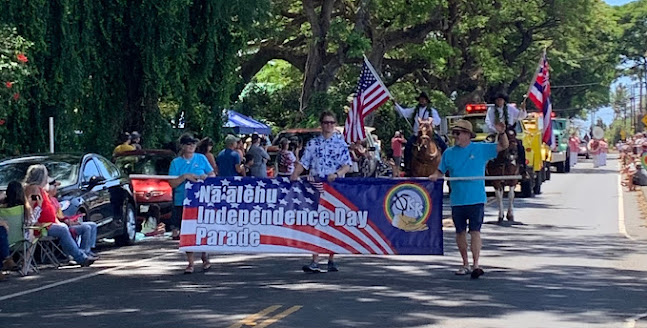
The annual OKK Nāʻālehu Independence Day Parade rolls along Hwy 11 starting at 11 a.m., followed by activities
at Nāʻālehu Community Center and Park, tomorrow, Saturday, July 1. Photo by Brenda Iokepa Moses |
"BEYOND DISAPPOINTING" ARE WORDS OF REACTION FROM UNIVERSITY OF HAWAI'I PRESIDENT DAVID LASSNER regarding Thursday’s Supreme Court ruling that raced based affirmative action is unconstitutional. The ruling concerns University of North Carolina and Harvard University, but can be applied to affirmative action at other educational institutions.
The UH President said, "With the adoption of our new strategic plan by the University of Hawaiʻi Board of Regents in November 2022 we have recommitted ourselves to diversity and equity as Foundational Principles. Notwithstanding the new ban on use of race in admissions decisions, UH stands firmly committed to provide higher education opportunities for all, especially those historically underrepresented in our student bodies, as well as to continue to diversify our faculty, staff, and leadership. The families and communities of Hawaiʻi need and deserve no less.
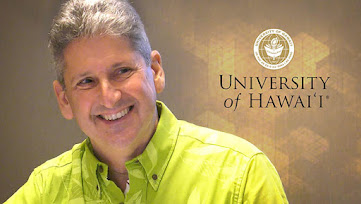 |
U.H. Pres. David Lassner said he is beyond disappointed in this
week's U.S Supreme Court ruling on affirmative action. U.H. Photo |
"UH takes great pride in the fact that our campuses are often ranked as the most diverse in the country, reflecting the population of Hawaiʻi. Our seven UH community colleges have an 'open door' admissions policy, and our three universities currently admit all qualified undergraduate applicants to the campus. Our strong commitment to student diversity and equity focuses on encouraging and welcoming students from all backgrounds, especially those who have been underrepresented, into higher education and then supporting their success once enrolled.
"We are now analyzing the Supreme Court ruling and will need to determine if any changes will be required to adhere to the ruling while maintaining our commitments to diversity and equity to meet the educational and workforce needs of Hawaiʻi."
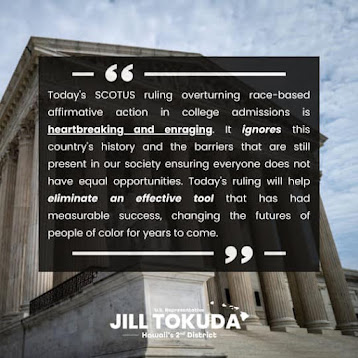
Kaʻū's Representative in the U.S. House of Representatives said the SCOTUS ruling is
“heartbreaking and enraging. It ignores this country’s history and the barriers that are still present in our society ensuring everyone does not have equal opportunities.” She said it"will help eliminate an effective tool that has had measurable success, changing the futures of people of color for years to come."
See Sen. Mazie Hirono's response in Thursday's Kaʻū News Briefs at . Sen. Brian Schatz said, "“This misguided ruling undermines the decades of progress we’ve made, but the fight is not over. Our march toward racial justice goes on.”
THE NATIONAL MARINE SANCTUARY FOUNDATION'S 2023 LEADERSHIP AWARD went to Hawai'i Congressman Ed Case during the June Capitol Hill Ocean Week in Washington, D. C.
Ocean Week brings together advocates for the world’s oceans. The Foundation honors one or two political leaders per year who demonstrate a commitment to ocean, coastal and Great Lakes stewardship.
Previous awardees include Pre. Bill Clinton, Pres. George W. Bust, First Lady Laura Bush, U.S. Sen. Ted Stevens of Alaska and U.S. Sen. Sheldon Whitehouse of Rhode Island.
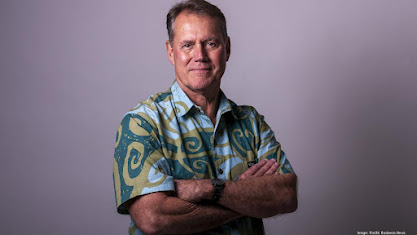 |
Congressman Ed Case wins the Leadership Award from the
National Marine Sanctuary. Photo from PBN |
Case said, “While I was truly honored to have received this award, it is just a moment in time when compared to the critical threats that face our oceans across a number of fronts. I am mostly just grateful to be part of a community of true passion who cares so deeply for our oceans and are so personally committed to saving them from what has become their worst enemy: humankind.”
The Foundation recognized Case, who in Congress formerly represented Kaʻū and the rest of rural Hawai'i and supported saving Kaʻū's Coast, and now represents urban Hawai'i. He was noted by the National Marine Sanctuary Foundation as a longtime leader in ocean policy in Congress. Case was also an early advocate for and was instrumental in the designation of the Papahānaumokuākea Marine National Monument in 2006 and current efforts to expand protections for the Pacific Remote Islands.
 |
Sol Pili Kaho'ohalahala receives Sanctuary Wavemaker Award.
Photo from NOAA |
Case, a member of the House Appropriations and Natural Resources Committees since his return to Congress in 2019, also co-led reauthorization of the Coral Reef Conservation Program and continues to fight for ocean-based climate solutions, sustainable climate ready fisheries management, and international cooperation and coordination in saving the world’s oceans.
Case shared the 2023 Leadership Award with his colleague, Congressman Raúl M. Grijalva of Arizona. The Foundation said Grijalva has been a leading voice on environmental and social justice issues since being elected Congress more than two decades ago. In 2018, he became Chair of the House Committee on Natural Resources, a role in which he successfully elevated climate action, environmental justice and indigenous affairs in national ocean policy.
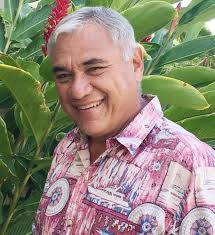 |
William Aila receives a Sanctuary
Wavemaker Award. |
Two fellow Hawai'i residents - Solomon (Sol) Pili Kahoʻohalahala and William J. Ailā – received the Foundation’s Sanctuary Wavemaker Award for their critical work benefiting national marine sanctuaries. Kahoʻohalahala, who served with Case in the Hawai‘i State House of Representatives, serves as Chairperson of the Hawaiian Islands Humpback Whale National Marine Sanctuary Advisory Council. He is the current native Hawaiian member on the Pacific Remote Islands Marine National Monument community group and a member of the Pacific Remote Islands Coalition. During the Obama Administration, he advocated successfully for the expansion of Papahānaumokuākea Marine National Monument, creating the world’s largest marine protected area, and currently serves as its native Hawaiian elder on the reserve advisory council.
Aila, who has served Hawai'i in various capacities including Chair of the Board of Land & Natural Resources and Hawaiian Homes Commission, "has been deeply committed to protecting areas that have deep cultural importance as well as significant natural resource value. He expanded Hawai'i’s Natural Area Reserve program, streamlined permitting for restoration of Hawaiian fishponds and helped create the first community-based subsistence fishing area in Haena, Kaua'i. He was also instrumental in the creation and expansion of Papahānaumokuākea Marine National Monument and was the former chair of the Papahānaumokuākea Reserve Advisory Council," said a statement from Case's office.
GOV. JOSH GREEN SIGNED THE STATE'S $37.2 BILLION FISCAL BIENNIUM OPERATING BUDGET on Friday. A statement from his office said it provides "sweeping income support to Hawaiʻi's working families, and to fund state operations."
He signed HB954 (Act 163), which gives $104 million of income support to local taxpayers. The statement from the Governor's office said, many "will receive tax refunds worth thousands of dollars that will flow back into their household budgets to help make ends meet. The bill doubles the size of the
Earned Income Tax Credit for five years, providing $50 million in additional support. The bill also doubles the amount of the Food Excise Tax Credit, benefitting an additional 90,000 of the most economically vulnerable residents in the state. Working families who struggle to pay for child or dependent care will receive a refundable credit of up to $3,000 to help ease the high costs of living they face every day."
The Governor said, "The people of Hawaiʻi honored me with this position in the hope that my administration would make their lives better. It is a top priority of mine, and it is thanks to the collaboration between my Administration and legislative leaders that our families will receive this relief."
House Speaker Scott Saiki said it "will deliver direct relief to over 200,000 families, our statewide parks and trails, our climate, and unsheltered individuals in need of mental health assistance."
 |
Food Excise Tax Credit doubles in the new state budget bills
signed by the Governor. Image from HI Tax Fairness |
Sen. Donovan Dela Cruz, chair of the Senate Ways and Means Committee, hailed the tax break bill as a positive financial benefit for struggling families. "HB954 is a positive step towards addressing the financial challenges faced by the ALICE (Asset Limited, Income-Constrained, Employed) population. By increasing the tax credits for household and dependent care services, refundable income, and income threshold and credit amounts for refundable food and excise tax, HB954 aims to provide much-needed support to working families."
The state budget that Green also signed, HB300 (Act 164), appropriates $10.7 billion in FY24 and $9.8 billion in FY25 for general funds; $19 billion in FY24 and $18.2 billion in FY25 for Executive Branch departments and agencies for the operating budget. The budget appropriates $2.9 billion in FY24 and $1.3 billion in FY25 for capital improvement projects. Governor Green yesterday provided official notice to lawmakers, finalizing line-item reductions and vetoes.
Dela Cruz said the resources provided within the budget, "coupled with the shared commitment of the legislature and the Governor, will allow for considerable progress to be made in addressing Hawaiʻi's greatest challenges. Millions of dollars have been put forth to tackle homelessness, the housing crisis, mental health, and workforce shortages, to name a few."
The statement from the Governor's office broke down some of the big picture plans in the budget with headlines:
Developing affordable housing and infrastructure. "Housing is at a crisis level in the state. Many families leave because they don't have access to affordable housing and some even become homeless. This budget funds a multi-prong approach to build more units, provide subsidies to renters, and to develop much-needed infrastructure to speed up housing development. This budget appropriates $280M to the Hawaiʻi Housing Finance Development Corporation Rental Housing Revolving fund to develop more affordable housing units, $100M to the Dwelling Unit Revolving fund to develop infrastructure and support for affordable housing, over $70M to develop infrastructure, $50M for teacher housing, and $6M for the state rent supplement program to help eligible families pay part of their monthly rent."
 |
Hawai'i's Child Wellness Incentive Program will
pay $50 to state Medicaid recipients for each well
child examination. Photo from DOE |
Getting people the care they need. "This budget invests in Hawaiʻi's people. Access to high-quality, comprehensive health care services is vital for physical, social, and mental health. This budget increases the provider reimbursement rate for Medicaid recipients ($30M in general funds and $42.8M in federal funds each fiscal year). This means that thousands of low-income individuals and families will get better access to high-quality healthcare. This budget also appropriates $3.3M in FY24 and $4.5M in FY25 for the Child Wellness Incentive Program which will pay $50 to state Medicaid benefit recipients for each completed well-child examination. This will incentivize more care, early on, for our keiki which leads to healthier outcomes later in life.
'We must address homelessness in Hawaiʻi, and it will take action, resources, and for us to work together to implement multiple approaches. This budget takes a multi-faceted approach to address homelessness by providing funds for family assessment centers ($3.1M), housing first and rapid re-housing programs ($15M), homeless outreach services ($3.5M), 'ohana zones ($15M) and kauhale ($48M)."
Expanding and improving our healthcare services. "To help recruit and retain the health care workers we need for our residents, we are making big investments ($30M) in the Hawaiʻi State Loan Repayment Program. This program helps pay off educational loans for healthcare workers, including social workers, therapists, and many others who care for patients in Hawaiʻi in areas where there is a healthcare shortage. This budget also makes large investments in our hospital system. We are appropriating $50M to expand the Intensive Care Unit and Medical Surgical Unit at Hilo Medical Center, $2.3M for the Kona community Hospital Pharmacy Expansion, and nearly $30M for Hawaiʻi Health Systems statewide to improve and renovate hospitals, including on our neighbor islands and in our most rural areas.
Preserving our islands for current and future generations. "Hawaiʻi is home to some of the most ecologically diverse areas in the world, and we must act to protect, conserve and manage the unique natural resources that make Hawaiʻi so special.
"This budget appropriates over $100M towards the climate, energy, and environment.
Substantial investments are made to protect our natural resources ($20M), restore our state parks ($25M) and ecosystems ($14.8M). We are also funding our Climate Change Carbon Smart Land Management Assistant Pilot Program, which promotes carbon sequestration through forest conservation, farmland preservation, and other regenerative land management practices ($2M). Lastly, we are appropriating $50M to the Hawaiʻi Green infrastructure Authority's Solar Energy Storage Loan Program to increase loan opportunities for ALICE households for the installation of solar panels and battery storage systems ($50M)."
Educating our keiki. "We know that early education for our keiki allows them to develop the skills and tools they need to succeed later in life. That's why this budget provides $38.8M to the Preschool Open Doors Program which will expand assistance to eligible families to pay for preschool for 3- and 4-year-olds, and 36 positions and $3.9M in FY24 and 126 positions and $7.6M in FY25 for preschool teachers, educational specialists, and assistants for the EOEL Public Prekindergarten Program.
"We also need to make sure we support all learners throughout their educational journey. This budget provides 13 additional positions and $1.2M for bilingual and bicultural school home assistants across schools statewide and $5M for classroom supplies to help our schools. In addition, Governor Green's Administration will provide to our schools and university system, additional resources from the discretionary fund that the legislature made available. We know that education is one of the best investments and that we need to support our education system from keiki to college and beyond."
.jpeg)

.jpg)

.jpg)
.jpg)

.jpeg)


.png)
.jpg)


.jpeg)
.jpeg)


.jpeg)


