About The Kaʻū Calendar

Friday, July 28, 2023

Kaʻū News Briefs, Friday, July 28, 2023

Experience Volcano This Weekend
Experience Volcano Festival begins early Saturday 7 a.m. with Volcano's 'Ohi'a Lehua Runs for keiki to adults, all starting and finishing at Volcano School of the Arts & Sciences, followed by music, hula, arts, crafts, presentations and dining events throughout Volcano for the next two days. See Festival schedules below.  Photo from Experience Volcano Hawai'i


FOUR NĒNĒ WERE KILLED ON HWY 11 NEAR THE ENTRANCE TO PĀHALA recently, according to word on the street in the village. The story is that the nēnē nested on the grounds of Kaʻū
 Hospital, and that the mother, father and two offspring were run over and killed on the adjacent highway. 
National Park Service Photo
     Nēnē is the Hawaiian goose and state bird, a threatened species under the Endangered Species Act.
     Hawai'i Volcanoes National Park issued a message on Friday. "Slow down for nēnē! These beloved and rare Hawaiian geese are on the move, so let's be extra cautious....."                  Regarding nēnē in the National Park, the message said, "Keep your eyes peeled as many nēnē are spotted on roads and in parking lots.
Together, let's ensure the survival of these beautiful geese by giving them a brake!"
     The rangers also recommended "no feeding allowed, as it could lead to risky associations with people and cars. Let's show some respect to our nēnē friends and cherish their presence in the park!"

THE PARENT ORGANIZATION FOR KAʻŪ HOSPITAL, Hawaiʻi Health Systems Corp., has entered into extended contract negotiations with Kaiser Permanente to provide hospital services for Kaiser Commercial, Medicare Advantage, and QUEST Integration members. The present contract was scheduled to end on Dec. 31, 2022, but has been extended several times through Aug. 15, 2023.
    The statement from HHSC says the organization "is hopeful that an agreement with Kaiser can be reached prior to the expiration of the current extension."
    HHSC facilities and associated clinics affected by the expiring Kaiser contract are located on Hawaʻi Island, O'ahu and Kauaʻi. On this island, they are Kaʻū Hospital, Hilo Medical Center, Hale Ho'ola Hamaku, Kohala Hospital and Kona Community Hospital. On Kaua'i they are Kaua'i Veterans Memorial Hospital and Samuel Mahelona Memorial Hospital. On Oʻahu they are Le'ahi Hospital and Maluhia.
    The statement says, "HHSC is a public hospital system supported by state funds to assure Hawaiʻi's diverse communities receive essential healthcare services."

To read comments, add your own, and like this story, see facebook.com/kaucalendar.See latest print edition at kaucalendar.com, in the mail and on stands.

MONITORING KILAUEA WITH OCEAN NOISE is the subject of this week's Volcano Watch, written by scientists and affiliates of USGS Hawaiian Volcano Observatory:
    Ocean swells are constantly occurring across the Earth's oceans. These swells interact with the ocean crust below, creating continuous ocean noise that travels all over the Earth, including through our active
volcanoes here in Hawai'i. Because ocean noise signals are always being generated, scientists can use these seismic sources to identify small changes occurring in the Earth's crust over time.
    In climates that experience all four seasons, scientists have shown that ocean noise travels through these regions faster in times when snowpack is present and slower in times when the snow has melted. This winter speedup is due to the overlying snowpack compressing the subsurface and closing any fractures below it.
    When the snow thaws, the subsurface is no longer compressed, the fractures open again, and the snow melt percolates into these fracture systems. This causes ocean noise to travel through these regions more slowly in the spring and summer months. Similarly, in climates that experience excessive rainfall, such as Hawai'i, such precipitation diffuses into the ground, opening fractures and cracks, and causing slowdowns in ocean noise propagation speeds.
    Magma moving under active volcanoes can cause similar opening and closing of fracture systems resulting in changes in the velocity at which ocean noise signals travel through a volcano. Scientists at the Hawaiian Volcano Observatory are developing new techniques that utilize such velocity changes to understand what is happening beneath the surface of volcanoes on the Island of Hawaiʻi.
    The figure shown below indicates changes in the velocity of ocean noise traveling through the summit region of Kīlauea volcano several months before, and in the month after, the start of the summit eruption in December 2020.
    From September to mid-October 2020, the velocity of ocean noise in Kīlauea summit region remained fairly constant. However, by mid-October 2020, velocities in the summit region began to decrease rapidly. When magma migrates beneath the surface, it opens cracks and fractures in the region immediately above it. The opening of these fracture systems, as well as the influx of the magma itself, causes a slowdown in the propagation speed of ocean noise signals through that region.
Scientists at the Hawaiian Volcano Observatory have concluded that magma began to move from deeper depths beneath Kīlauea summit by mid-October 2020. By early December 2020, velocities began to decrease at a more dramatic rate suggesting a more rapid inflow of magma into Kīlauea summit. At that point, earthquake and ground deformation patterns beneath the summit indicated that a small intrusion of magma had occurred.
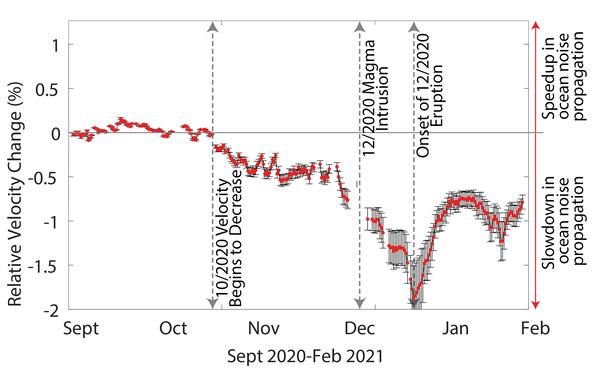
The figure shows changes in the propagation speed of ocean noise signals (red filled circles) through Kīlauea volcano from September 2020–February 2021. Positive values indicate a speedup in the propagation speed of ocean noise while negative values indicate a velocity slowdown. The black bar around each red circle indicates the uncertainty in the relative velocity change measurement. USGS image

    By mid-December 2020, the velocity of ocean noise traveling through Kīlauea's summit decreased even more, indicating the continued invasion of magma into the volcano.
Finally, on December 20, 2020, at approximately 9:30 p.m. HST, the eruption at Kīlauea's summit began. Following the onset of this eruption, as seen in the figure, a dramatic increase in the propagation speed of ocean noise signals through the summit region was observed. As magma was removed from the shallow storage reservoir, by the outpouring of lava, the region above it deflated. This deflation causes the closure of fractures within the shallow summit, and a resulting increase in the velocity of ocean noise through the summit.
This example demonstrates how monitoring for changes in ocean noise velocity could potentially be used to aid in forecasting volcanic activity. Hawaiian Volcano Observatory scientists are working to better understand this process and apply it as a real-time monitoring tool at both Kīlauea and Mauna Loa volcanoes.
There is no active lava at Halema'uma'u but it still emits about 106 tonnes per day of sulphur dioxide. USGS photo

Volcano Activity Updates
    Kīlauea is not erupting. Its USGS Volcano Alert level is ADVISORY.
    Active lava has not been visible within Halemaʻumaʻu crater at the summit of Kīlauea since June 19.          Earthquake activity in the summit region increased slightly over the past week. Summit tiltmeters generally showed gradual inflation for much of the past week. A sulfur dioxide (SO2) emission rate of approximately 106 tonnes per day was measured on July 26.
    Mauna Loa is not erupting. Its USGS Volcano Alert Level is at NORMAL.
    Webcams show no signs of activity on Mauna Loa. Seismicity remains low. Summit ground deformation rates indicate slow inflation as magma replenishes the reservoir system following the recent eruption. SO2 emission rates are at background levels.
    No felt earthquakes were reported in the Hawaiian Islands during the past week.
    HVO continues to closely monitor Kīlauea and Mauna Loa.

To read comments, add your own, and like this story, see facebook.com/kaucalendar.See latest print edition at kaucalendar.com, in the mail and on stands.


To read comments, add your own, and like this story, see facebook.com/kaucalendar. See latest print edition at kaucalendar.com, in the mail and on stands.

Five thousand in the mail, 2,500 on the street.
See the July edition of The Kaʻū Calendar Newspaper


Thursday, July 27, 2023

Kaʻū News Briefs, Thursday, July 27, 2023

Experience Volcano this Weekend 
Keoki Kahumoku, who has mentored many young musicians in Kaʻū and led many Hawaiian music retreats in Pāhala, will perform at the Experience Volcano Festival this weekend. Kahumoku, a Hawaiian slack key guitarist, composer, singer and music teacher, is featured on Grammy winning albums. He will perform at Kīlauea Lodge on Saturday from 2 p.m. to 3 p.m. and at Volcano Winery on Sunday from noon to 2 p.m. See Festival map and schedules below. Photo from Experience Volcano Hawai'i
THE OFFICE OF SUSTAINABILITY, CLIMATE, EQUITY & RESILIENCE was signed into law on Wednesday by Mayor Mitch Roth. He called it a step forward for the County of Hawaiʻi to reaffirm its commitment to "safeguarding the environment, combating climate change, and building a sustainable and resilient future for generations to come."
    Bill 48, championed by Hawaiʻi County Council Chair Heather Kimball and Councilwoman Rebecca Villegas, "represents a collaborative effort between County leadership, community advocates, and concerned citizens who recognize the urgent need to address the pressing challenges posed by a changing environment." says the statement from the Mayor's office. "The creation of the Office of Sustainability, Climate, Equity & Resilience will play a pivotal role in shaping and implementing the County's response to these challenges, as well as following through on its Integrated Climate Action Plan," which was completed and published on June 30. See it at: http://cohplanning.konveio.com/.  
Hawaiʻi County Council Chair Heather Kimball and Councilwoman Rebecca Villegas
join Mayor Mitch Roth to establish by law the new Office of Sustainability, Climate, 
Equity & Resilience. Photo from the Mayor's Office
  The Mayor stated, "In order to make sure that our keiki have a home where they can thrive for generations, we need to make sure that the anchors that keep them grounded here are preserved in perpetuity. Those anchors are things like our environment, culture, and natural resources — all of which will be the focus of our new OCSER. We know that too many of our kids are leaving, and we are committed to making it so that they only do so by choice and not by necessity."
   He said the Office of Sustainability, Climate, Equity & Resilience will act as a central hub for coordinating efforts across various city departments and community organizations. It will work towards implementing innovative policies and programs to reduce greenhouse gas emissions, promote renewable energy, enhance energy efficiency, protect biodiversity, and fortify our infrastructure against climate change's impacts.
    County Council Chair Kimball said, "The design and mission of OSCER is a new approach that has been specifically developed in response to a two-year process to identify gaps between plan and implementation in the areas of sustainability, climate change, equity, and resilience. The Office will provide technical, policy, and resource support both internally and with our community partners, resulting in effective and coordinated progress. I think Bill 48 and the collaborative approach used to develop it represents best practice in public policy development."
     OSCER is designed to collaborate with local businesses and residents to raise awareness about sustainable practices, foster eco-friendly initiatives, and advocate for responsible environmental policies. "Through active community engagement and partnerships, this Office will strive to create a unified front in the battle against climate change and ensure a greener, healthier future for Hawaiʻi Island," said Kimball.
    Councilmember Rebecca Villegas said, "Big mahalo to everyone who contributed to getting Bill 48 over the finish line. I'm deeply honored to have played a part in creating this progressive new Office of Sustainability, Climate, Equity, and Resilience. While we still have a lot of work ahead of us, I believe we are now better equipped to navigate and mitigate the challenges directly related to climate change."
     The Mayor said he extends his deepest gratitude to the members of the County Council, community leaders, and everyone who played a crucial role in the development and passage of Bill 48. He emphasized that this momentous achievement would not have been possible without the collective dedication and commitment of all those involved. Chair Kimball added, "It was wonderful to see it come to fruition when Mayor Roth signed it on Wednesday."
    Calling this "a new chapter in Hawaiʻi County's history," the Mayor called upon all residents, businesses, and organizations to "unite to support the vital mission of the Office of Sustainability, Climate, Environment, and Resilience. Only through collective action can we hope to confront the challenges ahead and build a sustainable, resilient, and thriving future for our island home." 

PATHWAY TO REMOVING OBSTACLES is a federal Housing & Urban Development program to "reduce barriers to affordable housing production by helping local communities address restrictive zoning, land use, and regulatory policies," said Gov. Josh Green. On Thursday he said it will help him solve the housing shortage in Hawai'i. "The program also expands financing for affordable, energy-efficient, and resilient housing, and promotes commercial-to-residential conversion opportunities," says the statement from the Governor's office.
        The Governor's office announced that $1 million to $10 million in grants from Pathway to Removing Obstacles align with Green's "July 17 Emergency Proclamation on Housing's goal to eliminate the red tape, which has held back the development of affordable housing in Hawaiʻi for decades."
From Gov. Josh Green's facebook regarding signing an Emergency
 Proclamation enabling the administration to build mass housing
 in Hawai'i to address the affordability issue.
    Green said, "The chronic shortage of affordable housing is the number one economic threat that Hawaiʻi families face today."
    The Governor's office also announced that under the Governor's Emergency Proclamation for Housing, "the state has identified about 50,000 new housing units in the pipeline to be built over the next decade. The state plans to help developers build those units by streamlining the approval process without compromising cultural and environmental protections."
   Green said the HUD Secretary told him that Hawaiʻi families face some of the biggest challenges in the nation when it comes to finding affordable housing. At the time, she announced that Hawaiʻi was also eligible for a $3.1 billion nationwide HUD program to battle homelessness.
    He said the state will apply for both the HUD homeless and new Pathway to Remove Obstacles housing grants to reduce housing barriers in this state.
    HUD announced the programs this week and reiterated remarks of HUD Secretary Marcia Fudge when she recently visited this island. She noted that communities nationwide are suffering from a lack of affordable housing, and housing production is not meeting the increasing demand. HUD's Pathway to
Removing Obstacles supports communities taking steps to remove barriers such as:
    Barriers caused by outdated zoning, land use policies, or regulations;
    Inefficient procedures;
    Gaps in available resources for development;
    Deteriorating or inadequate infrastructure;
    Lack of neighborhood amenities;
    Challenges to preserving existing housing stock such as increasing threats from natural hazards, redevelopment pressures, or expiration of affordability requirements.

WAYNE CHUNG TANAKA HAS ISSUED A SIERRA CLUB EDITORIAL ON THE EMERGENCY PROCLAMATION TO BUILD MASS HOUSING to solve the affordable housing shortage. Tanaka, Chapter Director for Sierra Club of Hawai'i, is a licensed attorney and engineer. He graduated from Punahou, Harvey Mudd Claremont College and U.H. Richardson School of Law. He has worked for Office of Hawaiian Affairs and non-profits, and has written on numerous topics, including konohiki fishing rights, nearshore fisheries management, indigenous food sovereignty and race and politics in Hawai'i. Here is his opinion piece on the Emergency Proclamation by Gov. Josh Green to quickly create mass affordable housing:
Wayne Chung Tanaka says the housing crisis "requires cool
heads and a focus on relevant facts - least a dire situation
be made even worse." Photo from Sierra Club
      Emotions ran high at the governor’s emergency proclamation news conference last week. Heartbreaking stories were shared about nurses and teachers leaving the islands, and interns dreaming of moving home — albeit with little details connecting these plights with the proclamation’s actual language.

   As we know, however, crises require cool heads, careful analysis, and a focus on relevant facts — lest a dire situation be made even worse. Unfortunately, the factual matter of what this proclamation says should be cause for deep concern, for nearly everyone calling Hawai'i home. It not only rolls back decades of protections for our environmental and cultural integrity, but also attacks the very foundations of our democratic society, for a purported “solution” that would cause much more harm than good.
    First, the use of emergency powers to whack-a-mole the complex and multifaceted housing crisis sets an incredibly dangerous precedent. What would distinguish this action from a future governor making an emotional declaration of “crime” as an emergency — and then adopting his own laws for curfew hours and fast-tracking private prison development, regardless of community input, social impacts or the foreclosure of other public health and safety solutions?
    Second, all of us concerned with the state budget should know that the proclamation suspends the Legislature’s role in directing how taxpayer dollars are spent. It also suspends the statutory procurement processes for competitive bidding that safeguard against waste and corruption. In other words, money set aside for any other purpose could be redirected behind the scenes to hand- selected corporations, for anything remotely related to housing.

Tanaka states that the Governor's Emergency Proclamation on housing development
 "suspends our Sunshine Law - a bedrock of government transparency ensuring public
 notice of board and commission meetings, as well as the public's right to testify."
Photo from the state Office of Information Practices. See https://oip.hawaii.gov/
    Third, the proclamation suspends our Sunshine Law — a bedrock of government transparency ensuring public notice of board and commission meetings, as well as the public’s right to testify. Any state or county board, commission or council could meet without public notice and make any housing-related decisions, including over infrastructure and energy development, without public input.
    Fourth, the proclamation’s housing policies are controversial at best and harmful at worst. The proclamation lacks any affordability requirements, income limits, or a meaningful definition of “Hawaii resident.” Nothing would prevent the predictable outcome, where new arrivals with cash in hand quickly snap up new homes — placing even more of our limited developable lands and resources into the hands of the most fortunate, further widening our wealth gap, and driving more kama‘aina off-island.
    Addressing Section 8 discrimination, tackling our ongoing short-term rental problems, and regulating private equity firms that buy and flip rental housing are just some of many, many strategies that would target actual, direct causes of local residents’ housing woes. Such strategies would not benefit developers, however, and do not appear to be on the governor’s radar.
    Fifth, the proclamation places our food security at risk. Its decimation of the Land Use Commission’s
authority would allow agricultural lands to be summarily approved for development, 100 acres at a time, without express, fact-based conditions to minimize impacts to present or future local food production. This could also happen without public notice or input, given the Sunshine Law suspension.
    Sixth, the proclamation’s supposed safeguards are illusory. The lead housing officer can approve and negotiate projects without any review or approval by the much-touted 22-member “Build Beyond Barriers Working Group,” which itself lacks the expertise to evaluate the myriad considerations associated with development in Hawai'i, including our limited and fragile resources, dire need for water and food security, and unique island values.
    This all powerful “LHO” also holds sole authority to investigate and enforce compliance with everything from owner- occupancy requirements to construction and community commitments — a
Herculean task for one project, much less dozens involving tens of thousands of housing units across the islands. Enforcement would also be literally impossible after the intended one-year life of the proclamation, as the lead housing officer position it creates would no longer exist.
   Emotions aside, the facts of the matter are that even beyond an environmental and cultural lens — through which its failings are obvious and alarming — this proclamation is an affront to our system of government, fiscal accountability, public transparency and the socioeconomic realities of life in our islands. Those of us recognizing its potential for long-lasting harm will do our best to see it rescinded. Will you join us?  See https://sierraclubhawaii.org/


Five thousand in the mail, 2,500 on the street.
See the July edition of The Kaʻū Calendar Newspaper


Wednesday, July 26, 2023

Kaʻū News Briefs, Wednesday, July 26, 2023

Punalu'u needs protection and visitor education, says Hawai'i Tourism Authority, which sent out a Request For Proposals for a stewardship plan, aiming to contract with a community organization. Photo by Bob Martin
PUNALU'U NEEDS PROTECTION AND HAWAI'I TOURISM AUTHORITY WILL PROVIDE STEWARDSHIP FUNDING. HTA announced Wednesday it has selected Punalu'u Black Sand Beach and two other sites on this island for a Request for Proposals to provide protection, visitor education and the hiring of stewards to work there. HTA promises funding.
    HTA Director of Planning Caroline Anderson said, “This initiative is a part of the Hawai‘i Tourism Authority’s ongoing commitment to the community as we support residents’ desired approaches to managing visitor impacts and preserving natural and cultural resources in their neighborhoods. The program is intended to engage stewards from each area who will help to educate others about their home and how to care for the places they are visiting.”

Honu at tidepools along Punalu'u Beach, which has been named by Hawai'i
Photo by Julia Neal
    HTA announced on Wednesday that it wants to partner with "‘āina-based non-profit organizations to develop and manage the community stewardship program” at Punalu'u, Pohoiki and Kealakekua Bay. HTA noted that Punalu'u is one of the sites where protection of natural and cultural spaces is identified in the  Hawai‘i Island Destination Management Action Plan and that visitor education is needed. The Action Plan notes “increased overcrowding, congestion, degradation of resources, and safety hazards.” 
Honu frequent the sand with many footprints at
 Punalu'u Black Sand Beach. Photo by Bob Martin

     An Action Stewardship Program was already launched in Keaukaha in a “collaborative destination management effort,” according to HTA.
    An HTA statement says it will choose contractors for Punalu'u, Pohoiki and Kealakekua who “will be responsible for working with the local community to recruit and hire stewards from the designated area or district.”
    HTA lists the following objectives:
    Increase understanding of appropriate behavior and respect for Hawaiian culture, natural resources, and the surrounding communities through positive visitor-steward interactions.
    Train stewards to share place-based mo‘olelo (history), mo‘omeheu (culture) and ho‘oulu (hope for the future).
    Emphasize safety and redirect visitors from dangerous land and ocean conditions to parks and beaches that are open for visitation.
    Minimize trespassing on private and government lands.
    Encourage visitors to pick up their ‘ōpala (rubbish) and leave the area better than when they arrived.
   Gather data for the state Department of Business, Economic Development & Tourism Resident Sentiment Survey
    Gather data to track visitation.
    See and download the Hawai'i Island Destination Management Action Plan at https://holomua.hawaiitourismauthority.org/media/sz1dbbfb/hta-hawaii-island-action-plan-2021.pdf 
See and download the application and Request for Proposals at visit hvcb.org. Proposals are due by 4:30 p.m. on Aug. 18 to IHVB Destination Manager Rachel Kaiama at rkaiama@hvcb.org. For more info, call (808) 294-1737 or email rkaiama@hvcb.org.


KAʻŪ HOSPITAL & RURAL HEALTH CLINIC will host its first annual Community Health Fair on Saturday, Aug. 26 at Pahala Community Center from 10 a.m. to 2 p.m.
     The event features free health education for the commuity, entertainment, prizes and more. 
   It is sponsored by Ka'u Hospital Charitable Foundation, Ka'u Rural Health Community Association and the hospital and clinic.
     Contact Salena Espejo, Community Health Worker at 808-932-4205 or sespejo@hhsc.org.


HAWAI'I RANKS NINTH AMONG STATES WITH LOWEST CREDIT CARD DEBTS. Alaska ranks the highest.
    Median credit card debt in Hawai'i is $2,936. The expected time until payoff is 12 months and nine days. The report comes from WalletHub, which notes that credit card debt in Hawai'i is drastically lower than in most of the country. The report says that Americans increased their collective credit card debt by a record $179.4 billion last year - the grand total at over $1.1 trillion.
    WalletHub drew upon data from TransUnion, the Federal Reserve, the U.S. Census Bureau and WalletHub's proprietary credit card payoff calculator to determine the cost and time required to repay the median credit card balance in each of the 50 states and the District of Columbia.
    Dorris Perryman, one of the WalletHub financial consultants wrote: "One of the leading causes of large amounts of credit card debt is overspending: buying unnecessary purchases that do not contribute to a person's well-being. Paying the minimum amount on a high-interest credit card does not allow you to reduce the balance on the account.
Image from WalletHub
    "Falling for the rewards programs that establishments offer for your loyalty can also contribute to credit card debt. These programs come with a price of having to constantly buy more to receive less than the interest on their loyalty cards. Unless you travel for work every day, it is best to stay away from these programs as they do not benefit the customer but rather the organization.
    "A person living paycheck to paycheck does not have enough money or savings to cover simple emergencies and must use their credit cards to make ends meet."
    Paul Obermann, who also consults for WalletHub, explains the nationwide rise in credit card debt: "There are two major reasons. First, people who start accumulating credit card debt often do not have a choice. Unexpected expenses, such as unforeseen medical or other emergencies, may push people to overextend and spend more than they can pay back in time. Using a credit card is one of the easiest ways to borrow money since other loans are often not as readily available. However, credit card debt is one of the worst ways to borrow since credit cards have some of the highest interest rates. The second reason is poor budgeting. Most of us own at least one credit card (probably more), and it takes a lot of effort to track how much is owed and make payments before interest kicks in. Default sometimes simply happens because of forgetfulness rather than the inability to pay. Given the high interest rates on credit card debt, once interest is owed, it is often a downward spiral from there, and it becomes less likely to pay off the
debt without other cash injections, loans, or major life changes."
   John Pelletier, Director, Center for Financial Literacy, makes some suggestions: "I know it is hard for many, but you must spend less than you earn so you can build a rainy-day fund that equals three to six months of expenses. This should cover necessities like food, shelter, utilities, and transportation to work. About four out of 10 adults do not have a rainy-day fund."
   Obermann says more: "A budget is the key here...It should allow leeway for saving money, meaning the monthly bottom line should be positive. The remaining money each month should go into an interest-paying account, such as a savings account. This account should not be touched unless there are emergencies. The budget may also include a category for 'emergency savings' so that there is always some money on hand to cover emergencies without having to borrow funds. Unexpected situations (despite their name) should be expected when making a budget."
   On what government can do, WalletHub advisor Karen Holden writes: "Unfortunately, our government has not been particularly encouraging of low debt. For example, mortgage debt is encouraged by income
Image from WalletHub
tax preferences for home owners versus renters. Our health care system causes individuals with high-cost health conditions to go into debt. Two roles of government that could be protective within our current system are: Bankruptcy rules could take into account expenses that were more unpredictable – e.g., losses due to natural disasters or medical crises not covered by health insurance. Our Consumer Financial Protection Bureau has been instrumental in providing information (e.g., on credit cards about payoff periods) to consumers. The government could play a larger role in protecting consumers against information that encourages debt."
   Pelleteir advises: "The government should be more aggressive in capping interest rates and not allowing usurious interest rates on payday lending and title loans, as some states do. And we need more states to create payroll-deducted retirement programs that small employers can use for free for all of their employees with a simple payroll deduction to the state-administered plan. Nearly four in ten full-time working adults work for employers without retirement plans in states that do not offer these. Currently, about one in four states has these plans with small companies. The ideal is automatically enrolling all employees in a plan that starts putting 3 percent of salaries into a 401K and having an auto-escalation clause over time so that retirement savings increase as income increases."


Five thousand in the mail, 2,500 on the street.
See the July edition of The Kaʻū Calendar Newspaper