About The Kaʻū Calendar

Saturday, July 29, 2023

Kaʻū News Briefs, Saturday, July 29, 2023

Experience Volcano Festival continues Sunday with more cultural activities, including, hula, dance, chant
art, crafts and food at many venues across Volcano Village from 10 a.m. to 4 p.m. See calendar and map below.
Image from Experience Volcano Hawai'i

BILLY BARNETT WON VOLCANO'S 'OHI'A LEHUA HALF MARATHON on Saturday in 1 hour, 21 minutes and 28 seconds. The Half-marathon and 5K were the opening for the annual Experience Volcano Festival, which continues Sunday, with music, hula, food, arts, crafts and much more.
     In the Half-marathon, Patrick Stover took second in 1:23:15 David Collier took third in 1:23:31. 
     In the Women's Division, Summer Corke took first in 1:42:32. Bethany Anne Pratt took second in 1:44:54. Jamie Meaden took third in 1:45:50.
     In the 5K, Lyman Perry took first in 19 minutes and 35 seconds. Cody Smith took second in 20:05. Calvin Howell took third in 20:40.
     In the Women's 5K, Tessa Miller took first in 23.25. Annabella Anthony took second in 23:46. Shannon Postler took third in 24.02.
       See more results in upcoming Kaʻū News Briefs with photos of runners in the Volcano rainforest and open countryside. See the complete results now at https://results.chronotrack.com/event/results/event/event-72105?lc=en.


MUFI HANNEMANN, former Kaʻū resident who decades ago established Punalu'u Sweet Bread bakery for C. Brewer, has been named to the Hawai'i Tourism Authority board. Gov. Josh Green, who lived at Punalu'u years later as a young physician, announced the appointment Friday. When Hannemann worked on Punalu'u's development, he lived at what is now Punalu'u Bake Shop in Nā'ālehu.  His appointment to the HTA board requires state Senate confirmation.
Mufi Hannemann
Photo by Julia Neal
    Hannemann, President and CEO of Hawai'i Lodging & Tourism Association, also serves on the U.S. Travel & Tourism Advisory Board, advising the U.S. Secretary of Commerce. He is a former Mayor of Honolulu and has run for governor, coming through Kaʻū with a fundraising dinner and community meetings.
     HTA recently named Punalu'u as one of three places on the island that needs more protection and tourist education, given its popularity with visitors. HTA has sent out a Request for Proposals and plans to fund a stewardship plan. See http://kaunewsbriefs.blogspot.com/2023_07_26_archive.html.
    Another member of the Hawai'i Tourism Authority board with Kaʻū connections is James McCully, of McCully Works, who owns coffee lands above Pāhala and worked with the previous owners to help the coffee farmers and other buyers acquire the farm land they rented fee simple. See his other work at mwww.mccullyworks.com.
    Other members of the HTA board appointed by Green are its Chairman, Blaine Miyasato, who awaits Senate confirmation, and manages government affairs for Hawaiian Airlines; Mahina Paishon Duarte, co-founder Waiwai Collective and co-author of the ‘Aina Aloha Economic Futures declaration; and James Kunane Tokioka, head of the state Department of Business, Economic Development & Tourism. Other members are: Sig Zane, CEO of Sig Zane Designs; David Z. Arakawa, Executive Director, Land Use Research Foundation of Hawai‘i; Stephanie Iona, a Civil Engagement Consultant; Kimberly Agas, General Manager of Aulani, A Disney Resort & Spa; Dylan Ching, VP of Operations for TS Restaurants; Mike White, GM for Ka'anapali Beach Hotel & The Plantation Inn; and Sherry Menor-McNamara, President & CEO of Chamber of Commerce Hawai'i.

MUFI HANNEMANN ON PUNALU'U SWEET BREAD AND SMALL BUSINESS IN RURAL
Mufi Hannemann years ago after establishing the sweetbread
 bakery in Nā'ālehu. Photo from Hannemann
HAWAI'I: Hannemann, the recent appointment by Gov. Josh Green to the Hawai'i Tourism Authority Board, wrote in 2017 about his enthusiasm for starting A small business in a rural place like Kaʻū:
    "One of the best projects that I worked on during my stint on the Big Island was the establishment of the Punalu'u Sweet Bread Bake Shop and Visitor Center at the plantation managers house that I resided in while living in Nā'ālehu . (Talk about working your way out of a house and I don't even bake.
    "We took a local recipe that was the basis of the ono- licious Punalu'u sweet bread and parlayed it into a successful small business enterprise synonymous with the district of Kaʻū. Today the business has expanded and flourished under the ownership of Duane Kurisu and is frequented by locals and visitors alike. Sweet bread and the other baked products are marketed throughout the state and they have become a popular omiyage item."

HAWAI'I COUNTY CIVIL DEFENSE BROADCAST THIS MESSAGE ON SATURDAY: National Weather Service has issued a Coastal Hazard message for North Facing Shores, East Facing Shores, South
Facing Shores, West Facing Shores of All Hawai'i Island District(s) of Hawaii Island beginning 2 p.m. on Sunday through 6 p.m. Wednesday.
     A Coastal Hazard message means minor coastal flooding is expected. Residents in low lying coastal areas are advised:
    The most dangerous time for flooding is between noon and 6 p.m. Avoid driving through flooded roadways. Move electronics, vehicles, and other valuables to higher ground. Secure canoes, or other watercraft stowed on beaches. Boat owners should monitor vessels to ensure mooring lines don't get to tight and be aware of overwash around boat ramps. See more on Hawai'i County Hazard Impact Map:


HAWAI'I VETERANS EXPOSED TO NUCLEAR TESTING OR TO TOXINS IN GULF AND VIETNAM WARS and their survivors are urged by Congressman Ed Case to file for benefits by Wednesday, Aug. 9. Those who can not file by then can submit an intent to file.
    Case wrote that the PACT Act of August 2022, which stands for Promise to Address Comprehensive
Toxics: Expands and extends eligibility for VA health care to certain diseases linked to exposures to toxins during service in the Vietnam and Gulf Wars and post-9/11 era as well as in nuclear testing. It adds more than 20 presumptive conditions for burn pits, Agent Orange and other toxic exposures. It adds more presumptive-exposure locations for Agent Orange and radiation. It requires the VA to provide a toxic exposure screening to every veteran enrolled in VA health care. It helps improve research, staff education and treatment related to toxic exposures.
    The PACT Act is one of the largest VA health care and benefit expansions ever. While there is no deadline for filing, PACT Act claims, in order for any benefits to also be paid back to the date of
the law’s enactment, those claims must be filed by August 9, 2023.
    Case, a member of the U.S. House Committee on Appropriations and of its Subcommittee on
Military Construction and Veterans Affairs (2019-2023) and Subcommittee on Defense (2023-), said he 
was honored to co-introduce and vote for the PACT Act to "keep our promise to our nation’s veterans, but this law is only as good as our veterans and survivors gaining full access to authorized benefits including back pay and care where eligible. I want to ensure that all eligible Hawaiʻi veterans and their survivors not only apply for PACT Act benefits but do so by August 9th to qualify for the retroactive benefits.
    “The VA has also consistently said that even if veterans and survivors are uncertain whether they are eligible for PACT Act benefits, they should apply anyway,” continued Case. He urged any veterans with need or questions about PACT to contact his office at (808) 650- 6688 or ed.case@mail.house.gov.
    Go to https://www.va.gov/resources/the-pact-act-and-your-va-benefits/ to file PACT Act claim or intent to file. 

To read comments, add your own, and like this story, see facebook.com/kaucalendar.See latest print edition at kaucalendar.com, in the mail and on stands.


Five thousand in the mail, 2,500 on the street.
See the July edition of The Kaʻū Calendar Newspaper
www.kaucalendar.com


Friday, July 28, 2023

Kaʻū News Briefs, Friday, July 28, 2023

Experience Volcano This Weekend
Experience Volcano Festival begins early Saturday 7 a.m. with Volcano's 'Ohi'a Lehua Runs for keiki to adults, all starting and finishing at Volcano School of the Arts & Sciences, followed by music, hula, arts, crafts, presentations and dining events throughout Volcano for the next two days. See Festival schedules below.  Photo from Experience Volcano Hawai'i


FOUR NĒNĒ WERE KILLED ON HWY 11 NEAR THE ENTRANCE TO PĀHALA recently, according to word on the street in the village. The story is that the nēnē nested on the grounds of Kaʻū
 Hospital, and that the mother, father and two offspring were run over and killed on the adjacent highway. 
National Park Service Photo
     Nēnē is the Hawaiian goose and state bird, a threatened species under the Endangered Species Act.
     Hawai'i Volcanoes National Park issued a message on Friday. "Slow down for nēnē! These beloved and rare Hawaiian geese are on the move, so let's be extra cautious....."                  Regarding nēnē in the National Park, the message said, "Keep your eyes peeled as many nēnē are spotted on roads and in parking lots.
Together, let's ensure the survival of these beautiful geese by giving them a brake!"
     The rangers also recommended "no feeding allowed, as it could lead to risky associations with people and cars. Let's show some respect to our nēnē friends and cherish their presence in the park!"

THE PARENT ORGANIZATION FOR KAʻŪ HOSPITAL, Hawaiʻi Health Systems Corp., has entered into extended contract negotiations with Kaiser Permanente to provide hospital services for Kaiser Commercial, Medicare Advantage, and QUEST Integration members. The present contract was scheduled to end on Dec. 31, 2022, but has been extended several times through Aug. 15, 2023.
    The statement from HHSC says the organization "is hopeful that an agreement with Kaiser can be reached prior to the expiration of the current extension."
    HHSC facilities and associated clinics affected by the expiring Kaiser contract are located on Hawaʻi Island, O'ahu and Kauaʻi. On this island, they are Kaʻū Hospital, Hilo Medical Center, Hale Ho'ola Hamaku, Kohala Hospital and Kona Community Hospital. On Kaua'i they are Kaua'i Veterans Memorial Hospital and Samuel Mahelona Memorial Hospital. On Oʻahu they are Le'ahi Hospital and Maluhia.
    The statement says, "HHSC is a public hospital system supported by state funds to assure Hawaiʻi's diverse communities receive essential healthcare services."

To read comments, add your own, and like this story, see facebook.com/kaucalendar.See latest print edition at kaucalendar.com, in the mail and on stands.

MONITORING KILAUEA WITH OCEAN NOISE is the subject of this week's Volcano Watch, written by scientists and affiliates of USGS Hawaiian Volcano Observatory:
    Ocean swells are constantly occurring across the Earth's oceans. These swells interact with the ocean crust below, creating continuous ocean noise that travels all over the Earth, including through our active
volcanoes here in Hawai'i. Because ocean noise signals are always being generated, scientists can use these seismic sources to identify small changes occurring in the Earth's crust over time.
    In climates that experience all four seasons, scientists have shown that ocean noise travels through these regions faster in times when snowpack is present and slower in times when the snow has melted. This winter speedup is due to the overlying snowpack compressing the subsurface and closing any fractures below it.
    When the snow thaws, the subsurface is no longer compressed, the fractures open again, and the snow melt percolates into these fracture systems. This causes ocean noise to travel through these regions more slowly in the spring and summer months. Similarly, in climates that experience excessive rainfall, such as Hawai'i, such precipitation diffuses into the ground, opening fractures and cracks, and causing slowdowns in ocean noise propagation speeds.
    Magma moving under active volcanoes can cause similar opening and closing of fracture systems resulting in changes in the velocity at which ocean noise signals travel through a volcano. Scientists at the Hawaiian Volcano Observatory are developing new techniques that utilize such velocity changes to understand what is happening beneath the surface of volcanoes on the Island of Hawaiʻi.
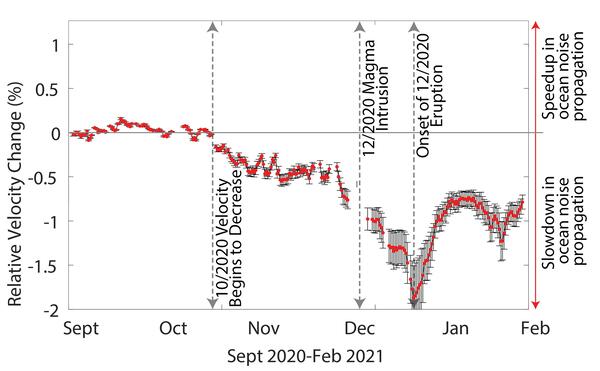
    The figure shown below indicates changes in the velocity of ocean noise traveling through the summit region of Kīlauea volcano several months before, and in the month after, the start of the summit eruption in December 2020.
    From September to mid-October 2020, the velocity of ocean noise in Kīlauea summit region remained fairly constant. However, by mid-October 2020, velocities in the summit region began to decrease rapidly. When magma migrates beneath the surface, it opens cracks and fractures in the region immediately above it. The opening of these fracture systems, as well as the influx of the magma itself, causes a slowdown in the propagation speed of ocean noise signals through that region.
Scientists at the Hawaiian Volcano Observatory have concluded that magma began to move from deeper depths beneath Kīlauea summit by mid-October 2020. By early December 2020, velocities began to decrease at a more dramatic rate suggesting a more rapid inflow of magma into Kīlauea summit. At that point, earthquake and ground deformation patterns beneath the summit indicated that a small intrusion of magma had occurred.
The figure shows changes in the propagation speed of ocean noise signals (red filled circles) through Kīlauea volcano from September 2020–February 2021. Positive values indicate a speedup in the propagation speed of ocean noise while negative values indicate a velocity slowdown. The black bar around each red circle indicates the uncertainty in the relative velocity change measurement. USGS image

    By mid-December 2020, the velocity of ocean noise traveling through Kīlauea's summit decreased even more, indicating the continued invasion of magma into the volcano.
Finally, on December 20, 2020, at approximately 9:30 p.m. HST, the eruption at Kīlauea's summit began. Following the onset of this eruption, as seen in the figure, a dramatic increase in the propagation speed of ocean noise signals through the summit region was observed. As magma was removed from the shallow storage reservoir, by the outpouring of lava, the region above it deflated. This deflation causes the closure of fractures within the shallow summit, and a resulting increase in the velocity of ocean noise through the summit.
This example demonstrates how monitoring for changes in ocean noise velocity could potentially be used to aid in forecasting volcanic activity. Hawaiian Volcano Observatory scientists are working to better understand this process and apply it as a real-time monitoring tool at both Kīlauea and Mauna Loa volcanoes.
There is no active lava at Halema'uma'u but it still emits about 106 tonnes per day of sulphur dioxide. USGS photo

Volcano Activity Updates
    Kīlauea is not erupting. Its USGS Volcano Alert level is ADVISORY.
    Active lava has not been visible within Halemaʻumaʻu crater at the summit of Kīlauea since June 19.          Earthquake activity in the summit region increased slightly over the past week. Summit tiltmeters generally showed gradual inflation for much of the past week. A sulfur dioxide (SO2) emission rate of approximately 106 tonnes per day was measured on July 26.
    Mauna Loa is not erupting. Its USGS Volcano Alert Level is at NORMAL.
    Webcams show no signs of activity on Mauna Loa. Seismicity remains low. Summit ground deformation rates indicate slow inflation as magma replenishes the reservoir system following the recent eruption. SO2 emission rates are at background levels.
    No felt earthquakes were reported in the Hawaiian Islands during the past week.
    HVO continues to closely monitor Kīlauea and Mauna Loa.

To read comments, add your own, and like this story, see facebook.com/kaucalendar.See latest print edition at kaucalendar.com, in the mail and on stands.


To read comments, add your own, and like this story, see facebook.com/kaucalendar. See latest print edition at kaucalendar.com, in the mail and on stands.

Five thousand in the mail, 2,500 on the street.
See the July edition of The Kaʻū Calendar Newspaper


Thursday, July 27, 2023

Kaʻū News Briefs, Thursday, July 27, 2023

Experience Volcano this Weekend 
Keoki Kahumoku, who has mentored many young musicians in Kaʻū and led many Hawaiian music retreats in Pāhala, will perform at the Experience Volcano Festival this weekend. Kahumoku, a Hawaiian slack key guitarist, composer, singer and music teacher, is featured on Grammy winning albums. He will perform at Kīlauea Lodge on Saturday from 2 p.m. to 3 p.m. and at Volcano Winery on Sunday from noon to 2 p.m. See Festival map and schedules below. Photo from Experience Volcano Hawai'i
THE OFFICE OF SUSTAINABILITY, CLIMATE, EQUITY & RESILIENCE was signed into law on Wednesday by Mayor Mitch Roth. He called it a step forward for the County of Hawaiʻi to reaffirm its commitment to "safeguarding the environment, combating climate change, and building a sustainable and resilient future for generations to come."
    Bill 48, championed by Hawaiʻi County Council Chair Heather Kimball and Councilwoman Rebecca Villegas, "represents a collaborative effort between County leadership, community advocates, and concerned citizens who recognize the urgent need to address the pressing challenges posed by a changing environment." says the statement from the Mayor's office. "The creation of the Office of Sustainability, Climate, Equity & Resilience will play a pivotal role in shaping and implementing the County's response to these challenges, as well as following through on its Integrated Climate Action Plan," which was completed and published on June 30. See it at: http://cohplanning.konveio.com/.  
Hawaiʻi County Council Chair Heather Kimball and Councilwoman Rebecca Villegas
join Mayor Mitch Roth to establish by law the new Office of Sustainability, Climate, 
Equity & Resilience. Photo from the Mayor's Office
  The Mayor stated, "In order to make sure that our keiki have a home where they can thrive for generations, we need to make sure that the anchors that keep them grounded here are preserved in perpetuity. Those anchors are things like our environment, culture, and natural resources — all of which will be the focus of our new OCSER. We know that too many of our kids are leaving, and we are committed to making it so that they only do so by choice and not by necessity."
   He said the Office of Sustainability, Climate, Equity & Resilience will act as a central hub for coordinating efforts across various city departments and community organizations. It will work towards implementing innovative policies and programs to reduce greenhouse gas emissions, promote renewable energy, enhance energy efficiency, protect biodiversity, and fortify our infrastructure against climate change's impacts.
    County Council Chair Kimball said, "The design and mission of OSCER is a new approach that has been specifically developed in response to a two-year process to identify gaps between plan and implementation in the areas of sustainability, climate change, equity, and resilience. The Office will provide technical, policy, and resource support both internally and with our community partners, resulting in effective and coordinated progress. I think Bill 48 and the collaborative approach used to develop it represents best practice in public policy development."
     OSCER is designed to collaborate with local businesses and residents to raise awareness about sustainable practices, foster eco-friendly initiatives, and advocate for responsible environmental policies. "Through active community engagement and partnerships, this Office will strive to create a unified front in the battle against climate change and ensure a greener, healthier future for Hawaiʻi Island," said Kimball.
    Councilmember Rebecca Villegas said, "Big mahalo to everyone who contributed to getting Bill 48 over the finish line. I'm deeply honored to have played a part in creating this progressive new Office of Sustainability, Climate, Equity, and Resilience. While we still have a lot of work ahead of us, I believe we are now better equipped to navigate and mitigate the challenges directly related to climate change."
     The Mayor said he extends his deepest gratitude to the members of the County Council, community leaders, and everyone who played a crucial role in the development and passage of Bill 48. He emphasized that this momentous achievement would not have been possible without the collective dedication and commitment of all those involved. Chair Kimball added, "It was wonderful to see it come to fruition when Mayor Roth signed it on Wednesday."
    Calling this "a new chapter in Hawaiʻi County's history," the Mayor called upon all residents, businesses, and organizations to "unite to support the vital mission of the Office of Sustainability, Climate, Environment, and Resilience. Only through collective action can we hope to confront the challenges ahead and build a sustainable, resilient, and thriving future for our island home." 

PATHWAY TO REMOVING OBSTACLES is a federal Housing & Urban Development program to "reduce barriers to affordable housing production by helping local communities address restrictive zoning, land use, and regulatory policies," said Gov. Josh Green. On Thursday he said it will help him solve the housing shortage in Hawai'i. "The program also expands financing for affordable, energy-efficient, and resilient housing, and promotes commercial-to-residential conversion opportunities," says the statement from the Governor's office.
        The Governor's office announced that $1 million to $10 million in grants from Pathway to Removing Obstacles align with Green's "July 17 Emergency Proclamation on Housing's goal to eliminate the red tape, which has held back the development of affordable housing in Hawaiʻi for decades."
From Gov. Josh Green's facebook regarding signing an Emergency
 Proclamation enabling the administration to build mass housing
 in Hawai'i to address the affordability issue.
    Green said, "The chronic shortage of affordable housing is the number one economic threat that Hawaiʻi families face today."
    The Governor's office also announced that under the Governor's Emergency Proclamation for Housing, "the state has identified about 50,000 new housing units in the pipeline to be built over the next decade. The state plans to help developers build those units by streamlining the approval process without compromising cultural and environmental protections."
   Green said the HUD Secretary told him that Hawaiʻi families face some of the biggest challenges in the nation when it comes to finding affordable housing. At the time, she announced that Hawaiʻi was also eligible for a $3.1 billion nationwide HUD program to battle homelessness.
    He said the state will apply for both the HUD homeless and new Pathway to Remove Obstacles housing grants to reduce housing barriers in this state.
    HUD announced the programs this week and reiterated remarks of HUD Secretary Marcia Fudge when she recently visited this island. She noted that communities nationwide are suffering from a lack of affordable housing, and housing production is not meeting the increasing demand. HUD's Pathway to
Removing Obstacles supports communities taking steps to remove barriers such as:
    Barriers caused by outdated zoning, land use policies, or regulations;
    Inefficient procedures;
    Gaps in available resources for development;
    Deteriorating or inadequate infrastructure;
    Lack of neighborhood amenities;
    Challenges to preserving existing housing stock such as increasing threats from natural hazards, redevelopment pressures, or expiration of affordability requirements.

WAYNE CHUNG TANAKA HAS ISSUED A SIERRA CLUB EDITORIAL ON THE EMERGENCY PROCLAMATION TO BUILD MASS HOUSING to solve the affordable housing shortage. Tanaka, Chapter Director for Sierra Club of Hawai'i, is a licensed attorney and engineer. He graduated from Punahou, Harvey Mudd Claremont College and U.H. Richardson School of Law. He has worked for Office of Hawaiian Affairs and non-profits, and has written on numerous topics, including konohiki fishing rights, nearshore fisheries management, indigenous food sovereignty and race and politics in Hawai'i. Here is his opinion piece on the Emergency Proclamation by Gov. Josh Green to quickly create mass affordable housing:
Wayne Chung Tanaka says the housing crisis "requires cool
heads and a focus on relevant facts - least a dire situation
be made even worse." Photo from Sierra Club
      Emotions ran high at the governor’s emergency proclamation news conference last week. Heartbreaking stories were shared about nurses and teachers leaving the islands, and interns dreaming of moving home — albeit with little details connecting these plights with the proclamation’s actual language.

   As we know, however, crises require cool heads, careful analysis, and a focus on relevant facts — lest a dire situation be made even worse. Unfortunately, the factual matter of what this proclamation says should be cause for deep concern, for nearly everyone calling Hawai'i home. It not only rolls back decades of protections for our environmental and cultural integrity, but also attacks the very foundations of our democratic society, for a purported “solution” that would cause much more harm than good.
    First, the use of emergency powers to whack-a-mole the complex and multifaceted housing crisis sets an incredibly dangerous precedent. What would distinguish this action from a future governor making an emotional declaration of “crime” as an emergency — and then adopting his own laws for curfew hours and fast-tracking private prison development, regardless of community input, social impacts or the foreclosure of other public health and safety solutions?
    Second, all of us concerned with the state budget should know that the proclamation suspends the Legislature’s role in directing how taxpayer dollars are spent. It also suspends the statutory procurement processes for competitive bidding that safeguard against waste and corruption. In other words, money set aside for any other purpose could be redirected behind the scenes to hand- selected corporations, for anything remotely related to housing.

Tanaka states that the Governor's Emergency Proclamation on housing development
 "suspends our Sunshine Law - a bedrock of government transparency ensuring public
 notice of board and commission meetings, as well as the public's right to testify."
Photo from the state Office of Information Practices. See https://oip.hawaii.gov/
    Third, the proclamation suspends our Sunshine Law — a bedrock of government transparency ensuring public notice of board and commission meetings, as well as the public’s right to testify. Any state or county board, commission or council could meet without public notice and make any housing-related decisions, including over infrastructure and energy development, without public input.
    Fourth, the proclamation’s housing policies are controversial at best and harmful at worst. The proclamation lacks any affordability requirements, income limits, or a meaningful definition of “Hawaii resident.” Nothing would prevent the predictable outcome, where new arrivals with cash in hand quickly snap up new homes — placing even more of our limited developable lands and resources into the hands of the most fortunate, further widening our wealth gap, and driving more kama‘aina off-island.
    Addressing Section 8 discrimination, tackling our ongoing short-term rental problems, and regulating private equity firms that buy and flip rental housing are just some of many, many strategies that would target actual, direct causes of local residents’ housing woes. Such strategies would not benefit developers, however, and do not appear to be on the governor’s radar.
    Fifth, the proclamation places our food security at risk. Its decimation of the Land Use Commission’s
authority would allow agricultural lands to be summarily approved for development, 100 acres at a time, without express, fact-based conditions to minimize impacts to present or future local food production. This could also happen without public notice or input, given the Sunshine Law suspension.
    Sixth, the proclamation’s supposed safeguards are illusory. The lead housing officer can approve and negotiate projects without any review or approval by the much-touted 22-member “Build Beyond Barriers Working Group,” which itself lacks the expertise to evaluate the myriad considerations associated with development in Hawai'i, including our limited and fragile resources, dire need for water and food security, and unique island values.
    This all powerful “LHO” also holds sole authority to investigate and enforce compliance with everything from owner- occupancy requirements to construction and community commitments — a
Herculean task for one project, much less dozens involving tens of thousands of housing units across the islands. Enforcement would also be literally impossible after the intended one-year life of the proclamation, as the lead housing officer position it creates would no longer exist.
   Emotions aside, the facts of the matter are that even beyond an environmental and cultural lens — through which its failings are obvious and alarming — this proclamation is an affront to our system of government, fiscal accountability, public transparency and the socioeconomic realities of life in our islands. Those of us recognizing its potential for long-lasting harm will do our best to see it rescinded. Will you join us?  See https://sierraclubhawaii.org/


Five thousand in the mail, 2,500 on the street.
See the July edition of The Kaʻū Calendar Newspaper