About The Kaʻū Calendar

Tuesday, October 03, 2023

Kaʻū News Briefs Monday, Oct. 2, 2023

 
Low-angle aerial view of the Great Crack and surrounding 1823 lava flows (dark gray) along Kīlauea’s lower Southwest Rift Zone. The crack is about 50 feet (15 meters) wide in this area with similar but variable depth, depending on the amount of rock rubble filling the opening. USGS photo by D. Downs.
THE GREAT CRACK MEETING DREW QUESTIONS OF ACCESS. The public meeting on The Great Crack and Ala Wai‘i, makai of Hwy 11 between Volcano and Pāhala, drew many questions and comments about local access to the place and how access could change to include more people.
    National Park Service sponsored the gathering at Pāhala Community Center on Sept. 23. Hawai‘i Volcanoes National Park acquired the 1,951-acre Great Crack lands in 2018 and adjacent 2,750-acre Ala Wai'i in 2022. Ala Wai‘i was described as needing more studies to determine its future use. Both areas are managed by the park as wilderness backcountry, open to the public for day hiking. Overnight use is allowed with a backcountry permit obtained through Hawaiʻi Volcanoes National Park Backcountry Office.
    Signage in the gathering place for public input said "The Great Crack parcel was designated potential wilderness in 1978, which dictates current allowed uses." The Wilderness Act says wilderness character encompasses four intrinsic qualities:
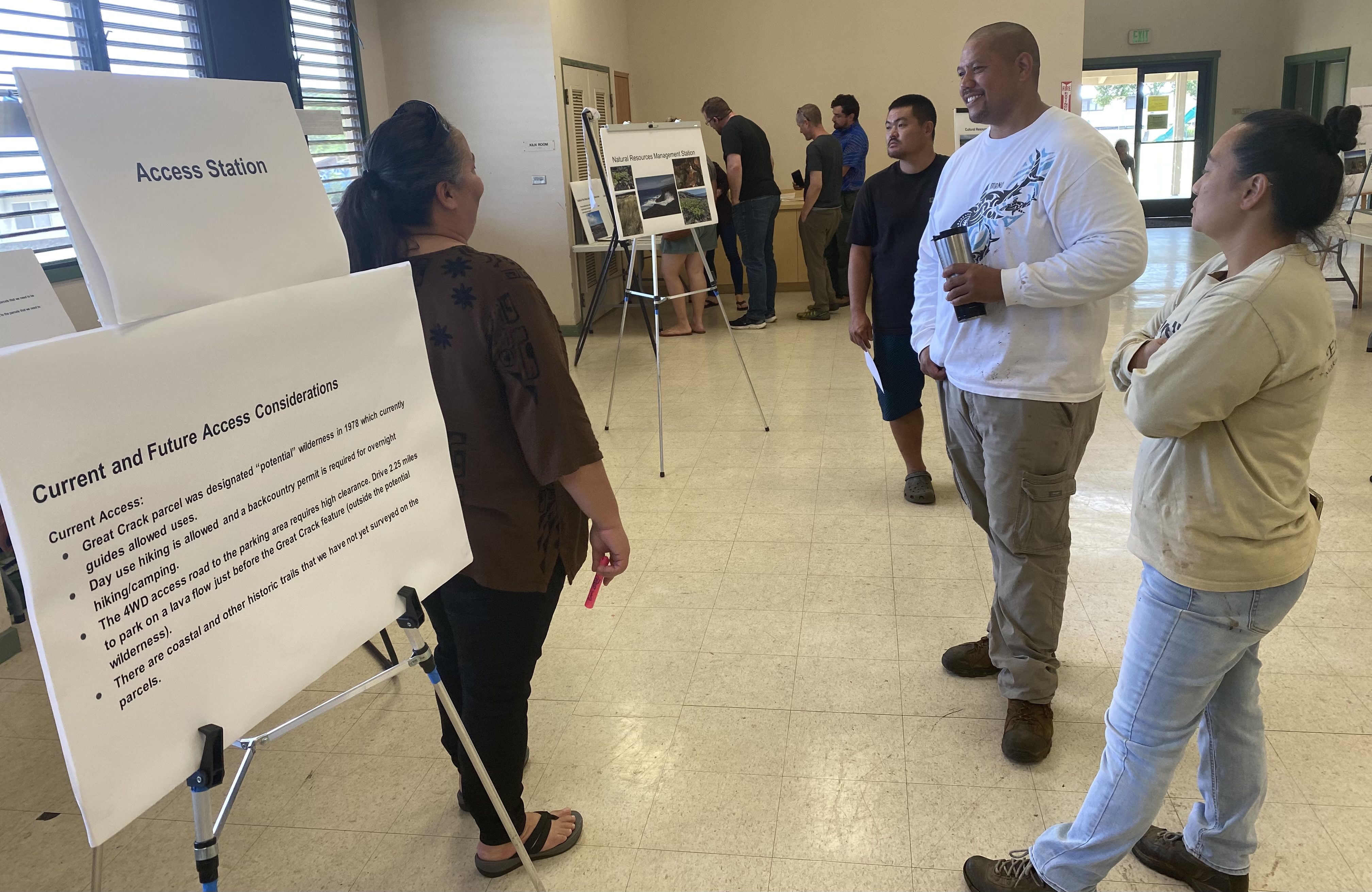
Locals ask about continued public access to the lands around The
Great Crack for hunting, and fishing. Photo by Julia Neal
                          Untrammeled - Wilderness is essential unhindered and free from the actions of modern human control or manipulation.
    Natural - Wilderness ecological systems are substantially free from the effects of modern civilization.
    Undeveloped - Wilderness retains its primeval character and influence and is essentially without permanent improvement or modern human occupation.
    Solitude - Wilderness provides outstanding opportunities for connection that is not disrupted by sights and sounds of people (that are not wanted.)
    Members of the public wrote notes such as asking how collecting opihi and fishing in the area might be affected by the Park management. Would pig and goat hunting be allowed to continue? Will there be access to the ocean on the trail between Hwy 11 mile markers 40 and 42? Will there be access to Keawe Tree Road? Do not block it, said a commenter who reported he uses it for fishing twice a week and wants vehicular access. Will there be access to The Great Crack between mile markers 45 and 46? It was also suggested to ban ATVs, and to manage but not eradicate animals to include fish plus limu.
    Other comments posted on boards in the public meeting place included the consideration of any two-wheel drive access and the possibility of a parking place for people to leave vehicles and hike. Will there be restrooms? A water station? Would vehicles be able to go all the way to the coast? Would limitations be
Hawai'i Volcanoes National Park Superintendent
Rhonda Loh shows maps of the planning area.
Photo by Julia Neal
imposed, only if necessary, for protecting a special place within the area? Will there be online reservations for permits? Will locals get the priority? Will the Park accommodate traditional fishing and gathering? Will there be flexibility in adjusting permit dates, given weather, surf and other situations for locals who fish and gather?
    No buildings or infrastructure to obstruct the viewshed urged another commenter. Another suggestion was "No permit for overnight stay." and giving local access by ID or driver's license. Making no road improvements was another.
    Hawaiian cultural expert Jesse Ke suggested to connect park representatives to families in the area. It was also suggested that a longtime paniolo of the area, Anthony Oliveira, be contacted to connect with families with knowledge of the place.
    See natural and human history of the lands, planning ideas and a portal for more input at https://www.nps.gov/havo/learn/historyculture/the-great-crack-and-ala-waii.htm. Written comments can be sent to Superintendent, Hawai‘i Volcanoes National Park, P.O. Box 52, Hawai‘i National Park, HI 96718.


Kekuhi Kealiʻikanakaoleohaililani
AFTER DARK IN THE. PARK: Long before Hawaiian people had a written language, they passed along traditional knowledge and culture through moʻolelo (story), hula (dance), mele (song & poetry), and oli (chanting.)
     On Tuesday, Oct. 17 in Kīlauea Visitor Center auditorium at 7 p.m. during After Dark in the Park, Kekuhi Kealiʻikanakaoleohaililani of Hālau O Kekuhi guides participants to connect to the landscapes of Hawai‘i on a deeper level. Passed down from her grandmother, Edith Kekuhi Kanakaʻole, her hula, chant, and stage performances have touched thousands of lives. This event is expected to be well attended. Doors will open for seating beginning at 6:30pm.

    Program is co-sponsored by Friends of Hawai‘i Volcanoes National Park. Your $2 donation helps to support park programs. Admission is free but Park entrance fees apply.

Sunday, October 01, 2023

Kaʻū News Briefs Sunday, Oct. 1, 2023

Volunteer Coach,  Pastor Kevin Brown, leads a prayer before Trojans beat the Daggars 54-28 on Saturday. See more below.
Photo by Mark Peters

ELECTRICITY BILLS WOULD GO UP IF THE INDUSTRIAL SOLAR PROJECT GOES FORWARD at Ocean View, according to the state Consumer Advocate who works for the Department of Commerce & Consumer Affairs. The opinion of Consumer Advocate was provided on Friday as four parties to a Formal Complaint to the Public Utilities Commission filed post-hearing briefs on the matter. The Consumer Advocate filed a 14-page brief while the industrial solar developer filed 25 pages and the 
utility companies Hawaiian Electric and Hawaiian Electric Light Co. filed a single page.

    The industrial solar project is dependent on a Feed In Tarif which allows higher prices to be charged for alternative energy. However, the project has been delayed for so long that the price of electricity to the consumer would be higher islandwide should the project be built.
    The Consumer Advocate argued that all 26 projects on 26 separate lots in Ocean View that are in the FIT program under one owner should be reviewed and subjected to the Competitive Bidding Framework. The FIT program was established in 2008 as an agreement between the electric company and the state as "a policy designed to support the development of renewable energy sources by providing a guaranteed, above-market price for producers."

     HECO set the FIT rates high, at 23.8c per kWh, which resulted in a "feeding frenzy" according to Big Island energy guru, Mark Mangelsdorf.
    The FIT Program opened to applicants in December 2011, and 10 megawatts were allocated to the Big Island. However, one developer, Solar Hub, was allocated 4.5 megawatts and another, Mr. Braunthal, was allocated 2.25 megawatts, all to be sited in three makai subdivisions in Ocean View. This meant that 65 percent of all the power intended for generation on the Big Island, under the FIT program, was slated for generation in Ocean View. In 2015, SPI, a large solar company based in Shanghai acquired the applications from both developers, creating a 6.5-megawatt project on 26 sites.
    Since 2011, the price for solar power projects with battery storage has dropped to 9c per kWh – the rate negotiated for the new Waikaloa Project. It has been calculated that the difference between 23.8c per kWh and 9c per kWh amounts to $60 million over the 20-year life of the project – an amount that would be passed through to ratepayers.

    In 2016, two Ranchos residents filed a Formal Complaint against the project claiming many instances of mismanagement by HECO and HELCO, the administrators of the FIT Program. In 2021, the PUC decided that the complaint should be narrowed down to a single issue – was the Competitive Bidding Framework circumvented when the project was admitted to the FIT Program? The difference between FIT and the Competitive Bidding process depends largely on the size limits – 2.72 megawatts is the largest size for the FIT project on either HELCO or MECO grids. This dovetails with the competitive bidding threshold, which requires that any project over 2.72 megawatts must be competitively bid.
    The Complainants, Peter and Ann Bosted, argued that since Solar Hub's initial project had a capacity of 4.5 MW, and since SPI's current project has a capacity of 6.5 MW the project should not be in the FIT Program. However, the attorneys for SPI argue that since 17 of the projects are in the name of 17 shell companies, all owned by SPI, they are not required to be competitively bid.
    The most recent Consumer Advocate's brief arguing that the project should be competitively bid became the third brief it has filed in support of the Complainants who wish to have the Ocean View project removed from FIT.
    In 2016, when the construction of a new Transmission Line to cross Highway 11 was needed by the project, the Consumer Advocate criticized the project. At that time, the Consumer Advocate wrote:
    "With the understanding that 26 of the 27 remaining projects are owned or controlled by the same entity/entities, these projects may have been an attempt to circumvent the competitive bidding process since the combined capacity of the 26 projects in question exceeds the competitive bidding threshold for the Island of Hawai'i."
    In 2020, the Consumer Advocate filed a Statement of Position urging the PUC to "consider 1) current market conditions that support a lower price per kWh for renewable energy projects, 2) the realization of recent market prices that were attained through a competitive bidding process, 3) the value of moving on from legacy programs or past parameters, as evidenced by the Commission's recent decision in the CBRE 
proceeding; and 4) most importantly, how the public interest might best be served."
    On Friday the Consumer Advocate cited a precedent set in 2011 when the Commission decided that a developer who planned to create multiple TMKs or lots from a single large agricultural lot, using the condominium property regime (CPR), locating one FIT project on each lot. The PUC decided against his proposal, citing the fact that it would resemble a large project that had been segmented to qualify for FIT.
    The Consumer Advocate noted that the "petitioner proactively sought a Commission decision before the FIT rules were finalized and presumably before any substantial investments were made on his part".
    The Consumer Advocate added "Treating the facts in this matter any differently from the Commission's 2011 order would send a very concerning message to all persons that come before the Commission. It would signal that, rather than seeking clarification from the Commission up front, persons might be better off relying upon 'technical maneuvering and hyper-literal attempts to parse the language of various regulatory decisions' in order to act in a manner that is potentially inconsistent with the policies that the Commission seeks to promote, while pointing to whatever investments they are able to make in their project as a justification for avoiding adverse decision by the Commission after the fact."
    The CA argued that, if the Commission had been asked first, the Commission would have refused permission, it concluded: "The Commission should find in favor of the Complainants, by finding that the 26 projects are subject to the competitive bidding and not eligible for the FIT Program."


Ocean Nihipali-Sesson rolls out to pass with Camdon Higbee in pass protection. Photo by Mark Peters

KAʻŪ TROJANS DEFEATED PAHOA DAGGERS 54-28 at the home football game on Saturday in front of a supportive home fanbase at Pāhala Ballfield. It's the second win in a row, with the last two games racking up 118 points, a school record. Next Saturday, Trojans travel to Waimea to take on Hawai‘i Preparatory Academy, with game time set for 2 p.m. The final two games are home games, the first on Saturday, Oct. 14 against Kamehameha High School at 1 p.m. and Friday, Oct. 20 against Honoka‘a, with game time set for 6 p.m.

Records broken as the Trojans nail their second straight win,
racking up 118 points in two games.
Photo by Mark Peters
    On Saturday, Trojans offense was on full display, gaining a total of 539 yards. The run netted a whopping 405 yards led by Ocean Nihipali-Sesson with 24 carries for over 179 yards.
    Adahdlyah Ellis-Reyes turned 12 carries into 164 yards. Jaestin Karasuda added five carries for 54 yards. The 134-yard gained in passing was led by Adahdiya Reyes-Ellis with 121 yards and two touchdowns, both caught by TJ Kuahuia-Faafia. He achieved five catches for 106 yards to lead the Trojan receivers.

Trojan offense clears the way for Kaʻū ground game. Photo by Mark Peters

Jaestin Karasuda carries the ball around the end for a touchdown. Photo by Mark Peters

HAWAIIAN CRAFT VENDORS are sought for Ho‘okupu Hula No Kaʻū Cultural Festival to be held on Saturday, Nov. 4 at Keola Pu‘uhonua cultural grounds behind Nāʻālehu Bake Shop. The celebration of hula, craft and culture will feature performers from Mexico, Japan, Virginia, O’ahu, Maui and Hawai‘i Island and will be sponsored by Hālau Hula ‘O Leionālani.  It is a free event and the public is invited to bring lawn chairs.
    Any interested Hawaiian craft vendors can call Kumu Hula Debbie Ryder at 808 -649-9334.

Ho‘okupu Hula No Kaʻū Cultural Festival returns live after COVID with dancers and singers from
Hawai‘i, Mexico, Japan and the mainland. Hawaiian vendors are sought for the Nov. 4 date at
Keola Pu'uhonua cultural grounds behind Nāʻālehu Bake Shop. Photo by Julia Neal


Saturday, September 30, 2023

Kaʻū News Briefs Saturday, Sept. 30, 2023

A mock care room at the new Hopena Kuloli Medical Training Institute in Ocean View Town Center. Photo from Hokulani Porter

A CERTIFIED NURSE ASSISTANT SCHOOL IS SET TO OPEN IN OCEAN VIEW. Called Hopena Kūloli Medical Training Institute, it is located in Ocean View Town Center. An open house will be held on Wednesday, Oct. 11 from 3 p.m. to 6 p.m. with detailed information to register. Classes are set to begin Oct. 11 for seven weeks on Tuesdays and Wednesdays from 9 a.m. to 2 p.m. Clinical practicum dates will be announced and are usually four days in length. Hopena Kūloli Medical Training Institute plans to offer evening classes later in the year.
    Founder Hokulani Porter said that Hopena Kūloli Medical Training Institute "is catalyzing a monumental change." She and other health care providers, including physicians, have described the communities from Pāhala through Nāʻālehu and Ocean View to Captain Cook as a desert for home health care, particularly for the elderly.
    Porter is a nurse practitioner and owner of the training institute. She started in nursing as a single mom by signing up for a Certified Nurse Assistant course. She said, "It changed my life to start making a living wage that helped me to get my head above water as well as to escape the need of dependency on the welfare system." After being employed in several long-term care homes as a CNA, Porter returned to school to become a Licensed Practical Nurse, then Registered Nurse and Nurse Practitioner for the past 11 years.
    Porter received an 'Ike Ao Pono scholarship that helps Hawaiian students to enter the professional nursing field at University of Hawai'i, Mānoa and to bring more health practitioners out to Hawai'i's rural communities. She came to to Kaʻū Hospital for all her clinical study hours and graduated in 2012. She said, "I greatly enjoy the people and community of Kaʻū and feel at home here." She said her roots include her great grandmother from Kaʻū.
Hokulani Porter to train
Certified Nursing Assistants
in Ocean View 
    
    When working in Kaʻū, Porter said, she realized the dire need for more health care and started laying her foundation to help solve the problem. Nearly a decade later while working as a personal care provider for patients at Kaʻū Wellness Clinic in Ocean View, she said she sees that the lack of health care resources "are even scarcer, especially access to home health services that assist our elderly."
    Porter said she also wants to increase employment opportunities in Kaʻū, so more people can work near home, avoid long drives and save on fuel. The mission of Hopena Kūloli Medical Training Institute is "to inspire students to refocus and rebuild, to enhance oneself through education. We want our students to build themselves a career that will support themselves and the needs of their families." CNA's can work in home health on a schedule that works for them. They can also find employment in a hospital or acute care setting and continue to rise in the nursing field.

    Skills learned as a CNA can also be applied to a variety of work settings. Porter said the school teaches attention to detail, verbal and written communication, consistency, interpersonal skills, record-keeping, knowledge of medical terminology and the understanding of common health disorders.
    To take the classes for the CNA certification, students must be 18 years of age or older, have a high School graduate or GED equivalent, be able to read, write, and communicate in English language. At completion of the course, students sit for a national board exam that awards them a certificate allowing them to work for any health facility throughout the United States.
   For more information, call Hokulani Porter at 808-777-0674

To read comments, add your own, and like this story, see facebook.com/kaucalendar. See latest print edition at kaucalendar.com, in the mail and on stands.

THE MEASURE TO KEEP THE FEDERAL GOVERNMENT FUNDED for the next 45 days was successfully supported by Hawai'i's Congressional Delegation on Saturday and includes funding to help with the Maui firestorm disaster. Sen. Mazie Hirono noted that the bill includes $16 billion in supplemental funding for the federal Disaster Relief Fund. It passed the Senate by a vote of 88-9 on Saturday night. The bill passed the House earlier in the day by a vote of 335-91. Pres. Joe Biden signed it into law.
   Hirono said, “Today, I voted to keep the federal government open and deliver critical disaster relief for Maui. With $16 billion in disaster relief funding, this legislation will help ensure FEMA and the federal family of agencies have the resources they need to continue their important recovery work on Maui and in other communities impacted by disasters across the country. This bipartisan agreement benefits the people of Hawai'i and our country and prevents the chaos a shutdown would cause.
    “Radical House Republicans were willing to bring us to the brink of a government shutdown in a failed attempt to slash safety net programs, endangering the welfare of children and families across our country. Astoundingly, 90 of them still voted to shut down the government today without any alternatives. In the critical days ahead, Congress must also keep its commitment to fund and support Ukraine, as we’ve consistently done on a bipartisan basis. Failure to do so would send a dangerous message to Vladimir Putin and Xi Jinping about our commitment to defending democracy and our national security. Work remains over the next 45 days.”

To read comments, add your own, and like this story, see facebook.com/kaucalendar. See latest print edition at kaucalendar.com, in the mail and on stands.

WHAT DO WE KNOW ABOUT THE KULANAOKUAIKI TEPHRA OF KĪLAUEA VOLCANO? That is the title of this week's Volcano Watch, the monthly column written by USGS Hawaiian Volcano Observatory scientists and affiliates. This week's author is HVO intern and University of Deleware graduate student Abigail R. Nalesnik, who writes:
A paint brush is very useful to discern individual Kulanaokuaiki Tephra units
 by clearing away overlying younger ash and Pele's hair. At this field site on the
 south flank of Kīlauea, the Kulanaokuaiki Tephra is overlain by Observatory Shield
lava flows and underlain by the Kīpuka Nēnē lava flows. This helps give great time
 constraints to the deposition of this tephra. USGS photo by Kendra J. Lynn.

   My work has been focused on finding and sampling parts of the Kulanaokuaiki Tephra, which erupted from Kīlauea 1,000–1,600 years ago (400–1000 CE).
    The Kulanaokuaiki Tephra is part of the Uēkahuna Ash, and it has been best studied on the south flank of Kīlauea. Five stratigraphically distinct subunits, K-1 through K-5, make up the Kulanaokuaiki Tephra. All of them are composed of tephra—rock pieces ejected from a vent during explosive volcanic eruptions.
    After they are ejected from the vent, tephra travel through the air for a distance; where they fall is determined in part by their shape and mass. These particles may travel far when a large explosive eruption has a plume high enough to reach trade wind and even jet stream heights. The plume that produced some of the Kulanaokuaiki Tephra deposits on the south flank of Kīlauea is estimated to have reached 9–11 miles (14–18 km) 
    I am studying the Kulanaokuaiki Tephra deposits to learn more about where the tephra settled, how the eruptions happened and what the physical properties of the tephra itself can share about magmatic processes. It’s important to study a tephra unit with primary deposition, meaning that the deposit appears exactly as it was originally deposited.
   Let’s examine the typical sequence of Kulanaokuaiki Tephra from the bottom (the first eruptions) to the top (the last eruptions). K-1 is usually the thickest of the units and is commonly found resting on the Kīpukanēnē lava flow field (350–190 BCE). It is made up of small 0.2–0.4 inch (0.5–1 centimeter) pumice from high lava fountains that lofted this lighter material for several miles (kilometers).
    K-2 is reworked and appears similar to K-1 but is chemically distinct making it useful as a geochemical marker between field sites.
    There is a stark color and grain size change in K-3. It’s mostly made up of dark scoria ranging from less than 0.04 inches (1 millimeter) to over 1.2 inches (3 centimeters) in size. K-3 is a loose deposit and if I poked an exposure of it with a paint brush, pieces quickly fall out of the outcrop. I sub-sample K-1 and K-3 at several localities, which will be useful to explore the properties of each unit from beginning to end.
    K-4 is a bright orange, fine grained layer that feels like cement when trying to dig into it. You certainly know it when it is present, so like K-2, it is a useful marker in the stratigraphy.
    Lastly, K-5 is a scattered scoria deposit. It’s not always present but it begins poking out when you dig down from the top to sample. It can sometimes also be found embedded in the top of K-4!
 Stratigraphic column of the Kulanaokuaiki Tephra sequence, and an in-the-field
 look at this section with closer photographs of subunits K-1, K-3, and K-5. At
some localities, there are interbedded lava flows that help correlate unitd across
 units across larger distances on Kīlauea volcano.USGS photos by Abigail Nalesnik.
    During my ventures on Kīlauea’s south flank, I’ve found that the thickness of subunits K-2 and K-4 are variable over short distances and are typically thicker in low-lying areas. Does this mean that more tephra truly fell in these localized areas (unlikely), or was some of it moved by wind or water in a process known as reworking?
    We ask these questions because explosive eruptions like those that generated the Kulanaokuaiki Tephra have never been seen in the modern era at Kīlauea, so only their primary deposits can give us clues. The variable thickness of K-2 and K-4 suggests that the deposit was reworked, so my study of the Kulanaokuaiki eruptions focuses on units K-1, K-3, and K-5.
    Farther down Kīlauea’s south flank, the Kulanaokuaiki Tephra deposit quickly changes. K-5 disappears, lost in the weeds of the soil and local vegetation. The bright orange K-4 becomes thinner, and the grains of K-3 become smaller. The once-abundant K-1 also disappears, as we are farther from the assumed source area of the summit.
    As I follow these units to the coast, the only remaining discernible unit is K-3. This part of the deposit made it all the way to Halapē and beyond, ultimately settling in the ocean.
    After making observations and sampling the Kulanaokuaiki Tephra deposit in the field, I’ll begin the work of analyzing samples in the USGS Hawaiian Volcano Observatory's new state-of-the-art lab. My work will help to better interpret the explosive eruptions that produced the Kulanaokuaiki Tephra, giving us more insight into Kīlauea’s eruptive processes over time.
    Volcano Activity Updates: Kīlauea is not erupting. Its USGS Volcano Alert level is ADVISORY.
The Kīlauea summit eruption that began on September 10th stopped on September 16. Summit seismicity has remained low, with very few earthquakes over the past week, and tremor is at background levels. Summit tilt showed a couple of deflation and inflation cycles (DI-events) over the past week, with several microradians of net inflation. The most recent sulfur dioxide (SO2) emission rate, of approximately 150 tonnes per day, was measured on September 25.
    Mauna Loa is not erupting. Its USGS Volcano Alert Level is at NORMAL. Webcams show no signs of activity on Mauna Loa. Seismicity remains low. Summit ground deformation rates indicate slow inflation as magma replenishes the reservoir system following the recent eruption. SO2 emission rates are at background levels.
    No earthquakes were reported felt in the Hawaiian Islands during the past week.

To read comments, add your own, and like this story, see facebook.com/kaucalendar. See latest print edition at kaucalendar.com, in the mail and on stands.