About The Kaʻū Calendar

Sunday, February 04, 2024

Kaʻū News Briefs Feb. 4, 2024

USDA's Rural Energy for America Program will fund programs for new energy sources in rural places like Kaʻū, quarterly
through Sept. 24. See below for Hawai‘i projects already funded and how to apply. USDA photo

IRONWORKERS UNION 625 has endorsed Dr. Kimo C. Alameda in his run for Mayor of Hawai‘i County. The Alameda campaign issued a statement saying it is "the first major endorsement of the 2024 mayoral race" and "signals that the Big Island mayor's race is now in full swing as other unions and organizations consider which candidates they might support. Alameda is hopeful that he will receive additional endorsements as well."

    Alameda said, "I'm excited to earn the support of everybody who wants to bring the spirit of aloha back to County government."
    Local 625 represents almost a thousand members across the state, including many on Hawaiʻi Island, "who provide essential construction, repair, and maintenance services for critical infrastructure projects," noted the Alameda statement.
    The union endorsement statement said, "Local 625, under the leadership of Mr. T. George Paris, is proud to endorse Dr. Kimo Alameda for mayor. We know he will always put the community first, and fight for the infrastructure investments that Hawaiʻi Island needs."

    Alameda noted "Almost a hundred years ago, my grandfather was an ironworker in Hilo. Back in those days, he and his crew would build and fix all the steam engines, railroad tracks, boilers, and other machinery used on the old sugar mills. Today, Local 625 continues to keep that legacy of hard work and dedication alive. I am very proud to be supported by the amazing members of Local 625."
    See more on the Alameda campaign at www.kimoformayor.com.


To read comments, add your own, and like this story, see facebook.com/kaucalendar. See latest print edition at kaucalendar.com, in the mail and on stands.


A FATAL HIT AN RUN ON HWY 11 NEAR KA‘ALU‘ALU ROAD INTERSECTION in Wai‘ōhinu early Sunday morning has led to a Hawai‘i Island police search for the driver of the unknown vehicle that hit
the pedestrian. The victim is a 25-year-old Kealakekua man, Kevin Adonay Catellanos-Rodriguez.
    Responding to a call at 3:59 a.m., police investigators determined that an unknown vehicle, possibly a pickup truck or SUV-type vehicle, struck Catellanos-Rodriguez. He was possibly in the middle of the northbound (Kona) lane. After striking the pedestrian, the unknown vehicle fled the area in an unknown direction. Catellanos-Rodriguez was transported to the Kona Community Hospital where he was pronounced dead at 10:28 a.m.
    Failure to render aid when a person is injured or killed in a traffic collision is a Class B felony that may be punishable by up to 10 years in prison and fines up to $25,000. Failure to render aid is covered under section 291C-14 of the Hawai‘i Revised Statutes.
    The Area II Traffic Enforcement Unit has initiated a negligent homicide investigation and is asking anyone who may have witnessed the collision to contact Officer Dayson Taniguchi at (808) 326-4646, ext. 229, or email at dayson.taniguchi@hawaiicounty.gov. Tipsters who prefer to remain anonymous may call Crime Stoppers at (808) 961-8300.
    This is the fifth traffic fatality this year compared to two at this time last year.

To read comments, add your own, and like this story, see facebook.com/kaucalendar. See latest print edition at kaucalendar.com, in the mail and on stands.

FUTURE HEALTH PROFESSIONALS FROM KAʻŪ HIGH did well at the HOSA gathering at Hawai‘i Convention Center in Honolulu, Jan. 29-31, according to teacher and mentor Dr. Angie Miyashiro. The HOSA conference was part of the statewide Career & Technical State Organizations Conference, 
Alashae Barrios qualifies to attend the
 national HOSA convention in Houston
 this June. Photo by Dr. Angie Miyashiro
representing 45 public, private and postsecondary schools.                   
Future Health Professionals from Kaʻū High did well at the annual HOSA
state competition in Honolulu in late January. Photo from HOSA
    Miyashiro reported that Alajshae Barrios placed third, qualifying her to attend the national HOSA convention from June 26 - 29 in Houston.
    Maryline Amon came close to qualifying, coming in fifth. The other attendees from Kaʻū High who followed close behind the top two are: Anastasia Kovalik, Rojelin Capueta, Aubrey-Ann Delos Santos, Coleen Ramos, Janeea Bonoan and Nyori Soriano.
    The Career & Technical State Organization Conference serves as a forum for students from four of the five Hawai‘i CTSOs — the Distributive Education Clubs of America (DECA), Future Health Professionals (HOSA), Family, Career and Community Leaders of America (FCCLA), and SkillsUSA — to apply their Career and Technical Education (CTE) learning in a competitive showcase.
    “The CTSO conference is the culminating event for students to take all of this knowledge that they've been learning in class, and display that in front of authentic judges,” said Daniel Addis, CTE educational specialist for the Hawai‘i State Department of Education.
    Approximately 1,700 students from across the state participated in a range of authentic, real-world competitions in areas including business and marketing, retail merchandising, drone operations, robotics, health science, emergency preparedness, engineering technology and more.                 Competitions took place at the Hawai‘i Convention Center in the form of written exams, interviews and presentations, along with team and individual challenges.           Culinary, automotive technology and carpentry competitions took place off site at Kapi‘olani Community College, Leeward Community College and the Carpenters Training Center in Kapolei.
   Community business partners were invited to judge competitions within their respective fields or industries to help ensure that the student CTE skills were in alignment with real-world industry standards.
    “We really rely on our business partnerships to make sure that we're giving the kids the skills they need to be in that career in the future,” said CTSO State Coordinator Margaret Miura.
    With leadership-building as one of the main focuses of CTSO, business partners also help to mentor and guide students looking to enter an industry.
    A statement from organizers said, "The annual conference aligns with the Department’s efforts to strengthen career and college pathways by providing relevant, real-world learning opportunities that help ensure all graduates are globally competitive. Winners of the state competitions will go on to compete in national CTSO tournaments later in the school year."
    The fifth Hawai‘i CTSO, Future Farmers of America, will host its annual statewide conference on Kaua‘i at the end of February. The Ka‘ū High FFA chapter is raising money to attend the event. To donate to Kaʻū FFA, email kaweni.ibarra@k12.hi.us or send donations to Kaʻū FFA, P.O. Box 100, Pāhala, HI 967677.

To read comments, add your own, and like this story, see facebook.com/kaucalendar. See latest print edition at kaucalendar.com, in the mail and on stands.

A FARM ON THIS ISLAND WILL RECEIVE A $388,667 GRANT to install a 246-kilowatt (kW) DC solar photovoltaic system. The project, funded by U.S. Department of Agriculture's Rural Energy for America Program, is estimated to generate 422,591 kilowatt hours (kWh) and replace an on-site energy usage through a net-metering agreement planned with a utility company. The location for the Hualua Farm, LLC project is in Hawi.
    USDA continues to accept REAP applications and will hold funding competitions quarterly through Sept. 30, 2024 for energy projects in rural places like Kaʻū. The funding includes a dedicated portion for underutilized renewable energy technologies. For information on application deadlines and submission details, see page 19239 of the March 31 Federal Register. 
    On other Hawaiian Islands, there is other recent funding through REAP.
    A coffee stand and agricultural building project will receive a $23K grant for Johnny V. Enterprises in Hana, Maui.
    Moloka‘i Sea Farms will get an $80K grant to install a 29.520 kilowatt (kW) solar power system to include 72 solar panels for a shrimp farm in Kaunakakai on Moloka‘i. The system is estimated to generate 49,000 kilowatt hours (kWh) per year and replace energy usage from a utility company to ultimately being off the grid.
    Garden Island Dental LLC will get a $28,511 grant to help Garden Island Dental LLC install a 14.4 kilowatt (kW) renewable energy solar project. The business is in Lihu‘e, Kaua‘i and will generate 20,773 kilowatt hours (kWh) for a cost savings of $9,221 annually.
    Under the current federal administration, USDA has invested more than $1.6 billion through REAP in 5,457 renewable energy and energy efficiency improvements throughout the country to help rural business owners lower energy costs, generate new income and strengthen their resiliency of operations.
    Rural Energy for America Program provides grants and loans to help ag producers and rural small business owners expand their use of wind, solar and other forms of clean energy and make energy efficiency improvements. "These innovations help them increase their income, grow their
businesses, address climate change and lower energy costs for American families," says a statement from USDA.
    For additional funding, U.S. Department of Agriculture Secretary Tom Vilsack announced that USDA is investing $207 million in renewable energy and domestic fertilizer projects to lower energy bills, generate new income, create jobs, and strengthen competition for U.S. farmers, ranchers and agricultural producers. Many of the projects are being funded by the Inflation Reduction Act, the nation’s largest-ever investment in combatting the climate crisis. 
     Vilsack made the announcement in late January at the 105th annual American Farm Bureau Federation convention in Salt Lake City, Utah, and said the investments "will expand access to renewable energy infrastructure and increase domestic fertilizer production, all while creating good-paying jobs and saving people money on their energy costs that they can then invest back into their businesses and communities.”


The Kaʻū Calendar newspaper, 5,000 in the mail. 2,500 on the streets.


See https://apply.mykaleidoscope.com/scholarships/CUHawaiiMorePossibilities2024


Saturday, February 03, 2024

Kaʻū News Briefs Feb.3, 2024

Hawai‘i state legislators visited Kaʻū last summer and stopped in at the historic Sasaki Store in Pāhala to meet with The Kaʻū Calendar. See upcoming stories on their initiatives that involve this district during the 2024 Hawai‘i Legislature.
Photo by Rep. Jeanne Kapela

WONDERING WHAT'S GOING ON WITH THE 2024 HAWAI‘I LEGISLATURE AND KAʻŪ'S PUBLIC SERVANTS, STATE SEN. DRU KANUHU AND REP. JEANNE KAPELA?
    Public Access Room, sponsored by the Hawai‘i Legislature. offers two Zoom workshops this coming week, noting that there are plenty of 2024 Hawai‘i Legislature public hearings scheduled as deadlines start to hit. Two staffers have joined PAR to assist with the participation of public voices in the process.

State legislators enjoyed local foods and Kaʻū
Coffee as they discussed local issues inside the
old Sasaki Store, now called Market House.
Photo by Jeanne Kapela 
    The first Zoom workshop is Keeping Up with the Legislature on Wednesday, Feb. 7. It covers hearing notices, committee reports, amended drafts, and the decking deadline. PAR will cover some tips for perspective, improve advocacy efforts, and make work a little easier for the public. Register here:
https://us06web.zoom.us/meeting/register/tZMrcuqhqD8tEt08KEN57Cuye9VYAsvHdBDN.
    The second Zoom session is Floor Sessions and Orders of of the Day It is an overview of the action that takes place when the House and Senate convene in their chambers. It's on Friday, Feb. 9 at 1 p.m. Register here: https://us06web.zoom.us/meeting/register/tZErduCpqjIvEtYT56pI0suUCeHUe1gVPBrf ,
   The PAR staff consists of veterans and new hires. Andy Eckhardt worked with PAR last session and Courtney Mrowczynski worked with PAR in 2020 (that crazy year when the session was interrupted by COVID). They are friendly voices helping callers and smiling faces who greet those who walk through the door and make PAR their office when flying to Honolulu to attend the Hawai‘i Legislature. A statement from PAR says, "They're already pros at explaining the legislative process, how to use the website, the meaning of the deadlines, and what resources can be found where. And, like all of us, they learn more every day!" Visit the Staff page. Use the drop-down menu on the About tab on PAR's website.

Rep. Jeanne Kapela brought legislators to Kaʻū
last summer. Photo from Rep. Jeanne Kapela
    PAR calls itself Your Office at the Capitol. The non-partisan Public Access Room is there to help answer questions about the legislative process and how to participate. Call 808/587-0478 or email par@capitol.hawaii.gov. In Honolulu, visit the PAR office (Room 401) to use a computer, recharge phone or laptop, or watch hearings remotely. There are also a wealth of handouts to pick up.
    PAR also helps the public to find all the current public hearings: Click the view button on the gray Hearing Notices box under the picture on the Legislature's homepage (capitol.hawaii.gov).
    PAR informs the public on how to watch what's going on at the Hawai‘i Legislature: Click the view button on the Live & On-Demand Video box on the Legislature's home page. The link is also found in the row beneath the picture. Choose either the House or Senate YouTube channel. (Tip: The "Playlists" tab on the YouTube pages shows you separate playlists for each committee.)
     Quickly find video of a bill's hearing: Enter a bill number in the search bar (upper right) on the Legislature's website. On the status page, the YouTube link in the Hearing Notices box will open the hearing video.
    Past informational briefings: Use the Reports & Lists page and select the Hearing Notices bar. This is helpful to review any of the budget briefings conducted by the money committees last month.
     Need help signing up for emailed hearing notices or offering testimony? Visit the "Engagement 101" page on PAR's website (lrb.hawaii.gov/par/) for instructions and videos. Or reach out to PAR for help – to walk hrough it. 
    Upcoming deadlines: February 7 = House Triple Referral filing; February 8 = Senate Triple Referral filing, February 15 = First Lateral filing; March 1 = First Decking.
PAR staffers: Virginia Beck, Andy Eckhardt, Keanu Young and Courtney Mrowczynski, Photo from PAR

To read comments, add your own, and like this story, see facebook.com/kaucalendar. See latest print edition at kaucalendar.com, in the mail and on stands.

A COMMUNITY ACCESS PRENATAL CLINIC IS OFFERED fourth Sunday of every month. No one is turned away for lack of funds, but all insurance is accepted. Location is 94-2166 South Point Rd. at the Old Kalae Coffee. Phone (808)450-0498. Upcoming dates are 2/25, 3/24, 4/28, 5/26 and 6/23.

FEWER EARTHQUAKES WERE HAPPENING BETWEN VOLCANO AND PĀHALA  on late Friday and Saturday. Kīlauea volcano was not erupting and seismicity in the summit and along the Koa‘e fault system southwest of the summit decreased significantly.

    USGS reported that "more than 3,000 earthquakes were recorded over the past week during this event, which coincided with ground deformation patterns indicative of magma moving from beneath the summit to the southwest under the Koa‘e fault system."
    However, USGS also reported: "The intrusion of magma into this area appears to have slowed, and the likelihood of an eruption has decreased. A VAN/VONA was issued earlier this morning, lowering the Alert level from Orange/Watch to Yellow/Advisory. "

    There were less than 150 earthquakes on Saturday, with about 650 on Friday and 750 on Thursday in the summit and Southwest Rift Zone areas, including the Kaʻū Desert.

To read comments, add your own, and like this story, see facebook.com/kaucalendar. See latest print edition at kaucalendar.com, in the mail and on stands.

KEEP A BACKUP WATER SUPPLY AND CONSERVE WATER when heavy rains that could interrupt electrical power are predicted. That's the message from the county Department of Water Supply this weekend, which sent out an explanation.
    The Department of Water Supply requires a significant amount of dependable electricity to move approximately 25 million gallons of water each day and deliver it to more than 45,000 homes, businesses, farms, and community facilities located throughout much of Hawai‘i Island.
    Hawaiian Electric issued a statement leading up to this weekend, urging customers to prepare for heavy rains and winds that were expected to impact Hawai‘i Island through the weekend. “During severe
weather, strong winds can blow trees or debris into power lines, causing outages and damaging electrical equipment. Falling trees can hit utility poles or overhead lines, knocking lines down or causing poles to lean, which may result in outages. Heavy rains can also lead to flooding of underground cables or other equipment,” Hawaiian Electric said in the statement. Outages in areas designated by the State as at-risk for fires may experience longer outages due to the possible need to conduct visual or aerial inspections before power may be safely restored, it added.
    Department of Water Supply operates backup generators at key well sites to help maintain a limited amount of water service during temporary power outages. "However, an extended power outage could leave portions of DWS’ water systems empty and customers with no water," reports DWA. "Should this scenario be anticipated, DWS will instruct its affected customers to use their tap water only for drinking, cooking, and hygiene purposes to preserve the limited amount of available potable water. Irrigation, car washing, and non-essential uses of water would be suspended until power is restored."
   DWS stated that it "strongly urges its customers and those who depend on a continuous supply of DWS water to review their personal situations and prepare accordingly. Customers should have alternate sources of potable water and enough supply to meet their essential needs during a prolonged power outage that disrupts DWS service. Ways to safely store drinking water are listed in the Water Emergency Preparedness guide available under the Community drop-down menu option on the Department’s website, hawaiidws.org.
    Updated messaging will be posted at hawaiidws.org and on the DWS Facebook page at facebook.com/HawaiiDWS. To reach the DWS, please call (808) 961-8050 during normal business hours, (808) 961-8790 for after-hour emergencies, or email: dws@hawaiidws.org.


The Kaʻū Calendar newspaper, 5,000 in the mail. 2,500 on the streets.


See https://apply.mykaleidoscope.com/scholarships/CUHawaiiMorePossibilities2024


Friday, February 02, 2024

Kaʻū News Briefs Feb.2, 2024

Sunrise reflected in the windows of the buildings at Uēkahuna bluff in Hawaiʻi Volcanoes National Park. 
Photo by Janice Wei/NPS


HAWAIIAN VOLCANO OBSERVATORY BUILDINGS AND INFRASTRUCTURE ARE UNDER REPAIR, IMPROVEMENT OR REMOVAL. The USGS and National Park Service project began this week with fencing off Jaggar Museum, former US Geological Survey Hawaiian Volcano Observatory buildings at Uēkahuna and part of the parking lot. The buildings were structurally damaged during the 2018 Kīlauea eruption and summit collapse and will be removed in weeks ahead.
    Crater Rim Drive will also be realigned to improve safety and reduce congestion at the park entrance.
An administrative lane will be added, and a roundabout will be installed beyond the entrance station. Unless extensions are granted, the contract for Phase One of the Disaster Recovery Project is 600 days.
    "Park visitors, tour operators and the community should expect reduced parking, delays at the entrance station, and the potential for temporary area closures, especially if a summit eruption occurs during construction," said Hawaiʻi Volcanoes National Park Superintendent Rhonda Loh. "We thank our partners, visitors and the community for their patience during this process."
    Half the parking lot at Uēkahuna is blocked for the construction project staging area. Vehicles longer than 25 feet and wider than eight feet will not be allowed past Kīlauea Military Camp, and the gravel overflow parking lot at Kīlauea Visitor Center will also be secured as a staging area.
    The USGS statement says that the park will restore Uēkahuna to a more natural landscape, considered by Native Hawaiians and other groups as a sacred area. The buildings will be removed, but the observation deck will remain. Interpretive displays will be minimal so as not to impede the panoramic views or influence how individuals interpret the sense of place.
Illustration from the plans for construction underway to replace and repair structures and the summit of Kīlauea. NPS image
  Following the 2018 disaster, Hawaiʻi Volcanoes National Park and the USGS Hawaiian Volcano Observatory completed civic engagement, public scoping and an Environmental Assessment. The park released a Finding of No Significant Impact on the plan to move forward with the Disaster Recovery Project.
    Construction of the new USGS HVO field station near the historic ballfield at Kīlauea Military Camp is also underway but is not expected to have major impacts on visitation. Some materials from the original HVO buildings like decorative stained glass, plaques, rock work and other materials will be used in the new facility.
    Phase Two of the Disaster Recovery Project includes the rehabilitation of Kīlauea Visitor Center and is slated to begin as early as Fall 2024.
    Hawaiʻi Volcanoes National Park and Kīlauea summit underwent a massive change in 2018 when magma drained from the chamber beneath Halema‘uma‘u crater. The caldera collapsed and triggered thousands of earthquakes and clouds of rock and ash between May and August 2018. The seismic activity was centered near the crater, and significantly impacted buildings and roads in the vicinity of Uēkahuna. Most of the park closed for 134 days.
    Visitors are advised to stay informed of construction-related updates and delays by planning ahead and checking the park website.

To read comments, add your own, and like this story, see facebook.com/kaucalendar. See latest print edition at kaucalendar.com, in the mail and on stands.

A MAGNITUDE 3.7 EARTHQUAKE, followed by an M 3.6 occurred near Pu‘u Mo‘o, on Friday evening. The 180-foot cone is about 6 miles west of Pāhala on the coast. A string of smaller earthquakes also occurred along and near the coast. More than 700 earthquakes occurred between Volcano and Pāhala on Friday, punctuated by a Magnitude 3.7 and 3.6 in the evening. This USGS map shows quakes during the last week through Friday at 2 p.m.


MAUNA LOA 2022: A RETROSPECTIVE ON EARLY HOURS OF THE ERUPTION is the title of this week's Volcano Watch, written by U.S. Geological Survey Hawaiian Volcano Observatory scientists and affiliates.
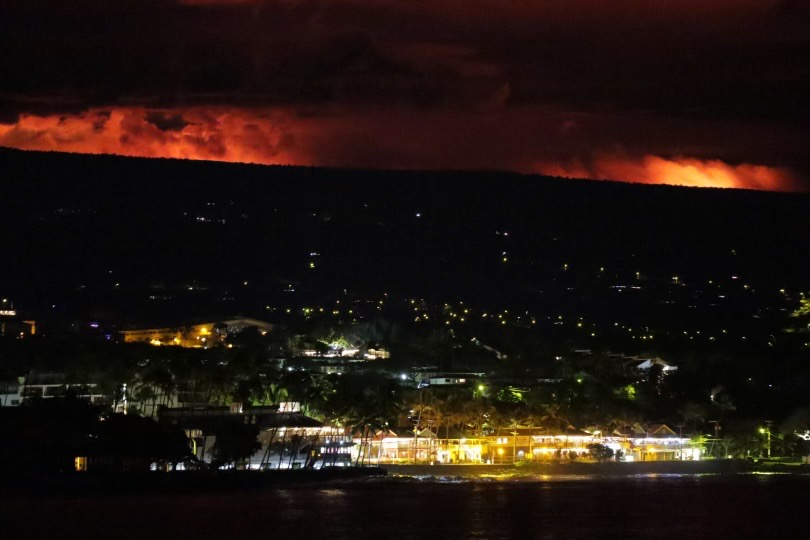
    In the late hours of November 27, 2022, Mauna Loa began erupting. Lava was visible on the west side of the Island of Hawaiʻi, from Kailua-Kona to Waikoloa. Social media was ablaze with pictures and commentary of lava flows descending the west flank toward communities.
Color photograph of glow from volcanic eruption lighting the night sky above a town
View from Kailua-Kona of Mauna Loa lava flows from the south caldera during the early morning hours of November 28, 2022. Photo courtesy of Ilya Bilyk. 
    This volcanic activity caused anxiety among local residents, and tensions remained high after the USGS Hawaiian Volcano Observatory (HVO) issued a statement that the flows were not a threat to communities and people living on the west side of the island. How could that be? "We see the flows!" was the public's response.
    Past eruptive behavior is an excellent guide to future activity. From past eruptions, we know that lava flows from the Southwest Rift Zone of Mauna Loa can threaten communities in a matter of hours and quickly reach the ocean.
    It is the same past behavior that gave HVO the confidence to say that those flows, seen from Kona, were not a threat to folks living on the west side of the island. Let us explain.
Mauna Loa has erupted 34 times since 1843. Each eruption started in Mokuʻāweoweo, and likely the south caldera area; however, there are very few eyewitness observations of the onset of eruptions in the 19th and 20th centuries due to the great distances, high altitude, cold, and lack of water (to name a few).
Trying to sleuth the activity from geologic mapping is confounded by frequent eruptive activity, as old eruptions were covered by new eruptions, obliterating the past eruptive history.
    Fortunately, there were some astute observers and intrepid adventurers who hiked to the summit for the 19th and early 20th-century eruptions. And in the late 20th century, technology (airplanes and satellites) helped us to document some of the activity.
 A view of fissure 4 erupting in November of 2022 on the Northeast Rift Zone of Mauna Loa. Fissure 4 formed at approximately 7:30 p.m. On the next morning, Nov. 29, the fountains there were 5-10 m (16-33 ft) tall. USGS photo by F. Trusdell 
  Based on those observations, we can say with confidence that the activity in the early hours of the 2022 Mauna Loa eruption was similar to some past eruptions. Similar reports from the west side of the island—of flows descending from the south caldera region toward South Kona, as observed in 2022—also occurred in 1851, 1879, 1887, 1897, 1899, 1903, 1907, 1926, 1933, 1940, 1949, 1975, and 1984.
    Flows that erupted in the south caldera region, but were not confirmed by visual observations from Kona, include the 1868, 1916, 1919, and 1950.
    Flows that are visible high on Mauna Loa's west flank erupt from the south caldera region of Mauna Loa, outside the topographic depressions of the summit region. Activity in this location is easily visible from the south and west sides of the island, which can be alarming. However, none of these previous lava flows in the south caldera region, whether observed or not, traveled far enough to threaten South Kona. Thus, just because folks can see lava from the west side of the island, high on Mauna Loa's west flank, does not indicate that lava will head south or that Kona will be inundated.
    In 2022, monitoring parameters clearly indicated that only the summit region was active in the initial hours, without lava propagating down the Southwest Rift Zone. This is why HVO was confident in issuing a statement that the flows were not a threat to the west side of the island.
    Since the south caldera region is often active at the start of eruptions, and lava flows are common, it is important to be aware that this type of activity is normal, and it does not necessarily constitute a threat to communities on the western flank of Mauna Loa. Ultimately, we must wait until Pele decides whether the eruption will move out of the summit and south caldera to determine if it poses a threat.
    Eruptions are an inevitable part of Mauna Loa's future, but the associated hazards can be anticipated by careful documenting of its past behavior as a guide to the future. Additionally, we are increasing our webcam network to include views of the south caldera and upper Southwest Rift Zone regions of Mauna Loa. In the future, we will have near real-time visual surveillance of this portion of the volcano, enhancing our existing monitoring network and aiding us in our primary mission: to issue timely and accurate warnings of hazardous volcanic activity.
USGS photo taken from Saddle Road Nov. 29, 2022, shows lava flows moving northeast
 downslope of Mauna Loa from the 
Northeast Rift Zone eruption. USGS photo by David Free

Volcano Activity Updates: Kīlauea is not erupting. Its USGS Volcano Alert level is WATCH. Elevated rates of earthquake activity and ground deformation in the Kīlauea summit region began in the early morning of January 31, prompting HVO to raise the alert level and aviation color code to WATCH/ORANGE. Earthquake locations extend from the area just south of the caldera 5-7 miles (8-11 km) southwest along the Koa‘e fault system and ground deformation patterns suggest inflation in that region. These observations indicate that pulses of magma continue to move beneath the surface of southwest of the summit. Periods of increased earthquake activity and rates of ground deformation can be expected to continue in this region. No unusual activity has been noted along the rift zones.
    Mauna Loa is not erupting. Its USGS Volcano Alert Level is at NORMAL.
   Webcams show no signs of activity on Mauna Loa. Summit seismicity has remained at low levels over the past month. Ground deformation indicates continuing slow inflation as magma replenishes the reservoir system following the 2022 eruption. SO2 emission rates are at background levels.
    Three earthquakes were reported felt in the Hawaiian Islands during the week ending Thursday: a M3.3 earthquake 7 km (4 mi) S of Volcano at 1 km (0 mi) depth on Jan. 31 at 3:43 p.m. HST, a M3.5 earthquake 7 km (4 mi) SW of Volcano at 0 km (0 mi) depth on Jan. 31 at 3:42 p.m. HST, and a M3.0 earthquake 1 km (0 mi) SW of Pāhala at 35 km (22 mi) depth on Jan. 30 at 7:58 a.m. HST.
HVO continues to closely monitor Kīlauea and Mauna Loa.


The Kaʻū Calendar newspaper, 5,000 in the mail.2,500 on the streets.