About The Kaʻū Calendar

Monday, February 12, 2024

Kaʻū News Briefs Feb.12, 2024

Hawai‘i Farmers Union United and many hemp startup organizations are asking for testimony to oppose a bill that they claim would be a setback to the emergence of a stable hemp industry in Hawai‘i. See more below. USDA photo

LEGISLATION TO ESTABLISH MORE EDUCATIONAL SUPPORT TO ASSIST COFFEE AND ORCHARD CROP INDUSTRIES goes to public hearing on Tuesday, Feb. 13 at 3:30 p.m. at the 2024 Hawai'i Legislature.
    Agricultural Extension Agents Andrea Kawabata and Matt Miyahara are asking for the Kaʻū community's help in supporting the measure. In a statement released Monday, they noted that Kaʻū's state Senator Dru Kanuha and colleagues introduced measure SB2060 Relating to Agriculture. It would establish an Educational Support Associate position within the University of Hawaiʻi College of Tropical Agriculture & Human Resources' Kona Cooperative Extension "to support your coffee and orchard crop industries."
    The Tuesday hearing includes video conferencing. Those who plan to submit written testimony are urged to do so as soon as possible. Read more and submit testimony here:
https://www.capitol.hawaii.gov/session/measure_indiv.aspx?billtype=SB&billnumber=2060&year=2024

To read comments, add your own, and like this story, see facebook.com/kaucalendar. See latest print edition at kaucalendar.com, in the mail and on stands.

OPPOSITION TO A BILL ON HEMP IS ENCOURAGED BY HAWAI‘I FARMERS UNION UNITED. The organization sent out a message on Monday asking for testimony against SB3335 at the Hawai‘i Legislature.
    The statement says that "Hawai‘i hemp farmers are asking for your support to ensure years of work in the legislature, which resulted in the passage of a pro-farmer and pro-hemp bill last year, HB 1359, Act 263, are not lost." Farmers Union asks for testimony to the Senate Committees on Health and Human
Services, Judiciary, urging the removal of all hemp elements from SB 3335 relating to medical and recreational cannabis that is a pathway for recreational marijuana.
    Farmers Union stated," This bill will turn Hawai‘i's hemp industry into an import sector, wiping out Hawai‘i farmers and processors. Removing hemp from this bill will not stop the bill from creating a pathway for recreational cannabis if that's what the legislature wants. Please review the following Zoom meeting on YouTube for more details on why co-mingling regulatory structures for a federal approved crop, hemp, with a federally illicit scheduled substance, marijuana, results in losses and impact to all hemp industry sectors (food, fiber, fuel, CBD, etc.): https://youtu.be/HehmZ3ntLCE?si=-OvxpWMv78wW19f1."
    Hawai‘i Farmers Union contends that the "Hawai‘i hemp industry has an agricultural mission that is moving Hawai‘i towards greater sustainability, producing a variety of value-added products in addition to hemp cannabinoids: food, building materials (some of which are being trialed in affordable housing pilot
projects), plastics pilots to replace plastic cutlery, textiles, fuel, etc. Furthermore, the Hawai‘i hemp cannabinoid sector is focused on producing high quality health products, mirroring the success of noni, lion's mane, olena (turmeric), etc. and Hawai‘i CBD products are tested to the highest standards in the U.S. for hemp products ensuring they are free of herbicide, pesticides, metals, mycotoxins, etc. and all hemp product manufacturers in Hawai‘i are expected to follow good manufacturing practices."
    Farmers Union theorizes that the "Legislature is exploring regulating hemp with marijuana because the state has not enforced on imported hemp products that are not legal in Hawai‘i and not made by Hawai‘i farmers, high THC hemp gummies and smokeable products.
    "The recreational marijuana bills will not fix this enforcement issue or touch the imports, but this bill will penalize Hawai‘i hemp farmers and put their business services at risk, banking, insurance, etc. The hemp industry has proposed three regulatory pathways that will address this problem without threatening the greater Hawai‘i hemp industry."

To read comments, add your own, and like this story, see facebook.com/kaucalendar. See latest print edition at kaucalendar.com, in the mail and on stands.

Eli Crook working for a half-nelson pin against an opponent from Kohala. Photo by Coach Ray Mazyck

THE TROJAN WRESTLING TEAM TRAVELED to Konawaena for their last season tournament before the BIIF Championship on Feb. 17. The Trojans started off the first round hot with 4 out of 5 participants getting wins. Seniors Stephen Alder and La‘akea Kajiwara-Ke both won their first matches by pin in the first round. Freshman Eli Crook was able to secure a big pin in the third round of his first match of the day. 
Stephen Adler facing off against opponent from Kamehameha.
Photo by Coach Ray Mazyck
    In the semi-finals round, Ocean Nihipali-Sesson was able to secure a pin against Wai‘akea to advance into the finals where he had to medical forfeit, defaulting for 2nd place at the tournament. Stephen Adler, La‘akea Kajiwara-Ke, and Eli Crook all had tough semi-final matches and all 3 ultimately lost their match, dropping them into matches to compete for 3rd place. La‘akea caught a forfeit to take 3rd, while Stephen and Eli both wrestled hard against tough opponents and lost both taking 4th place in their respective weight classes. Rain Nihipali-Sesson had a rematch against the Kealakehe girl and had a much closer match, almost securing a pin against her opponent. The Kealakehe girl was able to fight back and pin Rain for the second time on the day. 
    “The level of growth these wrestlers have had this season is monumental, said Wrestling Coach Ray Mazyck. "In all my 25 years of wrestling experience, I’ve never seen this amount of growth within three months of training. These first-year Trojan wrestlers are showcasing the results of their hard work and dedication, and frankly it’s impressive.” 
    Next weekend Trojans travel back to Konawaena for the BIIF Championship to compete for their spot in the State Tournament in O‘ahu Feb. 23-24. The Coach said, “Next week is what we have been training for all season, the top 5 wrestlers from each weight class qualify for state. I have faith that all of our wrestlers will earn their slots in the state tournament. They just have to show up and do what they’ve been training to do.”


The Kaʻū Calendar newspaper, 5,000 in the mail. 2,500 on the streets.


See https://apply.mykaleidoscope.com/scholarships/CUHawaiiMorePossibilities2024


Kaʻū News Briefs Feb. 11, 2024

Exchange students from Japan stop along Ka‘alaiki Road between Nāʻālehu and Pāhala to hear the mo‘olelo, the stories about
Pu‘u Enuhe - caterpillar hill and Pu‘u Makanau from leader ‘Āina Akamu of Kaʻū High. Photo by Myra Sumida

OKK board member Carol Massey hosts students at
Eva Liu's OKK vegetable farm.
 Photo by Myra Sumida
JAPANESE EXCHANGE STUDENTS, VISITING    KAʻŪ FAMILIES, departed on Sunday after more than a week of immersion in Kaʻū life, environment and education. An Aloha Dinner at Pāhala Hongwanji Saturday evening brought the student visit from Nakaminato High School to a close. They return to Hitachinaka City in Ibaraki Prefecture on Monday.

Kampyo workshop, stripping gourds for
making maki sushi. Photo by Myra Sumida
  During the Aloha Dinner, sponsored by O Ka‘ū Kākou,  Pāhala Hongwanji and the host families, Sensei Masato Naritomi, who started the Sister School relationship in 21018, said he and his students look forward to welcoming exchange students to Japan.
    Exchange student Kune Nambu said she was very happy to come here to see animals she had never seen before, including horses and nēnē. Yusea Iyo said she enjoyed shopping to buy the local gifts. Sena Nukagawa focused on landscape and the opportunity "to become friends with everyone at Kaʻū High." Takumi Terunuma said he treasures making good friends laying volleyball and visiting ranches, coffee fields, the ocean and mountains. The students also went bowling at Kīlauea Military Camp, traveled on back roads and to Punalu‘u and Eva Liu's OKK vegetable farm.
    The leader from the school said this trip was difficult to permit 

Exchange students enjoy fresh coconut water
and spoon meat at Punalu'u. Photo by Myra Sumida
since Japan opened up for traveling outside the country later than many other places and families were still cautious about allowing their children to travel since the pandemic.
    A business teacher from the Japanese school, Kenta Abe, said, "I want to cherish this visit. I want to see you in Japan." Participants noted their enjoyment of Sumo Breakfast at Ken's House of Pancakes in Hilo. When someone orders, the gong sounds and everyone calls out "Sumo."
    Host family member Kayo Munnerlyn said she is a Japanese tour guide and was able to share not only the history of Kaʻū but also discussed World War II and Japan's longstanding friendship with the U.S. She also hosted a kampyo workshop to make maki sushi.
    Host family member Kenoe Grace said, "It was an amazing experience with two kids from a completely different culture. He said he served them a variety of food from Hawaiian to Chinese and that they enjoyed going outdoors to see the spectacular stars and night with the family telescope. His family, with student daughter Kalea, took the exchange students to a hula festival in Kona.
    Host family member Breann Ebanez also mentioned the student's enjoyment of Kaʻū's night skies. She said students became immersed in her home with its big family and animals. On the road, she noted a visit to South Point and to Volcano School of the Arts & Sciences, as well as picture taking at King Kamehameha Statue and walking in Hilo and eating pancakes.
    Also hosting students were OKK President Wayne and Nora Kawachi and Cyrus and Myra Sumida.

Japanese exchange students visit Volcano School of the Arts & Sciences.
Photo by Myra Sumida

To read comments, add your own, and like this story, see facebook.com/kaucalendar. See latest print edition at kaucalendar.com, in the mail and on stands.
WITH THIS YEAR MARKING THE 64TH ANNIVERSARY OF THE U.S.-JAPAN SECURITY TREATY AND FITH ANNIVERSARY OF THE U.S.-JAPAN TRADE ACT, there is a call for inviting Japan's Prime Minister to address the U.S. Congress. Hawai‘i Senator Mazie Hirono and Republican Senator Bill Hagerty of Tennessee are leading 27 of their Senate colleagues in sending a bipartisan letter to the Speaker of the U.S. House of Representatives, Mike Johnson, encouraging him to invite Japanese Prime Minister Fumio Kishida to address a Joint Session of Congress during his Official Visit to the United States in April.
    Hirono and the Senators wrote, “Inviting Prime Minister Kishida to address Congress would be a timely and tangible expression of the unwavering commitment of the United States to our Alliance and to a Free and Open Indo-Pacific. Our Alliance with Japan is also fundamental to stability and prosperity in the Indo-Pacific,” the Senators continued. “Japan—a vibrant democracy with strong people-to-people ties with our country—is the fifth-largest goods trading partner with the United States. Japanese firms are the second-largest source of foreign direct investment in our country.

    “A strong U.S.-Japan Alliance is more important than ever. Inviting Prime Minister Kishida to address a Joint Session of Congress would further enhance our bilateral diplomatic ties and highlight the shared strategic interests and values between our two nations,” the Senators concluded.

To read comments, add your own, and like this story, see facebook.com/kaucalendar. See latest print edition at kaucalendar.com, in the mail and on stands.

HAWAI‘I AIR TOUR MANAGEMENT ACT IS INCLUDED IN THE FEDERAL AVIATION ADMINISTRATION'S REAUTHORIZATION BILL, with bi-partisan support, according to Hawai‘i's Senator Brian Schatz. The package includes measures to help airports adapt to extreme weather and improve air tour management in Hawai‘i, making tours safer for passengers and less noisy for residents. The bills are called  Hawai‘i Air Tour Management Act, the Improved Transportation Consumer Protection Act and the Natural Hazard Resilience for Airports Act.
    “These provisions will help airports in Hawai‘i and across the country become more resilient to disasters, which are becoming more frequent and severe every year. They’ll also make air tours in Hawai‘i safer for passengers and reduce noise levels for residents,” said Schatz, a senior member of the Senate Commerce, Science, & Transportation Committee.
    Provisions would ensure that airport projects to improve resilience to sea level rise and extreme weather are eligible for funding under the FAA’s Airport Improvement Program. FAA would also be directed to participate as a technical advisor in Hawai‘i’s air noise and safety task force to address the noise impacts of these flights. 
    Schatz pointed out that in Hawai‘i, at least 85 people have died in air tour crashes since the National Transportation Safety Board began keeping records – the highest number of any state.
THE CREATE ACT would unlock federal resources for artists and small businesses in Creative industries, to help them grow, according to Sen. Brian Schatz who introduced the legislation into the U.S. Senate last week with cosponsorship from Republican Texas Senator, John Cornyn. 
    The CREATE Act would offer direct support to artists and small businesses by:
    Expanding the Microloan Program qualifications to include artists and arts entrepreneurs, Performing Arts Professionals, and the Hawai‘i Arts Alliance;
    Providing support to state, regional, and local art agencies, artists, and creative workers through traditional economic development tools;
    Directing the Small Business Administration (SBA) to develop procedures for evaluating the business proposals and plans of non-employer businesses and small businesses within the creative economy;
    Tasking the SBA with partnering with relevant stakeholders to develop a technical assistance program that targets the specific needs of artists and arts entrepreneurs; and
    Establishing a program to examine helping local arts agencies and nonprofits with planning grants.
   Schatz said that the creative economy includes businesses focused on individual creativity, skill, talent, or expression of indigenous culture or regional or local heritage culture. "These businesses collectively add $919.7 billion annually to the nation's Gross Domestic Product, with a growth rate nearly double the rest of the economy."
    The CREATE Act has been endorsed by more than 170 organizations including Esty, eBay, Patreon, The Recording Academy, Americans for the Arts, Arts Workers United, National Alliance of Community Economic Development Associations, National Assembly of State Arts Agencies, Small Business & Entrepreneurship Council, League of American Orchestras, The Educational Theatre Association, American Federation of Musicians of the United States and Canada, OPERA America, Dance/USA, Western States Arts Federation, Inspire Washington, New England Foundation for the Arts, Association of  Performing Arts Professionals.
    Companion legislation in the U.S. House of Representatives has been introduced by U.S. Representatives Debbie Dingell (D-Mich.) and Jennifer Gonzalez-Colon (R-Puerto Rico).
Matt Drayer teaches a Korean
Natural Farming class.


AN INTRODUCTION TO KOREAN NATURAL FARMING CLASS will be held at Ancient Valley Growers Farm at 96-1034 Center Rd, above Pahala in Wood Valley on Saturday, Feb. 24 from 10 a.m. to noon. It is sponsored by Hawai‘i Farmers Union United. The fee is $30 for non-members.
     Instructor Matt Drayer said, "In this hands-on class we will be learning two of the many Korean Natural Farming recipes from start to finish. You will go home at the end of the class more confident in your ability to make your own inputs to enrich your soil!"
    Participants are invited to enjoy a potluck luncheon following the class. RSVP to Kau@hfuu.org.


The Kaʻū Calendar newspaper, 5,000 in the mail. 2,500 on the streets.


See https://apply.mykaleidoscope.com/scholarships/CUHawaiiMorePossibilities2024


Saturday, February 10, 2024

Kaʻū News Briefs Feb. 10, 2024

Hawai‘i Tourism Authority's graduates of stewardship training for Punalu‘u, which was contracted to Ka ‘Ohana O Honu‘apo. The four-month training was called Ka‘ū Hoa Pili ʻĀina Stewardship Program. Ceremonies were Saturday at Herkes Kaʻū District Gym Multi-Purpose Room. 
Photo by Julia Neal

HAWAI‘I TOURISM AUTHORITY'S PUNALU‘U PROGRAM to train stewards to educate visitors and the public about caring for Punalu‘u came to a close on Saturday with graduation ceremonies for ten students. HTA funded the nonprofit Ka ‘Ohana O Honu‘apo. Students received stipends and guest presenters received an honorarium for the program titled Ka‘ū Hoa Pili ʻĀina Stewardship Training Program.
    Trainers and presenters included Ka ‘Ohana O Honu‘apo board members Nohea Ka‘awa, Daniel Dierking, Ken Sugai, Jodie Rosam, Megan Lamson and Honu‘apo's Loko I‘a coordinator John Replogle. Other guest trainers included Laila Kaupu, Makani Gregg, Seafina Gaete, Kau‘i Felder, Kalā Mossman, Pam Fujii and Wally Ito. Replogle ran the program as Mālama ‘Āina Coordinator. The Assistant Coordinator was Alexis Kerver.
   During the graduation ceremonies, Hō‘ike Honoring Haumāna of Ka‘ū Hoa Pili ʻĀina Training Program, students said they learned about the natural resources and ongoing stewardship along the entire Kaʻū Coast and mauka into the native forest during the four-month program. They also visited places outside Kaʻū including the native plant nursery inside Hawai‘i Volcanoes National Park and Miloli‘i.
    Visits to Punalu‘u included a tour with Guy Enriques, who shared his life growing up there where his grandmother was a native Hawaiian speaker and his family members remain part of the fishing community.
    HTA also chose Kealakekua Bay for a similar program and said that both Punalu‘u and Kealakekua have become especially popular with visitors, resulting in overcrowding, congestion, natural and cultural resource degradation, and safety hazards.

Students made the stamps and printed the cloth to make kīhei, which they wore at
graduation from the stewardship program, funded by Hawai‘i Tourism Authority.
Photo by Julia Neal

    When announcing the programs, Rachel Kaiama, Island of Hawai‘i Visitors Bureau destination manager, said “With the support of HTA and its emphasis on destination management, we are seeing more ways in which regenerative tourism on Hawai‘i Island is working through ‘āina- and placed-based community models. These programs will further assist in our collaborative efforts to care for the natural and cultural resources of sacred places with resident-community stewards taking the lead for Punalu‘u and Kealakekua."
     HTA's invitation to the graduation ceremony said the program for Punalu‘u focused on "pono practices at Punalu'u and other Kaʻū sites to share and engage with visitors." It invited the attendees to "Discuss the Ka'ū Hoa Pili ʻĀina effort with training program director Jodie Rosam of Ka ‘Ohana O Honu‘apo" and with Kaiama from the Visitors Bureau.
    Nine of the students made presentations, each showing a native or canoe plant that had meaning to them and explaining the impact of the program on their lives.

    Alden Wells, a Volcano resident who lived in his family home at Honu‘apo for three years, presented the mountain naupaka plant and noted the other naupaka that grows by the ocean. He said they are symbolic of the 18 years of his life, living mauka and makai. He noted that Kaʻū is "one tight-knit community" and that living here has had a big impact on him.
    He also talked about Hawai‘i being the extinction capital of the world, but also having hope, pointing out that through the program he was able to steward an area where all of the plants around him were native Hawaiian.
     Christine Alley said she grew up here and through the program was able to visit places she didn't know existed, increasing her experience of everything Kaʻū has to offer. She said there is a need for more stewardship programs to help raise appreciation for the place. She noted that many people are not necessarily "proud of being from here," and thanked the mentors "who have impacted on me."

Ka 'Ohana O Honu'apo logo 
    Neil Nevis, from Kahuku, presented a ti plant, which he described as a canoe plant brought by early Polynesians. He talked about restoring rock walls at Honu‘apo and going to places he had never been, like Kaiholena in the mountains, as part of the classes and volunteer days.
   Crystal Leonards of Kahuku brought a wiliwili tree. She said it reminded her of what it means to be strong and resilient. She described learning about endangered plants and the surprise of learning how unique the ecosystems are on this island. Leonards pointed out the impacts of feral ungulates on the forests, emphasizing that pigs can spread Rapid ‘Ōhia Death. She highlighted the stark differences in forest health between fenced and unfenced areas.
   Coby Lund presented a popolo plant used in Hawaiian medicine and for dyes. He expressed appreciation for the diverse experience of the training program, saying he initially "thought we would be kicking out tourists from bothering the turtles" at Punalu‘u. He said the program gave him a deep connection to Ka‘ū and changed the way he goes about his life.
    Chelseae Kobzi, who was raised in Pāhala, and is accomplished in hula, presented the Kalo plant, also called taro. She said the shoots remind her of ‘ohana; the roots remind her of the ground "where you come from;" and the heart-shaped leaves remind her of love.

    She also noted taking a class on limu, seaweed, which was part of the program and said she now has her own dried, pressed limu collection. She said she appreciated time spent with the community in Miloli‘i and said, "Hopefully, we can eventually have some strong hui out here, like them." She said, "You don't have to be Hawaiian to be aloha. It's your action."
    She talked about Punalu‘u where she saw nēnē and butterflies flying by, and whales waving. She emphasized stewardship of South Point, which is also overrun with traffic and expressed "grief for the ‘āina."
    Ali Birnbaum, originally from Connecticut, presented the naupaka plant from the seashore. She expressed gratitude for learning to take "care of the land." She said she wants to encourage more volunteering along the Kaʻū Coast and gave Miloli‘i as a good example of a community working together. She noted that she helped gather pili grass for a hale there. She said "the heart of the program is going out and helping."
    Jimmy Cocallas, who lives mauka of Kalae, on the border of Waiomao and Kiolaka‘a, presented a kō plant, sugar cane. He said he has his own juicer and goes to market with it. He noted the desecration of South Point and said there is a need for resource management.
Christine Inserra of Kiolakaʻa brought an ʻōhiʻa, highlighting that ʻōhiʻa are the first colonizers of a new lava flow, and build entire forests from tiny seeds that take root into the cracks of new flows. She expressed heartfelt memories of the program and how it has impacted her. A former resident of Hōnaunau, she said Kaʻū has grabbed ahold of her, and that she has never felt more at home.
Another graduate of the program was Hezekiah Keaohuloa-Aldaya, of Pāhala, who reported being absent due to work obligations.
    In its announcement, HTA stated that "Under the direction of the non-profit Ka ʻOhana O Honu‘apo, this program is part of HTAʻs community-driven approach to destination management as guided by the 2020-2025 Strategic Plan and Hawai‘i Island Destination Management Action Plan. HTA has issued a new request for proposals for its 2024-2027 Development of Destination Management Action Plans. See www.hawaiitourismauthority.org/rfps/.

To read comments, add your own, and like this story, see facebook.com/kaucalendar. See latest print edition at kaucalendar.com, in the mail and on stands.

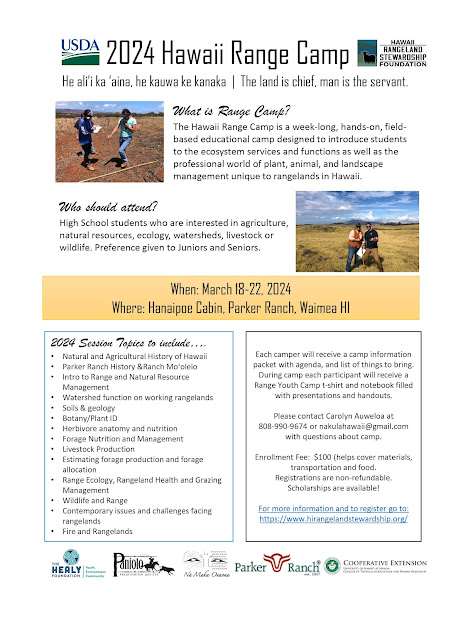
KAʻŪ YOUTH ARE INVITED TO APPLY FOR RANGE CAMP IN WAIMEA.  The Hawai‘i Range Camp is in its inaugural year and will welcome the first cohort of haumāna during Spring Break March 18-22 for a week-long, high-school-aged, environmental education camp focused on rangeland working landscapes. The home base will be Hanaipoe Cabin at Parker Ranch in Waimea.         
    Camp will introduce haumāna to the ecosystem services and functions as well as the professional world of plant, animal, and landscape management unique to rangelands in Hawai‘i. This will be facilitated by presentations and immersive experiences with local experts in scientific disciplines related to rangelands, livestock, wildlife, watersheds, soils, and plants, as well as experienced professionals who are involved in managing resources of these kinds daily.
   The theme for this year's Hawai‘i Range Camp is He aliʻi ka ʻāina, he kauwā ke kanaka - "The land is chief, man is the servant." The goal of this program is to cultivate a relationship with and grow an understanding of and respect for these landscapes that humans occupy and that support communities and ways of life. 
    A statement from the organizers says, "The values of kuleana, pono, and mālama are the seeds that will be sown in these young people that we expect will bear fruit as they find their paths and determine their roles in our future. We hope to inspire them to not only love this place and care deeply for it but also to help them understand our history and the challenges that lie ahead and motivate them to use the gifts and opportunities they have to serve our aliʻi, our ʻāina, well."
    Camp sessions in this yearʻs program include: Natural History of Hawai‘i, Agricultural History of Hawai‘i. Parker Ranch History. Intro to Range and Natural Resource Management, Watershed function on working rangelands, Soils and geology, Climate, Soils and grasslands, Botany/Plant ID, Animal Science: Herbivore anatomy and nutrition, Grass-based livestock production and Forage Nutrition and Management, Estimating forage production and forage allocation, Range Ecology, Rangeland Health and Grazing Management. and Wildlife and Range.
    Nicole Glase will give a presentation and discussion on Contemporary Issues and Challenges Facing Rangelands.
   The entire program is field-based. Haumāna will learn practical skills including estimating available forage, plant identification, and soil texturing.                  Lessons also include digging and exploring a soil pit with application to describing soil horizons and understanding soil development processes and the way geology affects the soils here.
    Participants will learn about the unique anatomy of herbivores and how they interact with landscapes and make the food choices they do. They will also
discuss how grazing animals affect Hawai‘iʻs rangelands, how to recognize indicators of rangeland health and the challenge of balancing forage demand with the landʻs potential. 
     Ma ka hana ka ʻike is the main learning model. Evening sessions will feature talk story sessions with kūpuna and current leaders to discuss Hawai‘iʻs history and events and circumstances and changes that have shaped the ʻāina. The last day will culminate in a capstone project where haumāna will translate the ʻike they have gained from the week into the contemporary language of their peers, aka social media.
     Sponsors include Hawai‘i Range & Stewardship Foundation, the U.S. Department of Agriculture, The Healy Foundation, Paniolo Preservation Society, Na Maka Onaoa, Parker Ranch and University of Hawai‘i Cooperative Extension. 


The Kaʻū Calendar newspaper, 5,000 in the mail. 2,500 on the streets.


See https://apply.mykaleidoscope.com/scholarships/CUHawaiiMorePossibilities2024