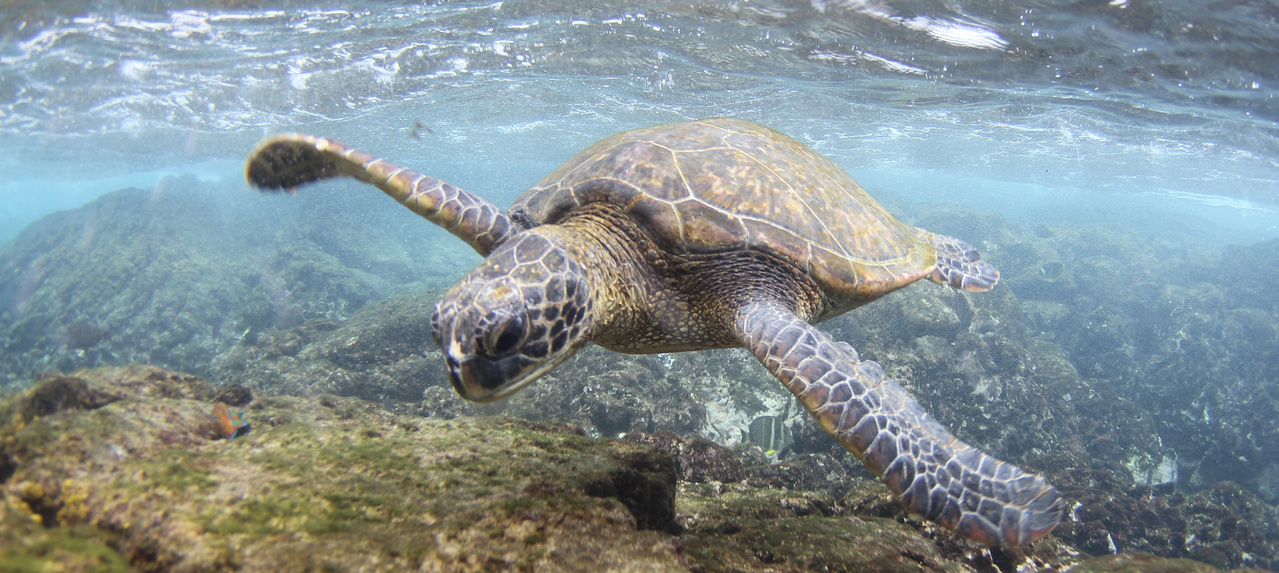
 |
| Green sea turtles got their periodic health checks at Punalu‘u on Friday from long time turtle researcher and conservationist George Balazs, NOAA, University of Hawai‘i Marine Options Program and Mālama Pono Punalu‘u, with federal permits granted. NOAA photo |
GREEN SEA TURTLE EXPERT DR. GEORGE BALAZS CAME TO PUNALU‘U on Friday with University of Hawai‘i Marine Option students, researchers from NOAA and volunteers from Mālama Pono Punalu‘u. They began their mission to give honu- green sea turtles - a health check in a traditional Hawaiian ceremony with chanting and acknowledging the ocean and the honu as they faced the bay.
With permits granted, they entered the waters with snorkeling gear, lifted turtles onto rafts and brought them to shore where they conducted health checks for disease, tumors, blindness. They measured and weighed each turtle and took them back into the bay.
U.H. Hilo's Marine Option Program has assisted NOAA researchers for more than 40 years, with Balazs in the lead for most of those years. Green sea turtles were declared an endangered species and received federal protection in 1973. With NOAA, University of Hawai‘i, state Department of Land & Natural Resources and community organizations, their populations recovered from the time of possible extinction but remain endangered and protected from hunting and harassment. They often bask at Punalu‘u Beach and feed in the offshore waters. They are the largest hard-shelled turtles in the world and can weigh over 300 pounds.
U.H. Hilo's Marine Option Program has assisted NOAA researchers for more than 40 years, with Balazs in the lead for most of those years. Green sea turtles were declared an endangered species and received federal protection in 1973. With NOAA, University of Hawai‘i, state Department of Land & Natural Resources and community organizations, their populations recovered from the time of possible extinction but remain endangered and protected from hunting and harassment. They often bask at Punalu‘u Beach and feed in the offshore waters. They are the largest hard-shelled turtles in the world and can weigh over 300 pounds.
According to Rylee Clark and Ryan Sack who study the history of Turtle Tagging at Punalu‘u, it is one of the longest running studies of Hawaiian green sea turtles. They note that the Hawaiian population is a
subpopulation of Chelonia mydas, genetically distinct from other green sea turtles. This biometric study has been crucial in determining the population's growth rate, habitat preference, and population trend, according to the researchers.
One Marine Options project is a comprehensive history of involvement with this research. It compiles historical documents associated with turtle tagging at Punalu‘u Beach Park, and conducts interviews with key research participants.
Another aims to analyze over 1,200 records of Punalu`u turtle data from 1976-present. It includes statistical analyses on carapace size, mass, presence of tumors, and differences between males and females, and comments made about the turtles when they were observed.
Over the years, Balazs has also been involved the the rescue of two critically endangered female hawksbill turtles that were trapped in the Black Sand Beach pond.
 |
| Kauila, the hawksbill turtle goddess, is legendary at Punalu'u. Painting by Herb Kane |
One Marine Options project is a comprehensive history of involvement with this research. It compiles historical documents associated with turtle tagging at Punalu‘u Beach Park, and conducts interviews with key research participants.
Another aims to analyze over 1,200 records of Punalu`u turtle data from 1976-present. It includes statistical analyses on carapace size, mass, presence of tumors, and differences between males and females, and comments made about the turtles when they were observed.
Over the years, Balazs has also been involved the the rescue of two critically endangered female hawksbill turtles that were trapped in the Black Sand Beach pond.
In addition to its fame for basking green sea turtles, Punalu‘u is the place of the legend of the hawksbill turtle goddess Kauila, depicted in an image by famed artist Herb Kane whose paintings were displayed when a museum was located at Punalu‘u. Hawksbills nest at Punalu‘u almost annually.
Balazs researches and seeks conservation of marine turtles worldwide, through his nonprofit. He served as Hawai‘i Senior Sea Turtle Scientist at NOAA’s Pacific Islands Fisheries Science Center. He says his mission is "Serving Sea Turtles and the Communities Culturally and Biopolitically Bonded to Them."
TESTIMONY CAN BE GIVEN LOCALLY DURING THE PUNALU‘U SPECIAL MANAGEMENT AREA PERMIT PUBLIC HEARING next Thursday, March 7. County Council member Michelle Galimba announced on Friday that access to a Zoom link for public testimony to the Windward Planning Commission on the SMA permit application for a 225-unit development of accommodations plus commercial enterprise at Punualuʻu by Black Sands LLC will be available at Nāʻālehu Community Center on March 7, beginning at 9 a.m.

COUNTY PLANNING DIRECTOR'S REPORT RECOMMENDING APPROVAL OF SPECIAL MANAGEMENT AREA PERMIT FOR BLACK SAND BEACH, LLC explains the purpose of the SMA regulations. This is the second installment of the report by County Planning Director Zendo Kern, issued ahead of the March 7 public hearing regarding approval of an SMA permit for the Black Sand Beach, LLC project:
The purpose of Chapter 205A, Hawaii Revised Statutes ( HRS) and Special Management Area Rules and Regulations of the County of Hawai‘i, is to preserve, protect, and where possible, to restore the natural resources of the coastal zone areas.
Therefore, special controls on development within an area along the shoreline are necessary to avoid the permanent loss of valuable resources and the foreclosure of management options. The objectives and policies of Chapter 205A, HRS include, but are not limited to, the protection of coastal recreational resources, historic resources, scenic and open space resources, coastal ecosystems, marine resources, beaches, and controlling development in coastal hazard areas.


.heic)


.jpg) |
| Volunteers, students and researchers participate in a ceremony of respect for ocean and honu ahead of giving green sea turtles their periodic health check at Punalu‘u Black Sand Beach on Friday. Photo by Ophir Danenberg |
To read comments, add your own, and like this story, see facebook.com/kaucalendar. See latest print edition at kaucalendar.com, in the mail and on stands.
AN EVENT, CALLED KAʻŪ TIME TO SPEAK OUT and a Rally to Stop Big Development at Punalu‘u, has been set by Punalu‘u resident Guy Enriques for Saturday, March 2, from 10 a.m. to noon at Punalu‘u Big Pavillon at the County Park.
According to a flyer for the event, the schedule and topics will be Update on Current Situation at 10 a.m., Speakers at 10:05 a.m., What's Next at 10:10 am. and Sign Waving at visible parts of Punalu‘u from 10:30 a.m. to noon.
Enriques is leader of the Mālama Pono Punalu‘u organization that volunteers to help protect the honu and Punalu‘u Black Sand Beach. Enriques is a former County Councilman and is volleyball coach at Kamehameha School. He grew up at Punalu‘u where his mother, the late Jeanette Howard, started a lei stand in the 1950s. That business run by his extended family remains at Black Sand Beach today.
Enriques recently served as one the mentors for the Hawai‘i Tourism Authority's program to train stewards for Punalu‘u. HTA recently named Punalu‘u as one of two places needing stewardship to protect its resources and to educate visitors. Ten Ka‘ū residents received the training from Ka ‘Ohana O Honu‘apo who brought the trainees to Punalu‘u for a day to meet with Enriques during the four months of training.
 |
| Guy Enriques during hawksbill turtle nesting season at Punalu‘u Black Sand Beach. Photo by Jennifer Johansen |
Enriques is leader of the Mālama Pono Punalu‘u organization that volunteers to help protect the honu and Punalu‘u Black Sand Beach. Enriques is a former County Councilman and is volleyball coach at Kamehameha School. He grew up at Punalu‘u where his mother, the late Jeanette Howard, started a lei stand in the 1950s. That business run by his extended family remains at Black Sand Beach today.
Enriques recently served as one the mentors for the Hawai‘i Tourism Authority's program to train stewards for Punalu‘u. HTA recently named Punalu‘u as one of two places needing stewardship to protect its resources and to educate visitors. Ten Ka‘ū residents received the training from Ka ‘Ohana O Honu‘apo who brought the trainees to Punalu‘u for a day to meet with Enriques during the four months of training.
To read comments, add your own, and like this story, see facebook.com/kaucalendar. See latest print edition at kaucalendar.com, in the mail and on stands.
She said, "This will allow those in the community who do not wish to travel to Hilo for the in-person meeting of the Windward Planning Commission at the County Council Chambers at the County Building and who do not wish to sign up for an individual Zoom link to still provide testimony on the SMA permit application."
Staff from the office of Councilmember Galimba will be at Nāʻālehu Community Center to help community members to provide Zoom testimony to the Commission. The agenda for the Windward Planning Commission meeting is at https://records.hawaiicounty.gov/WebLink/1/edoc/128532/2024-03-07%20Planning%20Commission%20Agenda.pdf.
To read comments, add your own, and like this story, see facebook.com/kaucalendar. See latest print edition at kaucalendar.com, in the mail and on stands.
 |
| The Hawai'i Tourism Authority's stewardship training for Punalu‘u is complete, according to HTA, which named Punalu‘u in need of management and the education of visitors. Photo by Julia Neal |
A RECENT STEWARDSHIP TRAINING FOR PUNALU‘U has been completed and Hawai‘i Tourism Authority released a statement on Thursday. It says:
"Ten Kaʻū community residents were recently celebrated at a hō‘ike in Pāhala for completing Ka‘ū Hoa Pili ‘Āina, a four-month, ‘āina-based education training program as part of the Hawai‘i Tourism Authority’s (HTA) destination management efforts and Hawai‘i Island Community-Based Action Stewardship Program."
“The Ka‘ū community voiced the need to better manage tourism impacts on the natural resources in Punalu‘u through place-based curriculum,” said Mufi Hannemann, HTA Board Chair who spent part of his career working in Pāhala and living in Nāʻālehu. "We thank Ka ‘Ohana O Honu‘apo for facilitating this community effort and the work of these local stewards to ensure the protection and preservation of this special place.”
HTA reports that "Facilitated by the non-profit Ka ‘Ohana o Honu‘apo, a resource stewardship organization based in Nā‘ālehu, the Ka‘ū Hoa Pili ‘Āina program focused on recruiting and training ten local stewards in the practices of mālama ‘āina built on the foundation of cultural practices and protocols, conservation and biological sciences, and place-based messaging about the Ka‘ū area."
Daniel Nāho‘opi‘i, HTA's interim president and CEO, said "It is important to HTA that we continue to listen to our residents and support the collaborative initiatives they want to see within their communities. Mahalo to these stewards for committing themselves to the rigors of the training and the stewardship of their home moku (district), Ka ‘Ohana O Honu‘apo for their leadership
and collaboration, and the many kumu and organizations for providing their mana‘o in this process.”
The statement notes that "HTA is funding the Ka‘ū Hoa Pili ‘Āina program under its destination stewardship and community efforts as guided by its Hawai‘i Island Destination Management Action Plan (DMAP)."
Rachel Kaiama, Island of Hawai‘i Visitors Bureau’s (IHVB) destination manager, said, “This pilot program is a partnership with the community to support place-based, kamaʻāina and visitor education efforts while mitigating user impacts in Punalu‘u and the greater Ka‘ū area.”
The HTA statement said, "As part of the training, Ka ‘Ohana o Honu‘apo worked with 13 other organizations to share information on a wealth of topics, including the Hawai‘i Wildlife Fund, Nā Mamo O Kāwā, Kua‘āina Ulu Auamo (KUA)’s Limu Hui, The Nature Conservancy, Hawai‘i Volcanoes National Park, Kalanihale, Hui Aloha Kīholo, Edith Kanaka‘ole Foundation, Kamehameha Schools, Volcano Rare Plant Facility, Kaulana Mahina, Island CPR and Mālama Pono Punalu‘u.
"Trainees delved into land-use changes, watershed protection, heritage management and coastal restoration projects. They completed CPR and First Aid training and learned communication skills for sharing the importance of pono practices with visitors and kama‘āina.
"In addition to learning species identification and monitoring practices, the trainees took their skills out in the field to conduct ʻopihi monitoring and limu surveys. Other immersive activities included forest and loko i‘a (Hawaiian fish pond) restoration, marine debris removal, community-based management, communication skills building, mo‘olelo sharing and learning about impacts to watersheds.
 "Speaking on behalf of Ka ‘Ohana o Honu‘apo, a representative said the training was not intended to steward one place or one ʻāina, but instead, was a landscape-scale, comprehensive training program for the entire district of Ka‘ū.
“'The trainees learned a great deal about the resources within Kaʻū, plus land-use changes over time, the impacts of climate change, invasive species, etc., and heard from experts in their fields relative to conservation and stewardship,' detailed the Ka ‘Ohana O Honu‘apo representative. 'They also formed collaborations and partnerships with other organizations and community members, which opened up the potential to learn and incorporate stewardship activities not yet happening in Kaʻū.'”
"A potential stewardship opportunity cited was the success of community-based management in Miloliʻi, and how to bring those practices to the Kaʻū coastline. The trainees also studied the impacts of Rapid ʻŌhiʻa Death on Hawai‘i’s forests and ways to mitigate its spread through decontamination strategies and protocols.
"Trainees received a monthly stipend for their participation and were required to attend all instructional events and steward-related opportunities, as well as engage with visitors to effectively communicate pono behaviors and safety protocols. In addition, they participated in a number of volunteer opportunities with multiple groups and organizations in Ka‘ū and South Kona. Trainees hailed from across the Kaʻū District.
The HTA statement reports that "Sharing how the stewardship program has directed her 'to a purposeful life,' trainee Chelsae-Lynn Kobzi said the best part of the program was working with organizations and 'seeing whatʻs available out there as there is so much to do.' She added participation has 'brought me purpose, confidence and a whole new perspective.'
"With a deeper connection to their ‘āina, the newly launched group of stewards can seek to reconnect with the different organizations and individuals they worked with during the training to remain involved in efforts to help mālama ‘āina. This can be done on a volunteer basis or through employment opportunities.
"Looking to the future, Kaiama said the idea for the training program is to show how community stewardship training and implementation can be done and then hope for more like it to be self-sustained or partially supported by state and county agencies.
“'It would be ideal for community-based steward programs to foster the economic job diversification we need as these volunteers and others like them can benefit from well-paying jobs that uplift their community while protecting the natural and cultural resources of the island,' added Kaiama. 'This is the regenerative tourism model we would like to see more of.'
Funded and supported by HTA and administered by IHVB, the Hawai‘i Island Community-Based Action Stewardship Program "builds on the success of other community-based programs around the state including at Hanauma Bay State Park, Hā‘ena State Park and Lē‘ahi (Diamond Head State Monument)," says the HTA statement.
To learn more about how destination management and stewardship is advancing on the island of Hawai‘i, visit: https://holomua.hawaiitourismauthority.org/hawaii-island/.
 |
| “The Ka‘ū community voiced the need to better manage tourism impacts on the natural resources in Punalu‘u," said HTA Chair Mufi Hannemann |
HTA reports that "Facilitated by the non-profit Ka ‘Ohana o Honu‘apo, a resource stewardship organization based in Nā‘ālehu, the Ka‘ū Hoa Pili ‘Āina program focused on recruiting and training ten local stewards in the practices of mālama ‘āina built on the foundation of cultural practices and protocols, conservation and biological sciences, and place-based messaging about the Ka‘ū area."
Daniel Nāho‘opi‘i, HTA's interim president and CEO, said "It is important to HTA that we continue to listen to our residents and support the collaborative initiatives they want to see within their communities. Mahalo to these stewards for committing themselves to the rigors of the training and the stewardship of their home moku (district), Ka ‘Ohana O Honu‘apo for their leadership
 |
| “This pilot program is a partnership with the community to support place-based, kamaʻāina and visitor education efforts while mitigating user impacts in Punalu‘u and the greater Ka‘ū area,” said Destination Manager Rachel Kaiama. |
The statement notes that "HTA is funding the Ka‘ū Hoa Pili ‘Āina program under its destination stewardship and community efforts as guided by its Hawai‘i Island Destination Management Action Plan (DMAP)."
Rachel Kaiama, Island of Hawai‘i Visitors Bureau’s (IHVB) destination manager, said, “This pilot program is a partnership with the community to support place-based, kamaʻāina and visitor education efforts while mitigating user impacts in Punalu‘u and the greater Ka‘ū area.”
The HTA statement said, "As part of the training, Ka ‘Ohana o Honu‘apo worked with 13 other organizations to share information on a wealth of topics, including the Hawai‘i Wildlife Fund, Nā Mamo O Kāwā, Kua‘āina Ulu Auamo (KUA)’s Limu Hui, The Nature Conservancy, Hawai‘i Volcanoes National Park, Kalanihale, Hui Aloha Kīholo, Edith Kanaka‘ole Foundation, Kamehameha Schools, Volcano Rare Plant Facility, Kaulana Mahina, Island CPR and Mālama Pono Punalu‘u.
"Trainees delved into land-use changes, watershed protection, heritage management and coastal restoration projects. They completed CPR and First Aid training and learned communication skills for sharing the importance of pono practices with visitors and kama‘āina.
"In addition to learning species identification and monitoring practices, the trainees took their skills out in the field to conduct ʻopihi monitoring and limu surveys. Other immersive activities included forest and loko i‘a (Hawaiian fish pond) restoration, marine debris removal, community-based management, communication skills building, mo‘olelo sharing and learning about impacts to watersheds.

“'The trainees learned a great deal about the resources within Kaʻū, plus land-use changes over time, the impacts of climate change, invasive species, etc., and heard from experts in their fields relative to conservation and stewardship,' detailed the Ka ‘Ohana O Honu‘apo representative. 'They also formed collaborations and partnerships with other organizations and community members, which opened up the potential to learn and incorporate stewardship activities not yet happening in Kaʻū.'”
"A potential stewardship opportunity cited was the success of community-based management in Miloliʻi, and how to bring those practices to the Kaʻū coastline. The trainees also studied the impacts of Rapid ʻŌhiʻa Death on Hawai‘i’s forests and ways to mitigate its spread through decontamination strategies and protocols.
"Trainees received a monthly stipend for their participation and were required to attend all instructional events and steward-related opportunities, as well as engage with visitors to effectively communicate pono behaviors and safety protocols. In addition, they participated in a number of volunteer opportunities with multiple groups and organizations in Ka‘ū and South Kona. Trainees hailed from across the Kaʻū District.
The HTA statement reports that "Sharing how the stewardship program has directed her 'to a purposeful life,' trainee Chelsae-Lynn Kobzi said the best part of the program was working with organizations and 'seeing whatʻs available out there as there is so much to do.' She added participation has 'brought me purpose, confidence and a whole new perspective.'
 |
| Ho‘ike for completion of the recent HTA stewardship training. Photo by Julia Neal |
"Looking to the future, Kaiama said the idea for the training program is to show how community stewardship training and implementation can be done and then hope for more like it to be self-sustained or partially supported by state and county agencies.
“'It would be ideal for community-based steward programs to foster the economic job diversification we need as these volunteers and others like them can benefit from well-paying jobs that uplift their community while protecting the natural and cultural resources of the island,' added Kaiama. 'This is the regenerative tourism model we would like to see more of.'
Funded and supported by HTA and administered by IHVB, the Hawai‘i Island Community-Based Action Stewardship Program "builds on the success of other community-based programs around the state including at Hanauma Bay State Park, Hā‘ena State Park and Lē‘ahi (Diamond Head State Monument)," says the HTA statement.
To learn more about how destination management and stewardship is advancing on the island of Hawai‘i, visit: https://holomua.hawaiitourismauthority.org/hawaii-island/.
To read comments, add your own, and like this story, see facebook.com/kaucalendar. See latest print edition at kaucalendar.com, in the mail and on stands.

BLACK SAND BEACH, LLC PROVIDED IMAGES OF REPAIRS AND CLEANUP it has accomplished at Punalu‘u. Project Director Norman Quon said on Friday that the Black Sands team is all in with joining the community to clean up and plan for managing the traffic at the beach. He pointed to the restoration of parking away from the beach, the cleaning up of hazards at abandoned buildings, the blocking of parking along the road to the beach, repair of a walking bridge for pedestrians and overall increased landscape management.
The presentation of photos of the work includes a support statement for Black Sand Beach, LLC's proposal before the county's Windward Planning Commission for a Special Management Area permit. The project would include construction of 225 accommodations, rebuilding the old golf course clubhouse, restoring the golf course, building a wellness center, and putting a market and restaurant near the Black Sand Beach. It would also include planning for coastal preservation and public access.
To read comments, add your own, and like this story, see facebook.com/kaucalendar. See latest print edition at kaucalendar.com, in the mail and on stands.
 |
| The Planning Director's review points to an EIS and its Cultural Impact Assessment from 2006, as well as an updated Cultural Assessment by Black Sands, LLC. The old EIS can be read at https://files.hawaii.gov/dbedt/erp/EA_EIS_Library/2006-10-08-HA-DEIS-Sea-Mountain-Punaluu.pdf |
The purpose of Chapter 205A, Hawaii Revised Statutes ( HRS) and Special Management Area Rules and Regulations of the County of Hawai‘i, is to preserve, protect, and where possible, to restore the natural resources of the coastal zone areas.
Therefore, special controls on development within an area along the shoreline are necessary to avoid the permanent loss of valuable resources and the foreclosure of management options. The objectives and policies of Chapter 205A, HRS include, but are not limited to, the protection of coastal recreational resources, historic resources, scenic and open space resources, coastal ecosystems, marine resources, beaches, and controlling development in coastal hazard areas.
Coastal Recreational Resources: All proposed improvements will occur on State Land Use ( SLU) Urban designated lands, and no improvements are proposed within the entire shoreline frontage of the project site that is within the SLU Conservation District.
Portion of the shoreline frontage of the project site managed by the County as part of the Black Sand Beach Park complex of which facility and ground maintenance is conducted by the County Parks and Recreation Department. There are numerous coastal recreational resources that are currently enjoyed by community members and visitors to the area. The beach park allows for camping, fishing, hiking, and includes pavilions for gathering and other recreational uses. The black sand beach is heavily used by visitors and the community for fishing, and beach- type activities. Access to the shoreline is via the county beach park, and the black sand beach area. Lateral shoreline access ( access along the shoreline) is open and accessible from many points along the shoreline of the project area. Staff visited the site and were able to traverse the entire shoreline from the most northern end of black sand beach south towards to the Beach Park and beyond. The proposed coastal reserve area will also provide additional cultural and recreational access and will preserve this area of the shoreline for the future. The proposed project will not interfere with the current level of shoreline access in this area, however, the increase in development will ultimately bring more visitors to the shoreline. In order to
mitigate the increased foot traffic and visitors to the coastal area the applicant will work to improve the existing infrastructure to accommodate the increase in visitors, as well as providing consistent resource management which has been severely lacking over the past 2 decades.
Portion of the shoreline frontage of the project site managed by the County as part of the Black Sand Beach Park complex of which facility and ground maintenance is conducted by the County Parks and Recreation Department. There are numerous coastal recreational resources that are currently enjoyed by community members and visitors to the area. The beach park allows for camping, fishing, hiking, and includes pavilions for gathering and other recreational uses. The black sand beach is heavily used by visitors and the community for fishing, and beach- type activities. Access to the shoreline is via the county beach park, and the black sand beach area. Lateral shoreline access ( access along the shoreline) is open and accessible from many points along the shoreline of the project area. Staff visited the site and were able to traverse the entire shoreline from the most northern end of black sand beach south towards to the Beach Park and beyond. The proposed coastal reserve area will also provide additional cultural and recreational access and will preserve this area of the shoreline for the future. The proposed project will not interfere with the current level of shoreline access in this area, however, the increase in development will ultimately bring more visitors to the shoreline. In order to
.HEIC) |
| Punalu'u Black Sand Beach. Photo by Ophir Danenberg |
The applicant has already begun improving the parking area that provides access to the Black Sand Beach area, minimizing the current parking scheme which allows vehicles to park next to the pond and on the sandy beach. Based on the proposed development being outside the shoreline area, as well as the dedication of the coastal preservation site, and the improvements to existing infrastructure ( i. e., parking), the Planning Department believes the impacts to coastal resources can be mitigated. Additionally, having one entity ( landowner) that has the ability to holistically manage the entire project site where no management has been occurring is an improvement. The applicant will also be required to address, via study, the proposed projects potential impacts on coastal, cultural, and water quality via the submission of a Water Quality and Marine Life Monitoring and Management plan, Pond management plan, Cultural Resources Management plan, and a Shoreline Management Plan all to be approved by the Planning Dept. prior to development to further enshrine the conservation of the areas resources. Based on our review, the proposed projects potential impacts to the coastline or other areas utilized for public recreational activities at the shoreline will be mitigated, and therefore will not impede or hinder the public's ability to access the shoreline.
Historic and Cultural Resources: The extensive project area includes cultural remains, such as a heiau, burial sites and habitation sites, and natural resources such as ponds, black sand beach, viewplanes, and the rugged Ka‘ū coastline — all of which are considered significant cultural and historic resources. While there are numerous sites throughout the area, the project has been designed to not impact lands where known cultural sites or features have been identified by the cultural and archeological assessments conducted for this application.
Historic and Cultural Resources: The extensive project area includes cultural remains, such as a heiau, burial sites and habitation sites, and natural resources such as ponds, black sand beach, viewplanes, and the rugged Ka‘ū coastline — all of which are considered significant cultural and historic resources. While there are numerous sites throughout the area, the project has been designed to not impact lands where known cultural sites or features have been identified by the cultural and archeological assessments conducted for this application.
Staff notes that based on information provided, the majority of the new development will occur in areas previously disturbed by past land use activities including extensive grading which occurred in this area in the 1960s- 1970' s (prior to SMA law). The 2006 Cultural Impact Assessment (CIA) and the subsequent updated CIA in 2023 identified important cultural site and practices within the project site, which include: stone cultural remains (e.g., heiau, ahu, caves, mounds, enclosures), petroglyphs and trail segments, a fishpond, marine resources important to native Hawaiians, and the black sand beach. Additionally, since 1969 the project area has been extensively developed, which included significant grading and grubbing of the landscape to create the golf course.
Several cultural resources were identified in archival literature, archaeological surveys, and interviews conducted for ethnographic study and included in the updated CIA. The sites identified include heiau and ko‘a shrines, burial sites, a historic cemetery associated with a historic church, petroglyph areas, and other storied places. Other cultural resources for this community include the gathering of plants such as coconut, kukui, noni, ti pants, hau, hala, various medicinal plants, lei flowers, and seeds that are found throughout the project area.
.jpg) |
| Planning Director Zendo Kern writes that one of the most significant cultural resources of Punalu‘u is the ocean, bays, coves and rugged Kaʻū Coast and that Punalu‘u is the only viable, accessible beach for residents from Pāhala to Nāʻālehu. Photo by Ophir Danenberg |
One of the most significant cultural resources of the Punalu' u area is the ocean, bays, coves, and coastal areas within the project area as well as beyond the project site boundaries. From the Volcano area to South Point, Punalu`u is the only viable/ accessible beach for the residents from Pahala to Na`alehu and as such maintaining continued access to the beach, ocean, and coastal area is important to this region.
As stated in the 2006 CIA, the entire Punalu`u area (Punalu`u, Ninole, Hama, Wailau and Hilea) still has an abundance of cultural resources in spite of prior plantation and resort activities simply because the people of this area continue to practice these cultural traditions. Despite the vegetation overgrowth and dilapidated former resort structures, the area continues to be utilized by locals and visitors alike.
As stated in the 2006 CIA, the entire Punalu`u area (Punalu`u, Ninole, Hama, Wailau and Hilea) still has an abundance of cultural resources in spite of prior plantation and resort activities simply because the people of this area continue to practice these cultural traditions. Despite the vegetation overgrowth and dilapidated former resort structures, the area continues to be utilized by locals and visitors alike.
The proposed development will likely impact some cultural resources during and after construction, such as sub-surface structures, midden, artifacts, or unmarked reburials. This could be mitigated with a cultural monitor and archaeologist present for any subsurface activity as well as surface activity. Preservation and Burial Treatment plans are recommended to properly care for identified archaeological features recommended for preservation. In addition, the CIA Update recommended that mitigation should include a walk-through of kupuna/cultural practitioners, Kuleana landowners, the archaeologist, and the development planners to record all the burial areas that are not recorded in the archaeology report or SMA application.
An advisory group made up of primarily kupuna knowledgeable of the area, Kuleana owners and other Punalu`u landowners, could be formed to advise planners of cultural protocol, sensitive areas, and cultural resources burials, medicine, food and craft plants, and other cultural resources). Before any future construction is started an additional Burial Treatment Plan for inadvertent burials or reburials is recommended that includes cultural protocols (i.e. re-wrapping ` iwi kupuna, ceremony, etc.) as well as State and County regulations. Any construction ground activity will include the requirement to have a cultural and archeological monitor on- site during all ground disturbing activities.
To read comments, add your own, and like this story, see facebook.com/kaucalendar. See latest print edition at kaucalendar.com, in the mail and on stands.

APPLYING FOR HEAD AND ASSISTANCE FOOTBALL COACHING POSITIONS through Kaʻū High School Athletic Department has been extended through Thursday, March 28 at noon. Applications can be picked up at the Kaʻū High & Pāhala Elementary School office. Completed applications can be dropped off to the school office or to the Athletic Director's office. For more information or questions, call Athletic Director Jaime Guerpo at (808)313-4161 or (808)289-3472.


.heic)


%20(1).jpg)


