About The Kaʻū Calendar

Thursday, June 06, 2024

Kaʻū News Briefs June 6, 2024

Thin pahoehoe lava from the 12 eruption this week. USGS photo

THE VOLCANIC ERUPTION THIS WEEK WILL LIKELY NOT RESTART, according to USGS Hawaiian Volcano Observatory. HVO reported on Thursday that there is tremor, degassing and incandescence involving the fissure vents in the Kīlauea Southwest Rift Zone. However, the activity has decreased since the 12 hour eruption on June 3, "making it unlikely that this eruption will restart. Volcanic gas emissions at the eruption site remain above background levels. Overall seismicity in the summit region including the eruption area remains low. Inflationary ground deformation of the summit continues. Although the eruption has paused, additional pulses of seismicity and deformation could result in new eruptive episodes within the area or elsewhere on the Southwest Rift Zone." The degassing has brought vog across Kaʻū and a decrease in air quality.

To read comments, add your own, and like this story, see facebook.com/kaucalendar. See upcoming events, print edition and archive at kaunews.com. Support this news service with advertising at kaunews.com. 7,500 copies in the mail and on stands.

Four periods of earthquake activity showing two distinct clusters. USGS images
TWO DISTINCT CLUSTERS OF EARTHQUAKES shook Kīlauea during four recent time periods of swarm activity, as shown by USGS Hawaiian Volcano Observatory's illustration released on Thursday. "The event counts at the south caldera cluster increase while the counts at the upper East Rift Zone cluster diminish from the first to the fourth time periods," from April 217 to the eruption on June 3, reports USGS.

To read comments, add your own, and like this story, see facebook.com/kaucalendar. See upcoming events, print edition and archive at kaunews.com. Support this news service with advertising at kaunews.com. 7,500 copies in the mail and on stands.

KEEPING. UP WITH KILAUEA is the title of this week's Volcano Watch, a weekly article and activity update written by U.S. Geological Survey Hawaiian Volcano Observatory scientists and affiliates. The following article was written by Research Corporation of the University of Hawai'i seismic analyst Maddie Hawk:
    Kīlauea began erupting from fissures southwest of Kaluapele (the summit caldera) just after midnight on June 3; the eruption ceased just nine hours later, though lava flows continued to slowly spread for several more hours. Prior to the brief eruption, the USGS Hawaiian Volcano Observatory (HVO) had been monitoring pulses of heightened seismic activity in the summit area for weeks.
    How did these earthquakes give us insight into the features of the molten magma below and the eruption that was to come?
    Earthquakes result from the breaking of cooler, brittle rock. As magma moves into an area, it forces the surrounding rock to bend and then break. This brittle rock "failure" is what seismologists at HVO see daily on live data streams as earthquakes. The locations of earthquakes can outline magma chambers, indicate fault movement, or show where magma is moving into new area. At Kīlauea, earthquake swarms paired with changes in ground motion as seen on tiltmeters give HVO scientists an idea of the pressurization of magma chambers beneath the surface.
    The proposed magma plumbing system at Kīlauea is divided into three main chambers: the Halemaʻumaʻu reservoir, the south caldera reservoir, and the Keanakākoʻi reservoir. In the weeks leading up to Monday's eruption, there were three distinct periods of heightened unrest. From April 27–May 3, May 6–9, and May 17–18, two distinct clusters of earthquakes occurred in the south caldera and the upper East Rift Zone (see box 3 in Figure 1).
    During these swarms, earthquake locations often switched between the south caldera cluster and the upper East Rift Zone cluster as magma pressure levels fluctuated within the different storage regions. The event counts at the south caldera cluster increase while the counts at the upper east rift cluster diminish as the system moved closer to eruption. Rates of ground tilt, measured by summit tiltmeters would also increase during the earthquake swarms, indicating an increased pulse of magma was accumulating beneath the surface.
    Although the earthquakes occurred in distinct clusters, they could have happened in response to the stresses created by magma chambers located nearby. For this reason, there were several possibilities scenarios. First, magma accumulation could stop, and no eruption would occur. Magma accumulation could continue with an eruption in Kaluapele or magma could migrate to the southwest with either an intrusion (similar to last January) or eruption.
    As we now know, magma did indeed migrate to the southwest and this time it erupted.

Aerial image of the Southwest Rift Zone eruption of Kīlauea, viewed during an overflight at approximately 6 a.m. on June 3, 2024. USGS image

    Just after noon on Sunday, June 2, earthquakes increased again beneath the south caldera region and intensified quickly, prompting HVO to raise the alert level and aviation color code for Kīlauea at 5:30 p.m. HST.
    For twelve hours, earthquakes of up to M4.1 shook the summit region until 12:30 a.m. Monday morning, when a fissure opened about 1 mile (2 km) southwest of the caldera. The eruption happened in
the vicinity of ground cracks that formed in the late January intrusion.
    Past eruptions in this area—in 1971 and 1974—have been brief, so it was no surprise when the fissure stopped erupting nine hours after the eruption began. Fortunately, the short-lived eruption occurred within a closed area of Hawaiʻi Volcanoes National Park; it did no damage to infrastructure. This was the first eruption in this area of Kīlauea in 50 years, and the first eruption outside of Kaluapele since 2018. Only 
about 100 acres were covered with new lava, compared to over 500 during the September 2023 eruption within Kaluapele.
    While lava has stopped moving on the surface of Kīlauea, volcanic gas emissions remain elevated and activity beneath the surface remains dynamic. HVO scientists will continue to closely monitor for signs of change.

Volcano Activity Updates
    Kīlauea is not erupting. Its USGS Volcano Alert level is ADVISORY.
    Kīlauea erupted briefly on Monday, June 3, southwest of Kaluapele (Kīlauea caldera) within the closed area of Hawai'i Volcanoes National Park. Tremor and incandescence associated with the fissure vents are still present but have decreased significantly since June 3. Sulfur dioxide emission rates remain elevated in the upper Southwest Rift Zone eruption area; an emission rate of 400 tonnes per day was measured today, June 6, for the combined areas of Kīlauea summit and the recent eruption. Overall seismicity in the summit region including the eruption area remains low, although inflationary ground deformation of the summit continues. Additional pulses of seismicity and deformation could result in new eruptive episodes within the area or elsewhere on the Southwest Rift Zone.
    Mauna Loa is not erupting. Its USGS Volcano Alert Level is at NORMAL.
    Webcams show no signs of activity on Mauna Loa. Summit seismicity has remained at low levels over the past month. Ground deformation indicates continuing slow inflation as magma replenishes the reservoir system following the 2022 eruption. SO2 emission rates are at background levels.
    Nine earthquakes were reported felt in the Hawaiian Islands during the past week: a M3.5 earthquake 4 km (2 mi) S of Pāhala at 30 km (18 mi) depth on June 5 at 4:18 a.m. HST, a M3.1 earthquake 3 km (1 mi) SSW of Pāhala at 31 km (19 mi) depth on June 3 at 7:01 a.m. HST, a M4.1 earthquake 7 km (4 mi) SSW of Volcano at 0 km (0 mi) depth on June 2 at 9:12 p.m. HST, a M3.2 earthquake 7 km (4 mi) SW of Volcano at 1 km (1 mi) depth on June 2 at 7:38 p.m. HST, a M4.0 earthquake 7 km (4 mi) SSW of Volcano at 0 km (0 mi) depth on June 2 at 7:06 p.m. HST, a M3.1 earthquake 7 km (4 mi) SSW of Volcano at 0 km (0 mi) depth on June 2 at 6:15 p.m. HST, a M3.4 earthquake 7 km (4 mi) SW of Volcano at 1 km (1 mi) depth on June 2 at 5:15 p.m. HST, a M3.1 earthquake 8 km (4 mi) SW of Volcano at 1 km (0 mi) depth on June 2, 2024 at 4:58 p.m. HST, and a M3.4 earthquake 12 km (7 mi) S of Waikoloa at 35 km (22 mi) depth on June 1 at 7:16 p.m. HST.
    HVO continues to closely monitor Kīlauea and Mauna Loa.


Wednesday, June 05, 2024

Kaʻū News Briefs June 5, 2024

Matt Baker and Vance Bjorn, of Silicon Valley Coffee, hear the history of R&G Coffee and the evolution of Kaʻū Coffee after sugar plantation days, as they visit with Bong Aquino, who farms 27 acres, mostly by himself. Photo by Julia Neal

KA'U COFFEE FARMS OPENED UP TO VISITORS ON WEDNESDAY, with growers sharing their stories of creating their successful enterprises and coming from many different backgrounds. Bong Aquino came out of agriculture in Kaʻū and remembered the days of the sugar plantation shutting down. He and
The Kudos on the former Bull Kailiawa
farm in Cloud Rest. Photo by Julia Neal
Gloria Camba created R&G Farms and Aquino takes care of their 27 acres, mostly by himself, hiring help for picking and some pruning. He told visitors that he has a good life working on the quiet farm in Pear Tree, with the extraordinary mountain and ocean views, among rows of Norfolk pines, banana and palm trees. 
    He said he has rejected offers to sell his Ka'u Coffee
 to Kona and wants to protect the Kaʻū Coffee brand.
     Kaʻū Coffee grower Ray Kudo talked about growing up in Pahala and leaving for a long time to build a career as an executive with ABC stores. He and his wife Norma both worked there, with Ray running the stores in Kona and the Island of Kaua'i. After their retirement, they couldn't keep still and decided to shift to an entire new way of life. They bought the former farm of the late Kaʻū Coffee grower Bull Kailiawa and built a small house on the property. Their acreage at Cloud Rest sits under the mountain peak. They said they love the peace and quiet and enjoy the steady work maintaining their farm.
    They also own a condo on Ali'i Drive in Kona but say that 90 percent of their time is spent in the quiet countryside where they grow not only coffee but a good deal of fresh vegetables for themselves and their friends. Ray Kudo's daughter recently graduated from Harvard University.


Pops from A Farm along the old sugar cane road between Pahala and  Na'alehu visits other Kaʻū Coffee farms to celebrate 
their success during Kaʻū Coffee Festival Week. Photo by Julia Neal


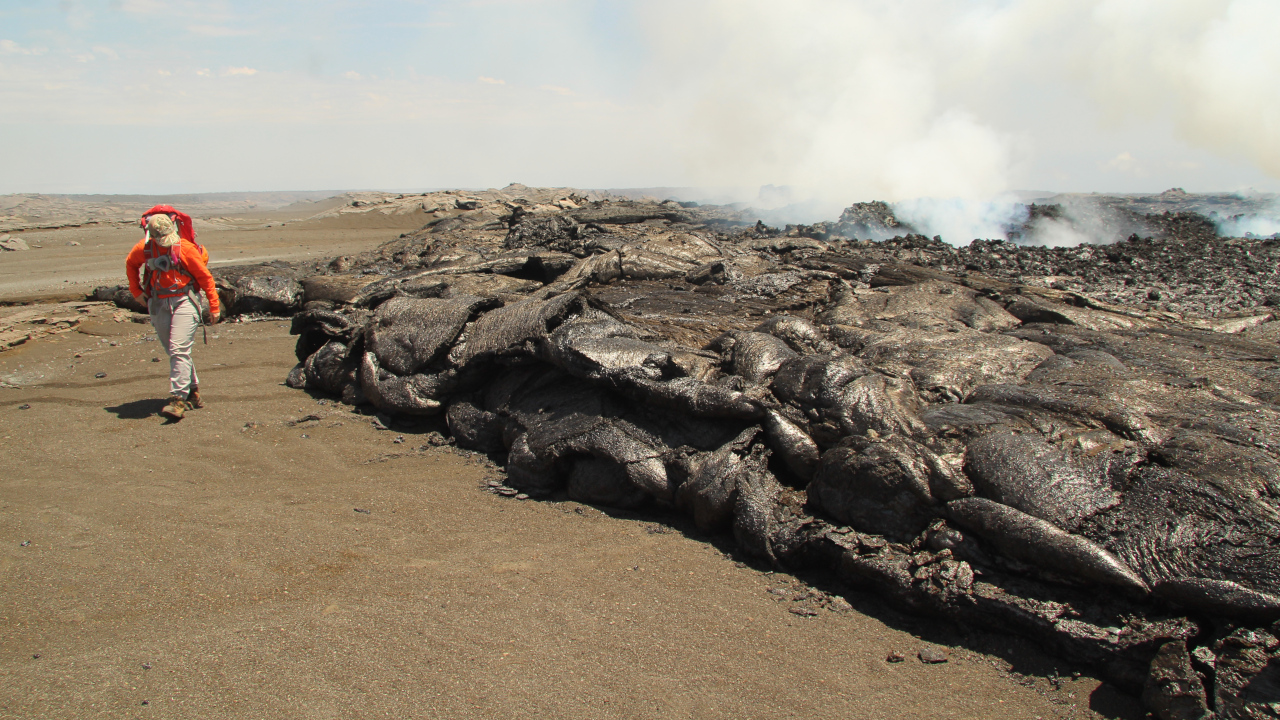
THE SOUTHWEST RIFT ZONE ERUPTION REMAINED PAUSED ON WEDNESDAY. On Tuesday, Hawaiian Volcano Observatory geologists visited the area to take measurements of the previous day's lava flows. They examined part of the lava flow from fissure 2. Note that none of the lava flow is as tall as the geologist; similar to the December 1974 eruption from the same area on Kīlauea, the eruption of June 3 produced extremely thin Pāhoehoe flows. This contrasts with other recent eruptions like that at Pu‘u‘ō‘ō on Kīlauea's East Rift Zone between 1983 and 2018, where Pāhoehoe flows sometimes inflated to tens of meters in thickness. M. Zoeller of USGS Hawaiian Volcano Observatory took this photo.


KA'U DESERT REMAINS CLOSED TO VISITORS FOLLOWING THIS WEEK'S VOLCANIC ERUPTION. Hawai'i Volcanoes National Park reported Wednesday that Kaʻaha has reopened and is accessible by Puna Coast Trail.
    Kaʻū Desert area remains temporarily closed due to volcanic gases from Kīlauea that are hazardous to everyone. Closures include Kaʻū Desert, Footprints, Hilina Pali Road, Kulanaokuaiki Campground, Pepeiao Cabin and Maunaiki Trail.
    Although the eruption that started Monday is over for now, the vent is still glowing and degassing. The eruption covered about 88 acres in this remote area, located 2.5 miles southwest of Kīlauea caldera. Steady plumes of gas were seen Wednesday morning, wafting upward and downwind of the fissures.
     According to USGS, unrest remains high. Tremor is still present, glow could still be seen from the fissures over Tuesday night, with active degassing of SO2 (sulfur dioxide) still occurring. Changes in the character and location of unrest can occur quickly, as can the potential for the eruption to restart at the same fissures or in a new area, reported Hawai'i Volcanoes National Park.

Plumes of volcanic gas are expelled from a vent and drift skyward and laterally along a ground fissure. Image taken
 from Uēkahuna overlook west. NPS Photo by S. Stucker


Tuesday, June 04, 2024

Kaʻū News Briefs June 4, 2024

Visit Ka'u Coffee farms on Wednesday from 10 a.m. to 5 p.m., an event of Kaʻū Coffee Festival Week. See map and list of  farms
at www.kaucoffeefestival.com. Photo from Kaʻū Coffee Festival

SEVENTEEN KAʻŪ COFFEE FARMS will be open for visitors tomorrow, Wednesday from 10 a.m. to 5 p.m. during Ka'ū Coffee Festival Week.
    Ka'ū Coffee Farms at Cloud Rest to be open are those belonging to the following growers: Kudo, Norberte, Artizabal, Marques, Koi, and Miranda.
    Ka'ū Coffee Farms at Pear Tree to be open are those belonging to the following growers: A Farm, Ramos, Lazaro, Val Ramos, Hernandez, Ancheta, Tabios, Gascon, Melchor, and R&G Farms.
    The Ka'ū Coffee Farm at Wood Valley to be open is Silver Cloud and Kaʻū Coffee Mill.
   Here is the link to the map showing the lists and locations of all the farms - https://www.kaucoffeefestival.com/.../7c518f...

Meet the farmers, explore the Kaʻū Coffee farms on Wednesday from 10 a.m.  to 5 p.m. at Moa'ula, Pear Tree and Wood Valley above Pahala. See the map for farm locations at www.kaucoffeefestival.com.
Photo from Kaʻū Coffee Festival

KAʻŪ COFFEE FESTIVAL RECIPE WINNERS ARE ANNOUNCED. The Recipe Contest at Ka'ū Coffee Mill on Saturday was the kickoff event of Kaʻū Coffee Festival Week.
    In the Pupu Category, Patty Fujimoto came in first with her Tita Taquitos with Aikane Coffee, Braised
Kaʻū Coffee Mill hosted Kaʻū Coffee Recipe Contest on 
Saturday, with entries in Pupu, Entree and Dessert.
Photo by Julia Neal

Kuahiwi Beef. Second was Kristen Davis with her Goat Cheese with Ka'ū Coffee Lehua Honey. Third was Zane Monteleone with his Burrata Salad with Ka'ū Coffee Balsamic Reduction.
    In the Entree Category first was Keone Grace with this Ka'ū Coffee Blackened Opakapaka. Second was Zane Monteleone with his Maui Nui Venison Pastrmi Dip with Ka'ū Coffee Au Jus. Third was Paul Eddy with his Roasted Ka'ū Coffee Chicken.
    In the Dessert Category, Patty Fujimoto won with her Ka'ū Coffee Layer Cake.
    Brittany Zagoria was second with her Ka'ū Coffee Sponge in a Chocolate Bowl. Third was Cosette Paseka with her Ka'ū Coffee Cupcakes with Ka'ū Coffee Cayenne Candied Bacon.
    The judges were Carl Okuyama of 'Ohana Foods, and Ruyanne Manuel and Tyler Hess of Kaʻū Coffee Mill.

To read comments, add your own, and like this story, see facebook.com/kaucalendar. See upcoming events, print edition and archive at kaunews.com. Support this news service with advertising at kaunews.com. 7,500 copies in the mail and on stands.

KAI KAHELE IS RUNNING FOR OFFICE OF HAWAIIAN AFFAIRS TRUSTEESHIP. Kahele has roots in Miloli'i, his late father Gil Kahele also having served this area in public office. Kai Kahele represented Kaʻū and beyond as a state Senator and also as a Congressman.
    Kaialiʻi Kahele officially announced his candidacy for the OHA Trustee on Saturday in Hilo. He would become the OHA Trustee for this island, Moku ʻO Keawe.
    Kahele described his vision for a more equitable and just Hawaiʻi, reaffirming his commitment to serving the Native Hawaiian community. His candidacy comes with a formal endorsement from current Hawaiʻi Island OHA Trustee Mililani Trask.
    Kahele said, "It has been just over two years since I last stood before you here in Hilo, sharing a
heartfelt vision for a different Hawaiʻi, a Hawaiʻi that does not yet exist. A Hawaiʻi not owned and controlled by the few wealthy enough to afford it, but rather stewarded by the many who choose to mālama it."
    Kahele reflected on his journey over the past two years, which included service in the Hawaiʻi Air National Guard, his professional career as a pilot with Hawaiian Airlines, and his role as a faculty member at UH Hilo. Beyond his focus on personal and professional endeavors, Kahele said he retains a deep-seated desire to return to public service.
    "Recently, Office of Hawaiian Affairs Trustee Mililani Trask informed me that she was not seeking reelection to OHA. After several conversations, Trustee Trask asked me to run for her seat, pledging her support for my candidacy," Kahele stated. "After much thought and discussion with my wife Maria, my ʻohana, and those closest to me, it became clear that when our kūpuna and community leaders ask us to serve, we don't hesitate – we just do it."
    Kahele said that Trask has served as an OHA Trustee with dedication and commitment. She formally endorsed Kahele, highlighting his qualifications and vision for the future of OHA.
    "I am proud to endorse Kai Kahele for the position of OHA Trustee representing Moku ʻO Keawe," said Trask. "Kai brings a wealth of experience, a deep understanding of our community's needs, and a proven
Social Justice advocate and attorney Mliliani Trask endorses Kai Kahele
for Office of Hawaiian Affairs Trustee. Photo from Kahele for Hawai'i
track record of advocating for Native Hawaiians. His leadership, vision, and unwavering commitment to our people make him the ideal candidate to continue the important work of OHA. I have full confidence that Kai will serve our community with integrity, transparency, and a steadfast dedication to improving the lives of Native Hawaiians."
    Kahele emphasized his belief in OHA's potential to significantly improve the lives of Native Hawaiians. He acknowledged the organization's past challenges but expressed confidence in its future under strong leadership.
    "To me and many other Native Hawaiians, OHA has never fully realized its potential as a Hawaiian institution with the constitutional autonomy to truly serve our people," Kahele noted. "But despite its shortcomings, I truly believe OHA is the institution with the greatest potential to make a difference in the lives of Native Hawaiians."
    Kahele highlighted experience and relationships at both state and federal levels, saying they uniquely qualify him to serve as an OHA Trustee. He also contiued his commitment to not ask for campaign donations, instead urging supporters to donate to families affected by the Lahaina fires through ʻĀina Momona.
    "This campaign will not dial for dollars, flood your emails asking for money, fill your mailbox with flyers, solicit, or host a single fundraiser. Instead, if you feel compelled to give, rather than giving to this campaign, please consider donating to a family from Lahaina," said Kahele.
Kahele called for unity and collective action to build a better future for Hawaiʻi. "Together, we can build a Hawaiʻi where our people thrive - one that is more equitable and just, where our culture flourishes, where all Native Hawaiians can succeed, and where our future is secured for generations to come."
For more information on Kahele's candidacy and his vision for OHA, visit kaikahele.com.

To read comments, add your own, and like this story, see facebook.com/kaucalendar. See upcoming events, print edition and archive at kaunews.com. Support this news service with advertising at kaunews.com. 7,500 copies in the mail and on stands.

Vog rolled across Ka'u on Tuesday, with smoke still rising from cracks in the area of Monday's eruption. USGS image

A WEBCAM AT SOUTH POINT SHOWS VOG coming in from the southwest rift zone of Kīlauea volcano. While the eruption has paused, smoke continued to rise today from the cracks in the area of Monday's outpouring of lava, makai of Hwy 11 between Pāhala and Volcano. The air quality deteriorated from good to moderate for much of the island but recovered by evening. See the air quality map at https://air.doh.hawaii.gov/home/map