About The Kaʻū Calendar

Saturday, August 31, 2024

Kaʻū News Briefs Aug. 31, 2024

  Kaʻū Quarterback Adahdlyah Ellis-Reyes runs for a nice gain during the home game on Saturday against Hawai'i Preparatory Academy from Waimea, the first game of the season. Photo by Mark Peters
Triton Blanco puts a block on the HPA defender.
Photo by Mark Peters
THE FIRST GAME OF THE TROJAN FOOTBALL SEASON drew Hawai'i Preparatory Academy to the   Kaʻū home field on Saturday. HPA took home all the points, 46 of them.
     The first game for the Trojans followed the cancellation last Saturday against Pahoa, with Tropical Storm Hone threatening offshore. The Department of Education cancelled Pahoa's road trip and Hone became a hurricane, passing just below South Point.
    The next game is Kaʻū at Kohala on Saturday, Sept. 7, Kaʻū at Kamehameha in Kea'au on Friday, Sept. 13, and Kaʻū at Honoka'a at 6 p.m. on Friday, Sept. 20 at 6 p.m. Kaʻū travels to Pahoa on Thursday, Sept. 26. Kohala comes to Kaʻū on Saturday, Oct. 5. Kaʻū goes to Hawai'i Preparatory Academy on Saturday, Oct. 12 and Kamehameha comes to Kaʻū on Saturday, Oct. 19. Honoka'a travels to Kaʻū on Saturday, Oct. 26, followed by BIIF Division Championships.
   Athletic Director Jaime Guerpo. Head coach is Connor Norton. Assistant Coach is Mark Peters. Coaching staff includes Greg Rush, Ray Mayzack, Duane Pua, Time Drafaul, Ted Blanco and Walter Parada. Athletic Trainer is Moses Whitcomb.

Time for the coin toss for the first Trojan football game of the 2024 season with the Captains,
10 Triton Blanco, 12 Eddie Wirtz, 22 Vladimir Fedoruk and 3 Adahdiyha Ellis-Reyes.
Photo by Mark Peters

To read comments, add your own, and like this story, see facebook.com/kaucalendar. See upcoming events, print edition and archive at kaunews.com. Support this news service with advertising at kaunews.com. 7,500 copies in the mail and on stands.

BLUE WATER EXCHANGE recently welcomed Chelsaelynn Kobzi, of Kaʻū, to a six-month cultural exchange program that involved traveling to Native American lands and hosting young adults from Moloka'i, American Samoa, Waianae on O'ahu, Oakland, Sacramento, San Bernadino in California, and Carson City in Nevada. The first five months were connecting on zoom and in workshops. They were followed by the eight young adults spending a month in the areas of Lake Tahoe, Fortuna, Meyers and Humboldt, California where they met with native American tribes - the Washoe, the Miwuk, the Karuk, and the Wiyot.
 Blue Water Exchange group that visited here and traveled to California tribal areas for cultural exchange.
Top row: Aspen Carrillo from Carson City, NV's Washoe/Paiute tribe; Wayson Josue from Waianae on O'ahu; Kailee Layaoen from Galt, CA; and Josue Canizales from San Bernadino, CA. Bottom row: Sierra Fata from Pago Pago, American Samoa; Chelsealynn Kobzi from Kahuku in Kaʻū; Athena Sabaria from Oakland, CA and Jesica Parker from Moloka'i. 
Photo from Blue Water Exchange
    Kobzi said that when visiting the Washoe, "we had a beautiful cultural ceremony on their ancestral lands, where the sand sparkled of fools gold. We were able to learn how to make pine needle baskets. We worked with the youth in their community garden, and had the privilege of riding in kayaks with youth to identity invasive species at Lake Tahoe."
    She said the Miwuk shared their ancestral lands in the El dorado hills of California where the temperature reached almost 100 degrees in the day. She said the Blue Water group learned to make cordage out of milkweed. They also made pine nut bracelets beginning with the nuts still in the shell and lightly roasted. "We shaved the nuts till the seed was exposed." She said that tiny wolf spiders crawled up my legs while I was mesmerized with my project. Normally I would be scared. It did feel weird but they felt harmless and curious."
    She said the group was "privileged enough to be able to cool off in their beautiful river where I met Whale Rock and Grandmother Rock."
    When visiting the Karuk, said Kobzi, "we were able help restore beaver dams, and identify different species of salmon. We had fun working together with the cross nets to catch baby fish." She said they also learned about "cultural fires and the importance of traditional burns which is making a comeback" in mitigating wildfires. She tribe partner with forestry prescribed burns. Kobzi said, "Traditionally it was women who gathered seeds before the burns. And it was they who started them. Some plants need fire to make good weaving material for baskets."
    When visiting with the Wiyot, Blue Water Exchange guests received traditional meals at tribal reservation called Table Bluff. She said the team learned how to measure tall Redwood trees with lasers and learned of invasive fish. We also got to camp for three nights with employees of the Six Rivers

National Forest and U.S. Forest Service. She said there was no phone and wifi service, but there were bears, mountain lions, poison oak and poison ivy. "We did hikes, grass identification and seed harvesting. We swam in the river...so cold and refreshing."
    Kobzi was able to welcome the group to Hawai'i Island, "where I had the opportunity to share my beautiful home with my new found friends. "We spent five days with James Akau at Kahuku Ranch. We had the opportunity to help rebuild rock wall at Kawā, listen to stories from elders of Kaʻū. We did invasive species clean up and native planting at Ka'iholena with The Nature Conservancy."
   Blue Water Exchange spent a few days at Kilauea Military Camp cabins for a few hikes and met with Mauna Kea Water Alliance. "We had makawalu workshops and mo'olelo workshops. We also did a very unique, diverse cultural ceremony for tutu Pele, which made it such a manaful experience, especially being a well seasoned hula dancer of Halau Hula o Leionalani with Debbie Ryder," said Kobzi.
    The group spent the last week in O'ahu attending a conservation conference  "It was inspirational to see such young youth so confident in knowing how to strengthen their communities and 'aina. We learned to make lauhala mats with tutu Lorna Pacheco. We worked on a invasive rhino beetle larvae removal, with Kanaloa, we planted wetland taro with aunty Donnie and uncle Wally in the valleys of Ioleka'a."
    Kobzi said she stayed an extra day to fulfill a life long dream of going to the Bishop Museum to see the rich history. "And spent relaxing moments with my new friends on the shore of Kula'ila'i in Waianae. It was a life changing experience that needs to be shared with the world...and I hope a few other kids from   Kaʻū can have the opportunity one day."
    Read more about Blue Water Exchange and the upcoming registration this Fall for 2025 at https://sites.google.com/bluewaterexchange.org/program/home?authuser=0

To read comments, add your own, and like this story, see facebook.com/kaucalendar. See upcoming events, print edition and archive at kaunews.com. Support this news service with advertising at kaunews.com. 7,500 copies in the mail and on stands.


Kaʻū News Briefs Aug. 30, 2024


Ash rises above Halema‘uma‘u within Kīlauea's summit caldera in this May 27, 2018, telephoto image from near Volcano House Hotel in Hawai‘i Volcanoes National Park. USGS photo

ISLAND OF HAWAI'I INTERAGENCY OPERATIONS PLAN FOR VOLCANIC ERUPTIONS has been adopted. It is the subject of this week's Volcano Watch, the weekly column by USGS Hawaiian Volcanoes Observatory scientists and affiliates. The partners in the plan are Hawaiʻi County Civil Defense Agency, Hawaiʻi Volcanoes National Park, and the U.S. Geological Survey Hawaiian Volcano. It can be read at Ihttps://d9-wret.s3.us-west-2.amazonaws.com/assets/palladium/production/s3fs-public/media/files/island_of_hawaiBBi_interagency_plan_for_volcanic_eruptions_v1.0_july_2024_public.pdf.
    Volcano Watch states, "While our three agencies have worked well responding to volcanic unrest and eruptions together for decades, the Interagency Volcano Plan puts our practices down on paper. We have developed it when our volcanoes have been relatively quiet—away from the stress of a crisis response—to make deliberate choices and decisions on how we can best serve our community and visitors to the Island of Hawaiʻi going forward, strengthening the partnership between the three agencies in the process.

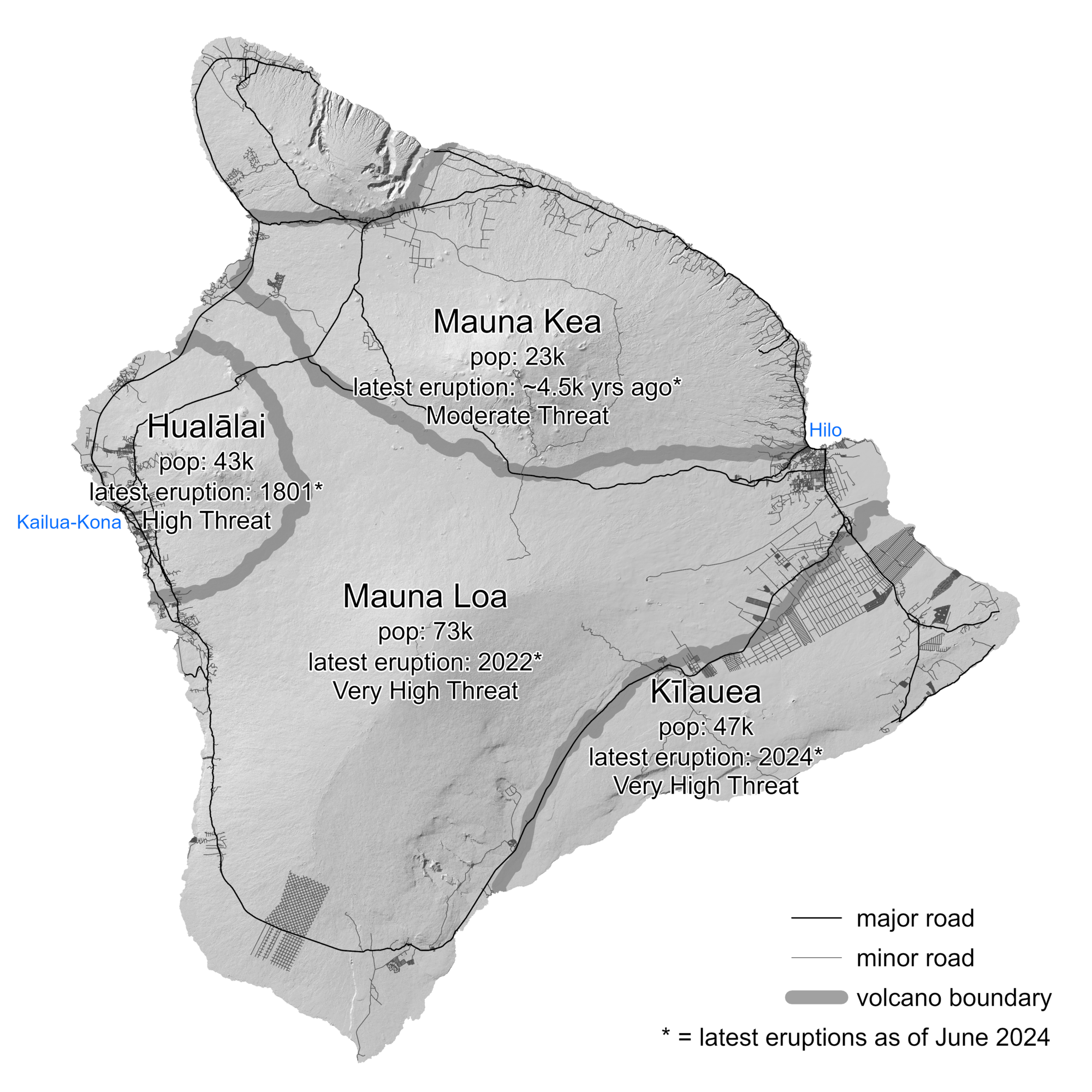
Map of Island of Hawaiʻi
Map of Island of Hawaiʻi, highlighting the four active
or potentially active volcanoes of the Island, the number
of people living on each volcano based on 2020 census
data, major roads (transportation corridors) and minor roads
(proxy for population density), when each volcano last erupted,
and each volcano's national threat assessment designation.

     Why is the Interagency Volcano Plan needed? The Island of Hawai'i consists of five volcanoes. Four volcanoes (Kīlauea, Mauna Loa, Hualālai, and Mauna Kea) are considered active and three of them have erupted since the year 1800. Based on 24 factors including eruptive history, eruptive style and associated hazards, and population exposure, the 2018 Update to the U.S. Geological Survey National Volcanic Threat Assessment identified Kīlauea and Mauna Loa as very high threat volcanoes, Hualālai as a high threat volcano, and Mauna Kea as a moderate threat volcano. For context, there are only 18 very high threat volcanoes in the 
United States.
    Volcanic eruptions in Hawaii can profoundly impact local communities, infrastructure, human health, agriculture, businesses, and tourism. A well-coordinated volcanic incident response can minimize loss of life, injury, social and economic disruption, and long-term consequences. This requires timely, accurate, relevant, and trusted information to threatened and impacted communities, and to the general population for situational awareness.
    In 2018, lava flows from the lower East Rift Zone of Kīlauea destroyed 612 residences. At Kīlaueaʻs summit, Hawaiʻi Volcanoes National Park and neighboring communities were affected by thousands of earthquakes as the summit incrementally collapsed over the course of three months during the same eruption. In 2022, Mauna Loa erupted for the first time in 38 years; fortunately, the impacts were minimal. HVO monitored these volcanic events, working closely with landholding agencies such as the Hawaiʻi Volcanoes National Park, and emergency managers, led by the Hawaiʻi County Civil Defense Agency.
    The Interagency Volcano Plan draws on the formal and informal USGS after-action reviews for the 2018 Kīlauea and 2022 Mauna Loa eruptions, respectively, to improve planning and response protocols. The development of the Interagency Volcano Plan spanned nearly two and a half years—interrupted by Covid-19 outbreaks, 6 eruptions, and other emergency responses—building on regular discussions between the three agencies on how to best work together during volcanic crises. It draws from elements of other USGS volcano observatories' interagency coordination plans but is uniquely developed for the Island of Hawaiʻi.

    The Interagency Volcano Plan addresses volcanic unrest and eruption response coordination on the Island of Hawaiʻi. Unrest hazards may include seismicity, ground deformation (including ground cracks and subsidence), volcanic gases and air pollution (vog), and associated hazards. Not all unrest leads to an eruption. Eruptive hazards may include all the unrest hazard and also active vents (including fissures), lava flows, lava bombs, tephra fall (including ash), laze, and (rare in Hawaii) pyroclastic density currents.
    The Interagency Volcano Plan is intended to be a guide, as each volcanic incident is unique. It is supported by detailed Standing Operating Guidelines and/or Standing Operating Procedures maintained by each participating agency. The Interagency Volcano Plan documents how the three agencies work together during volcanic crises, with the understanding that circumstances may require situation-specific changes and adaptations. It covers the roles and responsibilities of each agency, how notification of a volcanic situation is completed, jurisdictional areas of responsibility, incident command, information flow, and aviation coordination.
    The three agencies that are part of this first version of the Interagency Volcano Plan are based on the Island of Hawaiʻi and were identified as having the most significant opportunities to improve interagency coordination in the USGS 2018 Kīlauea eruption after-action review. Additional agencies will be incorporated in future versions of the Interagency Volcano Plan, and work on version 2 is slated to start in October 2025.

USGS Volcano Activity Updates
    Kīlauea is not erupting. Its USGS Volcano Alert level is ADVISORY. Seismic activity and ground deformation continues at Kīlauea's summit and upper-to-middle East Rift Zone. Over the past week, about 400 earthquakes were detected beneath Kīlauea's upper East Rift Zone and about 100 events were detected between Maunaulu and Puʻuʻōʻō in the middle portion of the East Rift Zone within Hawaiʻi Volcanoes National Park. Over the past week, Kīlauea's summit showed overall slow inflation with relatively little ground deformation recorded in the upper-to-middle East Rift Zone regions. Unrest may continue to wax and wane with changes to the input of magma in these areas; changes can occur quickly, as can the potential for eruption.
    Mauna Loa is not erupting. Its USGS Volcano Alert Level is at NORMAL.
    One earthquake was reported felt in the Hawaiian Islands during the past week: A M3.0 earthquake 7 km (4 mi) NE of Honoka'a at -1 km (0 mi) depth on August 28 at 8:22 p.m. HST.
    HVO continues to closely monitor Kīlauea and Mauna Loa.
    Visit HVO's website for past Volcano Watch articles, Kīlauea and Mauna Loa updates, volcano photos, maps, recent earthquake information, and more. Email questions to askHVO@usgs.gov.

To read comments, add your own, and like this story, see facebook.com/kaucalendar. See upcoming events, print edition and archive at kaunews.com. Support this news service with advertising at kaunews.com. 7,500 copies in the mail and on stands.

THE FIRST KAʻŪ TARO FESTIVAL has been announced. It is planned for Saturday, Dec.14, from noon to 5 p.m. at Kaʻū Herkes District Gym complex in Pāhala.
     The sponsoring organization is 'O Ka'ū Kākou, which sent out a statement saying it is "very excited and proud to announce the first annual, first on the Big Island, Kalo Festival." It is called Kāniwala Kalo O Ka'ū.
     OKK invites the community to "celebrate all things Kalo!" The afternoon will feature live musical entertainment, hula dancers, lucky number prize drawings.
     There will be a Kalo Mō'i and Mō'iwahine (King & Queen) coronation ceremony. Ka’ū residents under the age of 25 are eligible. Contestants must be able to attend the event for the Coronation Ceremony and participate in the Pahala Lighted Christmas Parade that evening on a parade float.
    The event is slated as "a time to stock up for your holiday feasts and gifts." The Taro Festival will feature a wide array of vendors to include foods, arts, crafts, jewelry, live plants, baked goods and more. OKK seeks those who may be able to present the following: laulau, kulolo, live kalo plants and corms, taro leaf, poi, taro chips, squid luau, laulau stew, kalo apparel items, kalo print items, kalo prints and photography, kalo jewelry, kalo carvings kalo paintings, kalo tea and anything else involving kalo.
    All money raised from this event by 'O Ka'ū Kākou will go to the OKK Scholarship Fund and to the OKK Ka'ū Educational Center.
      The Pāhala Lighted Christmas Parade follows the festival at 6 p.m.
'O Ka'ū Kākou welcomes sponsors and vendors who wish to have a booth at the event and contestants for the Kalo Mō'i and Mō'iwahine court. For more details, see www.okaukakou.org/kau-taro-festival. "Come for the Kalo, stay for the parade!," says the announcement.
    For more information, contact  Tim at okaukakou.org.scholarship@gmail.com email or 808-582-2342 phone/text.

To read comments, add your own, and like this story, see facebook.com/kaucalendar. See upcoming events, print edition and archive at kaunews.com. Support this news service with advertising at kaunews.com. 7,500 copies in the mail and on stands.

FROM CONFLICT TO CONNECTION: BUILDING STRONGER RELATIONSHIPS is the September topic for the non-profit Ku'ikahi Mediation Center's Finding Solutions, Growing Peace, Brown Bag Lunch Series. Talks are Third Thursdays from noon to 1 p.m. via Zoom.
    This month's speaker on Sept. 19 is Kathy Tan who advises, "Conflict is inevitable,"but how we respond to it can make all the difference in our relationships. In truth, conflict is an opportunity for growth."
     The announcement said participants can "Learn practical tools and strategies to shift from adversarial
to collaborative approaches, fostering empathy, understanding, and constructive communication. Equip yourself to prevent and resolve conflicts at work, at home, and in the community."
    Tan, M.A. is founder and CEO of Amalu Coaching, LLC, which provides empowerment coaching "grounded in trauma-informed and equity-centered practices." With a master's degree in Social Entrepreneurship & Change, she focuses on leadership development, employee well-being, and team cohesion. "Tan's expertise in diversity, equity, inclusion, and domestic violence peer counseling fosters inclusive, high-performing environments," according to Ku'ikahi Mediation.
    Ku'ikahi's Brown Bag Lunch Series is free and open to the public. Attendees are encouraged to enjoy an informal and educational talk-story session and connect with others interested in Finding Solutions, Growing Peace.
    To get the Zoom link, register online at https://freebrownbagtalk.eventbrite.com. For more information, contact Ku'ikahi Mediation Center at (808) 935-7844 ext. 3 or shelby@hawaiimediation.org. Or visit www.hawaiimediation.org.
    This lunch-and-learn series is made possible thanks in part to funding from the County of Hawai'i and Hawai'i Island United Way.

To read comments, add your own, and like this story, see facebook.com/kaucalendar. See upcoming events, print edition and archive at kaunews.com. Support this news service with advertising at kaunews.com. 7,500 copies in the mail and on stands.


Friday, August 30, 2024

Kaʻū News Briefs Aug. 29, 2024

The Kaʻū Coast is one of the favorite places for aquarium collectors to catch longnose butterfly fish.
Photo from Honolulu Aquarium
THE EFFORT TO BAN AQUARIUM FISH COLLECTING, with the Kaupiko family of Miloli'i as lead plaintiffs to stop the practice, met an obstacle on Thursday. In a four-one decision, Hawai'i Supreme Court ruled that the pet industry's environmental review of commercial aquarium fish collection in West Hawai‘i is legally adequate today. The ruling means the state Board of Land & Natural Resources may proceed with considering permits to reopen nearly the entire West Hawai‘i coastline to commercial aquarium collection, which has historically stripped hundreds of thousands of native fish from Hawai‘i’s reefs each year.
Achilles tang are often collected for the aquarium trade.
Photo from Waikiki Aquarium
    The Court’s ruling in Kaupiko v. BLNR effectively ends a de facto ban on commercial collection that has been in place since an earlier Supreme Court decision in 2017 mandated public disclosure and analysis of the aquarium pet trade’s effects.
    Willie Kaupiko, Ka‘imi Kaupiko, Mike Nakachi, For the Fishes, the Center for Biological Diversity, and Kai Palaoa, represented by Earthjustice, filed suit in 2021 to enforce Hawai‘i’s environmental review laws after a Board tie vote resulted in default approval of the aquarium pet trade’s second impact statement for West Hawai‘i. The Board had previously rejected the trade’s first attempt at an impact statement by a unanimous vote in 2020. The Supreme Court’s ruling today upholds the trade’s second impact statement.
Moorish idols, very popular in the aquarium trade.
 Photo by Zanclus Cornutus
An aquarium collector takes fish from a reef in Hawai`i. Photo by Brooke Everett
  Ka'imi Kaupiko said, “We believe in the power of the government to work together with our communities to find long-term and pono solutions for our fishery management issues,” said Ka‘imi Kaupiko. He has also advocated successfully alongside his neighbors and family to establish a community-based subsistence fishery area fronting their village in 2022. “But with the court’s decision approving this impact statement, how can we ever be sure that these processes work for the people of Hawai‘i and our future generations?”    In addition to challenging the industry’s impact statement in court, several of the Kaupiko plaintiffs joined with others across Hawai‘i last year to request that the Board ban commercial aquarium collection statewide through regulations. The Board unanimously approved the request last December but has not yet begun its formal public rule-making process.
    “We are very concerned that today’s ruling will open the floodgates to destructive levels of commercial aquarium harvesting in Hawai‘i’s waters,” said Rene Umberger, Executive Director of For the Fishes. “Removing fish from our reefs, which face a host of other dangers from pollution to climate change, threatens the delicate ecology that depends on these aquatic species. It’s disappointing that the court is upholding an insufficient environmental impact statement that fails to disclose and mitigate against known environmental consequences of this industry.”
    For decades, commercial aquarium fish collectors targeted West Hawai‘i’s vibrant waters for small reef fish, packaging the live fish in plastic bags for export to aquarium fish wholesalers and retailers across the continental United States. The court’s approval of the industry’s second impact statement effectively allows the Board to resume issuing permits for commercial collection in West Hawai‘i.
    “The court’s decision paves the way for the Board to make management decisions based on incomplete and faulty information, which undermines the purpose of Hawai‘i’s environmental review laws and the Board’s public trust obligations,” said Earthjustice attorney Mahesh Cleveland. “We are disappointed by the decision but stand ready to make our case to the Board that the industry’s plans for reopening collection in West Hawai‘i are deeply flawed, and that permits must be denied.”
Kole tang are prized traditional Hawaiian food. The fish suffers 
widespread aquarium collection in the state. Photo by Victoria Martocci
    Meanwhile, DLNR has continued to push forward with commercial collection permitting. Last Friday, the Board was poised to approve terms and conditions for eventual permits, but the Board’s decision was contested by West Hawai‘i community members, effectively halting any Board decision on permits until the contested proceeding is resolved. The public provided overwhelming testimony against the permitting proposal, and the Board will ultimately decide, after further public input, whether to grant or deny the community’s contested case request and any permits.
    “Ending this collection ban leaves Hawai‘i’s delicate reef fish completely exposed to the dangerous whims of a pet industry that couldn’t care less about their wellbeing,” said Maxx Phillips, Hawai‘i director and attorney at the Center for Biological Diversity. “This decision jeopardizes the fragile balance of our reef ecosystems. We’ll keep fighting these permits and working to make sure that Hawai‘i’s marine wildlife is protected for future generations.”

To read comments, add your own, and like this story, see facebook.com/kaucalendar. See upcoming events, print edition and archive at kaunews.com. Support this news service with advertising at kaunews.com. 7,500 copies in the mail and on stands.

KAʻŪ LADIES VOLLEYBALL CONTINUED ITS WINNING STREAK TO THREE STRAIGHT GAMES. On Thursday, the Trojans bested Ka 'Umeke School in Hilo, in three sets, 25-10, 25-12 and 25-14.
    McKenzie Dacoito came up with 6 Kills and 6 Aces. Jezerie Rose Nurial-Dacalio pounded 5 Kills and made 1 Block. Zia Rae Wroblewski earned 4 Kills and 1Ace. Leahi Kaupu scored 3 Kills and 4 Aces. Jazmyn Navarro posted 3 kills and 3 aces. Kiara Ortega-Oliveira totaled 2 aces. CaLiyah Silva-Kamei earned an ace.

To read comments, add your own, and like this story, see facebook.com/kaucalendar. See upcoming events, print edition and archive at kaunews.com. Support this news service with advertising at kaunews.com. 7,500 copies in the mail and on stands.
THE USGS VOLCANO UPDATE FOR THURSDAY:
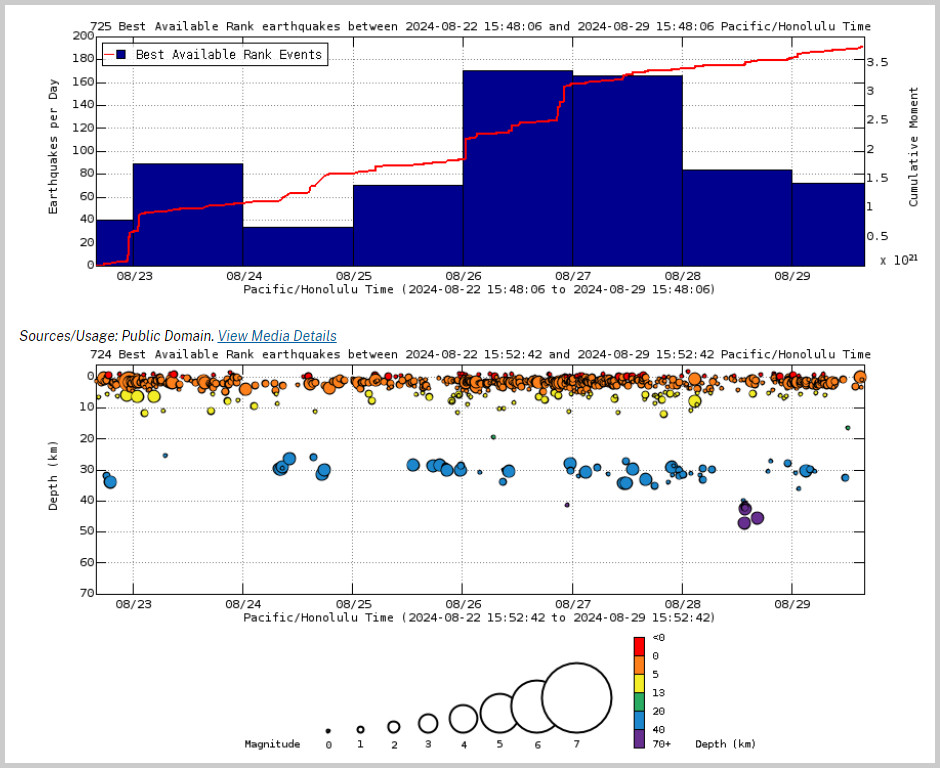
    Summit Observations: Approximately 20 earthquakes were detected beneath Kaluapele (Kīlauea’s summit caldera) over the past 24 hours at depths of 1–3 km (0.6–1.9 mi) below the ground surface, most with magnitudes of less than M2.0. Rates of deformation at the summit remained relatively low, with deflationary tilt at summit tiltmeters over the past day. An overall gradual inflationary trend continues to be seen on GPS instruments around the summit region. The most recent measurement of the summit’s SO2 emission rate was approximately 75 tonnes per day on August 20, 2024.


Top illustration shows number of earthquakes per day during the past week via the blue bars. The red line is the cumulative moment (energy) release. The bottom illustration shows depth of earthquakes during the past week in the area shown on the map above. Depth is reported relative to sea level, which is equal to a depth of zero on the above plot. On both figures, circle-size represents magnitude, and color indicates depth. USGS graphs

     Rift Zone Observations: Over the past 24 hours, there have been approximately 44 earthquakes beneath Kīlauea’s UERZ region, extending from Puhimau Crater southeast to Maunaulu. Most earthquakes have been smaller than M2.0. Events have remained at depths of 1–3 km (0.6–1.8 miles) beneath the surface. Currently, deformation remains stable over the past 24 hours.Activity in the middle East Rift Zone (MERZ) remains low. There were no significant changes in the POC tiltmeter over the past day. GPS instruments continue to record inflation in the region.
    Measurements from continuous gas monitoring stations downwind of Puʻuʻōʻō in the middle East Rift Zone—the site of 1983–2018 eruptive activity—remain below detection limits for SO2, indicating that SO2 emissions from this area are negligible.
    At this time, there is no evidence of elevated seismicity or ground deformation beneath the lower East Rift Zone, and Southwest Rift Zone activity remains low. Current activity is restricted to the summit and upper East Rift Zone region. Analysis: UERZ unrest since 8/20/24 may represent another pulse of magma being supplied to the UERZ, following the intrusive event that occurred near Pauahi Crater over July 22–25, 2024. Currently, the MERZ has not shown signs of increased unrest; however, magma has recently re-established a path to Kīlauea’s MERZ. Unrest could potentially extend to the MERZ with continued magma supply.

To read comments, add your own, and like this story, see facebook.com/kaucalendar. See upcoming events, print edition and archive at kaunews.com. Support this news service with advertising at kaunews.com. 7,500 copies in the mail and on stands.